REDUCING IDLE TIME AND COLLISION TIME IN TOKEN DCF
USING SWAP AND APPEND PROCESS FOR WIRELESS NETWORK
Shailja Uikey and Namrata Sahayam Department of Electronics Communication,
Branch Communication System, Jabalpur Engg. College – Jabalpur
Abstract—IEEE 802.11 DCF is the MAC
protocol currently used in wireless LANs. However, due to idle and collision times, 802.11 DCF performs poorly when it comes to channel utilization, system throughput, and channel access time. To overcome these sources of inefficiency in 802.11 DCF, we propose a distributed and dynamically adaptive MAC protocol for wireless networks, called Token-DCF with swap or append process. Main focus of our approach is on reducing idle and collision times by introducing an algorithm of token passing using swap or appends process. In swap and append process, strong data searched by DCF process and its queue length if greater than the threshold level, will focus on the minimum queue length in header list and swap or add it with the new neighboring node, by increasing system throughput and channel access time. We simulate Token-DCF, using swap and append process and 802.11 in ns-2 to measure and compare performance of MAC protocols.
I. INTRODUCTION
IEEE 802.11 defines the distributed coordination function (DCF) to share the wireless medium among multiple stations. DCF employs CSMA/CA with a binary
exponential backoff algorithm to resolve channel contention. DCF specifies random backoff, which forces a station to defer its access to the channel for a random period of time. This backoff period corresponds to the number of idle slots a station has to wait before its transmission attempt. If multiple stations choose the same backoff, they will attempt to transmit at the same time and collisions will occur. Two types of overhead are associated with random access protocols. One is channel idle time (i.e., backoff time) which is the time when contending stations are waiting to transmit. Another is collision which happens when multiple stations transmit simultaneously. If there are few contending stations, idle time is the dominant overhead. If there are many contending stations, collision probability increases and becomes the main source of low channel utilization.
II. RELATED WORK
We summarize the prior work into:
1) Token-DCF: An opportunistic MAC protocol for wireless networks [1}
2) Distributed MAC protocols to improve the efficiency of 802.11 DCF [2].
4) Scheduling algorithms of wireless networks [4], [5], [6], [7].
The main design goal of Token-DCF is to reduce both idle time and collision time by introducing an implicit token passing algorithm. Token-DCF achieves 2X improvement in system throughput and channel access delay compared to 802.11 DCF for most network configurations [1]. Various MAC protocols have been proposed to improve the efficiency of DCF. Cali et al. modify the backoff algorithm of the IEEE 802.11 MAC protocol and derive a contention window size that maximizes network throughput [2]. The backoff window size is tuned at run-time to increase the overall throughput. In this protocol, for light and medium load conditions, where the window size defined in 802.11 DCF is sufficient for guaranteeing low collision probabilities, the standard backoff algorithm is adopted.
The Wireless Token Ring Protocol (WTRP) [3] is a token bus protocol, derived from IEEE 802.4. WTRP presents a token passing MAC protocol for wireless networks. When token passing is to be used in a WLAN, the characteristics of the wireless medium, such as connectivity loss, network partitioning and token loss, raise additional token management issues.
Longest-Queue-First scheduling (a.k.a., greedy maximal scheduling) [4] is another centralized scheduling algorithm, which has been observed to achieve throughput optimality in most practical wireless
networks. LQF makes scheduling decisions based on the queue length information as follows. It starts with an empty schedule and first adds the link with the largest queue length to the schedule. It then looks for the link with the largest queue length among the remaining links. This selected link will be added to the schedule only if this addition creates a feasible schedule (i.e., the set of added links satisfies the SINR constraints). This process continues until no more links can be added to the schedule. Throughput optimal scheduling algorithms are generalized in many different directions [5], [6], [7].
III. TOKEN-DCF DESIGN
In Token-DCF, when a station transmits on the channel, it might give a privilege (i.e., a token) to one of its neighbors. When a transmission ends, the privileged station, starts transmitting after a short period of time, namely SIFS (Short Inter Frame Space). Non-privileged stations follow the backoff procedure of 802.11 to access the channel.
Token-DCF is fully distributed and does not require any centralized point of coordination.In Token-DCF, queue length of a station is included in the MAC header of the transmitted packets and is overheard by the neighboring stations. Each station keeps track of queue length of its neighbors. Overview
Token-DCF is implemented in the MAC layer of the protocol stack. Scheduling information is embedded in the MAC header of data packets and is transferred to the neighboring stations via overhearing. Each station maintains queue length of the neighboring stations. These queue lengths are then used in the scheduling phase to select the privileged station for the next transmission. Transmitting station announces the privileged station in the privileged field of the MAC header of the data packets it transmits. By overhearing these packets, the privileged station is informed that it has a higher priority for the next transmission.
A. Reducing idle time
The scheduling algorithm of Token-DCF determines which neighbor is chosen as the privileged station. When a transmission ends, the privileged station starts transmitting after SIFS, if the channel is sensed idle. Non-privileged stations follow the backoff procedure of IEEE 802.11 to access the wireless medium. Backoff mechanism of 802.11 DCF is shown in Figure 1. In this mechanism, after a transmission ends, the station senses the channel after DIFS interval and if the channel is sensed idle, it waits for a random backoff time.
Channel access method of our protocol is shown in Figure 2. In Token-DCF, when the channel becomes idle, the privileged station, if there is any, starts transmitting on the channel immediately, and non-privileged stations have to defer backoff count down till when transmission of the privileged station finishes. This process of giving a privilege to one of the neighbors of the transmitting station repeats in each transmission. Whenever a privileged station transmits on the channel, the idle time of the channel is limited to SIFS. On the other hand, in IEEE 802.11 protocol, the channel idle time between two consecutive transmissions is equal to DIFS plus random backoff duration. Furthermore, since the privileged station immediately transmits after waiting an idle duration of SIFS, while all other stations should wait for at least a longer DIFS, the transmission of the privileged station will not collide with other transmissions.
B. Swapping process
Next neighboring node is searched [strong data] by DCF process. If its queue length is greater than the threshold level, collision will occur and the data in the node will be lost. We will focus on the minimum queue length in header list and swap it with the new neighboring node and add their information like node id and queue length in the header list. Then again privileged process will start, and continuity of the process will remain same.
C. Append process
The threshold level of each node is assumed to be 200 bytes, i.e., each node can contain 200 bytes of data.When a neighboring node is searched [strong data] by DCF process. If the strong data exceeds 200 bytes, means its queue length is greater than the threshold level, collision will occur and the data in the node will be lost. We will focus on the minimum queue length in header list and add it with the new neighboring node and add their information like node id and queue length in the header list. Then again privileged process will start, and continuity of the process will remain same.
Suppose, a new neighboring node is searched with data of between 300-400 bytes. Here swapping process is used. If minimum bytes are searched then swapping probability decreases as data of
each node becomes close to threshold level. In this case append process is suitable as it adds data 200-300 bytes to nodes with minimum data.
If higher value is added, and then it will exceed the threshold level, here swapping process is suitable.
IV. EVALUATION
In the example considered, the threshold level of each node is assumed to be 200 bytes, i.e., each node can contain 200 bytes of data. Suppose we run DCF process for 60 nodes. Then Source node searches for the node with the largest queue length, i.e., the node with largest data, in its header list. Then checks the total receives size of data and calculates the throughput.
[THROUGHPUT = NUMBER OF PACKETS RECEIVE / NUMBER OF PACKETS GENERATED] SIFS 10 ms DIFS 30 ms Slot time 10 ms maxp 5 times Cw min 32 Cw max 1024 single node size 200 bytes (multi-information) (1 bytes single information)
Once found, the node with largest queue length is granted privilege. Now privilege process is run for this node. The data contained inside the node is distributed among each selected node. The amount of data to be distributed is determined by taking the average of the bytes of data inside the privileged node. The average is calculated by dividing the total bytes of data, inside that node, by total number of selected node.
[Average = Total bytes of data/ Total no. of selected node]
The selected node, among which the data is distributed, is the nodes which have minimum bytes of data. Reason for doing this is that if data is add to nodes which already have enough data, it may exceed the threshold level, and thus collision of node may occur. To prevent this, we select a predefined number of nodes, in our example nodes are selected by sorting out of 60 nodes on the basis of byte of data they contain, the first 30 nodes, having least data, are taken.
Every time the average bytes of data are calculated, it is checked that any selected nodes exceeds its threshold level if the data is added to it. If it does exceed, the process is stopped and addition of bytes is avoided.
In special cases when the data searched by the new neighboring node is of 400 bytes, 200 bytes is stored in the node but the remaining 200 bytes cannot be added to
the nodes because each contains some data.
Here the swapping process is used and the remaining 200 bytes of data is replaced with the data of the node with minimum bytes of node. Then again privilege process is repeated.
Second special case in append process, if a new neighboring node is searched with strong data whose bytes is above 200 bytes, for instance 250 bytes, then the new neighboring node stores the 200 byte. The node with minimum byte of node is searched in header list and the remaining 50 bytes of data is added to it. Then again privilege process is repeated.
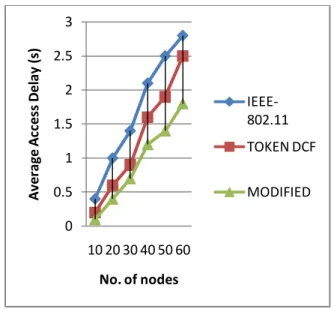
The swapping process makes the strong data safe. Whereas append process prevents the data from being wasted. Also since the privileged process is repeated less frequently. The end to end delay is decreased.
Figures 3 plot the performance parameters in a single-hop network. The size of the network is 150mx150m and all flows are single-hop.
Fig. 3: Aggregate throughput (area=150mx150m)
The aggregate throughput of 802.11 DCF and Token-DCF modified token DCF is presented in Figure 3. As can be seen, throughput gain obtained by modified Token-DCF using modified process compared to Token DCF and IEEE 802.11.
Fig. 4: Packets loss (area = 150m x 150m)
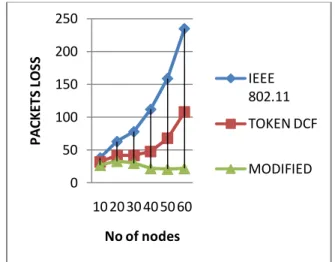
Figure 4 shows the packets loss of the three protocols. Packets loss is defined as the number of packets loss in modified Token DCF (Swap and append process) as compared to Token DCF and IEEE 802.11 Mac protocol.
In simple DCF process SIFS time DIFS time both times are used.
Node takes 50 ms t0 transmit a data (10 ms for SIFS time and 40 ms for DIFS and slot time).
According to base paper in privilege process, the DIFS and slot time are reduced and only 10 ms of SIFS time is used.
According to base paper, in privilege process, when a data of a node is greater than the threshold level then it is lost data and DCF is used again to search a new data node. If a node is given privilege but it is not accepted then that node is loss. DCF process is run again due to which the performance is degraded and delay also increases.
To increase the performance and decrease the delay, append process and swapping process is used.
Figure 5 shows the average access delay of the three protocols.
0 1 2 3 4 5 6 7 8 10 20 30 40 50 60 A gg rega te t h ro u gh p u t (b p s) NO. OF NODES IEEE 802.11 TOKEN DCF MODIFIED 0 50 100 150 200 250 10 20 30 40 50 60 P A C KE TS L O SS No of nodes IEEE 802.11 TOKEN DCF MODIFIED
Fig. 5: Average access delay (area=150mx15O)
V. CONCLUSION
In this paper, we present the design and performance evaluations of Token-DCF using swap and append process. Token-DCF is a distributed MAC protocol that uses an opportunistic overhearing mechanism to schedule network stations for transmission on the channel. The main designs goals of Token-DCF using swap and append process is to increasing system throughput and channel access time by introducing an algorithm of token passing using swap and append process.
0 0.5 1 1.5 2 2.5 3 10 20 30 40 50 60 A ve ra ge A cc es s D el ay (s ) No. of nodes IEEE-802.11 TOKEN DCF MODIFIED
VI. REFERENCES
[1] Token DCF: An opportunistic MAC protocol for wireless networks. 2013 IEEE. [2] F. Cali, M. Conti, and E. Gregori, “Dynamic tuning of the ieee 802.11 protocol to achieve a theoretical throughput limit,” IEEE/ACM Trans. On Networking, vol. 8, no. 6, December 2000. [3] M. Ergen, D. Lee, A. Puri, P. Varaiya, R. Attias, R. Sengupta, S. Tripakis, “Wireless token ring protocol,” Proceedings of the Eighth IEEE Symposium on Computers and Communications (ISCC 2003) pp. 710-715, 2003.
[4] L. Tassiulas and A. Ephremides, “Stability properties of constrained queueing systems and scheduling policies for maximum throughput in multihop radio networks,” IEEE Transactions on Automatic Control, 37(12): pp. 1936-1948, 1992.
[5] A. Dimakis and J. Walrand. “Sufficient conditions for stability of longest-queue-first scheduling: Second-order properties using fluid lim-its.” Advances in Applied Probability, 38(2):505521, 2006.
[6] S. Shakkottai, R. Srikant, and A. Stolyar. “Pathwise optimality of the exponential scheduling rule for wireless channels,” Advances in Applied Probability, 36:10211045, 2004.
[7] A. Eryilmaz, R. Srikant, and J. Perkins. “Stable scheduling policies for fading wireless channels,” In Proceedings of IEEE International Symposium on Information Theory, 2003