Abstract— A significant and increasingly popular approach that helps in the retrieval of image data from a huge collection is called Content Based Image Retrieval (CBIR). In order to find an image, image has to be represented with certain features. Color and texture are two important visual features of an image. In this paper we propose an efficient image retrieval technique which uses dominant color and texture features of an image. An image is uniformly divided into 8 coarse partitions as a first step. After the above coarse partition, the centroid of each partition (“color Bin” in MPEG-7) is selected as its dominant color. Texture of an image is obtained by using Gray Level Co-occurrence Matrix (GLCM). Color and texture features are normalized. Weighted Euclidean distance of color and texture features is used in retrieving the similar images. The efficiency of the method is demonstrated with the results.
Index Terms—Dominant color, Gray level cooccurrence
matrix, Image retrieval, Weighted Euclidean distance
I. INTRODUCTION
Content based means that the search will analyze the actual contents of the image rather than the metadata such as keywords, tags and descriptions associated with the image. Content based image retrieval (CBIR) depends on several factors, such as, feature extraction method, suitable features to use in CBIR, similarity measurement method, mathematical transform chosen to calculate effective features, user feedback, etc. All these factors are important in CBIR. Since an improvement to any of these influencing factors can result in a more effective retrieval mechanism. The term 'content' in this context might refer to colours, shapes, textures, or any other information that can be derived from the image itself. In CBIR (Content Based Image Retrieval) images are arranged systematically according to their visual feature.
Image retrieval in CBIR is processed by three ways, in the target search method; pattern matching and object recognition is performed. Image retrieval from large data base with indefinite information is challenging task. The category search method involves object recognition and arithmetic pattern recognition problems. Features selection and classifications from huge number of classes is relatively
Manuscript received Sept, 2015.
Ku. Aboli W. Hole, Dept of computer sci.& Information Technology Sant Gadage Baba Amravati University, Amravati, India.
Prof.Prabhakar L. Ramteke, Fac. Of computer sci. & InformatiTechnology Sant Gadage Baba Amravati , Amravati, India
difficult task. Search by association is the third method, which suffers from semantic gap. Semantic gap is the difference between extracted information from the visual data and its interpretation for a user in a given situation. Feature of an image involves global or local features. Global features of image contain complete characteristics of entire image and local feature used for a small group of pixels. Global features are very sensitive to location so there is problem in distinguishing forefront and background of image; so it is difficult to decide grade for identifying important visual features To decrease computation, entire image is divided in nonoverlapping small blocks and features are extracted for each block separately. Thereafter, segmentation is done by k-means clustering or normalized cut criteria.
Similarity measurement
Once features are extracted, from all the database images and the query image, the similarity measurement becomes the crucial issue in content based image retrieval. Similarity measurement is the process of finding the difference or similarity between the database images and the query image using their features. The database image list is then sorted according to the ascending order of distance to the query image and images are retrieved from the database according to that order. Euclidean distance is widely used to calculating this distance. The Euclidean distance, also known as L2 distance and it has been used in many content based image retrieval approaches. It is applicable when the image feature vector elements are equally important and the feature vectors are independent of one another.
Due to the proliferation of video and image data in digital form, Content Based Image Retrieval (CBIR) has become a prominent research topic. This motivates the extensive research into image retrieval systems. From historical perspective, one shall notice that the earlier image retrieval systems are rather text-based search since the images are required to be annotated and indexed accordingly. However, with the substantial increase of the size of images as well as the size of image database, the task of user-based annotation becomes very cumbersome, and, at some extent, subjective and, thereby, incomplete as the text often fails to convey the rich structure of the images.
This motivates the research into what is referred to as CBIR. Therefore an important problem that needs to be addressed is fast retrieval of images from large databases. To find images that are perceptually similar to a query image, image retrieval systems attempt to search through a database. CBIR can greatly enhance the accuracy of the information being returned and is an important alternative and complement to traditional text-based image searching.
An Effective Image Retrieval Scheme Using
Dominant Color And Texture Features
For describing image content color and texture have been used. Color is one of the most widely used low-level visual features and is invariant to image size and orientation. There is color histogram as conventional color features used in CBIR. For representing color in terms of intensity values, a color space is defined as a model. A color component or a color channel is one of the dimensions. The RGB model uses three primary colors, red, green and blue, in an additive fashion to be able to reproduce other colors. As this is the basis of most computer displays today, this model has the advantage of being easy to extract. In a true-color image each pixel will have a red, green and blue value ranging from 0 to 255.
Without any other information, many objects in an image can be distinguished solely by their textures. Texture may describe the structural arrangement of a region and the relationship of the surrounding regions and may also consist of some basic primitives. Texture is a very general notion that can be attributed to almost everything in nature. For a human, the texture relates mostly to a specific, spatially repetitive (micro) structure of surfaces formed by repeating a particular element or several elements in different relative spatial positions. Generally, the repetition involves local variations of scale, orientation, or other geometric and optical features of the elements.
Texture is a key component of human visual perception. Like color, when querying image databases, this makes it an essential feature to consider. Everyone can recognize texture, but it is more difficult to define. Unlike color, texture occurs over a region rather than at a point. It is normally perceived by intensity levels and as such is orthogonal to color. Texture can be described in terms of direction, coarseness, contrast and so on. It has qualities such as periodicity and scale. It is this that makes texture a particularly interesting facet of images and results in a plethora of ways of extracting texture features.
Image textures are defined as images of natural textured surfaces and artificially created visual patterns, which approach, within certain limits, these natural objects. Image sensors yield additional geometric and optical transformations of the perceived surfaces, and these transformations should not affect a particular class of textures the surface belongs. It is almost impossible to describe textures in words, although each human definition involves various informal qualitative structural features, such as fineness, coarseness, smoothness, granularity, lineation, directionality, roughness, regularity, randomness, and so on.
These features, which define a spatial arrangement of texture constituents, help to single out the desired texture types, e.g. fine or coarse, close or loose, plain or twilled or ribbed textile fabrics. It is difficult to use human classifications as a basis for formal definitions of image textures, because there is no obvious ways of associating these features, easily perceived by human vision, with computational models that have the goal to describe the textures. Nonetheless, after several decades of research and development of texture analysis and synthesis, a variety of computational characteristics and properties for indexing and retrieving textures have been found. In many cases, the textural features follow from a particular random field model
of textured images. We will implement CBIR system that is based on dominant color and texture.
II. LITERATUREREVIEW
In [1], an efficient image retrieval technique which uses dominant color and texture features of an image is proposed. The proposed method yielded higher average precision and average recall with reduced feature vector dimension.
A new and effective color image retrieval scheme for combining all the three i.e. color, texture and shape information, which achieved higher retrieval efficiency is presented in [2]. By using fast color quantization algorithm with clusters merging, the image is predetermined, and then a small number of dominant colors and their percentages can be obtained. Then using a steerable filter decomposition which offers an efficient and flexible approximation of early processing in the human visual system, the spatial texture features are extracted. After that the pseudo-Zernike moments of an image are used for shape descriptor, which have better features representation capabilities and are more robust to noise than other moment representations. Finally, the combination of the color, texture and shape features provide a robust feature set for image retrieval.
Trademark image retrieval (TIR) system is proposed in [3] to deal with the vast number of trademark images in the trademark registration system. The proposed approach commences with the extraction of edges using the Canny edge detector, performs a shape normalization procedure, and then extracts the global and local features. The local features describe the interior details of the trademarks, while the global features capture the gross essence of the shapes. To measure the similarity between the query and database images, a two-component feature matching strategy is used. An image retrieval system is presented in [4], which used HSV color space and wavelet transform approach for feature extraction. Firstly, the color space is quantified in non-equal intervals, then one dimension feature vector is constructed and the color feature is represented. Similarly, by using wavelet, the work of texture feature extraction is obtained. Finally, based on wavelet transform, color feature and texture feature are combined. A method of multi features retrieval is provided. The image retrieval experiments indicated that visual features were sensitive for different type images. With simple variety, the color features opted to the rich color image. Texture feature opted to the complex images.
A comprehensive survey, highlighting current progress, emerging directions, the spawning of new fields, and methods for evaluation relevant to the field of image retrieval is presented in [5]. It consider that the field will experience a paradigm shift in the foreseeable future, with the focus being more on application-oriented, domain-specific work, generating considerable impact in day-to-day life.Dominant color descriptor (DCD) is one of the color descriptors proposed by MPEG-7 in [6] that has been extensively used for image retrieval. Among the color descriptors, the salient color distributions in an image or a region of interest are described by DCD. DCD provides an intuitive, effective and compact representation of colors presented in an image. The efficiency of computation for
dominant color extraction is significantly improved by this approach.
A content-based image retrieval method based on an efficient combination of multi resolution color and texture features is proposed in [7].
Image retrieval mechanism is explored in [8], based on combination of color and texture features. Using the discrete wavelet frame analysis, which is an over complete decomposition in scale and orientation, texture features are extracted. In [9], an introduction to various aspects of CBIR is mentioned. According to it, CBIR is the application of computer vision techniques to the image retrieval problem, that is, the problem of searching for digital images in large databases.
III. PRAPOSEDMETHODOLOGY
Dominant color region in an image can be represented as a connected fragment of homogeneous color pixels which is perceived by human vision. Image Indexing can be based on this concept of dominant color regions present in the image. The segmented out dominant regions along with their features can be used as an aid in the retrieval of similar images from the image database. The procedure to extract dominant color of an image is as follows:
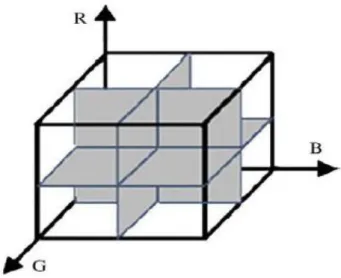
The RGB color space can be uniformly divided into 8 coarse partitions as shown in Fig.1. If there will be several colors located on the same partitioned block, they can be assumed to be similar. After the above coarse partition, the centroid of each partition can be selected as its quantized color.
Fig. The coarse division of RGB color space
Extraction of texture of an image
The notion of texture generally refers to the presence of a spatial pattern that has some properties of homogeneity. A texture representation for image retrieval can be obtained using this notion. The ability to match on texture similarity can often be useful in distinguishing between areas of images with similar color (such as sky and sea, or leaves and grass).
A variety of techniques can be used for measuring texture similarity. The best established can be rely on comparing values of what are known as Second-order statistics calculated from query and stored images. Essentially, these
can calculate the relative brightness of selected pairs of pixels from each image. From these, we can calculate measures of image texture.
Gray Level Co-occurrence Matrix (GLCM)
A statistical method of examining texture that considers the spatial relationship of pixels is the Gray Level Co-occurrence Matrix (GLCM). Also known as the Gray-level spatial dependence
matrix.
The GLCM functions characterize the texture of an image by calculating how often pairs of pixel with specific values and in a specified spatial relationship occur in an image, creating a GLCM and then extracting statistical measures from this matrix.
Creating a Gray Level Co-occurrence Matrix
To create a GLCM, the graycomatrix function is used.
The graycomatrix function creates a GLCM by calculating how often a pixel with the gray-level value i occurs in a specific spatial relationship to a pixel with the value j.
By default, the spatial relationship is defined as the pixel of interest and the pixel to its immediate right (horizontally adjacent), also we can specify other spatial relationships between the two pixels. The number of gray levels in the image determines
the size of the GLCM.
graycomatrix uses scaling to reduce the number of intensity values in an image to eight.
It is required to convert image into gray scaled image.
Image histogram
An image histogram is a type of histogram that acts as a graphical representation of the tona ldistribution in a digital image. It plots the number of pixels for each tonal value. The horizontal axis of the graph represents the tonal variations, while the vertical axis represents the number of pixels in that particular tone. By looking at the histogram for a specific image a viewer will be able to judge the entire tonal distribution at a glance. A normalized histogram gives the relative proportions of each pixel in the image and hence approximates to the probability distribution of pixel intensities. A normalized histogram is one in which the sum of the frequencies is exactly 1The histogram's x-axis reflects the range of values in Y. The histogram's y-axis shows the number of elements that fall within the groups; therefore, the y-axis ranges from 0 to the greatest number of elements deposited in any bin.
IV. RESULT
Graphical user interface
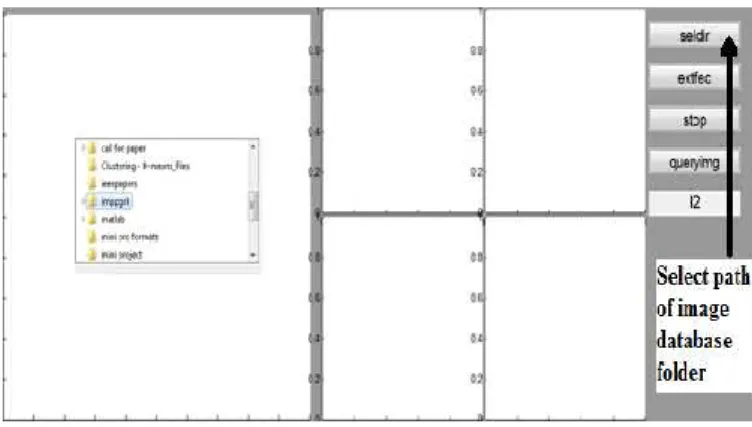
A graphical user interface (GUI) is a graphical display in one or more windows containing controls, which enable a user to perform interactive tasks as shown in Fig.1 A good GUI can make a program easier to use by providing them with a consistent appearance and intuitive control like push buttons, list boxes, sliders, menus, and so forth.The GUI should behave in an understandable and predictable manner, so that the user knows what to expect when he or she perform an action
Fig 1.Image Database Path Selection
The graphical user interface window consists of five buttons having different function created due to handles. All buttons are of string type, default „uicontrol‟ style is a pushbutton. The default parent is the current figure. When we click on „seldir‟ button, code created for path of the image database folder selection is executed and a small window for image folder selection is open as shown in Fig Small window shown in Fig.1 is providing path for image database for feature extraction. Once the features of images present in database are extracted then there is no need of feature extraction again. Extracted feature are saved in .xls file and corresponding locations of images are stored in .mat file. The feature extraction process represent in Fig.2, in which images with their histogram are shown.
Fig.2 Feature Extraction of Database Images
We extract six features, contains colour, energy, contrast, correlation, homogeneity and histogram above a grayscale colorbar. The number of bins in the histogram is specified by the image type. For grayscale image, histogram uses a default value of 256 bins and for binary image, histogram uses 2 bins.
V. FUTURERESEARCH
There are many area open for future scope, first the user may not want the exact similar images at the top but require some difference between them. Therefore it will require decreasing the weight of images that are too similar to each other. Because it increase the diversity of search top ranked images. Second, the K-means algorithm require some time to convergence because it is iterative process. So pay attention
to reduce this convergence time. Third, allow more local feature and some time global
VI. CONCLUSION
In this paper, we have focused on recently developed image mining techniques. The purpose of image mining techniques is discovering meaningful correlations and formulations from previously collected image data. Many different application areas utilize image mining as a means to achieve effective usage of semantic information about images. Image mining is becoming progressively more widespread in both the private and public sectors. Sector such as biomedical, space research organization, remote sensing, fashion, crime prevention, publishing, medicine, architecture, commonly use image mining to reduce costs, enhance research, and increase sales. As image mining is still not fully focused,
there is a huge scope for its development. Future research
should highlight on development of powerful query
language, devise automatedimage mining techniques based
on image retrieval techniques based on its content. The CBIR
provide simple mechanism for image retrieval by measuring minimum distances among the images. The images considered as node and similarities between images as weight of node. The similarity measurement of images is based on the common visual feature between the images. Image clustering and finding the minimum distance among the images provides better image retrieval results.
ACKNOWLEDGMENT
My thanks to the Guide, Prof. P. L. Ramteke and Principal Dr. A. B. Marathe, who provided me constructive and positive feedback during the preparation of this paper
.
REFERENCES
[1] M.Babu Rao, Dr. B.Prabhakara Rao, Dr. A.Govardhan, “Content based image retrieval using Dominant color and Texture features”, International Journal of Computer science and information security, Vol.9 issue No: 2, February 2011. pp:41 - 46
[2] X-Y Wang et al., “An effective image retrieval scheme using color, texture and shape features”, Comput. Stand. Interfaces (2010), doi:10.1016/j.csi.2010.03.004
[3] Chia-Hung Wei, Yue Li, Wing-Yin Chau, Chang-Tsun Li, “Trademark image ret -rieval using synthetic features for describing global shape and interior structure” Pattern Recognition, 42 (3) (2009) 386–394.
[4] JI-QUAN MA, “Content-Based Image Retrieval with HSV Color Space and Texture Features”, proceedings of the 2009 International Conference on Web Information Systems and Mining.
[5] Ritendra Datta, Dhiraj Joshi, Jia Li, James Z. Wang, “Image retrieval: ideas, influences, and trends of the new age”, ACM Computing Surveys, 40 (2) (2008) 1– 60. [6] Nai-Chung Yang, Wei-Han Chang, Chung-Ming Kuo, Tsia-Hsing Li,“A fast MPEG- 7 dominant color extraction with new similarity measure for image retrieval”, Journal of Visual Communication and Image Representation, 19 (2) (2008) 92–105.
[7] Young Deok Chun, Nam Chul Kim, Ick Hoon Jang, “Content-based image retrieval using multiresolution color and texture features”, IEEE Transactions on Multimedia 10 (6) (2008) 1073–1084.
[8] S. Liapis, G. Tziritas, “Color and texture image retrieval using chromaticity histograms and wavelet frames”, IEEE Transactions on Multimedia 6 (5) (2004) 676–686.
[9] http://en.wikipedia.org/wiki/Content-Base
[10] P. Howarth and S. Ruger, “Robust texture features for still-image retrieval”, IEEE Proceedings of Visual Image Signal Processing, Vol.152, No. 6, December 2005.
Author Profile
Aboli Wasudeorao Hole, received the B.E. degree in Computer Science from, P. R. Pote(Patil) College Of Engineering And Technology, Amravati in 2013 and is currently persuing Master‟s Degree in Computer Science and Information Technology from H.V.P.M‟s College of Engineering And Technology, Amravati.
Prof. Prabhakar L. Ramteke, received the B.E. degree in Information Technology from, Government College Of Engineering And Technology and M.E. degree from Prof. Ram Meghe Institute of Technology, Badnera, respectively. His field of specialization is Mobile Computing. He is currently working as Associate Professor at H.V.P.M‟s college of Engineering and Technology, Amravati.