2152
ISSN: 2278 – 7798 All Rights Reserved © 2015 IJSETRMitigation of Jamming Attack in Vehicular Ad hoc
Network
Rohini Rawat1, Dr. Deepti Sharma2,
M-Tech Student, Department of CSE, Advance Institute of Technology and Mgt, Palwal, Haryana, India1 HOD, Department of CSE, Advance Institute of Technology and Mgt. Palwal, Haryana, India 2
Abstract— Vehicular Ad-hoc Network (VANET) is taking more attention in automotive industry due to the safety concern of human lives on roads. Security is one of the safety aspects in VANET. To be secure, network availability must be obtained at all times since availability of the network is critically needed when a node sends any life critical information to other nodes. However, it can be expected that security attacks are likely to increase in the coming future due to more and more wireless applications being developed and deployed onto the well-known expose nature of the wireless medium. In this respect, the network availability is exposed to many types of attacks. In this paper, jamming attack on network availability is presented and also provide a RTS/CTS mechanism to mitigate the jamming attack in VANET. A model to secure the VANET from the jamming attacks has been developed and gives a possible solution to overcome the attacks have been discussed.
Keywords—Vehicular Ad hoc Network (VANET); security; availability; security attack; Jamming Attack
I. INTRODUCTION
Vehicular Ad-hoc Network (VANET) is a kind of networks in which vehicle nodes can communicate in multihop fashion with each other on the road [6]. Vehicular Ad-hoc Networks have recently drawn interest of researchers and industry due to their potential to improve road safety and traffic coordination[7]. The packets that are exchanged require timely and reliable delivery which poses a real challenge to VANETs. Security is a vital issue where little interruption, such as intermittent disconnections can create problem to the users. This is particularly crucial if critical life information is being communicated between a sender and a receiver. In this paper, we consider a particular class of DoS attacks called Jamming. In fact, the vehicle nodes in vehicle ad hoc networks share a wireless medium. Thus, a radio signal can be jammed or interfered, which causes the message to be corrupted or lost. If the attacker has a powerful transmitter, a signal can be generated that will be strong enough to engulf the targeted signals and disrupt communications. Jamming decreases the performance of network by affecting its throughput, network load, end to end delay etc. There are many different attack strategies, a jammer can performed, exposed below [5]:
II. LITERATURE REVIEW
Mario Strasser et al. considers the problem of how can two devices that do not share any secrets establish a shared secret key over a wireless radio channel in the presence of a communication jammer. An inherent challenge in solving this problem was that known anti-jamming techniques (e.g., frequency hopping or direct-sequence spread spectrum) which should support device communication during the key establishment required that devices should shared a secret spreading key (or code) prior to the start of their communication. This requirement created a circular dependency between anti jamming spread-spectrum communication and key establishment. The author proposed an Uncoordinated Frequency Hopping (UFH) scheme that breaks the dependency and enables key establishment in the presence of a communication jammer. The author performed a detailed analysis of UFH scheme and showed its feasibility, both in terms of execution time and resource requirements[1].
Hasbullah H. et al. explained the need to obtain network availability all the time in order to ensure security. Authors categorized DOS attacks into three categories: 1) Basic Level (overwhelm node resources). 2) Extended level (jamming the channel). And 3) Distributed Denial of Services (DDOS). A proposed solution was given based on relying on utilizing the On-Board-Unit (OBU) that each vehicle is equipped with. OBU is supposed to make a decision as to prevent a DOS attacks using one of the proposed techniques (switching channels, technology or use frequency hopping) to avoid DOS attack[2].
S. Babar et al. studied jamming attack intensively. It classified jamming attack into active and reactive jamming. Authors evaluated the impact of different types of jammers using NS2 simulation. The data was analyzed to show that reactive jamming is more difficult to detect than other attacks because of the intelligent behaviour. The paper contribution suggested using the behavioural modelling and analysis tools to understand jamming attacks behaviours to develop an efficient defence strategy[3].
Longquan Li et al. represents Self-Healing Wireless Networks under Insider Jamming Attacks in 2014 In this work, they
2153
ISSN: 2278 – 7798 All Rights Reserved © 2015 IJSETRdesign a protocol that was capable of self-healing wireless networks under jamming attacks. The protocol identified and excluded an insider jammer and then restores normal data communications among benign nodes despite the presence of jamming by an initially unknown compromised node. The proposed scheme integrate key management, jammer identification and jammer isolation in one system. Finally, they evaluated the protocol with USRP devices and GNU Radio in the context of jammer localization. The experiments showed that the proposed protocol must identify and isolate the insider jammer with high accuracy[4].
III. PROPOSED METHOD
The RTS/CTS mechanism is a handshaking process that minimizes the occurrence of collisions when hidden nodes are operating on the network. The working mechanism of RTS/CTS implementation is shown in figure 1.
Figure: CTS/RTS Mechanism
The AP mobile node receives RTS data from Mobile node A and replies to it with a CTS frame while authenticating it to send data. Meanwhile, the Mobile Node B receives the CTS frame since the Mobile Node A is sending data and the mechanism informs the mobile Node B that the AP is transmitting or receiving data at that time frame. This makes Mobile Node B to wait for a particular time. When a jamming attack is launched on the network, fake RTS frames are sent to the AP mobile node that keeps the medium busy and prevents other nodes from being able to commence with legitimate MAC operations, or introduces packet collisions causing forced and repeated back offs.
The algorithm is as follows:
1. Deploy the nodes.
2. Use RTS & CTS frames for reliable communication. 3. Set the maximum number of packets to be sent by the requesting node/replying node as a Packet_Threshold. 4. Check for each requesting/replying node
{ If
Packet_Sent > Packet_Threshold then
Declare the node as the attacker node.
Block that node. }
5. Display the list of blocked nodes in the network. The blocked node will not be able to participate in the further transmissions.
IV. SYSTEM MODEL
A. Description of the First Scenario
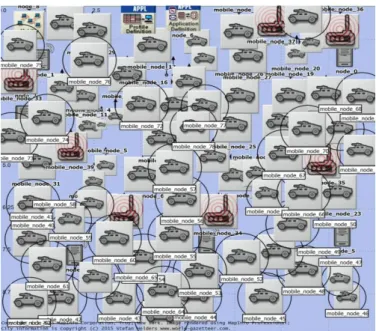
This scenario consists of 100 mobile nodes deployed randomly in the area of 50*50 km. Nodes move in this area on the basis of random waypoint mobility model with a constant speed of 10 m/s. With the help of this algorithm, random trajectories of the mobile nodes have been set. The ad-hoc routing protocol is changed accordingly as per the requirements of the simulation study in order to analyze the results under a particular protocol i.e. AODV or DSR. Here, the start time is taken as 10 seconds and the stop time is set to the end of the simulation. The packet inter-arrival time and the packet size is set to 0.03 seconds (exponential) and 2000 (exponential).
Figure 2: Scenario without attack
The scenarios are simulated and analysed on the basis of two parameters- Throughput and Delay.
1. Throughput- Represents the total number of bits (in bits/sec) forwarded from wireless LAN layers to the higher layers in all WLAN nodes of the network.
2. Delay- Represents the end to end delay of all the packets received by the wireless LAN Macs of all the WLAN nodes in the network and forwarded to the higher layers.
The simulation was performed for 300 seconds while the number of seeds used was 300 in order to provide 1 hour simulation performance.
B. Description of the Attack Scenario
Here, we have placed two jammer nodes in order to engage the physical jamming attack in the network.
2154
ISSN: 2278 – 7798 All Rights Reserved © 2015 IJSETRFigure 3: Attack Scenario.
The physical jamming is launched by continuous transmissions and/or by ensuring packet collisions at the receiver. The jammers leading to these attacks can deny complete access to the channel by monopolizing the wireless medium. The nodes trying hard to communicate have an unusually large carrier sensing time waiting for the channel to become idle. The jammer used here is mobile pulse jammer. Jammers also need to be configured according to the network’s requirements. Here, the trajectory of the jammer nodes is set to VECTOR. The jammer bandwidth is set to 100000 and the jammer base band frequency is taken as 2402. The pulse width is taken as 2.0. The start time and the stop time are set to 10 seconds and end of the simulation respectively.
C. Description of the Third Scenario
In order to implement the proposed technique for the detection of the physical jamming attack, following detection technique is proposed.
Proposed Technique
In order to enhance the throughput of the entire network, the presence of the jammer node is very necessary to be stated. Various techniques were opted for the discovery, prevention and mitigation of the jamming attack. In order to enhance the throughput and decrease the delay as compare to the existing approaches, a meliorated detection mechanism is proposed in this dissertation, for the detection of the physical jamming attack.
1. In case, if packet size exceeded to a particular RTS threshold, that packet would have to wait for a particular RTS/CTS interval in order to completely forward that packet to its destination. So, the buffer size is taken as 102400000. 2. Also, high data rate of 54 mbps is taken which were previously 11 mbps during the simple and the attack scenario.
3. The value of the physical characteristics is set to Extended Rate PHY.
4. So, apart from performing the modifications in the data rate and buffer size for the prevention of penalties caused by the drawbacks of the existing techniques and in order to improvise the throughput, improved AODV parameters are also adopted. Here, the active route timeout is taken as 30 seconds.
V. PERFORMANCE RESULTS
Scenario 1 represents the scenario with no malicious event and normal network state, scenario 2 represents the network that is under the jamming attack and scenario 3 represents the mobile jammers and implementation of the proposed method.
A. Throughput
It is clearly seen that the jamming attack decreases the overall network throughput in comparison to the normal network state. However, the entire network throughput is increased once the proposed unified mechanism is implemented.
2155
ISSN: 2278 – 7798 All Rights Reserved © 2015 IJSETRFigure 4: Throughput of all three scenarios at 200 nodes B. End To End Delay
In first scenario of 100 nodes of our experimentation, packets Delay with peak value of approx. 0.010 seconds. In second scenario which is with jamming attack, packets delay Increases to value of approx 0.35 seconds. In first scenario of 200 nodes of our experimentation, packets delay is approx. 0.0020 seconds. In second scenario which is with jamming attack, packets delay increases to value of approx. 0.30 seconds.
Figure 5: Delay of all three scenarios at 100 nodes
Figure 6: Delay of all three scenarios at 200 nodes
The recovery of the end to end delay decreases with our proposed mechanism by elimination of the jamming attack as end to end delay comes to similar to the value 0.000256 seconds. Thus our proposed mechanism eliminates jamming attack in network.
VI. CONCLUSION AND FUTURE WORK
The unified mechanism is implemented on the selected nodes on the network and deployed in the specific area. The findings of the research clearly states that, the implementation of such unified mechanisms have a significant impact on the overall network through positively. On the other hand, the implementation of such mechanisms does not only mitigate the jamming attack effects, it also increases the overall performance above the normal state of the network. We consider future research work focused on using real time attacks which is needed to ascertain greater degree of detection of specific vulnerabilities in both Mobile and ad hoc Sensor networks.
REFERENCE
[1] Grzybek, A.; Seredynski, M.; Danoy, G.; Bouvry, P., "Aspects and trends in realistic VANET simulations, Wireless, Mobile and Multimedia Network, 2012 IEEE International Symposium on a , vol., no., pp.1,6, 25-28 June 2012
[2] Jie Li, Huang Lu, “ACPN: A Novel Authentication Framework with Conditional Privacy-Preservation and Non-Repudiation for VANETs” , IEEE Transactions on Parallel and Distributed Systems, 2012
[3] Chim, T.W.; Yiu, S.M.; Hui, L.C.K.; Li, V.O.K., "VSPN: VANET-Based Secure and Privacy-Preserving
2156
ISSN: 2278 – 7798 All Rights Reserved © 2015 IJSETRNavigation," Computers, IEEE Transactions on , vol.63, no.2, pp.510,524, Feb. 2014
[4] Yen-Wen Lin; Guo-Tang Huang, "Optimal next hop selection for VANET routing," Communications and Networking in China (CHINACOM), 2012 7th International ICST Conference on , vol., no., pp.611,615, 8-10 Aug. 2012
[5] Harri, J.; Filali, F.; Bonnet, C., "Mobility Models for vehicular ad hoc networks: a survay and taxonomy," Communications Surveys & Tutorials, IEEE , vol.11, no.4, pp.19,41, Fourth Quarter 2009 [6] Sun Xi; Xia-Miao Li, "Study of the Feasibility of VANET and its Routing Protocols," Wireless communication, Networking and Mobile Computing, 2008. WiCOM '08. 4th International Conference on , vol., no., pp.1,4, 12-14 Oct. 2008.
[7] Sherali Zeadally, Ray Hunt, Yuh-Shyan Chen,Angela Irwin, Aamir Hassan,“ Vehicular Ad hoc Networks(VANET):Status, Results, Challenges”. Springer Science, Business Media.2010 [8] Samara, Wafaa A.H. Al-Salihy, R.sures, “Ghassan Security Analysis of Vehicular Ad hoc Networks”2010 International Conference on Network Applications,Protocols and Services. [9] Verma, K.; Hasbullah, H.; Kumar, A., "An efficient defense method against UDP spoofed flooding traffic of denial of service (DoS) attacks in VANET," Advance Computing Conference (IACC), 2013 IEEE 3rd International , vol., no., pp.550,555, 22-23 Feb. 2013 [10]Performance Comparison Of AODV and DSDV Routing Protocols in Mobile Ad Hoc Networks, Aditi Sharma,Sonal Rana, Leena Kalia, International Journal of Emerging Research in Management and Technology, ISSN:2278-9359 Volume-3, Issue-7, July 2014.
[11] Ait Ali, K.; Baala, O.; Caminada, A., "Routing Mechanisms Analysis in Vehicular City Environment," Vehicular Technology Conference, 2011 IEEE 73rd , vol., no., pp.1,5, 15-18 May 2011 [12] Bhoi, S.K.; Khilar, P.M., "A secure routing protocol for Vehicular Ad Hoc Network to provide ITS services," Communications and Signal Processing (ICCSP), 2013 International Conference on , vol., no., pp.1170,1174, 3-5 April 2013 [13] Pathre, A.; Agrawal, C.; Jain, A., "A novel defense scheme against DDOS attack in VANET," Wireless and Optical Communications Networks (WOCN), 2013 Tenth International Conference on , vol., no., pp.1,5, 26-28 July 2013
[14] Hamieh, A.; Ben-othman, J.; Mokdad, L., "Detection of Radio Interference Attacks in VANET," Global Telecommunications Conference, 2009. GLOBECOM 2009. IEEE , vol., no., pp.1,5, Nov. 30 2009-Dec. 4 2009
[14] Lyamin, N.; Vinel, A.; Jonsson, M.; Loo, J., "Real-Time Detection of Denial-of-Service Attacks in IEEE 802.11p Vehicular Networks," Communications Letters, IEEE , vol.18, no.1, pp.110,113, January 2014
[15] Yeongkwun Kim; Injoo Kim; Shim, C.Y., "A taxonomy for DOS attacks in VANET," Communications and Information Technologies (ISCIT), 2014 14th International Symposium on , vol., no., pp.26,27, 24-26 Sept. 2014
[16] Verma, K.; Hasbullah, H.; Kumar, A., "An efficient defense method against UDP spoofed flooding traffic of denial of service (DoS) attacks in VANET," Advance Computing Conference (IACC), 2013 IEEE 3rd International , vol., no., pp.550,555, 22-23 Feb. 2013 [17] Li He; Wen Tao Zhu, "Mitigating DoS attacks against signature-based authentication in VANETs," Computer Science and Automation Engineering (CSAE), 2012 IEEE International Conference on , vol.3, no., pp.261,265, 25-27 May 2012
[18] Pooja, B.; Manohara Pai, M.M.; Pai, R.M.; Ajam, N.; Mouzna, J., "Mitigation of insider and outsider DoS attack against signature based authentication in VANETs," Computer Aided System Engineering (APCASE), 2014 Asia-Pacific Conference on , vol., no., pp.152,157, 10-12 Feb. 2014
[19] Durech, J.; Franekova, M.; Holecko, P.; Bubenikova, E., "Security analysis of cryptographic constructions used within communications in modern transportation systems on the base of modelling," ELEKTRO, 2014 , vol., no., pp.424,429, 19-20 May 2014
[20] Nafi, N.S.; Khan, R.H.; Khan, J.Y.; Gregory, M., "A predictive road traffic management system based on vehicular ad-hoc network," Telecommunication Networks and Applications Conference (ATNAC), 2014 Australasian , vol., no., pp.135,140, 26-28 Nov. 2014
[21] Kumar, A.; Sinha, M., "Overview on vehicular ad hoc network and its security issues," Computing for Sustainable Global Development (INDIACom), 2014 International Conference on , vol., no., pp.792,797, 5-7 March 2014
[22] Mehta, K.; Malik, L.G.; Bajaj, P., "VANET: Challenges, Issues and Solutions," Emerging Trends in Engineering and Technology (ICETET), 2013 6th International Conference on , vol., no., pp.78,79, 16-18 Dec. 2013
[23] Nafi, N.S.; Khan, J.Y., "A VANET based Intelligent Road Traffic Signalling System," Telecommunication Networks and Applications Conference (ATNAC), 2012 Australasian , vol., no., pp.1,6, 7-9 Nov. 2012
[24] Shuai Yang; Rongxi He; Ying Wang; Sen Li; Bin Lin, "OPNET-based modeling and simulations on routing protocols in VANETs with IEEE 802.11p," Systems and Informatics (ICSAI), 2014 2nd International Conference on , vol., no., pp.536,541, 15-17 Nov. 2014 [25] Sadeghi, M.; Yahya, S., "Analysis of Wormhole attack on MANETs using different MANET routing protocols," Ubiquitous and Future Networks (ICUFN), 2012 Fourth International Conference on , vol., no., pp.301,305, 4-6 July 2012
[26] Jhaveri, Rutvij H.; Patel, Ashish D.; Dangarwala, Kruti J., "Comprehensive Study of various DoS attacks and defense approaches in MANETs," Emerging Trends in Science, Engineering and Technology (INCOSET), 2012 International Conference on , vol., no., pp.25,31, 13-14 Dec. 2012
[26] C. Sommer, Z. Yao, R. German, and F. Dressler, “On the need for bidirectional coupling of road traffic micro simulation and network simulation,” in Mobility Models ’08: Proceeding of the 1st ACM SIGMOBILE workshop on Mobility models. New York, NY, USA: ACM, 2008, pp. 41–48
[27] Zhao and G. Cao, “Vadd: Vehicle-assisted data delivery in vehicular ad hoc networks,” Vehicular Technology, IEEE Transactions on, vol. 57, no. 3, pp. 1910 –1922, may 2008.
[28] Q. Chen, D. Jiang, and L. Delgrossi, “Ieee 1609.4 dsrc multi-channel operations and its implications on vehicle safety communications,” in Vehicular Networking Conference (VNC), 2009 IEEE, oct. 2009, pp. 1 –8.
[29] Y. H. Choi, R. Rajkumar, P. Mudalige, and F. Bai, “Adaptive location division multiple access for reliable safety message dissemination in vanets,” in Wireless Communication Systems, 2009. ISWCS 2009. 6th International Symposium on, sept. 2009, pp. 565 – 569.
2157
ISSN: 2278 – 7798 All Rights Reserved © 2015 IJSETR[30] Biswas, S., & Misic, J to Privacy-preser. (2013). "A Cross-layer Approach ving Authentication in WAVE-enabled VANETs." Vehicular Technology, IEEE Transactions on 62(5): 2182 – 2192 [31] Pradweap, R. V., & Hansdah, R. C. (2013). A Novel RSU-Aided Hybrid Architecture for Anonymous Authentication (RAHAA) in VANET. In Information Systems Security (pp. 314-328). Springer Berlin Heidelberg.
[32] Prado, A., Ruj, S., & Nayak, A. (2013, June). "Enhanced privacy and reliability for secure geocasting in VANET." In Communications (ICC), 2013 IEEE International Conference on (pp. 1599-1603). IEEE.
[33] Gupta, D.; Kumar, R., "An improved genetic based Routing Protocol for VANETs," Confluence The Next Generation Information Technology Summit, 2014 5th International Conference -, vol., no., pp.347, 353, 25-26 Sept. 2014