Inheritance and Complementation: A Case
Study of
Easy
Adjectives and Related
Nouns
D an Flickinger*
Hewlett-Packard Laboratories
John N e r b o n n e t
Deutsches Forschungszentrum ffir Kfinstliche Intelligenz
Mechanisms for representing lexically the bulk of syntactic and semantic information for a lan- guage have been under active development, as is evident in the recent studies contained in this volume. Our study serves to highlight some of the most useful tools available for structured lexical representation, in particular (multiple) inheritance, default specification, and lexical rules. It then illustrates the value of these mechanisms in illuminating one corner of the lexicon involving an unusual kind of complementation among a group of adjectives exemplified by easy. The virtues of the structured lexicon are its succinctness and its tendency to highlight significant clusters of linguistic properties. From its succinctness follow two practical advantages, namely its ease of maintenance and modification. In order to suggest how important these may be practically, we extend the analysis of adjectival complementation in several directions. These further illustrate how the use of inheritance in lexical representation permits exact and explicit characterizations of phenomena in the language under study. We demonstrate how the use of the mechanisms em- ployed in the analysis of easy enables us to give a unified account of related phenomena featuring nouns such as pleasure, and even the adverbs (adjectival specifiers) too and enough. Along the way we motivate some elaborations of the HPSG (head-driven phrase structure grammar) framework in which we couch our analysis, and offer several avenues for further study of this
part of the English lexicon.
1. Introduction
The lexicon is a large and complex set of information about the words used in a grammar or natural language processing system. Its importance has become more central in the research of the past decade, which has seen the rise of radically lexical- ized theories such as head-driven phrase structure grammar (HPSG), in which phrase structure rules play a vestigial role. Newer theories place increasingly high demands on lexical representation. A simple calculation may illustrate the quandary of lexical representation: feature systems for contemporary systems normally distinguish at least 30 features (while 40 or 50 is not rare). The number of values a feature takes ranges from 2 to the number of categories (more exactly, to the number of sequences or sets of a small size, where all the members of the sequence, etc. are categories). Under the undoubtedly optimistic assumption that feature value ranges could be reduced to booleans, we still are faced with 230 -=- 109 feature combinations--whose individual
Computational Linguistics Volume 18, Number 3
representation is clearly to be avoided, not "solved. ''1 The natural tack is certainly to represent just the categories actually used in the vocabulary, but this could incur a good deal of redundancy if it meant that each feature combination were represented separately on each word.
The structured or hierarchical lexicon solves this difficulty (cf. Flickinger, Pollard, and Wasow 1985 and Flickinger 1987). In structured lexicons, word classes may stand in a relationship of inheritance to one another, in which case the properties of the bequeathing class accrue automatically to the inheriting class. Once we allow that a single class may be heir to more than one bequeathing class, we allow, in principle, that no word class property ever need be examined more than once. Thus we eliminate one central source of redundancy in lexical specification. One of the goals of this paper is to motivate the use of inheritance in lexical specification. To do this, we take a narrowly circumscribed phenomenon in English grammar--that of vp-complement- taking adjectives, as in hard + to deliver--and spell out the lexical specifications a thorough treatment demands. The sheer complexity of these specifications cries out for a redundancy-eliminating approach, and we propose a structured lexicon treatment. The grammatical analysis not only serves to motivate the general approach, it also illustrates several key issues in the design of structured lexicons, such as the use of default inheritance, the need for lexical rules, and the range of phenomena amenable to this sort of treatment.
The goals of this paper are to introduce the structured lexicon in a fairly simple form, to motivate its basic theoretical device, that of inheritance, with a real example taken from an existing system, and finally to show how the elimination of redundancy achieved with the structured lexicon aids in maintaining the lexicon. We argue for im- proved maintainability by examining concrete extensions and potential modifications of the grammatical description provided. We turn n o w to a brief characterization of this phenomenon.
The rich collection of syntactic and semantic p h e n o m e n a exhibited by a familiar group of adjectives such as tough and easy present a challenge to those who seek to provide explicit formal characterizations of linguistic properties. We offer here a de- tailed description of the properties of these adjectives, involving optional and obliga- tory complementation, control, long-distance dependence, optional modification, and specification. The purpose of this description here is not the linguistic analysis itself (which we find interesting nonetheless), but rather its use in demonstrating the prac- tical utility of inheritance as a tool for linguistic description, and also the predictive analytical power that inheritance affords in the study of the lexicon. In illustration of the latter, we extend our analysis of easy adjectives to a similar group of nouns such as pleasure, and then to the unusual adverbs too and enough, which function as specifiers in adjectival gradation.
The fundamental data are illustrated in (1); examples such as these have not at- tracted attention in computational linguistics, even if they have often appeared in studies within the generative framework. An early discussion of them is found in Miller and Chomsky (1963), with a score and more of additional studies published in the years since. Most of the salient properties of these adjectives have already been brought to light, but in piecemeal fashion and most often as part of a larger debate about the nature of u n b o u n d e d dependencies, where detailed syntactic and seman- tic characterizations of these missing object constructions proved less important. 2 We
1 Cf. Gazdar et al. 1985, Appendix for a small grammar that nonetheless exceeds the size speculated on here.
Dan Flickinger and John Nerbonne Inheritance and Complementation
return to the characteristic properties of these adjectives in Section 3, where they are catalogued and given formal representation.
(1)
a. Bill is easy to talk to. b. It is easy to talk to Bill. c. Bill is easy for Mary to talk to. d. It is easy for Mary to talk to Bill.We chose this phenomenon as a vehicle to recommend lexical inheritance because it illustrates a wide range of grammatical phenomena, aH of which make demands on lexical resources (at least in the lexicalized grammar in which the analysis is framed). In addition to the grammatical demands, the data justify the use of a lexical rule (derivational rule) to relate pairs such as (a) and (b) in (1)--so we shall argue at any rate--thus illustrating a further inheritance-like relationship in the lexicon.
The remainder of the paper is structured as follows: Section 2 summarizes the aspects of HPSG that are important to our proposal, and Section 3 develops the fun- damental analysis that Section 4 illustrates in a series of analytical "snapshots" of a single example. Section 5 suggests extensions of the fundamental analysis, especially to further lexical classes (developing the argument that structured lexicons are easily maintained and extended), and a final section summarizes and suggests directions for future work. Appendix A presents the framework for lexical description developed in Flickinger et al. (1985) and Flickinger (1987). The framework is convenient for feature- based grammars, but it allows the specification of other lexical properties as well. This Appendix presents a notation that is precise while avoiding redundancy, e.g., in char- acterizing the kinds of complements that these adjectives permit, and in expressing the relationships that hold between pairs like the easy of (la) and that of (lb). Since a fundamental claim of hierarchical lexicons is that they eliminate redundancy and thus improve modifiability, there is a second appendix, Appendix B, which demonstrates the modifiability of the structured lexicon.
2. Grammatical Theory
The phenomena involved in the analysis of the easy adjective class illustrate (obligatory and optional) subcategorization, control, long-distance dependence, optional modifi- cation, and specification (the last in its interaction with adjectival gradation with too and enough). As such, it represents an excellent demonstration vehicle for the lexi- cal demands of grammatical analysis. Our analysis is formulated within head-driven phrase structure grammar (HPSG), the grammatical theory developed by Carl Pol- lard and Ivan Sag during the mid and late 1980s. See Pollard (1984; 1985; 1988; 1989) and Pollard and Sag (1987; 1988; 1991). As the lengthy list of publications might sug- gest, this grammatical theory is well enough documented so that we may restrict our
Ross (1967), Postal (1971), Bresnan (1971), Chomsky (1973), Lasnik and Fiengo (1974), Jackendoff (1975), Chomsky (1977), Fodor (1978), Brame (1979), Nanni (1980), Schachter (1981), Jacobson (1982,
pp. 221-223), Sag (1982), Maling and Zaenen (1982, pp. 253--254), Kaplan and Bresnan (1982,
Computational Linguistics Volume 18, Number 3
remarks here to the distinctive characteristics of the assumptions used here. We assume familiarity with feature-based grammars and basic familiarity with HPSG as well.
In all linguistic theories there is a division of labor between grammatical rules and the lexicon, and this concerns the amount of information contained in each. At the rule-based extreme lie non-feature-based context-free grammars, where the lexicon merely links lexical items to nonterminals; in these grammars it is indeed customary to view the lexicon as a set of unary rules. The grammatical rules thus effectively encode all linguistic information. At the lexical extreme we find feature-based catego- rial grammars, which allow function argument application as the only grammatical rule. Here the lexicon bears the burden of encoding linguistic information, and the contribution of rules is marginal. We emphasize that HPSG is found very close to the lexical extreme, because this highlights the significance of the present work--HPSG is a framework whose lexical d e m a n d s are very nearly maximal.
Subcategorization information is lexically based in HPSG, m u c h as it is in Cat- egorial Grammar (Bach 1988). Grammatical heads specify the syntactic and semantic restrictions they impose on their complements and adjuncts. For example, verbs and verb phrases bear a feature SUBCAT whose content is a (perhaps ordered) set of fea- ture structures representing their unsatisfied subcategorization requirements. Thus the feature structures associated with transitive verbs include the information:
[subcat: / [ NPe:acc ] ' [NPcase: n o m ] / ]
(where
hip
abbreviates a substantial feature structure.) Applied to adjectival VP com- plementation, this treatment of subcategorization leads naturally to the postulation of adjectives that subcategorize for VPs, etc. (details follow).The significance of subcategorization information is that it represents a (perhaps ordered) set of grammatical categories with which a subcategorizer combines in form- ing larger phrases. When a subcategorizer combines with a subcategorized element, the resultant phrase no longer bears the subcategorization specification--it has been discharged. Compare Pollard and Sag (1987, p. 71) for a formulation of the HPSG subcategorization principle.
We shall in general present subcategorization specifications in a slightly different way from that above, i.e., not as a single feature whose value is a list, but rather as a collection of c o m p l e m e n t features with category values. Compare Borsley (1987) for a development of this approach, which we shall not attempt to justify here. We will therefore reorganize the information above in the following way:
subject: [ NP case: n o m
°bject: [ NP ] case: acc
We choose this representation here only because we find the keywording of gram- matical functions,
subject,
etc., more perspicuous than an encoding in terms of list positions, but nothing in the analysis hinges on the one or the other representation.Dan Flickinger and John Nerbonne Inheritance and Complementation
utterances.) In case an element is not discharged, something must be said about its semantics. Here we borrow an idea from Situation Theory, and specify that unsatu- rated predicate argument structures (or infons; see Devlin 1991) m a y hold when there is some way of filling out the unfilled argument positions so that the result holds. This has the effect of existentially quantifying over unfilled argument positions. Linguis- tically, there are many other ways in which arguments may be omitted (cf. Fillmore 1985), but this seems to suffice for the adjectives under examination here.
Control and modification, the latter being the relation between an adjunct and a head, are both lexically realized in the case of the easy adjectives. We regard there as being a control relation between for Smith and toget in complex adjectivals such as easy for Smith to get (cf. Gazdar et al. 1985: 83ff). Modification plays a role when complex adjectivals appear in construction with nominal heads, as in easy job for Smith to get. These are common assumptions in the analyses of control and modification.
Long-distance dependence is treated in HPSG in much the same way it was treated in GPSG (cf. Gazdar et al. 1985), and we assume basic familiarity with this type of analysis. We recall that the site of a missing element in a "gappy" constituent bears a feature SLASH whose value is a specification of the expected material. The SLASH specification is propagated by general principles (which we shall not elucidate) to the higher level constituents, until it is matched by a "filler" or a subcategorizing element. When the gappy constituent is adjoined to a filler or subcategorizing element, the result no longer bears the SLASH value.
Important for our purposes is the possibility of a lexical entry specifying that a dependent may contain a gap. (Cf. Gazdar et al. 1985, pp. 150-153 for the first mention of this suggestion.) We shall exploit this in the analysis of several word classes below, viz., the ones that subcategorize for a VP with an NP in SLASH. It is unusual to find a subcategorization specification for SLASH, but not unique: comparatives likewise subcategorize for gappy complements, as in seen in examples such as taller than it is A wide. We shall require lexical specifications that lead to feature structures of the following form:
stem: easy
sere: easy( ~ ] , ^ ~ ] )
syn.loc.subcat:
sub j: [ syn: NP-nom ] sem: ~-~
pp-for: [ sem:[-~ ]
xcomp:
syn: VP-inf sem: ~ ]
slash: [ sem:[~] ]
Computational Linguistics Volume 18, Number 3
Det
Y
N P
/\
N
These books
VP
/ \
V AdjP
/ \
are A.dj
easy
V P / N P
/ \
V V P / N P
/ \
to V
have
S / N P
/ \
NP V P / N P
/\
Bob V N P / N P
read
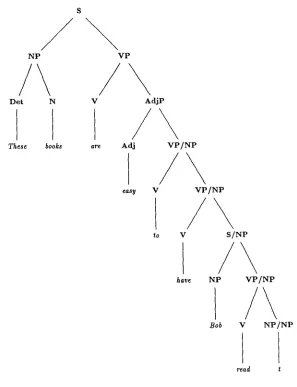
Figure 1
C o m p l e x adjectivals s u c h as easy s u b c a t e g o r i z e for a c o m p l e m e n t VP c o n t a i n i n g a " s l a s h e d " NP, i.e., a VP m i s s i n g an N P ( w h o s e e x p e c t e d p o s i t i o n m a y be arbitrarily deep).
The variety of linguistic phenomena exemplified in the easy class of adjectives guarantees that it is a demanding testing ground for theories of lexical representation. 3
3. Adjectival VP Complementation
We assume familiarity with the mechanisms of lexical inheritance and lexical rules in the analysis to follow, but we provide an overview of these mechanisms for lexical
[image:6.468.97.394.47.434.2]Dan Flickinger and John Nerbonne Inheritance and Complernentation
representation in Appendix A. The fundamental data we shall be concerned with are repeated in (2):
(2) a. b. C. d.
Other adjectives
amusing annoying (3) boring
comfortable confusing
Bill is easy to talk to. It is easy to talk to Bill. Bill is easy for Mary to talk to. It is easy for Mary to talk to Bill.
that show this same distribution include the following:
depressing great nice
difficult hard painful
exhausting important tiresome
fun impossible terrible
good impressive tough
Given pairs like (2a,b) and (2c, d), two dusters of properties begin to suggest them- selves as part of the definitions of the relevant lexical entries. The first of these clusters we will associate with the class of words containing lexical entries for the easy of (2a,c) and its counterparts in (3), a class we term SLASH-EASY. The other cluster of prop- erties we associate with a second class termed IT-EASY, containing the lexical entries for the variant of easy in (2b, d) and its counterparts in (3). We begin by simply iden- tifying the relevant properties in each of these two classes, supported by examples as necessary; then we provide motivation for factoring these properties into several word classes linked by inheritance.
Adjectives in the IT-EASY class have two obligatory complements, an NP subject and a verbal complement; in addition they have one optional complement, a PP headed by the preposition for. As seen in (4), the verbal complement can be either infinitival or gerundive, and (5) shows that this complement can be a VP even with a PP-for present, or an infinitival S, again with or without the optional PP-for complement. The subject NP must be the expletive it.
(4) a. It was great working for Bill. b. It was great to work for Bill.
(5) a. It's easiest for the dogs to feed them at noon. b. For the dogs, it's easiest to feed them at noon. c. It's easiest for the dogs to be chained up all day. d. *For the dogs, it's easiest to be chained up all day. e. It's easiest for me for the dogs to be chained up all day. f. For me, it's easiest for the dogs to be chained up all day.
Examples (5e, f) demonstrate that not only VP complementation but also S comple- mentation, is involved in easy subcategorization. Note that S complementation never requires a controller, and that the PP phrase in such structures is mobile (5f). In addi- tion to the conclusion that a variety of complementation schemes are used with easy,
Computational Linguistics Volume 18, Number 3
We a c c o m m o d a t e these facts semantically b y aUowing that easy a n d similar adjec- tives d e n o t e two-place relations b e t w e e n individuals a n d states of affairs. The relation holds b e t w e e n the pair, roughly, w h e n it is easy (or convenient) for the i n d i v i d u a l w h e n the state of affairs obtains. Examples (5e,f) s h o w that the individual i n v o l v e d in the easy relation n e e d not be i n v o l v e d in the state of affairs, i.e., that there is no nec- essary semantic control i n v o l v e d in this relation. 4 The control facts are clear enough: w h e n this easy is c o m b i n e d with an S, there is no semantic control; a n d w h e n it is com- b i n e d with a VP, there is no grammatically specified controller of the V P - - a l t h o u g h there m a y be pragmatic inference a b o u t the u n d e r s t o o d subject.
Adjectives in the SLASH-EASY class also h a v e t w o obligatory c o m p l e m e n t s , an N P subject a n d a verbal c o m p l e m e n t , as well as an optional PP-for c o m p l e m e n t . In contrast to the first class, this class specifies that the subject is a n o r m a l (nonexpletive) NP, and that the verbal c o m p l e m e n t m u s t contain an N P gap. Moreover, this verbal c o m p l e m e n t m u s t be infinitival, not g e r u n d i v e , as seen in (6), and m u s t be a VP, not an S, as s h o w n in (7). 5
(6) a. Bill was great to w o r k for. b. *Bill was great w o r k i n g for.
(7) a. For me, Bill was easy to talk to.
b. *Bill was easy for m e for M a r y to talk to.
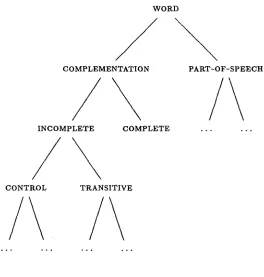
In the w o r d class hierarchy w e assume, sketched in A p p e n d i x A, there is a w o r d class CONTROL, w h i c h introduces a verbal c o m p l e m e n t subcategorization, and w h i c h serves as the superclass f r o m w h i c h b o t h of the classes IT-EASY a n d SLASH-EASY inherit. H o w e v e r , neither of these classes is an i m m e d i a t e subclass of CONTROL; w e d r a w on the data p r o v i d e d in (8) a n d (9) b e l o w to m o t i v a t e t w o i n t e r m e d i a t e w o r d classes that will stand b e t w e e n C O N T R O L a n d these two in the hierarchy.
The English lexicon contains t w o m o r e g r o u p s of adjectives that h a v e m u c h in c o m m o n with the t w o variants of easy i n t r o d u c e d above, b u t m u s t be kept distinct. Lasnik a n d Fiengo (1974:535) identified a set of adjectives including pretty a n d melodi- ous, illustrated in (8).
(8) a. D i s n e y l a n d is p r e t t y to look at. b. Sonatas are m e l o d i o u s to listen to.
c. *It is p r e t t y to look at Disneyland. d. *It is m e l o d i o u s to listen to sonatas.
e. ?Disneyland is p r e t t y for children to look at.
f. ?Sonatas are m e l o d i o u s for serious musicians to listen to.
4 There is an interesting pragmatic problem lurking in the control specifications involved here. If one specifies the control relationships exactly, then one needs to postulate systematic structural ambi- guity in examples such as (5c), where the sequence of PP and VP may or may not be analyzed as an constituent. This seems plausible, but then we would like to have a pragmatic account of w h y there is normally no distinction, i.e., why the control relationship is inferred, or, equivalently for all intents and purposes, why the S reading is so strongly preferred.
Dan Flickinger and John Nerbonne Inheritance and Complernentation
Members of this class of adjectives share much in common with the SLASH-EASY adjectives, but have two significant differences: first, as shown by (8c,d), they do not have a corresponding entry with an expletive
it
subject, and second, they assign a real thematic role to their subjects. That is, (8a) entails that Disneyland is pretty, while (la) does not entail that Bill is easy. The two-place relation suggested above for IT-EASY and SLASH-EASY adjectives could not account for the validity of this inference, since the subject of the adjective plays no direct role in the relation whatsoever. A distinct semantic relation is called for here, one in which the subject does play a role (which effectively makes this class a kind of EQUI adjective in contrast to the raisingeasy).
It also appears that these adjectives do not permit the optional PP-for complement licensed byeasy
in (lc), though judgments are less clear. In order to express these differences, we introduce a class SLASH-COME which will include the entries forpretty
adjectives, and which will also serve as the class from which SLASH-EASY inherits. 6Similarly, English has a set of adjectives that have much in common with the IT-EASY adjectives of (lb, d), but with no counterparts of the SLASH-EASY type.
(9) a. It is possible to talk to Bill only at breakfast. b. It is unnecessary to fire Bill.
c. *Bill is possible to talk to only at breakfast. d. *Bill is unnecessary to fire.
The second principal difference between adjectives such as
possible
and those of the IT-EASY class is that the former do not permit an optional PP-for phrase complement; they do allow the verbal complement to be either a VP or an S (containing a PP-for subject), but (10) shows that if a PP-for is present, it must be contained within the complement.(lO)
a. It is unnecessary for Mary to fire Bill. (M firing B) b. *For Mary, it is unnecessary to fire Bill. (M firing B) c. *It is unnecessary for Mary for you to fire Bill.Again, we express the distinction between the set of adjectives like
possible
and the IT-EASY adjectives by introducing a fourth class IT-SUBJ parallel to SLASH-COME 7These four class definitions, together with one supporting class, are given in (11- 16), with the Superclasses attribute showing the relevant inheritance relations.
(11)
IT-SUN
Superclasses Complements
Subject-Features Subject-Role XComp-features
Control
(NForm
it)
none(VForm Infinitival) (Complete + - )
Computational Linguistics Volume 18, Number 3
The disjunctive specification (Complete + - ) overrides the default (Complete - ) specified in the CONTROL class, and means that the verbal complement may be either a VP (Complete - ) or an S (Complete +). This is an example of further specifying a default specification.
(12)
SLASH-COMP
Superclasses Control
Complements
XComp-Subj-Semantics XComp-features
x
(SLASH (Category Noun) (NForm Normal) (Complete +) (Predicative - ) (Case Accusative) ) (Semantics
Subject-Semantics) )
The SLASH feature on the XComp specifies that the VP must contain a gap for a normal (non-expletive) noun phrase, which is accusative case and which is not predicative. This nonpredicative specification serves to exclude examples like *Bill is difficult to become (assuming the complement of become is predicative), since the gap for that complement would fail to satisfy the restriction on SLASH given in (12). The SLASH specification furthermore notes that the SLASH semantic value is identical to that of Subject-Semantics. As was explained in Section 2 above, this is the form a lexical specification of semantic coindexing takes.
The controller of the controlled complement is specified through the attribute XComp-Subj-Semantics; for example, in CONTROL, this attribute has the value Subject- Semantics, since subjects are default controllers. But the complements of SLASH- COMP are not grammatically controlled (cf. (8e,f)), a fact that requires an overwriting specification. The semantic variable x is used here because it will not represent the semantics of any grammatical complement, which ensures that no grammatical con- trol is effected (see examples (9a,b)). This is an example of a subregularity appearing within an exceptional specification.
The classes for the two variants of easy adjectives we have discussed have one cluster of properties in common: they both license the optional PP-for phrase seen in preceding examples. To further reduce redundancy, we define in (13) the class FOR- EXPERIENCER, from which the two classes in (14-15) also inherit.
(13)
FOR-EXPERIENCER
Superclasses Complements
PP-for-Features
PP-for-Oblig PP-for-Role
PP-for
(Category Preposition) (Lexical - ) (PForm For)
Dan Flickinger and John Nerbonne Inheritance and Complementation
(14)
IT-EASY
Superclasses It-Subj, For-Experiencer Complements
XComp-Features (VForm Infinitival Gerund)
SLASH-EASY
Superclasses Slash-Comp, For-Experiencer
Complements
Subject-Role none
XComp-Subj-Semantics PP-For-Semantics (15)
As expected, the IT-EASY class eases one restriction on the verbal complement; note too that no controller is specified, in keeping with remarks on (5). On the other hand, the SLASH-EASY class blocks inheritance of the subject's thematic role assign- ment (the default value having been specified in the INCOMPLETE class from which CONTROL inherits), and alters the control relationship (inherited from SLASH-COMP and ultimately from CONTROL) so that the PP-For phrase rather than the subject of
easy
is interpreted as the subject of the VP complement. These are two further examples of the way in which default overwriting is employed; note that the latter represents a subregularity within a subregularity (cf. SLASH-COMP).With reasonable assumptions about the definitions of other relevant classes in the hierarchy, along with an explicit definition of the class ADJECTIVE, provided here for clarity in (16-17), we can introduce the (sparse) lexical entries for the two variants of
easy
employed in (la,b), as given in (17,18):(16)
ADJECTIVE
Superclasses Major
Features (Category Adjective) (Predicative + - )
(17)
easy-la
Superclasses Adjective, Slash-Easy Semantics easy
Spelling "easy" Phonology / i z i /
easy-lb
Superclasses Adjective, It-Easy Semantics easy
Computational Linguistics Volume 18, Number 3
F O R - E X P E R I E N C E R
C O N T R O L
ITq IUBJ SLAStt-COMP
IT-EASY SLASH-EASY
easy-lb easy-la
[image:12.468.81.405.52.265.2]ADJECTIVE
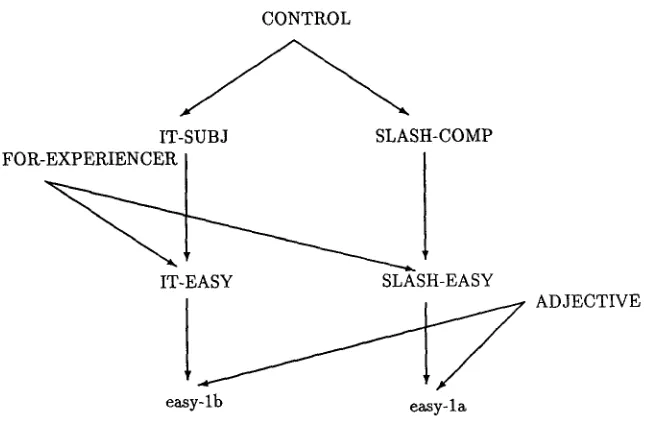
Figure 2
The structure of word classes directly involved in the definition of complex adjectival lexical entries.
Pairs of sparse lexical entries like those in (17,18) are related b y a lexical rule w e label LR-EASY, w h i c h simply states that for each m e m b e r of the class IT-EASY there exists a c o r r e s p o n d i n g lexical e n t r y belonging to the class SLASH-EASY, with e v e r y t h i n g b u t the Superclasses p r o p e r t y identical in the two (sparse) entries.
Rule
LR-EASY lexical rule
LR-EASY
LE2-Classes - IT-EASY = LE1-Classes - SLASH-EASY
Once each of (17) a n d (18) are fleshed out to include all of their inherited properties, they will of course be quite distinct, as n e e d e d to e n s u r e the differences in distribution that w e h a v e described. Figure 2 s u m m a r i z e s the inheritance relationships thus far.
4. An Example Analysis
The p u r p o s e of this section is primarily i l l u s t r a t i v e - - w e w o u l d like to d e m o n s t r a t e the effect of the lexical specifications suggested on m o r e familiar elements of grammatical analysis, viz. phrases, parse trees, and predicate logic representations.
Dan Flickinger and John Nerbonne Inheritance and Complementation
herited semantics, i.e., one in which the relation denoted has an argument place for the denotations of each of the role-playing complements, in this case the PP-FOR phrase and the XCOMP. This class of adjectives also has a SUBJECT among its complements, but it bears no role (as word class SLASH-EASY specifies), because this is a raising construction. For this reason, there is no argument place reserved in the semantics of
easy-SLASH
adjectives for the subject's denotation. To conserve space in the diagrams below, relations will be specified not using the keyword coding shown in word class and lexical entry specifications (above), but rather in the more familiar order coding.In order to make not only the semantics but also the syntax somewhat clearer in its intended effect, we include here somewhat elaborate analytical sketches of the complex adjectival phrase
easy to get Mary to hire
in (19):(19) Tom is easy to get Mary to hire.
To begin, we note that the sparse lexical entry for the SLASH-EASY version of
easy
may be filled out to a much richer structure if inherited properties are noted explicitly.
easy-la
Features Complements
PP-for-Features
PP-for-Oblig PP-for-Role PP-for-Semantics XComp-Features
XComp-Subj-Semantics XComp-Oblig
XComp-Semantics XComp-Role Subject-Role Semantics Spelling Phonology
(Category Adjective) (Predicative + - ) PP-for, Subject, XComp
(Category Preposition) (Lexical - ) (PForm For)
No For
PP-For-Semantics
(Category Verb) (Complete -)(Lexical - ) (SLASH (Category Noun) (Complete +)
(NForm Normal) (Predicative - ) (Case Accusative) )
(Semantics Subject-Semantics) ) PP-For-Semantics
Yes
XComp-Semantics State-of-Affairs none
easy "easy" / i z i /
Computational Linguistics Volume 18, Number 3
stem: easy syn.loc.head: Adj sem: easy( [ ~ , ^ [ ~ )
syn.loc.subcat:
sub j: [ syn: NP-nom ]
sem: ~]
pp_for: [ sY n: PP-f°r ] sem: [ ]
syn: VP-inf
sere: ~ ]
xcomp: subject.sem: [ ~
slash: [ 2eYnm:~ -acc ]
We would like to draw attention to two semantic coindexings in the structure, which are lexically specified and which simplify subsequent (grammatical) processing. The coindexing of the xcomp's subject with the pp-for is effected in the SLASH-EASY word class, and the semantic coindexing seen above is just a consequence of that. The coindexing of the xcomp's slash's semantics value with the subject's semantics, on the other hand, derives ultimately from SLASH-COMP.
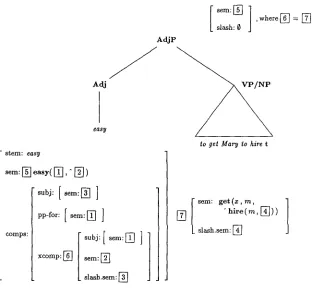
In Figure 3 we examine the combination of a token from this class of easy adjectives and a VP/NP. The very sparse specification of the mother phrase's features is, in fact, solely for purposes of legibility--all of the information specified on the mother node may be derived from general HPSG principles, so that nothing is specified, e.g., on the rule that licenses head-complement combinations. The fact that the semantics attribute is identified with the subcategorizer's semantics follows from the HPSG Semantics
Principle, which states that the semantics of a phrasal node is always to be identified with the semantics of a head in a head complement combination. The fact that the slash value of the mother structure is empty follows from the Binding Inheritance Principle, which states that slash values are collected going u p a tree--unless a head subcategorizes for an element containing a slash value, in which case the slash satisfies the subcategorization requirement. The identification of the feature structure labeled V~, which is just the representation of the phrasal node dominating to get Mary to hire, with one of the adjective's subcategorization specifications, that labeled ~ ] , is just a condition for the applicability of the head-complement rule, not an additional specification. Of course, the phrasal node is massively underspecified here, but the suppressed information is predictable, not merely hidden.
Dan Flickinger and John Nerbonne Inheritance and Complementation
Adj
easy
slash: 0 AdjP
to get Mary to hire t • stem: easy
sem: [~ easy( [-i-], ^ ~] )
s bj: [som[] ]
pp or: [ sem:[ ]
comps:
subj: [ som:[ ]
xcomp:[] sem:[]
L slash.sem: [ ]
s e r e : get(x,m, 1
[ ] " hire(m, ~]))
slash.sere: [ ]
Figure 3
The combination of complex adjective and slashed VP complement.
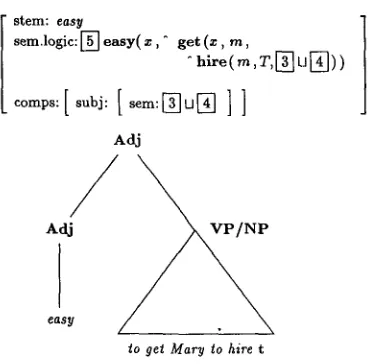
To complete this illustration, we spell out the effects of unification on the structure above in Figure 4. Note in particular that because the slash semantics on the VP phrase is identified with the slash semantics on the subcategorized-for VP, which in turn is identified with the semantics of the subject for easy, the resultant phrase will bind its subject to the deeply embedded object argument position of the verb hire. This takes place even though the subject plays no role in the easy relation itself. This is exactly what is wanted semantically of a raising construction.
5. E x t e n s i o n s a n d Lexical M a i n t e n a n c e
[image:15.468.72.387.56.349.2]Computational Linguistics Volume 18, Number 3
stem: easy
sem.logic: [ ] easy( z, ^ get (z, m,
" hire(m, T,~] U ~]) )
comps:[ subj: [sem:[~]U[~] ] ]
Aa5
[image:16.468.149.334.50.232.2]to get M a r y to hire t
Figure 4
The result of combining complex adjective and slashed VP complement. Note that the subject of easy is still semantically coindexed with the missing VP object.
But the practical advantage of the structured lexicon may ultimately also be of scientific value, and that is because a structured lexicon is more easily maintained and extended than a nonstructured one. This advantage derives immediately from the characteristic that lexical properties are normally specified only once. Modifications tend then to be minimal and extensions less frightening. The ultimate scientific benefit this may bring derives from the fact that it is then easier in systems with structured lexicons to experiment with grammatical description.
The following section is an attempt to buttress the claim that structured lexicons are easily extended. We examine therefore extensions to the analysis above of adjec- tives that govern VP complements--to nouns with similar subcategorizations, to the adjectival specifiers too and enough, and to adjectives that govern S complements rather than VP complements.
5.1 Pleasure Nouns
Adjectives like easy have been the most widely studied group of lexical types that populate the classes introduced in the analysis above, but they do not have exclusive claim to those classes. Lasnik and Fiengo (1974) observed that the English lexicon also contains a group of nouns with similar properties, as illustrated in (20-21),
(20) a. Nureyev is a pleasure to watch. b. This course is a breeze to pass. c. Venice is a delight to visit.
(21) a. It is a pleasure to watch Nureyev. b. It is a breeze to pass this course. c. It is a delight to visit Venice.
Dan Flickinger and John Nerbonne Inheritance and Complementation
NP gap; and one that selects an expletive
it
subject and an infinitival complement with no gap. Given the word class definitions developed on the strength of the adjectival examples, an obvious analysis of the nominal examples suggests itself:pleasure,
likepleasant,
has one lexical entry belonging to the SLASH-EASY class, and a second entry that inherits from the IT-EASY class. The (sparse) descriptions of both entries are given in (22-23), parallel to those foreasy
given in (17-18) above, the salient difference being that the noun entries inherit from the class Common-Noun where the adjective entries inherited from the Adjective class. 8(22)
pleasure-la
Superclasses Common-Noun, Slash-Easy Spelling "pleasure"
Semantics.Pred pleasure Phonology / p l E z h r /
pleasure-lb
Superclasses Common-Noun, It-Easy Spelling "pleasure"
Semantics.Pred pleasure Phonology / p l E z h r / (23)
Having declared nouns like
pleasure
to have entries that are members of SLASH- EASY and IT-EASY, nothing more needs to be said in order to capture the syntactic relationship between these two forms ofpleasure.
The lexical rule we proposed earlier to link pairs of adjectives like the two variants ofeasy
is defined as a regularity holding between the two classes SLASH-EASY and IT-EASY, making no mention of the class ADJECTIVE in its formulation. Hence it also serves to link the pair of noun entries in (22-23).Some further explanation needs to be provided about the semantics of this class of nouns, since the nouns do seem semantically anomalous even if we shall maintain that all of the apparent anomaly ultimately stems from their having a subject--and thus being available for control (by
be
and other raising verbs). In general a common noun is interpreted as a relation between a theme argument and the denotation of its complements, if there are any. For example,friend
is interpreted as a relation between a theme argument and the denotation of the complement PP-OF phrase. We refer to the theme argument of the relation denoted by the common noun as its denotation. An apparent peculiarity of nouns such aspleasure
is that there appears to be no denotation of the noun in the usual sense, e.g., in (20a). At issue is whether there is any theme argument position for the "pleasure" in the relation denoted bypleasure.
That is, doespleasure
denote the same two-place relation between individuals and states of affairs thatpleasant
does, or is there a third argument position inpleasure
that is occupied by an (abstract) "pleasure" individual?The suspicion that no denotation is involved likely stems from our intuition that we do not seem to refer to an object that is a
pleasure
in uttering either (20a) or (21a), at least not any more than we would if we had usedpleasant
in the place ofa pleasure.
Computational Linguistics Volume 18, Number 3
Now this suggests that the noun (phrase) is used predicatively, much as m a n y noun phrases are after the verb be. Compare Tom is a linguist.
This does not help a great deal, however. Even though the analysis of predicative NPs is an old topic semantically (cf. the definition of be in Montague 1973, p. 261), there has been essentially no successful attempt to treat predicative nouns as if they had no denotation. Any attempt to do so seems to run afoul of the standard (if limited) determination and adjectival modification found in phrases such as no great pleasure to watch; at least such examples point out the inevitable duplication a semantic analysis would incur if predicative nominals had no denotation.
We therefore interpret pleasure as a three-place relation
pleasure
(theme : e~ for : x~ soa : s)which obtains just in case e is the pleasure x has in case s. It should of course also turn out that this relation for some e holds iff pleasant (for : x~ soa : y), but we will not be concerned with showing that here. e provides a denotation that is subject to determination (no) and (intersective) adjectival modification (great). Under this anal- ysis, a pleasure to watch and no pleasure to watch denote quantifiers, i.e., in each case a set of properties of pleasures (e's from above). Of course, a quantifier does not by itself represent a proposition, something that could be true or false---for that it must be paired with a property. In these cases, the relevant property is always the universal (existence) property; i.e., utterances of sentences such as (20a) are true just in case there is a pleasure of the relevant kind (and mutatis mutandis for the negative existentials). We therefore postulate that the predicate be in these sentences denotes the universal property. 9
What is striking about this proposal is that it assigns the common noun pleasure exactly the semantics the general scheme predicts--a relation between a theme and the denotations of other complements. For this reason, the word classes for pleasure nouns make no special stipulations about semantics.
We therefore derive feature structures such as the following, which are used in the syntax and semantics processing of the word pleasure. The first structure represents the member of the SLASH-EASY class, and the second the member of the IT-EASY class. (We have simplified the structures to highlight the semantically relevant parts.)
stem: "pleasure"
sem.logic: pleasure (e, ~ - ~ [ ] )
subcat:
subj: I s e r e : [ ] ]
pp-for: I s e m : [ ] ]
[ subj: [[sem: [ ] ] 1
xcomp: logic: 2~
sem: slash:
Dan Flickinger and John Nerbonne Inheritance and Complementation
stem: "pleasure"
sere.logic: pleasure (e, ~-~,^ ~-] )
comps:
subj:
NP-it
pp-for: [ sem: [ ~ []
x c o m p : I s u b j e c t : s e m : ~ ] ] ] sere: [ ~
On the other hand, the noun classes are exceptional in that the nouns involved have subjects--a property they inherent finally from INCOMPLETE, in the one case through CONTROL, IT-SUBJ, and IT-EASY; and in the other from CONTROL, SLASH- COMP, and SLASH-EASY. It is this property, shared by the NPs they give rise to, that explains (i) their ability to be controlled, e.g., by the verb be--only unsaturated phrases are subject to control; (ii) their inability to function in normal NPs, e.g., in the subject position of any intransitive verb; and finally (iii) the fact that they can stand in construction with the main verb
be
without being asserted to be identical to its subject. We turn n o w to further points on the syntax of thepleasure
nouns. The two defini- tions of entries for "pleasure" also predict the grammaticality judgments seen in (24), analogous to the examples given above for adjectives, and based on the definitions given for the IT-EASY and SLASH-EASY word classes. 1°(24) a. Nureyev is a pleasure for us to watch. b. It is a pleasure for us to watch Nureyev.
c. For us, Nureyev is a real pleasure to watch.
d. *For us, Nureyev is a real pleasure for our parents to watch. e. For us, it is a real pleasure for our parents to watch Nureyev. f. It is a real pleasure for us for our parents to watch Nureyev.
g. *Nureyev is a pleasure watching. h. It is a pleasure watching Nureyev.
10 N o t h i n g w e have said so far captures the fact that s o m e pairs of m e m b e r s of these two classes, such as "pleasant" a n d "pleasure," are morphologically related. We do not offer here a proposal for capturing n o n p r o d u c t i v e regularities of this kind, t h o u g h some extension of the lexical rule m e c h a n i s m m i g h t serve, an extension that w o u l d d e p e n d heavily on the ability to specify negative exceptions to lexical rules, given examples like the following.
(i) It is difficult to hire Bill.
(ii) *It is a difficulty to hire Bill.
(iii) *Bill is a difficulty to hire.
(iv) It is impossible to w o r k with Bill.
(v) *It is an impossibility to w o r k with Bill
Computational Linguistics Volume 18, Number 3
Recalling further that the adjectives we looked at above fell into not two but four distinct classes, we might expect to find nouns as well that belong to the other two classes, IT-SUBJ and SLASH-COMP. Such instances are found in English, as illustrated for IT-SUBJ nouns by the examples in (25), and for SLASH-COMP nouns by those in (26), drawn from Lasnik and Fiengo. 11
(25) a. It would be a mistake to fire Bill. b. It was a shock to find Bill here.
c. *Bill would be a mistake to fire. d. *Bill was a shock to find here.
(26) a. This room is a pigsty to behold. b. Nureyev is a marvel to watch.
c. *It is a pigsty to behold this room. d. *It is a marvel to watch Nureyev.
The noun
mistake
and the adjectivepossible
have in common just those properties specified by the IT-SUBJ class (together with its superclasses); and like the differences betweenpleasure
andeasy,
their differences result frommistake
being a member of the COMMON-NOUN class whilepossible
inherits from the ADJECTIVE class. Since the lexical rule relating the two variants ofpleasure
(and the two variants ofeasy)
is defined to link members of the two classes SLASH-EASY and IT-EASY, the rule correctly does not predict the existence of similar alternate entries for nouns likemistake
andpigsty.
Interaction with lexical rules. Given that the domain of lexical rules is always one or more word classes, and that the LR-Intraposition rule is defined on the IT-SUBJ class, we predict the grammaticality of the following examples with
pleasure
nouns, since they also have entries belonging to the IT-SUBJ class, and should be expected to conform to the LR-Intraposition rule. Here again, the combined devices of inheritance and lexical rule produce the desired results for nouns without requiring that anything be added to the analysis motivated from data on adjectives and verbs.(27) a. (For me) to stay another day would be a real pleasure. b. It would be a real pleasure (for me) to stay another day.
c. To visit Venice now might be a disappointment for you. d. It might be a disappointment for you to visit Venice now.
5.2
Too
andEnough
To drive home our central point about the expressive and predictive power of inher- itance in lexical representation, we turn to a third, small class of lexical entries that show complementation properties like those we have already seen. Jackendoff (1972) noticed that the words
too
andenough
also appear in constructions with an infinitival complement that contains an NP gap, as illustrated in (28) with examples drawn fromDan Flickinger and John Nerbonne Inheritance and Complementation
Lasnik a n d Fiengo (1974). 12
(28) a. The mattress is thin.
b. *The mattress is thin to sleep on. c. The mattress is too thin to sleep on.
d. The football is soft.
f. *The football is soft to kick. g. The football is soft e n o u g h to kick.
In particular, the examples in (29) suggest that these a d v e r b s select for comple- m e n t s that are the same as adjectives like pretty, entries that are not related via lexical rule to variants that license an expletive it subject.
(29) a. *It is too thin to sleep on this mattress. b. *It is soft e n o u g h to kick this football:
Informally, it seems that w h e n too or enough combines with an o r d i n a r y adjec- tive, the resulting p h r a s e (too thin and soft enough) exhibit c o m p l e m e n t a t i o n properties v e r y m u c h like those of pretty adjectives. By defining the lexical entries for these two adverbial specifiers as m e m b e r s of the SLASH-COMP class, w e begin to p r o v i d e an account for examples (28c,g) as well as those in (29). The e n t r y for too is given in (30), inheriting both from the ADVERB class and from the SLASH-COMP class; the e n t r y for enough is similar, leaving out of the present discussion an account of the linear o r d e r difference b e t w e e n the t w o adverbs with respect to the adjective they modify.
(30)
"too"
Superclasses Adverb, Slash-Comp Spelling "too"
P h o n o l o g y / t u /
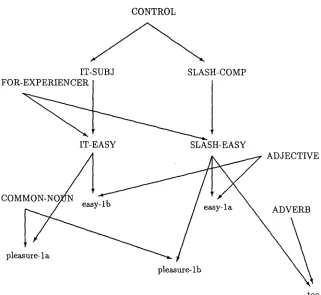
With the inclusion of this class of adverbs, o u r lexical s u b h i e r a r c h y involving com- p l e m e n t a t i o n of slashed VPs has g r o w n to a p o i n t w h e r e it surely d e m o n s t r a t e s the virtues of the structured lexicon approach. Figure 5 illustrates the m o r e c o m p l e t e struc- ture. It is a curious fact that the n u m b e r of lexical classes does not g r o w e n o r m o u s l y e v e n while fairly detailed analyses involving v e r y different grammatical areas are un- dertaken. In several years of d e v e l o p m e n t at H e w l e t t - P a c k a r d Laboratories involving detailed analyses of d o z e n s of constructions, the n u m b e r of w o r d classes n e v e r ex- ceeded 400. This m u s t be d u e finally, not to the lexical analysis tool, b u t rather to the t e n d e n c y of language to reuse significant classes.
This analysis of these two u n u s u a l adverbs has left begging an i m p o r t a n t is- sue a b o u t h o w the c o m p l e m e n t a t i o n specifications p r o v i d e d b y too are p r o p a g a t e d u p to the p h r a s e too thin. 13 We have said little here a b o u t h o w lexically s u p p l i e d
12 Baltin (1987) presents a more recent analysis of these "degree complements."
13 One might be tempted to try a lexical rule approach that would treat too thin as a derived lexical item that selects for a VP complement. But slightly more complicated examples quickly render this approach untenable. Cf. This country is too thinly populated to worry about (where we take the scope of the specifier
Computational Linguistics Volume 18, Number 3
C O N T R O L
IT-SUBJ SLASH-COMP
F O R - E X P E R I E N C E R
IT-EASY SLASH-EASY
/ ~ ~ ADJECTIVE
pleasure-la
~
j/
~ ~
pleasure-lb
~ \
too
Figure 5
The lexical subhierarchy involving elements that govern "slashed" verb phrases. Note that the original hierarchy needed very little modification, merely addition. We speculate that this is due to the fact that significant classes are being identified in detailed grammatical description. There is also a version of too that inherits from ADVERB and IT-EASY that is not shown (since it was not discussed). The asymmetry is only apparent.
subcategorization information is e m p l o y e d in parsing, referring the reader to full ac- counts given in Pollard and Sag (1987) a n d related references. Yet it is clear that some- thing more m u s t be said about this construction, given that in HPSG it is the syntactic head of a phrase that imposes constraints on its complements; a n d w e assume that
thin, not too, is the head of the phrase too thin to sleep on. To motivate the necessary elaboration of our analysis for these two adverbs, we turn to one more set of data involving g a p p y infinitival complements, one that has received little s t u d y to date.
Excursus on subcategorization transfer. As the example in (31) shows, adjectives such as easy appear not only in predicative constructions like those illustrated above, b u t also as nominal modifiers.
(31) John is an easy m a n to talk to.
[image:22.468.85.406.52.347.2]Dan Flickinger and John N e r b o n n e Inheritance a n d C o m p l e m e n t a t i o n W h i l e t h e e x a m p l e in (31) is g o o d , e m p l o y i n g t h e e a s y t h a t b e l o n g s to t h e EASY- S L A S H class, t h e e x a m p l e s in (32-33) a r e u n g r a m m a t i c a l . T h e a n a l y s i s w e h a v e p r o - v i d e d t h u s f a r d o e s n o t y e t e x p l a i n t h e g r a m m a t i c a l i t y o f (31) a n d t h e u n g r a m m a t i - c a l i t y of (32,33).
(32) a. *John is a n e a s y to t a l k t o m a n . b. *John is a n e a s y m a n .
(33) a. *John is a n e a s y m a n to t a l k to Bill. b. *John is a m a n e a s y to t a l k to Bill.
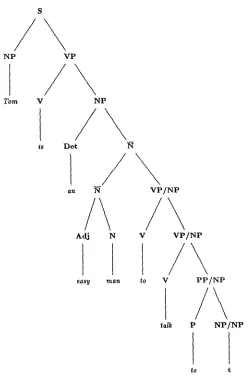
W e w i l l f o c u s o n e x p l a i n i n g t h e g r a m m a t i c a l i t y of (31), a s s u m i n g t h a t t h e r i g h t s y n t a c t i c s t r u c t u r e f o r t h e s e n t e n c e is t h e b i n a r y - b r a n c h i n g s t r u c t u r e g i v e n i n (34), w h e r e e a s y f o r m s a c o n s t i t u e n t w i t h m a n , a n d w h e r e to talk to is s i s t e r to t h e p h r a s e
e a s y m a n . W e a d o p t t h e b i n a r y s t r u c t u r e l a r g e l y b e c a u s e it w i l l s i m p l i f y t h e e x p o s i t i o n h e r e ; it m i g h t b e e q u a l l y d e f e n s i b l e to h o l d t h a t easy, m a n , a n d to talk to a r e all s i s t e r s o f a s i n g l e p h r a s e 2 4
W h a t is a w k w a r d a b o u t t h i s s t r u c t u r e is t h a t t h e h e a d n o u n m a n d o e s n o t b y i t s e l f s u b c a t e g o r i z e f o r t h e V P / N P . ~5 R a t h e r , it s e e m s t h a t w h e n e a s y c o m b i n e s w i t h m a n , t h e r e s u l t i n g p h r a s e h a s a s u b c a t e g o r i z a t i o n list t h a t c o n t a i n s n o t o n l y t h e o p t i o n a l a n d o b l i g a t o r y c o m p l e m e n t s t h a t m a n s t a r t e d o u t w i t h , b u t a l s o t h e o b l i g a t o r y V P / N P c o m - p l e m e n t a n d t h e o p t i o n a l F o r - P P c o n t r o l l e r r e q u i r e d b y easy. N o m e c h a n i s m p r e s e n t e d s o f a r p r o v i d e s f o r a n a d j u n c t c o m b i n i n g w i t h its h e a d to affect t h e s u b c a t e g o r i z a t i o n of t h a t h e a d o r of t h e r e s u l t i n g p h r a s e . Yet if t h e p h r a s e s t r u c t u r e p r o p o s e d i n (33) is c o r r e c t , s o m e k i n d o f m e r g i n g o f s u b c a t i n f o r m a t i o n b e t w e e n a d j u n c t a n d h e a d m u s t b e p r o v i d e d for. 16
14 And it is worth noting that the alternative constituent structure would not modify the head
relationship, and therefore would not substantially alter the analytic problem--that of explaining how a complement to talk to can be licensed by a nonhead.
15 At least not with the intended reading. There is a suspiciously similar construction, illustrated in (i), which might be expected to shed some light on the proper analysis of (31), but which has a restricted enough interpretation to suggest that it should be treated separately, probably inheriting a specification from the more general construction exhibited in (31).
a. John is a man to admire. (i) b. Mary is a woman to emulate.
c. This is a word to keep on the tip of your tongue.
These examples seem to mean something like John is a good man to admire or Mary is a good woman to emulate, where the semantic contribution of good has been incorporated into the N-VP/NP construction in (i). To test this, consider the examples in (ii), where the good reading should lead to an anomalous interpretation, and does (cf. the corresponding examples in (iii)).
(ii) a. ?Mary is a person to underestimate. b. ?Sharks are animals to tame.
(iii) a. Mary is an easy person to underestimate. b. Sharks are difficult animals to tame.
Given the constrained interpretations of examples like those in (i-ii), it does not seem defensible to treat easy man to talk to as simply the modifier easy combining with man to talk to. Any such attempt would be strained in accounting for (ii); in addition, such an analysis would leave unexplained the ungrammaticality of *John is an easy man.
16 It is probably worth noting that extraposition seems unlikely to be generalizable to all cases involving transferable subcats, at least if extraposition is to be bounded uniformly:
Computational Linguistics Volume 18, Number 3
S
/ \
N P V P
/ \
T o m V N P
/ \
Is D e t N
/
an N
/\
A ~ N
easy m a n ~o
\
V P / N P/ \
V V P / N P
/ \
V P P / N P
/\
talk P N P / N P
~o t
Figure 6
Complex adjectivals "wrapped" around a modified noun. Note that the N head of the I~I constituent in construction with the complex adjectival has not licensed it.
Subcategorization transfer has taken place.
The e x a m p l e s in (34-35) illustrate that the flow of i n f o r m a t i o n f r o m an a d j u n c t ' s list of subcats to the h e a d ' s m u s t b e quite restricted; it w o u l d n o t d o to s i m p l y m e r g e the C o m p l e m e n t s list of a n y adjunct w i t h that of the h e a d in e v e r y case.
(34) a. *an eager m a n to please b. *a fearful m a n of s n a k e s c. *a f r i g h t e n e d m a n b y s n a k e s d. *an a n g r y m a n at John
[image:24.468.125.377.49.430.2]Dan Flickinger and John Nerbonne Inheritance and Complementation
The a b o v e examples m i g h t suggest that w h a t distinguishes easy from these o t h e r adjectives is that the V P / N P c o m p l e m e n t of easy is obligatory, while the PP comple- m e n t s of the a b o v e adjectives are optional. While there are not m a n y adjectives against which to test this hypothesis, the one clear case of an adjective that takes an obligatory c o m p l e m e n t counts against the idea:
(36) a. a m a n fond of snakes b. *a fond m a n
c. *a f o n d m a n of snakes.
The analysis we p r o p o s e localizes in lexical entries the ability of a subcat to be transferred from adjunct to head. Just as subcats can be m a r k e d for the oblig- a t o r y / o p t i o n a l distinction in a class definition or in a lexical entry, so can they be m a r k e d for a distinction we t e r m transferable. While as a default subcats will be non- transferable, those subcats that are identified b y a class or lexical e n t r y as transferable will be subject to the following informally stated principle.
Transferable Subcat Principle.
W h e n a transferable subcat on a d a u g h - ter in a local subtree is not associated with some sister in that subtree, the subcat b e c o m e s part of the c o r r e s p o n d i n g subcat list of the h e a d d a u g h t e r in that subtree.In the constructions studied here, this principle applies in cases w h e r e the lexical e n t r y or p h r a s e with a transferable subcat serves as an adjunct (easy) or a specifier (too),
so that the w o r d or phrase's subcat list is not used directly. The intent of the principle in such cases is to m a k e the transferable subcat a part of the head, so the subcategorization principle will ensure that the i n f o r m a t i o n is p r o p a g a t e d to the m o t h e r node. This is i n t e n d e d as a modification of the subcategorization principle---note that it has the effect of licensing a kind of " d i s c o n t i n u o u s constituent. "~7
H a v i n g i n t r o d u c e d this additional p r o p e r t y of subcats, that they can be specified as transferable, w e note that the default value for this p r o p e r t y m u s t be negative, since in general subcats from adjuncts and specifiers do not pass to heads, as seen in (33) a n d (34) above. This default value will be o v e r r i d d e n for the V P / N P a n d the For- PP subcats in the SLASH-COMP class, to reflect the grammaticality of both examples in (37).
(37) a. That was a m e l o d i o u s sonata to listen to. b. John is an easy m a n to please.
M e m b e r s of the SLASH-COMP class, including the relevant lexical e n t r y for easy,
will inherit this n o n d e f a u l t transferable p r o p e r t y for both the X C o m p and the For-PP, so w h e n easy combines as an adjunct with the h e a d n o u n man, these t w o subcats will b e c o m e part of the subcategorization of man, b y the principle above, a n d will then b e c o m e part of the subcategorization of the n o d e easy man, accounting for the grammaticality of (31) above.
Example (32a) will be ruled out because of an i n d e p e n d e n t constraint that re- stricts p r e - h e a d adjuncts to those that are (Head-Final +). Example (32b) is e x c l u d e d because easy has an obligatory V P / N P c o m p l e m e n t , which m u s t be i n c l u d e d as an