Assessment of the Annual Planning Process -
Executing Strategy
Public Version - Master Thesis
J. P. A. van der Veer
Strategy:
From Ancient Greek
στρατηγα
(strategia):
"office of general, command, generalship"
στρατηγ
(strategos):
"the leader or commander of an army, a general"
from
στρατ
(stratos):
"to lead, to conduct"
- The science and art of military command as applied to the overall
planning and conduct of warfare;
- A plan of action intended to accomplish a specific goal;
- The art of using similar techniques in politics or business.
Strategy and Politics
Assessment of annual Planning Process –
Executing Strategy
Author: J.P.A. van der Veer
Educational Setting: University of Twente, Faculty of Management and Governance. Programme: Master of Science in Business Administration.
Specialization: Innovation Management.
Supervisors University of Twente: Dr. Rik van Reekum, Assistant Professor NIKOS.
Prof. Dr. Ir. Petra de Weerd-Nederhof, Professor Organisation Studies and Innovation, Program Director Business Administration.
Location/Date: Enschede, Tuesday June 16th, 2009.
Important Note: This is the public version.
Preface
This report stands for the ending of my education at the University of Twente, a period of important personal and academical growth, and is the Magnum Opus in my educational career. Though I am sure other courses will follow! After studying at technical institutions for Mechanic and Engineer, my latest challenge became the Master of Science in Business Administration; track Innovation Management at the University of Twente, Enschede. This social sciences direction is a very different path away from my background in engineering, and I see it as a useful combination for my future career.
The research is named: “Assessment of Annual Planning Process - Executing Strategy”. The initial assignment pointed towards an assessment of the planning process, but later on it became clear that the problem behind the problem was strategy execution. The subject was fairly new to me, it really gave me an insight in how companies are administered from top level. The research took place at the Marketing department. Results of the research are conclusions about the current state, theory and finally recommendations for the management to improve the annual planning process and thus the strategy execution capabilities.
First of all, my gratitude goes out to my supervisors at the company. I enjoyed the conversations and discussions and the difficulties that are related to it, and for their guidance, critical feedback during the graduation period. Their practical view on the assignment has contributed very much to the relevance of this research. I also would like to thank my indirect colleagues of Marketing and IT of the office floor where I was located for providing a interesting and fun place to work.
Second, I would like to thank my supervisors at the University of Twente Rik van Reekum and Petra de Weerd-Nederhof for their guidance and critical feedback during the graduation period. The discussions we had where always very constructive to keep an eye on the theoretical level that should be incorporated in the thesis and to find problems behind problems. The art of looking further is always more difficult than it seems.
I would also like to thank the -always very busy and tight sceduled- managers of the Divisional Leadership Team for cooperating in the preliminary research, the interviews and the survey. Their input was very important for me to conduct this research and analysis of the current situation. Also I would like to thank the managers I
interviewed at the benchmark companies.
Last but not least, special thanks goes out to my girlfriend, family, family in law and friends for their continued support during the long period called graduation. They as well encouraged me in tough times to go on with writing my chapters and finalisation of the now concluded research.
JPA van der Veer,
Executive Summary
This research provides the management with recommendations for the improvement of the annual planning process. The background of the problem is researched, and gaps where identified by searching for discrepancies between the current situation and theory. Benchmark analysis focusing on the gaps revealed how other
companies cope with these gaps.
In the preliminary research, agreement is achieved about the problems that are focus of this research: the Annual Planning Process not deployed as it should be and there is no sound coupling between the Strategic Plan and the Profit Plan. This is the core problem: Strategy Execution.
Literature regarding strategy execution indicated that the most important drivers of strategy execution are effective information flows and clarified decision rights. Literature research resulted in items explaining effective information flow and a clarified decision making process. These items where used in a survey which measured the current situation. The survey, short interviews and the all employee survey indicated that information flow about strategy related issues is insufficient and the decision making process for strategy related issues are not present.
The survey indicates that communication and information flow are better when employees know there is a communication- and information sharing protocol present. Also the known presence of a formal decision making protocol leads to a more rational perceived decision making process. Therefore, the two drivers for strategy execution identified in the first part of the research can be indicated as a gap.
The identified gaps are researched at three benchmark companies. These companies have similarities regarding structure and are all in business to business. The companies aligning their businesses with their strategy perceive low strategic drift. This because of short lines, central strategy making and execution and the cooperation in strategy making. Related to the gaps, they have more effective information flows and more clear decision rights.
In order to make the organisation more mature in the process of strategy deployment and subsequently gain maturity in the operational excellence, five recommendations are proposed that focus on improving the gaps identified. The first and most important recommendation is to appoint a dedicated strategy manager. If there is a dedicated strategy manager, the strategy execution process will be more controlled and centralized, leading to a more inclusive and aligned process. This strategy manager should then focus on the following recommendations; to get higher involvement of the Leadership Team, to set up a formalized decision making process, to introduce scenario planning and to adopt a closed loop in the management system.
In earlier discussions, Roadmapping in the APP was questioned. Initially, the problem was that only R&D used it, while it was thought that it must be used company wide. Roadmapping is just an intermediary form of strategy making and strategy execution, and thus the recommendation was: discard the Roadmapping Process in the APP. This part of the process was removed before the end of this research.
Management Samenvatting
Dit onderzoek verschaft het management aanbevelingen voor het verbeteren van het jaarlijks planning proces. Er is onderzoek gedaan naar de achtergrond van het probleem en er zijn verschillen geïdentificeerd doormiddel van het vergelijken van de huidige situatie en theorie. Deze verschillen (gaps) zijn onderzocht bij andere bedrijven doormiddel van een vergelijkend onderzoek om te kijken hoe het eventueel beter of anders kan.
In het vooronderzoek is overeenstemming bereikt over de problemen die zich voordeden in de praktijk. Deze problemen zijn als input gebruikt voor het opzetten van het onderzoek. Vooral het laatste probleem, de koppeling tussen de lange en korte termijn plannen, is het kernprobleem. Ook wel “Strategie uitvoeren” genoemd.
Literatuur geeft aan dat effectieve informatiestromen en heldere besluitvorming de twee belangrijkste pijlers zijn voor het uitvoeren van strategie. Dieper onderzoek in deze twee velden resulteerden in onderwerpen die deze twee pijlers vormen. Deze onderwerpen zijn onderzocht in de praktijk om de huidige situatie te meten. De enquête samen met korte interviews en het werknemersonderzoek gaven aan dat informatiestromen met betrekking tot strategie onvoldoende waren en dat besluitvormingsprocessen met betrekking tot strategie niet aanwezig waren. De enquête geeft aan dat informatiestromen beter worden als medewerkers weten dat er een protocol aanwezig is. Hetzelfde geldt voor een besluitvorming, dit wordt rationeler wanneer er een
besluitvormingsprotocol aanwezig is. De indicaties uit de theorie wordt hiermee bevestigd, en dus blijkt dat bij de twee pijlers van strategie uitvoering -effectieve informatiestromen en heldere besluitvorming- onvoldoende zijn. Deze pijlers zijn onderzocht bij drie andere bedrijven die ongeveer vergelijkbaar zijn. Deze bedrijven hebben een goed proces voor het uitvoeren van strategie en hebben korte communicatielijnen samen met heldere verdeling en bevoegdheid van besluitvorming. Deze bedrijven wijken hierdoor weinig van de koers die zij hebben ingezet.
Om het proces te verbeteren zijn er vijf aanbevelingen gedaan die het jaarlijks planning proces zullen verbeteren. Met het verbeteren van het proces worden de initiële problemen aangepakt en zal het uitvoeren van strategie verbeteren. Ten eerste zal het aanstellen van een strategie manager een groot deel van oplossing zijn. Een speciaal toegewijde kracht zal het proces meer centraliseren en controleren waardoor de strategie ook daadwerkelijk in praktijk komt. De strategie manager zou zich daarna moeten gaan bezighouden met de opvolgende aanbevelingen. Deze zijn het creëren van hogere betrokkenheid van het middenmanagement, het opzetten van een besluitvormingsproces, het introduceren van scenarioplanning en het implementeren van een closed loop (feedback in het proces voor verbetering van het proces zelf).
TABLE OF CONTENTS
INTRODUCTION
1
CHAPTER 1:
BACKGROUNDS
3
1.1
Annual Planning Process
3
1.1.1
Corporate Planning Process
3
1.1.2
Annual Planning Process
4
1.2
Preliminary Research
4
1.2.1
Focusing on the Problem
5
1.3
Research Approach
7
1.3.1
Research Objective
7
1.3.2
Problem Statement
8
1.3.3
Research Questions
8
1.3.4
Research Model
9
1.3.5
Research Strategy
10
CHAPTER 2:
THEORETICAL FRAMEWORK
11
2.1
Strategic Management
11
2.2
Turning Strategy into Action
12
2.2.1
Strategy Execution
12
2.2.2
Wicked Problems.
13
2.2.3
Strategy Execution with the BSC
14
2.2.4
Strategy-as-Practice
15
2.2.5
Strategy-to-Performance Gap
15
2.2.6
Aligning Organisational Factors with Strategy
17
2.2.7
Strategic Planning Audit
18
2.2.8
Combining strategy execution
19
2.3
Effective Information Flows
20
2.3.1
Information Flow Through Communication
20
2.3.2
Leadership and Communication
20
2.4
Clarifying Decision Rights
21
2.4.1
Different Decision Making Processes
21
2.4.2
Decision Making in the DNA Profiler
23
2.4.3
Strategic Decision Making Process
25
CHAPTER 3:
RESEARCH METHODOLOGY
29
3.1
Research Method
29
3.3
Operationalisation
30
3.3.1
General Information
30
3.3.2
Effective Information Flows
31
3.3.3
Clarification Decision Making
31
CHAPTER 4:
GAP ANALYSIS
33
4.1
Current Situation
33
4.2
Identification of Gaps
33
4.2.1
Effective Information Flow
33
4.2.2
Clarify Decision Rights
33
CHAPTER 5:
BENCHMARKS
35
5.1
Implications for the company
35
CHAPTER 6:
CONCLUSIONS AND RECOMMENDATIONS
37
6.1
Conclusions
37
6.2
Recommendations
39
6.3
Discussion
45
REFERENCES
47
REFLECTION
51
APPENDICES
53
Appendix I:
Matrix Structure
55
Appendix II:
Interview pre research
56
Appendix III:
Employee Survey
57
Appendix IV:
Survey
58
Appendix V:
Constructs
68
Appendix VI:
Questionnaire Results
71
Appendix VII:
Cronbach’s Alfa’s per construct
71
Appendix VIII:
Correlations among IF and DM dimensions
71
Appendix IX:
Independent samples t-test
71
Appendix X:
Reasons why Strategic Plans fail.
72
Appendix XI: The Old and New Strategy Calendar
73
Introduction
Imagine you are a general in the 19th century, taking your troops into foreign territory. Obviously you would need detailed maps showing important towns and villages, surrounding landscape, key structures like bridges and tunnels, and the roads and highways that pass through the region. Without such information, you couldn't communicate your strategy to your field officers and the rest of your troops. Many executives are trying to do just that. When attempting to implement business strategies, employees are given only limiteddescriptions of what they should do and why those tasks are important. Without clearer and more detailed information, it's no wonder many companies are unsuccessful in executing their strategies. After all, how can people carry out a plan that they don't understand? (R. S. Kaplan & Norton, 2000). Some authors indicate that 63 per cent of the companies fail at executing their strategy (Neilson, Martin, & Powers, 2008), some authors even report a staggering number of 90 per cent (D. P. Kaplan, 2007).
Therefore, the assignment sounds: “Assessment of annual Planning Process - Executing Strategy”.
The research objective is to provide the management with recommendations about the improvement of the strategy execution process byresearching the backgrounds of the problem in a problem-analysis where the problem is cleared, and by searching for discrepancies in a gap-analysis where the current situation is compared with the theory and benchmarks about the annual planning process.
In the first chapter the backgrounds are given. Then the Annual Planning Process is described from the
Chapter 1:
Backgrounds
This chapter explores the research backgrounds in four parts. The first part describes the organisation where the research is executed. In the second part the assessed subject is explained. Here the subject, the Annual Planning Process, is explained and the elements are described. In the third part the preliminary research describes the manner in which the problem is clarified to give input for the last part, the research approach. The research approach concludes with the questions that are to be answered in this thesis.
1.1
Annual Planning Process
This chapter explores the research object of this thesis from a corporate level down to the level that this research is on. First the corporate level planning process is described.
1.1.1
Corporate Planning Process
Strategic Planning is one of the most comprehensive and important processes within the company. Through planning it will be clear how great one can be given the market vision and which path can be taken to get there. The Strategic Plan gives guidance for the future, and at a lower level, it gives more detailed and tactical plans for implementing strategy in the day to day basis.
In the company the Strategic Plan indicates goals and strategies for achieving profitability, productivity and competitive advantage and alignment of organizational competencies, assets and resources to achieve them. The
Profit Plan identifies and quantifies resources and actions required to achieve goals and strategies detailed in the Strategic Plan. The Organizational Capability Assessment (OCA) drives a high-performance culture by identifying and developing a diverse and talented workforce.
Elements of the Corporate Planning Process
Within the company, senior management identified four strategic concepts. These concepts are the framework for the individual strategic plans and help setting the focus in the strategic plan (SP).
Created annually, the Profit Plan (PP) is one of the major planning processes of the company. The purpose of the Annual Profit Plan is to set annual financial goals and specific operating plans in support of the desire to be a premier industrial company. The quantity of resources and short term actions needed to support the financial objectives are fully detailed in the Profit Plan. The Profit Plan process provides a unified planning and reporting approach across all businesses. The result is that capital decisions and goals for growth and financial returns for the upcoming year are based on a consistent economic outlook.
1.1.2
Annual Planning Process
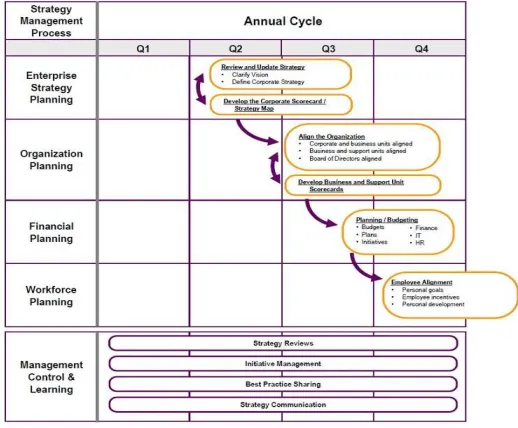
[image:16.612.91.528.232.316.2]The Annual Planning Process consists historically out of two parts, strategic planning and profit planning. In the last few years there was need for an extra intermediary step in order to connect the long term strategy better to the short term operations, this is the roadmapping process. This can simply be stated as linking the strategy better to tactics. The strategy describes why and what long term issues, while the tactics describe short term which, when, where, how and who issues. The roadmapping comes in because the strategic issues are too unclear about the specific short term issues that need to be executed at plant or at operational function level. It is a bridging step in order to decrease the gap between the strategic plan and profit plan. A simplified version of the current Annual Planning Process is shown in figure 9: High Level Annual Planning Process.
Figure 9: High Level Annual Planning Process.
The first step in the annual planning process is creating the strategic plan in the Strategic Planning Process. This plan is constructed by the Leadership Team (LT) and starts with the strategic plan of last year.
The Roadmapping Process has the goal to select a portfolio for the upcoming year that is aligned with the strategic plan. This intermediate step between the strategic plan and the profit plan is there to make a rational selection in order to link the daily operations with the overall long term strategy.
The Profit Planning Process identifies and quantifies resources and actions required to achieve goals and strategies detailed in the Strategic Plan.
1.2 Preliminary Research
It can be concluded that a gap lies at the middle of the APP process, this is the Roadmapping process (the process of linking the SP to the PP). Here, only R&D together with a few other disciplines deploy the process. The process is meant for bridging the step between the strategic plan and the profit plan, and should be executed at more departments or disciplines than R&D such as marketing, sales, HR and finance. It is clear that the RM process is known, but solely seen as owned by R&D. This is also concluded when looking at question three of the last section.
According to a large-scale research of Neilson et al. (2008) about strategy execution, companies go straight to organizational restructuring instead of looking at the core causes of the problem, and then in the long term fail at executing strategy. It is important that the core problems are solved first by building the fundamental information flows and clarifying decision rights (See figure 11: What matters most to strategy execution).
Calendar year 2008
Strategic Planning 2008-2013
Roadmapping 2008-2011
Profit Planning 2009
Then, motivators and structure become more obvious: “A brilliant strategy, blockbuster product, or breakthrough technology can put you on the competitive map, but only solid execution can keep you there.” (Neilson et al., 2008). Therefore, the core problems that lie on the base of the problem are designing information flows and
[image:17.612.79.312.145.238.2]clarifying decision rights.
Figure 11: What matters most to strategy execution (Neilson et al., 2008).
1.2.1
Focusing on the Problem
After the pre-research, further development of a research area and focus of the research question is necessary. When thinking about the reasons behind a problem, there can be many things that lie on the base of the problem. If one thinks about the observation that there is room for improvement, does it mean there is an opportunity or a problem? Is there proof to support this? Is it a perception, goal or reality problem? The subsequent part gives a lay out and conclusion en-route to the research approach. This part focuses on the problem so it can be fed into the research approach and gives the base for the theoretical research.
Analyzing the problem according to Kramer (1978), there is a practical problem when: 1) there is a problem holder 2) there is a tension between the current situation and the whished situation where the problem holder is in 3) the situation creates discomfort and 4) the problem holder tries to transform the situation with directed effort in order to take away the discomfort. Therefore, a practical problem is dependant on a problem holder and his
environment and thus is not objective. Problems are not autonomous, they are made in a framework inside the thoughts that the problem holder handles (Kramer, 1978 p. 39). Linking the above statement to the preliminary research, the problem holder is the person that is responsible for the process, the Marketing Manager.
The processes of image formation with problem holders are information processing. The question is how an individual composes an image of its reality and which factors influence this so that a problem arises. According to Anderson (1975) there are two steps in image formation. Primary and secondary perception. The primary perception is formed by the secondary perception which are physiological processes, and are compared with what’s already in the memory. The discrepancy between the two then creates a problem. Another way of image formation is the interpretation and appreciation of the semantic image that is sent by the (what Neisser, 1976 calls) schemata; what is already in the memory. Through the perceptual cycle there is an image of what is to be expected. Therefore, there is a barrier for things that are not expected and thus are rejected by the mind. This is the expectation pattern, and this has an influence on the creation of problems with the problem holder. To solve the problem it is important to know which factors influence this perceptual cycle. The three factors are the “Weltanschauung”, knowledge of literature and the goal of which the image is formed.
Through the comparison and appreciation of the goal, perception or reality a discomfort can emerge within the problem holder. The emergence of a problem is thus dependent on the properties of the problem holder and his or her environment. Three ideal types of problems can therefore be recognized. A reality-, goal- or perception problem. According to Kramer, a problem situation has a problem holder, a problem solver and an environment. These are analytical entities that are dependant on the situation and can be assigned to single or multiple entities (system boundaries) (Kramer, 1978).
1.3
Research Approach
In this paragraph the approach to the research is presented. The research is a practice-focused one. The goal is a contribution to an intervention to change an existing situation in practice. It is about solving a handling problem. The company expects concrete and directly applicable advises as a result of the research. When looking at the practice focused research intervention cycle, there can be five kinds of phases identified. Problem analysis, Diagnosis, Design, Intervention and Evaluation. When choosing e.g. phase three, one must be sure that phase one and two are thoroughly clear and that they provide a solid base for the research that is to be executed.
The different actors that are involved in the process are all managers of people (MOP’s) throughout the organisation. Managers at divisional level are responsible for making a strategic plan (strategy), managers at more operational levels are responsible for the profit plan (tactical). Therefore, the stakes are different considering the levels in the organisation. Of course an alignment of the strategy throughout the organisation must be goal, but with the different levels and disciplines a solid coupling is key.
The person that has primary responsibility for facilitating the process is the marketing manager. He is the main facilitator of the process and on the other hand also responsible for the deliverance of business intelligence. Therefore, his involvement is twofold in that sense. Together with the LT, he makes sure that the Strategic Plan is finished, and simultaneously other people of the marketing department are making sure that business intelligence is delivered.
When the goal is design-oriented research, one cannot skip the problem analytical and diagnostic phase. First must be clear what the problem is, why this is a problem and who’s problem it is. Therefore, when looking at the assignment, focus is on problem analysis and diagnosis. The problem must be analysed, and subsequently the aim is to gain insights in backgrounds, causes and contingencies of the problem at hand that is handled in the previous paragraph. The choice then is for a “gap analysis” type of research in combination with a problem analytical research. In this type of research, it is the goal to identify a gap between what is described in theory and what actually happens in practice. This comprises gaps in problem analytical elements as well as in diagnostic elements. When the gaps are identified, a gap-analysis is performed to compare the gaps with “best practices”. This is a much more focused manner to make a comparison between companies.
1.3.1
Research Objective
To provide the management with recommendations about the improvement of the strategy execution process, BY
1.3.2
Problem Statement
"What recommendations are to be provided to the management in order to improve the process of strategy execution in the Annual Planning Process in light of theory and industry benchmarks?"
Definitions
• Recommendations:
Opinion or advice as a result from research about what could be done about a situation or problem at the company.
• Strategy Execution:
The process that ensures the high-level strategy with long-term vision created by high-level managers is put into practice at an organisation. This is also referred as putting strategy into practice. Strategy execution deals with the managerial exercise of supervising the ongoing pursuit of strategy.
• Annual Planning Process:
The APP refers to the process as depicted in Figure 9: High Level Annual Planning Process. This is the Strategic planning process, the Roadmapping process and the Profit planning process in a sequential order.
• Theory:
Theory is a testable model of the manner of interaction of a set of natural phenomena, capable of predicting future occurrences or observations of the same kind and capable of being tested through experiment or otherwise verified through empirical observation.
• Benchmarks:
Reference framework for measuring the quality of certain performance. Performance of other companies in the same sector is used as reference to judge e.g. the quality of business administration. It is executed by leaders of industry. Companies displaying operational excellence are perceived as leading.
1.3.3
Research Questions
1. What is the gap between the current strategy execution process and theory?
a. What are the theoretical implications for executing strategy? b. How does the process of strategy execution currently look like? c. What is the gap to focus on in the benchmark companies?
2. How do the strategy execution processes look at benchmark companies focusing on the gap?
a. How do the strategy execution processes look at the benchmark companies? b. What are the implications for the Annual Planning Process?
3. What are the recommendations for improvement of the strategy execution process?
a. What does theory indicate to repair the gap?
1.3.4
Research Model
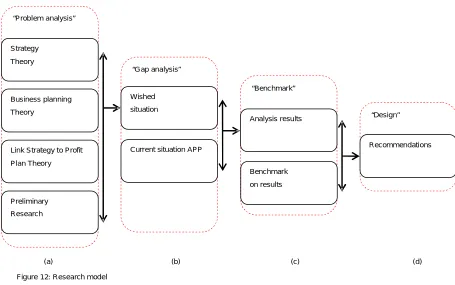
[image:21.612.77.532.181.466.2]Nature of research is a problem-analytical and diagnostic research. The problem analytical part researches the possible influences of critical factors on the subject. Because there is a causality between critical factors on the subject there is a conceptual model from where there is looked at theory. The diagnostic research is to be given direction by the researchers by means of choices between possible explanations of the problem. The gap analysis is in place to find the discrepancy between the current and desired situation.
Figure 12: Research model “Problem analysis”
“Gap analysis”
“Design” “Benchmark”
Strategy Theory
Business planning Theory
Link Strategy to Profit Plan Theory
Preliminary Research
Wished situation
Current situation APP
Benchmark on results Analysis results
Recommendations
(b) (c) (d)
1.3.5
Research Strategy
Until now, this chapter was about creating the conceptual research design. This means the development of a clear reachable and steering question and the construction of a research model, the what of the research. Now the focus is on what we must do in order to answer the questions. Thus, thinking about how the research is to be executed. The object under study is a process. Therefore, the sources of information can be persons in that process, media supporting the process, current execution of the process in real life, documents about or from the process, and literature concerning (strategic) planning.
First source of information is the information gathered from persons. People can give a real big diversity of information and they can do this quick and focused. People can be a data source when talking about themselves and about others and they can be a knowledge source when being considered an expert in some fields. A disadvantage of persons as source is that in some areas the threshold is high when talking about difficult personal or political issues.
Then, documents are used in order to get information about, mainly, the current execution and current design of the process. Concerning the APP, documents have a large degree of confidentiality because this is the core of the strategy that the organisation has in order to gain competitive advantage. Finding the right documents require a high level of creativity and social skills in order to get the most information. Advantages are that documents are fairly easy to gather and they require low cost for obtaining them. In addition, documents are relatively unexposed to strategic behaviour of respondents. Disadvantage is that documents can contain too much information and thus are not examinable anymore. Then, purposive samples have to be made.
Chapter 2:
Theoretical framework
As defined by (Johnson, Scholes, & Wittington, 2007), “Strategy is the direction and scope of an organisation over the long term, which achieves advantage in a changing environment through its configuration of resources and
competences with the aim of fulfilling stakeholder expectations”. To summarize some main characteristics of strategic decisions: Strategic decisions are likely to be complex in nature. This is especially the case in companies with a wide geographical scope. Strategic decisions have to be made in situations when there is a high uncertainty about the future. They also affect operational decisions, a choice to sell a new product in a new country leads to new operational activities. The link between strategy and operations is important for two reasons. First, the operations must be in line with the strategy. Second, at operational level the real strategic advantage must be achieved. Strategic decisions are also demanding an integrated approach. Managers have to go cross-functional and cross operational to agree on the items discussed. Last, Strategic decisions mostly involve change in organisations. This is always difficult considering the culture and heritage that are embedded in an
organisation.
When talking about the different levels of strategy, three levels can be distinguished: Corporate level strategy, this is concerned with the overall purpose of the organisation and how value will be added to the different parts. Business (or SBU) level, this is about how to compete in a particular market. The company can be perceived as a SBU because the products they are delivering are mostly aimed at home countries and to a limited amount to markets in and around them. The third level of strategy is the operational level strategy. This concerns how a component of an organisation delivers products or resources to the strategic business unit. It is very important that the different levels of strategy are aligned with each other.
2.1 Strategic Management
Strategy has to be managed. Strategic management is more than just strategic decision making. Moreover, it differs a lot from the day-to-day operational management. The scope of strategic management is concerned with complexity of non-routine situations organisational wide. This is a major challenge for managers who are mostly involved in operational activities. Strategic management has three elements put forward by Johnson et al. (2006): Understanding the 1) strategic position, 2) strategic choices and 3) turning strategy into action. This research focuses on the last point.
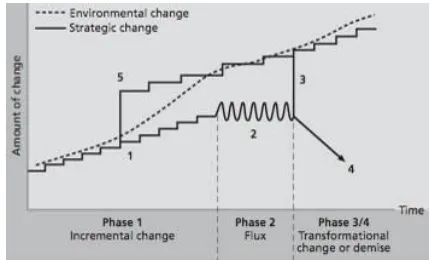
[image:23.612.286.502.532.662.2]Historical studies of the change of the pattern of strategy development and change in organisations have shown that typically organisations go through long periods of relative continuity and thus not changing the strategy or at most changing the strategy incrementally. This can go on for a while, but this tends to create strategic drift. This is where strategies fail to address the strategic position and see the performance deteriorating (see figure 13: Strategic fit).
2.2 Turning Strategy into Action
The CMM is trying to assure that the process of linking strategy to daily operations is clear, but as perceived in the preliminary research this is not completely the case. This paragraph discusses the strategy literature in order to find a common ground for the clarification of the problem. This literature is looking at how strategy is executed.
2.2.1
Strategy Execution
Research within more than fifty countries, in more than thousand organisations concerning more than 125,000 useable respondents (where 25% are executive functions) indicates: “Enterprises fail at strategy execution because they go straight to structural reorganisation and neglect the most powerful drivers of effectiveness, that
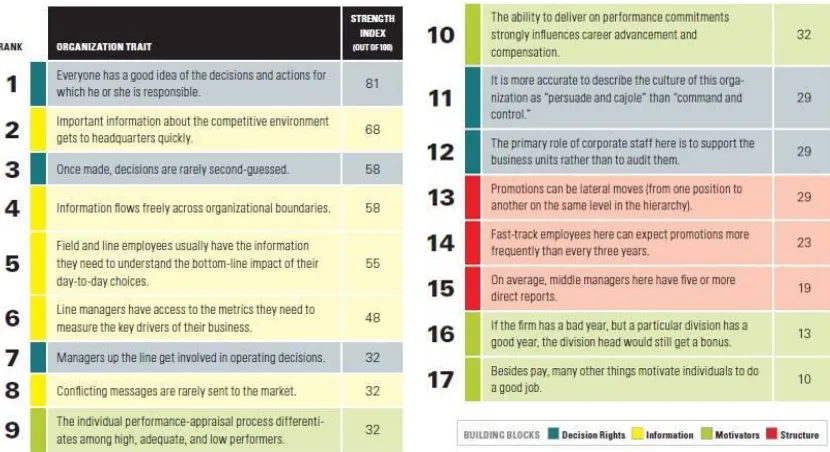
is, decision rights and information flow”(Neilson et al., 2008). If a company has a new strategy because of e.g. a new technology, only a solid strategy execution (process) can keep the company in a solid position, meaning the strategy leads the way to the best possible alignment with the environments of the organisation. However, the majority of the 125,000 respondents admit they are not good at it. What matters the most to strategy execution according to Neilson et al. (2008) is making sure that information flows are routed correctly across organisational boundaries and that the decision rights are clarified correctly. Subordinate to that is the correct alignment of motivators and making changes to structure. If the first two are right, the latter two often become obvious. Neilson et al. bring a list of seventeen fundamental traits forward for organisational effectiveness in executing strategy that are drawn from 26,000 people in 31 countries of companies successful in implementing strategy. These traits are ranked in order of importance based on a strength index, and clear is the first half (1-8) is only in the field of effective information flows and clarifying decision rights. Only three of the seventeen at the lower ends in the list are in the category structure. Thus, the items that are useful for the research at the company that connect the problem to theory are the four building blocks and thus all the seventeen traits. These are displayed in figure 14:
[image:24.612.98.513.443.669.2]Seventeen Fundamental Traits for Effective Strategy Implementation (Neilson et al., 2008).
2.2.2
Wicked Problems.
Though the problem of putting strategy into practice is not a “wicked problem”, there are some elements that can be recognised, and thus some solutions for managing a wicked problem can be used in assessing the problem. One speaks about a “wicked” problem when there are five criteria recognised in the problem. These criteria originally stem from the ten properties of wicked problems described by Webber and Rittel, see figure 15: Ten properties of wicked problems (Webber & Rittel, 1973).
Figure 15: Ten properties of wicked problems (Webber & Rittel, 1973)
Wicked problems are perceived to stem from the beginning of the industrial age. The first criterion is that the problem involves many stakeholders with different values and priorities. In this case the many stakeholders can be recognised as the many disciplines that all have various priorities and maybe different values. Priorities differ very much for example between sales and operations. Values are not likely to differ much because of the strict focus on global ethics. The first criterion is therefore affirmed. The second criterion is that the problems roots are complex and tangled
Managing the wickedness of strategy is virtually impossible. However, the less wicked, the easier it is to cope with them. The first item to manage wicked problems is to involve stakeholders, to document opinions and to
communicate. Companies can manage wicked problems not by being more systematic but by using social planning processes with the aim of creating a shared understanding and foster joint commitment. As Camillus (2008) states it: “All planning processes are, at their core, vehicles for communication with employees at all levels and between business units” and “At Meryll Linch the corporate planners three most important rules are communicate, communicate and communicate”.
The second manner to manage wicked problems is to define the corporate identity. Mission statements are the foundations of strategies and therefore a companies identity. The third way to manage wickedness is to focus on action. It is better to start right away than to get too much involved in the science of muddling through. Smart companies therefore need to encourage a level of risk taking and learn from their mistakes. Fourth thing to do when managing a wicked problem is to adapt a “feed-forward” orientation. Feedback systems are a powerful tool for learning when a strategy is already sound, but when talking about complete new ones it is not enough. Scenario planning is one of them. It can make people think of situation that are not probable but can open up minds. To conclude the wicked problems part, I would like to end with a quote that is quite applicable to the problem: “The easy problems have been solved, designing systems is difficult because there is no consensus on what the problems are, let alone how to solve them” (Camillus, 2008).
2.2.3
Strategy Execution with the BSC
[image:26.612.94.353.491.705.2]In a business consulting article, Norton (2007), indicates six best practices that will enhance strategy execution (see figure 16: Six best practices for strategy execution). Here, it is claimed that high performers have more formal processes for clear articulation of strategy and measures, they manage a limited number of key strategic issues, they regularly report on and manage strategy, they communicate about the strategy, they align business and support units to strategy and they link strategic initiatives to the budget. This all should be an integrative process which can be cascaded down into the organisation with the use of the Balanced Score Card (Norton, 2007).
2.2.4
Strategy-as-Practice
A rather new field of study is Strategy-As-Practice (SAP). This field of research has taken on the task of looking at the “how” of strategy rather than looking at the “what” with the goal to balance the two because the “what” is already well researched. It is the question of how managers actually weave the pattern of strategy and how the strategy is created and realized from the point of view of social sciences.
[image:27.612.93.440.375.540.2]Valmra et al. (2006) point out seven functions of strategy as practice that categorize the typical generic activities within the strategy process. The first is the “what” in strategy and the last is the “how” strategy is implemented. The first activity is the base of the process. This is the process of making sense of the organisation and its environment. Upon this activity itself there can be no action derived, but it builds the base and direction of the subsequent activities. Subsequent are the activities of creating new ideas and activities and creating a formal strategy. As a kind of intermediate step between the what and how there is the communicating a coherent strategic direction step. This is also recognised as a very important step by various other authors. A fifth generic action is to create a coherent understanding about implementation. This of course builds on the subsequent step but still there are more means to do it and it is important to get the action executed. All the former must lead to the sixth generic action to be undertaken, that is the manner of how strategic decisions are made at all levels of management. Decisions are made at all levels and thus at all points in time where people are involved in strategy making. This means that the strategy implementation is dependant on decisions made, and thus at all levels at all times. The seventh and last category is the process of control. It is important to keep track of results to make adjustments to strategy, a feedback loop.
Table 3: The relation of the seven generic activities to other classifications (Valmra, Metsla, Rannus, & Rillo, 2006).
Furthermore, they compare their seven generic activities with other strategy making classifications from (Hart, 1992), (Gioia & Chittipeddi, 1991) and (Jarzabkowski, 2005) see table 3: The relation of the seven generic activities to other classifications. (Valmra et al., 2006)
2.2.5
Strategy-to-Performance Gap
[image:28.612.96.445.148.356.2]
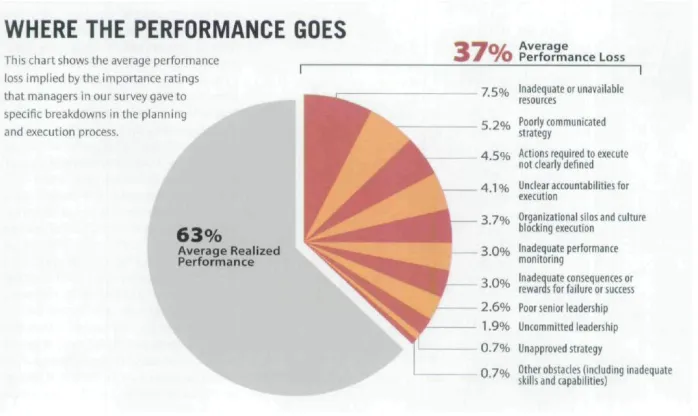
projections, value is lost in the translation of plans, performance bottlenecks are rarely visible to senior management and the strategy-to-performance gap fosters a culture of under performance. It is stated that companies typically realize only about 60 per cent of their strategies’ potential value because of defects and breakdowns of planning and execution (see figure 17: Where the performance goes).
Figure 17: Where the perform ance goes (Mankins and Steele, 2005)
2.2.6
Aligning Organisational Factors with Strategy
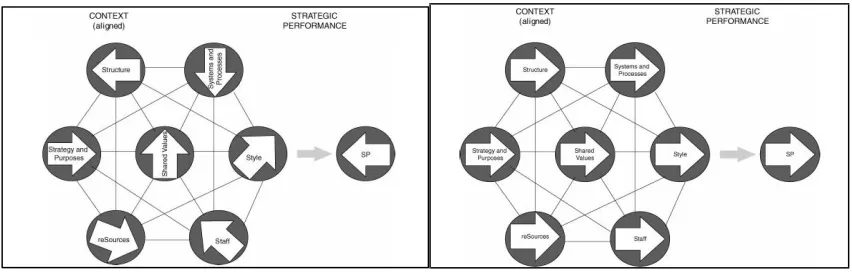
As stated by Higgins (2005) successful executives spend a great deal of their time on executing their strategy. They realize strategy execution is just as important, if not more important, as strategy formulation. Much of successful strategy execution revolves around aligning (see figure 18: 8S alignment) key organisational factors with strategy, especially in these times of faster changes in the environment. Higgins stated: “At a minimum, executives must align the following cross functional organizational factors; structure, systems and processes,
leadership style, staff, resources, and shared values with each new strategy that arises in order for strategy to
succeed. […] All of these factors have been integrated in a practical model for successfully executing strategy that
[image:29.612.93.519.297.433.2]I call the Eight “S”s of Strategy Execution.” (Higgins, 2005). On a cross-functional basis, virtually everything an organization does is covered within the 8S. During the execution stage, the model serves as a roadmap for implementation. In addition, if you want to uncover what the cause for the failure of strategy execution might be, this model usually points to the reason. The underlying principle of the 8S model is that different strategies require different kinds of structures, systems, style, staffing, resources, and shared values to make them work. If there is not an excellent match among these factors, performance suffers (Higgins, 2005).
2.2.7
Strategic Planning Audit
The change in the strategic planning process over time due to the continuously changing environment leads to the question of effectiveness of the process. Before the eighties, the scope was narrow, the number of issues was low, the number of participants was low and the planning formality was high. During, and a bit after the eighties, this was the opposite situation. Therefore, for assessing if the strategic planning process is affective, Piëst (1993) developed a planning audit and put forward some factors that are important for the change of the situation. The questions in the planning audit are:
First, one should ask if the strategic planning process is integrated in the decision making process. When yes, it is effective. Decision-making is the heart of planning.
Second, one should ask what the function is of planning. Is it anticipatory of coordinating? Here the danger exists that different decision makers will be led toward making a series of unrelated choices.
Third question is to explore what the organizational consequences are of planning. If the consequences are slight, one can see that strategy rarely effects the organization and thus the execution of strategy is low.
Fourth question is how quick issues on the planning agenda changes. One should be engaged in formal procedures but not too much because flexibility is also needed.
Last question is how many issues are on the planning agenda. This should not be the case in order to keep from fragmentation and maintain focus and agreement. In order to change a planning process one can keep three factors in mind for successful execution. Changing a planning process is a time consuming and difficult task, even when all noses are set in the same way. This is because past experience is hardly relevant for the new situation and it is uncertain how changes must be implemented. The first factor is to let the planners take the initiative, but let the managers take the decisions at the content side. Secondly, it is important to have support of top
2.2.8
Combining strategy execution
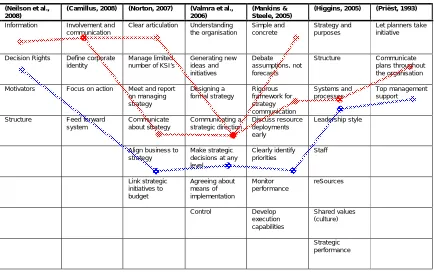
[image:31.612.89.523.175.447.2]Combining the articles elaborated above, table 4 displays that it is clear the common base for solid execution of strategy in first place are effective information flows (top red line) and clarifying decision rights (bottom blue line). Therefore, these concepts form the basis of this research and are further investigated in the subsequent part. The article of Neilson et al. (2008) is taken as a starting point.
Table 4: Connection of Strategy as Practice literature with focus on Information Flow and Clarifying Decision Rights.
Focusing on the concepts of effective information flows and clarifying decision rights, the next paragraphs explain more focused literature that is in track with the two concepts. It must be noted that the term Strategic Decision Making is not exactly the goal, it has a double meaning in this research. This term is used for decisions that influence content of strategy and not the process side of strategy, but when looking further, there is always the goal of putting strategy into action and then it is applicable. Therefore, the terms decision making and strategic decision-making are partly related. Organisational information flow is the other term from Neilson et al. This is related to communication. Therefore these related terms are both incorporated.
(Neilson et al., 2008)
(Camillus, 2008) (Norton, 2007) (Valmra et al., 2006)
(Mankins & Steele, 2005)
(Higgins, 2005) (Priëst, 1993)
Information Involvement and communication
Clear articulation Understanding the organisation
Simple and concrete
Strategy and purposes
Let planners take initiative
Decision Rights Define corporate identity
Manage limited number of KSI’s
Generating new ideas and initiatives Debate assumptions, not forecasts
Structure Communicate plans throughout the organisation Motivators Focus on action Meet and report
on managing strategy Designing a formal strategy Rigorous framework for strategy communication Systems and processes Top management support
Structure Feed forward system Communicate about strategy Communicating a strategic direction Discuss resource deployments early Leadership style
Align business to
strategy
Make strategic decisions at any level Clearly identify priorities Staff Link strategic initiatives to budget Agreeing about means of implementation Monitor performance reSources
Control Develop
2.3 Effective Information Flows
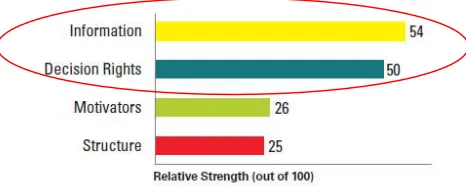
According to Neilson et al. (2008) the most important fundamental building block for successful strategy execution is designing effective information flows. It has a relative strength of 54 out of 100 in the research (See figure 19: Relative strength (out of 100)). Organizational communication can be defined as: “The process by which information is exchanged and understood by two or more
people, usually with the intent to motivate or influence behaviour.”
(Daft, 2007) or “Communication is the process to impart information from a sender to a receiver with the use of a medium” (Wikipedia, 2008b). Thus, communication literature can be researched in order to explain and analyse the “effective information flows” principle. This of course in the context of strategy execution.
2.3.1
Information Flow Through Communication
Organisational communication is a main aspect influencing the quality of the collaboration and cooperation within organisations (Hoegl & Proserpio, 2004) (Biele, Rieskamp, & Czienskowski, 2008) and therefore communication is becoming increasingly important to any organisation. Berry (2006) and O’Kane and Hargie (2007) also indicate communication is critical to organisational success. It also indicates that it can serve functions as improving the organisational climate and increasing cooperation between employees. Communication is generally recognized as a central task of management for organisational development and can influence motivation and commitment (Rowley, 1999). Communication is becoming more and more strategic and should be a part of the strategy of all organisations (Goodman, 2001) (Hargie, Tourish, & Wilson, 2002). Organisations are therefore challenged to search for processes that enable effective communication (Berry, 2006). This is in line with the initial problem statement of this thesis. Furthermore, Kelly (2000) defines personal and organisational barriers that hinder effective communication. Of course, there are also the different styles of communication. Verbal and non-verbal (Harris, Harris, & Nelson, 2007). In addition, different communication channels define whether the information flows horizontal (up- or downward) or vertical. It is stated that external communications about the companies direction are important for customers and stakeholders.
2.3.2
Leadership and Communication
Internal and external communication of strategy is a central role of any CEO. The significance of communication within leadership is put forward by Hax & Majluf (1991): “… the central role of the CEO is generating and communicating the basic goals of the organisation. Also outside publicly owned companies need to inform
external stakeholders of the direction that the company is following. Internal communication is full of strategic
content and is essential to mobilize all the individuals working in the firm in the same desired direction.” The importance of communication is also stressed by Thompson (1997). It is put that understanding and acceptance of the leadership’s strategic vision needs to be ensured: “Effective communication systems, both formal and informal, are required to share the strategic vision and inform people of priorities and strategies and to ensure
strategies and tasks are carried out expeditiously.”
Also important, especially for the CMM, is that Hill and Jones (1995) emphasize the role of communication in facilitating, understanding and coordination between the separate functional hierarchies within organizations. In line with that, Hax & Majluf (1991) state: “Managing the interface of a variety of independent businesses, functions, and geographical areas, including possibly, a wide number of countries with completely different
cultural backgrounds, requires enormous communication and informational skills, and extraordinary wisdom to
reconcile legitimately different points of view.”
Moss and Warnaby (1998) state that: “… the importance of communications to the strategy-making process clearly emphasize the internal role of communications in facilitating the implementation and control of strategy
making within organizations. … More significantly, there is rarely any discussion of who within the organization
should be responsible for managing the communication process or where the communication function may fit into
the overall strategic management process. The absence of any explicit reference to a distinct role for either
corporate or marketing communications functions can be seen to reflect an essentially tactical orientation in
thinking about the role of these communication functions throughout the strategy literature. In this sense,
communications has been treated primarily as an ‘enabling’ function, facilitating the successful implementation of
strategic decisions, but it is not in itself seen as a key element in the strategic decision-making process.”
2.4 Clarifying Decision Rights
The concepts that are needed in order to analyse the “Clarifying Decision Rights” section of Neilson et al. (2008) (Figure 20: Relative strength (out of 100)) are items from the strategic decision making process (SDMP) literature. As stated earlier, it must be noted that the strategic element in SDMP must not be overstated. In strategy execution the focus is on making sure the intended strategy is
realised through a process of cascading. Strategy execution is perceived as steering the emergent strategy towards the deliberate strategy (Johnson et al., 2007 p.564). Throughout this process, many decisions must be made. In this paragraph, the elements of decision making in the literature are set out to indicate what elements are important in order to analyze the situation of the company and the benchmark companies. Based on this chapter a questionnaire is created for empirical research. The questionnaire of Neilson et al. (2008) is integrated for the internal perception towards strategy execution. Specific elements of decision-making are further used for in-dept analysis.
2.4.1
Different Decision Making Processes
A decision making process in the most simple form is a rational process that is a step by step one (See figure 21:
[image:33.612.103.521.648.686.2]Classic Decision Making process(Nickols, 2005)). This process is seen in many places with minor variances. The process is easily understood, appears to be rational, is widely known and most managers are comfortable with it. The process originates from a problem solution process. However, is does not reflect the reality of strategic or complex decisions and does not take political and other aspects in account.
Figure 21: Dewey’s Classical Decision Making process (Nickols, 2005).
A more iterative model that incorporates goals and objectives also stresses the need for implementation of the decision is the military model (See figure 22: Military Decision Making Model).
This is basically the classical model with feedback loops and focuses in the last two steps on implementation of the decision with a subsequent step that is command lead and manage. A feedback loop runs from the latter to implement decision to check and correct.
[image:34.612.292.464.70.237.2]Mintzberg et al. (1976) studied 25 strategic decisions and the process they were in. From their conclusions, they build a model that is widely known in decision-making literature (See figure 23: Mintzberg’s general model of the strategic decision process). The model draws attention to many key aspects of (strategic) decision making with three phases and seven routines. It also describes the dynamical nature of the process by means of many feedback loops and interrupts can occur when in the process. In addition, the article describes patterns of different strategic decisions as exhibits. Downside of the model is that it is not understandable and it has limited practical guidance.
[image:34.612.92.512.392.649.2]Figure 23: Mintzberg’s general model of the strategic decision process.
[image:35.612.93.224.164.291.2]
A more complex decision making process is the Cynefin model (See figure 24: Cynefin Framework), developed by Snowden et al. (2007). The framework draws on research into complex adaptive systems theory, cognitive science, anthropology, narrative patterns and evolutionary psychology. It proposes promising new approaches to communication, decision-making, policy-making and knowledge management in complex social environments. Some of the characteristics can be used in order to clarify the decision process in the light of sense making in decision processes.
Figure 24: Cynefin Framework
Extracting the most important characteristics of decision processes, it can be concluded that if there is a strategic decision made, there have to come many more decisions to execute what is decided in the strategic decision. A strategic decision is a commitment to a course of action. The process of decision-making has to accommodate the generating of possible courses of action, whether one or many, whether custom, ready-made or adaptive. Evaluation in order to judge what the course of action will be is absolutely necessary. Without commitment the decision is fatally flawed (Nickols, 2005). The proposed model of Nickols (2005) (See figure 25: Strategic Decision Making Process) also provides elements of decision making that are useful for the research of the concept of Neilson et al. (2008), clarify decision making. Note that the outcome is communication! This is the most important element indicated by Neilson et al. (2005) and indicates once again that the elements are related in an important way.
Figure 25: Strategic Decision Making Process
2.4.2
Decision Making in the DNA Profiler
[image:35.612.95.312.484.620.2]
organisation (See figure 26: Four Building Blocks of Organisational DNA). The different combinations of results subsequently indicate what type of organisation it is. It can be Passive-Aggressive: “Everyone agrees, but nothing changes.” Fits-and-Starts: “Let 1,000 flowers bloom.” Outgrown: “The good old days meet a brave new world.”
Over managed: “We’re from Corporate, and we’re here to help.” Just-in-Time: “Succeeding by the skin of our teeth...” Military Precision: “Flying in formation...” and Resilient: “As good as it gets...”. The four building blocks are inextricably related but the focus is on decision rights and information flow. It is stated that is these two are improved, the other two will follow almost automatically (Neilson et al., 2008). When looking at decision-making through the framework of Neilson et al., it comprises every decision in the company. Though this may not be the focus of the research in the first instance, putting strategy into practice does apply to most people in an
organisation. In contrast, strategy making is only designated to top management levels. Decision-making process measures of the DNA Profiler are also used to gain a more in-depth insight in the decision processes of
[image:36.612.97.268.252.378.2]benchmark studies.
2.4.3
Strategic Decision Making Process
One concept of the strategic decision making process is presented by Papadakis et al. (1998) in their research on the relation between the decision process characteristics and management and contextual factors (see figure 27:
[image:37.612.97.431.160.376.2]Strategic Decision-Making Processes: The Role of Management and Contextual Factors).
Figure 27: Strategic Decision-Making Processes: The Role of Management and Contextual Factors.
In their framework they use concepts for measurements from (Fredrickson, 1984) for rationality, (P. H. King, 1975), (Marsh, Barwise, Thomas, & Wensley, 1988) and (Stein, 1980) for financial reporting and rule formalisation (Tannenbaum, 1968) and (Grinyer, Al-Bazzaz, & Yasai-Ardekani, 1986) for horizontal decentralisation and lateral communication (Pettigrew, 1973), (Mintzberg et al., 1976) and (Hickson, Wilson, Cray, Mallory, & Butler, 1986) for politicisation and (Butler, Davies, Pike, & Sharp, 1991) and (Eisenhardt & Bourgeois, 1988) for problem solving dissention. Some of the seven measures of decision process characteristics can be used in order to research the conclusion in track of Neilson et al. (2008). Clarifying decision rights can be seen as the same as any decision process in a strategic context, therefore the link is made. The concept of the decision process as described by Papadakis et al. (1998) is explained below. This is the base of the concept of clarifying decision rights as described by Neilson et al. (2008). When the process of decision-making is clear, the clarification of decision rights should be a logical next step in the organisation. Below the decision process characteristics:
Financial reporting. On the basis of (P. F. King, 1975) (Marsh et al., 1988) and (Stein, 1980), Papadakis (1998) extracted financial measures that are in the core of the strategic decision process. This is a supporting measure that reports the degree of reporting activities in support of the SD. This variable measures the degree of financial reporting activities and consists out of six items: use of NPV-IRR methods, inclusion of pro forma financial statements, detailed cost studies and incorporation of the SD into companywide financial plans.
Rule Formalization. This specific factor variable incorporates seven items and measures the degree of rule formalization during the making of the SD (P. F. King, 1975; Stein, 1980). Items are the degree to which there exists a written procedure guiding the process, existence of a formal procedure to identify alternative ways of action, formal screening procedures, formal documents guiding the final decision, predetermined criteria for SD evaluation.
Hierarchical Decentralisation.This measure concerns the level of management participation at all five of the before mentioned stages. The hierarchical levels are owner, CEO, first level manager, middle management and lower management (Grinyer et al., 1986; Tannenbaum, 1968).
Lateral Communication. This is measured in the same way as the Hierarchical Decentralisation. At every of the five stages the participation of all major departments is measured. The departments are sales, marketing, finance, production, HR and SCM (Tannenbaum, 1968).
Politicisation. This variable is measured by coalition formation, degree of negotiating among participants, the degree of external resistance encountered and the degree of process interruptions (Hickson et al., 1986; Mintzberg et al., 1976; Pettigrew, 1973).
The research model, which is given below (See figure 28: Research Model), depicts the two prerequisites for strategy execution effectiveness that are expected to influence the eight concepts. The two main overarching factors are based on Neilson et al. (2008), and the concepts are based on deeper literature research as above in the chapter 2.
The first prerequisite for effective strategy execution is the presence of a communication- or information sharing protocol. This assumption is based on theory discussed in chapter 2.3. If there is a communication- or information sharing protocol present, it must have a positive effect on the execution of the strategic plans. Therefore, it is stated that the prerequisite communication- and information sharing protocol leads to better overall strategy execution capabilities.
The second prerequisite for effective strategy execution is the presence of a decision making protocol. This assumption is based on the theory in chapter 2.4. If there is a decision making protocol present, it must have a positive effect on strategy execution.
The research model stated in words:
Are the prerequisites “presence of communication- and information sharing protocol” and “presence of a decision
making protocol” leading to a significant difference in perceived attitudes towards the eight concepts of effective
information flows and clarified decision making?
Presence of decision
making protocol
Communication
Information Flow
Decision Making rationality
Decision making process
Financial Support
Procedural Rationality
Politicisation
Problem Solving Dissention
Presence of
Communication- and
information sharing
protocol
Independent variables Dependent Variables
[image:39.612.92.405.305.528.2](prerequisites) (attitudes)
Chapter 3:
Research Methodology
After a description of the company and the preliminary research in chapter one, and the creation of a theoretical framework in chapter two, the current chapter describes the way the research is executed. The model for strategy execution from chapter two, is to be tested empirically. What information is needed to answer the research question 1b: How does the current process of strategy execution look like when viewed through the research model? In this chapter, the research methodology is explained. First the method of research is explained which describes the way data is gathered. Secondly, the population of research is described. Closing the chapter, the operationalisation describes the manner of variable construction.
3.1 Research Method
The preliminary research focused on the confirmation of the indications that the assignment provider had. Therefore, a semi structured interview was held among ten members of the top management team in different disciplines which was aimed at mirroring the ideas of the assignment provider and looking for similar ideas and opinions of the interviewees. The conclusions of that research can be found in chapter 1.3. Furthermore, also for the rest of the research, document research is executed and a meeting with R&D is attended.
For the testing of the research model, a survey was constructed for data gathering. This is because of the large group of people involved in the process strategy creation and especially strategy execution. In addition, the geographical spread of those persons involved also was a barrier for interviews. Thus, the large number of people together with the geographical spread of those people made that a quantitative research approach was chosen as a base for testing the research model and for describing the theoretical model. Furthermore, semi open interviews were held with about ten people, positioned in all disciplines, to get a down to earth practical view on how lower level managers look at the whole process of “strategy execution”. This can be found in chapter 4.1.3. Here it is left open what strategy really is in the framework of this research, and the opinion of the interviewees is left in tact regarding strategy. In this way, it can be observed that e.g. not every person has the same idea about what the strategy really is.
A last method for gathering information for a broader view on executing strategy, a benchmark analysis is performed with three other companies (Yin, 2000). The goal here was to focus on the gaps that where identified and gain information via a semi-structured interview at different companies. The interviews where held with managers at high levels using a semi structured interview.
3.2 Population and Sampling
Therefore, the choice was made to survey the population of managers that are responsible for creation of the strategic plan and the managers that are responsible for understanding, translating, deciding and feeding the more explicit plans down in the organisation. In terms of the strategic framework, these managers are responsible for effective information flows and clarified decision rights
The unit of analysis in this research is the strategy execution process. Based on the theoretical framework, effective information flows and clarified decision rights, this unit is measured. It is not a simple random sample that can be used to generalize for a large population. Survey errors can be as following. Coverage error is minimized through the use of e-mail. Since the message came from the same company e-mail, there are no concerns regarding a spam filter or something like that. A sampling error is also no concern since the population of respondents is selected on the base of their location in the hierarchy. The non-response error is more concerning though.