for Language Processing: Application to
Modeling Context Effects in Ambiguous
Chinese Word Boundary Perception
Kok-Wee Gan+
Hong Kong University of Science Technology
Kim-Teng Lua~
National University of Singapore and
Martha Palmer+
University of Pennsylvania
This paper proposes that the process of language understanding can be modeled as a collective phenomenon that emerges from a myriad of microscopic and diverse activities. The process is analogous to the crystallization process in chemistry. The essential features of this model are: asynchronous parallelism; temperature-controlled randomness; and statistically emergent active symbols. A computer program that tests this model on the task of capturing the effect of context on the perception of ambiguous word boundaries in Chinese sentences is presented. The program adopts a holistic approach in which word identification forms an integral component of sentence analysis. Various types of knowledge, from statistics to linguistics, are seamlessly integrated for the tasks of word boundary disambiguation as well as sentential analysis. Our experimental results showed that the model is able to address the word boundary ambiguity problems effectively.
1. Introduction
This paper suggests that the language understanding process can be effectively mod- eled as the statistical outcome of a large number of independent activities occurring in parallel. There is no global controller deciding which processes to run next. All pro- cessing is done locally by many simple, independent agents that make their decisions stochastically. The system is self-organizing, with coherent behavior being a statisti- cally emergent property of the system as a whole. The model, in a nutshell, simulates language understanding as a crystallization process. This process consists of a series of hierarchical, structure-building activities in which high-level linguistic structures are formed from their constituents and get properly hooked up to each other as the process converges.
The essential features of the model are:
• The process of sentence analysis is a series of computational activities that determine how various constituents in a sentence can be
meaningfully related.
• Department of Computer Science, Hong Kong University of Science and Technology, Clear Water Bay, Kowloon, Hong Kong
t Department of Computer Information Science, University of Pennsylvania, Philadelphia, PA 19104-6389 :~ Department of Information Systems & Computer Science, National University of Singapore, Lower
Computational Linguistics Volume 22, Number 4
• All computational activities are carried out by a large number of procedures known as codelets.
• A linguistic structure is not built by a single codelet. Rather, it is
constructed by a sequence of codelets. The execution of this sequence of codelets is interleaved with other codelets that are responsible for building other structures.
• The order by which structures are built is not explicitly programmed, but is an emergent outcome of chains of codelets working in an asynchronous parallel mode.
• Computational activities are a combination of top-down and bottom-up activities.
• Computational activities are indirectly guided by a semantic network of linguistic concepts, which ensures that these activities do not operate independently of the system's representation of the context of a sentence.
• Decision making is stochastic, with the amount of randomness being controlled by a parameter known as the computational temperature.
We have applied our model to the task of capturing the effect of context on the perception of ambiguous word boundaries in Chinese sentences (Gan 1993). Our ap- - proach differs from existing work on Chinese word segmentation (Liang 1983; Wang, Wang, and Bai 1991; Fan and Tsai 1988; Chang, Chen, and Chen 1991; Chiang et al. 1992; Sproat and Shih 1990; Wu and Su 1993; Lua and Gan 1994; Lai et al. 1992; Sproat et al. 1994; Sproat et al. 1996) primarily in that our system performs sentence inter- pretation, in addition to word boundary identification. Our system figures out where the word boundaries of a sentence are by determining how various constituents in a sentence can be meaningfully related. The relations the system builds represent its interpretation of the sentence. In the initial stage of a run, the system constructs re- lations between characters of a sentence. Through a spreading activation mechanism, the system gradually shifts to the construction of words and of relations between words. Later, the system progresses to identifying and constructing chunks (in other words, phrases), and to establishing connections between chunks. Note that there is no top-level executive that decides the order of these activities. At any given time, the system stochastically selects one action to execute. Therefore, efforts toward building different structures are interleaved, sometimes cooperating and sometimes competing. The system's high-level behavior, therefore, arises from its low-level stochastic actions. We will give a detailed description of this application in this paper. In Section 2, we introduce the problem of ambiguous Chinese word boundary perception, and follow, in Section 3, with a s u m m a r y of the current practices in Chinese word identification. We describe our model in Section 4, showing a sample run of our program in Section 5 to illustrate the behavior of the model. Finally, some discussions of the model are covered in Section 6. In Section 7, we compare our model with others, and explore areas for future research in Section 8.
2. Ambiguous Chinese Word Boundary Perception
characters, such as ~
shu~gu6
'fruit'. It is possible that the component characters of a word are fre@, such as ;~shut
and ~gu6
of the word ;q<~shu~gu6
'fruit', which mean 'water' and 'fruit' respectively. For any two Chinese characters in a sentence, denoted as x and y, ifxy
cannot be combined together to function as a word, a single word boundary exists between these two characters. If x and y can be constituents of the same word, yet at the same time m a y also be free, then word boundary ambiguity exists in these two characters. If there is a unique word boundary before x and after y, we refer to the ambiguity existing inxy
as acombination ambiguity.
On the other hand, if there is a word boundary ambiguity between the charactersxy
and the char- acter that precedes or follows them, say z, and these three characters can be grouped into eitherxy z
orx yz,
then we say that anoverlap ambiguity
exists. A sentence that allows an ambiguous fragment to have multiple word boundaries will end up with more than one interpretation. This type of ambiguity is calledglobal ambiguity
with respect to the sentence. On the other hand, if only one w a y of segmenting the word boundary of an ambiguous fragment is allowed in a sentence, we call this
local
ambiguity
with respect to the sentence. Global ambiguity can only be resolved with discourse knowledge. An example for each category is shown in (1) t o (4). 2 Through- out this paper, we follow the guidelines on Chinese word segmentation adopted in China. 3Overlap, Local Ambiguity
(1)
zh~
w~i
zhiyudn
gOngzu6 de yali hOn dat h i s C L 4 worker work STRUC 5 pressure very great
'This worker faces great pressure in his work.'
The underlined fragment ~ 1 2 ~
yudn gOngzuD
in (1) has overlap, local ambiguity. The middle character IgDng
can combine with the previous character ~yudn
to form the word H Iyudngong
'worker', leaving the third character functioning as a monosyllabic word ~zuD
'do'. The middle character can also combine with the next character to form the word X2~gongzuD
'work', leaving the first character alone. The sentence containing this fragment allows only one w a y of segmenting the word boundary, which is shown in (1). The character ~yudn
combines with the character preceding it, lI~zhi,
to form the bisyllabic word ~zhiyudn
'worker', and the two characters 32gong
and ~zuD
form a word.Overlap, Global Ambiguity
(2)a.
w?Smen y~o
xuesh~ng hu6
d6 y6u yiyi we want student live C S C 6 have meaning'We want our students to have a meaningful life.'
1 A free character is one w h i c h can occur i n d e p e n d e n t l y as a w o r d (Li a n d T h o m p s o n 1981). 2 The characters u n d e r l i n e d in sentences (1) to (4) are the locations of w o r d b o u n d a r y ambiguities w e
w o u l d like to focus on. This convention will be used throughout in this paper.
3 See Contemporary Chinese Language Words Segmentation Standard Used for Information Processing, fifth edition, 1988, published in China.
4 CL s t a n d s for a CLassifier.
5 STRUC stands for the STRUCture w o r d ~ de.
Computational Linguistics Volume 22, Number 4
b.
w{~men y?~o
xuf
sh~nghu6
d6 y6u yiyi we want learn life CSC have meaning 'We want to learn how to lead a meaningful life.'The fragment _~e_~
xud shdng hu6
also has overlap ambiguity, where the middle character can either combine with the first character to form a word, or combine with the last character to form a word. The sentence containing this fragment has two plausible interpretations as shown in (2a) and (2b). Both alternations: ~ ~xudshdng
hu6
'student live' (2a) and -~ ~41.~xu~ sh~nghu6
'learn life' are acceptable.Combination, Local Ambiguity
(3) ~)~ ~ ~ I ] -]-~j~ ~ nr
de
bidoqing shff~n hudj~
you STRUC look very funny 'You look very funny.'In (3), the two characters in the fragment n t ' ~
shif~n
can either function as two au- tonomous words q~shi
'ten' and ~f~n
'mark', or they can combine together to function as a bisyllabic word f f ' ~shif~n
'very'. Given the sentential context of (3), however, only the second alternation is correct.Combination, Global Ambiguity
(4)a. ~ ~ ~l~ ~__ ]~
w6men dou h~n
n~n
gub
we all very hard live 'We all have a hard life.'b.
wfimen dou h~n
ngmgub
we all very sad 'We all feel very sad.'The fragment ]~]~
ngmgub
also has combination ambiguity. It differs from (3) in that the sentence in which it appears has two plausible interpretations. Hence, this fragment can either be segmented as ~l~ndm
'hard' and i~gub
'live' in (4a), or as ~ i ~n~ngub
'sad' in (4b).3. Existing Approaches
Traditionally, word identification has been treated as a preprocessing issue, distinct from sentence analysis. We will therefore only discuss current practices in word iden- tification, leaving sentence analysis aside. Several techniques have been used in word identification, ranging from simple pattern matching, to statistical approaches, to rule- based methods. The most popular pattern-matching method is based on the Maximum Matching heuristics, commonly known as the MM method (Liang 1983; Wang, Wang, and Bai 1991). This method scans a sentence from left to right. In each step, the longest matched substring is selected as a word by dictionary look-up. For example, in sen- tence (5),
(5)
fisu~nj~
de
f~ming
y~y~
zh6ngdacomputer STRUC invention implication profound 'The invention of the computer has profound implications.'
the first three characters are identified as the word ~ t ~ J ~
fisu~nfi'computer'
because it is the longest matched substring found in a word dictionary. With the same reasoning, the words ~ de 'STRUC', ~faming
'invention', ~y~y~
'implication', and ~zhbngd~
'profound' are identified.Statistical techniques include the relaxation approach (Fan and Tsai 1988; Chang, Chen, and Chen 1991; Chiang et al. 1992), the mutual information approach (Sproat and Shih 1990; Wu and Su 1993; Lua and Gan 1994), and the Markov model (Lai et al. 1992). These approaches make use of co-occurrence frequencies of characters in a large corpus of written texts to achieve word segmentation without getting into deep syntactic and semantic analysis. For example, the relaxation approach uses the usage frequencies of words and the adjacency constraints among words to iteratively derive the most plausible assignment of characters into word classes. First, all possi- ble words in a sentence are identified and assigned initial probabilities based on their usage frequency. These probabilities are updated iteratively by employing the consis- tency constraints among neighboring words. Impossible combinations are gradually filtered out, leading to the identification of the most likely combination. The mutual information approach is similar to the relaxation approach in principle. Here, mutual information is used to measure how strongly two characters are associated. The mu- tual information score is derived from the ratio of the co-occurrence frequency of two characters to the frequency of each character. In a sentence, the mutual information score for each pair of adjacent characters is determined. The pair having the highest score is grouped together. The sentence is split into two parts by the two characters just grouped. The same procedure is applied to each part recursively. Eventually, all word boundaries will be identified.
Both the pattern-matching and the statistical approaches are simple and easy to implement. It is well known, however, that they perform poorly when presented with ambiguous fragments that have alternate word boundaries in different sentential con- texts. For instance, the fragment - ~
shif~n,
which is a bisyllabic word in sentence (3a), functions as two separate word, s in sentence (6).(6)
Computational Linguistics Volume 22, Number 4
The MM method will regard this fragment as a bisyllabic word nutj " shff~n 'very' regardless of the sentential context in (3a) and (6), since this word is longer than the lengths of the two monosyllabic words n u shf 'ten' and ~ f~n 'mark'. As a result, this method fails to correctly identify the word boundaries in sentence (6). Within statistical approaches, considering, for example, the mutual information method (Lua and Gan 1994), the same fragment is identified as a bisyllabic word in both sentences (3a) and
(6) 7.
By checking the structural relationships among words in a sentence, rule-based approaches aim to overcome limitations faced by pattern-matching and statistical ap- proaches. However, many of the rules in existing rule-based systems (Huang 1989; Yao, Zheng, and Wu 1990; Yeh and Lee 1991; He, Xu, and Sun 1991; Chen and Liu 1992) are either arbitrary and word-specific, or overly general. For example,
Rule
Given an ambiguous fragment xyz where x, z, xy, and yz are all possible words, if x can be analyzed as a so-called direction word, segment the fragment as x yz, else segment it as xy z (Liang 1990).
This syntactic rule works in sentence (7).
(7) ~ ~ -[ v ~--~
t~ ff~ xi?~ shenzi
he bend d o w n b o d y 'He bends d o w n his body.'
The fragment T : ~ xi?~ shen zi in sentence (7) is ambiguous. As -F xi?~ 'down' is a direction word, the fragment is segmented as -~ ~:j~ xi?l sh@nzi ' d o w n body', which is as desired.
Similarly, this rule will segment the fragment ~]~lJ~ w?li gu6 r~n as ~ [~l),, w?~i gu6rdn 'out citizen', since ~ w?zi 'out' is also a direction word. Therefore, when this fragment appears in sentence (8a),
(8)a. ~ ;~ P~I~J~
ta sh~ w?~igu6r~n
he COPULA foreigner 'He is a foreigner.'
the word boundaries identified will be:
t4 sh~ w?d gu6r~n
he COPULA out citizen
which is incorrect.
Examples (7) and (8) illustrate that although syntactic information has been incor- porated in word segmentation, there are still errors. In contrast, people are extremely flexible in their perception of word boundaries of ambiguous fragments appearing in different sentential contexts. We believe that the separation of word identification from the task of analysis accounts for the difference in performance. This has motivated us to study how word identification and sentence analysis can be integrated.
4. The Statistically Emergent Model
This model is inspired by the work done in the Fluid Analogies Research Group (Hof- stadter 1983; Meredith 1986; Mitchell 1990; French 1992). There are four main compo- nents in this model. Namely, (i) the
conceptual network,
which is a network of nodes and links representing some permanent linguistic concepts; (ii) the workspace, which is the working area in which high-level linguistic structures representing the system's current understanding of a sentence are built and modified; (iii) thecoderack,
which is a pool of structure-building agents (codelets) waiting to run; and (iv) thecomputational temperature,
which is an approximate measure of the amount of disorganization in the system's understanding of a sentence.4.1 The Conceptual Network
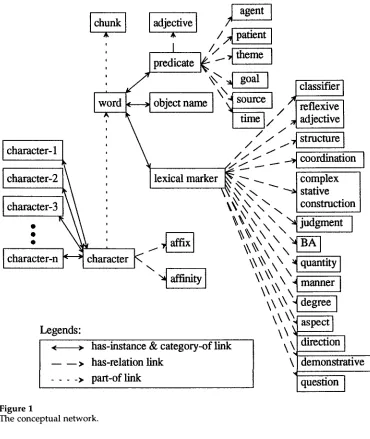
This is a network of nodes and links representing some permanent linguistic concepts (Figure 1).
In the network, a node represents a concept. For example, the node labeled
charac-
ter
represents the concept of character; the nodeword
represents the concept of word; the nodechunk
represents the concept of chunk; the nodescharacter-l, character-2,
up tocharacter-n
represent the actual characters in a sentence; theaffix
andaffinity
nodes represent the concepts of relations between characters; the nodesclassifier, reflexive ad-
jective, structure,
etc., represent the concepts of relations between words; the nodesagent, patient, theme,
etc., represent the concepts of relations between chunks.A link represents an association between two nodes. There are four types of links: (i)
category-of links,
oris-a
links, which connect instances to types, for example, the connections fromcharacter-I, character-2,
up tocharacter-n
to thecharacter
node;(ii) has-instance links,
the converse of category-of links; (iii)has-relation links,
which associate a node with the relations it contributes, for example, the connection from thecharacter
node to theaffix
node represents that thecharacter
node contributes to the character-based relation named asaffix;
(iv) part-of links, which representpart-of
relations between two nodes. The direction of apart-of
link, for instance, the link from thecharacter
node to theword
node, is interpreted as 'thecharacter
is part of theword'.
During a run of the program, nodes become activated when perceived to be rele- vant, and decay when no longer perceived to be relevant. Nodes also spread activation to their neighbors, and thus concepts closely associated with relevant concepts also become relevant. The activation levels of nodes can be affected by processes that take place in the workspace. Several nodes in the network (e.g.,agent, patient, word, chunk,
etc.), when activated, are able to exert top-down influences on the types of activities that may occur in the workspace in subsequent processing. The context-dependent activation of nodes enables the system to dynamically decide what is relevant at a given point in time, and influences what types of actions the system engages in.4.2 The Workspace
The workspace is meant to be the region where the system does the parsing and construction required to understand a sentence. This area can be thought of as corre- sponding to the locus of the creation and modification of mental representations that occurs in the mind as one tries to form a coherent understanding of a sentence. The construction process is done by a large number of processing agents.
Computational Linguistics Volume 22, Number 4
*
//q patient
I predlicate f/---q theme ]
,
~,'-
i J
X\~-~
classifier
i I i ~ , , ~ / re
.~ \
I ~ n e l . . . a ~ j ~ c ~ w
:
\
/ / / ,
structur~
[charact~r_l I
'
\
.'..
~ _ _
: \
" f / _ _ C _, coo~.tion I
re
,
~
//___
i character-2 l \
:
/lexical
marker ~ , ~ - -... -...
complex
[
I~\
,
\4 ~ ,.\
~ stative
I
[character-3 I \ \
,
\4 ~ \ \
construction
rt \ \
:
~ ' ~ ' X" "-4 judgment
I ¢hara~ter-n l'-"t c.ara~t~r r', \
\\ ,, ,,~1
quantity I
a.ff~ty
\\\\ \
"~
i
\\\\ d manner [
\\ \\ ~
degree
I
L < nds:
<
r- has-instance & category-of link
\ X. direction
]
- - - - > has-relation link
\ demonstrative J
. . . . • part-of link
question[
Figure 1
The conceptual network.
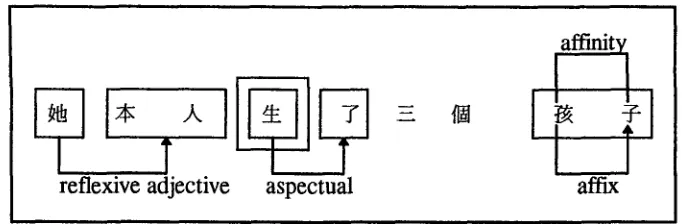
(9) ~ ~.X. ~ T' - - ~ ~
t~ b6nr~n sh~ng le s~n g~ hfiizi
she self give birth ASP three CL child 'She herself has given birth to three children.'
[image:8.468.53.423.54.493.2]reflexive adjective
aspectual
affinity
I T
affix
Figure 2
A possible state of the workspace.
Types of relations
Non-linguistic - -
Linguistic
Figure 3
An overview of the types of relations.
statistical
between character objects
between word objects
between chunk objects
word objects. It is possible to have unitary constituency whereby one object is the only part of another object. The chunk object ~l~ sh~ng 'give birth' is an example.
Each object in the workspace has a list of descriptions not shown in Figure 2. For example, descriptions of character objects include their morphological category (stem/affix) and whether they are bound or unbound. 8 Descriptions of word objects include their categorial information and sense. Descriptions of chunk objects m a y also include these two descriptions, except that here, these two descriptions are derived from the category and the sense of the word that is the governor.
The directed arc connecting two objects in Figure 2 denotes a linguistic relation between the objects connected. We adopt the dependency grammar notation (Tesni6re 1959; Mel'~uk 1988) in which the object pointed to by an arrow is the dependent while the object where the arrow originates is the governor. The undirected arc connecting the characters ~ hdi and ~ zi in Figure 2 represents a statistical relation, and statistical relations are undirected in our representation.
An overview of our classification of relations is shown in Figure 3.
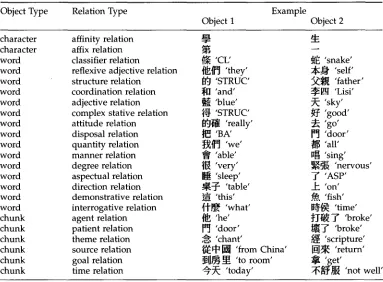
A list of all types of relations is summarized in Table 1; a detailed exposition can be found in Gan (1994).
In Figure 2, the connection between the word objects ~ ta 'she' and ~.h. b~nr~n
'self' is a reflexive adjective relation, the connection between the word objects ~ sh~ng
'give birth' and -j" le 'ASP' is an aspectual relation, and the two arcs connecting the character objects ~ hdi and --~ zi are affix and affinity relations.
[image:9.468.52.393.56.168.2]Computational Linguistics Volume 22, Number 4
Table 1
A list of all types of relations.
Object T y p e Relation Type Example
Object 1 Object 2
character affinity relation -~-
character affix relation ~
word classifier relation (~ 'CL' ~f~ 'snake'
word reflexive adjective relation ~lJ~] 'they' 2~]" 'self'
word structure relation i~1 'STRUC' .~J~ 'father'
word coordination relation ~11 'and' ~]~1~I 'Lisi'
word adjective relation ~- 'blue' ~ 'sky'
word complex stative relation ~ 'STRUC' ~ 'good'
word attitude relation ~ J ~ 'really' ~ 'go'
word disposal relation ~] 'BA' ]~ 'door'
word quantity relation ~J~] 'we' ~ 'all'
word manner relation ~ 'able' II~I 'sing'
word degree relation ~[~ 'very' ~ [ ~ 'nervous'
word aspectual relation ]~ 'sleep' ~ 'ASP'
word direction relation ~:-~ 'table' _]~ 'on' word demonstrative relation ~ 'this' ,,~, 'fish' word interrogative relation ~ - ~ 'what' I ~ 'time'
chunk agent relation ~[~ 'he' ~]'(6~ T 'broke'
chunk patient relation [~ 'door' ~ * 'broke'
chunk theme relation ~ 'chant' .~ 'scripture'
chunk source relation ~ [] 'from China' [ ~ 'return' chunk goal relation ~1]]~ ~]~ 'to room' ~ 'get'
chunk time relation @ ~ 'today' ~i~J]~ 'not well'
4.3 T h e C o d e r a c k
The building of linguistic structures (e.g., word and chunk objects, descriptions of objects, relations between objects) is carried out by a large number of agents known as codelets. These codelets reside in a data structure called the coderack. A codelet is a piece of code that carries out some small, local task that is part of the process of building a linguistic structure. For example, one codelet m a y check for the possibility of building an aspectual relation between the words ~4~ sh~ng 'give birth' and - T l e 'ASP' of sentence (9). There are several codelet types. Each type is responsible for building one of the relations shown in Table 1. In addition, there are word and c h u n k codelet types, which are responsible for the construction of words and chunks. Two special codelet types, namely, breaker and answer, will be explained in Section 5. Here, we make a distinction between codelets and codelet type. The latter is a prewritten piece of code while the former are instances of the latter.
[image:10.468.52.435.87.369.2]building chunk objects will be posted, which will further lead to the posting of codelets that determine how chunk objects can be related.
Note that there is no top-level executive deciding the order in which codelets are executed. At any given time, one of the existing codelets is selected to execute. The selection is a stochastic one, and it is a function of the relative urgencies of all existing codelets. The urgency of a codelet is a number assigned at the time of its creation to represent the importance of the task that it is supposed to carry out (this is an integer between 1 to 7, with 1 as the least urgent and 7 as the most urgent). Many codelets are independent and they run in parallel. Therefore, efforts towards building different structures are interleaved, sometimes co-operating and sometimes competing. The rate at which a structure is built is a function of the urgencies of its dedicated codelets. More promising structures are explored at high speeds and others at lower speeds. Almost all codelets make one or more stochastic decisions, and the high-level behavior of the program arises from the combination of thousands of these very small choices. In other words, the system's high-level behavior arises from its low-level stochastic substrate. To summarize, the macroscopic behavior of the system is not preprogrammed; the details of how it emerges from the low-level stochastic architecture of the system are given in Sections 5.2 and 5.3.
4.4 The Computational Temperature
The computational temperature is an approximate measure of the amount of coherency in the system's interpretation of a sentence: the value at a given time is a function of the amount and quality of linguistic structures that have been built in the workspace. The computational temperature is in turn used to control the amount c~f randomness in the local action of codelets. If m a n y good linguistic structures have been built, the temperature will be low, and the system will make decisions less randomly. When few good linguistic structures have been found, the temperature will be high, leading to m a n y more random decisions and hence to more diverse paths being explored by codelets. 9
The notion of temperature used here is similar to that in simulated annealing (Kirkpatrick, Gelatt, and Vecchi 1983). Both start with a high temperature, allowing all sorts of random steps to be taken, and slowly cool the system down by lowering the temperature. However, the decrease in temperature in our system is not necessarily monotonic. It varies according to the amount of coherency in the system's interpreta- tion of a sentence. Thus, our system has an extra degree of flexibility, which allows uphill steps in temperature; in effect, this means that the system is annealing at the metalevel as well.
5. An Example
We will use a sample run of the program on sentence (9) to illustrate m a n y central features of the model, including the selection of a codelet; the selection of competing alternatives; the interaction between the workspace and the conceptual network; etc. Note that this section would be overwhelmed with details if a step-by-step explanation were given. A detailed trace of the system's execution on this sentence can be found in Gan (1994), and a short description of the program's behavior can be found in Gan (1993). Here, only selected snapshots are highlighted.
Sentence (9) is an example with local, overlap, and combination ambiguities in the
Computational Linguistics Volume 22, Number 4
Table 2
Initial state of the coderack.
Codelet Type Urgency (U) Temperature-regulated Urgency Quantity Ut = 100 Ut = 0
word 2 2 16 14
affinity 3 2 81 20
affix 3 2 81 8
fragment :~:,K~ b~n r~n sh~ng. Without considering the sentential context, these three characters have three possible word boundaries: :~ d~ ~L b~n rfn sh~ng 'CL h u m a n give birth', ~ , ~ ~ b~nr~n sh~ng 'self give birth' or ~ ,~e~_ b~n r~nsh~ng 'CL life'. Given the sentential context of (9), however, only the second alternative is correct.
5.1 Initial Setup
When the parsing process starts, the program is presented with the sentence. The temperature is clamped at 100 for the first 80 cycles to ensure that diverse paths are explored initially (the range of the temperature varies between 0 and 100). A cycle is the execution of one codelet. The number 80 is decided based on intuition and trial-and-error; it is not necessarily optimal. The workspace is initialized with nine character objects, each corresponding to a character of the sentence. Since the workspace contains only character objects, the only relevant concepts are: character, affinity, affix, and each character of the sentence. The corresponding nodes in the conceptual network, namely: character, affinity, affix, ~ ta, ~ b~n, up to ~ zi, are set to full activation. Fourteen instances of word codelet are posted to the coderack. They are responsible for identifying and constructing monosyllabic words. Twenty instances of affinity codelet are also posted to identify and construct affinity relations between characters. Eight instances of affix codelet are posted to identify and construct affix relations between characters. In general, the number of codelets posted is a function of the length of a sentence.
5.2 Selection of a C o d e l e t
Among all codelet instances that exist in the coderack, only one of them is stochas- tically selected to execute each time. The choice of which codelet instance to execute depends on three factors: (i) its urgency, (ii) the number of codelet instances in the coderack that are of the same type as the individual instance, and (iii) the current temperature. At cycle 0, the coderack contains the statistics as shown in Table 2.
The temperature-regulated urgency (Lit) is derived in the following way:
Ut = U ~120-t)/30
(1)
where t denotes the temperature, which ranges between [0,1001. This equation is used to magnify differences in urgency values when the temperature is low. Conversely, at high temperatures, it will minimize differences in urgency values. The idea is to let the system explore diverse paths when the temperature is high, while always stick to one search path when the temperature is low.
I
I
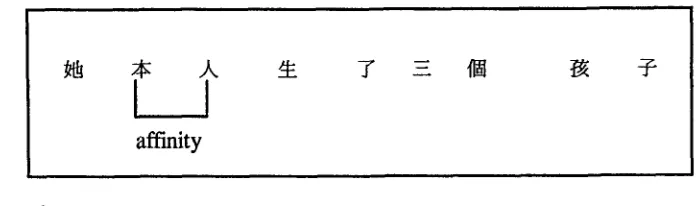
[image:13.468.42.390.54.157.2]affinity
Figure 4
State of the workspace at cycle 17.
These probabilities are derived as follows:
Uj, t x Qj
(2)
P'(G)=
u
i=1(
i,t X Qi)where Qi and
Qj
are the quantities of codelet typesCi
andCj
respectively,Ui, t
andUj, t
are the urgencies of codelet typesCi
andCj
at temperature t respectively, and n is the total number of codelet types.Supposing that the coderack contains the same types of codelets with the same quantities, but the temperature is 0, the probability of selecting an instance of a word codelet, an affinity codelet, and an affix codelet becomes 8.99%, 65.01%, and 26.00% respectively. Therefore, at low temperatures, codelets with high urgency are preferred.
5.3 Construction of Linguistic Structures
Linguistic structures include high-level objects (words and chunks) and relations be- tween two objects (see Table 1). In this run, for example, an affinity relation between the character objects ~:
b~n
and ),, rdn is constructed by an instance of an affinity codelet at cycle 17 (Figure 4).An affinity codelet works on any two adjacent character objects to evaluate whether an affinity relation should be built between these two characters. The affinity relation is a quantitative measure that reflects how strongly two characters co-occur statis- tically. It is derived from mutual information (Fano 1961), which is the probability that two characters occur together versus the probability that they are independent. Mathematically, it is:
P(a,b)
A(a, b) = log 2 P(a)P(b)
(3)where
A(a, b)
is the affinity relation between the character objects a and b,P(a, b)
is the probability that the two character objects co-occur consecutively, P(a) and P(b) are the probabilities that a and b occur independently. To derive affinity relations between characters, we have the usage frequencies of 6,768 Chinese characters specified in the GB2312-80 standard, and the usage frequencies of 46,520 words derived from a corpus. The total usage frequency of these words is 13,019,814. (The data was obtained from Liang Nanyuan, Beijing University of Aeronautics and Astronautics.)Computational Linguistics Volume 22, Number 4
codelets, and so on. The cycle in which a structure is built is not preprogrammed. Rather, it emerges from the statistics of the interaction of all codelets in the coderack.
5.4 Selection of Competing Structures
It may happen that a structure being constructed is in conflict with an existing struc- ture. In this run, for example, an affinity relation between the characters .£. r~n and
shgng is being considered at cycle 79. This structure is in conflict with the previously constructed affinity relation between the characters dg b~n and .),. r~n. The decision about which competing structure should win is decided stochastically as a function of two factors: (i) the strengths of the competing structures, and (ii) the temperature. The strength of a structure is an approximate measure of how promising the structure is. It is an integer ranging between 0 and 100, inclusive. The strengths of different structures are derived according to either linguistic knowledge encoded in the lexicon or certain statistical measures. Equation (3) is a key factor in deriving the strength of an affinity relation. In this run, the strength of the proposed affinity relation between the characters .£. r~n and ~ sh~ng is 55, while that of the existing affinity relation between the characters ~ b~n and ),. r~n is 56. These two values are adjusted by the temperature according to equation (4).
St ~ S (120-t)/40 (4)
where St is the temperature-regulated strength, S is the original strength, and t is the temperature. The effect of equation (4) is similar to equation (1): to maximize differences in strength values at low temperatures, and to minimize differences at high temperatures. At cycle 79, the temperature is still clamped at 100, and hence the temperature-regulated strengths of these two competing structures are both 7 (rounded up to the nearest integer). The decision about which structure should win is therefore a random one, as both have an equal probability of success. According to equation (4), at low temperatures, it is increasingly difficult for a new structure of lesser strength to win in competition against existing structures of greater strength. Since the system's behavior is more random at high temperatures, it is able to explore diverse paths in the initial stage when little structure has been built. When a large number of structures deemed to be good have been found, which entails a low temperature, the system will proceed in a more deterministic fashion, always preferring good paths to bad ones. Indeed, in this case, the new affinity relation between the characters .£. r~n and
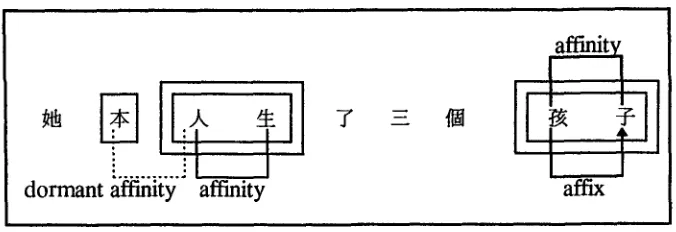
shgng has won. Instead of destroying the affinity relation between the characters
b~n and ),. r~n, this structure is retained, but it becomes dormant in the workspace.
5.5 The interaction between the Workspace and the Conceptual Network
l
affinit
dormant affinity
affinity
affix
Figure 5
State of the workspace at cycle 180.
5.6 Detection and Resolution of Erroneous Structures
By the end of cycle 180, the following structures have been built (Figure 5):
active
sh~ng,
~- zi;
active
active
relations: an affinity relation between the characters ,K,
r~n
a n d~dd hdi
a n d -~zi,
an affix relation b e t w e e n the characters ~hdi
a n dw o r d objects: ~zj~
hdizi
'child', ),.~4~r~nsh~ng
'life', and :~b~n
'CL';chunk objects: ,K.~_
r~nsh~ng
"life', and ~:j~hdizi
'child';d o r m a n t relations: an affinity relation between the characters ~:
b~n
a n dr~n.
A m o n g them, the w o r d ~
b~n
'CL' is a classifier. This w o r d has activated theclassifier
n o d e in the conceptual network, which in turn causes the posting ofclassifier
codelets to the coderack. The responsibility of this type of codelet is to explore the possibility of establishing a classifier relation b e t w e e n a classifier and an object name. 1° The use of a classifier is in general idiosyncratic. This type of idiosyncrasy is encoded in the lexicon. Since ~b~n
cannot be the classifier of the object n a m e ,K.~r~nsh~ng
'life', a special type of codelet k n o w n as a breaker codelet is posted to the coderack. The role of a breaker is to identify erroneous linguistic structures, a n d set t h e m to dormant, restoring a n y d o r m a n t competing structure w h e n necessary.At cycle 187, a breaker codelet is executed that examines structures that are "in- trouble", namely, the words :~
b~n
a n d ),,~4~r~nsh~ng
'life'. Since the c o m p o n e n t characters of the second w o r d can be free, the breaker codelet concludes that this is an erroneous grouping. The w o r d yk.~4~r~nsh~ng
'life' is m a d e dormant. The other structures that support the w o r d ,K.~r~nsh~ng
'life', n a m e l y the affinity relation be- tween the characters ,K.r~n
a n d ~sh~ng
a n d the chunk ,~.~-~r~nsh~ng
'life', are also m a d e dormant. The competing alternative, the affinity relation b e t w e e n the charactersb~n
a n d ),,rdn,
is reactivated. This snapshot also illustrates an i m p o r t a n t feature of the system: syntactic analysis can be performed w i t h o u t waiting for the system to complete the task of w o r d identification. [image:15.468.52.390.55.171.2]Computational Linguistics Volume 22, Number 4
affinity
reflexive adjective
aspectual
affiniv
affix
I
I!I
quantity
classifier
Figure 6
State of the workspace at cycle 373.
5.7 T h e Final State
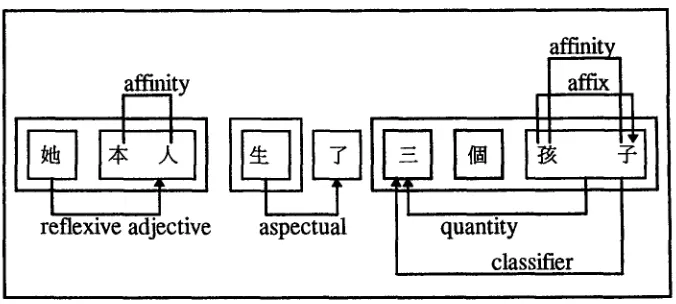
Figure 6 shows the state of the workspace at the end of cycle 373. For easy reference, sentence (9) is repeated here:
(9) ~ :~.K. ~ T G ~I ~x-~
ta b~nr~n sh~ng le san g~ h~izi
she self give birth ASP three CL child 'She herself has given birth to three children.'
The list of structures built are:
• active relations: an affinity relation between the characters ~ b~n and .~
r~n, ~ h~i and ~ zi, an affix relation between the characters ~ h~i and
zi, a reflexive adjective relation between the words ~ ta 'she' and
;4;.~ b~nr~n 'self', a classifier relation between the words ~ g~ 'CU and
~ h~izi 'child', a quantity relation between the words ~ san 'three'
and ~ : ~ h~izi 'child', an aspectual relation between the words ~ sh~ng
'give birth' and ~ le 'ASP';
• active words: ~ ta 'she', :~:.J~ b~nr~n 'self', ~ sh~ng 'give birth', T l e 'ASP', -~ san 'three', ~l g~ 'CU, and ~ h~izi 'child';
• active chunks: ~:4:.~ ta b~nr~n 'she herself', P4~ sh~ng 'give birth', and
~--.{~l~x~ san g~ h~izi 'three CL children';
• dormant relations: an affinity relation between the characters K r~n and
sh~ng;
• dormant words: d~-I~ r~nsh~ng 'life';
• dormant chunks: ) , ~ r~nsh~ng 'life'.
[image:16.468.77.415.55.207.2]agent
theme
reflexive
adjective
aspect
4
classifier
quantity
Figure 7
A complete analysis of sentence (9).
40O
3OO
2oo
100
0 affray
|
afk~•
t
!
II
•
• • •
[image:17.468.35.407.62.196.2]word chtmk refl~ adj. clas~fier quantity aspecttlal
Figure 8
A graph of structures constructed against cycle number.
boundaries of a sentence. The system currently adopts a greedy approach and starts posting large numbers of this type of codelet as soon as it has identified a plausible interpretation of the word boundaries of a sentence. Hence, although instances of agent and theme codelets were present in the coderack, they were being overwhelmed by the ubiquitous answer codelets.
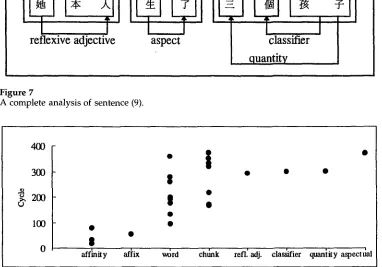
Figure 8 summarizes the cycle number in which various types of structures were constructed during this run. In this figure we see that affinity relations are built earlier than words, reflecting the system's preference for words of greater lengths. The system makes use of statistical information (the mutual information scores) to make quick and reliable guesses of the locations of these words. It can also be observed that overall, there is a gradual shift in the types of operations executed, from being character- centered initially, to word-centered, and then to chunk-centered. From time to time, however, the construction of different types of structures is interleaved.
6. System Performance and Discussions
[image:17.468.31.413.112.379.2]Computational Linguistics Volume 22, Number 4
scribed in Section 2. When the sentential contexts of locally ambiguous fragments (both the overlap and combination type) were varied, our system was able to identify the correct word boundaries. When the system was presented with sentences with global ambiguities, it produced all the plausible alternative word boundaries. However, at any run of such a sentence, only one alternative is generated. The system's behavior is similar to human performance in the goblet/faces recognition problem in perception (Hoffman and Richards 1984). We cannot see both the goblet and the faces at the same time, but we are able to switch back and forth between these two interpretations. The frequencies of generating all the alternatives vary from one sentence to another. It is important to note that such frequencies are not meant to indicate some kind of "goodness" measure of alternative word boundary interpretations. Neither are they meant to reflect the preferences of a human. They are merely a reflection of the usage frequencies of Chinese characters and words in our dictionary.
The system's ability to generate different word boundaries for a globally ambigu- ous sentence arises from its stochastic search mechanism, which does not rule out a priori certain possibilities. This feature enables the system to occasionally discover less-obvious interpretations of word boundaries. For example, in addition to the two apparent ways of aligning the fragment ~ , ~
yTjrnggu6
as either ~ , ~ i~yfjrnggu~
'already over' or B , ~yfjrnggu6
'already go through' in sentences (10a) and (10b), a less-obvious possibility that the system has identified is: ~, ,~ i~y~jTnggu~
'already experience over', where i~gu6
'over' is the complement of .~jTng
'experience'.(10)a.
w~ y~j~ng
gu~
le
xu~sh~ng shfd?li
I already over ASP student period 'My student days are over.'b.
w~ yr
jTnggu6
le
xu~sh~ng shid?zi
I already go through ASP student period 'I have already gone through the period as a student.'C.
w6 y~
j~ng
gu?~
le
xu~sheng shid?li
I already experience over ASP student period 'I have already experienced student life.'
The system rarely produces the less-obvious interpretations. This demonstrates that its mechanisms are able to strike an effective balance between random search and deterministic search, imbuing it with both flexibility and robustness.
(11)
zhonggu6 yz
kdif~
h~
sh?mg w~i
China already exploit and yet notkaifa de z~yu~n dOu h~n duo
exploit STRUC resource all very m a n y
'China has m a n y resources which have either been exploited or not yet been exploited.'
(12)*
zhdnggu6 yr
kaifa
hd
sh?mg w~i
China already exploit and yet not
kai f~ de ziyu~n dOu h6n3
open distribute STRUC resource all very duo m a n y
In this run, the bisyllabic word ~_~ /a//f~ 'develop' has been wrongly identified as two monosyllabic words ~'] /a/i 'open' and ~ ft/'distribute'. To determine the proper use of two juxtaposed predicates, such as ~J kai 'open' and ~ fa 'distribute' in this case, requires a careful study of serial verb constructions. It is inevitable that the system would make such a mistake as our linguistic descriptions have not yet covered this phenomenon.
In comparison, consider the performance of a strictly statistical approach based on mutual information (Lua and Gan 1994): the latter wrongly identified the word boundaries in 11 out of the 30 ambiguous fragments. For the 6 fragments that appear in globally ambiguous sentences, the mutual information approach gave only one interpretation of the word boundaries. In terms of processing speed, the mutual infor- mation approach took an average of 110.4 ms to process one character; our approach took 1.7 s. 11 The extra time in our approach is spent in parsing sentences.
7. C o n c l u s i o n
In this paper, we reported on a stochastically emergent model for language processing and described its application to the modeling of context effects in ambiguous Chinese word boundary interpretation. The model simulates language processing as a collective phenomenon that emerges from a myriad of microscopic and diverse activities. The proposed mechanism, whereby word objects and chunk objects are formed by the hooking up of character objects as the latter are gradually cooled down, is analagous to the crystallization process in chemistry.
Our application is distinct from existing work in two main respects:
Word identification: We show that the full power of natural language processing can be brought to bear on the issue of word identification effectively and seamlessly. The model is able to resolve ambiguities appearing in different sentential contexts. This is an improvement over statistical approaches such as the relaxation method (Fan and Tsai 1988), which generates all possible ways of grouping the characters of a sentence into words, and then uses some scoring function to select the
Computational Linguistics Volume 22, Number 4
best combination. At the same time, this model eliminates the use of ad hoc rules, as syntactic and semantic analysis are interleaved with word identification. This application is diametrically opposed to the
reductionist approach of separating word segmentation and sentence analysis into two distinct stages. We have argued that our approach can avoid the computational problem of combinatorial explosion as the architecture has appropriate mechanisms to regulate run-time resources dynamically.
Sentence analysis: We show that a sentence can be analyzed without assuming a presegmented input. The main feature is that there is no fixed, predetermined order of morphological, syntactic, and semantic analysis, since the control mechanism is a nondeterministic one. Essentially, the order in which these analyses are carried out is dependent on what has been discovered so far by the system, and the system's perception of what is relevant to the task it is currently investigating.
The essential idea of the proposed model is that of stochastically guided conver- gence to what is called a globally optimum state. This model shares some features with APRIL (Annealing Parser for Realistic Input Language) (Sampson, Haigh, and Atwell 1989). APRIL uses simulated annealing to determine the most plausible parse tree of a sentence. It begins with an arbitrary tree. Many local modifications are generated randomly. They are either adopted or rejected according to their effect on a plausibil- ity measure. Modifications that improve the plausibility measure are always accepted; while unfavorable modifications are rejected only if the loss of merit exceeds a certain threshold. The threshold value is generated randomly but its mean value decreases according to some predefined schedule. This differs from the behavior of the compu- tational temperature in our system, which does not have a monotonically decreasing property. Our system further differs from APRIL in the following aspects: (i) APRIL begins with an arbitrary parse tree whereas our system begins with no parse structure; (ii) APRIUs plausibility measure is defined using statistics collected from a treebank of manually parsed English text while ours is derived from mutual information statis- tics and linguistic constraints; (iii) parse trees in APRIL are immediate-constituency type while ours are dependency-based. That is, nodes in our system are either char- acters, words, or chunks. There are no nonterminal nodes defined with grammatical categories.
8. Future W o r k
Our application, which handles only thirty sentences at present, has enabled us to focus on the mechanisms that underlie the process of sentence comprehension, and their interactions. With the progress made in this study, which would not have been possible if we had plunged straight into large-scale unrestricted texts, our next concern would be to address the issue of scalability. There are two aspects to this issue.
The effect of various parameter values chosen for the formulae shown in Section 5 on the operation of the program: These values are set by trial-and-error. They are not specifically tailored to our test set. To finesse these parameters in order to completely weed out unpromising search paths is impossible, since decision making in the system is stochastic. We therefore do not anticipate that the setting of the various parameter values is an issue during scaling up. The values of the parameters m a y affect the rate of convergence, but they will not affect the accuracy of the system in terms of the analysis results.
The possibility of generating thousands of codelets as a result of using a large lexicon: We do not expect such a scenario to occur. Instead, having a large lexicon means that the system is able to handle more sentences. The number of codelets spawned to process a sentence is determined by the number of characters and words in the sentence, and the types of words and chunks in the sentence, not by the size of the lexicon. In addition, there are built-in mechanisms to manage the growth of codelets. We have demonstrated in Section 5 how we have made use of statistics (the maximum matching heuristics and mutual information) to avoid generating all possible word boundary combinations. The sample run in Section 5 has also demonstrated that the program need not finish executing all codelets in the coderack before it is allowed to stop, and that simpler and more clear-cut decisions tend to be made before the more subtle ones. Furthermore, certain features of the system, namely, the stochastic selection of a codelet by relative urgencies, the use of the conceptual network as a top-down controller, the interactions between the conceptual network and the workspace, enable the system to dynamically decide on the number and the types of codelets to be generated.
Computational Linguistics Volume 22, Number 4
Acknowledgments
Throughout the course of this work, we have benefited from discussions with Alain Polgu~re, Melanie Mitchell, Robert French, Ngai-lai Cheng, Chew Lim Tan, Loke Soo Hsu, Gee Kim Yeo, Guojin, Zhibiao Wu, and Paul Wu. We would like to express our thanks to them. We are also grateful to the reviewers for their insightful comments and suggestions.
References
Chang, Jyun-Sheng, C. D. Chen; and S. D. Chen. 1991. Chinese word segmentation through constraint satisfaction and statistical optimization (in Chinese). In
Proceedings o/ ROCLING-IV, R.O.C. Computational Linguistics Conference, pages 147-165.
Chao, Yuen-Ren. 1957. Formal and semantic discrepancies between different levels of Chinese structure. Bulletin o/The Institute of History and Philosophy, XXVIII: 1-16. Chen, Keh-Jiann and Shing-Huan Liu. 1992.
Word identification for Mandarin Chinese sentences. In Proceedings of COLING-92,
pages 101-107.
Chiang, Tung-Hui, Jing-Shin Chang, Ming-Yu Lin, and Keh-Yih Su. 1992. Statistical models for word segmentation and unknown resolution. In Proceedings of
ROCLING V, R.O.C. Computational
Linguistics Conference, pages 121-146. Fan, Charng-Kang and Wen-Hsiang Tsai. 1988. Automatic word identification in Chinese sentences by the relaxation technique. Computer Processing of Chinese and Oriental Languages, 4(1): 33-56. Fano, Robert M. 1961. Transmission of
Information. MIT Press, Cambridge, MA. French, Robert M. 1992. Tabletop: An
Emergent, Stochastic Computer Model of Analogy-Making. Ph.D. thesis, University of Michigan.
Gan, Kok-Wee. 1993. Integrating word boundary identification with sentence understanding. In Proceedings of the 31st Annual Meeting of the Association for Computational Linguistics, pages 301-303. Ohio State University, June.
Gan, Kok-Wee. 1994. Integrating Word Boundary Disambiguation with Sentence Understanding. Ph.D. thesis, Department of Information Systems & Computer Science, National University of Singapore. He, Ke-Kang, Hui Xu, and Bo Sun. 1991.
Design principle of expert system for automatic word segmentation in written
Chinese (in Chinese). Journal of Chinese Information Processing, 5(2): 1-14. Hoffman, Donald D. and Whitman A.
Richards. 1984. Parts of recognition.
Cognition, 18: 65-96.
Hofstadter, Douglas R. 1983. The
architecture of JUMBO. In Proceedings of the International Machine Learning Workshop,
edited by Ryszard Michalski. Huang, Xiang-Xi. 1989. A produce-test
approach to automatic segmentation of written Chinese (in Chinese). Journal of Chinese Information Processing, 3(4): 42-48. Kirkpatrick, S., C. D. Gelatt Jr., and
M. P. Vecchi. 1983. Optimization by simulated annealing. Science, 220: 671-680. Lai, T. B. Y., S. C. Lun, C. F. Sun, and M. S.
Sun. 1992. A tagging-based first-order Markov model approach to automatic word identification for Chinese sentences. In Proceedings of the 1992 International Conference on Computer Processing of Chinese & Oriental Languages, pages 17-23.
Li, Charles N. and Sandra A. Thompson. 1981. Mandarin Chinese: A Functional Reference Grammar. University of California Press.
Liang, Nan-Yuan. 1983. Automatic word segmentation in written Chinese and an automatic word segmentation
system----CDWS (in Chinese). In
Proceedings of the National Chinese Language Processing System.
Liang, Nan-Yuan. 1990. The knowledge of Chinese words segmentation (in Chinese).
Journal of Chinese Information Processing,
4(2): 29-33.
Lua, Kim-Teng and Kok-Wee Gan. 1994. An application of information theory in Chinese word segmentation. Computer Processing of Chinese & Oriental Languages,
8(1): 115-123.
Mel'~uk, Igor A. 1988. Dependency Syntax: Theory And Practice. State University Press of New York.
Meredith, Marsha J. 1986. Seek-Whence: A model of pattern perception. Technical Report 214, Computer Science
Department, Indiana University, Bloomington, IN.
Mitchell, Melanie. 1990. Copycat: A Computer Model of High-Level Perception and
Conceptual Slippage in Analogy-Making.
Ph.D. thesis, University of Michigan. Polgu~re, Alain. To appear. Meaning-text
semantic networks as a formal language. In Current Issues In Meaning-Text
Sampson, Geoffrey, Robin Haigh, and Eric Atwell. 1989. Natural language analysis by stochastic optimization: A progress report on project APRIL. Journal of Experimental and Theoretical Arti~'cial Intelligence, 1(4): 271-287.
Sproat, Richard and Chilin Shih. 1990. A statistical method for finding word boundaries in Chinese text. Computer Processing of Chinese & Oriental Languages,
4(4): 336-351.
Sproat, Richard, Chilin Shih, William Gale, and Nancy Chang. 1994. A stochastic finite-state word-segmentation algorithm for Chinese. In Proceedings of the 32nd Annual Meeting of the Association for Computational Linguistics, pages 66-73. Sproat, Richard, Chilin Shih, William Gale,
and Nancy Chang. 1996. A stochastic finite-state word-segmentation algorithm for Chinese. Computational Linguistics,
22(3).
Tesni~re, Lucien. 1959. Eldments de la syntaxe structurale. Klincksieck, Paris.
Wang, Xiaog-Long, Kai-Zhu Wang, and Xiao-Hua Bai. 1991. Separating syllables and characters into words in natural language understanding (in Chinese).
Journal of Chinese Information Processing,
5(3): 48-58.
Wu, Ming-Wen and Keh-Yih Su. 1993. Corpus-based automatic compound extraction with mutual information and relative frequency count. In Proceedings of R.O.C. Computational Linguistics Conference VI, pages 207-216.
Yao, Tian-Shun Gui-Ping Zhang, and Ying-Ming Wu. 1990. A rule-based Chinese automatic segmenting system (in Chinese). Journal of Chinese Information Processing, 4(1): 37-43.
Yeh, Ching-Long and Hsi-Jian Lee. 1991. Rule-based word identification for Mandarin Chinese
sentences--A unification approach.