Abstract—The lack of a large pool of relatively low cost IT professionals could prevent Saudi Arabia from becoming a competitive offshore IT solutions centre that provides IT services to regional and global markets [2]. This paper provides a comprehensive analysis of the ICT skills needed in local ICT organizations and identifies the gap between this requirement and the ICT skills supplied by the educational institutes of Saudi Arabia. The methodology adopted identifies the main ICT skills clusters, the skills supplied by the local educational institutions and the skills demanded by the ICT market and analyses the skill gap using an economic-theory driven approach. The results of this study suggest that industry and educational institutions work together to close the ICT skill gap through educational and training programs.
Index Terms— Education, Information Technology, Saudi Arabia, Skills Gap Analysis
I. INTRODUCTION
N terms of spending on information and communications technology, Saudi Arabia is one of the fastest growing countries in the region. Total IT spending in the Kingdom reached SR 27 billion in 2010 and is forecast to reach SR 46.3 billion in 2015, representing a compound annual growth rate (CAGR) of 11.4% [1]. This growth is expected to create a large number of new IT jobs within IT departments of organizations as well as in local IT companies.
Currently, Saudi Arabia faces a shortage of skilled IT professionals. The Commission of Information Technology and Communication in Saudi Arabia (CITC) projected that the cumulative gap of IT professionals is expected to reach nearly 30,000 professionals by 2014 [2]. The shortage could impact efficiencies of IT operations in organizations and in turn, affect their business performance. It could also impede the ability of local IT companies to meet the needs of the rapidly growing market. The availability of a reliable national pool of skilled IT professionals is critical to the building of sustainable IT industries.
The goals of the IT Skills Gap Analysis are to better understand the state of IT skills in Saudi Arabia, explore the market needs and quantify and analyze the supply and demand for ICT skills. Ultimately, this would ensure that industry and market requirements become the driving forces for the development and delivery of Saudi training,
Manuscript received May 17, 2012; revised June 07, 2012.
Lilac Alsafadi is with the Information Technology Department, College of Computer and Information Sciences, Riyadh, Saudi Arabia (corresponding author to provide phone: 4781479; fax: 966-1-4781479; e-mail: [email protected]).
Rana Abunafesa is with the Information Technology Department, College of Computer and Information Sciences, Riyadh, Saudi Arabia (corresponding author to provide phone: 4781479; fax: 966-1-4781479; e-mail: [email protected]).
education and workforce development programs to improve the competitiveness of the ICT sector. The study is based on questionnaire and interview results obtained from both workers and employers in the Saudi ICT market.
A. Study Methodology
There are various definitions of skills gap. Formal methodology for quantifying a “skills gap” is either completely lacking as in much of the policy-oriented research, or is too convoluted as is often the case in the economic literature [4]. The difference between the skills needed for a job versus those skills acquired by a prospective worker is the definition adopted in this paper. An economic-theory driven approach to skills gap analysis is followed by comparing aggregate data on labour supply and demand. The skill gap is calculated as the industry skill demand minus the education skill supply. The intention of the skills gap analysis is to indicate whether present local ICT employees have the necessary skills and competence for their jobs and if not, what further development they need.
The first step in developing the methodology for measuring the skills gap involved identifying the IT organization in which interviews would be conducted. The sample was limited to the city of Riyadh, the capital of Saudi Arabia and to organizations with IT departments and organizations operating in the local ICT industry. Riyadh has the largest number of players who operate in the Saudi ICT industry.
The next critical early phase involved identifying the right skills categories to use as the basis for the research. “Skills for Competitiveness Developed Initiative” by the United States Agency for International Development (USAID) and the Ministry of Communications and Information Technology (MCIT) in Egypt defined skills clusters and segment selections [3], which were adopted in our study. A survey was developed to list the technical and business skills into skills clusters, each of which can be analyzed and evaluated independently. Experts were asked to participate in a trial exercise to validate the content and style of the survey. The objective of this was to ensure that the questions were clear, complete and unambiguous; the survey was then distributed to the participants. A total of 200 workers were surveyed to identify the skills acquired from local educational institutes as well as the skills required by their employers. In addition, 12 employers in the local ICT market were surveyed and interviewed to identify the types of skills and level of professionalism demanded of their prospective employees.
B. About the workers
Around 200 ICT workers chosen randomly from the market completed our survey. Of the surveyed respondents,
ICT Skills Gap Analysis of the Saudi Market
Lilac Alsafadi, and Rana Abunafesa
87% had graduated from local education institutes in the last five years, 97% had a bachelor degree in a computing related field, 79% of the respondents lived in Riyadh and 93% were of Saudi nationality.
As for the industries in which the respondents were employed, 32% of respondent worked in higher education, 21% in ICT organisations, 17% in the healthcare industry, 10% in the banking industry and 20% in other industries. As for the employers target market, 34% of employing organisations were local, 25% international, 14% regional, and 27% of respondent were not aware of the target market of the organization they work in. In addition, 46% of the employing organisations were private, 26% were government, 25% semi-government, and 3% of respondent were not aware of the type of the organizations they work in.
The relationship between the respondents’ majors and jobs was quantified. On a scale from 0 to 5, where 0 means not related and 5 means very related, 61% of respondents find their jobs to be related or very much related to their field of study and 4% of respondents found their jobs are not related to their field of study.
The next section presents information on skills gaps organised by grouping related skills into skills clusters.
II. SKILLSGAPINTHESAUDIICTINDUSTRY As mentioned in the previous section, the study grouped related skills together into Skills Clusters. This grouping facilitated capturing the detailed requirements of the individual skills needed in the market. Skills Clusters include: Programming Languages, Database Platforms, Platforms, Application Categories, Connectivity and Integration, Certification, Technical Writing, Business and Management, and Business and Communication.
The charts below are the results collected from the ICT workers. The left dark bars indicate skills required in their current jobs (demand) and the right light bars indicate skills acquired by ICT workers from local education institutes (supply). The charts depict two factors: market need of skills and skills gap. Skills needed by more than 70% of employers are considered highly needed, skills needed between 30%–70% are considered of medium need and skills below 30% are considered of low need. Skills with no or very low need were removed from charts.
Skills gap is defined as the difference between the markets need (demand) and the current skills supplied by local education institutes (supply). A skills gap above 50% is considered high. The local education programs should focus on narrowing down this gap by offering majors and courses that directly address these skills.
The tables below are the results collected from the employers, while the charts show the results collected from the workers (local universities alumni). Skills required by more than 50% of surveyed employers are highlighted. The tables depict two factors: total market need of a skill and the skill level.
1) Programming Languages
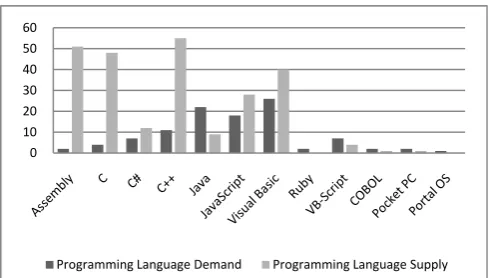
The educational program emphasises a set of basic programming areas and it covers most of the programming skills the market needs. The results of the ICT worker survey in Figure 1 show a 31% market demand for Visual Basic, 26% market demand for Java and 21% market
[image:2.595.306.551.82.221.2]demand for Java script programming skills. Java scored the highest in the skills gap reaching 13%.
Fig. 1. ICT Programming Language Demand and Skills Gap
As for the employer survey results, Table 1 shows that 80% of employers require Java programming skills, 70% require Visual Basic and 60% of employers require programming skills in C++, Java Script and VB Script. The table also indicates the need of employers for high skills in these programming areas and that future demand will be focused on the Java script language. In general, the skills gap in Saudi Arabia is low in programming languages.
TABLE I
SKILLS LEVEL AND PERCENTAGE OF ICTMARKET DEMAND FOR
PROGRAMMING LANGUAGE
Programming Language
Currently Required Required in Future
High Med Low High Med Low
Assembly 0.0 0.0 0.1 0.0 0.0 0.1
C 0.0 0.1 0.3 0.0 0.1 0.2
C# 0.1 0.0 0.4 0.0 0.0 0.3
C++ 0.1 0.3 0.2 0.0 0.1 0.2
Java 0.5 0.3 0.0 0.4 0.0 0.0
JavaScript 0.4 0.2 0.0 0.3 0.1 0.2
Visual Basic 0.4 0.1 0.2 0.1 0.2 0.0
Ruby 0.0 0.1 0.1 0.1 0.0 0.1
VB-Script 0.3 0.1 0.2 0.1 0.1 0.1
Delphi 0.0 0.0 0.1 0.0 0.0 0.1
COBOL 0.0 0.0 0.3 0.0 0.0 0.1
Pocket PC 0.1 0.1 0.1 0.2 0.1 0.0
Palm OS 0.1 0.0 0.2 0.1 0.1 0.1
Portal OS 0.2 0.2 0.0 0.2 0.0 0.0
2) Database Platforms
Fig. 2. ICT Database Platform Demand and Skills Gap
As with basic programming skills, database platforms are fairly well covered. Figure 2 shows a market demand for Oracle, Microsoft SQL server and MySQL database platforms, with 47%, 32% and 29% market demand, respectively. Microsoft SQL Server showed a 5% skill gap and there was no skill gap for Oracle and MySQL. Table 2 shows that the database platform skills required by employers are as follow: 90% of employers require
0 10 20 30 40 50 60
Programming Language Demand Programming Language Supply
0 10 20 30 40
DB2 Informix Microsoft
SQL
server
MySQL Oracle Sybase Siebel
Microsoft SQL server, 70% of employers require database skills in Oracle and 50% of employers require database skills in DB2 and MySQL. A slight increase in the requirement for MySQL platform will appear in the future.
TABLE II
SKILLS LEVEL AND PERCENTAGE OF ICTMARKET DEMAND FOR
DATABASE PLATFORMS
Database Platforms Currently Required Required in Future
High Med Low High Med Low
DB2 0.1 0.2 0.2 0.1 0.2 0.2
Informix 0.1 0.0 0.1 0.1 0.0 0.1
Microsoft SQL server 0.4 0.4 0.1 0.3 0.3 0.0
MySQL 0.2 0.1 0.2 0.3 0.1 0.2
Oracle 0.6 0.1 0.0 0.6 0.0 0.0
Sybase 0.2 0.0 0.2 0.2 0.1 0.1
Siebel 0.1 0.1 0.1 0.1 0.1 0.1
3) Platforms
Fig. 3. ICT Platform Demand and Skills Gap
In the platform skills, the results of the ICT worker survey illustrated in Figure 3 indicate that 48% of the local ICT market demands skills in Windows platform, 33% demand platform skills in .Net and 24% in Web Service platforms. Windows, .Net and WEB Service score the highest in the skills gap, calculated as 21%. Second in the skills gap of the ICT worker survey are Linux and Websphere followed by Java platforms, scoring 10%, 9% and 8%, respectively. However, the results of the ICT employer survey (Table 3) show a 60% current demand for medium skills in Linux and Java Platform, 70% of employers require advanced to medium skills in Unix and Web Service platforms and 80% require advanced level skills in Windows. The ICT employer survey also shows that the demand will continue in the future for advanced skills in Windows, Unix and Web Services and Linux and Java platforms. This need appeared to be linked to the increased demand for Java programming skills, which is well covered by Saudi locals.
4) Applications
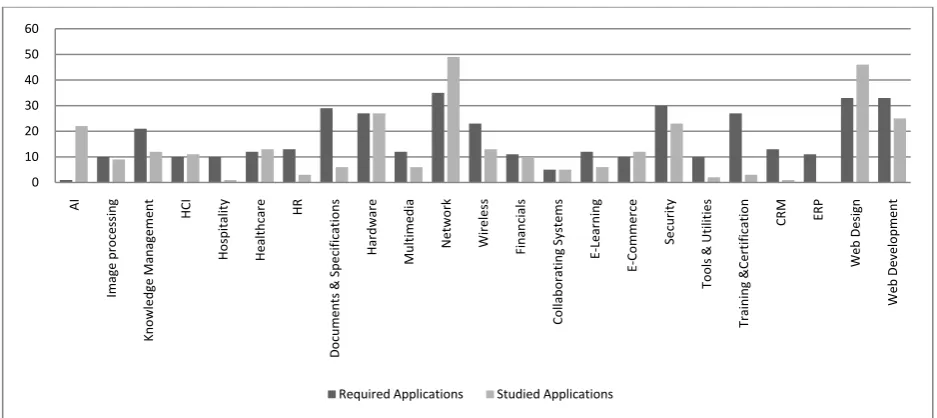
Figure 4 shows a 43% demand from the local ICT market for applications skills in Networks, 41% for Web Design and Web Development, 37% for Security, 36% for Documents and Specifications and 33% for Training and Certification. The highest skills gap is related to Documents and Specifications calculated at 28% and Training and Certification calculated at 30%. Although the results of the ICT worker survey show a 26% market demand for skills in
knowledge management, the results of the ICT employer survey show a 100% market demand for data mining and data warehousing and 70% demand for advanced skills in Knowledge Management. In addition, Table 4 shows a 100% of employers demand for skills in Documents and Specifications, 70% for skills in Hardware, Network and Enterprise Resource Planning. Third in demand is image processing and financials with a total demand of 60%. Fourth in demand is Human Computer Interaction, healthcare, Security, tools and utilities, Customer Relationship Management and Web development with a total of 50% demand. The demand for these applications skills is current and will continue in the future.
TABLE III
SKILLS LEVEL AND PERCENTAGE OF ICTMARKET DEMAND FOR
PLATFORMS
Platforms Currently Required Required in Future
High Med Low High Med Low
Browser Based 0.2 0.2 0.0 0.1 0.2 0.0
Consols 0.2 0.1 0.0 0.3 0.0 0.0
Embedded 0.0 0.0 0.1 0.0 0.1 0.0
Java Platforms 0.2 0.3 0.1 0.3 0.1 0.0
Legsacy Platforms 0.0 0.0 0.1 0.0 0.1 0.0
Linux 0.1 0.4 0.1 0.3 0.1 0.1
Machintosh 0.0 0.1 0.1 0.0 0.1 0.1
Mobile Platforms 0.0 0.1 0.2 0.1 0.1 0.1
MS-DOS 0.0 0.0 0.2 0.0 0.0 0.2
Mainframes 0.0 0.2 0.0 0.0 0.0 0.1
Remotely Hosted 0.0 0.1 0.0 0.0 0.1 0.0
UNIX 0.4 0.3 0.0 0.4 0.2 0.0
WEB Service 0.4 0.3 0.0 0.5 0.1 0.0
WINDOWS 0.6 0.2 0.0 0.6 0.1 0.0
Websphere 0.1 0.1 0.1 0.3 0.0 0.1
TABLE IV
SKILLS LEVEL AND PERCENTAGE OF ICTMARKET DEMAND FOR
APPLICATIONS
Applications
Currently Required
Required in Future
High Med Low High Med Low
AI 0.2 0.0 0.2 0.0 0.1 0.0
Image processing 0.4 0.2 0.0 0.2 0.1 0.0
Knowledge Management 0.5 0.2 0.0 0.3 0.1 0.0
Data warehouse & Mining 0.4 0.2 0.5 0.3 0.1 0.1
Human Computer Interactive 0.1 0.1 0.3 0.1 0.1 0.2
Healthcare 0.2 0.1 0.2 0.3 0.1 0.0
HR 0.2 0.1 0.1 0.1 0.0 0.0
Documents & Specifications 0.3 0.4 0.4 0.1 0.0 0.0
Game 0.0 0.0 0.0 0.0 0.0 0.0
Hardware 0.4 0.3 0.0 0.2 0.2 0.1
Multimedia 0.1 0.2 0.1 0.0 0.2 0.1
Network 0.6 0.1 0.0 0.5 0.1 0.0
Wireless 0.2 0.2 0.0 0.0 0.0 0.0
Financials 0.3 0.1 0.2 0.4 0.0 0.0
Collaborating Systems 0.1 0.2 0.0 0.3 0.0 0.0
E-Learning 0.1 0.2 0.1 0.1 0.1 0.0
E-Commerce 0.0 0.1 0.0 0.1 0.0 0.0
Security 0.4 0.0 0.1 0.4 0.0 0.0
Tools & Utilities 0.3 0.1 0.1 0.4 0.1 0.0
Training & Certification 0.1 0.0 0.1 0.1 0.0 0.0
Customer Relationship
Management 0.3 0.2 0.0 0.4 0.0 0.0
Geographic Information
Systems 0.0 0.0 0.1 0.0 0.0 0.1
Enterprise Resource Planning 0.5 0.0 0.2 0.4 0.2 0.0
Web Design 0.3 0.1 0.0 0.3 0.0 0.1
Web Development 0.5 0.0 0.0 0.4 0.0 0.1
0 5 10 15 20 25 30 35 40
Fig. 4. ICT Applications Demand and Skills Gap
5) Connectivity and Integration
Fig. 5. ICT Connectivity and Integration Demand and Skills Gap
The ICT worker survey results in Figure 5 show a 47% demand from the local market for System Analysis Skills, 36% demand for System Integration Skills and 32% demand for Technical Solutions Requirements. The highest skill gap appears in the connectivity and integration of systems related to Technical Solutions Requirements skills calculated at 23%. System Integration Skills reported the second highest skill gap calculated at a 17% and Requirement Analysis for Performance recorded third highest with a 15% gap.
The employer survey results in Table 5 show a 90% employer demand for Technical Solution Requirements skills, 80% for System Analysis Skills, 70% employer demand for Workflow and Work Process tools and System Integration skills, 60% demand for XML and System Integration skills and 50% demand for Requirement Analysis for Performance. The employer demand is for advanced skills in the above system connectivity and integration skills. The results show that the demand for Workflow and Work Process tools, System Analysis Skills, and System Integration skills are current and will remain in the future. In general, the Saudi market has high demand for advanced skills in connectivity and integration skills. The demand is almost covered by Saudi locals and the Saudi market faces low skills gap in this cluster.
TABLE V
SKILLS LEVEL AND PERCENTAGE OF ICTMARKET DEMAND FOR
CONNECTIVITY AND INTEGRATION
Connectivity & Integration
Currently Required
Required in Future
High Med High Med High Med
XML 0.4 0.1 0.1 0.3 0.0 0.0
COBRA 0.0 0.0 0.1 0.0 0.0 0.1
Workflow & work process
tools 0.2 0.3 0.2 0.4 0.2 0.0
System Analysis Skills 0.7 0.1 0.0 0.5 0.1 0.0
System Integration Skills 0.5 0.2 0.0 0.4 0.1 0.0
Technical Solutions
Requirements 0.4 0.2 0.3 0.2 0.0 0.0
Requirement analysis for
performance 0.2 0.3 0.0 0.2 0.1 0.0
[image:4.595.306.551.318.595.2]6) Certification
Fig. 6. ICT Certification Demand and Skills Gap
The ICT worker survey results in Figure 6 show that 33% of the local market demand is for ORACLE certificates, 32% for Microsoft certificates, 20% for CISCO Security and 16% for CISCO Certification and A+. The highest certification gap appears in Microsoft, Oracle, and CISCO Security with a gap percentage of 24%, 20% and 15%, respectively.
The employer survey results show a market preference for certification. The highest demand is for CISCO Network Certification from 90% of respondents. Microsoft and ITIL is currently in demand by 80% of employers and 70% of employers show current demand for CISCO Network Security, ORACLE and PMP. The table also shows future demands for the above mentioned certification.
0 10 20 30 40 50 60
AI
Image
pr
o
ces
si
ng
Kn
owled
ge
Management
HCI
Hosp
itality
Heal
thcar
e
HR
Do
cuments
&
Sp
ec
ific
ation
s
Hard
ware
Mu
ltim
ed
ia
Ne
twork
Wireless Financi
al
s
Co
lla
bo
ra
ti
ng
System
s
E
‐
Lear
ni
ng
E
‐
Co
mmer
ce
Sec
u
rity
Tools
&
Utilities
Tr
ai
ni
ng
&Certification
CR
M
ER
P
Web
Design
Web
Dev
el
o
pment
Required Applications Studied Applications
0 5 10 15 20 25 30 35 40
XML Workflow &
work process
tools
System
Analysis Skills System
Integration
Skills
Technical
Solutions
Requirements
Requirement
analysis for
performance Connectivity & Integration required Connectivity & Integration studied
0 5 10 15 20 25 30
TABLE VI
SKILLS LEVEL AND PERCENTAGE OF ICTMARKET DEMAND FOR
CERTIFICATION
Certification
Currently Required
Required in Future High Med Low High Med Low
PMP 0.5 0.1 0.1 0.5 0.1 0.0
Six Segma 0.2 0.1 0.1 0.2 0.1 0.1
ITIL 0.5 0.3 0.0 0.6 0.1 0.0
ISO9xxx 0.2 0.1 0.1 0.3 0.1 0.0
TickIT 0.0 0.2 0.0 0.0 0.2 0.0
Vendor specific 0.1 0.2 0.0 0.1 0.2 0.0
CompTIA 0.0 0.1 0.2 0.0 0.1 0.2
Legislation of Products & IP 0.0 0.1 0.1 0.0 0.2 0.0
Oracle 0.6 0.0 0.1 0.6 0.1 0.0
Microsoft 0.5 0.3 0.0 0.4 0.3 0.0
COPC (variant of ISO for call
centers) 0.1 0.2 0.0 0.0 0.3 0.0
CISCO Network Certification 0.7 0.1 0.1 0.5 0.1 0.1
CISCO Network Security 0.5 0.1 0.1 0.4 0.1 0.1
A+ 0.1 0.1 0.0 0.1 0.1 0.0
7) Technical Writing
[image:5.595.44.294.70.267.2]Technical writing is a form of communication between technology developers and system users. Closing the skills gap in this category will improve the user acceptance along with the overall quality of implementation. The ICT workers survey shows 76% of market demand for Technical writing in English. The gap is currently highest in English languages. Table 7 shows equal current demand for both Arabic and English technical writing skills. The demand for Arabic technical writing will decrease by half in the future. In general, the highest demand of the local ICT market and the highest skill gap relates to English Technical Writing skills.
Fig. 7. ICT Technical Writing Demand and Skills Gap
TABLE VII
SKILLS LEVEL AND PERCENTAGE OF ICTMARKET DEMAND FOR
TECHNICAL WRITING
Technical Writing Skills Currently Required Required in Future
High Med Low High Med Low
Technical writing English 0.2 0.3 0.1 0.5 0.1 0.0
Technical writing Arabic 0.2 0.2 0.2 0.2 0.0 0.1
8) Business and project management
In the Business and Management Skills category depicted in Figure 8, the largest skills gap in the ICT worker survey scored 18% in Change Management skills, 15% in Management Development and Report Management Skills and 12% in Business Continuity and Business Process Modelling skills. In addition, the figure shows that the highest demand is on Change management skills, Estimation for Projects skills, and Management Development and Business process modelling with 24%, 18%, and 15%, respectively. Yet the overall demand is considered low on this category of skills.
As for the employer survey, 80% of employers demand Risk Management Skills and 50% of employers demand Business Process Modelling, Change Management and Legal Data Communication Skills.
Figure 9 depicts the Business and Communication Skills category. Problem Solving and Presentation Skills showed high demand in this category of the ICT worker survey of 61% and 52%, respectively. The highest skills gap scored 52% in Problem Solving Skills, 39% in Presentation skills, 37% in People Management Skills, 34% in Time Management and 33% in Leadership skills. Problem Solving Skills is the second highest skill gap in the local market after English Technical Writing skills mentioned in the previous category.
[image:5.595.307.551.269.427.2]The employer survey results indicate 60% market demand for Problem Solving and People Management Skills and 50% market demand for Negotiation, Leadership and Teambuilding and Team Communication Skills.
Fig. 8. Business and Management Skills Demand and Skills Gap
Fig. 9. Business and Communication Demand and Skills Gap
Fig. 10. Project & Customer Management Demand and Skills Gap
0 10 20 30 40 50 60
Technical DOC
Management
Technical writing English Technical writing Arabic Technical writing required Technical writing studied
0 2 4 6 8 10 12 14 16 18
Business & Management Skills Required Business & Management Skills Studied
0 10 20 30 40 50
Business & Communication required Business & Communication studied
0 5 10 15 20 25 30
[image:5.595.46.291.436.535.2] [image:5.595.305.553.609.766.2]Table VIII
SKILLS LEVEL AND PERCENTAGE OF ICTMARKET DEMAND FOR BUSINESS, COMMUNICATION AND MANAGEMENT
Business & Communication Skills
Currently Required Required in Future
High Med Low High Med Low
Business process modeling
& Analysis 0.3 0.1 0.1 0.4 0.0 0.0
Balanced scorecard 0.0 0.1 0.0 0.2 0.0 0.0
Change management skills 0.2 0.3 0.0 0.3 0.3 0.0
Competitive Analysis 0.0 0.2 0.0 0.2 0.0 0.0
Contract Management 0.0 0.3 0.0 0.2 0.1 0.0
Estimation for Projects 0.0 0.1 0.0 0.1 0.2 0.0
Evaluation Planning and
market development 0.0 0.2 0.1 0.2 0.1 0.0
Facilitation 0.0 0.1 0.0 0.1 0.0 0.0
Financial Analysis 0.3 0.0 0.1 0.2 0.2 0.0
General business
awareness 0.0 0.1 0.1 0.2 0.1 0.0
knowledge Transfer skills
(Industry specific) 0.2 0.0 0.1 0.4 0.0 0.0
Legal data communication
skills 0.1 0.3 0.1 0.2 0.0 0.0
Partnership Management 0.0 0.2 0.0 0.1 0.1 0.0
Pricing and Packaging 0.0 0.1 0.0 0.1 0.0 0.0
Prioritization Management 0.2 0.1 0.0 0.3 0.0 0.0
Proposal Development &
Management 0.1 0.1 0.1 0.2 0.1 0.0
Report Management
Methodology 0.1 0.2 0.0 0.3 0.0 0.0
Risk Management 0.3 0.2 0.3 0.1 0.0 0.0
Supplier Relations
Management 0.0 0.0 0.0 0.0 0.3 0.0
Service Level Agreement 0.3 0.1 0.0 0.3 0.0 0.0
Supply Chain Management 0.2 0.1 0.0 0.2 0.0 0.0
Solution selling skills 0.0 0.2 0.0 0.1 0.1 0.0
Standardized business
procedures skills 0.2 0.1 0.1 0.3 0.0 0.0
Business process modeling
& Analysis 0.3 0.1 0.1 0.4 0.0 0.0
Balanced scorecard 0.0 0.1 0.0 0.2 0.0 0.0
Change management skills 0.2 0.3 0.0 0.3 0.3 0.0
Customer Communication 0.2 0.1 0.0 0.2 0.0 0.0
Sales 0.2 0.0 0.1 0.2 0.0 0.0
Marketing & Market
Research Planning 0.1 0.0 0.1 0.1 0.0 0.1
Business Planning 0.1 0.1 0.1 0.2 0.0 0.1
Proposal development 0.0 0.0 0.1 0.0 0.0 0.1
International business 0.0 0.1 0.1 0.1 0.0 0.0
Negotiation skills 0.1 0.3 0.1 0.3 0.0 0.1
Leadership skills 0.1 0.3 0.1 0.3 0.0 0.1
Time Management 0.3 0.0 0.1 0.0 0.2 0.1
Teambuilding & Team
communication skills 0.3 0.1 0.1 0.3 0.1 0.0
Presentation skills 0.2 0.1 0.1 0.1 0.3 0.1
Problem Solving skills 0.4 0.2 0.0 0.4 0.0 0.0
People Management skills 0.2 0.1 0.3 0.0 0.0 0.0
III.CONCLUSION
Saudi’s ICT sector exhibits skills gaps in two primary areas: technology-based skills and business and soft skills. For the most part, Saudi does not have severe skills gaps for basic technology-based skills. This could be due to the limited demand in the market for advanced technologies. The ICT worker survey indicated that the highest skill required in their jobs is English Technical Writing skills and the most significant gaps lie in English Technical Writing and Problem Solving Skills. These skills gaps must be considered remarkable and should be dealt with through a variety of means including immediate corrective programs.
The results also indicate medium skill gaps for management and personal communication skills. Management skill gaps include time management, people management and document management. A common
comment by employers is that it is difficult to hire Saudi locals with baseline skills, such as Business Writing and Technical Writing in both Arabic and English. They emphasised that English language skills are critical for people working in ICT.
It is important to note that many of the technology-based skills are taught at college or university level. However, business and communication skills, such as writing, leadership, critical thinking, presentation and communications must begin even sooner. The ICT industry must work with the Ministry of Education in Saudi Arabia to equip students with basic writing, presentation and communication skills by the time of high school graduation. In general, most employers feel that graduates from the universities are not equipped with the needed soft skills.
In the study, some employers could not project future demand for skills, which explains the overall decrease in the employers’ demand for future skills.
Finally, it is recommended that a Skills Gap Analysis should be conducted at least every four years to ensure that the ICT industry always has relevant skills gap data. This data is critical in order to minimise the time spent in education and training and enable workers to focus on those specific skills that are in demand. The study results should be translated into a set of short- and long-term objectives implemented as changes in local education curricula for closing the skills gap. However, there is no question that advanced technology skills gaps may present with the Saudization initiative in the Saudi market in general and the ICT market specifically.
REFERENCES
[1] The Communications and Information Technology Commission (CITC). IT Report 2010 Kingdom of Saudi Arabia. Available
www.citc.gov.sa/.../IT%20006%20E%20-%20IT%20Report%202010.pdf .
[2] The Communications and Information Technology Commission (CITC). IT Report 2009 Kingdom of Saudi Arabia. Available http://www.citc.gov.sa/arabic/Reportsandstudies/Reports/Documents/ IT%20005%20A%20-%20IT%20Report%202009.pdf
[3] Moustafa El-Gabaly and Mehdi Majidi. The Information
Communication Technology (ICT) Penetration and Skills Gap Analysis (SGA). Planning and Learning Inc., July 2003