Transmission, Authentication and Compression
Using Cloud Computing
Likitha G Gowda1, Shubha S V2, Siri P3
1
Student VIII Sem, Department of Information Science & Engineering, NIE, Mysuru
2
Student VIII Sem, Department of Information Science & Engineering, NIE, Mysuru
3
Student VIII Sem, Department of Information Science & Engineering, NIE, Mysuru
Cloud computing environments are facing serious problem in security which are, Confidentiality of Data, Integrity of the Message and Authenticity of the users. Since user’s personal data is being stored in an unencrypted format on a remote machine operated by third party vendors who provide various services, the impact of user’s identity and unauthorized access or disclosure of files are very high. Hence user authentication in cloud computing plays a major role in handling cloud security issues. And the other major problem that has been faced by the cloud service providers is that transmission of huge data, be it in a form of text, audio, image or video which results in the major consumption of the resource. Hence data compression is a very useful technique that helps in reducing the size of text data and storing the same amount of data in relatively fewer bits resulting in reducing the data storage space, resource usage or transmission capacity.
Keywords: Authenticity, confidentiality, integrity, transmission, unencrypted format.
I. INTRODUCTION
Cloud provides users with storage space and makes user friendly and timely acquire data. However there is lack of very strong authentication and less storage space for the files to be stored. Since cloud has been majorly used by people to store, share their personal data. This forms a strong need to come up with system that could solve above problem.
We are achieving the same by providing a strong multifactor authentication while logging in as well as authentication check in homepage so that third party cannot access any data of the authorised user, this is achieved using Google Authenticator.
To make optimal utilization of given storage space the files to be uploaded are compressed in their size by approximately up to 60 percentage. This can be achieved by implementing G-Z algorithm namely Deflate compression.
To make data and password much secured we are encrypting them using AES Encryption.
In order to make this system more interactive a chat messenger feature has also been added where authorized users who are online can communicate with each other using this application. Here chat messenger is provided using SignalR.
II. METHODS AND MATERIAL
This system provides users facilities like authentication using Google authenticator, encryption of data and passwords using AES encryption, compression of files using Deflate compression, chat communication among authorized users using SignalR.
The system comprises of four module
A. AUTHENTICATION USING GOOGLE AUTHENTICATOR
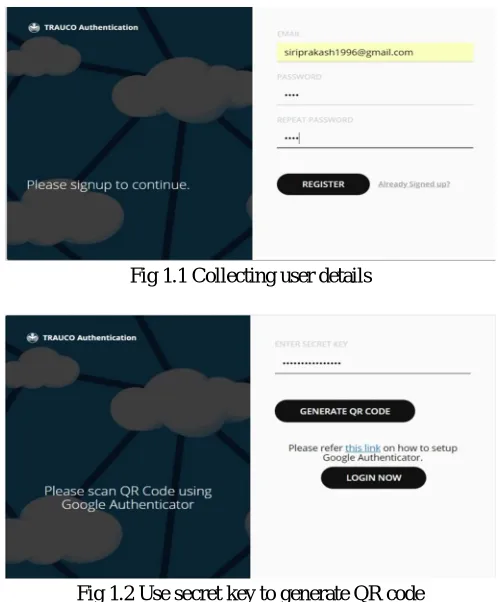
Fig 1.2 Use secret key to generate QR code
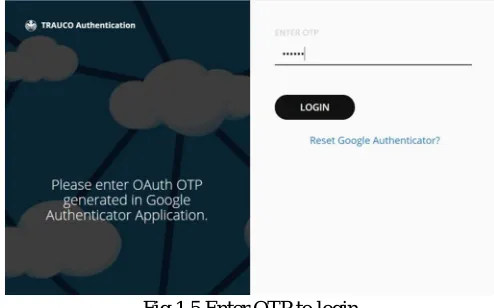
[image:2.612.178.437.77.710.2]Fig 1.5 Enter OTP to login
B. Gzipalgorithm
The gzip algorithm also known as deflate algorithm uses lz77 and huffman coding. Computer programs have lot of redundant codes or data. The same code will be repeated may a time in a single context. Computer storage, on the other hand, is a valuable resource. It becomes less and less scarce every day, but every time capacity increases.
Conceptually, lz77 is pretty straightforward . When the word occurs for the second times it removes that and in that position it creates piointer to the word encountered for the first time. Lets take a glance at figure 1.6 and figure 1.7. Figure 1.6 contains some words and figure 1.7 shows all of the places wherever text from a previous purpose within the document is recurrent. Lz77 will a really smart job of exploiting that redundancy and creating economical use of accessible storage.
[image:3.612.186.427.472.588.2]Figure 1.6 Uncompressed ASCII text
Figure 1.7 LZW compression
For example <25,5> indicates that, to uncompress the document, search backward 25 characters, and reproduce the five characters you find there. This relatively short document is compressed at just over 3:1 and the compression ratio increases as documents get longer.
C. SIGNAL R
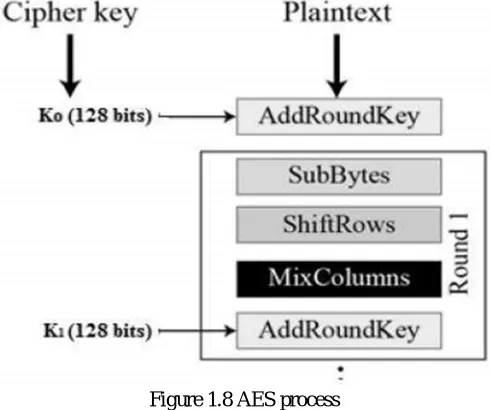
Figure 1.8 AES process
During Byte substitution the 16 input bytes are substituted by looking into a settled table (S-box) given in outline,result will be 4 rows and columns in matrix form. During Shift rows as shown in fig 1.8 each of the four rows of the matrix is shifted to the left. In MixColumns takes 4 bytes of one of the rows and one column and outputs four completely new bytes, which replace the original column. In Addround key the 16 bytes of the lattice are xored. On the off chance that this is the last round then the yield is the ciphertext. In a similar manner other rounds are followed.
III. RESULTS AND DISCUSSION
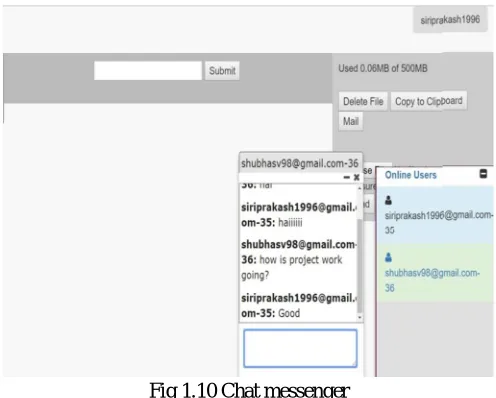
This system provides organisation a platform for internal upload of a file, internal sharing of a file and internal deletion of a file shown in fig 1.8. Here all above feature are provided with strong authentication, good rate of compression and provides file details like file name, file size, file type, file created date shown in fig 1.9. This system also provides internal chat communication among the authorized users shown in fig 1.10
[image:4.612.178.439.592.722.2]Fig 1.10 Chat messenger
IV. CONCLUSION
The proposed system provides good authentication , good percent of compression , internal upload, delete and sharing of files. It has a similar but better performance when compared to older techniques. Also, this new techniques provides integration of mentioned all above four modules ie transmission, authentication and compression ,encryption and chat communication under a single platform This system also provides intercommunication facility between the authorized users who are online using chat messenger. Authentication mentioned here is two factor Google Authenticator . Good percent of compression is achieved using Deflate compression . Chat messenger is implemented using SignalR library.
This system is majorly used among organizations since this provide good authentication , good percent of compression , internal upload, delete and sharing of files along with internal communication through chat messenger.
REFERENCES
[1] “Cloud security assessment and identity management” by A. Bhardwaj and V. Kumar. Published in: Computer and Information Technology (ICCIT), 14th International Conference on, dec. 2011, pp. 387 –392
[2] “A Block-sorting Lossless Data Compression Algorithm”, by M. Burrows and D. J. Wheeler. Published in:Digital Systems Research Center Research Report 124, May 1994
[3] “Data security and privacy protection issues in cloud computing,” by D. Chen and H. Zhao. Published in Computer Science and Electronics Engineering (ICCSEE), 2012 International Conference on, vol. 1, march 2012, pp. 647 –651
[4] “A Semantic-Based Access Control for Ensuring Data Security in Cloud Computing”, by M.Auxilia and K. Raja. Published in IEEE conference on Radar, Communication and Computing, 2012
[5] “Cloud Computing Security Management”, by Sameera Abdulrahman Almulla, Chan Yeob Yeun, Published in Engineering systems management and its applications (2010), pp. 1-7.
[6] “Danger in Clouds”, by Steve Mansfield-Devine, Published in Network Security (2008), 12, pp. 9-11