NITROGEN EXCRETION IN ASCIDIACEA
I. EXCRETION OF AMMONIA AND TOTAL NON-PROTEIN NITROGEN BY IVAN GOODBODY
Department of Natural History, University of Aberdeen*
{Received z~] September 1956)
INTRODUCTION
The existence in certain ascidian species of small closed vesicles or sacs containing concretions of solid material has led many zoologists in the past to consider that excretion in these animals is wholly carried out by the storage of insoluble excretory products. The concretions inside these vesicles are usually described as being composed of uric acid or purines; the evidence upon which this is based will be discussed in a second paper. The early discoveries of storage excretion led sub-sequent workers in the field to focus their attention almost exclusively on this aspect of the problem, and induced Burian (1924) in his extensive review of the subject to claim that the nitrogen metabolism of ascidians was similar to that of snails, insects, reptiles and birds.
The literature on ascidian excretion leads one to suppose that these animals remove all their waste nitrogen by storing it as granules of insoluble uric acid or purine bases, such as guanine or xanthine. This, if true, would be remarkable in animals which have such an abundant water circulation through the branchial chamber. (Ciona intestinaMs for instance may filter 2-3 1. of water/hr. and Molgula
manhattensis about 1 l./hr. Figures calculated from data in Jergensen, 1952.) The
work of Needham (1929, 1931) and Delaunay (1931, 1934) has shown that there is a general relationship between the main nitrogenous end product of metabolism and the habitat of the animal or its embryo. Animals which have an abundant supply of water tend to excrete their nitrogen chiefly as ammonia which diffuses readily into the surrounding medium. Ammonia, however, is very toxic and unless it can be rapidly removed must be converted into less toxic substances; hence, in animals with a reduced water circulation the main nitrogenous end product becomes either urea or uric acid. Uric acid excretion is typical of animals in which water conservation is of primary importance either in the embryo or in adult life; typical examples are insects, reptiles and birds. It is unlikely that an ascidian at any stage of its life should suffer from difficulties of water conservation.
In the light of these facts a re-investigation of nitrogen excretion in ascidians was undertaken in an attempt to clear up what at first sight is an anomalous situation. The investigation is divided into two parts; in the present paper it will be shown that ascidians are essentially the same as other marine animals and excrete
siderable quantities of ammonia such as to suggest that their protein metabolism is ammonotelic. In a second paper the problem of purine metabolism will be dis-cussed in relation to the nature of the renal concretions.
The results are based on a study of three different species: Ciona intestinaUs (Linnaeus) representing a type in which storage vesicles are absent; Ascidiella
aspersa (Muller) a species with numerous small renal vesicles; Molgula manhattensis
(Dekay) a species with a single large renal vesicle. For simplicity these are referred to throughout the text by their generic names only.
MATERIAL AND METHODS
Live ascidians were obtained from three sources. The Marine Laboratory at Millport provided Ciona and Ascidiella, the journey by rail taking about 18 hr. The Dove Marine Laboratory at Cullercoats also supplied Ciona and Ascidiella; animals collected there in the morning reached Aberdeen the same evening. The Marine Laboratory at Plymouth supplied Molgula, the rail journey taking 36-48 hr.
On arrival animals were kept in their containers until a temperature equilibrium had been reached between their water and the aquarium water to which they were to be transferred. Experiments were commenced as early as possible so as to ensure that most animals still had plenty of food in their guts during the experi-ments. Ideally it would be better to keep the animals for some days before con-ducting experiments as handling and transport are liable to increase their metabolic rate (Jergensen, 1952); however, under the available aquarium conditions the animals would have become short of food in this time.
As far as possible animals selected for experiments were of 50 mm. or more in length. As much as possible of the surface dirt and encrusting organisms was removed from the test, either by picking off or scrubbing very gently with a soft nylon tooth-brush. Specimens of Ciona and Molgula were usually fairly free from encrustations, but Ascidiella often had barnacles and hydroids attached to the test. After cleaning, the animals were placed in clean sea water for at least an hour before being transferred to the experimental dishes.
Arrangement of the experiments
Each animal was placed in a glass crystallizing dish with a measured volume of filtered sea water, usually 200 or 250 ml., and the dish was covered with a sheet of glass; the animals were left in these dishes for periods varying between 20 and 35 hr., after which they were removed and the water filtered to remove any faeces. Except in one series of experiments when starved animals were deliberately used, any experiments in which no faeces were passed were rejected as also were those in which the animals showed signs of becoming unhealthy. The latter was tested for by tapping the dish sharply to ensure that the siphon closing mechanism was working correctly.
Nitrogen excretion in ascidiacea 299
same manner as that from the experimental dishes. All the dishes were placed on a bench away from direct sunlight and in a room with a reasonably constant temperature.
Deproteinization
This was effected with the zinc sulphate-barium hydroxide method described by Somogyi (1945). 1 ml. of each solution was used for every 50 ml. sea water; this was added 1 ml. at a time and alternately zinc-sulphate and barium hydroxide, with shaking between each addition. The precipitate was filtered off and the clear filtrate used for subsequent analysis.
Estimation of ammonia
Ammonia was estimated by combining distillation in Markham's apparatus (1942) with nesslerization, the coloured solutions being then compared in a Hilger Spekker. 5 ml., samples of the deproteinized solution were distilled, the distillate being made up to 20 ml. with glass distilled water. After nesslerization the resulting coloured solution was compared against a blank made by nesslerizing 20 ml. distilled water.
Estimation of total soluble non-protein nitrogen {NPN)
The method chosen was to evaporate an acidified sample of the water almost to complete dryness, and to carry out a macro-Kjeldahl digestion on this followed by a micro-distillation in Markham's apparatus; the ammonia in the distillate was then determined as before by nesslerization.
Limitations of the method
The method outlined for the determination of ammonia and total NPN is open to criticism on a number of points, but providing the limitations are realized it provides a sufficiently accurate relationship between ammonia and NPN for the purposes of this investigation. A control experiment on the recovery of urea-N suggests that an accuracy of 10% is all that may be expected.
Bacterial action may be considered as the most serious source of error, as it is not possible to measure its extent. Dresel & Moyle (1950) passed the sea water through a bacterial filter candle before using it in similar experiments; in the present case at any rate this would appear to be of little value as it is not possible to sterilize the outside of the animal, and bacteria are certain to be introduced from this source when the animal is placed in the water. In order to reduce this error as far as possible the ammonia determinations were made at the earliest possible opportunity, usually within 6 hr. of the end of the excretion period, and the solutions were kept in a refrigerator until the distillations were made.
3oo
Patel & Sreenivasan (1948) have shown that in Kjeldahl digestions there is a loss of nitrogen during prolonged heating after clearance of the digest when selenium is used as a catalyst; the error amounts to about 5 % and is not considered here as being serious.
Dry weights
During the course of experiments with Ascidiella a suitable drying oven was not available; tissues were dried overnight at 56° C (the highest temperature available) and then transferred to a vacuum desiccator and dried over concentrated sulphuric acid for 24 hr. In the case of Ciona and Molgula tissues were dried overnight at
ioo° C and cooled in a desiccator. The two sets of data are not strictly comparable but the error in using the first method may not be very great.
EXPERIMENTAL RESULTS
[image:4.451.69.381.340.587.2]Table 1 summarizes the data collected for all three species of ascidian so as to show the relation between ammonia production and total soluble non-protein nitrogen excreted. Table 2 shows the detailed results of experiments on Ascidiella; com-parable data were obtained for both the other species. It is at once apparent from these tables that not only is there a considerable quantity of soluble non-protein nitrogen excreted by these ascidians, but that it is largely composed of ammonia.
Table 1. Ammonia nitrogen (AmN) expressed as a percentage of total
non-protein nitrogen (NPN) excreted by three species of ascidians
Species
Ciona intettinalis Ascidiella asperta Molgula manhattentii
No. expts.
17 8 5
AraN
NPNXI°°
87 95 88
S.D. ±17
± 7
±10
Table 2. Ammonia nitrogen (AmN) and total soluble non-protein
nitrogen (NPN) excreted by Ascidiella aspersa
Expt. no.
1 2
3 4 5 6 7 8
Duration in hr.
2 9 2 9 2 9 2 3 23 3 3 »3 2 3
Hg. AmN excreted
461 159 n o 686
2 7 8 3 7 i
498
2 1 6
Hg. NPN excreted
435
184 " 3
673
2 9 2 4 2 8
489
3 3 i
AmN
NPNXI°°
106 86 89 1 0 2 95 87
1 0 2 94 Mean 95
Nitrogen excretion in ascidiacea 301
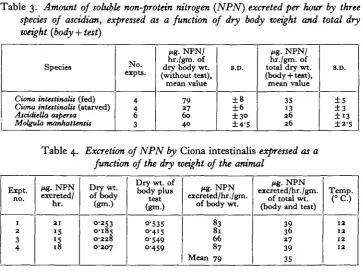
This relationship is summarized for all three species in Table 3, and an example of the detailed data is shown for Ciona in Table 4. In view of uncertainty about the precise nature and function of the ascidian test (which certainly contains living material, but is nevertheless a protective organ comparable to the lamellibranch shell) the data have been expressed in two ways: as a function of body weight without the test, and as a function of total body weight including the test. Table 3. Amount of soluble non-protein nitrogen (NPN) excreted per hour by threespecies of ascidian, expressed as a function of dry body weight and total dry weight {body + test)
Species
Ciona intestinalis (fed) Ciona intestinalu (starved) AscidUUa atpersa Molgula manhattentis JNo. expts. 4 4 6 3
Mf- N P N / hr./gm. of dry body wt. (without test), mean value 79 27 6 0 4 0 8.D. ±8 ±6 ±3° ±4-5 Mg- NPN/ hr./gm. of total dry wt. (body + test), mean value 35 13 26 26 8.D. ±5 ±3
± 1 3
±2-5
Table 4. Excretion of NPN by Ciona intestinalis expressed as a
function of the dry weight of the animal
Expt. no. 1 2 3 4 fig. NPN excreted/ hr. 21 15 15 18 Dry wt. of body (gm.) 0-253 0-185 O-2Z8 O-2O7
Dry wt. of body plus test (gm.) O-535 0-415 0-549 0-459 Mg. NPN excreted/hr./gm.
of body wt.
83 81 66 87 Mean 79 Mg. NPN excreted/hr. /gm.
of total wt. (body and test)
39 36 27 39 35 Temp. (°C.) 12 12 12 12 DISCUSSION
The figures obtained for ammonia and total nitrogen excretion in ascidians may be compared with those for other animals in two ways. The ammonia nitrogen as a percentage of NPN may be compared in animals from a similar environment, and the total nitrogen excreted per gram of dry weight per hour may also be compared.
Table 5. The percentage of ammonia nitrogen (AmN) excreted in relation
to total non-protein nitrogen (NPN) in some marine animals
Animal
Coelenterata
Actinia
Annelida
Aphrodite Stpunculiu
Arthropoda
Gammanu locusta Carcmus
Meria
Mollusca
Mytilut Mya
Littorina (summer) Littorina (winter) Sepia
Octopus
Echinodermata Urochordata
Ciona intestinalis Atcidiella asperta Molgula manhattensis
AmN
NPNXI°°
52-7
8 0
S°
8 0
67-8
4 2 9
0-11-4 ai-5
4 0 61 67
33-SO 25-48
87
95 88
Authority
Delaunay (1934)
Delaunay (1937) Delaunay (1934)
Dresel & Moyle (1950) Delaunay (1934) Delaunay (1927)
Spitzer (1937) Delaunay (1937)
Spitzer (1937) Delaunay (1934) Delaunay (1934) Delaunay (1934)
Present work Present work Present work
Table 5 shows the percentage of ammonia in relation to the total NPN in a number of marine animals. It is apparent that the figures found for ascidians are high compared with most other animals, the only ones that approach anywhere near to the ascidian figures being Gammarus locusta (80%) and Aphrodite (80%). Ammonia production varies with a number of different factors; Specht (1934) found that in the protozoan Spirostomum large amounts of ammonia were excreted when the oxygen tension was less than that corresponding to equilibrium with air. Oxygen tension is unlikely to have been low in the experiments of this investigation. More important perhaps is the relation between food and ammonia production. Thus in Paramecium Cunningham and Kirk (1941) found that in the absence of substrate ammonia production was about 91 %, with fibrin it was about 76%, with glucose 35 % and it disappeared altogether when starch was used as substrate. In
Lumbricus Cohen & Lewis (1949) give a figure of 66-91 % for normal animals and
less than 10% when they are starving; for the same animal Delaunay (1934) gives 21-47% for starved and 47% for fed animals. In the present experiments with
Ciona intestinalis values ranging from 47 to 98 % ammonia nitrogen were obtained
Nitrogen excretion in ascidiacea 303
Some animals excrete more of their nitrogen as ammonia in winter than in summer. Thus Littorina (Spitzer, 1937) excretes 61 % as ammonia in winter and only 40% in summer, and similarly Unto (idem) excretes 44% in winter as against 25% in summer; these differences are possibly due to differences in habitat and feeding at different seasons. The experiments on ascidians were all carried out in the winter months.In the absence of evidence to the contrary it is considered that the high ammonia fraction in ascidians is normal and is correlated with the high turnover of water in these animals. Nevertheless, in the lamellibranch molluscs Unto and Mytilus which by virtue of their filter-feeding habits have a somewhat similar mode of life to ascidians, there is a relatively low ammonia fraction in the total excreted soluble nitrogen (Spitzer, 1937). However, both these animals have a relatively high amino-fraction in their excreted nitrogen which suggests that their protein metabolism is inefficient.
The figures calculated for total NPN in relation to dry weight of tissue in ascidians compare quite favourably with what is to be found in other animals. Very few actual figures are to be found in the literature, but they may be roughly calculated from the known data, so as to demonstrate that the excretion of nitrogen by ascidians is of an order comparable to that found in other animals. Data are given for milligrams of total nitrogen excreted per 24 hr. per 100 g. of wet weight for molluscs (Spitzer, 1937), Anodonta sp. and Hirudo medicinalis (Przylecki, 1922) and the earthworm Pheretima posthuma (Bahl, 1945). For amphipods and isopods Dresel & Moyle (1950) give data expressed in milligrams per 10 gm. wet weight per 24 hr. Dry weight figures for these species are not given; Weinland (1918) quotes a figure of 9 % of the wet weight in Anodonta (without the shell), and in the absence of better data dry weight has been assumed to be 10 % of wet weight for all the animals named. This procedure is questionable as some species will undoubtedly have higher values, but it provides an approximate means of comparing the data. The data for all these animals are set out in Table 6. The figures for molluscs from Spitzer and Przylecki are weights without shell.
The figures given for ascidians, while of the same order as for other animals, are somewhat high particularly when compared with the filter-feeding molluscs Unto,
Anodonta and Mytilus; the discrepancy is not quite so big if the test is included in
3°4
In comparison with the amphipods, particularly Gammarus zaddachi, the ascidian values are low. This is to be expected if only on the grounds that amphipods are fairly active animals and will undoubtedly have a higher metabolic rate than ascidians; the difference may also be accentuated by the manner in which dry weight values have been estimated.
Table 6. Comparison of total soluble non-protein nitrogen excreted in various
animals expressed as a function of wet weight and of dry weight
Nota. (i) Except in ascidians dry weights are not known; dry weight is taken as being 10 % of wet
weight (see text), (ii) Season of the year is only known for ascidiana and molluscs other than
Anodonta. (iii) Species nomenclature of amphipods and isopods (other than Asellus aquaticus)
follows Spooner (1947), Sexton and Spooner (1940), and Webb & Sillem (1906). Asellus aquaticus I.,, is presumably the species referred to.
Animal
Ciona (without test) Ciona (with test) Ascidiella (without test) Ascidiella (with test) Molgula (without test) Molgula (with test)
Unto Mytilus Paludina Littorma Limnaea Arion Anodonta Hirudo Pheretima Ligia oceamca Oniscus asellus Porcellio laevis Armadillidium vulgare Asellus aquaticus Gammarus locusta G. zaddachi G. pulex Marinogammarus marinus M. pirloti Orchestia sp.
Mg. N/ioo g. wet wt./24 hx.
Summer — — — — — 5-8 — 2-7 57-o 15-9 26-s Winter — — — — — 1-4 2-8
I -4
23-7
— 2-4 1 3 2
5'» 13 3 3 4 2 6 49 6 0 23 1 1 2 9 2 0 Mg- N/g. dry wt./hr. Summer — — — — — 2 4 1 1
2 4 0 66 n o Winter 79 35 6 0 2 6 4 0 2 6 6 1 2 6 99 2 1 — 1 0 55 2 2 54 1 2 1 2 17 108 204 2 5 0
96 46
1 2[ 83 Authority Present work Present work Present work Present work Present work Present work Spitzer (1937) Spitzer (1937) Spitzer (1937) Spitzer (1937) Spitzer (1937) Spitzer (1937) Przylecki (1922) Przylecki (1922) Bahl (1945)
Dresel & Moyle (1950 Dresel & Moyle (1950 Dresel & Moyle (1950 Dresel & Moyle (1950 Dresel & Moyle (1950) Dresel & Moyle (1950) Dresel & Moyle (1950) Dresel & Moyle (1950) Dresel & Moyle (1950)
Dresel & Moyle (1950) Dresel & Moyle (1950)
The important point therefore, which emerges from this work is that ascidians are essentially similar to other aquatic animals in this aspect of their physiology, and there are good grounds for supposing that their protein metabolism is ammono-telic. The question of storage excretion and its significance will be returned to in a second paper.
SUMMARY
Nitrogen excretion in ascidiacea 305
2. Three species of ascidian have been studied: Ciona tntesttnalis, Ascidiella
aspersa and Molgula manhattensis. Evidence is brought forward to show that these
ascidians excrete soluble nitrogen chiefly in the form of ammonia.
3. The quantities of soluble non-protein nitrogen excreted are slightly higher than is found in the filter-feeding molluscs; this is probably due in part to an increased metabolic rate subsequent to transport and handling.
4. Ammonia may form as much as 95 % of the total non-protein nitrogen excreted.
5. The methods employed are subject to an error up to 10%. Appropriate acknowledgements will be made in the second paper.
REFERENCES
BAHL, K. N. (1945). Studies on the structure, development and physiology of the nephridia of Oligochaeta. VI. The physiology of excretion and the significance of the enteronephric type of nephridial system in Indian earthworms. Quart. J. Micr. Set. 85, 343-89.
BURIAN, R. (19Z4). Die Exkretion: Tunicaten. In Handbuch der vergleichenden Pkysiologie. Edited by H. Winterstein.
COHEN, S. & LEWIS, H. B. (1949). Nitrogenous metabolism of the earthworm (Lumbricus terrestris).
Fed. Proc. 8, 191.
CUNNINGHAM, B. & KIRK, P. L. (1941). The chemical metabolism of Paramedttm caudatum. J. Cell.
Comp. Physiol. 18, 299-316.
DELAUNAY, H. (1927). Tav. de la Station Biologique d'Arcachon, 1927. 1. Quoted by Needham
DELAUNAY, H. (1931). L'Excretion azot£e des invertebres. Biol. Rev. 6, 265-301.
DELAUNAY, H. (1934). Le m£tabolisme de Pammoniaque d'apres les recherches relatives aux invertebres. Ann. Physiol. Phyticochim. Biol. 10, 695-725.
DRESBL, E. I. B. & MOYLE, V. (1950). Nitrogenous excretion of Amphipods and Isopods. J. Exp.
Biol. 37, 210-25.
JORGENSEN, C. B. (1952). On the relation between water transport and food requirements in some marine filter feeding invertebrates. Biol. Bull., Woods Hole, 103, 356-63.
MARKHAM, R. (1942). A steam distillation apparatus suitable for micro-Kjeldahl analysis. Biochem.J. 36, 790-91.
NEEDHAM, J. (1929). Protein metabolism and organic evolution. Sci. Progr. Twent. Cent. 33, 633-48. NEEDHAM, J. (1931). Chemical Embryology. Cambridge University Press.
PATEL, S. M. & SREENTVASAN, A. (1948). Selinum as a catalyst in Kjeldahl digestions. Analyt.Chem. ao, 63-5.
PRZYLECKI, ST. J. (1922). L'excretion ammoniacale chez les invertebres dans les conditions normales et exp^rimentales. Arch. int. Physiol. 30, 45-51.
PRZYLECKI, ST. J. (1926). La repartition et la degradation de 1'acide urique chez les invertebres.
Arch. int. Physiol. 37, 157—202.
SEXTON, E. W. & SPOONBR, G. M. (1940). An account of Marinogammarus (Schellenberg) Gen. Nov. (Amphipoda), with a description of a new species, M. pirloti. J. Mar. Biol. Ass. U.K. 34, 633-82.
SOMOGYI, M. (1945). Determination of blood sugar. J. Biol. Chem. 160, 69-^73.
SPECHT, H. (1934). Aerobic respiration in Spirostomum ambiguum and the production of ammonia.
J. Cell. Comp. Physiol. 5, 310-33.
SPITZER, J. M. (1937). Physiologisch-flkologische untersuchungen fiber den exkretstoffwechsel der Mollusken. Zool. Jb. (Abt. 3), 57, 457-96.
SPOONER, G. M. (1947). The distribution of Gammarus species in estuaries. Part 1. J. Mar. Biol.
Ass. U.K. 37, 1-52.
WEBB, W. N. & SILLEM, C. (1906). The British Woodlice. London.