A Study on Impact of Buy Back of Shares
N. Sushmitha
Anurag Group of Institutions, India
Abstract: The present study examines the reaction of market share prices on announcement of share buyback, as a tool of restructuring of shares and the regulation of buyback practices in India. Companies announce buyback of shares either to increase the value of issued shares or to eliminate any fear by shareholders who may be looking for a controlling stake. The effect of announcement of buyback is always revealed on share prices. The selected companies and its impact on financial performance before and after buy back of shares
Keywords: Share prices of the company, company performances before and after buy back announcement
I. INTRODUCTION
Revolution of Stock Market buying of shares can trade back to 16th Century. Likewise, Buyback of shares have been popular in many countries like United States of America, Canada, Germany, Japan and United Kingdom in the year 1980- 1990 started the Buyback of shares program in their countries. Under the Securities and Exchange Commission (SEC) procedures, buyback of shares by US corporations can be done in four different methods, namely,
A. Open market repurchases, B. Fixed price tender offer, C. Dutch auction tender offers and D. Privately negotiated repurchase
The buyback of shares was referred as the repurchase of company own shares. Before 1998 the buyback of shares by company was prohibited under section 77 of the Indian Companies Act. Now in India Company repurchase their own shares after the companies Act (Amendment) 1999. A number of companies such as Reliance Industries and Ashok Leyland offered to buy back the equity shares immediately.
Conditions of Buy Back of Shares
1) A company that buyback back it shares will not be issued with fresh capital, except bonus issue, for the next 12 months. 2) The company has to state the amount to be used for the buyback of shares and seek prior approval of shareholders.
3) The buyback of shares can be processed only by utilizing the free reserves like reserves not specifically earmarked for some purpose.
4) The company must not borrow funds to buy back shares
5) The shares bought under the buyback schemes will be extinguished and they cannot be reissued.
a) Impact of share Buyback: Companies have believed that the buyback will be financially beneficial for the company, the buying shareholders and the remaining shareholders. If the company distributed surplus cash or free cash flow and it maintains its operating efficiency, EPS will improve. The share price will improved as Price Earnings ratio has expected to remain the same after the buyback. And debt equity ratio will improve because reduced the equity capital. Firms will low debt equity ratio will be able to move the companies to their target capital structure.
II. OBJECTIVES OF THE STUDY
A. To study the buyback announcement of share prices of the company before and after buy back B. To study the performance of the company post and pre announcement of buy back of shares
III. NEED FOR THE STUDY
Buyback of shares was a corporate tool or financial re-engineering in an organization. Buyback of shares has been very familiar in US but it was unfamiliar in India. There was hardly any Indian research related to Buyback of shares to help and guide the corporate managers, Investors, Market regulators, Policy makers, Teachers and students on this subject. Beside these, the research may throw some light on why the companies were going for buyback of shares and what were the factors influence them for participating in stock market.
IV. SCOPE OF THE STUDY
The study has been confined to all the companies listed in Indian stock exchange specially NSE, and BSE has gone for buy back of shares recently
A. Significance of the Study
Share buyback by Indian companies is gaining popularity. Companies as well as capital market can be thus rejuvenated by resorting to this new tool of financial re-engineering. The decisions - whether are all that attractive to company and its shareholders depend upon many factors, which may be unique to each case. Due consideration has been given to each factor before a final decision is made. This study will help in understanding all factors. This study will help in understanding regulatory requirement of the buyback decision as many a time company use buy back decision to manipulate the price. How to buyback decision more efficient and transparent.
V. RESEARCH METHODOLOGY
1) Data Collection: As per this research, the secondary data from difference sources and websites was used.
2) List of selected Companies: Eclerx services ltd, Quick heal technologies ltd, Tech Mahindra ltd, Coal India ltd, Ongc ltd 3) Secondary Data: Secondary data is collected from already available data i.e. in this research utilized the secondary data from
various sources of websites
VI. REVIEW OF LITERATURE
Alice et al (2013) explained the abnormal returns of repurchasing firms with net insider buying versus net insider selling in a given quarter were significantly higher for the quarter immediately after the repurchase and the three subsequent years. For repurchases accompanied by net insider selling, abnormal returns were negligible after only one year. Share repurchases associated with net insider selling were positively related to illiquidity, option exercises by insiders and pre-repurchase returns and negatively correlated with industry-adjusted book to market ratios when compared to other repurchases.
Andreas and Alexandre (2006) studied on abnormal returns for the period from May 1998 to April 2003. This author that found positive abnormal returns of 5 percent around the statements to seek approval by the annual general meeting of shareholder (AGM), and abnormal returns of almost 7 percent at the time of the repurchases. By taking these two events together, the valuation effects sum up to about 12 percent. These reports announcement effected four times higher for Germany than reported in studies for the U.S.
Amedeo etal (2012) showed that companies tend to buyback of shares when the share price was slopes down. And also showed that there were negative abnormal returns in preceding months of buyback and positive abnormal returns in periods of following months with repurchase activity. Samples were only 4795 companies in the U.S Companies of the Whole Universe (listed on NYSE, NASDAQ and AMEX).
Dann (1981)investigated that share buy-back led to shareholders experiencing positive share returns of approximately 15 percent and that these positive returns were mostly permanent in that share prices did not return to their pre-buy back date levels David and Garrison (1989) examined the impact of common stock repurchasing firms common stock returns. They have many other studies undertaken in the past on the usage of event study methodology to measure the likely impact of buyback announcements on share prices and their returns, however, this was a first study undertaken in Indian scenario.
Masulis and Mayers (1991) have found abnormally high earnings by the companies follow buy-backs, according to this study managers announce buy-backs when they believe the shares of their company are undervalued.
Harris and Ramsay (1995) examined share buy-back for the period 1989-93 in Australia. They found that although the announcement of share buy-backs is associated with a positive abnormal price performance, the effect is not statistically significant. Pavabutr and Sirodom (2008) examined the impact of stock splits on stock price and various aspects of liquidity using daily and intra-day data from the Stock Exchange of Thailand between 2002- 2004. Their paper finds evidence that stock splits can have favourable impact on stock price through reduction of trade frictions such as bid-ask spreads and price impact measures
VII. DATA ANALYSIS AND INTERPRETATION
[image:3.612.66.551.205.345.2]These are the 5 selected companies’ announcement of the buyback of shares
Table No: 1 shows the public announcement of floor price of the shares, starting date and ending date, buy back size through BSE, and NSE
Announcement
date of buyback Starting date Ending date Floor price Buyback size Eclerx services
ltd
14-march-2019 31-may-2019 14-june-2019 1500 1746666
Quick heal
technologies ltd 5-March-2019 20-May-2019 31-May-2019 275 6363636 Tech Mahindra
ltd
21-Feb-2019 25-march-2019 05-April-2019 950 20585000
Coal India ltd 04-Feb-2019 01-March-2019 15-March-2019 235 44680850 ONGC ltd 20-Dec-2018 29-Jan-2019 11-Feb-2019 159 252955974
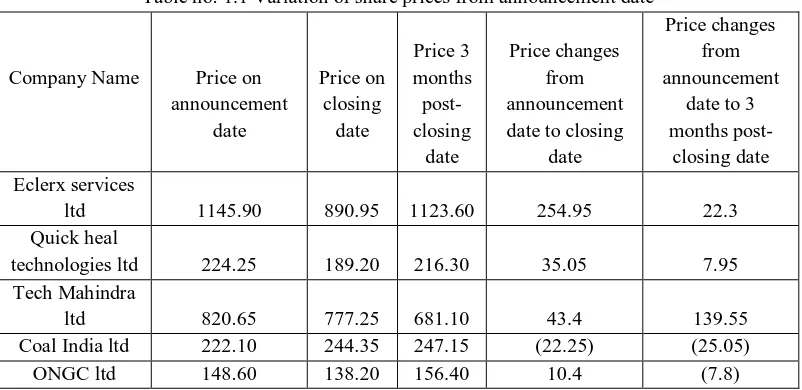
During the period of buy back that is from starting start to closing date of offer the post buy back has been studied and the share price is more than 15%of the firm announcing buy back has high. The similar movement can also be noticed in longer period from starting to ending period of the offer, on comparing the share price on closing date and before two months of announcement of share price is made to be positive.
Table no: 1.1 Variation of share prices from announcement date
Company Name Price on announcement
date
Price on closing
date
Price 3 months post-closing
date
Price changes from announcement date to closing
date
Price changes from announcement
date to 3 months
post-closing date Eclerx services
ltd 1145.90 890.95 1123.60 254.95 22.3 Quick heal
technologies ltd 224.25 189.20 216.30 35.05 7.95 Tech Mahindra
ltd 820.65 777.25 681.10 43.4 139.55 Coal India ltd 222.10 244.35 247.15 (22.25) (25.05) ONGC ltd 148.60 138.20 156.40 10.4 (7.8)
[image:3.612.107.508.432.627.2]To study the performance of the companies post and pre announcement of buy back depends upon the following financial ratios 1) Return on Assets: ROA = Net income/ total Assets
2) Return on Equity: ROE = Net income/shareholder equity
3) Earnings per share: EPS = Profit after tax/ Number of shares out standing 4) Price Earnings Ratio: P/E Ratio= Market value of share/EP
A. Eclerx services ltd
1) About the Company: Eclerx is an Indian IT consulting and outsourcing multinational company based in Mumbai and Pune. Eclerx is a public limited company shares are listed on the Bombay Stock Exchange and National Stock Exchange of India. 2) Offer: The Board of Directors of the Company at its meeting held on 14.03.2019 has interalia approved a proposal to buy back
up to 17, 46,666 Equity Shares of the Company, being 24.95% of the total paid up equity share capital and free reserves of the Company, for an aggregate amount not exceeding Rs.262 Cores at Rs. 1500 under the "Tender offer" route using the stock exchange mechanism
[image:4.612.67.550.432.496.2]3) Buy Back Strategy: Eclerx services ltd estimated the entitlement ratio to be 40-42 percent. However, the real acceptance ratio should be 30-40 percent higher as many shareholders do not take part in the buyback. Eclerx services ltd estimated the acceptance ratio to be around 55-60 percent. Earlier too, the company had initiated a buyback twice with a reasonable acceptance ratio. Moreover, this buyback looks attractive as is available at a 41 percent premium. The maximum tenure is estimated at 3-4 months
Table no:2.3 Information for calculation of financial ratios Particulars Before buy back After buy back
Total Assets 1095.35 1305.21
Net worth 1056.72 1266.49
Number of shares as per market price 101.03 110.05 Profit After Tax(PAT) 278.12 209.16
Table no: 2.4 financial ratios of the Eclerx services ltd
Particulars Before buy back After buy back
Return on Assets 21.54 13.94
Return on Equity 25.39 16.05
Earning per share (EPS) 73.23 60.07
Price Earning ratio (P/E) 13.7 18.3
Comparison of the company before and after buy back of shares:
4) Return on Assets: Company’s ROA in the year 2018 was 21.54 and in year 2019 was 13.94 this is due to increase in the total assets which goes up from rs.1095.35 core to 1305.21 core.
5) Return on Equity: Company’s ROE has decreased from 25.39 in 2018 to 16.05 in 2019 reason behind this is that total net worth of the company has been increased from s.1056.72crore to 1266.49 crore in 2019.
6) Earning per Share: Company’s EPS has decreased from 73.23 in 2018 to 60.07 in 2019 due to increase in the shareholding percentage of the company before and after buy back of shares
7) Price Earnings Ratio: Company’s P/E ratio has increased from 13.7 to 18.3 due to increase in market value of share from 101.03 in 2018 to 110.03 in 2019
B. Quick Heal Technologies Ltd
1) About the Company:Quick Heal Technologies Ltd is an IT security Solutions Company headquartered located at Pune India. The company was formerly known as CAT Computer Services Ltd and was started as a computer service center in 1995. The company renamed as Quick Heal Technologies Pvt. Ltd. in 2007.
3) Buy back strategy:The primary objective of a share buyback programme is to arrest the fall in the value of a stock by reducing the supply of the stock, which essentially pushes up the share price through a better P/E multiple.
Table no: 2.5 Information for calculation of financial ratios Particulars Before buy back After buy back
Total Assets 679.06 794.06
Net worth 678.05 724.31
Number of shares as per market price
123.53 132.09
Profit After Tax(PAT) 78.88 83.96
Table no:2.6 Financial ratios of the Quick heal technologies ltd: Particulars Before buy back After buyback
Return on assets 9.93 9.79
Return on equity 10.56 10.70
Earning per share 11.21 11.90
Price earnings ratio(P/E) 11.05 11.10
Comparison of the company before buy back and after buy back
4) Return on Assets: Company’s ROA in the year 2018 was 9.93 and in year 2019 was 9.79 this is due to increase in the total assets which goes up from rs.679.06core to 794.06core.
5) Return on Equity: Company’s ROE has decreased from 10.56 in 2018 to 10.70 in 2019 reason behind this is that total net worth of the company has been increased from Rs. 679.05crore to Rs. 724.31 crore in 2019.
6) Earning per Share: Company’s EPS has increased from 11.21 in 2018 to 11.90 in 2019 due to increase in the shareholding percentage of the company before and after buy back of shares
7) Price Earnings Ratio (P/E): Company’s P/E ratio has increased from 11.05to 11.10 due to increase in market value of share from 123.53 in 2018 to 132.09 in 2019
C. Tech Mahindra ltd
1) About the Company:TechMahindraLimited is an Indian multinational subsidiary of the Mahindra Group, providing information technology (IT) services and business process outsourcing (BPO) to companies in various vertical and horizontal markets. Anand Mahindra is the Chairman of Tech Mahindra, which is headquartered at Pune and has its registered office in Mumbai.
2) History: Mahindra & Mahindra started a joint venture with British Telecom in 1986 as a technology outsourcing firm. British Telecom initially had around 30 percent stake in the Tech Mahindra Company. In December 2010, British Telecom sold 5.5 per cent of its stake in Tech Mahindra to Mahindra & Mahindra for Rs 451 crore. In August 2012, British Telecom sold 14.1 per cent of its stake to institutional investors for about Rs 1,395 crore. In December 2012, British Telecom sold its remaining 9.1 per cent (11.6 million shares) shareholding to institutional investors for a total gross cash proceeds of Rs 1,011.4 crores. This sale marked the exit of British Telecom from Tech Mahindra.
3) Offer: Approved the proposal to the buyback of not exceeding 20,585,000 equity shares (representing 2.10% of the total number of equity shares in the paid-up share capital of the Company) at a price of Rs.950 per equity share (the "Buy Back Offer Price") payable in cash for an aggregate consideration not exceeding Rs.1,956 Crore (the "Buyback Offer Size") through " Tender Offer".
[image:5.612.64.547.239.307.2]Table no: 2.7 Information for calculation of financial ratios
Particulars Before buy back After buy back
Total Assets 21882.10 20916.50
Net worth 20771.80 21877.80
Number of shares as per market price 622.81 700.27 Profit After Tax(PAT) 3999.30 4380.40
Table no: 2.8 Financial ratios of the Tech Mahindra ltd:
Particulars Before buy back After buy back
Return on assets 14.92 14.43
Return on equity 20.46 21.21
Earning per share 40.84 44.54
Price earnings ratio(P/E) 15.25 15.70
Comparison of the company before buy back and after buy back
5) Return on Assets: Company’s ROA in the year 2018 was 14.92 and in year 2019 was 14.43 this is due to decrease in the total assets which goes down from RS.21882.10 core to 20916.50core.
6) Return on Equity: Company’s ROE has decreased from 20.46 in 2018 to 21.21 in 2019 reason behind this is that total net worth of the company has been increased from Rs. 20771.80 crore toRs. 21877.80 crore in 2019.
7) Earning per Share: Company’s EPS has increased from 40.84 in 2018 to 44.54 in 2019 due to increase in the shareholding percentage of the company before and after buy back of shares
8) Price Earnings Ratio (P/E): Company’s P/E ratio has increased from 15.25 to 15.70 due to increase in market value of share from 622.81 in 2018 to 700.27 in 2019
D. Coal India ltd
1) About the Company:Coal India Limited (CIL) the state owned coal mining corporate came into being in November 1975. With a modest production of 79 Million Tonnes (MTs) at the year of its inception CIL today is the single largest coal producer in the world. Operating through 82 mining areas CIL is an apex body with 7 wholly owned coal producing subsidiaries and1 mine planning and Consultancy Company spread over 8 provincial states of India. CIL also manages 200 other establishments like workshops, hospitals etc. Further, it also owns 26 technical & management training institutes and 102 Vocational Training Institutes Centers. Indian Institute of Coal Management (IICM) as a state-of-the-art Management Training ‘Centre of Excellence’, the largest Corporate Training Institute in India - operates under CIL and conducts multi-disciplinary management programmers CIL is a Maharatna company - a privileged status conferred by Government of India to select state owned enterprises in order to empower them to expand their operations and emerge as global giants. The select club has only few members out of more than Central Public Sector Enterprises in the country.
2) Offer: Approved the proposal to the buyback of not exceeding 4, 46,80,850 equity shares (representing 0.72% of the total number of equity shares in the paid-up share capital of the Company) at a price of Rs. 235 per equity share (the "Buy Back Offer Price") payable in cash for an aggregate consideration not exceeding Rs. 1,050 Crore (the "Buyback Offer Size") through " Tender Offer".
3) Buy Back Strategy:The Buyback is being undertaken by the Company to return surplus funds to its Shareholders. Additionally, the Company’s management strives to increase Shareholders’ value and the Buyback would result inter alia in the following: a) The Buyback involves allocation of higher of number of equity shares as per their entitlement or 15% of the number of equity
shares which the Company proposes to Buyback reserved for small shareholders. The Company believes that these reservation small shareholders would benefit a large number of public Shareholders, who would get classified as “Small Shareholders; b) The Buyback may help in improving return on equity, by reduction in the equity base, and other financial ratios, thereby
leading to long term increase in Shareholders’ value; and
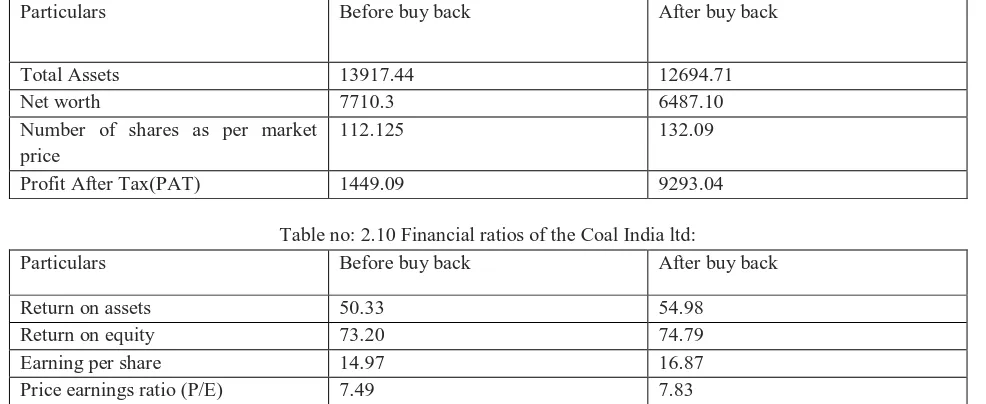
Table no.:2.9 Information for calculation of financial ratios Particulars Before buy back After buy back
Total Assets 13917.44 12694.71
Net worth 7710.3 6487.10
Number of shares as per market price
112.125 132.09
[image:7.612.62.555.91.293.2]Profit After Tax(PAT) 1449.09 9293.04
Table no: 2.10 Financial ratios of the Coal India ltd:
Particulars Before buy back After buy back
Return on assets 50.33 54.98
Return on equity 73.20 74.79
Earning per share 14.97 16.87
Price earnings ratio (P/E) 7.49 7.83
Comparison of the company before buy back and after buy back
4) Return on Assets: Company’s ROA in the year 2018 was 50.33 and in year 2019 was 54.98 this is due to decrease in the total assets which goes down from RS.13917.44 core to 12694.71 core.
5) Return on Equity: Company’s ROE has decreased from 73.20 in 2018 to 74.79 in 2019 reason behind this is that total net worth of the company has been decreased from Rs. 7710.3crore to Rs. 6487.30 crore in 2019.
6) Earning per Share: Company’s EPS has increased from 14.97 in 2018 to 16.87 in 2019 due to increase in the shareholding percentage of the company before and after buy back of shares
7) Price Earnings Ratio (P/E): Company’s P/E ratio has increased from 7.49 to 7.83 due to increase in market value of share from 112.12 in 2018 to 132.09in 2019
VIII. FINDINGS AND CONCLUSION
A. Findings
1) The effect of buyback announcement on share price is positive with reference to selected companies. When buyback of shares is announced then the share price goes up means the buyback news gives good return.
2) Buyback of shares is fundamentally a method of readjusting the capital structure of the company and as such does not reverse the warning of shareholder wealth maximization
3) Through bay back the company assets are increased, and the market value of shares price increased before and after buy back announcement
4) Earnings per share value increased because of buy back of shares
5) Through buy back of shares the shares holders will get maximum returns and they can increase the shareholders wealth maximization
6) The market returns of all buyback companies before and after the buyback of shares. It denotes that there is a positive movement of share price after the event. It indicates that the difference among the market prices is highly deviated by comparing the Pre-event period. Approximately the difference is increased by 50%. The overall average returns are increased, there is possibility for negative return, hence it is very important to watch the market very keenly and investment should be done during buyback announcement.
7) Most of the companies participated in buyback of shares in order to maintain optimal capital structure. Free cash flow has the second factor to obtain buyback of shares decision in company. Some of the factors negatively influenced the buyback of share announcement such variables company will concentrated like current assets and total assets etc.
B. Conclusion
While scrutinizing a buyback offer, attention must be paid to the size of the buyback relative to the company’s free float and with the newly granted stock options. The buyback announcements are a mere statement of the company’s intentions and need not necessarily be effected in actuality. However, if the announcement is backed by a tender offer, the possibility of the fulfillment of buyback promise does exist. Buyback of shares as a process of capital restructuring which allows a company to buy back its own shares, which were issued by it earlier. Companies’ buyback shares either to increase the value of shares. Most of the companies participated in buyback of shares in order to maintain optimal capital structure. Impact on share price for buyback decision, before buyback announcement there are slight changes in the share price but after the buyback announcement in company there is big change in the company share price.
REFERENCES
[1] PUNITHAVATHY PANDIAN (SECOND EDITION): “Security analysis and Portfolio management”, Vikas publishing house pvt.ltd.
[2] M. RANGANATHAM &R.MADHUMATHI (2006): “Investment analysis and portfolio management” , Pearson education.
INTERNAL SOURCES
A. https://www.moneycontrol.com/nifty/nse/nifty-live
B. https://www.moneycontrol.com/stock-charts/statebankindia/charts/SBI#SBI C. https://www.moneycontrol.com/stock-charts/hdfcbank/charts/HDF01#HDF01 D. https://www.moneycontrol.com/stock-charts/infosys/charts/IT#IT
E. https://www.moneycontrol.com/stock-charts/wipro/charts/W#W