279
©IJRASET: All Rights are Reserved
Categorizing and Labelling of Twitter Dataset
using RCNN Model
Pradnya Saval
1, Tahera Shaikh
21, 2Computer Engineering Department, Mumbai University
Abstract: The fast advancement in the Web, web based business and interpersonal organizations realizes a lot of client created messages on the Web, for example, online surveys for items, administrations and web journals. Such messages as online audits are typically subjective and semantic arranged. The semantic introduction to separate and classify such messages appropriately is of incredible research and commonsense esteem. Order of writings is trying due of limited logical data and the scanty semantic data they regularly contain. The current research on content arrangement of writings fundamentally incorporates include based methods. The advancement of profound learning models has accomplished astounding outcomes in PC vision and discourse acknowledgment. In this content categorization method we will actualize the use of Convolution Neural Systems (CNNs) and Intermittent Neural Systems (RNNs) which acknowledges dynamic length input utilizing online networking information, for example, twitter. The proposed framework expects to build the execution measurements, for example, time and exactness to over 80% contrasted with other profound learning strategies.
Keywords: Neural network, Convolutional neural network, Recurrent neural network, Twitter dataset, Deep learning
I. INTRODUCTION
Content classification is the undertaking of appointing predefined classes to content records. It gives applied perspectives of reports and is utilized as a part of different applications in reality. For instance, cooking formulas are commonly sorted out by kind of fixings utilized, having a place with different land locales, formulas given by individual gourmet experts, scholastics can be classified to various spaces, therapeutic reports can be arranged to various tests et cetera. Spam separating is another application for content order where we channel or sort messages which are not to our significance. Content classification depends on words in which straightforward measurements of the mixes of words are performed till date. On the other hand, different analysts have discovered profound taking in valuable in isolating data from crude information running from PC vision to discourse acknowledgment to content arrangement. Characteristic dialect handling (NLP) has helped a great deal from the restoration of profound neural systems (DNN). There are different sorts of DNN designs in particular Recursive Neural System (RecursiveNN), Repetitive Neural System (RecurrentNN) and Convolutional Neural System (CNN). To beat the impediments of RNN calculation two new sorts of calculations have been created to be specific Long here and now memory (LSTM) and Gated Intermittent Unit (GRU)[1][4]. The following are the various models in deep learning:
A. Recursive Neural Network (RecursiveNN):
RecursiveNN has turned out to be effective in building sentences. The RecursiveNN grab the clarification of a sentence utilizing a tree structure. The execution of this model wholely relies upon the portrayal of the tree structure giving the time multifaceted nature of O(n2) where n is the length of the content. Utilizing this model could be tedious at the point when the model takes a shot at long sentences and even relationship betweentexts is difficult to speak to utilizing a tree structure. Along these lines it is expressed that demonstrating long sentences by recursive neural system is deficient [2]. The principle preferred standpoint of recursive neural organize is that it is proficient in building sentences anyway it is wasteful to demonstrate long sentences and reports. The execution of this model relies upon the literary tree structure and along these lines the execution corrupts as the tree structure increments relying on the content.
B. Recurrent Neural Network (Recurrent NN)
280
©IJRASET: All Rights are Reserved
RNN has the catch the logical data and can catch semantics of long messages as it can deal with self-assertive information and yield lengths. The utilization of RNN is for the most part utilized for content and discourse examination [3].
C. Convolutional Neural Network (CNN)
CNN reports higher execution contrasted with RecurrentNN. CNN processes the most educational n-grams of the considerable number of words in a sentence and concentrates the most profitable data. CNN can be utilized of estimation arrangement as the feelings are controlled by key expressions. It is an unprejudiced model and uses sustain forward ANN to reasonably segregate phrases utilizing a maximum pooling layer. In this manner CNN can catch semantic data superior to repetitive and recursive neural system. The time many-sided quality of CNN is likewise O(n). Be that as it may, the past examinations tend that CNN utilize straightforward convolutional bits because of which it is hard to decide the measure of the window. . The utilization of CNN is for the most part utilized for picture and video handling [4].
D.Recurennt Convolutional Neural Network (RCNN)
To defeat the negative marks of the above model RCNN was presented for content arrangement. To start with, the bi-directional intermittent structure is connected which acquaint less commotion contrasted and other customary window based neural system and subsequently it gives better relevant data. Second, we present a maximum pooling layer which decently figures out which include assumes a vital part contrasted with different words in the sentence. Consequently, the RCNN is a blend of repetitive neural system and convolutional neural system with a period multifaceted nature of O(n) [4].
II. RELATEDWORK
CNN is joined with LSTM without the technique for word division. The technique utilized was Burn CNN in view of Zhang's display where k-max pooling is actualized rather than max-pooling. Max-pooling is a technique for down testing where a sliding window is utilized on a column and chooses a cell with most extreme esteem and after that the window is passed to next layer.[5] K-max pooling on the other hand doesn't have a window rather it performs choosing activity for the whole column. The best k esteems with greatest esteem is chosen and go to the following layer. In this way, the creators have utilized Singe CNN technique by utilizing k-max pooling which has the ability to acknowledge any length of contribution before a completely associated layer and gives preferable exactness over other conventional word-level strategies. This technique can be connected to other common dialects utilizing word division for future research.
In [2], the creator has connected RCNN an intermittent structure to catch the relevant data utilizing a bi-directional repetitive structure alongside the maximum pooling layer which removes the most significant element and key parts in the content or report. Utilizing this one-sided display the later words are more overwhelming than the past one. In any case, the viability is decreased as the key segments won't generally be available toward the finish of the archive as the basic convolutional bits are hard to decide the window measure. Henceforth, it is imperative to decide the window measure for a basic convolutional portion to decide the highlights of a document.
In [3], the creators have given a methodical examination of the profound learning models, for example, CNN, LSTM and GRU utilized as a part of characteristic dialect preparing and expecting to choose the most suitable profound neural system models. The strategies actualized contains the preparation information utilizing fundamental setup without complex traps and have utilized for scanning parameters for each demonstrate independently. The examination specifies that the CNN show utilizes convolutional layer and GRU models the contribution from left to right and utilize the last layer as the after effect of the info. Because of this the variety in the bunch estimate and shrouded measure causes wavering which can be overcome in the event that it can be enhanced to expand the execution of the models.
The utilization of CNN display removes lexical and sentence level highlights. The model takes all the word tokens and changes to vectors utilizing word embeddings. The lexical highlights are then removed by the things introduce in the sentence. After the extraction both the techniques are joined to deliver the last component vector. To determine which combine of words should be marks to the separate word. The creator has utilized SemEval-2010 Errand 8 dataset which is uninhibitedly accessible and contains 10,717 examples alongside 8,000 and 2,717 preparing what's more, test occasions individually. [4].
281
©IJRASET: All Rights are Reserved
There are two kinds of CNN in particular, clear adjustment of CNN from picture to content and second is basic CNN utilizing bag-of- words. There different strategies used to arrange utilizing CNN will be CNN for picture, CNN for content, seq-CNN for content and bow-CNN for content. The correlation of mistake rates (%) appeared in the paper, demonstrates that seq-CNN beats different strategies for classification utilizing three datasets in particular Motion picture Audits (IMIDB) with 8.74, Hardware Item Surveys (Elec) with 7.78 and News Articles (RCV1) with 9.96 [6].
TABLEII
RESEARCHTRENDSINDEEPLEARNING
Problem Methodology Future Scope
Mix of CNN and LSTM for word division. [1]
Zhang based model uses Roast CNN where the maximum pooling idea used to utilize k elements.
word division in other dialect handling.
Utilizations one-sided demonstrate. Be that as it may, the viability is
decreased because of confusion of segments toward the finish of the record. [2]
RCNN is utilized as the mix of utilizing the b-directional repetitive system alongside a maximum pooling layer which consequently gives the key parts in the document.
Determine the size bits in CNN.
Variety in group estimate and shrouded measure causes wavering. [3]
The strategies executed: Preparing information utilizing fundamental setup without complex traps. CNN utilizes convolutional layer then again GRU gets the
contribution from left hand side and gets the outcome from last layer.
Optimization of concealed size and bunch size to expand the execution of the models.
Determination of which name to be allocated to match of words. [4]
Explore the connection and concentrate the lexical highlights. It likewise determines which highlight should be marked. In the paper SemEval-2010 Undertaking 8 dataset is used.
It physically picks the best list of capabilities and increment the execution.
Less accomplishment in the change of data recovery [5]
Using CNN on different dataset and make two Conv-Nets one expansive and other little and introduce the weight utilizing Gaussian distribution.
Apply CNN to a huge scope of dialect preparing undertaking.
1D structure of content information should misuse for precise anticipate work. [6]
Two strategies to be specific straight forward CNN and pack of-words change are applied.
Increasing the proficiency of CNN show with the assistance of sack of-n-grams approach.
III.PROBLEMSTATEMENT
282
©IJRASET: All Rights are Reserved
[image:4.595.180.423.112.291.2]IV.PROPOSEDSYSTEM
Fig. 1. Proposed System Architecture
In the proposed framework, is partitioned into different stages:
1) Phase 1: The tweets are downloaded from twitter Programming interface which is in .json arrange. The downloaded tweets should be changed over into .csv arrange by pre-handling it for additionally preparing of the dataset.
2) Phase 2: The changed tweets request to be prepared by marking it in particular infected, preventive, informative and others.
3) Phase 3: Once the information is prepared the dataset is given to the models and loss function is figured
4) Phase 4: The yield of the model is tried relying upon the loss function and the preparation gave with respect to the figure shown below.
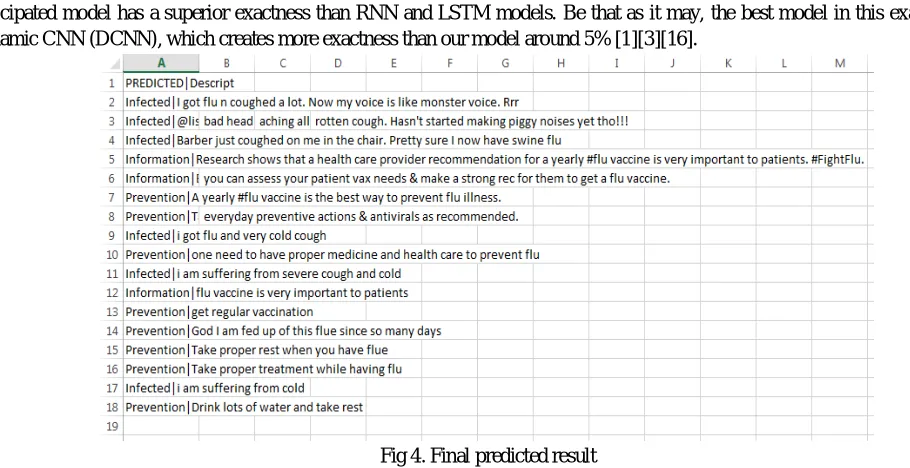
The train model utilizes the dimension vector for each word and the dataset is split into training data and test data along with dev data. A directory is created which stores the data that is trained by the model along with the timestamp of that training instance. The model is then evaluated using the training data and the test samples i.e., the tweets. For every batch the data is trained and stored in the directory that is categorized as description and the category.
Once the data is trained the next step is to predict the models using the test data that are random flu tweets extracted from the Twitter API. The .csv file is loaded in the model along with the predicted and description as the heading. The predictions are then classified dependending on the dictionary that is feed to the system and with the help of trained data the tweets are classified as preventive, infected and information.
[image:4.595.209.403.522.726.2]283
©IJRASET: All Rights are Reserved
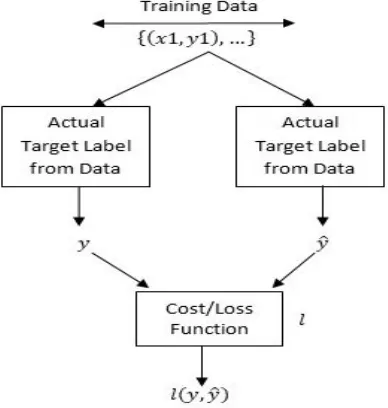
Fig 3.Flow of training data
The contribution to the model is given through preparing set. This information is given to the genuine target name and the neural system. The yield from the objective name and neural system is indicated as y and ŷ individually. Once the yield from both the
squares have been gotten we process the forecast is right to what level i.e., ŷ is contrasted and y and it is called as misfortune work. A misfortune work figures the disparity amongst y and ŷ is coordinated to as l as appeared in Fig 4. [9]
V. DATASET
In the proposed strategy we utilize tweets from Twitter Programming interface. The dataset contains tweets of swine influenza or simply expressed as influenza which are refined from the removed tweets. An aggregate of 10,48,576 tweets are gathered similarly for five classes that is tainted, preventive, useful and others. The information is prepared utilizing the data above and the tweets are then named relying on the pre-characterized names gave amid preparing.
VI.RESULTSANDDISCUSSION
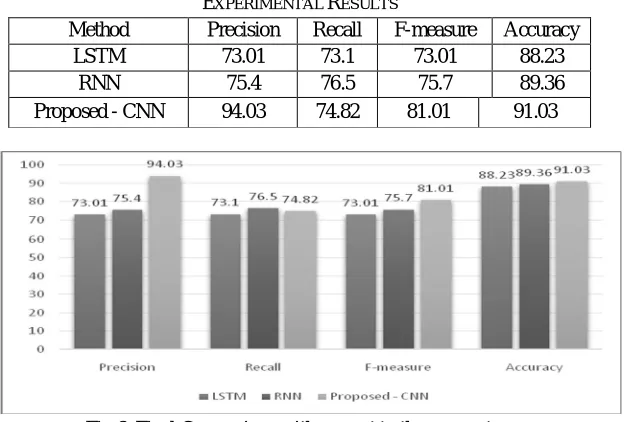
[image:5.595.195.414.109.343.2]The lead of the proposed CNN calculation is contrasted and other existing calculations. The outcome is appeared in Table V. Our anticipated model has a superior exactness than RNN and LSTM models. Be that as it may, the best model in this examination is dynamic CNN (DCNN), which creates more exactness than our model around 5% [1][3][16].
[image:5.595.54.509.514.748.2]284
©IJRASET: All Rights are Reserved
TABLEIII
RESULTS WITH VARIOUS DATASETS
Method 20News ACL SST
LSTM 70.01 73.01 80.23
RNN 75.4 75.7 89.36
CNN 79.02 82.16 81.05
RCNN 82.83 90.24 80.36
Fig 5. Comparison of various models with respect to different dataset [18] [19]
TABLEIV
EXPERIMENTAL RESULTS
Method Precision Recall F-measure Accuracy
LSTM 73.01 73.1 73.01 88.23
RNN 75.4 76.5 75.7 89.36
[image:6.595.148.460.362.573.2]Proposed - CNN 94.03 74.82 81.01 91.03
Fig 6. Final Comparison with respect to the parameters
We have inspected the model utilizing character input. The technique is directed by utilizing the mix of max and k-max pooling as said in the model depicted previously. The outcome in LSTM is awful contrasted with CNN as the criticism is likewise added to the model utilizing an overlook entryway which avoids the weights on the off chance that it is immaterial. CNN despite what might be expected is a fair model uses max-pooling and catches preferable semantic information over different models.
VII. CONCLUSIONS
285
©IJRASET: All Rights are Reserved
REFERENCES
[1] Thanabhat Koomsubha,“A Character-level Convolutional Neural Network with Dynamic Input Length for Thai Text Categorization”,
978-1-4673-9077-4/17/$31.00 ©2017 IEEE.
[2] Siwei Lai, Liheng Xu, Kang Liu, Jun Zhao,”Recurrent Convolutional Neural Networks for Text Classification”, Proceedings of the Twenty-Ninth AAAI
Conference on Artificial Intelligence, 2015.
[3] Wenpeng Yin, Katharina Kann, Mo Yu, Hinrich Schutze,”Comparative Study of CNN and RNN for Natural Language Processing”, Computation and
Language, February 2017.
[4] DaojianZeng, Kang Liu, Siwei Lai, Guangyou Zhou, Jun Zhao,”Relation Classification via Convolutional Deep Neural Network”,Proceedings of COLING
2014, the 25th International Conference on Computational Linguistics: Technical Papers, pages 2335–2344, Dublin, Ireland, August 23-29 2014.
[5] Xiang Zhang, Junbo Zhao, YannLeCum,”Character-level Convolutional Networks for Text Classification”, Computation and Language, December 2015.
[6] Rie Johnson, Tong Zhang,”Effective Use ofWord Order for Text Categorization with Convolutional Neural Networks”, Computation and Language,December
2014.
[7] Tharani.S, Dr. C. Yamini,”Classification using Convolutional Neural Network for Heart and Diabetics Datasets”, International Journal of Advanced Research
in Computer and Communication Engineering, ISO 3297:2007 Certified Vol. 5, Issue 12, December 2016.
[8] Shiyao Wang, ZhidongDeng,”Tightly-coupled convolutional neural network with spatial-temporal memory for text classification”, International Joint
Conference on Neural Networks (IJCNN), 2017.
[9] Rita Georgina Guimarães, Renata L. Rosa, Denise De Gaetano,”Age Groups Classification in Social Network Using Deep Learning”, IEEE Access,
Vol.5,2017.
[10] Nikhil Ketkar, Deep Learning with Python: A Hands-on Introduction, Apress, 2017.
[11] Atsuya Oishia,∗, Genki Yagawa, “Computational mechanics enhanced by deep learning”, 0045-7825/⃝c 2017 ElsevierComput. Methods Appl. Mech. Engrg. 327 (2017) 327–351
[12] Carlos Affonso a , ∗, AndréLuis Debiaso Rossi,” Deep learning for biological image classification”, Expert Systems With Applications, 0957-4174/© 2017 Elsevier, 114-122
[13] BilalJan, “Deep learning in big data Analytics: A comparative study”, Computers and Electrical Engineering, pp.1–13 , Elsevier, 2017
[14] Geert Litjens, “A survey on deep learning in medical image analysis”,Medical Image Analysis, pp.60–88, Elsevier, 2017
[15] Y. Kim, “Convolutional neural networks for sentence classification,” in Proceedings of the 2014 Conference on Empirical Methods in NaturalLanguage Processing (EMNLP), 2014, pp. 1746–1751.
[16] X. Zhang, J. Zhao, and Y. LeCun, “Character-level convolutional networks for text classification,” in Advances in Neural Information Processing Systems, 2015, pp. 649–657.
[17] P. Vateekul and T. Koomsubha, “A study of sentiment analysis using deeplearning techniques on Thai Twitter data,” in Computer Science and Software Engineering (JCSSE), 2016 13th International Joint Conference on, 2016.
[18] N. Kalchbrenner, E. Grefenstette, and P. Blunsom, “A convolutional neural network for modelling sentences,” in Proceedings of the 52nd Annual Meeting of
the Association for Computational Linguistics, {ACL} 2014, 2014, pp. 655–665.