Application of Neural Network Techniques in
Friction Stir Welding Process
Akshansh Mishra
1, Katyayani Jaiswal
2, A. Razal Rose
3, Gopikrishna Nidigonda
41Founder and Project Scientific Officer, Stir Research Technologies, Uttar Pradesh-273303 2Department of Computer Science and Engineering, IIT Ropar, Punjab-140001 3Faculty of Mechanical Engineering, SRM Institute of Science and Technology, Kattangulathur
4Faculty of Mechanical Engineering, SR Engineering College, Warangal
Abstract: Artificial Neural Network (ANN) is a brain modelling technique by providing a new approach to computing. It introduces a less technical way to develop machine solutions. This research paper discusses the use of Artificial Neural Network (ANN) concept in Friction Stir Welding research, for example it is used in the investigation of tool parameters, for the evaluation of feedback forces which is provided by Friction Stir Welding process. Previous research also shows that ANN finds application in developing the correlation between the Friction Stir Welding parameters of the light alloy plates and mechanical properties. This method was also used for predicting average grain size in Friction Stir Welding processes.
Keywords: Friction Stir Welding; AI Technique, Artificial Neural Network; Mathematical Modelling
I. INTRODUCTION
Artificial Neural Network (ANN) can be considered as a mathematical model of a human brain. This elemental inspired method marks the next generation advancement in the computing field. The composition of Artificial Neural Network (ANN) consists of a large number of simple processing elements or basic units called neurons. Each neuron applies an activation function to its net input to determine its output signal. Every neuron is connected to other neurons by means of directed communication links, each with an associated weight [1].
Each neuron has an internal state called its activation level, which is a function of the inputs it has received. This can be compared with a bottle with a liquid. If we have a bottle and if we fill in the bottle with a liquid, and if we have an alarm to caution us when the level of the liquid is up to the neck of the bottle, then activation level also does the same thing as that of the alarming signal we receive. As and when the neuron receives the signal, it gets added up and when the cumulative signal reaches the activation level the neuron sends an output. Till then it keeps receiving the input. So activation level can be considered as a threshold value for us to understand.
The technique is particularly suited to problems that involve the manipulation of multiple parameters and non-linear interpolation, and as a consequence are therefore not easily amenable to conventional theoretical and mathematical approaches. Neural networks have therefore seen growing application in materials property (mechanical and physical) determination, particularly the more difficult to analyse complex multiphase and composite materials, which are growing in popularity [2].
Friction Stir is a solid state joining process developed by The Welding Institute (TWI) in the UK in 1991. This method is used for joining the alloys of aluminium, magnesium, copper, titanium and as well as steel plates [3-8]. Artificial Neural Network (ANN) plays an important role in Friction Stir Welding (FSW) Research. It is basically used to develop the applications of Friction Stir Welding (FSW) and reduce the cost of experiments.
II. HOW DO ARTIFICIAL NEURAL NETWORK WORKS?
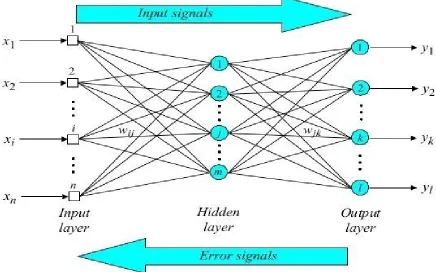
[image:2.595.80.516.156.428.2]This is a large and complex topic because there are many different types of artificial neural network models. The most common model, which has become the foundation for most of the others, is the 3-layer fully-connected back propagation (BP) model:
Figure 1: 3 layered fully connected back propagation model
A. Network Design
The basic idea is that you have three layers of "nodes." The "nodes" are intended to be analogous to neurons in a neural network of the brain, but the similarity is only metaphorical (real neurons don't work this way, but the analogy is not unreasonable). The nodes have values of 0.0 to 1.0, where 0 represents fully inactive "off" and 1 represents fully active "on" with many values in between. The three layers are an input layer, an output layer, and a "hidden" layer in the middle (hidden means neither input nor output, so not exposed to the outside world). The nodes are linked by connections which have a "weight" ("w" in the figure) that are analogous to synapses in the brain. Signal values propagate from the inputs, through the connection weights to the hidden nodes, and then onward through more connection weights to the output nodes. The number of the neurons at the first and the last layer are equal to the inputs and outputs of the ANN. The user determines the number of neurons at the intermediate layer (hidden layer) with trial and error. In most of the BP applications, each neuron is connected to all the neurons of the following layer.
In the beginning, the network will of course get the wrong answer because it knows nothing. This is where the "training" and "back propagation" comes in. The error values are propagated backward through the network using some complicated math that tells the algorithm how to modify each connection weight so that the network will get closer to the correct answer next time.
III. USE OF ARTIFICIAL NEURAL NETWORK (ANN) IN FRICTION STIR WELDING (FSW) PROCESS
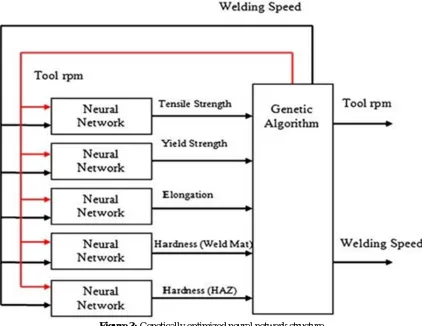
Figure 2: Five artificial neural networks for representation of the friction stir welding operation
Figure 3: Genetically optimized neural network structure
[image:3.595.87.509.382.708.2]Figure 4: Schematic of neural networks in this work for predicting Vickers micro hardness in triangle (a) and tapered cylindrical (b) pin profile tools.
It was observed that the Mean absolute percentage error (MAPE) for train and test data sets did not exceed 5.4% and 7.48%, respectively. MSE values for both networks were less than 10, which indicated appropriate trained models as shown in the Figure 5.
Figure 5: MSE for ANN models for triangle pin profile (a) and tapered cylindrical pin profile (b) tools
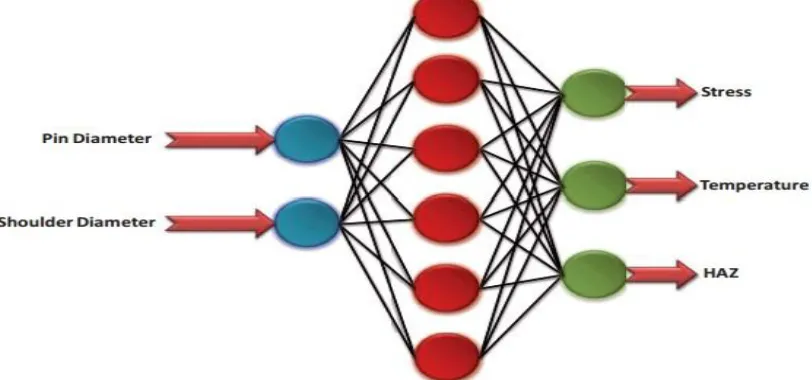
[image:4.595.95.501.540.730.2]Shojaeefard et al [11] numerically modelled a different tool pin and shoulder diameter for a Friction Stir Welding (FSW) process. He used Feed-forward neural network with back-propagation algorithm to understand the correlation between tool dimensions and peak temperature, maximum strain, and HAZ area as shown in the Figure 6.
It can be observed that the neural network having an input layer with two neurons for each input factor (pin diameter, shoulder diameter) and an output layer with three neurons (maximum strain, maximum temperature, and HAZ area) was used. In order to get the best network architecture evaluation of several architectures were performed and trained using the experimental data. Based on this analysis, the optimal architecture was selected as 2–6–2 NN, and both activation functions in hidden layer and output layer were ‘‘logsig.’’
[image:5.595.149.473.308.466.2]Fratini et al [12] in his research showed the capability of the AI technique in conjunction with the FE tool to predict the final microstructure of the Friction Stir Welded Joints. He designed the network architecture which was composed of five layers as shown in Figure 7. From the Figure 7 it is clearly seen that the neural network consisted of an input layer, three hidden layers and finally the output layer. Input layer was composed of four neurons which represented the local values of the equivalent plastic strain, the strain rate, temperature and the Zener Holloman parameter in a transverse section. The introduced three hidden layers have three, five and four neurons, respectively, and finally in the output layer one neuron is present corresponding to the output variable (D), namely the local value of the final average grain size. Each layer is fully connected to the next and according to the back propagation rule, the weights (wij) of the connections linking neurons belonging to two consecutive layers are adjusted in the learning stage with the aim to minimize the error between the desired output and the calculated one.
Figure 7: The utilized Neural Network architecture
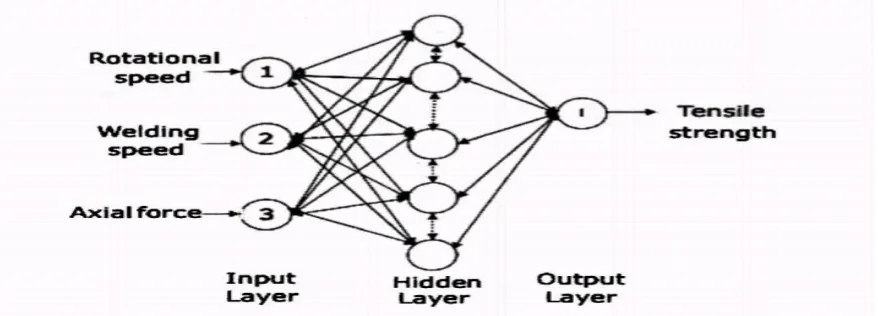
Jayaraman et al [13] pedicted the tensile Strength of Friction Stir Welded A356 Cast Aluminium Alloy by using Response Surface Methodology (RSM) and Artificial Neural Network (ANN). He used the topology architecture of feed-forward three-layered back propagation neural network as shown in the Figure 8. He noted that the performance of Artificial Neural Network (ANNs) is better than the other techniques, especially RSM when highly non-linear behaviour is the case. Also, this technique can build an efficient model using a small number of experiments; however the technique accuracy would be better when a larger number of experiments are used to develop a model.
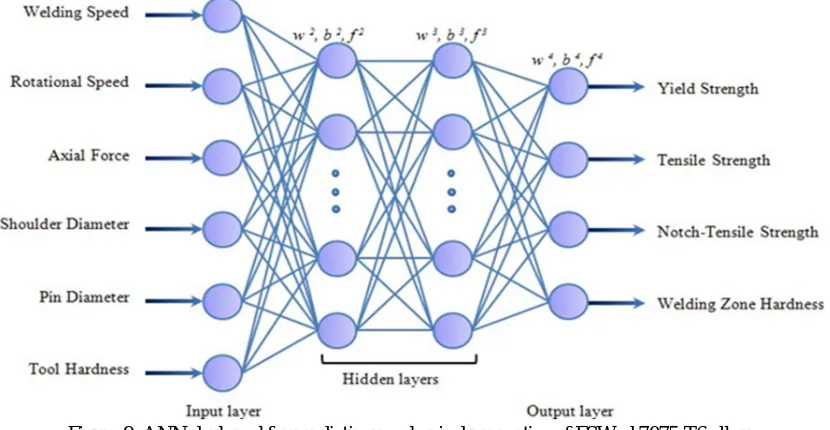
[image:5.595.80.519.575.733.2]Maleki et al [14] used ANN as an efficient approach for modeling the mechanical properties of Friction Stir Welded 7075-T6 Aluminum alloy. ANN devloped was based on Back propogation algorithm. Rotational speed of tool, welding speed, axial force, shoulder diameter, pin diameter and tool hardness are regarded as inputs of the ANNs. Yield strength, tensile strength, notch-tensile strength and hardness of welding zone are gathered as outputs of neural networks as shown in the Figure 9.
Figure 9: ANN devloped for predicting mechanical properties of FSWed 7075-T6 alloys
The least mean relative error (MRE) was obtained for the hardness of welding zone, yield strength, tensile strength and notch-tensile strength.
Khoursid et al [15] used the topology architecture of feed-forward three- layered back propagation neural network as illustrated in Figure 10 below for predicting the ultimate tensile strength, percentage of elongation and hardness of 6061 aluminum alloy.
Figure 10: Propagation artificial neural network
Equation is calculated as On = F(ΣIk * Wkn).On is the neuron’s output, n is the number of the neuron, Ik are the neurons inputs, k is the number of inputs, Wkn are the neurons weights. F is the Fermi function 1/(1+Exp(-4*(x-0.5))).
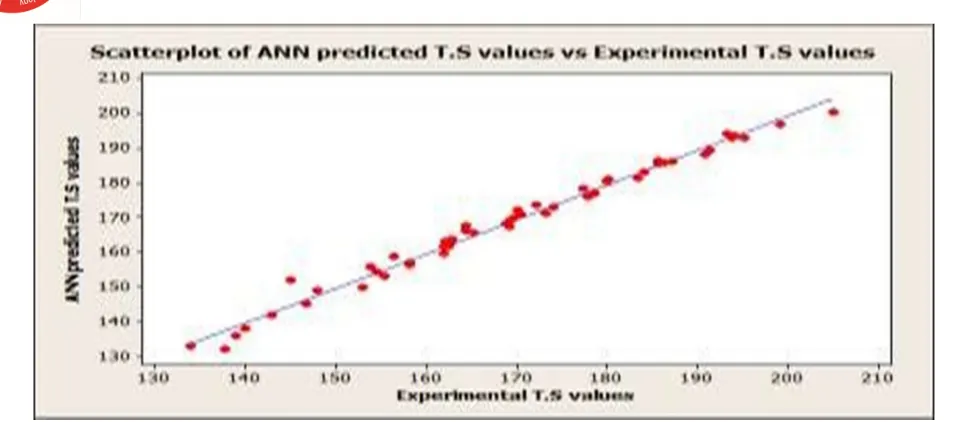
[image:6.595.139.456.462.655.2]Figure 11: Relation between experimental tensile strength and predicted tensile strength
Figure 12: Relation between experimental elongation% and predicted elongation%
The ANN model proved to be successful in terms of agreement with experimental results ratio 96.5%.
H. Okuyucu et al. [16] developed an artificial neural network (ANN) model for the analysis and simulation of the correlation between the friction stir welding (FSW) parameters of aluminium (Al) plates and mechanical properties. The input parameters of the model consist of weld speed and tool rotation speed (TRS). The outputs of the ANN model include property parameters namely: tensile strength, yield strength, elongation, hardness of weld metal and hardness of heat effected zone (HAZ). Good performance of the ANN model was achieved. The model can be used to calculate mechanical properties of welded Al plates as functions of weld & tool rotation speeds. The combined influence of weld speed and TRS on the mechanical properties of welded Al plates was simulated. A comparison was made between measured and calculated data. The calculated results were in good agreement with measured data. The aim of the paper was to show the possibility of the use of neural networks for the calculation of the mechanical properties of welded Al plates using FSW method. Results showed that, the networks can be used as an alternative in these systems. L Fratini and G Buffa [17] studied the continuous dynamic re-crystallisation phenomena occurring in the FSW of Al alloys. A good agreement with the experimental results was obtained using the ANN model. In regard to ANNs, it noted that ANNs perform better than the other techniques, especially RSM when highly non-linear behaviour is the case. Also, this technique can build an efficient model using a small number of experiments; however the technique accuracy would be better when a larger number of experiments are used to develop a model.
IV. CONCLUSIONS
A. The Artificial Neural Network (ANN) model provides little information about the design factors and their contribution to the response if further analysis has not been done. Generation of ANN model requires a large number of iterative calculations. B. Artificial Neural Network (ANN) method can be used to economize material and time by considering the accurate results and
acceptable errors.
C. This method can be used to model the mechanical procedures. By usin g mathematical modelling methods like ANN can save
time, material and costs and results are optimized in designs.
D. GONN’s performance is a viable option for modelling the friction stir welding process and searching for the optimal solutions.
E. A good correlation can be observed between the predicted data obtained from the Artificial Neural Network (ANN) and FEM
models.
REFERENCES
[1] Maind, S.B. and Wankar, P., 2014. Research paper on basic of artificial neural network. International Journal on Recent and Innovation Trends in Computing and Communication, 2(1), pp.96-100.
[2] Sha, W. and Edwards, K.L., 2007. The use of artificial neural networks in materials science based research. Materials & design, 28(6), pp.1747-1752. [3] Sato, Y.S., Kokawa, H., Enomoto, M. and Jogan, S., 1999. Microstructural evolution of 6063 aluminum during friction-stir welding. Metallurgical and
Materials Transactions A, 30(9), pp.2429-2437.
[4] Lienert, T.J., Stellwag Jr, W.L., Grimmett, B.B. and Warke, R.W., 2003. Friction stir welding studies on mild steel. WELDING JOURNAL-NEW YORK-, 82(1), pp.1-S.
[5] Mishra, Akshansh, et al. "Mechanical and Microstructure properties analysis of Friction Stir Welded Similar and Dissimilar Mg alloy joints." (2018). [6] Mishra, Rajiv S., and Z. Y. Ma. "Friction stir welding and processing." Materials science and engineering: R: reports 50.1-2 (2005): 1-78.
[7] Ouyang, Jiahu, Eswar Yarrapareddy, and Radovan Kovacevic. "Microstructural evolution in the friction stir welded 6061 aluminum alloy (T6-temper condition) to copper." Journal of Materials Processing Technology 172.1 (2006): 110-122.
[8] Dressler, Ulrike, Gerhard Biallas, and Ulises Alfaro Mercado. "Friction stir welding of titanium alloy TiAl6V4 to aluminium alloy AA2024-T3." Materials Science and Engineering: A 526.1-2 (2009): 113-117.
[9] Tansel, Ibrahim N., et al. "Optimizations of friction stir welding of aluminum alloy by using genetically optimized neural network." The International Journal of Advanced Manufacturing Technology 48.1-4 (2010): 95-101.
[10] Dehabadi, V.M., Ghorbanpour, S. & Azimi, G. J. Cent. South Univ. (2016) 23: 2146. https://doi.org/10.1007/s11771-016-3271-1
[11] Shojaeefard, Mohammad Hasan, et al. "Investigation of friction stir welding tool parameters using FEM and neural network." Proceedings of the Institution of Mechanical Engineers, Part L: Journal of Materials: Design and Applications 229.3 (2015): 209-217.
[12] Fratini, Livan, Gianluca Buffa, and Dina Palmeri. "Using a neural network for predicting the average grain size in friction stir welding processes." Computers & Structures 87, no. 17-18 (2009): 1166-1174.
[13] Jayaraman, M., et al. "Prediction of tensile strength of friction stir welded A356 cast aluminium alloy using response surface methodology and artificial neural network." Journal for Manufacturing Science and Production 9.1-2 (2008): 45-60.
[14] E Maleki 2015 IOP Conf. Ser.: Mater. Sci. Eng. 103 012034
[15] A.M. Khourshid , Ahmed. M. El-Kassas , H. M. Hindawy and I. Sabry, MECHANICAL PROPERTIES OF FRICTION STIR WELDED ALUMINIUM ALLOY PIPES, European Journal of Mechanical Engineering Research, Vol.4, No.1, pp.65-78, April 2017
[16] Hasan Okuyucu a, Adem Kurt a, Erol Arcaklioglu -Artificial neural network application to the friction stir welding of aluminum plates- Materials and Design 28 (2007) 78–84