The Hybrid Technique for Image Classification to
Detect Gender and Age using ANN and SVM
Ravinder Kumar
Assistant Professor, Computer Science and Engineering, Modern institute of technology and research centre Alwar, Rajasthan, India
Abstract: These days look into has investigated to separating helper data from different biometric procedures, for example, fingerprints, confront, iris, palm, voice and so forth. This data contains a few highlights like sexual orientation, age, whiskers, mustache, scars, stature, hair, skin shading, glasses, weight, facial imprints, tattoos and so forth. This data contributes increasingly to ID. The real changes that go over face acknowledgment are to discover age and sexual orientation of the individual. This paper contributes a huge overview of different face acknowledgment systems for finding the age and sexual orientation. The current systems are talked about in light of their exhibitions. Especially, the programmed estimation of age and sexual orientation from confront pictures can be helpful in an extensive variety of scientific applications. The portrayals got from various face locales are expected to Support Vector Machine (SVM) classifiers to evaluate the age and sexual orientation of the individual in the picture. Test investigation demonstrate the great after effects of this component based approach, and its extra advantages when confront pictures are influenced by impediments. As of late, profound neural systems have shown magnificent exhibitions in perceiving the age and sexual orientation on human face pictures. We show an examination exploring these distinctive impacts. In detail, our work looks at four prevalent neural system structures, examines the impact of retraining, assesses the vigor of the considered arrangement pre-handling by means of cross-technique test set swapping and instinctively imagines the model's forecast procedures in given preprocessing conditions utilizing the current Layer-wise Relevance Propagation (LRP) calculation. Our assessments on the testing Audience benchmark demonstrate that reasonable parameter introduction prompts a comprehensive impression of the info, repaying workmanship genuine information portrayals. With a mix of straightforward preprocessing steps, we achieve best in class execution in sex acknowledgment.
Keywords: Image tampering , DCT; DWT; ANN; SVM; DCTDWTImage-splicing , Copy move, Image forgery ,Active techniques.
I. INTRODUCTION
The face is a standout amongst the most widely recognized biometric qualities utilized by people to make an individual acknowledgment [1]: individuals have an extensive capacity to distinguish, extricate and decipher data identified with human face. Because of the about exponential development of the rate of face pictures transferred to the web in the course of the most recent decade, the advancement of programmed facial examination strategies is ending up progressively important with the motivation behind enhancing the exactness of frameworks that amole the visual capacities of the person.
Age and sex are two statistic traits that impact the morphology and appearance of a face. Facial age estimation alludes to the programmed marking of age gatherings or the particular times of people in view of highlights removed from the face. With the advance of age, the presence of human faces displays momentous changes identified with its form, the state of facial highlights (eyes, nose, mouth, and so forth.) and its appropriation, the skin pigmentation and the development of wrinkles, among others. The maturing procedure is impacted by outer (wellbeing, living style, smoking, and so on.) and inward (hereditary qualities, sexual orientation) factors, which makes age estimation troublesome for people, and significantly more troublesome for machines [5].
II. USINGTECHNIQUES
A. AGE Classification
Face acknowledgment frameworks are basic for ongoing applications, for example, for distinguishing proof of the missing youngsters and international ID check in light of the fact that there is the huge age distinction amongst exploring and exhibition pictures [6]. One more useful application in which age is a condition for access to an item is liquor or tobacco. Table IV speaks to the correlation of different procedures to discover the times of various classifications. Two vital components assume an imperative part in the genuine living.
Right off the bat, collected information recommend that age estimation countenances can be very precise, however there is the extension for advance change since age factor is touchy and relies upon the premise of gathering participation.
Furthermore, it is demonstrated that human face maturing relies upon ethnicity and sexual orientations. This examination gives right bearings for additionally research to distinguish the ages from the pictures.
The issue of consequently removing age related properties from facial pictures has gotten expanding consideration as of late and numerous strategies have been put fourth.
A nitty gritty review of such techniques can be found in and, all the more as of late, in [6]. We take note of that regardless of our emphasis here on age amass grouping as opposed to exact age estimation (i.e., age relapse), the review underneath incorporates techniques intended for either undertaking. Early techniques for age estimation depend on computing proportions between various estimations of facial highlights . When facial highlights (e.g. eyes, nose, mouth, button, and so on.) are limited and their sizes and separations estimated, proportions between them are computed and utilized for arranging the face into various age classes as indicated by hand-made tenets. All the more as of late, utilizes a comparable way to deal with show age movement in subjects under 18 years of age. As those techniques require precise limitation of facial highlights, a testing issue independent from anyone else, they are unsatisfactory for in-the-wild pictures which one may hope to discover on social stages.
B. Gender Classification
Gender classification is a simple undertaking for people to distinguish a man as per his or her face however it's an exceptionally difficult errand for PCs . Most recent 10 years of sexual orientation grouping for various databases . This examination gives productive headings for additionally inquire about in the field of sexual orientation grouping [7].
Gender classification characterization has picked up a great deal of enthusiasm for the examination group as a result of its wide application, for example, man-machine correspondence [8], security, law requirement, socioeconomics studies, instruction, and media transmission, and so forth. Sex arrangement is a valuable preprocessing venture for confront acknowledgment. The face acknowledgment has been investigated in a substantial way by numerous specialists yet not very many works have been investigated on account of sexual orientation grouping. The face picture is utilized for ordering the sex, so the sexual orientation characterization process can make confront acknowledgment twice as quick by diminishing the look time for perceiving the individual.
S.NO A B C D
PERSON AGE COMMUNIT Y
GENDER
1 BARBAR 40-49 BETTIE FEMALE
2 CHARLE
S
50-59 ATLENTICE MALE
3 DOROTH
Y
50-59 WILLISTON FEMALE
4 HELEN 40-49 OTWAY FEMALE
5 KEN 40-49 CEDAR
ISLAND
MALE
6 MAGRET 60-69 DAVIS FEMALE
Fig.1 Gender classification
C. Support Vector Machine (SVM)
Given an arrangement of focuses having a place with two classes, a Support Vector Machine (SVM) finds the riotous plane that isolates the biggest conceivable segment of purposes of a similar class on a similar side, while boosting the separation from either class to the hyper plane. PCA is first used to extricate highlights of face pictures and afterward segregation works between each match of pictures are found out by SVMs.[10]
D. Artificial Neural systems (ANN)
ANN is a machine learning calculation that has been utilized for different example grouping issues, for example, sex arrangement, confront acknowledgment, and order of outward appearance. ANN classifier has focal points for arrangement; for example, mind boggling speculation and great learning capacity.
The ANN takes the highlights vector as info, and trains the system to take in an intricate mapping for order, which will dodge the requirement for disentangling the classifier. Having the capacity to offer conceivably more prominent speculation through learning, neural systems/learning strategies have likewise been connected to confront acknowledgment.
E. Dual tree Complex Wavelet Transforms
One of the basic methods of dual tree complex wavelet transform is by applying a one sample delay between level 1 filter in each tree. But the problem arises in the selection of odd and even filters approach. In order to overcome this problem the Q-Shift dual tree method.
In the implementation of DTCWT there are two sets of filters are used, one set of filters are at level 1 and second set of filters are at higher levels. The filters which are used at higher levels are even length and having a group delay of approximately ¼. The time reverse of the tree provides the required delay difference of ½ samples in tree b. The real part of the complex wavelet coefficients are obtained at each scale in both tree.[11]
F. Discrete Wavelet Transform (DWT)
Discrete wavelet transform is one of most popular image processing tool that is used for feature extraction, detection, image compression and recognition purposes. DWT performs multi resolution analysis with localization in both frequency and time domains.DWT is employed in order to preserve the high-frequency components of the image. Wavelet transform has advantage of robustness, flexibility and less computational time over other transform.
where j is the power of binary scaling and k is a constant of the filter. In order to extract numerical attributes, we have used several statistics measures such as maximum, standard deviation, Euclidian distance, variance, skewness, log energy, and kurtosis.
G. Discrete Cosine Transform (DCT)
Discrete wavelet transform is much related to discrete Fourier transform. DCT alters images from time domain to frequency domain to de-correlate pixels, because fingerprint have high correlation and redundant information that reason high time complexity and high processing speed. In our case for comparative analysis we evaluate DCT is applied on fingerprint to extract features; same Attributes like DWT are considered here to gather useful information.
III. LITERATURESURVEY
Gokhan Ozbulak, ET. AL. [13].Age and gender are complementary soft biometric traits for face recognition. Successful estimation of age and gender from facial images taken under real-world conditions can contribute improving the identification results in the wild. In this study, in order to achieve robust age and gender classification in the wild, we have benefited from Deep Convolutional Neural Networks based representation. We have explored transferability of existing deep convolutional neural network (CNN) models for age and gender classification. The generic AlexNet-like architecture and domain specific VGG-Face CNN model are employed and fine-tuned with the Adience dataset prepare d for age and gender classification in uncontrolled environments. In addition, task specific GilNet CNN model has also been utilized and used as a baseline method in order to compare with transferred models. Experimental results show that both transferred deep CNN models outperform the GilNet CNN model, which is the state-of-the-art age and gender classification approach on the Adience dataset, by an absolute increase of 7% and 4.5% in accuracy, respectively. This outcome indicates that transferring a deep CNN model can provide better classification performance than a task specific CNN model, which has a limited number of layers and trained from scratch using a limited amount of data as in the case of GilNet. Domain specific VGG Face CNN model has been found to be more useful and provided better performance for both age and gender classification tasks, when compared with generic AlexNet-like model, which shows that transferring from a closer domain is more useful.
Thakshila R. Kalansuriya, ET. AL [15]. Automatic face identification and verification from facial images attain good accuracy with large sets of training data while face attribute recognition from facial images still remain challengeable. We propose a methodology for automatic age and gender classification based on feature extraction from facial images, namely, primary and secondary features. Our methodology includes three main iterations: Preprocessing, Feature extraction and Classification. Our solution is able to classify images in different lighting conditions and different illumination conditions. Classification is done using Artificial Neural Networks according to the different shape and texture variations of wrinkles on face images.
IV. PROPOSEWORK
A. Gender and Age Group Classification Module
The module mainly consists of two running modes. The first mode is the training mode and the second mode is the classification mode. As a first step, video frames are captured from the selected video in the training mode. Skin colored regions are obtained from the captured frames. The face detection algorithm is executed on the skin colored regions to extract frontal faces. Then, eyes, mouth and nose locations are determined. In the next step, the detected human faces are cropped, rotated to equalize y coordinates of two eyes and then histogram equalization of the rotated face image is applied. After these normalization steps, LBP feature extraction, pixel intensity comparisons for gender classification and DCT Mod2 feature extraction, edge detection around eyes, mouth, nose and cheeks for age classification are executed. The extracted features are written to files and prepared to train the classifiers. A Random Trees classifier is trained with the data which reside in LBP feature file. An Adaboost classifier is trained with the data which reside in pixel comparison file. In the classification mode, video frames are captured from the selected video. Skin colored regions are obtained from the captured frame. The face detection algorithm is executed on these locations and frontal faces are obtained. Then, eyes, mouth and nose locations of the faces are determined. In the next step, detected human faces are cropped, rotated to equalize y coordinates of two eyes and then histogram equalization of rotated face image is done. After these normalization steps, LBP feature extraction, pixel intensity comparisons for gender classification and DCT 15 Mod2 feature extraction, edge detection around eyes, mouth, nose and cheeks for age classification are executed. The extracted features are used as parameters to predict the gender and age group of the detected faces. Shows the flowchart of the overall architecture.
B. Artificial Neural Networks (ANN)
ANN is the interconnection between the essential units called fake neurons. A simulated neuron takes two data sources, duplicates them by a weight and includes them together. Each information connect has an autonomous weight related with it. In the event that the aggregate of the weighted information's esteem is more prominent or equivalent to the edge esteem, the yield is equivalent to 1. In the event that the whole is not as much as the limit esteem, the yield is 0. This is essential, since it enables counterfeit neurons to process the intelligent capacities AND, OR and NOT. The counterfeit neurons to process the three rationale capacities are joined to frame simulated neural systems. ANN depends on its capacity to change its weights keeping in mind the end goal to relate each bit of contribution to the comparing wanted yield. This capacity to adjust demonstrates particularly supportive for issues where there is a limited arrangement of results, however no sensible method to speak to every single conceivable info. With regards to FEBFRGAC check, an ANN is made by joining fake neurons into a structure containing three layers. The main layer comprises of neurons that are in charge of contributing a face picture test into the ANN. The second layer is a shrouded layer which permits an ANN to play out the mistake diminishment important to effectively accomplish the coveted yield. The last layer is the yield layer wherein the quantity of neurons in this layer is dictated by the measure of the arrangement of wanted yields, with every conceivable yield being spoken to by a different neuron. [18]
C. Support Vector Machine (SVM)
The Support Vector Machine (SVM) is one of the generally picked learning methods in directed grouping forms. The preparation informational index and its mark set is sustained into the classifier. The SVM classifier at that point finds an ideal choice limit to isolate the information in view of its relating names.
In machine learning, bolster vector machines (SVMs) are directed learning models with related learning calculations that investigate information utilized for arrangement and relapse examination. In help vector machine is utilized to break down the unpredictable information and gives the outcome. SVM is exceptionally valuable in discovering designs which are extremely helpful and not complex.[19].
D. Propose Algorithm
1) Stage 1: Read Image Set of Male and Female
2) Stage 2: Convert each information picture to dark scale.
3) Stage 3: Using ROI guideline performs includes extraction from singular picture. 4) Stage 4: Shuffle the Feature Vector grid.
5) Stage 5: Cross-Validate the grid and create the prepare informational index and the test informational collection. 6) Stage 6: Perform preparing on the prepare informational index of the SVM classifier.
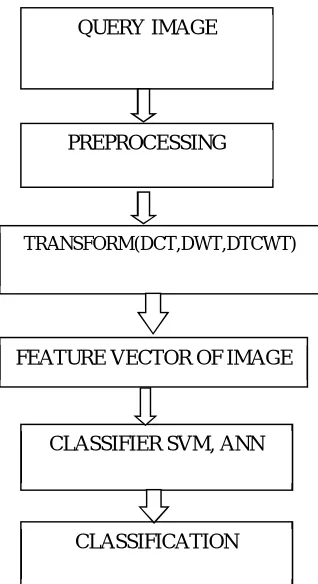
7) Stage 7: Perform testing on the test informational index along side the prepare vector. 8) Stage 8: Classifier, SVM, ANN
Fig. 2 The block diagram representation of proposed work
V. RESULTANALYSIS
We have used MATLAB 2013 for the implementations of face recognition and for the gender classification. In this work we are taking two face image databases and one test database which contained face image for the testing of the system. In this we are giving a test image as input and we have to identify an input image and classify it into a category of male or female. In fig 3.1 We have taken a color image and we are converting it into a gray scale image, because we can easily apply the computational techniques when the image is a gray scale image as compared to color images.
We have taken two databases for this face recognition and gender classification. The database is taken from the iit Kanpur’s database. And it is tested for the different number of images. This database consists of 10 images for each person in different pose and variations in lighting.
Fig. 3. Face image database for male QUERY IMAGE
PREPROCESSING
TRANSFORM(DCT,DWT,DTCWT)
FEATURE VECTOR OF IMAGE
CLASSIFIER SVM, ANN
[image:6.612.109.475.527.711.2]the minimum euclidean distance so the test image will classify into the Female because the minimum Euclidean distance is from female database. We have tested this with the iit Kanpur’s database and the accuracy is 88 percentage for the gender classification when we have taken around 50 face images for the test in which there is 35 known and 15 unknown images is there. After reduction of the dimension and extracting the feature of the images by using the Principal component analysis and after projecting the input image into the selected eigenvectors we can use either Euclidean Distance or Mahalanobis Distance for the classification of the input image or any other distance. So we have compared the accuracy of the algorithms when we used Euclidean distance and the Mahalanobis distance for the classification.
[image:7.612.193.422.373.512.2]Fig. 4 Face image database for female
Fig.5 Gender recognition process for detect of Male face 1
[image:7.612.195.419.542.696.2]Fig.7 Gender recognition process for detect of Female face 3
Fig.8 Age recognition process for detect of Male face 5
Fig.9 Age recognition process for detect of Male face 6
VI. CONCLUSION
In this paper, we introduce an approach to classify gender and age from images of human faces which is an essential part of our method for autonomous detection of anomalous human behavior. We present a method for image classification based on a pertained deep modal for feature extraction and representation followed by a SVM. Because very few data sets with labels of gender and age exist of tall images.
In this thesis, an attempt has been made to classify gender from facial image. The face portion is extracted from a given input image using skin color model, and morphological operations. The training data set is prepared for male, and female faces that included detected face regions. Gender Classification is divided into two steps, feature selection and classification. The face images are preprocessed and Canny edge detector is used to derive the edges of face images. The features of face are used for matching. The gender is classified using Posteriori class probability classifier and ANN is used to classify age, based on features of face images. The database used in the research work does not contain any facial images having spectacles. The facial image involving specs need to be identified correctly which is a challenging issue. Pixels in an image represent a large degree of correlation. By using pixels as features, there will be redundant information. This redundancy can be removed by using PCA. The principal component of the image gives uncorrelated coefficients. Thus, using Principal Component as feature seems to be a reasonable choice which is achieved using Principal Component Analysis.
In the future, the specified methodologies can be further improved by incorporating the below mentioned specifications in the implementation of the proposed mechanisms.
REFERENCES
[1] A. K. Jain, A. Ross, and S. Prabhakar.An introduction to biometric recognition. IEEE Transactions on Circuits and Systems for Video Technology, 14(1):4–20, Jan. 2004.
[2] T. Huang, Z. Xiong, and Z. Zhang. Face Recognition Applications, pages 617–638. SpringerLink : Bucher. Springer ¨ London, 2011.
[3] A. K. Jain, B. Klare, and U. Park. Face recognition: Some challenges in forensics. In Automatic Face & Gesture Recognition and Workshops (FG 2011), 2011 IEEE International Conference on, pages 726–733. IEEE, 2011.
[4] P. Tome, R. Vera-Rodriguez, J. Fierrez, and J. Ortega-Garcia.Facial soft biometric features for forensic face recognition. Forensic science international, 257:271–284, 2015.
[5] M. Tistarelli, D. Yadav, M. Vatsa, and R. Singh. Short-and long-time ageing effects in face recognition, pages 253–275. The Institution of Engineering and Technology (IET), 2013.
[6] H. Han, C. Otto, and A. K. Jain. Age estimation from face images: Human vs. machine performance. In Biometrics (ICB), 2013 International Conference on.IEEE, 2013.
[7] Yang, Zhiguang, Ming Li, and Haizhou Ai. "An experimental study on automatic face gender classification." In 18th International Conference on Pattern Recognition (ICPR'06), pp. 1099-1102, 2006.
[8] E. Eidinger, R. Enbar, and T. Hassner, “Age and gender estimation of unfiltered faces,” Transactions on Information Forensics and Security, IEEE, pp. 2170– 2179, 2014.
[9] J. Chen, S. Shan, C. He, G. Zhao, M. Pietikainen, X. Chen, and W. Gao. Wld: A robust local image descriptor. Trans. Pattern Anal. Mach. Intell., 32(9):1705– 1720, 2010.
[10] Supriya D. Kakade, “A Review Paper on Face Recognition Techniques”. International Journal for Research in Engineering Application & Management (IJREAM) ISSN : 2494-9150 Vol-02, Issue 02, MAY 2016.
[11] Guruprasad G1 , Veena S K2, “Face Recognition using Transform Domain Techniques”. IOSR Journal of VLSI and Signal Processing (IOSR-JVSP) Volume 5, Issue 3, Ver. II (May - Jun. 2015), PP 06-12 e-ISSN: 2319 – 4200, p-ISSN No. : 2319 – 4197
[12] Shahid Akbar , Ashfaq Ahmad , Maqsood Hayat, “Identification of Fingerprint Using Discrete Wavelet Transform in Conjunction with Support Vector Machine”. IJCSI International Journal of Computer Science Issues, Vol. 11, Issue 5, No 1, September 2014 ISSN (Print): 0814 | ISSN (Online): 1694-0784
[13] GökhanÖzbulak1 , Yusuf Aytar2 , Hazım Kemal Ekenel, “How Transferable are CNN-based Features for Age and Gender Classification?”. ©2016 GesellschaftfürInformatike.V., Bonn, Germany
[14] JiříPřibil1 , Anna Přibilová2 , Jindřich Matoušek3, “GMM-Based Speaker Gender and Age Classification After Voice Conversion”.
[15] Thakshila R. Kalansuriya, Anuja T. Dharmaratne, “Facial Image Classification Based on Age and Gender”. 2013 International Conference on Advances in ICT for Emerging Regions.
[16] Ke Zhang, Miao Sun, Xingfang Yuan, “Age Group and Gender Estimation in the Wild with Deep RoR Architecture”. IEEE TRANSACTIONS ON LATEX CLASS FILES,
[17] Phuoc Nguyen, Dat Tran, Xu Huang, and Wanli Ma,” Age and Gender Classification Using EEG Paralinguistic Features”. 978-1-4673-1969-0/13/$31.00 ©2013 IEEE
[18] Ramesha K1 , K B Raja2s , Venugopal K R2 and L M Patnaik, “Feature Extraction based Face Recognition, Gender and Age Classification”. Ramesha K et al. / (IJCSE) International Journal on Computer Science and Engineering, Vol. 02, No.01S, 2010, 14-23