Original Article
apM1 gene rs266729 C>G polymorphism and ischemic
stroke susceptibility: a meta-analysis base
on 7 case-control studies
Yanzhou Qu, Siying Lei, Jin Lv, Weikang Chen, Yingbiao Zhu, Jie Li, Pugang Li, Chunsheng Qu, Genlong Zhong, Shengwu Zhang, Likang Lan, Weiwen Qiu
Department of Neurology, Lishui People’s Hospital, Lishui 323000, Zhejiang, PR China
Received September 24, 2018; Accepted April 8, 2019; Epub June 15, 2019; Published June 30, 2019
Abstract: Objective: The goal of this study was to investigate the relationship between the adiponectin (apM1) gene rs266729 locus C>G polymorphism and ischemic stroke susceptibility by meta-analysis. Methods: The electronic databases of Pubmed, EMBase, Web of Science, Google scholar, CBM and CNKI were systematic searched with the text words of “stroke”, “apM1 gene”, “ADIPOQ”, “ACDC” “GBP-28” “Acrp30” and “polymorphism”. The relationship between apM1 gene rs266729 locus C>G polymorphism and ischemic stroke susceptibility was demonstrated by odds ratio (OR) and corresponding 95% confidence interval (95% CI). Data was pooled by random or fixed effect model according to the heterogeneity evaluation across the included studies. Publication bias was evaluated by Begg’s funnel plot and Egger’s line regression test. All the data was analyzed by ReviewMan 5.1 and Stata10.0 SE software. Results: Seven case-control studies were included in the meta-analysis. The relationship between apM1
gene rs266729 locus C>G polymorphism and ischemic stroke susceptibility was evaluated separated through the hypothesis of dominant (GG+CG vs CC), recessive (GG vs CC+CG) and homologous (GG vvs CC) genetic model. In a dominant genetic model, the combined OR = 1.20 (95% CI: 1.08~1.34) by fixed effect model. For a recessive genet -ic model, the OR was pooled by random effect model with point estimated of 1.26 and its 95% confidence interval of 0.78~2.05. In the aspect of homologous genetic model, the OR = 1.35 (95% CI: 0.82~2.22), through random effect model because of significant publication bias among the included studies. Conclusion: In the condition of dominant genetic model, people carrying G allele may have increased risk of developing ischemic stroke.
Keywords: Meta-analysis, apM1 gene, polymorphism, ischemic stroke
Introduction
Adiponectin (also known as GBP-28, apM1, AdipoQ and Acrp30) is a 244-amino-acid-long polypeptide (protein) which modulates a num-ber of metabolic processes, including glucose regulation and fatty acid oxidation [1]. apM1 gene is located on chromosome 3q27, a region highlighted as affecting genetic susceptibility to type 2 diabetes and obesity [2-4]. In this locus, there are several single nucleotide poly-morphism (SNP) which may affect the function of adiponectin. Several studies have investigat-ed the association between apM1 gene SNP and ischemic stroke susceptibility [5, 6]. Meta-analysis has also investigated the correlation of the apM1 gene rs22411766 T>G polymorphism and ischemic stroke risk [7]. In that meta-anal-ysis the authors found subjects with G SNP allele of apM1 gene may at high risk of
develop-ing ischemic stroke compared to T sdevelop-ingle nucle-otide. apM1 rs266729 locus is another impor-tant SNP site, which has been discussed in
many diseases. Furthermore, the SNP C>G
change has been investigated by several pub-lished case-control studies and meta-analysis [8]. In the present study, databases were screened and included all the case-control or cohort studies associated with apM1 gene rs266729 locus C>G polymorphism and isch-emic stroke susceptibility in order to further evaluate their association.
Material and methods
Publication searching in the electronic data-bases
ies were extracted by (Jin LV and Weikang Chen) independently. The dispute was solved by dis-cussion. The general information extracted in-
cluded: name of the firs and corresponding
authors; the journal name; the paper published time; the sample size of case and control groups; the patients ethnicity; the control type (Hospital population based or Community pop-ulation based). The data extracted from each included study included: sample size (case and control group); genotype of CC, CG and GG dis-tribution. Data were also extracted by two reviewers (Yingbiao Zhu and Jie Li) indepen- dently.
Study quality evaluation
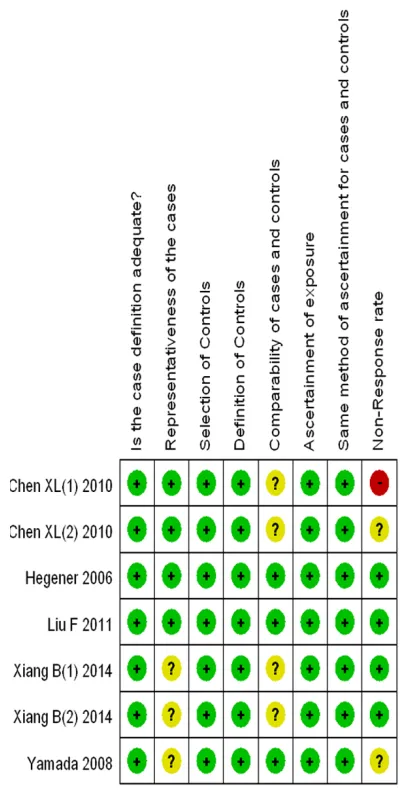
The general quality of the 7 included publica-tions was evaluated by the NEWCASTLE - OTTAWA QUALITY ASSESSMENT SCALE The general quality of each study was assessed by 8 items with high risk “ - ” moderate risk “ ? ” and low risk “+”.
were systematic searched with the text words of “stroke”, “apM1 gene”, “ADIPOQ”, “ACDC” “GBP-28” “Acrp30” and “polymorphism” by two reviewers independently. The study inclusion criteria was: (1) The study type was case-control or cohort studies; (2) The paper was published in English or Chinese; (3) The original study pro-vided the genotype distribution frequency (GG, GC and CC); The study exclusion criteria was: (1) Case report or review study type; (2) Papers published in other languages instead of English or Chinese; (3) Duplicated published data; (4) Genotype of CC, CG and GG in case and control group can’t be extracted or calculated from the original included studies. References of the potential relevant publications were also
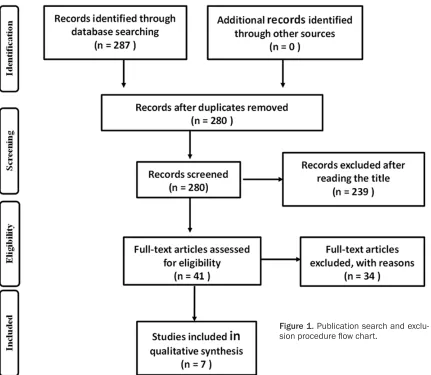
screened in order to find further suitable stud -ies. The paper screening and inclusion proce-dure is expressed in Figure 1.
Data extraction
General information and genotype (CC, CG and GG) distribution frequency of the included
[image:2.612.93.524.69.444.2]Statistical analysis
All the data was analyzed by ReviewMan 5.1 (http://ims.cochrane.org/revman/download)
and Stata10.0 SE software (http://www.stata. com; Stata Corporation, College Station, TX). The odds ratio (OR) was used to demonstrated the correlation between apM1 gene rs266729 locus C>G polymorphism and ischemic stroke susceptibility. I2 test was used to evaluate the
statistical heterogeneity. Data was pooled by
random or fixed effect model according to sta -tistical heterogeneity results (I2>50%, random
effect model; I2 ≤ 50%, fixed effect model).
Publication bias was investigated by Begg’s funnel plot and Egger’s test. Two tails P < 0.05
was considered statistical significant.
Results
The publication searching results
Through electronic searching the data bases of Pubmed, EMBase, Web of Science, Google scholar, CBM and CNKI, 7 studies were
identi-fied for inclusion in the meta-analysis [9-15].
General information is shown in Table 1. Studies quality
The general quality of the included studies is shown in Figure 2. Generally, the quality was high for the 7 publications. All studies addre-
ssed the “adequate case definition”, “selection of controls”, “definition of controls” “assess -ment of exposure” and “same method of ascer-tainment for cases and controls”. Only one study didn’t mention the “non-response rate”.
Statistical heterogeneity
Statistical heterogeneity for the included 7 studies was evaluated by I2 test. For dominant
[image:3.612.91.522.85.201.2]genetic model (GG+CG vs CC), the statistical heterogeneity among the included 7 studies was not statistical different (I2 = 39%, χ2 = 9.87,
Table 1. Characteristics of the 7 included studies
Study Year Country Sample sizhe Genotyping Case Control HWE
Case Control CC CG GG CC CG GG
Hegener [8] 2006 U.S 259 259 TaqMan 123 128 8 134 98 27 >0.05 Yamada [9] 2008 Japan 313 971 PCR_SSOP 163 120 28 575 346 50 >0.05 Chen XL (1) [11] 2010 China 357 345 TaqMan 174 108 35 176 104 24 NA Chen XL (2) [10] 2010 China 457 457 TaqMan 284 184 27 244 176 37 NA
Liu F [12] 2011 China 302 338 PCR_RFLP 144 125 33 189 128 21 >0.05 Xiang B (1) [14] 2014 China 372 416 PCR_RFLP 198 141 33 252 146 18 >0.05 Xiang B (2) [13] 2014 China 365 402 PCR_RFLP 193 139 33 243 141 18 >0.05
NA: Not available.
[image:3.612.85.289.231.635.2]P = 0.13). However, for recessive and homologous genetic model, the heterogeneity were statistical
significant (P < 0.05).
Meta-analysis
The relationship between apM1 ge- ne rs266729 locus C>G polymor-phism and ischemic stroke suscep- tibility was evaluated separated through the hypothesis of domi-nant (GG+CG vs CC), recessive (GG vs CC+CG) and homologous (GG vvs CC) genetic model. In a domi-nant genetic model, the combined OR = 1.20 (95% CI: 1.08-1.34) by
fixed effect model (Figure 3). For a
recessive genetic model, the OR was pooled by random effect model with point estimated of
1.26 and it 95% confidence inter -val of 0.78-2.05 (Figure 4). In the aspect of homologous genetic model, the OR = 1.35 (95% CI: 0.82-2.22), (Figure 5) through ran-dom effect model because of
sig-nificant publication bias among
the included studies. Sensitivity analysis
Sensitivity analysis was done by omitting each of the included stud-ies in data calculation. The pooled OR (point estimated) range from 1.09 to 1.15 (dominant genetic model, Figure 6), 1.21-1.48 (reces-sive genetic model, Figure 7) and 1.24-1.54 (homologous genetic model, Figure 8) by excluded any one of the included studies. This indicated that the pooled results were not sensitive to any single study.
Publication bias
Begg’s funnel plot and Egger’s line regression test were applied for Figure 4. Forrest plot for recessive genetic model (GG vs CC+CG).
Figure 5. Forrest plot for homologous genetic model (GG vs CC).
Figure 6. Forrest plot of sensitivity analysis by omitting each of the includ-ed studies in dominant genetic model (GG+CG vs CC).
Figure 7. Forrest plot of sensitivity analysis by omitting each of the included studies in recessive genetic model (GG vs CC+CG).
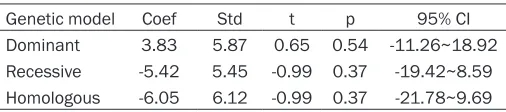
publication bias evaluation. In a dominant genetic model, the Begg’s funnel plot was symmetric (Figure 9) and Egger’s test indicated no
publi-cation bias (t = 0.65, P = 0.54). For
recessive and homologous genetic model the Begg’s funnel plot was asymmetric (Figures 10 and 11). However the Egger’s line regression test showed no publication bias (t = -0.99, P = 0.37), Table 2.
Discussion
In the present meta-analysis, 7 ca- se-control studies were included and no correlation was found be- tween apM1 gene rs266729 locus C>G polymorphism and ischemic stroke susceptibility in recessive and homologous genetic model. However, in the case of dominant genetic model, the correlation be- tween apM1 gene rs266729 locus C>G polymorphism and ischemic stroke was positive. People carrying G allele may have increased risk of developing ischemic stroke. How- ever, this correlation is week, only a slight elevated odds ratio was found (OR = 1.20) in comparing people with G allele to C allele. At the same time, several limitations were also existed in this meta-analysis which may also decrease the stability of results. The limitations of this meta-analysis include: ① statistical het-erogeneity across the include stud-ies. The statistical heterogeneity can weak the statistical power although random effect model was applied; ② Language restriction. In this study, only Chinese and English lit-erature was searched in the elec-tronic databases. Other studies pub-lished in Japanese, Germany, etc. were not searched and included in this meta-analysis. This language restriction ineluctable leads to omis-sion related studies; ③ Another key Figure 8. Forrest plot of sensitivity analysis by omitting each of the
[image:5.612.90.343.305.497.2]included studies in homologous genetic mode (GG vvs CC).
[image:5.612.91.347.542.720.2]Figure 10. Begg’s funnel plot for evaluation publication bias in re-cessive. Genetic model.
pooled with fixed effect model.
Second, the publication bias was not existed in this meta-analysis. Third, sensitivity analysis indicated the pooled results was not sensitive to each single publication of the includ-ed 7 studies which indicatinclud-ed the pooled results was relative stable. Previously studies have intimated the favorable cardiovascular effects at- tributed to adiponectin may lower risk of stroke [16]. However, a meta-analy-sis about adiponectin and risk of stroke based on prospective study performed by Arregui and his colleges [17] didn’t approve the positive effects of adiponectin on decreasing stroke risk. In Arregui’s study, the authors direct compared the risk ratio (RR) of stroke among people with high, moderate, and low adiponectin serum level and they didn’t found sta-tistical difference for RR of stroke. In conclusion, the correlation between apM1 gene rs266729 locus C>G poly-morphism or serum adiponectin pro-tein level and ischemic stroke
suscep-tibility was not definitive confirmed.
More case-controls or prospective cohort studies with large samples are needed to further elucidate the correlation.
Disclosure of conflict of interest
None.
Address correspondence to: Siying Lei, Department of Neurology, Lishui Peo- ple’s Hospital, No.15 Dazhong Road, Liandu Area, Lishui 323000, Zhejiang, PR China. Tel: +86 (0578) 2780122; E-mail: [email protected]
[image:6.612.93.342.304.478.2]References
Figure 11. Begg’s funnel plot for evaluation publication bias in ho-mologous genetic model.
Table 2. Parameters for Eggler’s line regression test
Genetic model Coef Std t p 95% CI
Dominant 3.83 5.87 0.65 0.54 -11.26~18.92 Recessive -5.42 5.45 -0.99 0.37 -19.42~8.59 Homologous -6.05 6.12 -0.99 0.37 -21.78~9.69
limitations is small sample size of this meta-analysis. Only 7 case-control studies were included in this study. The small samples also made the conclusion unstable. Except for the limitations, the study also have advantages.
First, there was no statistical heterogeneity in
the dominant genetic model and data was
[1] Díez JJ and Iglesias P. The role of the novel ad-ipocyte-derived hormone adiponectin in hu-man disease. Eur J Endocrinol 2003; 148: 293-300.
[image:6.612.90.343.549.605.2]the disease. Biomed Res Int 2014; 2014: 701915.
[3] Kouidhi S, Jarboui S, Marrakchi R, Froidevaux MS, Seugnet I, Abid H, Bchir F, Brahem M, Demeneix B, Guissouma H and Elgaaied AB. Adiponectin expression and metabolic mark-ers in obesity and Type 2 diabetes. J Endocrinol Invest 2011; 34: e16-23.
[4] Kawano J and Arora R. The role of adiponectin in obesity, diabetes, and cardiovascular dis-ease. J Cardiometab Syndr 2009; 4: 44-9. [5] Gu HF, Abulaiti A, Ostenson CG, Humphreys K,
Wahlestedt C, Brookes AJ and Efendic S. Single nucleotide polymorphisms in the proximal pro-moter region of the adiponectin (APM1) gene are associated with type 2 diabetes in Swedish caucasians. Diabetes 2004; 53 Suppl 1: S31-5.
[6] Li S, Lu N, Li Z, Jiao B, Wang H, Yang J and Yu T. Adiponectin gene polymorphism and ischemic stroke subtypes in a Chinese population. J Stroke Cerebrovasc Dis 2017; 26: 944-951. [7] Xiuju C, Zhen W, Yanchao S. A meta-analysis of
adiponectin gene rs22411766 T>G polymor-phism and ischemic stroke susceptibility. Open Med (Wars) 2016; 11: 115-120.
[8] Shen D, Xing S and Chen C. Adiponectin gene polymorphisms contributes to ischemic stroke risk: a meta-analysis. J Renin Angiotensin Aldosterone Syst 2015; 16: 178-84.
[9] Hegener HH, Lee IM, Cook NR, Ridker PM and Zee RY. Association of adiponectin gene varia-tions with risk of incident myocardial infarction and ischemic stroke: a nested case-control study. Clin Chem 2006; 52: 2021-7.
[10] Yamada Y, Kato K, Oguri M, Yoshida T, Yokoi K, Watanabe S, Metoki N, Yoshida H, Satoh K, Ichihara S, Aoyagi Y, Yasunaga A, Park H, Tanaka M, Nozawa Y. Association of genetic variants with atherothrombotic cerebral infarc-tion in Japanese individuals with metabolic syndrome. Int J Mol Med 2008; 21: 801-8.
[11] Chen XL. Adiponectinpolymorphism and isch-emic stroke susceptibility in Chinses Han pop-ulation. Zhengzhou University 2010.
[12] Chen XL, Cheng JQ, Zhang RL, Liu JP, Li XX, Tong YQ, Geng YJ. Study on the relationship be-tween polymorphism of adiponectin gene and risk of ischemic stroke among Han population in the Northern parts of China. Zhonghua Liu Xing Bing Xue Za Zhi 2010; 31: 129-32. [13] Liu F, He Z, Deng S, Zhang H, Li N, Xu J.
Association of adiponectin gene polymor-phisms with the risk of ischemic stroke in a Chinese Han population. Mol Biol Rep 2011; 38: 1983-8.
[14] Xiang B, Wang C and Wang XQ. Associations between single-nucleotide polymorphisms rs266729, rs2241766, rs822396 of adipo-nectin gene and TOAST subtypes of ischemic cerebrovascular disease in the elderly. Chinese Journal of Stroke 2014: 571-577.
[15] Xiang B, Zhang L and Wang XQ. The associa-tion of Adiponectin gene polymorphism (-11377C/G,-3964A/G,-45T/G) and cerebral infarction. Journal of Apoplexy and Nervous Diseases 2014; 31: 125-129.
[16] Kizer JR, Benkeser D, Arnold AM, Djousse L, Zieman SJ, Mukamal KJ, Tracy RP, Mantzoros CS, Siscovick DS, Gottdiener JS and Ix JH. Total and high-molecular-weight adiponectin and risk of coronary heart disease and ischemic stroke in older adults. J Clin Endocrinol Metab 2013; 98: 255-63.