Review Article
Genetic variants of
miR-146a
and
miR-499
and risk
of ischemic stroke in the Chinese population: a
meta-analysis and trial sequential analysis
Yuyao Wang1*, Yuxuan Wang2*, Yan Li1, Juntao Zhang1, Weili Zhang3,4, Rui Guo1
1Department of Biochemistry and Molecular Biology, Shanxi Medical University, Taiyuan 030001, Shanxi,
China; 2Department of Thoracic Surgery, Center for Mini-invasive Thoracic Surgery, Shanxi Dayi Hospital, Shanxi
Academy of Medical Sciences, Taiyuan 030032, Shanxi, China; 3State Key Laboratory of Cardiovascular Disease,
Fuwai Hospital, National Center for Cardiovascular Disease, Chinese Academy of Medical Sciences and Peking Union Medical College, Beijing 100037, China; 4Beijing Institute for Brain Disorders Center for Brain Disorders
Research, Capital Medical University, Beijing 100069, China. *Equal contributors.
Received April 25, 2018; Accepted September 6, 2018; Epub July 15, 2019; Published July 30, 2019
Abstract: Objective:Genetic variants in miRNA sequences may alter miRNA expression and/or maturation, result-ing in diverse functional consequences. The aim of the present meta-analysis was to investigate the association between miR-146a rs2910164 and miR-499 rs3746444 genetic polymorphisms and risk of ischemic strokes (IS) in the Chinese population. Methods:A literature search was conducted using PubMed, EMbase, Web of Science, and Chinese National Knowledge Infrastructure (CNKI) databases up to October 2017. Pooled effects (odds ratio [OR] together with 95% confidence intervals [CI]) were calculated. Subgroup analyses were carried out by status of Hardy-Weinberg equilibrium, sample size, genotyping methods, and subtypes of IS. Trial sequential analysis (TSA) was used to reduce the risk of type I errors and determine whether the evidence was firm. Results: A total of 10 eligible studies, consisting of 4,251 patients with IS and 5,812 controls, were finally included. Results showed that pooled OR for IS of the rs2910164 G allele was 1.23 (95% CI: 1.03-1.46, P = 0.022), compared to wild-type C allele under a recessive model, with high heterogeneity (I2 = 56.2%, P = 0.015). No significant association was found between the rs3746444 variant and IS under different genetic models. TSA showed a solid conclusion for association between the rs2910164 variant and IS risk. Conclusion:Current evidence suggests a weak association between miR-146a rs2910164 variant and risk of IS, whereas miR-499 rs3746444 variant might not be associated with elevated risk of IS in a Chinese population.
Keywords: MicroRNA, polymorphism, ischemic stroke, Chinese population
Introduction
Stroked are one of the leading causes of adult chronic disability and death, worldwide [1, 2]. In China, the annual stroke mortality rate is approximately 157 per 100,000, which has had
a significant impact on Chinese society [3].
Ischemic stroke (IS) is the most common type of stroke, accounting for 85% to 90% of all strokes [4]. Multiple factors, including hyper-tension, diabetes mellitus, dyslipidemia, smok-ing, and genetic variants, contribute to the risk of ischemic stroke [5-7].
MicroRNAs (miRNAs, miRs) are a group of small non-coding RNAs that play key roles of
post-transcriptional gene silencing in the pathophys-iology of ischemic strokes. It has been suggest-ed that miR-497 induces neuronal death and miR-15a contributes to the pathogenesis of ischemic vascular injuries [8, 9]. miR-21 and miR-126 have been found to be involved in the pathologic atherosclerosis of ischemic strokes [10, 11].
Genetic variants located in miRNA genes may affect pre-miRNA maturation or target sel- ection. Many studies have investigated the association of two miRNA polymorphisms in pre-miRNA sequences (miR-146a C > G rs- 2910164 and miR-499 A > G rs3746444) with
with rs2910164 GG genotype have a higher risk of ischemic stroke, in accord with recent
findings [13, 14]. The rs3746444 variant was
also found to be associated with susceptibility
to IS [15]. However, these results have not been replicated in other studies [15, 16]. Hence, this
meta-analysis of previous publication studies was conducted. To date, four meta-analyses were carried out to assess the relationship of these two genetic variants and IS [17-20]. Although subgroup analysis by ethnicity was
performed in these studies, findings were still
controversial, partly be due to the limited num-ber of studies and underpowered studies. As previous meta-analyses have not comprehen-sively investigated the association between miR-146a rs2910164 and miR-499 rs3746444 polymorphisms and risk of ischemic strokes in a Chinese population, the present analysis aimed to provide insight on this issue.
Materials and methods
Search strategy
This study systematically searched PubMed, EMbase, Web of Science, and Chinese National Knowledge Infrastructure (CNKI) databases for studies reported before October 2017, using the terms “miR-146a” or “miR-499” paired with “polymorphism’’, “genetic variant”, “ischemic stroke”, “cerebral infarction”, “ischemic cere-brovascular disease”, “Chinese”, and “China”, respectively. No language restrictions were applied. Review articles and bibliographies of relevant studies were manually scanned to identify eligible studies.
Studies were selected according to the follow-ing criteria: (1) Case-control designed; (2) Regarding miR-146a (rs2910164) or miR-499 (rs3746444) variants and IS risk; (3) Studies with complete data about genotype and allele frequencies or providing related information; and (4) Chinese origin. Exclusion criteria includ-ed: (1) Studies without raw data; (2) Family-based studies of pedigree design; and (3) Case reports, letters, commentaries, meeting re- cords, or review articles.
Data extraction and quality assessment
The following information was extracted from
each study: first author, years of publication,
study design, total number of cases and
con-trols, mean age of cases and concon-trols, percent-age of males in patients and controls, genotype
frequencies, genotyping method, and Hardy-Weinberg equilibrium (HWE) in controls. Data
extraction was performed independently by two authors (Wang and Wang). Any disagreements were resolved by consensus with a third author (Li).
Statistical analysis
Stata software (version 12.0, Stata Corporation, College Station, TX, USA) was used in this meta-analysis. Strength of association was
estimat-ed as odds ratio (OR) and 95% confidence inter -vals (CIs). For both polymorphisms, statistical analysis was performed under the allelic (rs2910164, G vs. C; rs3746444, G vs. A), dom-inant (rs2910164, GG+GC vs. CC; rs3746444, GG+GA vs. AA), and recessive (rs2910164, GG vs. GC+CC; rs3746444, GG vs. GA+AA) genetic
models. Significance of the pooled OR was
determined by Z test. A test of heterogeneity was conducted using Cochran’s Q test
(hetero-geneity was considered statistically significant
with a corresponding p-value < 0.10) and
Higgins I2 statistic (I2 > 50% indicates signifi
-cant heterogeneity among studies). A
random-effects model (DerSimonian and Laird method)
was applied if heterogeneity was observed.
Otherwise, a fixed-effects model (Mantel-Haenszel method) was used. Subgroup analy -ses were performed to investigate the probable source of heterogeneity, according to status of
HWE (yes or no), sample size (≥ 500 or < 500
cases), genotyping methods (restriction frag-ment length polymorphism [RFLP], Taqman, or others), and subtypes of IS (large artery
athero-sclerosis [LAA] or small vessel disease [SVD]).
Publication bias was assessed using Begg’s and Egger’s tests and by visual inspection of corresponding funnel plots. P-values < 0.05
indicate statistical significance regarding publi -cation bias. Sensitivity analysis was performed to assess the effects of an individual study on pooled results and the stability of results. In trial sequential analysis (TSA), two-sided tests were used. Type I error was set at 5% and power was set at 80%. Required information size was calculated based on a 15% relative risk reduc-tion. Trials ignored in the interim appeared to be due to low use of information (< 1%). TSA was carried out with the use of TSA software (version 0.9.5.5; Copenhagen Trial Unit, Copen-
Results
Study characteristics
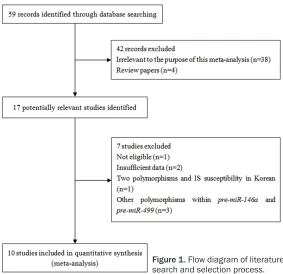
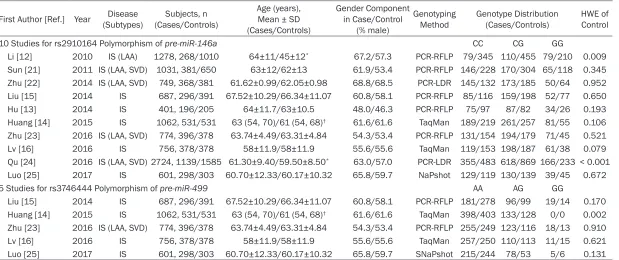
As shown in Figure 1, a total of 10 eligible origi-nal reports, consisting of 10,063 individuals for miR-146a and miR-499, were included accord-ing to inclusion criteria. For miR-146a rs29- 10164 polymorphism, 10 studies [12-16,
21-25] were finally enrolled, including a total of
4,251 patients with IS and 5,812 controls. For miR-499 rs3746444 polymorphism, 5 studies
[14-16, 23, 25] were finally enrolled, including a
total of 1,899 patients with IS and 1,981 con-trols. Enrolled studies and main characteristics are shown in Table 1. The genotype distribution among control subjects of most included
stud-ies did not deviate from the HWE, except for
two studies performed by Li et al. [12] and Qu et al. [24], respectively.
Association between miR-146a rs2910164 variant and IS
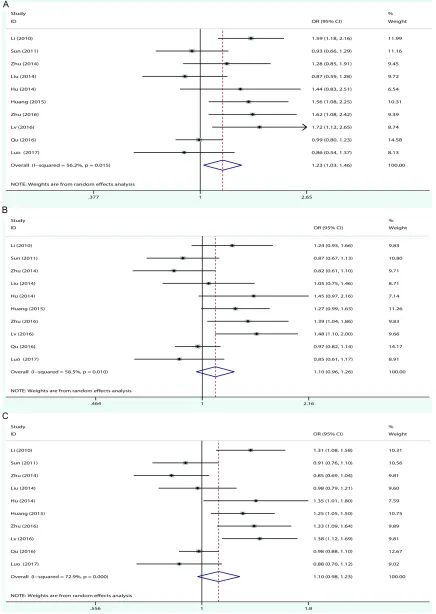
Under the recessive genetic model, the rs2910164 GG genotype was weakly associat-ed with IS risk, comparassociat-ed with the wild-type C allele using a random effects model. Pooled OR was 1.23 (95% CI: 1.03-1.46, P = 0.022) in the
Chinese population. Significant heterogeneity
plots are presented in Supplementary Figure 1B, 1C).
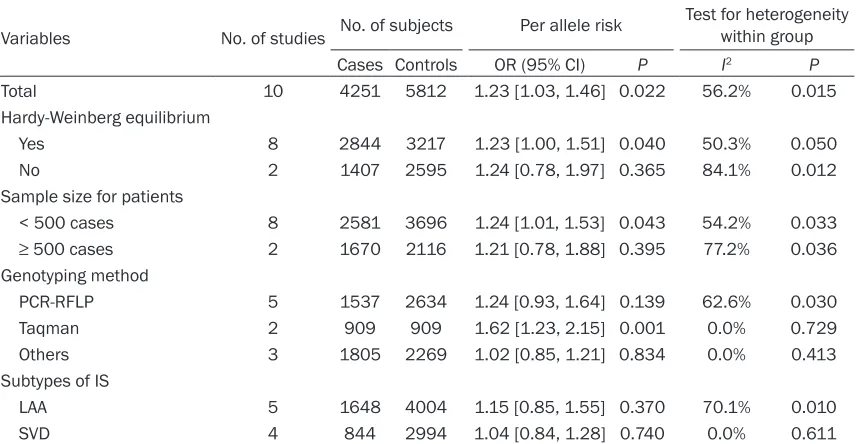
Subgroup analyses were further performed examining the effects of rs2910164 polymor-phism on risk of IS (Table 2). Under the reces-sive model, when studies were restricted to
those within the Hardy-Weinberg’s equilibrium,
for the risk of IS, the pooled OR of the GG geno-type of rs2910164 compared with the GC+CC genotype was 1.23 (95% CI: 1.00-1.51, P = 0.006), with high heterogeneity (I2 = 50.3%, P =
0.050). Heterogeneity within groups disap -peared when analyses were restricted to the
SVD subtype of IS (I2 = 0.0%, P = 0.611).
However, the OR for IS decreased to 1.04 with
a 95% CI of 0.84-1.28. Results became
statisti-cally insignificant (P = 0.740).
Association between miR-499 rs3746444 vari-ant and IS
No significant association was detected
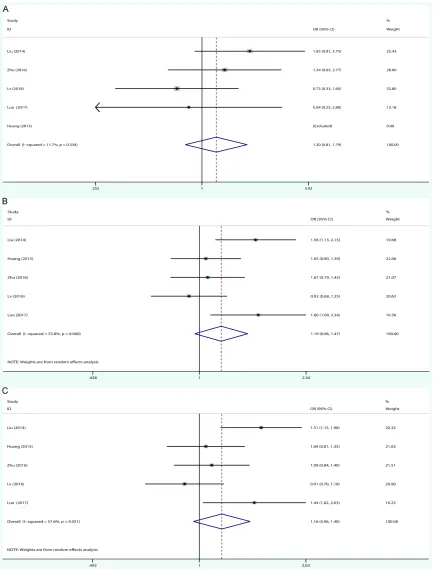
be-tween miR-499 rs3746444 and IS under the recessive model (OR = 1.20, 95% CI: 0.81-1.79, P = 0.366), without heterogeneity (I2 = 11.7%, P
= 0.334) (Figure 3A). No significant publication
bias was detected (Begg’s test P = 0.308, Egger’s test P = 0.469, Supplementary Figure
[image:3.612.91.374.71.345.2]1D). Pooled ORs were similar under the other Figure 1. Flow diagram of literature
search and selection process.
was found among 10 studies (I2 = 56.2%, P = 0.015) (Figure 2A) and no significant publica -tion bias was observed (Begg’s test P = 0.474, Egger’s test P = 0.357) (Supplementary Figure 1A). However, no signifi -cant association was found between the rs2910164 vari-ant and IS risk under the dom-inant genetic model. Pooled OR was 1.10 (95% CI: 0.96-1.26, P = 0.177), with high heterogeneity (I2 = 58.5%, P =
0.010) (Figure 2B). Under the allelic model, pooled OR was 1.10 (95% CI: 0.98-1.23, P = 0.119), with high heterogene-ity (I2 = 72.9%, P < 0.001)
(Figure 2C). No significant
Table 1. Main characteristics of studies included in meta-analysis
First Author [Ref.] Year (Subtypes)Disease (Cases/Controls)Subjects, n Age (years),Mean ± SD (Cases/Controls)
Gender Component in Case/Control
(% male)
Genotyping
Method Genotype Distribution(Cases/Controls) HWE of Control
10 Studies for rs2910164 Polymorphism of pre-miR-146a CC CG GG
Li [12] 2010 IS (LAA) 1278, 268/1010 64±11/45±12* 67.2/57.3 PCR-RFLP 79/345 110/455 79/210 0.009
Sun [21] 2011 IS (LAA, SVD) 1031, 381/650 63±12/62±13 61.9/53.4 PCR-RFLP 146/228 170/304 65/118 0.345 Zhu [22] 2014 IS (LAA, SVD) 749, 368/381 61.62±0.99/62.05±0.98 68.8/68.5 PCR-LDR 145/132 173/185 50/64 0.952 Liu [15] 2014 IS 687, 296/391 67.52±10.29/66.34±11.07 60.8/58.1 PCR-RFLP 85/116 159/198 52/77 0.650
Hu [13] 2014 IS 401, 196/205 64±11.7/63±10.5 48.0/46.3 PCR-RFLP 75/97 87/82 34/26 0.193
Huang [14] 2015 IS 1062, 531/531 63 (54, 70)/61 (54, 68)† 61.6/61.6 TaqMan 189/219 261/257 81/55 0.106
Zhu [23] 2016 IS (LAA, SVD) 774, 396/378 63.74±4.49/63.31±4.84 54.3/53.4 PCR-RFLP 131/154 194/179 71/45 0.521
Lv [16] 2016 IS 756, 378/378 58±11.9/58±11.9 55.6/55.6 TaqMan 119/153 198/187 61/38 0.079
Qu [24] 2016 IS (LAA, SVD)2724, 1139/1585 61.30±9.40/59.50±8.50* 63.0/57.0 PCR-LDR 355/483 618/869 166/233 < 0.001
Luo [25] 2017 IS 601, 298/303 60.70±12.33/60.17±10.32 65.8/59.7 NaPshot 129/119 130/139 39/45 0.672
5 Studies for rs3746444 Polymorphism of pre-miR-499 AA AG GG
Liu [15] 2014 IS 687, 296/391 67.52±10.29/66.34±11.07 60.8/58.1 PCR-RFLP 181/278 96/99 19/14 0.170 Huang [14] 2015 IS 1062, 531/531 63 (54, 70)/61 (54, 68)† 61.6/61.6 TaqMan 398/403 133/128 0/0 0.002
Zhu [23] 2016 IS (LAA, SVD) 774, 396/378 63.74±4.49/63.31±4.84 54.3/53.4 PCR-RFLP 255/249 123/116 18/13 0.910
Lv [16] 2016 IS 756, 378/378 58±11.9/58±11.9 55.6/55.6 TaqMan 257/250 110/113 11/15 0.621
two genetic models. For the dominant model, the OR was 1.19 (95% CI: 0.96-1.47, P = 0.108) with high heterogeneity (I2 = 55.8%, P = 0.060)
(Figure 3B). For the allelic model, the OR was 1.16 (95% CI: 0.96-1.40, P = 0.120) with het-erogeneity (I2 = 57.6%, P = 0.051) (Figure 3C).
No significant publication bias was detected
under either model (Begg’s test P = 0.462 and 0.806, Egger’s test P = 0.155 and 0.322, respectively; Funnel plots are presented in Supplementary Table 1E, 1F).
Sensitivity analysis
Omitting one study each time, regarding asso-ciation between miR-146a rs2910164 and risk of IS under the recessive genetic model, the
significance of pooled ORs disappeared after
multiple studies were excluded. This suggests the high probability of the presence of false-positive results. Remaining results remained similar for the two variants under different genetic models (Supplementary Figure 2). Trial sequential analysis
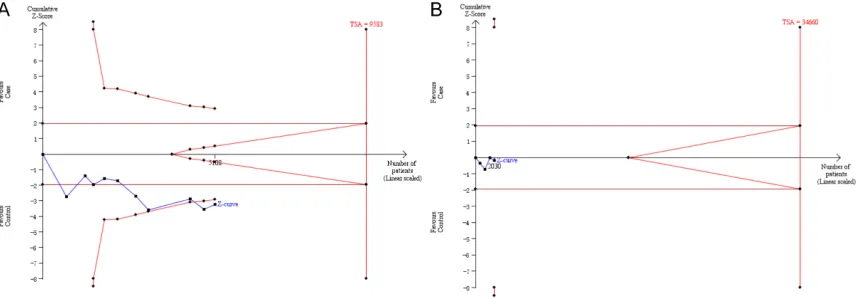
For overall analysis of the polymorphism miR-146a rs2910164, the total number of cases and controls were more than required. It was found that the cumulative Z-curve exceeded monitoring boundaries before reaching the required information size, indicating that
cumu-lative evidence is adequate and further trials were unnecessary (Figure 4A). On the other hand, TSA did not allow this study to draw any solid conclusions regarding association be- tween miR-499 rs3746444 polymorphism and IS risk. Further trials are warranted (Figure 4B).
Discussion
Strokes are a complex multifactorial disease. China has approximately 2.5 million new stroke cases each year. Strokes have become the leading cause of death in the country [26]. IS is the most common type of stroke, but its pre-cise pathophysiology remains unclear. Under- lying mechanisms of IS have been shown to comprise both genetic and environmental fac-tors. Numerous genetic studies have been
con-ducted to investigate the influence of gene
polymorphisms, including the miRNA variants, on occurrence of IS. To date, growing evidence has suggested that miRNAs, including miR-146a and miR-499, are involved in thrombosis
and inflammation pathways in the circulation system [27-29]. However, opinions concerning
their roles in IS are controversial and far from conclusive.
[image:6.612.92.520.86.308.2]As previously reported, miR-146a negatively regulates interleukin-1 receptor-associated kinase 1 (IRAK1) and tumor necrosis factor
Table 2. Stratified meta-analysis of the effects of rs2910164 polymorphism on risk for IS
Variables No. of studies No. of subjects Per allele risk
Test for heterogeneity within group
Cases Controls OR (95% CI) P I2 P
Total 10 4251 5812 1.23 [1.03, 1.46] 0.022 56.2% 0.015
Hardy-Weinberg equilibrium
Yes 8 2844 3217 1.23 [1.00, 1.51] 0.040 50.3% 0.050
No 2 1407 2595 1.24 [0.78, 1.97] 0.365 84.1% 0.012
Sample size for patients
< 500 cases 8 2581 3696 1.24 [1.01, 1.53] 0.043 54.2% 0.033
≥ 500 cases 2 1670 2116 1.21 [0.78, 1.88] 0.395 77.2% 0.036
Genotyping method
PCR-RFLP 5 1537 2634 1.24 [0.93, 1.64] 0.139 62.6% 0.030
Taqman 2 909 909 1.62 [1.23, 2.15] 0.001 0.0% 0.729
Others 3 1805 2269 1.02 [0.85, 1.21] 0.834 0.0% 0.413
Subtypes of IS
LAA 5 1648 4004 1.15 [0.85, 1.55] 0.370 70.1% 0.010
SVD 4 844 2994 1.04 [0.84, 1.28] 0.740 0.0% 0.611
PCR, polymerase chain reaction; RFLP, restriction fragment length polymorphisms; IS, ischemic stroke; LAA, large artery
Figure 3. Forest plots of miR-499 rs3746444 variant and ischemic stroke. A. Association between the miR-499 rs3746444 and ischemic stroke using the recessive model. B. Association between the miR-499 rs3746444 and ischemic stroke using the dominant model. C. Association between the miR-499 rs3746444 and ischemic stroke using the allelic model.
receptor-associated factor 6 (TRAF6), which
-ing TRAF6 and IRAK-1 expression, caus-ing
decreased levels of pro-inflammatory cyto -kines, such as interleukin (IL)-1, IL-6, IL-8, and tumor necrosis factor-a (TNF-a) [31]. Moreover,
miR-146a represses the pro-inflammatory NF-κB pathway as well as the MAP kinase path -way [32], which are important regulators in the pathology process of IS. On the other hand, miR-499 can regulate C-reactive protein [33],
which is a sensitive indicator of inflammation
associated with the risk of IS [34]. Although several epidemiological studies have assessed the relationship between miR-146a rs2910164 and miR-499 rs3746444 variants and risk of IS, the composite of these studies has failed to provide a consensus [17-20]. Few studies have focused on this issue in the Chinese popu- lation.
To the best of our knowledge, this is the first
meta-analysis that comprehensively assess- es association between the two well-known miRNA polymorphisms and susceptibility of IS in the Chinese population. The present analysis found a weak association between miR-146a rs2- 910164 polymorphism and IS in the Chinese
population, with high heterogeneity. However, this association became non-significant under
sub-group studies. For example, when
restrict-ed to the SVD subtype of IS or larger sample
size studies, results indicated the high proba-bility that the association was falsely positive. This may have been caused by shortcomings in the design and conduct of selected studies, “winner’s curse” phenomenon [35], or chance. On the other hand, miR-499 rs3746444
vari-ant yielded no significvari-ant overall association
with the risk of IS, with evidence of significant
heterogeneity across studies.
Meta-analyses aim to increase the power and precision of the estimated effects of genetic
variants on disease. However, results of the
present meta-analysis might be prone to sys-tematic or random errors due to repeated
sig-nificance testing of accumulated data. Thus,
TSA was conducted to decrease the risk of type
I errors and confirm more statistical reliability
of the data by estimation of required informa-tion size. This was accomplished by adjusting
the threshold of significance levels with the use
of Alpha-spending boundaries. In the current meta-analysis, TSA results indicated that the cumulative evidence might be adequate for the analysis of miR-146a rs2910164, whereas more trials are warranted for that of miR-499 rs3746444. Although TSA results of miR-146a rs2910164 showed that the cumulative Z-curve reached the perpendicular line (required infor-mation size), considering that high heterogene-ity was detected among studies and weak
sig-nificance of pooled results was present, more
well conducted studies with uniform methodol-ogy are necessary.
Currently, no data is available focusing on the relationship between miR-146a rs2910164 polymorphism and susceptibility to IS for more nationalities. There is only one article demon-strating that the G allele of the miR-146a poly-morphism is associated with an increased risk
of IS in the Korean population [36]. However,
[image:8.612.93.522.73.222.2]morphism and IS risk in the Chinese popula-tion. Notably, differential allele frequencies of miR-146a polymorphisms exerted
dispropor-tionate levels of influence on stroke risks in dif -ferent populations. It should be noted that the frequency of the G allele in East Asians was
sig-nificantly lower than that in Caucasians [37]
and Indians [38]. Prevalence of the G allele was 35% in the Chinese population [14], which is similar to that found in the Korean population [36]. Such a discrepancy may be caused by
dis-tinct ethnic specificity, which might affect levels
of mature miR-146a production.
Results of the present meta-analysis should be interpreted carefully because of the following potential limitations. First, the present study was mainly based on unadjusted estimates. Potential covariates, including age, drinking status, obesity, cigarette consumption, or other lifestyle factors, may have caused confounding
bias. Second, differences in the clinical classifi -cation of IS patients and subtypes, as well as the enrolled controls among the selected stud-ies, might have affected overall results. Third, studies involved in this meta-analysis were
small or medium-sized, with insufficient statis -tical power. Fourth, potential weakness of genetic association studies, such as genotyp-ing errors, gene-gene, and gene-environment interactions, might have also distorted out- comes.
In summary, based on current studies, the present analysis showed a weak association between miR-146a rs2910164 GG genotype and increased risk of IS in the Chinese popula-tion, whereas miR-499-rs3746444 might not be associated with elevated risk of IS in the Chinese population. Well-conducted studies with larger sample sizes and improved
method-ologies are required to verify the present find -ings. Moreover, analyses concerning IS sub-types and gene-gene and gene-environment interactions are necessary regarding the het-erogeneity of this disease.
Acknowledgements
This work was supported by the National Na- tural Science Foundation of China (No.8150- 0364) and the Youth Fund of Shanxi Medical University (No.02201402) to Y.Y.W., the Science
and Technology Department Basic Research
Project of Shanxi (201601D102069) and the
Special Clinical Medicine Research Funds of Wu Jieping Medicine Gene (320.6750.13309) to Y.X.W.
Disclosure of conflict of interest
None.
Address correspondence to: Dr. Weili Zhang, State Key Laboratory of Cardiovascular Disease, Fuwai Hospital, National Center for Cardiovascular Disease, Chinese Academy of Medical Sciences and Peking Union Medical College, 167 Beilishi Road, Beijing 100037, China. Tel: +86 10 60866432; Fax: +86 10 68331730; E-mail: Zhangweili1747@yahoo. com; Dr. Rui Guo, Department of Biochemistry and Molecular Biology, Shanxi Medical University, 56 Xinjian Road, Taiyuan 030001, Shanxi, China. Tel: +86 351 3985136; Fax: +86 351 3985136; E-mail: [email protected]
References
[1] Donnan GA, Fisher M, Macleod M, Davis SM. Stroke. Lancet 2008; 371: 1612-1623. [2] Strong K, Mathers C, Bonita R. Preventing
stroke: saving lives around the world. Lancet Neurol 2007; 6: 182-187.
[3] Liu L, Wang D, Wong KS, Wang Y. Stroke and stroke care in China: huge burden, significant workload, and a national priority. Stroke 2011; 42: 3651-3654.
[4] Matarin M, Singleton A, Hardy J, Meschia J. The genetics of ischaemic stroke. J Intern Med 2010; 267: 139-155.
[5] Domingues-Montanari S, Mendioroz M, Del Rio-Espinola A, Fernández-Cadenas I, Mon- taner J. Genetics of stroke: a review of recent advances. Expert Rev Mol Diagn 2008; 8: 495-513.
[6] Della-Morte D, Guadagni F, Palmirotta R, Testa G, Caso V, Paciaroni M, Abete P, Rengo F, Ferroni P, Sacco RL, Rundek T. Genetics of ischemic stroke, stroke-related risk factors, stroke precursors and treatments. Phar- macogenomics 2012; 13: 595-613.
[7] Prugger C, Luc G, Haas B, Morange PE, Ferrieres J, Amouyel P, Kee F, Ducimetiere P, Empana JP; PRIME Study Group. Multiple bio-markers for the prediction of ischemic stroke: the PRIME study. Arterioscler Thromb Vasc Biol 2013; 33: 659-666.
[9] Yin KJ, Deng Z, Hamblin M, Xiang Y, Huang H, Zhang J, Jiang X, Wang Y, Chen YE. Peroxisome proliferator-activated receptor delta regulation of miR-15a in ischemia-induced cerebral vas-cular endothelial injury. J Neurosci 2010; 30: 6398-6408.
[10] Weber M, Baker MB, Moore JP, Searles CD. MiR-21 is induced in endothelial cells by shear stress and modulates apoptosis and eNOS ac-tivity. Biochem Biophys Res Commun 2010; 393: 643-648.
[11] Wang S, Aurora AB, Johnson BA, Qi X, McAnally J, Hill JA, Richardson JA, Bassel-Duby R, Olson EN. The endothelial-specific microRNA miR-126 governs vascular integrity and angiogene-sis. Dev Cell 2008; 15: 261-271.
[12] Li L. Association of miRNA-146a polymorphi- sm with risk of cardiovascular disease and ischemia stroke and the mechanisms. Master thesis. Central South University 2010.
[13] Hu YM, Li SJ, Jiang XF, Li G, Zhang ML, Zhang QL, Xiang L. Study on the association of miR-146aC > G, miR-149 T > C polymorphism with susceptibility to ischemic stroke. Progress in Modern Biomedicine 2014; 14: 5648-5643. [14] Huang S, Zhou S, Zhang Y, Lv Z, Li S, Xie C, Ke
Y, Deng P, Geng Y, Zhang Q, Chu X, Yi Z, Zhang Y, Wu T, Cheng J. Association of the genetic polymorphisms in pre-microRNAs with risk of ischemic stroke in a Chinese population. PLoS One 2015; 10: e0117007.
[15] Liu Y, Ma Y, Zhang B, Wang SX, Wang XM, Yu JM. Genetic polymorphisms in pre-microRNAs and risk of ischemic stroke in a Chinese popu-lation. J Mol Neurosci 2014; 52: 473-480. [16] Lv GT, Wang S, Wang QK. Association of
miR-146a rs2910164 and miR-499 rs3746444 polymorphisms with risk of ischemic stroke. New Medicine 2016; 47: 257-260.
[17] Bao MH, Xiao Y, Zhang QS, Luo HQ, Luo J, Zhao J, Li GY, Zeng J, Li JM. Meta-analysis of miR-146a polymorphisms association with coro-nary artery diseases and ischemic stroke. Int J Mol Sci 2015; 16: 14305-14317.
[18] Xiao Y, Bao MH, Luo HQ, Xiang J, Li JM. A meta-analysis of the association between polymor-phisms in microRNAs and risk of ischemic stroke. Genes (Basel) 2015; 6: 1283-1299. [19] Zhu J, Yue H, Qiao C, Li Y. Association between
single-nucleotide polymorphism (SNP) in miR-146a, miR-196a2, and miR-499 and risk of ischemic stroke: a meta-analysis. Med Sci Monit 2015; 21: 3658-3663.
[20] Qin B, Zheng Y, Zhang W, Wang C, Wang J, Cai Z. Lack of associations between rs2910164 and rs11614913 polymorphisms and the risk of ischemic stroke. Int J Clin Exp Med 2015; 8: 18359-18366.
[21] Sun J. Association of miRNA-146a and EPHX2 polymorphisms with risk of ischemic stroke in Chansha han population and the mechanisms. Master thesis. Central South University 2011. [22] Zhu R, Liu X, He Z, Li Q. 146a and
miR-196a2 polymorphisms in patients with isch-emic stroke in the northern Chinese han popu-lation. Neurochem Res 2014; 39: 1709-1716. [23] Zhu XY. Association of miRNAs and MTHFR
gene polymorphisms with ischemic stroke in the Chinese han population. Doctoral thesis. Qindao University 2016.
[24] Qu JY, Xi J, Zhang YH, Song L, Song Y, Hui RT, Chen JZ. Association of the microrna-146a SNP rs2910164 with ischemic stroke inci-dence and prognosis in a Chinese population. Int J Mol Sci 2016; 17: E660.
[25] Luo HC, Luo QS, Wang CF, Lei M, Li BL, Wei YS. Association of 146a, 149, miR-196a2, miR-499 gene polymorphisms with is- chemic stroke in a Chinese people. Oncotarget 2017; 8: 81295-81304.
[26] Wang Y, Li Z, Zhao X, Wang D, Li H, Xian Y, Liu L, Wang Y. Stroke care quality in China: sub-stantial improvement, and a huge challenge and opportunity. Int J Stroke 2017; 12: 229-235.
[27] Kaudewitz D, Zampetaki A, Mayr M. MicroRNA biomarkers for coronary artery disease? Curr Atheroscler Rep 2015; 17: 70.
[28] Tan KS, Armugam A, Sepramaniam S, Lim KY, Setyowati KD, Wang CW, Jeyaseelan K. Expression profile of microRNAs in young stroke patients. PLoS One 2009; 4: e7689. [29] Sun T, Dong YH, Du W, Shi CY, Wang K, Tariq
MA, Wang JX, Li PF. The role of microRNAs in myocardial infarction: from molecular mecha-nism to clinical application. Int J Mol Sci 2017; 18.
[30] Hung PS, Liu CJ, Chou CS, Kao SY, Yang CC, Chang KW, Chiu TH, Lin SC. miR-146a enhanc-es the oncogenicity of oral carcinoma by con-comitant targeting of the IRAK1, TRAF6 and NUMB genes. PLoS One 2013; 8: e79926. [31] Zhang L, Chopp M, Liu X, Teng H, Tang T, Kassis
H, Zhang ZG. Combination therapy with VELCADE and tissue plasminogen activator is neuroprotective in aged rats after stroke and targets microRNA-146a and the toll-like recep-tor signaling pathway. Arterioscler Thromb Vasc Biol 2012; 32: 1856-1864.
[33] Yang B, Chen J, Li Y, Zhang J, Li D, Huang Z, Cai B, Li L, Shi Y, Ying B, Wang L. Association of polymorphisms in pre-miRNA with inflammato-ry biomarkers in rheumatoid arthritis in the Chinese Han population. Hum Immunol 2012; 73: 101-106.
[34] Yu H, Huang Y, Chen X, Nie W, Wang Y, Jiao Y, Reed GL, Gu W, Chen H. High-sensitivity C-reactive protein in stroke patients-The impor-tance in consideration of influence of multiple factors in the predictability for disease severity and death. J Clin Neurosci 2017; 36: 12-19. [35] Ioannidis JP, Ntzani EE, Trikalinos TA,
Contopoulos-Ioannidis DG. Replication validity of genetic association studies. Nat Genet 2001; 29: 306-309.
[36] Jeon YJ, Kim OJ, Kim SY, Oh SH, Oh D, Kim OJ, Shin BS, Kim NK. Association of the miR-146a, miR-149, miR-196a2, and miR-499 polymor-phisms with ischemic stroke and silent brain infarction risk. Arterioscler Thromb Vasc Biol 2013; 33: 420-430.
[37] Hamann L, Glaeser C, Schulz S, Gross M, Franke A, Nöthlings U, Schumann RR. A micro RNA-146a polymorphism is associated with coronary restenosis. Int J Immunogenet 2014; 41: 393-396.
Supplementary Table 1F.Begg’s test and Egger’s test for funnel plot asymmetries of miR-499
miRNA (minor allele) Genetic Model Models of test Begg’s test Egger’test
miR-499-rs3746444 (G) Allelic 0.806 0.322
Dominant 0.462 0.155
Recessive 0.308 0.469
Supplementary Table 1E.Begg’s test and Egger’s test for funnel plot asymmetries of miR-146a
miRNA (minor allele) Genetic Model Models of test Begg’s test Egger’test
miR-146a-rs2910164 (G) Allelic 0.592 0.412
Dominant 0.592 0.357