©IJRASET: All Rights are Reserved
595
Experimental Study on Partial Replacement of
Cement by Prosopis Juliflora Ash and Fine
Aggregate by Steel Slag
G.S. Saravanakumar 1, S. Manigandan 2
1, 2
Assistant Professor, Department of Civil Engineering, CK College of Engineering and Technology, Cuddalore, Tamilnadu, India.
Abstract: The main aim of this paper is to evaluate the performance of concrete by partial replacement of cement with prosopis Juliflora Ash and Fine aggregate with Steel Slag. Steel Slag is an industrial waste which is generated during the production of steel. In India, annual outcome of Steel Slag is about 10 Million Tonne.it is very important to utilize these waste in order to avoid the land pollution. Therefore, replacing some of the natural aggregate by Steel Slag would lead to considerable environmental benefits. Prosopis Juliflora Ash is the residue powder left after the combustion of wood, such as burning wood in home, hotels or an industrial power plant. It is also difficult to decompose and also absorbs more groundwater. Therefore, using PJA as a partial replacement of cement providing the green and clean environment. In this proposed work Prosopis Juliflora Ash with specified ratio of about 2.5%, 5%, 7.5% & 10% is replaced for cement and 10%, 20%, 30% & 40% of steel slag for partial replacement of fine aggregate is used. The mechanical properties of concrete such as compressive strength, tensile strength and workability has been evaluated. The optimum percentage of combined percentage was found to be 7.5% of PJA and 30% of SS. The project result reveals that 7.5% of PJA and 30% of SS enhance the strength of concrete compared to other replacements.
Keywords: Prosopis Juliflora Ash (PJA), Steel Slag (SS), compressive strength, tensile strength, workability, environmental benefits.
I. INTRODUCTION
©IJRASET: All Rights are Reserved
596
A. Scope And Objectives 1) General
a) To evaluate the compressive strength of conventional cube and partially replaced cubes by 2.5%, 5%, 7.5%, 10% of Prosopis Juliflora Ash (PJA) and 10%, 20%, 30%, 40% of steel slag (SS).
b) To determine the finest percentage mixture of PJA and SS in the concrete mix.
2) Objectives: The main objective to choose this project is categorized into four categories .it is mainly based on 4R’S, they are mentioned here
a) Reuse Reuse the waste product.
b) Reduce Reduce the waste generated.
c) Replacement Replacement of cement
& fine aggregate
d) Reconstruct Reconstruct the global environment.
3) Scope: The original scope of this project was to investigate the properties of concrete with steel slag as fine aggregate and prosopis juliflora ash as cement. The fresh and hardened properties of concrete were tested with steel slag aggregate and prosopis juliflora ash. In addition to this researchtests were also included such as compressive strength and split tensile strength of the concrete. For this research the percentage of volume of natural aggregate were replaced by steel slag by 10%, 20%, 30% & 40% and percentage of volume of cement were replaced by PJA 2.5%, 5%, 7.5% and 10%.
II. MATERIALS
A. Cement
Cement is the binder material which holds the aggregate together. The commonly available ordinary Portland Cement (OPC 53 grade) confirming to IS12269-1987 is preferred for this study. The properties of the cement were tested in laboratory and mentioned below.
Table 3.1 Preliminary test on cement SI.
NO
TEST RESULTS
1 Fineness of cement 3%
2 Normal consistency of cement 33%
3 Specific gravity of cement 3.16
4 Initial setting time of cement 33 mins 5 Final setting time of cement 535 mins
B. Fine Aggregate
Natural river sand passing through 1.18mm sieve and retained on 150μm sieve was used and tested as per IS: 2386-1983. The specific and confirmed Zone II grade of sand as per IS: 383 – 1987 was used.
Table 3.2 Preliminary test on fine aggregate
SI.NO TEST RESULTS
1 Fineness modulus 3.44
2 Specific gravity of fine aggregate
2.6
3 Water absorption of fine aggregate
1.23
C. Coarse Aggregate
©IJRASET: All Rights are Reserved
597
Table 3.3 Preliminary test on Coarse aggregate
D. Steel Slag
Steel slag is a by-product obtained either from conversion of iron to steel in a Basic Oxygen Furnace (BOF), or by the melting of scrap to make steel in the Electric Arc Furnace (EAF). We collected steel slag from PULKIT steel Re-Rolling mill, Pondicherry.
TABLE 3.4 Physical properties of Steel Slag
SI.NO DESIGNATION PROPERTIES
1 Color Light to dark
brown
2 Shape Highly angular
3 Bulk density 1911.11 kg/m3
4 pH (in water) 8
5 Combustibility Non-
combustible
6 Surface texture Rough
7 Specific gravity 2.73
TABLE 3.5 Chemical properties of Steel Slag
SI. NO CONSTITUENT COMPOSITION
1 Calcium Oxide (CaO) 40 – 52
2 Silica (SiO2) 10 – 19
3 Iron Oxide (FeO) 10 – 40
4 Manganese Oxide
(MnO)
5 – 8
5 Magnesium Oxide
(MgO)
5 – 10
6 Alluminium Oxide
(Al2O3)
1 – 3
7 Phosphorous Oxide
(P2O5)
0.5 - 1
E. Prosopis Juliflora Ash
[image:3.612.193.413.682.723.2]The Prosopis juliflora used for this study were acquired from the nearby areas in Cuddalore and converted as ash
TABLE 3.6 Physical properties of Prosopis Juliflora Ash
SI.NO TEST RESULTS
1 Fineness modulus 3.54
2 Specific gravity of coarse aggregate
2.73
3 Water absorption of coarse aggregate
0.7
1 Specific gravity 2.2
©IJRASET: All Rights are Reserved
599
Fig 4.1 Slump Cone Test
C. Casting Of Cubes And Cylinder
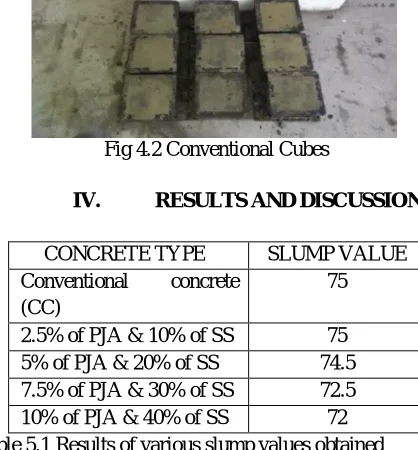
The total 45 numbers of cube (9 Nos. of Conventional concrete & 9 Nos. of cube for each 2.5% of PJA & 10% of SS, 5% of PJA & 20% of SS,
7.5% of PJA & 30% of SS, and 10% of CCA & 40% of SS replacements) are tested in a Compression testing machine.
Similarly, for each test that was conducted, the total number of 30 cylinders were prepared of size 150x300mm.The specimens were casted by using mixture as that used for cube casting and cured for 28 days at normal temperature to determine the split tensile strength of concrete.
Fig 4.2 Conventional Cubes
IV. RESULTS AND DISCUSSION
A. Slump Test
CONCRETE TYPE SLUMP VALUE
Conventional concrete (CC)
75
2.5% of PJA & 10% of SS 75
5% of PJA & 20% of SS 74.5
7.5% of PJA & 30% of SS 72.5
10% of PJA & 40% of SS 72
Table 5.1 Results of various slump values obtained
The slump obtained are within the permissible limit as per IS code 456 and appropriate for construction purpose and also has a good workability
B. Compressive Strength
Compressive strength is the capacity of a material or structure to withstand loads tending to reduce size, as opposed to tensile strength, which withstand load tending to elongate. In other words, compressive strength resist compression (being pushed together). In the study of strength of materials, tensile, compressive strength and shear strength of the concrete, 150mm x 150mm x 150mm cubes were cast and cured. After 7 days, 14 days, and 28 days of curing the cubes were tested under compression test machine of capacity 2000kN.
P/A
Where, P ultimate load (KN) A area (m2)
[image:5.612.198.407.337.562.2]©IJRASET: All Rights are Reserved
600
SI.NO % of PJA & SS Replacement
COMPRESSIVE STRENGTH
(N/mm2)
7D 14D 28D
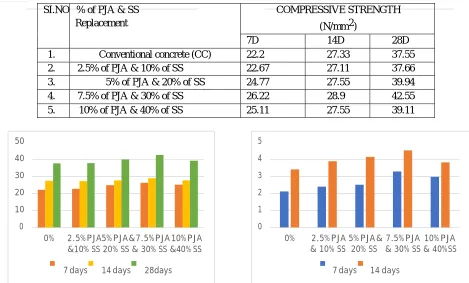
1. Conventional concrete (CC) 22.2 27.33 37.55
2. 2.5% of PJA & 10% of SS 22.67 27.11 37.66
3. 5% of PJA & 20% of SS 24.77 27.55 39.94
4. 7.5% of PJA & 30% of SS 26.22 28.9 42.55
5. 10% of PJA & 40% of SS 25.11 27.55 39.11
Chart 1: Overall Comparison Of Conventional and all Replaced concrete
C. Split Tensile Strength
Tensile strength is one of the basic and important properties of the concrete. The concrete is not usually expected to resist the direct tension because of its low tensile strength and brittle nature. However, the determination of tensile strength of the concrete is necessary to determine the load at which the concrete members may crack. The cracking is the form of tension failure. The split tensile strength was computed by using formula,
T = 2P/ πLD Where,
P ultimate load (KN)
L depth of the cylinder (m) D diameter of the cylinder (m).
The test results obtained by conducting split tensile strength test are tabulated below.
S.no
Percentage of PJA & SS Replacement
Tensile strength
(N/mm2)
7D 28D
1. Conventional concrete (CC)
2.12 3.40
2. 2.5% of PJA &
10% of SS
2.4 3.89
3. 5% of PJA & 20%
of SS
2.51 4.13
4. 7.5% of PJA &
30% of SS
3.29 4.52
5. 10% of PJA &
40% of SS
[image:6.612.70.539.74.357.2]2.97 3.81
Table 5.2 Results for Compressive Strength
Chart 2: Overall Comparison Of Conventional and all Replaced concrete 5 4 3 2 1 0
0% 2.5% PJA 5% PJA & 7.5% PJA 10% PJA & 10% SS 20% SS & 30% SS & 40% SS
7 days 14 days
50 40 30 20 10 0
0% 2.5% PJA 5% PJA & 7.5% PJA 10% PJA &10% SS 20% SS & 30% SS &40% SS
©IJRASET: All Rights are Reserved
601
V. CONCLUSION
The present work investigates the utility of prosopis juliflora ash as cement and steel slag as fine aggregate in the production of high compressive strength concrete.
A. In this project we tried to replace the cement and fine aggregate partially by prosopis juliflora ash (2.5%, 5%, 7.5% and 10%) and steel slag (10%, 20%, 30% and 40%) respectively to increase the strength of the concrete.
B. The mechanical behavior of concrete with partial replacement of cement by prosopis juliflora ash and steel slag as fine aggregate were investigated and presented.
C. Prosopis juliflora ash can be used to partially replace cement in the production of concrete to a maximum of 10% because replacement beyond it this reduces the strength of the concrete.
D. Steel slag can be used to partially replace fine aggregate in the production of concrete to a maximum of 40% because replacement beyond this reduces the strength of the concrete.
E. Higher percentage of prosopis juliflora ash in the production of concrete reduces the bonding capacity between the aggregate and also higher percentage of steel slag leads to reduction in the strength and workability of the concrete.
F. So, we concluded that the cement and fine aggregate replaced with prosopis juliflora ash at 7.5% and steel slag at 30% in concrete is suitable for construction. Moreover, it reduces the construction cost of cement and demand of fine aggregate and it also reduces the environmental pollution due to prosopis juliflora and steel slag.
REFERENSE
[1] PrabagarSubramaniam, KalyaSubasinghe, W.R. KeerthiFonseka, “The study of wood ash as an effective raw material for concrete block” IJRET: International Journal of Research in Engineering and Technology, Vol-04, Issue-02, Feb-2015. 6
[2] S. Barathan and B.Gobinath “Evaluation of wood ash as a partial replacement to cement” International Journal of Science, Engineering and Technology Research (IJSETR) Volume 2, Issue 10, October 2013.
[3] Khajuria Chetan, Rafat Siddique, “Use of Iron Slag as Partial Replacement of Sand to Concrete”, International Journal of Science, Engineering and Technology Research (IJSETR), Volume 3, Issue 6, June 2014 1877ISSN: 2278 – 7798, p.p 1877-1880.
[4] Kothai P.S., Dr.R.Malathy, “Utilization of Steel Slag in Concrete As A Partial Replacement Material for Fine Aggregates”, International Journal of Innovative Research in Science, Engineering and Technology, ISSN: 2319-8753, p.p 11585-11592.
[5] Palanisamy S.P., G. Maheswaran, M.G. L. Annaamalai, P. Vennilla, “Steel Slag to Improve the High Strength of Concrete”, International Journal of ChemTech Research, CODEN (USA) ISSN: 0974- 4290, Vol. 7, No. 5, p.p 2499-2505.
[6] Prasanna Krishna P, Venkata Kiranmayi K, “Steel Slag as a Substitute for Fine Aggregate in High Strength Concrete”, International Journal of Engineering Research & Technology (IJERT), ISSN: 2278-0181, p.p 810-814.
[7] Shetty M.S. (2002), ‘Concrete Technology Theory and Practice’, S.Chand and Company ltd, New Delhi.
[8] Suresh Reddy, S. and Kishore Kumar, M., (2013), ‘Utilization of Copper Slag as a Partial Replacement of Fine Aggregate in Concrete’, International Journal of Mechanical Engineering and Computer Applications, Vol 1, Issue 7, pp.140- 144.
[9] IS: 456-2000, “Plain reinforced concrete – code of practice, Bureau of Indian standards”, New Delhi, India.
[10]IS: 383-1970, “Specification for coarse and fine aggregates from natural sources for concrete (second revision), Bureau of Indian standards”, New Delhi, India. [11]IS: 10262-2009, “Recommended guidelines for concrete mix design, Bureau of Indian standards”, New Delhi, India.