ISSN Online: 2327-5227 ISSN Print: 2327-5219
DOI: 10.4236/jcc.2019.77014 Jul. 16, 2019 147 Journal of Computer and Communications
A Cooperative Evolution of Multiple Operators
Based Adaptive Quantum Genetic Algorithm for
Network Coding Resources Optimization
Hongbo Xu, Shasha Wang, Zhijian Qu*
School of Computer Science and Technology, Shandong University of Technology, Zibo, China
Abstract
In order to optimize the network coding resources in a multicast network, an improved adaptive quantum genetic algorithm (AM-QEA) was proposed. Firstly, the optimization problem was translated into a graph decomposition problem. Then the graph decomposition problem was represented by the bi-nary coding, which can be processed by quantum genetic algorithm. At last, a multiple-operators based adaptive quantum genetic algorithm was proposed to optimize the network coding resources. In the algorithm, the individual fitness evaluation operator and population mutation adjustment operator were employed to solve the shortcomings of common quantum genetic al-gorithm, such as high convergence rate, easy to fall into local optimal solu-tion and low diversity of the populasolu-tion in later stage. The experimental results under various topologies show that the proposed algorithm has the advantages of high multicast success rate, fast convergence speed and strong global search ability in resolving the network coding resource optimization problems.
Keywords
Network Coding, Quantum Genetic Algorithm, Multicast Networks, Optimization
1. Introduction
Multicast allows the information transmitted from single point to multiple points in networks. Compared with the traditional unicast and broadcast me-thods, multicast dramatically improves transmission efficiency. Multicast tech-nology can provide critical technical support for most services, such as distance learning, video on demand, data distribution in the data center and etc. [1]. How to cite this paper: Xu, H.B., Wang,
S.S. and Qu, Z.J. (2019) A Cooperative Evolution of Multiple Operators Based Adaptive Quantum Genetic Algorithm for Network Coding Resources Optimization. Journal of Computer and Communications, 7, 147-161.
https://doi.org/10.4236/jcc.2019.77014
Received: June 10, 2019 Accepted: July 13, 2019 Published: July 16, 2019
Copyright © 2019 by author(s) and Scientific Research Publishing Inc. This work is licensed under the Creative Commons Attribution International License (CC BY 4.0).
DOI: 10.4236/jcc.2019.77014 148 Journal of Computer and Communications Network coding is an effective technique for improving network throughput, and it also can bring many benefits for the multicast transmission. It allows in-termediate network nodes to perform arbitrary mathematical calculations to combine (encode) the input packets, and then output the encoded packets to the downstream nodes [2]. The key problem network coding based multicast tech-nology is how to quickly and efficiently determine the coding nodes of each route in the network. Therefore, the point-to-multipoint multicast rate can reach the upper limit specified by Shannon’s “maximum stream-minimum cut” theo-rem [3]. As an emerging technology, network coding technology has received much attention. However, this problem belongs to the NP-hard problem, and there is currently no clear and efficient solution.
The research on network coding technology initially focused on creating dif-ferent coding constructs. For example, a polynomial time algorithm for network coding was proposed by P. Sander et al. [4], an algebraic construction method for network coding was given by R. Koetter and M. Medard of MIT [5] [6]. Re-cently, research on network coding technology has become more diverse. For example, Sudipta Sengupta et al. [7] studied coding in wireless networks. In or-der to solve the Network Coding problem for Critical Infrastructure Networks, Rakesh Kumar et al. [8] proposed an architecture that realizes linear NC by de-composing the linear NC functions. Imad El Qachchach et al. [9] implemented an efficient multi-source network coding by using low-rank parity check code.
In 1996, A. Narayanan and M. Moore first combined the quantum computing theory with evolutionary algorithms and proposed the concept of the quantum genetic algorithm [10]. The quantum genetic algorithm has the advantages of small population size, maintaining population diversity, and being easy to paral-lelize. Compared with traditional genetic algorithms, it can solve the shortcom-ings of the traditional genetic algorithm such as sensitivity to population size, more iterations, easy falling into the local optimum solution, and slow conver-gence speed.
Quantum genetic algorithms have a wide range of applicability. In recent years, it has been the focus of research on solving optimization problems. For example, Lijun Mao et al. [11] applied the quantum genetic algorithm to the cloud computing job scheduling. Ye Zhang et al. [12] used it to solve the ob-serving and downloading integrated scheduling problem of earth observation satellite. Kong Haipeng et al. [13] presented an adaptive double chain quantum genetic algorithm (ADCQGA) for solving constrained optimization problems. Kim et al. [14] first introduced genetic algorithm to solve the network coding resources optimization problem in a multicast network. However, due to the in-stability of genetic algorithm, the effect is general. Based on Kim’s method, Qu et al. [15] [16] proposed a genetic algorithm to optimize network coding resources with transmission restriction in a multicast network.
DOI: 10.4236/jcc.2019.77014 149 Journal of Computer and Communications fitness evaluation function. For each individual, the evolutionary parameters should be considered carefully because the adjustment of the rotation angle is flexible. If the rotation angle is too small, the convergence speed of the algorithm is slow, and the rotation angle is too large, which makes the algorithm easy to fall into the local optimal solution.
To optimize the network coding resource in a multicast network, an adaptive quantum genetic algorithm based on the multi-operator coordination mechan-ism was presented. The algorithm can solve the problem of easy to fall into the optimal local solution by improving the diversity of the population in the later evolution stage.
2. Problem Formulation
In order to facilitate the research, this paper simplifies the network coding re-sources problem to be studied as follows: assume that the communication net-work is represented by a directed graph G (V, E) with all sides being unit flows. The edge with capacity K can be replaced with the side of the K unit flow in this graph. Then the single source multicast problem can be represented by a quater-nion (G, s, T, R), where G represents a directed topology, s is a multicast source node, T =
{
t t1, ,2,tn}
is the set of destination nodes, and R is the multicastrate of node s to all target nodes. We combine the coded nodes linearly. A cod-ing strategy that the multicast rate from s to all target nodes is R called a feasible linear network coding. For a particular (G, s, T, R), we hope that the last estab-lished multicast tree has as little coding as possible while achieving the given multicast rate R.
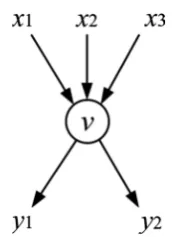
We use the number of encoded edges to measure the task quantities of the encoding operation. As shown in Figure 1, a coding node v has three input edges and two exit edges, where y1 = +x1 x2, y2= +x1 x2+x3. If at least two
input edges need to output information from an output edge simultaneously, then this output edge is defined as the coded edge. Therefore, the node has two coding edges and thus has two encoding operations. For a particular node in (G, s, T, R), it can be considered a potential coding node if and only if its number of input edges m≥2 and the exit edge n≥1.
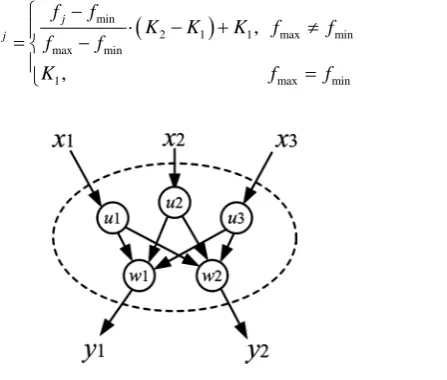
[image:3.595.329.417.588.707.2]In order to facilitate the design of the fitness function, we split all potential coding nodes. Assuming that an encoding node has m input edges and n output
DOI: 10.4236/jcc.2019.77014 150 Journal of Computer and Communications edges, we introduce p auxiliary nodes
{
u u1, 2,,up}
to connect with the nodes of the input links, and introduce q auxiliary nodes{
w w1, 2,,wq}
is connected with the nodes of the output links. Then all traffic flowing through the node can be represented as a linear combination between the secondary node ui and thesecondary node wj. The topological maps of each algorithm in this paper are all decomposed topological maps. For example, the topological map after the decomposition of the coding node v in Figure 1 is as shown in Figure 2.
3. Algorithm Description
3.1. Algorithm Flow
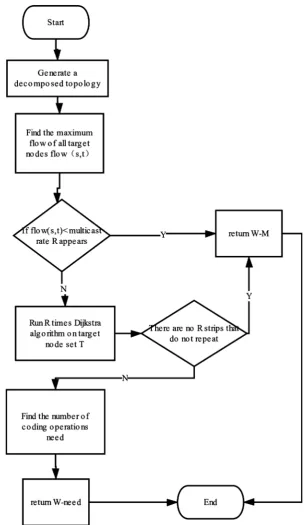
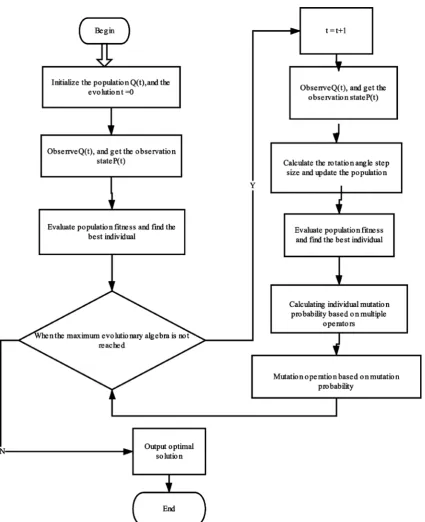
The whole algorithm includes three parts: the rotation angle adaptive adjust-ment mechanism, the multi-operator synergy mutation mechanism, and the population fitness evaluation. The overall algorithm flow can be described, as shown in Figure 3.
3.2. Rotation Angle Adaptive Adjustment Mechanism
The method of population update in this algorithm uses a quantum revolving door update strategy. Its update matrix can be expressed as follows.
( )
( )
( )
( )
cos sin
sin cos
i i i i
i i i i
α θ θ α
β θ θ β
′ −
=
′
(1)
In Equation (1),
(
α βi, i)
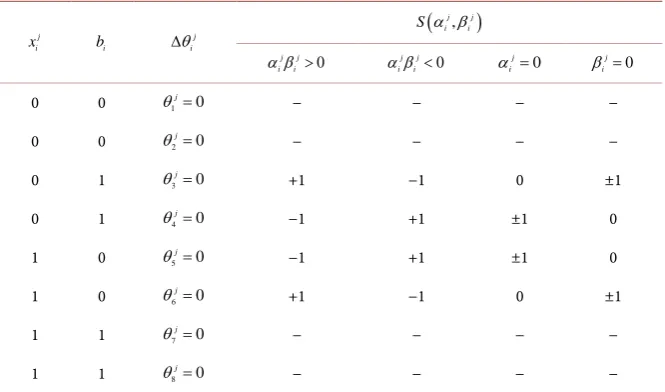
is the i-th qubit in the chromosome and θi is arotation angle. The adaptive adjustment mechanism modifies the rotation angle of individual evolution according to the fitness of different individuals. The ro-tation angle lookup table used in this algorithm is shown in Table 1.
In Table 1, f(x) represents the fitness value of the individual x, j i
x represents
the i-th position of the j-th individual, represents the i-th position of the optimal individual in the current population, and
(
j, j)
i i
S α β represents the rotation
angle in the polar coordinates. θj is the rotation angle step used by the j-th
in-dividual. Its definition is as follows.
(
)
min
2 1 1 max min
max min
1 max min
,
, j j
f f
K K K f f f f
K f f
[image:4.595.286.510.525.715.2]θ − ⋅ − + ≠ = − = (2)
DOI: 10.4236/jcc.2019.77014 151 Journal of Computer and Communications Figure 3.The flow chart for the AM-QGA.
In the current population, the i-th evolutionary rotation angle step and rota-tion direcrota-tion of the jth individual can be calculated by the Equarota-tion (3).
(
,)
j j j j
i S i i
θ θ α β
∆ = ⋅ (3)
3.3. Fitness Function Design
DOI: 10.4236/jcc.2019.77014 152 Journal of Computer and Communications Table 1. Rotation angle step lookup table.
j i
x bi
j i θ ∆
(
,)
j j i i S α β0
j j
i i
α β > j j 0
i i
α β < j 0
i
α = j 0
i
β =
0 0 1 0
j
θ = − − − −
0 0 2 0
j
θ = − − − −
0 1 3 0
j
θ = +1 −1 0 ±1
0 1 4 0
j
θ = −1 +1 ±1 0
1 0 5 0
j
θ = −1 +1 ±1 0
1 0 6 0
j
θ = +1 −1 0 ±1
1 1 7 0
j
θ = − − − −
1 1 8 0
j
θ = − − − −
into the maximization problem. For a single chromosome X, the fitness formula is designed as follows:
( )
max
, 1
, 0
W need f Fitness X
W n f
− =
= − =
(4) In this equation, nmax is the number of all coding edges in the topology map
corresponding to chromosome X, and need is the number of coding edges in the generated multicast tree, and W is a constant much larger than nmax.
The variable need can be calculated by the following steps. First, we generate the topological map corresponding to chromosome X and then use the topology map as input. Second, we use the dinic algorithm to solve the maximum flow (s, t) of the source point s to all other target nodes t∈T. If there is any flow (s, t) less than
mul-ticast rate R, this indicates that the topology can’t meet the condition. That is, if f = 0, then need = nmax, otherwise f = 1. For all target nodes t∈T, we use the
Dijkstra algorithm to solve the path set P s t
( )
, ={
P s t1( ) ( )
, ,P s t2 , ,,PR( )
s t,}
.For each target node, we run R times Dijkstra algorithm. It is necessary to ensure that for every P s tj
( )
, path set, for any i≠ j, P s ti( )
, P s tj( )
, = ∅. Werecord the passing edges in the tag array when we run the Dijkstra algorithm, which ensures that the repeated edges will not be taken during the next iteration of the algorithm. The path set P is all sides of the multicast tree. In this multicast tree, if the number of incident edges of a node is not less than 2, the corres-ponding output edge of the node is the coding edge. In the process of the Dijkstra algorithm, we could define two sets for all potential coding nodes. In this way, we record the edges emitted from the point, and the edges injected into the point, respectively. The need can be quickly calculated through these two sets. The whole process of the fitness evaluation function is shown in Figure 4.
3.4. Multi-Operator Synergy Mutation Mechanism
DOI: 10.4236/jcc.2019.77014 153 Journal of Computer and Communications Figure 4.Fitness assessment function flow chart.
DOI: 10.4236/jcc.2019.77014 154 Journal of Computer and Communications probability. The stability of the algorithm is enhanced.
The individual similarity evaluation operator Xsim is used to evaluate the
differences between individuals in the current population. As shown in the Equ-ation (5), where dmax and dmin respectively represent the largest and smallest
individual between the current population and the optimal individual. The davg is the average value of the Hamming distance between all individuals in the cur-rent population. min max min max min max min , 0, avg sim d d d d
X d d
d d − ≠ = − = (5)
The larger the similarity Xsim, the more the majority of the current
popula-tion is farther from the optimal solupopula-tion. In this case, the larger mutapopula-tion proba-bility can be used. The smaller the similarity Xsim, the more the current
popu-lation distance solution is closer. The individual mutation probability can be re-duced to make the algorithm converge faster.
The role of the individual fitness assessment operator is to evaluate the per-formance of each in the current population. The fmax and fmin respectively
represent the optimal fitness and the worst fitness value of the current popula-tion. The fi indicates the fitness value of the current individual.
max max min max min max min , 0, i fit f f f f f f y f f − ≠ − = = (6)
The larger the operator yfit, the worse the performance of the current indi-vidual. the greater the probability of mutation should be given to the current in-dividual so that it will mutate more quickly. The smaller the operator yfit, the better the performance of the current individual. A smaller probability of mutation should be given to the current individual. It could maintain its excellent traits.
The population variation adjustment operator Facc
( )
n is a function relatedto evolutionary algebra to avoid the premature occurrence of the algorithm. When the algorithm falls into the optimal local solution, the operator can in-crease the mutation probability and make the algorithm jump out of the optimal local solution.
( )
(
(
)
)
( )
max( )
(
)
max(
)
max max
1 , where
1 , where
0, where
acc acc
acc
s n
F n C f n f n T n T
s
F n
F n f n f n T n T
n T
−
− + ⋅ = − ∧ >
= − ≠ − ∧ >
≤
(7)
The n is the current evolutionary algebra, s is the maximum evolution algebra, T is the algebra of the optimal solution in the iterative process of the algorithm,
(
0 1)
C ≤ ≤C is the adjustment constant, fmax is the optimal adaptation in the
conti-DOI: 10.4236/jcc.2019.77014 155 Journal of Computer and Communications nuously, the mutation probability will increase correspondingly in the T + 1 generation.
The mutation probability of each individual in each evolution is determined by the individual similarity evaluation operator, the individual fitness evaluation operator, and the population variation adjustment operator. The formula for calculating the mutation probability is shown in Equation (8).
( )
0 max min
max min
,
0, n
fit sim acc
i n
p y x F n f f p
f f
⋅ ⋅ + ≠
=
=
(8)
In Equation (8), i n
p is the mutation probability of the i-th individual of the
n-th generation population, p0 is the initial mutation probability constant
de-termined according to different problems.
The multi-operator synergistic mutation mechanism mainly includes indi-vidual similarity evaluation operator, indiindi-vidual fitness evaluation operator, and population variation adjustment operator. Their combined action is to deter-mine the mutation probability of each in the current population.
4. Simulations and Analysis
In order to verify the effectiveness of the algorithm, this paper compares GA, QGA, and AM-QGA, and carries out the following experiments.
The software and hardware environment used in the experiment is: CPU: In-tel(R) Core(TM) i5-6200U CPU4 core 2.30 GHz; memory: 4 G; Windows10; Codeblocks 16.0; GCC 5.4.0.
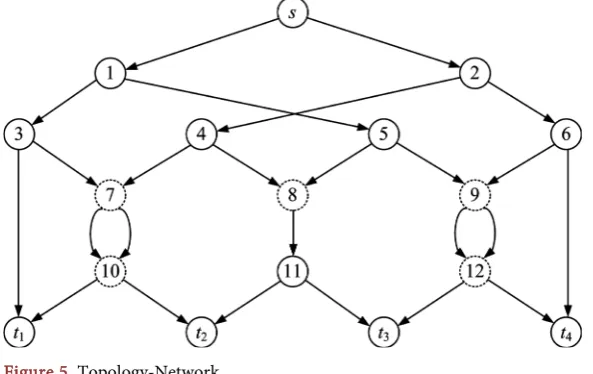
Firstly, we experimented with a small number of cases, as shown in Figure 5. The capacity of each link in the figure is unit capacity. The s is the source node, and t1, t2, t3, and t4 are destination nodes. According to the maximum flow minimum cut theorem, the multicast throughput between s and t1, t2, t3, and t4 is two units of capacity. In this experiment, the multicast throughput is set to 2 units. In Figure 5, the potential coding nodes are nodes 7, 8, 9, 10, 12, nmax is 9.
[image:9.595.227.524.533.720.2]And the required number of chromosome coding bits is 18. The minimum
DOI: 10.4236/jcc.2019.77014 156 Journal of Computer and Communications number of encodings required for Figure 5 using the exhaustive method is 0. In this experiment, the population size of GA, QGA, and AM-QGA was 30, and the termination algebra was 200.
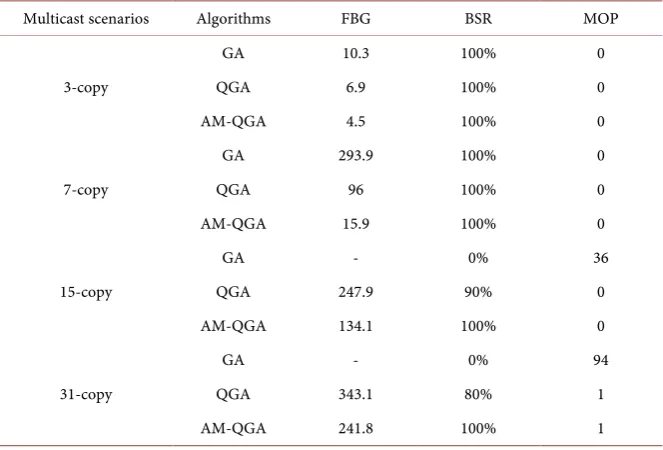
In the evaluation of algorithm performance, three evaluating indicators are the average optimal algebra, average optimal coding times, and the minimum number of coding times in ten experiments. They show as follows: FBG (first best solution generation), BSR (best solution success ratio), and MOP (mini-mum operation). The experimental results are shown in Table 2.
It can be seen from Table 2 that the three algorithms in this paper are the same as the results obtained by the violence calculation, so the correctness of the three algorithms can be proved.
In order to ensure the experimental results, this paper generated a larger scale topological map according to the literature [1] strategy. As shown in Figure 6, the original topology map is a directed topology map of one source point and two target nodes.
We copy Figure 6 into two copies and use the target starting point as the source point of the duplicated image to obtain the topological map, as shown in Figure 7. We named it 3-copy. Similarly, we get 7-copy, 15-copy, and 31-copy topologies, respectively. The total nodes, the number of edges, the number of target nodes, the number of potential coding nodes, the number of individual chromosome bits, the maximum number of coding operations, and all possible coding operands for these topological maps are shown in Table 3.
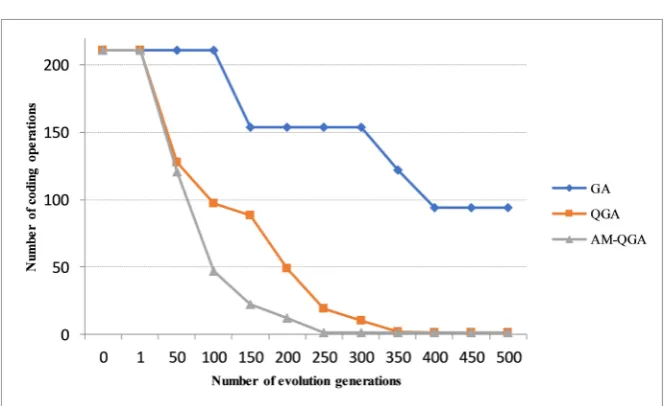
For the four topological maps in the above table, the same index is used for evaluation. The population size of GA, QGA, and AM-QGA is set to 30, and the ending algebra MAXGEN is 500. The average result of 10 experiments is ob-tained. The experimental results are shown in Table 4.
Table 2. Topology-Network algorithm operation result table.
Algorithm FBG BSR MOP
GA 8.1 100% 0
QGA 4.7 100% 0
AM-QGA 2.2 100% 0
DOI: 10.4236/jcc.2019.77014 157 Journal of Computer and Communications Figure 7. 3-copy network
Table 3. Network parameters.
Networks Nodes Links Sinks Code_Nodes Bits Max_Code_Links Possibilities
3-copy 19 30 4 7 34 15 32768
[image:11.595.207.539.442.667.2]7-copy 43 70 8 19 98 43 8.79609e+012 15-copy 91 150 16 43 226 99 6.33825e+029 31-copy 187 310 32 91 482 211 3.29101e+63
Table 4. Simulation results.
Multicast scenarios Algorithms FBG BSR MOP
3-copy
GA 10.3 100% 0
QGA 6.9 100% 0
AM-QGA 4.5 100% 0
7-copy
GA 293.9 100% 0
QGA 96 100% 0
AM-QGA 15.9 100% 0
15-copy
GA - 0% 36
QGA 247.9 90% 0
AM-QGA 134.1 100% 0
31-copy
GA - 0% 94
QGA 343.1 80% 1
AM-QGA 241.8 100% 1
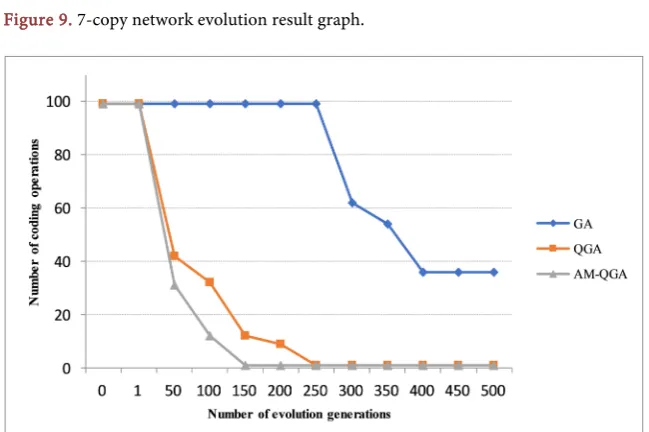
Figures 8-11 show the relationship between the optimal coding operands and evolutionary algebras of different algorithms in four different multicast scenarios.
DOI: 10.4236/jcc.2019.77014 158 Journal of Computer and Communications Figure 8. 3-copy network evolution result graph.
Figure 9. 7-copy network evolution result graph.
[image:12.595.211.536.484.700.2]DOI: 10.4236/jcc.2019.77014 159 Journal of Computer and Communications Figure 11. 31-copy network evolution result graph.
is the fastest, and it has the best global search ability and anti-early maturity ability. The convergence performance of the QGA is second only to AM-QGA. GA has the worst convergence performance and anti-local search ability. Be-cause AM-QGA adopts adaptive adjustment mechanism and multi-operator co-evolution mechanism, the search efficiency of the algorithm is much im-proved. And AM-QGA is not easy to fall into local optimum. It has the best performance among the three algorithms. Because QGA uses qubit coding, pop-ulation diversity is superior to a genetic algorithm, so its algorithm performance is better than the GA algorithm. Figures 8-11 show the relationship between the optimal operation codes calculated by different algorithms and their evolutio-nary algebras. It can be seen that when the GA and QGA calculate the big data graph, the optimal solution cannot be found after 500 generations sometimes. This shows that the quantum genetic algorithm is very easy to fall into local op-timum, although it converges quickly. By comparison, the BSR of AM-QGA is 100%. It can be seen that AM-QGA has strong global search ability in resolving the network coding resources problem. It can also maintain the diversity of the population well in the later period of the algorithm so that it can easily jump out of the optimal local solution. It can be concluded that AM-QGA has better sta-bility and better global convergence performance after fully considering indi-vidual distribution in the population and adjusting the mutation probability.
5. Conclusion
mechan-DOI: 10.4236/jcc.2019.77014 160 Journal of Computer and Communications ism based on individual similarity evaluation operator, individual fitness evalua-tion algorithm, and populaevalua-tion mutaevalua-tion adjustment operator. The AM-QGA is used to optimize the network coding resources in multicast network. The AM-QGA has the advantages of fast convergence, the high success rate of mul-ticast, and a strong ability to get rid of the local optimum solution. However, due to the high complexity of the evaluation function, the algorithm has the problem that the time complexity constant is too large and the running time is long. The next research direction is to optimize the evaluation function algorithm or use parallel operations to increase the speed of the algorithm.
Acknowledgements
This work was supported by Natural Science Foundation of Shandong Province (NO. ZR2016FM18); A Project of Shandong Province Higher Education Science and Technology Program (NO. J16LN20).
Conflicts of Interest
The authors declare no conflicts of interest regarding the publication of this paper.
References
[1] Williamson, B. (2000) Developing IP Multicast Networks (Volume One). Cisco Press, Indianapolis.
[2] Qu, Z., Liu, X., Zhang, X., Xie, Y. and Li, C. (2015) A Hamming-Distance-Based Adaptive Quantum-Inspired Evolutionary Algorithm for Network Coding Re-sources Optimization. The Journal of China Universities of Posts and Telecommu-nications, 22, 92-99. https://doi.org/10.1016/S1005-8885(15)60657-4
[3] Li, S.R., Yeung, R.W. and Cai, N. (2003) Linear Network Coding. IEEE Transactions on Information Theory, 49, 371-381. https://doi.org/10.1109/TIT.2002.807285
[4] Sanders, P., Egner, S. and Tolhuizen, L. (2003) Polynominal Time Algorithms for Network Information Flow. 15th ACM Symposium on Parallel Algorithms and Ar-chitectures, San Diego, 7-9 June 2003, 286-294.
https://doi.org/10.1145/777463.777464
[5] Kotter, R. and Medard, M. (2002) Beyond Routing: An Algebraic Approach to Network Coding. IEEE INFOCOM, New York, 23-27 June 2002, Vol. 1, 122-130. [6] Kotter, R. and Medard, M. (2003) An Algebraic Approach to Network Coding.
IEEE/ACM Transactions on Networking, 11, 782-795. https://doi.org/10.1109/TNET.2003.818197
[7] Sengupta, S., Rayanchu, S. and Banerjee, S. (2010) Network Coding-Aware Routing in Wireless Networks. IEEE/ACM Transactions on Networking, 18, 1158-1170. https://doi.org/10.1109/TNET.2010.2042727
[8] Kumar, R., Babu, V. and Nicol, D. (2018) Network Coding for Critical Infrastruc-ture Networks. IEEE 26th International Conference on Network Protocols, Cam-bridge, 24-27 September 2018, 436-437. https://doi.org/10.1109/ICNP.2018.00061
Communica-DOI: 10.4236/jcc.2019.77014 161 Journal of Computer and Communications tions and Networking Conference, Barcelona, 15-18 April 2018, 1-6.
https://doi.org/10.1109/WCNC.2018.8377229
[10] Narayanan, A. and Moore, M. (1996) Quantum Inspired Genetic Algorithms. IEEE International Conference on Evolutionary Computation, Nagoya, 20-22 May 1996, 41-46.
[11] Mao, L., Wang, X. and Li, J. (2018) Cloud Computing Resource Scheduling Re-search Based on the Improved Quantum Genetic Algorithm. Joint International Advanced Engineering and Technology Research Conference, Xi’an, 26-27 May 2018, 380-385. https://doi.org/10.2991/jiaet-18.2018.67
[12] Zhang, Y., Hu, X., Zhu, W. and Jin, P. (2018) Solving the Observing and Down-loading Integrated Scheduling Problem of Earth Observation Satellite with a Quan-tum Genetic Algorithm. Journal of Systems Science and Information, 6, 399-420. https://doi.org/10.21078/JSSI-2018-399-22
[13] Kong, H., Li, N. and Shen, Y. (2015) Adaptive Double Chain Quantum Genetic Al-gorithm for Constrained Optimization Problems. Chinese Journal of Aeronautics, 28, 214-228. https://doi.org/10.1016/j.cja.2014.12.010
[14] Kim, M., Aggarwal, V., O’Reily, U.M., et al. (2007) Genetic Representations for Evolutionary Minimization of Network Coding Resources. Applications of Evolu-tionary Computing. LNCS 4448. Springer, Berlin, 21-31.
https://doi.org/10.1007/978-3-540-71805-5_3
[15] Qu, J.Z., Liu, X.H. and Fu, J. (2012) Genetic Algorithm-Based Network Coding Re-sources Optimization in Multimedia Network. Proceedings of the 2012 Internation-al Conference on Systems and Informatics, Yantai, 19-20 May 2012, 1547-1550. https://doi.org/10.1109/ICSAI.2012.6223333