A Viewpoint for Search
¨
Ozg¨ur Akg¨un and Ian Miguel
School of Computer Science, University of St Andrews {ozgur.akgun,ijm}@st-andrews.ac.uk
Abstract. The performance of enumerating all solutions to an instance of Langford’s Problem is sensitive to the model and the search strategy. In this paper we compare the performance of a large variety of models, all derived from two base viewpoints. We empirically show that a channelled model with a static branching order on one of the viewpoints offers the best performance out of all the options we consider. Surprisingly, one of the base models proves very effective for propagation, while the other provides an effective means of stating a static search order.
1
Introduction
Langford’s Problem (number 24 at www.csplib.org) is specified as follows. Arrangeksets of numbers 1 tonin a sequence, so that each appearance of the numbermismnumbers on from the last. For example, the L(3,9) problem is to arrange 3 sets of the numbers 1 to 9 so that the first two 1’s and the second two 1’s appear one number apart, the first two 2’s and the second two 2’s appear two numbers apart, etc.
Alternative constraint programming models and search strategies for this problem were explored first by Smith [17]. Smith presented two models: the first corresponds to what we call thePositionalapproach in this paper (Section 2.2), and the second model is the dual of the first one. When viewed as a permu-tation problem, the dual viewpoint for a permupermu-tation may be constructed by interchanging the variables and the values. This approach has been studied fur-ther and generalised by [20,18,12,11,16]. Smith’s second model corresponds to theDirect approach in this paper (Section 2.1) with one exception. In our direct approach, a valuemis repeated ktimes, whereas in [17] the second occurrence of a valuemis represented withm+n, the third with m+ 2n, and so on.
In this paper we investigate the performance of a number of different models and search strategies for Langford’s Problem. We first present two approaches to modelling Langford’s Problem, using two separate viewpoints. We then employ a very strict channelling constraint between the two viewpoints to construct a channelled approach. We compare 20 variations in total, including the best search heuristic identified by [17] and the AllSAT solverBC MINISAT ALL[19] to enumerate all solutions. Our empirical evaluation shows that a static branching order on the Direct viewpoint in a channelled model offers the best performance.
2
Two Approaches to Modelling Langford’s Problem
In what follows we present two approaches to modelling this problem, using two separate viewpoints, in the Essence [7,8,9] constraint specification language. One is direct, has a sequence of numbers just like the problem specification. The other is positional, has a function from numbers and the repetition to the position in the sequence.
2.1 A Direct Approach
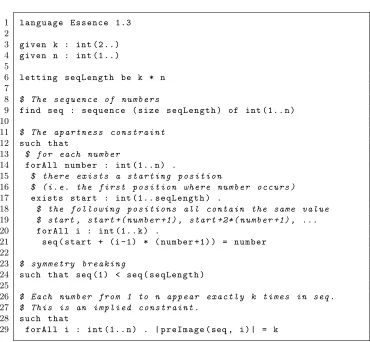
We first present aDirect problem specification for Langford’s Problem, given in Figure 1. AnEssencespecification identifies: the input parameters of the prob-lem class (given), whose values define an instance; the combinatorial objects to be found (find); the constraints the objects must satisfy (such that); identifiers declared (letting); and an (optional) objective function (min/maximising). This specification contains a single decision variable with a domain of type
sequence, with a fixed length. In order to solve an Essence specification, it is first refined into a solver-independent constraint model using the Conjure automated constraint modelling system [1,2,3,4] and then prepared for input to a particular constraint solver, such asMinion[10], or SAT by theSavile Row
system [13,14,15].
Sequences inEssence are not required to be of fixed length in general. A fixed length sequence is very similar to a one-dimensional array, except for the provision of some additional operators. For example, in this specification we use thepreImageoperator (on line 29) to denote all the index positions of a certain number. The apartness constraint (on lines 11–21) is written as a triply-nested quantified expression. For each number there exists a starting position: the first index where we see this particular number in the sequence. Once this position is denoted, the apartness constraint can be posted by constraining the appropriate positions in the sequence to be equal to the number in focus. As an alternative to the existential quantification we could have used auxiliary variables to denote the first positions of each number as a separateEssence variable. However, in this case we feel the existential quantification is clearer. Furthermore, our constraint modelling pipeline of ConjureandSavile Rowis able to generate a top level decision variable for the existentially quantified variables automatically. The second constraint (on line 24) is for breaking the reflection symmetry. The third constraint (lines 26–29) is implied: it states the fact that each number must occurk times in the sequence.
2.2 A Positional Approach
1 l a n g u a g e E s s e n c e 1.3 2
3 g i v e n k : int ( 2 . . ) 4 g i v e n n : int ( 1 . . ) 5
6 l e t t i n g s e q L e n g t h be k * n 7
8 $ The s e q u e n c e of n u m b e r s
9 f i n d seq : s e q u e n c e ( s i z e s e q L e n g t h ) of int ( 1 . . n ) 10
11 $ The a p a r t n e s s c o n s t r a i n t 12 s u c h t h a t
13 $ for e a c h n u m b e r
14 f o r A l l n u m b e r : int ( 1 . . n ) .
15 $ t h e r e e x i s t s a s t a r t i n g p o s i t i o n
16 $ ( i . e . the f i r s t p o s i t i o n w h e r e n u m b e r o c c u r s ) 17 e x i s t s s t a r t : int ( 1 . . s e q L e n g t h ) .
18 $ the f o l l o w i n g p o s i t i o n s all c o n t a i n the s a m e v a l u e 19 $ start , s t a r t +( n u m b e r +1) , s t a r t + 2 * ( n u m b e r +1) , ... 20 f o r A l l i : int ( 1 . . k ) .
21 seq ( s t a r t + ( i -1) * ( n u m b e r +1) ) = n u m b e r 22
23 $ s y m m e t r y b r e a k i n g
24 s u c h t h a t seq (1) < seq ( s e q L e n g t h ) 25
26 $ E a c h n u m b e r f r o m 1 to n a p p e a r e x a c t l y k t i m e s in seq . 27 $ T h i s is an i m p l i e d c o n s t r a i n t .
28 s u c h t h a t
[image:3.612.116.486.105.447.2]29 f o r A l l i : int ( 1 . . n ) . | p r e I m a g e ( seq , i ) | = k
Fig. 1.Essence Specification:Direct Approach to Modelling Langford’s Problem.
these positions need to be distinct, the function is marked to be injective.
Con-jure produces an all-different constraint when refining this injective function.
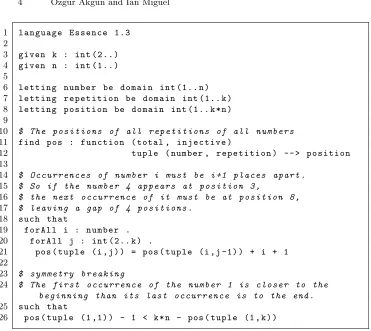
The apartness constraint (on lines 14–21) is written as a doubly-nested quanti-fied expression, and for each number repetition pair it posts a binary constraint. The second constraint (on line 27) is for breaking the reflection symmetry.
2.3 Channelling the Direct and Positional Approaches
1 l a n g u a g e E s s e n c e 1.3 2
3 g i v e n k : int ( 2 . . ) 4 g i v e n n : int ( 1 . . ) 5
6 l e t t i n g n u m b e r be d o m a i n int ( 1 . . n ) 7 l e t t i n g r e p e t i t i o n be d o m a i n int ( 1 . . k ) 8 l e t t i n g p o s i t i o n be d o m a i n int ( 1 . . k * n ) 9
10 $ The p o s i t i o n s of all r e p e t i t i o n s of all n u m b e r s 11 f i n d pos : f u n c t i o n ( total , i n j e c t i v e )
12 t u p l e ( number , r e p e t i t i o n ) - - > p o s i t i o n 13
14 $ O c c u r r e n c e s of n u m b e r i m u s t be i +1 p l a c e s a p a r t . 15 $ So if the n u m b e r 4 a p p e a r s at p o s i t i o n 3 ,
16 $ the n e x t o c c u r r e n c e of it m u s t be at p o s i t i o n 8 , 17 $ l e a v i n g a gap of 4 p o s i t i o n s .
18 s u c h t h a t
19 f o r A l l i : n u m b e r . 20 f o r A l l j : int ( 2 . . k ) .
21 pos ( t u p l e ( i , j ) ) = pos ( t u p l e ( i , j -1) ) + i + 1 22
23 $ s y m m e t r y b r e a k i n g
24 $ The f i r s t o c c u r r e n c e of the n u m b e r 1 is c l o s e r to the b e g i n n i n g t h a n its l a s t o c c u r r e n c e is to the end . 25 s u c h t h a t
[image:4.612.117.488.95.426.2]26 pos ( t u p l e (1 ,1) ) - 1 < k * n - pos ( t u p l e (1 , k ) )
Fig. 2.EssenceSpecification:PositionalApproach to Modelling Langford’s Problem.
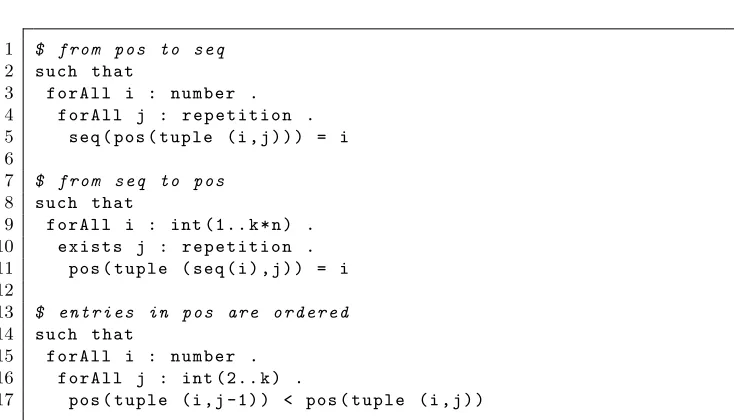
The channelling constraints (Figure 3) are very tight by design. Specifically, they only allow one assignment to the seqvariable for each assignment to the
posvariable and vice versa. We validate this by removing the problem constraint from either viewpoint and enumerating all solutions.
The first channelling constraint (on lines 1–5) set values of seqfrom values of pos. The second channelling constraint (on lines 8–11) does the inverse. The third constraint (on lines 13–17) is not required when both problem constraints are present, but when the Positional constraints are removed they provide tighter channelling and break symmetry.
3
Empirical Evaluation
1 $ f r o m pos to seq 2 s u c h t h a t
3 f o r A l l i : n u m b e r . 4 f o r A l l j : r e p e t i t i o n . 5 seq ( pos ( t u p l e ( i , j ) ) ) = i 6
7 $ f r o m seq to pos 8 s u c h t h a t
9 f o r A l l i : int ( 1 . . k * n ) . 10 e x i s t s j : r e p e t i t i o n . 11 pos ( t u p l e ( seq ( i ) , j ) ) = i 12
13 $ e n t r i e s in pos are o r d e r e d 14 s u c h t h a t
15 f o r A l l i : n u m b e r . 16 f o r A l l j : int ( 2 . . k ) .
[image:5.612.118.485.103.313.2]17 pos ( t u p l e ( i , j -1) ) < pos ( t u p l e ( i , j ) )
Fig. 3. Channelling constraints for integrating the Direct and Positional models in Essence
n. We use a timeout of four hours for each model-instance pair. Three instances ((2,15),(2,16),(2,17)) cannot be solved with any of our models, and these are excluded from our analysis. A further thirty instances are trivial (solved by one of the base models in under 5 search nodes), and these are kept in the plots. We analyse the 47 non-trivial instances in more detail. The Essence specifi-cations, the parameter files, scripts for rerunning the experiments, and the raw data containing our results can be found in a source code repository hosted at http://github.com/stacs-cp/ModRef2018-Langfords.
3.1 Comparing the Two Base Approaches
We compare the Direct and Positional approaches, using our modelling pipeline (Conjure 2.2.0,Savile Row1.7.0) to produce constraint models suitable for input toMinion1.8. We employ the default static branching order of Minion: the default variable ordering is by order of appearance, and the default value ordering is lexicographic. In general the positional model performs better (Fig-ure 4): it is able to enumerate all solutions to all but three of out 77 instances. The Direct model times out for 40 instances and performs much worse on the small number of instances it can solve.
Fig. 4.Search nodes with static variable ordering with the Direct model vs the Posi-tional model. Sorted by PosiPosi-tional. The timed-out instances are not plotted.
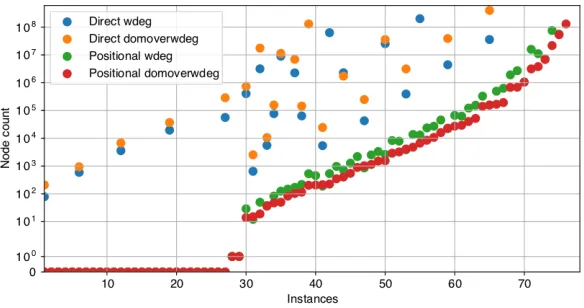
Fig. 5.Search nodes with weighted degree search heuristic with the Direct model vs the Positional model. Sorted by Positional-domoverwdeg. The timed-out instances are not plotted.
3.2 Channelled Approaches
At this point the Direct approach may seem hopeless. The Positional approach gives much better performance with the static variable ordering and with weighted degree heuristics in comparison.
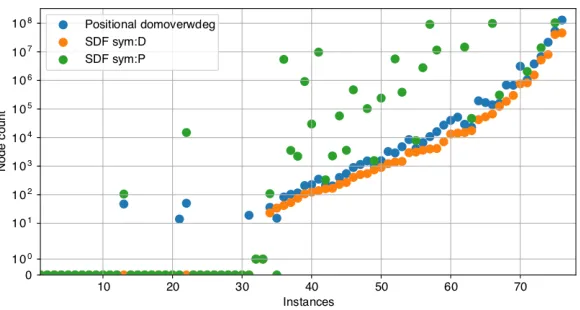
[image:6.612.156.448.352.506.2]models, in this paper we would like to break this symmetry. Since each model comes with a symmetry breaking constraint and since these are incompatible, we experiment with each one separately. In Figure 6, these models are denoted by ‘SDF sym:P’ when the symmetry breaking constraint of the Positional model is used, and by ‘SDF sym:D’ when the Direct one is used. We compare the performance of the channelled models with the performance of the best model so far: Positional-domoverwdeg. The results are given in Figure 6.
[image:7.612.158.448.286.441.2]Interestingly, the performance of the smallest domain first heuristic on the channelled model seems to depend heavily on which symmetry breaking con-straint is used. The ‘SDF sym:P’ version gives better results than Positional-domoverwdeg, whereas ‘SDF sym:D’ is much worse overall.
Fig. 6.Search nodes with the smallest domain first heuristic on channelled models vs Positional-domoverwdeg. Sorted by Positional-domoverwdeg. The timed-out instances are not plotted.
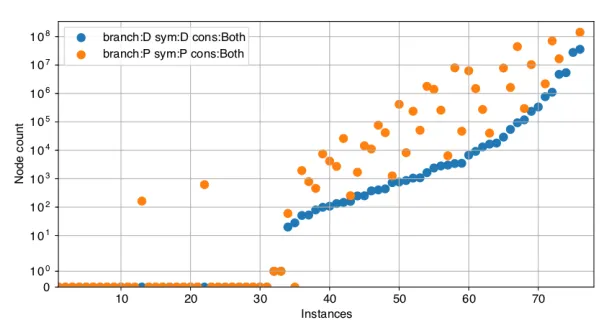
Figure 7 gives the difference between the ‘branch:D sym:D cons:Both’ and ‘branch:P sym:P cons:Both’ variations, where the first one uses a static vari-able ordering on the Direct model and the second one on the Positional model. Each model uses the corresponding symmetry breaking constraint and both sets of problem constraints. Hence, in comparison to the results given in Figure 4, these two variations use the same search order. However the results are inverted: branching on the Direct variables in the channelled model gives significantly bet-ter results than branching on the Positional variables. The Direct model by itself performs worse than the Positional model, yet branching on the Direct model performs significantly better than branching on the Positional model when the two models are channelled.
Fig. 7.Comparing the number of search nodes between static variable ordering on the Direct variables vs the Positional variables. Sorted by the ‘branch:D sym:D’ variation.
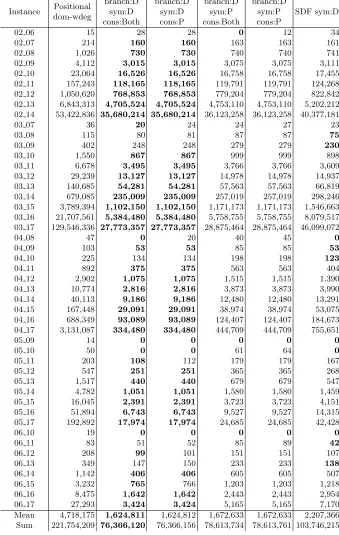
results in the smallest number of search nodes. Further reductions are obtained by using the symmetry breaking constraints of the direct model and keeping both sets of constraints.
3.3 Comparison against BC MINISAT ALL
We compare the performance of one of the best CP models to that of an AllSAT solver, BC MINISAT ALL [19]. We useSavile Rowto produce a SAT encoding for the Direct model, the Positional model, and a channelled model with the symmetry breaking constraint from the Positional model. We only experiment with these three variations for SAT, since variable ordering heuristics cannot be specified like they can in a constraint solver.
The SAT encoding for the Direct model times out on eleven of 77 instances with a 4-hour timeout, and the Positional model times out on four. The chan-nelled model performs better than either model in SAT as well, it solves all instances in 13,266 seconds in total. In comparison the channelled constraint model with the ‘branch:D sym:P cons:P’ variation (branching on Direct vari-ables, symmetry breaking using the Positional constraint, and only using the Positional problem constraints) solves all instances in 7,408 seconds in total.
4
Conclusion
Instance Positional dom-wdeg branch:D sym:D cons:Both branch:D sym:D cons:P branch:D sym:P cons:Both branch:D sym:P cons:P SDF sym:D
02 06 15 28 28 0 12 34
02 07 214 160 160 163 163 161
02 08 1,026 730 730 740 740 741
02 09 4,112 3,015 3,015 3,075 3,075 3,111 02 10 23,064 16,526 16,526 16,758 16,758 17,455 02 11 157,243 118,165 118,165 119,791 119,791 124,268 02 12 1,050,620 768,853 768,853 779,204 779,204 822,842 02 13 6,843,313 4,705,524 4,705,524 4,753,110 4,753,110 5,202,212 02 14 53,422,836 35,680,214 35,680,214 36,123,258 36,123,258 40,377,181
03 07 36 20 24 24 27 23
03 08 115 80 81 87 87 75
03 09 402 248 248 279 279 230
03 10 1,550 867 867 999 999 898
03 11 6,678 3,495 3,495 3,766 3,766 3,609 03 12 29,239 13,127 13,127 14,978 14,978 14,937 03 13 140,685 54,281 54,281 57,563 57,563 66,819 03 14 679,085 235,009 235,009 257,019 257,019 298,246 03 15 3,789,394 1,102,150 1,102,150 1,171,173 1,171,173 1,546,663 03 16 21,707,561 5,384,480 5,384,480 5,758,755 5,758,755 8,079,517 03 17 129,546,336 27,773,357 27,773,357 28,875,464 28,875,464 46,099,072
04 08 47 0 20 40 45 0
04 09 103 53 53 85 85 53
04 10 225 134 134 198 198 123
04 11 892 375 375 563 563 404
04 12 2,902 1,075 1,075 1,515 1,515 1,390 04 13 10,774 2,816 2,816 3,873 3,873 3,990 04 14 40,113 9,186 9,186 12,480 12,480 13,291 04 15 167,448 29,091 29,091 38,974 38,974 53,075 04 16 688,349 93,089 93,089 124,407 124,407 184,673 04 17 3,131,087 334,480 334,480 444,709 444,709 755,651
05 09 14 0 0 0 0 0
05 10 50 0 0 61 64 0
05 11 203 108 112 179 179 167
05 12 547 251 251 365 365 268
05 13 1,517 440 440 679 679 547
05 14 4,782 1,051 1,051 1,580 1,580 1,459 05 15 16,045 2,391 2,391 3,723 3,723 4,151 05 16 51,894 6,743 6,743 9,527 9,527 14,315 05 17 192,892 17,974 17,974 24,685 24,685 42,428
06 10 19 0 0 0 0 0
06 11 83 51 52 85 89 42
06 12 208 99 101 151 151 107
06 13 349 147 150 233 233 138
06 14 1,142 406 406 605 605 507
06 15 3,232 765 766 1,203 1,203 1,218
[image:9.612.137.476.119.654.2]06 16 8,475 1,642 1,642 2,443 2,443 2,954 06 17 27,293 3,424 3,424 5,165 5,165 7,170 Mean 4,718,175 1,624,811 1,624,812 1,672,633 1,672,633 2,207,366 Sum 221,754,209 76,366,120 76,366,156 78,613,734 78,613,761 103,746,215
channelled models is a static variable ordering on the viewpoint that, in isola-tion, is weaker. Our conjecture is that, through the channelling constraints, this static variable ordering produces a high quality dynamic variable ordering on the second viewpoint.
In future work, we will investigate whether this finding can be translated to other problem classes and whether our findings also hold with other constraint solvers.
Acknowledgements This work was supported by EPSRC EP/P015638/1. We thank our anonymous reviewers for helpful comments.
References
1. Akg¨un, ¨O.: Extensible automated constraint modelling via refinement of abstract problem specifications. Ph.D. thesis, University of St Andrews (2014)
2. Akg¨un, ¨O., Frisch, A.M., Gent, I.P., Hussain, B.S., Jefferson, C., Kotthoff, L., Miguel, I., Nightingale, P.: Automated symmetry breaking and model selection in Conjure. In: International Conference on Principles and Practice of Constraint Programming. pp. 107–116. Springer (2013)
3. Akg¨un, ¨O., Gent, I.P., Jefferson, C., Miguel, I., Nightingale, P.: Breaking con-ditional symmetry in automated constraint modelling with Conjure. In: ECAI. pp. 3–8 (2014)
4. Akg¨un, ¨O., Miguel, I., Jefferson, C., Frisch, A.M., Hnich, B.: Extensible automated constraint modelling. In: Proceedings of theTwenty-Fifth AAAI Conference on Artificial Intelligence. pp. 4–11. AAAI Press (2011)
5. Boussemart, F., Hemery, F., Lecoutre, C., Sais, L.: Boosting systematic search by weighting constraints. In: ECAI. vol. 16, p. 146 (2004)
6. Cheng, B., Choi, K.M.F., Lee, J.H.M., Wu, J.: Increasing constraint propagation by redundant modeling: an experience report. Constraints4(2), 167–192 (1999) 7. Frisch, A.M., Grum, M., Jefferson, C., Hern´andez, B.M., Miguel, I.: The Essence of
Essence. Modelling and Reformulating Constraint Satisfaction Problems pp. 73–88 (2005)
8. Frisch, A.M., Grum, M., Jefferson, C., Hern´andez, B.M., Miguel, I.: The design of Essence: A constraint language for specifying combinatorial problems. In: IJCAI. pp. 80–87 (2007)
9. Frisch, A.M., Harvey, W., Jefferson, C., Mart´ınez-Hern´andez, B., Miguel, I.: Essence: A constraint language for specifying combinatorial problems. Constraints 13(3), 268–306 (2008)
10. Gent, I.P., Jefferson, C., Miguel, I.: Minion: A fast scalable constraint solver. In: ECAI. vol. 141, pp. 98–102 (2006)
11. Hnich, B., Smith, B.M., Walsh, T.: Dual modelling of permutation and injection problems. Journal of Artificial Intelligence Research21, 357–391 (2004)
12. Hnich, B., Walsh, T.: Why channel? multiple viewpoints for branching heuristics. Modelling and Reformulating Constraint Satisfaction Problems p. 94 (2003) 13. Nightingale, P., Akg¨un, ¨O., Gent, I.P., Jefferson, C., Miguel, I.: Automatically
14. Nightingale, P., Akg¨un, O., Gent, I.P., Jefferson, C., Miguel, I., Spracklen, P.: Automatically improving constraint models in Savile Row. Artificial Intelligence 251, 35–61 (2017). https://doi.org/10.1016/j.artint.2017.07.001
15. Nightingale, P., Spracklen, P., Miguel, I.: Automatically improving SAT encoding of constraint problems through common subexpression elimination in Savile Row. In: CP. pp. 330–340. LNCS 9255, Springer (2015)
16. Smith, B.M.: Comparing dual viewpoints in permutation problems. Constraint Modelling and Reformulation (ModRef’09) p. 147
17. Smith, B.M.: Modelling a permutation problem (2000)
18. Smith, B.M.: Dual models of permutation problems. In: International Conference on Principles and Practice of Constraint Programming. pp. 615–619. Springer (2001)
19. Toda, T., Soh, T.: Implementing efficient all solutions sat solvers. Journal of Ex-perimental Algorithmics (JEA)21, 1–12 (2016)