Magnetization Performance of LDPC Reduced-Complexity
Decoding Algorithms
Manel Abdelhedi1, Omessaad Hamdi2, Ammar Bouallegue1
1SYSCOM Laboratory, ENIT, Tunis, Tunisia
2LaBRI Laboratory, University of Bordeaux, Bordeaux, France
E-mail: [email protected], [email protected], [email protected] Received March 20,2010; revised April 21,2010; accepted May 26,2010
Abstract
Low-density parity-check (LDPC) codes are very efficient for communicating reliably through a noisy channel. N.Sourlas [1] showed that LDPC codes, which revolutionize the codes domain and used in many communications standards, can be mapped onto an Ising spin systems. Besides, it has been shown that the Belief-Propagation (BP) algorithm, the LDPC codes decoding algorithm, is equivalent to the Thouless- Anderson-Palmer (TAP) approach [2]. Unfortunately, no study has been made for the other decoding algo-rithms. In this paper, we develop the Log-Likelihood Ratios-Belief Propagation (LLR-BP) algorithm and its simplifications the BP-Based algorithm and the λ-min algorithm with the TAP approach. We present the performance of these decoding algorithms using statistical physics argument i.e., we present the performance as function of the magnetization.
Keywords:LDPC Codes, Ising Spin, LLR-BP Algorithm, BP-Based Algorithm, λ-Min Algorithm, TAP Approach
1. Introduction
Low-density parity-check (LDPC) codes were first dis-covered by Gallager [3], in his thesis, in 1962 and have recently been rediscovered by Mackay and Neal [3,4]. These codes can get very close to the Shannon limit by mean of an iterative decoding algorithm called Belief- Propagation (BP) algorithm [5].
This performance combined with their relatively sim-ple decoding algorithm makes these codes very attractive for the next generation of digital transmission systems. Indeed, these codes have been chosen as a standard for the second Satellite Digital Video Broadcasting normali-zation (DVB-S2). So, the search for efficient implemen-tations of decoding algorithms is being a challenge.
The implementation of the BP algorithm is difficult. That’s why different simplifications of this algorithm were discovered. The BP algorithm can be simplified using the BP-Based algorithm [6] and the λ-min algorithm [7].
N. Sourlas [1] has shown in 1989 that there is a mathe-matical equivalence of error-correcting codes to some theoretical spin-glass models. This analogy has contributed to the present proximity of the statistical physics and the information theory. Therefore, the methods of statistical physics developed in the study of disordered systems
proved to be efficient for studying the properties of these codes. One of these methods is the Thouless-Anderson- Palmer (TAP) [2] approach which is shown equivalent to the BP algorithm by kabashima, et al. [8]. Unfortunately, no study has been made for the other decoding algorithms.
In this paper, we develop the Log-Likelihood Ratios- Belief Propagation (LLR-BP), the BP-Based and the λ-min decoding algorithms with the TAP approach. Their per-formance is evaluated as a function of a statistical physics parameter which is the magnetization.
This paper is organized as follows. Section 2 corre-sponds to a general description of the LDPC codes and their decoding algorithm. Section 3 describes the similar-ity between the BP algorithm and the TAP approach. In Section 4, we develop the LLR-BP algorithm and its simplifications the BP-Based algorithm and the λ-min algorithm with the TAP approach. Finally and before concluding, simulation results as function of the mag-netization are presented in Section 5.
2. LDPC Codes and Decoding Algorithm
2.1. Low-Density Parity Check Codessparse parity check matrix A M N
, whereNdenotes the codeword length and M the number of parity- check equations.Using a notation similar to that in [4,6], let L
j A/ j 1
denote the set of bit j that participate incheck. Similarly, we define the set of checks in which bit j participates asM
j
/Aj1
. We denote a setL
with bit j excluded byL
\ j , and a set
jM with parity check excluded by M
j \ . Finally, s
s1,...,sN
denotes the transmittedcode-word.
2.2. Belief Propagation Algorithm
This section summarizes according to [4,5], the iterative decoding of LDPC codes based on the BP algorithm. The likelihood of s is given by
j a j
f , with a j
f P(sj = a).
Let a j
q denotes the probability that bit j of s isa, given the information obtained via checks other than check. The quantity a
j
r is meant to be the probabil-ity of check is satisfied if bit jof s is considered fixed at a and the other bits have a separable distribu-tion given by the probabilities
ql :lL
\ j
[6].The standard iterative decoding algorithm based on the BP approach consists on the following main steps.
Initialization: The variables 0
j
q and 1
j
q are ini-tialized to the values 0
j
f and 1
j
f respectively.
Iterative processing:
1) Define 0 1
j j j q q
q
and for each ,
Lj , and for a
0,1 , compute
j
a a
j
j L l
l j
r r
q r
1 1 2 1 ( )\
2) For each j and M
j , and for a
0,1 update
\ ) (j M
a j a
j j a
j f r
q
) (j M
a j a j j a
j f r
q
where jand jare chosen such that
1
1
0
j j q
q and 0 11.
j j q
q
3) Create the word
s
ˆ
( ... )
s s
ˆ ˆ
1 N the detection of the transmitted codeword such that:0 if 1 ˆ
0 if 0 ˆ
j j
j j
q s
q s
IfH.sˆT 0the decoding process ends. Otherwise, we pass to another iteration of BP. A failure is declared and the decoding process ends if the number of iterations exceeds the maximum number of iterations and sˆ is not a valid codeword.
3. Decoding Problem from Statistical Physics
Point of View
3.1. Statistical Physics Analogy
In the previous section, we have described the LDPC codes using the additive Boolean group
0,1,
. How-ever, in order to apply methods of statistical physics, it is convenient to introduce an equivalent group, the multi-plicative binary group
1,1
,
[1].From a statistical physics point of view, the code can be regarded as a spin system. Each bit sj
j
S (1) is called a spin and takes values in
1 and the word
s sN
S 1 1,..., 1 can be seen as a collection of N
spins, called a configuration. The parity-check matrix gives rise to the interactions between the spins [1]. The decoding problem depends on posteriori like
S J
P \ where J is the evidence (received message or syndrome vector). By applying Bayes’ theorem this posteriori can be written in the form [1].
P J S P S
Z
S P S J P
S P S J P J
S P
S
ln \ ln exp 1
\ \ \
(1)In the statistical physics description, the probability (1) can be expressed as a Boltzmann distribution at the in-verse temperature [9].
\
1exp
\
P S J H S J
Z
(2) where H
S\J
is the Hamiltonian of the system.In this Hamiltonian, we identify two components that are necessary for the analysis of LDPC codes.
A term that guarantees that all parity checks are sat-isfied. It can be written with the Kronecker’s delta
[1].
M
L j
j
S J S
J P
1
, \
According [9], the ’s can be replaced by a soft con-straint.
M
L j
j
S J const
S J P
1
exp \
where.
A prior term that provides some statistical informa-tion on the dynamical variablesS. It can be repre-sented by the prior distribution
N Nj j
F S F S
P
cosh 2 exp )
( 1
where F is the external field. It is determined by the flip rate f of channel noise as
f f F ln1
2
1 .
So, the Hamiltonian H
S\J
is written as follows:
M
L j
N
j j
j S
F S J J
S H
1 1
\
where Jis the muti-spin coupling.
3.2. Decoding in the Statistical Physics
The decoding process corresponds to finding local magnetization at the inverse temperature ,
j j S
m and calculating estimates as [1].
jj m
Sˆ sign (3) The decoding performance in the statistical physics approach can be measured by the magnetization [1] defined by the overlap between the actual message and estimate:
N
j j jS
S N m
1
ˆ 1
Here the overage ... is performed over the matri-ces A. This value provides information about the typical performance of the code.
The Magnetization is an order parameter which has a standard of judgment whether the whole system exhib-its an ordered state or not.
If m1the system is in an ordered phase called ferromagnetic phase.
If m0the system is in a disordered phase called paramagnetic phase.
Two main methods can be employed for calculating the value of the magnetization: the replica method for diluted systems [9] and the TAP approach [8]. In this paper, we are interested only on the TAP approach. 3.3. TAP Approach
Kabashima, et al. [8] have shown the similarity between equations derived from the TAP [2] approach and those obtained from BP. The fields a
j
q correspond to the mean influence of sites other than the site j and the fields
a j
r represent the influence of jback over the system (reaction fields) [10].
The similarity can be exposed by observing that the likelihood P
J \S
is proportional to the Boltzmann weight [11]
L j
j j
B J \ S :j L exp J S
The conditional probability Sj
j
r can be seen as a nor-malized effective Boltzmann weight (effective Boltz-mann probability) obtained by fixing the bit Sj [10]
j L l
S l L j
S l l
B j
j eff
j S
j
l
l j
q L
l S J S J r
\
: \
) (
: \ \
Since spin variable Sj takes only two values1, it is convenient to express the BP/TAP algorithm using spin averages j
j
S j S
jq
S
1
and j
j
S j S
jr
S
1
rather than the
dis-tributions Sj
j
q and Sj
j
r themselves. We use
j j m
q
to denote j
j
S j S
jq
S
1
. Similar notation
j j m
r
ˆ is used for j j
S j S
jr
S
1
. Additionally, it was shown in [10] that the following statements hold
j L
l l
j J m
m
\
tanh ˆ
(5)
\ 1 ˆ
tanh tanh
j M
j
j m F
m (6)
The pseudo-posteriori can then be calculated
l
M j
j m F
m
ˆ tanh
tanh 1 (7) This provides a way for computing the Bayes optimal decoding as follows:
j
jj δq m
Sˆ sign sign (8) The result that qj mj is demonstrated as follows:
j S
j j S jSS
S j S
j j j
q
J S P S
J S P S
J S P S
J S H S
Z S m
j
j j
\ \ \
\ exp
1
\
4. LLR-BP Algorithm and its Simplifications
with TAP Approach
4.1. LLR-BP Algorithm with TAP Approach
In the LLR-BP algorithm instead of handling probabili-ties as in [3,5] we are going to deal with the LLRs. In practice, using LLRs as messages offers implementation advantages over using probabilities or likelihood ratios because multiplications are replaced by additions and the normalization step is eliminated [11].
In this section, we try to develop the LLR-BP with the TAP approach. Let xjand yj be the LLR of bit j
which are sent from bit node j to check node and from the check node to bit node j, respectively. From the statistical physics definition, the LLR is defined as follows [12]:
21 ln 2
' 1 1 j j j j x q q
x
(10) And
21 ln 2
' 1 1 j j j j y r r
y
(11) We need also the following results
j j j j j j j j j j m q q q q q q q q x 1 1 1 1 1 1 1 1 ln 2 1 tanh tanh (12)Like in (12), the variable mˆ can be also written as: j
jj y
mˆ tanh (13) So, from Equations (5), (12) and (13) we have
y F
F m x j M j j M j j
\ \ 11tanh tanh ˆ
tanh 1
(14)
Also, yjcan be written as
j L l l j j x J m y \ 1 1 tanh tanh tanh 1 ˆ tanh 1 (15)Finally, the posteriori LLR of bit Sjis
y F
x
j M
j
j
(16)
It’s not easy to implement (15) which has the form of a product. Our idea is to decompose the check node up-date into sign and magnitude processing like in [13]. We have from (15)
j L l lj J x
y \ tanh tanh tanh
(17)
Replacing
J by sign
J J and
xl
by sign
xl xl in (17) yields
j L l l j L l l j x J x J y \ \ 2 sign sign sign
(18)
j L l l j j L l l j x J y x J y \ ' ' \ 2 tanh 2 2 tanh 2 tanh tanh tanh tanh (19)Let f
t be defined by
1 1 ln 2 tanh ln tt
e e t
t
f (20)
Then, taking the logarithm of the inverse of both sides of (19) yields
' ' \ ' ' \ln tanh ln tanh 2 ln tanh
2 2 2
2
j l
l L j
j l
l L j
y J x
f y f J f x
(21) The Equation (20) verifies
te e e e t f f t t t t 1 1 1 1 1 1
ln (22)
So the Equation (21) can be written
' ' \ 2 j ll L j
y f f J f x
(23) Using (10) and (11), the Equation (23) can be written as
L j l
l
j f f J f x
y \ 2 2 2
(24)
\
\
1 sign
2
2 2
j
l l L j
l l L j
y
J x
f f J f x
(25)
4.2. BP-Based with TAP Approach
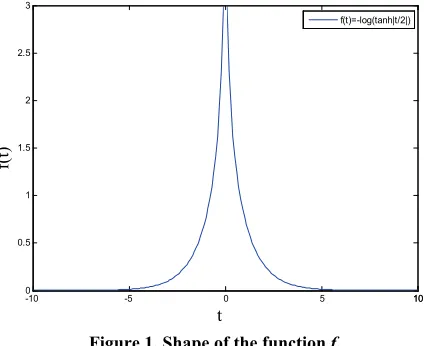
In this section, we try to develop the approximation of the BP algorithm: the BP-Based [6] algorithm, with the TAP approach. The key idea of this algorithm is that
mint t
f t f t
. The inequality is clear while de-picting the functionf
t on the Figure 1.The Equation (24) is then approximated by
\
\
\
2 2 2
min 2 , 2
min 2 , 2
j l
l L j
l l L j
l l L j
y f f J f x
f f J x
J x
(26)
So, the extrinsic information in the BP-Based algo-rithm written with the TAP equation is given by:
\ \
\ \
1
sign min 2 , 2
2
sign min ,
j l l L j l
l L j
l l L j l l L j
y J x J x
J x J x
(27) Therefore, there is an important simplification in the BP-Based algorithm with TAP approach since the check node update is replaced by a selection of the minimum input value.
4.3. λ-min Algorithm with TAP Approach
In this section, we try to develop the λ-min algorithm [7] with the TAP approach. In the check node update of (25), the magnitude processing is run using the function de-fined by (20). While depicting this function on the Fig-ure 1, it is clear that
t
t
f can be approximated by the maximal values of f
t which is obtained for the minimal values of t .So, like Guilloud, et al. [7] we propose to compute (24) with only the λ bits that participate in check and which have the minimum magnitude.
\
2 j 2 2 l
l L j
y f f J f x
(28)-10 -5 0 5 1010
0 0.5 1 1.5 2 2.5 3
t
f(
t)
[image:5.595.316.528.80.253.2]f(t)=-log(tanh|t/2|)
Figure 1. Shape of the function f.
With L
j0,...,j1
be the subset of L
which contains the λ bits that participate in check which xl have the smallest magnitude.
The extrinsic information in the λ-min algorithm writ-ten with the TAP equation is given by (29)
\
\
1 sign
2
2 2
j l
l L j
l l L j
y J x
f f J f x
(29)
Two cases will occur: if the bit j belongs to the sub-set L
, then yj are processed over
1
valuesof L
\ j, otherwise yj are processed over the λvalues of L
. Hence, for the second case, the com-putations have to be performed only once [13].5. Simulation Results
Simulations have been performed using regular (3,6) LDPC code of length N1008 and with 20 decoding iterations. We averaged the results over 10 codes. This ensemble of LDPC code is characterized by the same block length, the ones in each column and the ones in each row. For each run, a fixed code is used to generate 1008 bit codeword from 504 bit message. Corrupted ver-sions of the codeword are then decoded using LLR-BP, BP-Based and λ-min decoding algorithms.
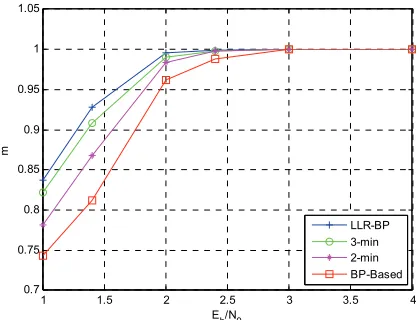
To observe the effect of the simplification in (27) and (29) on the performance from a statistical physics point of view, we have calculated the overlap between the ac-tual message and the estimate (magnetization) for each fixed code and for each algorithm. After, we average the obtained results for the 10 different codes. Figure 2 de-picts the magnetization performance of the LLR-BP, BP-Based and the λ-min algorithms.
f(t)
According the results of Figure 2, we can conclude the effectiveness of the λ-min algorithm. At a magnetiza-tion of 0.9, the BP-Based algorithm introduces a degra-dation of 0.5 dB with 20 iterations. The 2-min algorithm introduces a degradation of 0.3 dB. The performance of the 3-min algorithm is slightly worse than that of the LLR-BP algorithm, the degradation is only 0.08 dB.
Another remark from Figure 2 is that at high signal to noise ratio the magnetization is concentrate at the valuem1. This value corresponds to the ferromagnetic state in the statistical physics and to the perfect decoding in the information theory.
The analogy between the Bit Error Rate (BER) per-formance and the magnetization perper-formance can be exa- mined in [14].
6. Conclusions
In this paper, we have been interested in the decoding of LDPC codes from a statistical physics approach. First, we have examined the correspondence between LDPC codes and Ising spin systems. The relation between the BP algorithm and TAP approach is investigated. Then, we showed that LLR-BP algorithm and its simplification
i.e. the BP-Based algorithm and the λ-min algorithm can be obtained using the TAP approach of Ising spin sys-tems in statistical physics. Besides, we have presented the performance of the decoding algorithms using a sta-tistical physics parameter which is the magnetization.
Finally, we concluded that the BP-Based algorithm reduces the complexity for updating extrinsic informa-tion but there is degradainforma-tion in performance compared to the LLR-BP algorithm. The λ-min algorithm reduces the complexity for updating extrinsic information without degradation in performance compared to the LLR-BP algorithm especially when λ increases. These results con-
1 1.5 2 2.5 3 3.5 4
0.7 0.75 0.8 0.85 0.9 0.95 1 1.05
Eb/N0
m
[image:6.595.68.277.505.665.2]LLR-BP 3-min 2-min BP-Based
Figure 2. Magnetization performance of the LLR-BP, BP- Based and λ-min algorithms with λ = {2, 3}, for the (1008, 3, 6) LDPC code ensemble and with 20 decoding iterations.
firm with the results obtained in the information theory. As a perspective of our work, we propose to study the replica method. This is a method from the statistical physics applied to find the magnetization. Besides, we propose to simplify the equations of this method by the same approximation in the BP-Based algorithm and the λ-min algorithm in order to compare the analytic results with the experimental ones.
7. References
[1] N. Sourlas, “Spin-Glass Models as Error-Correcting Codes,” Nature,Vol. 339, No. 6227, 1989, pp.693-695. [2] D. J. Thouless, P. W. Anderson and R. G. Palmer,
“Solu-tion of Solvable Model of A Spin Glass,” Philosophical Magazine, Vol. 35, No. 3, 1977, pp. 593-601.
[3] R. G. Gallager, “Low-Density Parity-Check Codes,” M.I.T. Press, Cambridge, Massachusetts, 1963.
[4] D. J. C. Mackay and R. M. Neal, “Near Shannon Limit Performance of Low Density Parity Check Codes,” Elec-tronics Letters, Vol. 32, No. 18, 1996, pp.1645-1646. [5] D. J. C. Mackay, “Good Error-Correcting Codes Based
on Very Sparse Matrices,” IEEE Transactions on Infor-mation Theory, Vol. 45, No. 2, 1999, pp. 399-431. [6] M. P. C. Fossorier, M. Mihaljevic and I. Imai, “Reduced
Complexity Iterative Decoding of Low Density Parity Check Codes Based on Belief Propagation,” IEEE Tran- sactions on Communications, Vol. 47, No. 5, 1999, pp. 673-680.
[7] F. Guilloud, E. Boutillon and J. L. Danger, “λ-Min De-coding Algorithm of Regular and Irregular LDPC Codes,” Proceedingsof 3rd International Symposium on Turbo Codes & Related Topics, Brest, 2003, pp. 451-454. [8] Y. Kabashima and D. Saad, “Belief Propagation vs. TAP for Decoding Corrupted Messages,” Europhysics Letters, Vol. 44, No. 5, 1998, pp. 668-674.
[9] T. Murayama, Y. Kabashima, D. Saad and R. Vicente, “Statistical Physics of Regular Low-Density Parity-Check Error-Correcting Codes,” Physical Review E, Vol. 62, No. 2, 2000, pp. 1577-1591.
[10] R. Vicente, D. Saad and Y. Kabashima, “Finite-Connec- tivity Systems as Error-Correcting Codes,” Physical Re-view E, Vol. 60, No. 5, 1999, pp. 5352-5366.
[11] J. Chen, A. Dholakia, E. Eleftheriou, M. Fossorier and X. Y. Hu, “Reduced-Complexity Decoding of LDPC Codes,” IEEE Transactions on Communications, Vol. 53, No. 8, 2005, pp. 1288-1299.
[12] M. Mezard and A. Montanari, “Information, Physics and Computation,” Oxford University Press, Oxford, 2008. [13] F. Guilloud, “Generic Architecture for LDPC Codes
De-coding,” PhD Thesis, ENST Paris, 2004.