ISSN Online: 2327-6053 ISSN Print: 2327-6045
DOI: 10.4236/msce.2019.78002 Aug. 12, 2019 9 Journal of Materials Science and Chemical Engineering
Experimental Study of the Phase Equilibria in
the R-Al-Si Ternary Systems (R: Rare Earth
Element) the Ho-Al-Si Isothermal Section at
500
˚C
Anna Maria Cardinale, Nadia Parodi
Dipartimento di Chimica e Chimica Industriale, Università di Genova, Genova, Italy
Abstract
The effect of holmium addition to the Al-Si system has been experimentally studied, as the isothermal section at 500˚C. The constitution of the alloys has been determined by means of scanning electron microscopy (SEM), electron microprobe analysis (EDXS) and X-ray powder diffraction. The knowledge of the phase relationships in the R-Al-Si ternary systems (R: rare earths element) is essential to deeply understand the technological properties of the Al-Si based alloys, that are useful in different industrial fields. In the system inves-tigated have been identify nineteen ternary fields and twelve two phase fields. Three ternary compounds have been found in this ternary section: τ2-Ho2Al3Si2 (mS14-Y2Al3Si2), τ4-Ho2AlSi2 (oI10-W2CoB2) and τ5-Ho6Al3Si (tI80-Tb6Al3Si). The results obtained can be useful compared with the other known R-Al-Si systems also for predictive purposes.
Keywords
Al-Si Alloys, Rare Earth, Thermal Analysis
1. Introduction
The Al-Si alloys, both in the as cast and after thermal treatment conditions, have been recognized as interesting materials for the industries (e.g. automotive, heat exchanger, etc.). The addition of a rare earth element, at a very low concentra-tion, can modify the property of the alloys, improving some useful characters as low density and thermal expansion coefficients, good casting performance and weld ability, high wear resistance and temperature strength, good corrosion re-How to cite this paper: Cardinale, A.M.
and Parodi, N. (2019) Experimental Study of the Phase Equilibria in the R-Al-Si Ter-nary Systems (R: Rare Earth Element) the Ho-Al-Si Isothermal Section at 500˚C. Jour-nal of Materials Science and Chemical Engi-neering, 7, 9-17.
https://doi.org/10.4236/msce.2019.78002
DOI: 10.4236/msce.2019.78002 10 Journal of Materials Science and Chemical Engineering
sistance [1] [2] [3] [4]. All of the above leads to an increasing interest in the study of R-Al-Si based alloys (R being a trivalent rare earth element). The know-ledge of the phase equilibria and the transformations that take place during the solidification pathway of foundry aluminum based alloys are crucial, especially in planning and develop new materials. The industrially relevant R-Al-Si alloys have usually a concentration lying near the binary Al-Si eutectic composition and mischmetal (alloy of rare earth metals, whose typical composition includes approximately 50% Ce, 25% La and smaller small amounts of Nd and Pr) is of-ten added.
Moreover, owing to the definition of pseudo-lanthanide [5] it is possible to predict the behavior of an intermetallic phase not prepared yet, when experi-mental data are available for the adjacent members of this series. Taking into account the aforementioned considerations, investigations of a number of R-Al-Si systems have been carried out by our research group.
2. Literature Data
2.1. Boundary Binary Systems
As far as the binary systems are concerned, the Al-Si phase diagram is a simple eutectic, with the eutectic reaction at 12.2 at % Si and 577˚C and with no inter-metallic compounds found in this system [6]. Phase relationships in the Ho-Al system were assessed by [7]. There are five intermetallic compounds: Ho2Al (oP12-Co2Si type), Ho3Al2 (tP20-Al2Zr3 type), HoAl (oP16-ErAltype), HoAl2 (cF24-MgCu2 type) and HoAl3 (hR60-Al3Ho). The Ho-Si system, was recently assessed by [8]; at 500˚C temperature there are six intermetallic compounds in it as well: Ho5Si3 (hP16-Mn5Si3 type), Ho5Si4 (oP36-Sm5Ge4type), HoSi (oP8-FeB type), Ho4Si5, HoSi2−b (hP3-AlB2 type, ~38 at % Ho) and HoSi2−a (oI12-GdSi2 type, ~35 at % Ho). The Ho4Si5 compound was investigated [9] by means of single crystal X-ray diffraction and its structure was assumed to be Ho3Si4oS24-Ho2Si2.67 type.
2.2. R-Al-Si Ternary Systems
To our best effort literature data on R-Al-Si systems isothermal sections (in the whole range of concentrations) and liquid us projections mainly deal with the following: La-Al-Si (0 - 33 at % La) [10], Ce-Al-Si [11], Pr-Al-Si [12] [13], Nd-Al-Si [13], Sm-Al-Si ([13] and refs therein [14]), Eu-Al-Si [15], Gd-Al-Si, Al-Si-Tb and Al-Si-Dy ([13] and refs therein), Ho-Al-Si (0 - 33 at % Ho) [16], Er-Al-Si [17] and Y-Al-Si (0 - 33 at % Y) [18]. In the Ho-Al-Si ternary system, in literature [19], are reported the following compounds: HoAl2Si2 hP5-CaAl2O2 (τ1), Ho2Al3Si2 mS14-Y2Al3Si2 (τ2), HoAlSi oS12-YAlGe (τ3), Ho2Al1+xSi2−x oI10-W2CoB2 (τ4) and Ho6Al3Si tI80-Tb6Al3Si (τ5).
3. Experimental Techniques
ele-DOI: 10.4236/msce.2019.78002 11 Journal of Materials Science and Chemical Engineering
ments (aluminum, silicon and holmium at 99.999, 99.99 and 99.9 mass % purity respectively all supplied by Newmet Koch, Waltham Abbey, England). The starting metals, prepared in little pieces, have been weighed in a proper amount and then arc melted on a water cooled copper plate under vacuum, the samples were re-weighed after melting to check for any mass losses that were always less than 0.5 mass %. The samples have been annealed (in an alumina crucibles sealed in quartz tube under vacuum) at 500˚C for 720 hours and then quenched in water.
To characterize the samples after annealing the techniques used have been scanning electron microscopy (SEM), electron probe microanalysis based on energy dispersive X-ray spectroscopy (EDXS) and X-ray diffraction analysis (XRPD). As the metallographic analysis, the samples incorporated in a conductive resin support were prepared according to the standard method by SiC paper and di-amond paste polishing. After preparation the samples have been analyzed ap-plying an acceleration voltage of 20 kV for 50 s, and a cobalt standard was used for calibration. For the quantitative analysis the software packaging Inca Energy (Oxford Instruments, Analytical Ltd., Bucks, UK) was employed to process X-ray spectra.
To determine the crystal structures, and calculate lattice parameters of the different phases, the samples were prepared crushing them into powder in an agate mortar; then XRPD analysis was performed by the vertical diffractometer X’Pert MPD (Philips, Almelo, and The Netherlands). The indexing of the ob-tained diffraction data was achieved by comparison with literature or calculated data (the program Powder Cell [20]), the lattice parameters of the phases were calculated using the program LATCON [21].
4. Results and Discussion
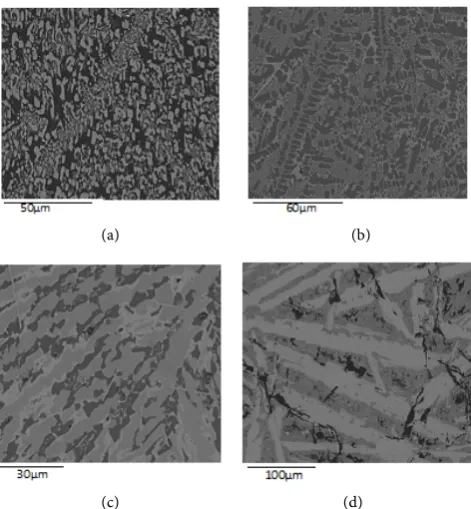
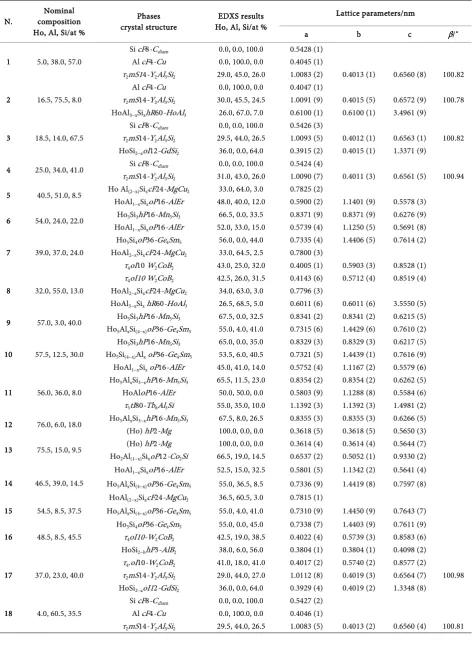
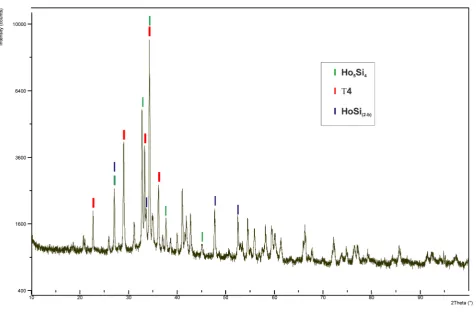
Table 1 reports data obtained from the eighteen samples synthesized and cha-racterized by using SEM/EDXS and X-ray powder diffraction, while Figure 1 reports the Ho-Al-Si isothermal section at 500˚C. It was drawn basing on the experimental data in Table 1 and contains the samples composition, the field described by means of dotted lines are hypothesized on the basis of the experi-mental data and the knowledge of the different R-Al-Si systems. In Figure 2 are shown the micrographic appearance of some selected samples after annealing and quenching, while Figure 3 reports the PXRD pattern of a three phase sam-ple.
4.1. Ternary Isothermal Section
DOI: 10.4236/msce.2019.78002 12 Journal of Materials Science and Chemical Engineering
Figure 1. The Ho-Al-Si ternary isothermal section at 500˚C, position and code of the samples are superimposed.
(a) (b)
[image:4.595.244.500.74.302.2](c) (d)
[image:4.595.256.492.348.603.2]DOI: 10.4236/msce.2019.78002 13 Journal of Materials Science and Chemical Engineering
Table 1. SEM-EDX and XRPD data on the Ho-Al-Si samples annealed at 500˚C and quenched.
N. composition Nominal Ho, Al, Si/at %
Phases
crystal structure Ho, Al, Si/at % EDXS results
Lattice parameters/nm
a b c β/˚
1 5.0, 38.0, 57.0
Si cF8-Cdiam 0.0, 0.0, 100.0 0.5428 (1)
Al cF4-Cu 0.0, 100.0, 0.0 0.4045 (1)
τ2mS14-Y2Al3Si2 29.0, 45.0, 26.0 1.0083 (2) 0.4013 (1) 0.6560 (8) 100.82
2 16.5, 75.5, 8.0
Al cF4-Cu 0.0, 100.0, 0.0 0.4047 (1)
τ2mS14-Y2Al3Si2 30.0, 45.5, 24.5 1.0091 (9) 0.4015 (5) 0.6572 (9) 100.78
HoAl3−xSixhR60-HoAl3 26.0, 67.0, 7.0 0.6100 (1) 0.6100 (1) 3.4961 (9)
3 18.5, 14.0, 67.5
Si cF8-Cdiam 0.0, 0.0, 100.0 0.5426 (3)
τ2mS14-Y2Al3Si2 29.5, 44.0, 26.5 1.0093 (5) 0.4012 (1) 0.6563 (1) 100.82
HoSi2−aoI12-GdSi2 36.0, 0.0, 64.0 0.3915 (2) 0.4015 (1) 1.3371 (9)
4 25.0, 34.0, 41.0 τ Si cF8-Cdiam 0.0, 0.0, 100.0 0.5424 (4)
2mS14-Y2Al3Si2 31.0, 43.0, 26.0 1.0090 (7) 0.4011 (3) 0.6561 (5) 100.94
5 40.5, 51.0, 8.5 Ho AlHoAl(2−x)SixcF24-MgCu2 33.0, 64.0, 3.0 0.7825 (2)
1−xSixoP16-AlEr 48.0, 40.0, 12.0 0.5900 (2) 1.1401 (9) 0.5578 (3)
6 54.0, 24.0, 22.0 HoAlHo5Si3hP16-Mn5Si3 66.5, 0.0, 33.5 0.8371 (9) 0.8371 (9) 0.6276 (9)
1−xSixoP16-AlEr 52.0, 33.0, 15.0 0.5739 (4) 1.1250 (5) 0.5691 (8)
7 39.0, 37.0, 24.0
Ho5Si4oP36-Ge4Sm5 56.0, 0.0, 44.0 0.7335 (4) 1.4406 (5) 0.7614 (2)
HoAl2−xSixcF24-MgCu2 33.0, 64.5, 2.5 0.7800 (3)
τ4oI10 W2CoB2 43.0, 25.0, 32.0 0.4005 (1) 0.5903 (3) 0.8528 (1)
8 32.0, 55.0, 13.0
τ4oI10 W2CoB2 42.5, 26.0, 31.5 0.4143 (6) 0.5712 (4) 0.8519 (4)
HoAl2−xSixcF24-MgCu2 34.0, 63.0, 3.0 0.7796 (3)
HoAl3−xSix hR60-HoAl3 26.5, 68.5, 5.0 0.6011 (6) 0.6011 (6) 3.5550 (5)
9 57.0, 3.0, 40.0 HoHo5Si3hP16-Mn5Si3 67.5, 0.0, 32.5 0.8341 (2) 0.8341 (2) 0.6215 (5)
5AlxSi(4−x)oP36-Ge4Sm5 55.0, 4.0, 41.0 0.7315 (6) 1.4429 (6) 0.7610 (2)
10 57.5, 12.5, 30.0
Ho5Si3hP16-Mn5Si3 65.0, 0.0, 35.0 0.8329 (3) 0.8329 (3) 0.6217 (5)
Ho5Si(4−x)Alx oP36-Ge4Sm5 53.5, 6.0, 40.5 0.7321 (5) 1.4439 (1) 0.7616 (9)
HoAl1−xSix oP16-AlEr 45.0, 41.0, 14.0 0.5752 (4) 1.1167 (2) 0.5579 (6)
11 56.0, 36.0, 8.0
Ho5AlxSi3−xhP16-Mn5Si3 65.5, 11.5, 23.0 0.8354 (2) 0.8354 (2) 0.6262 (5)
HoAloP16-AlEr 50.0, 50.0, 0.0 0.5803 (9) 1.1288 (8) 0.5584 (6) τ5tI80-Tb6Al3Si 55.0, 35.0, 10.0 1.1392 (3) 1.1392 (3) 1.4981 (2)
12 76.0, 6.0, 18.0 Ho5Al(Ho) hP2-Mg xSi3−xhP16-Mn5Si3 67.5, 8.0, 26.5 100.0, 0.0, 0.0 0.8355 (3) 0.3618 (5) 0.8355 (3) 0.3618 (5) 0.6266 (5) 0.5650 (3)
13 75.5, 15.0, 9.5 (Ho) hP2-Mg 100.0, 0.0, 0.0 0.3614 (4) 0.3614 (4) 0.5644 (7) Ho2Al(1−x)SixoP12-Co2Si 66.5, 19.0, 14.5 0.6537 (2) 0.5052 (1) 0.9330 (2)
14 46.5, 39.0, 14.5
HoAl1−xSixoP16-AlEr 52.5, 15.0, 32.5 0.5801 (5) 1.1342 (2) 0.5641 (4)
Ho5AlxSi(4−x)oP36-Ge4Sm5 55.0, 36.5, 8.5 0.7336 (9) 1.4419 (8) 0.7597 (8)
HoAl(2−x)SixcF24-MgCu2 36.5, 60.5, 3.0 0.7815 (1)
15 54.5, 8.5, 37.5 Ho5AlxSi(4−x)oP36-Ge4Sm5 55.0, 4.0, 41.0 0.7310 (9) 1.4450 (9) 0.7643 (7)
16 48.5, 8.5, 45.5
Ho5Si4oP36-Ge4Sm5 55.0, 0.0, 45.0 0.7338 (7) 1.4403 (9) 0.7611 (9)
τ4oI10-W2CoB2 42.5, 19.0, 38.5 0.4022 (4) 0.5739 (3) 0.8583 (6)
HoSi2−bhP3-AlB2 38.0, 6.0, 56.0 0.3804 (1) 0.3804 (1) 0.4098 (2)
17 37.0, 23.0, 40.0
τ4.oI10-W2CoB2 41.0, 18.0, 41.0 0.4017 (2) 0.5740 (2) 0.8577 (2)
τ2mS14-Y2Al3Si2 29.0, 44.0, 27.0 1.0112 (8) 0.4019 (3) 0.6564 (7) 100.98
HoSi2−aoI12-GdSi2 36.0, 0.0, 64.0 0.3929 (4) 0.4019 (2) 1.3348 (8)
18 4.0, 60.5, 35.5
Si cF8-Cdiam 0.0, 0.0, 100.0 0.5427 (2)
Al cF4-Cu 0.0, 100.0, 0.0 0.4046 (1)
DOI: 10.4236/msce.2019.78002 14 Journal of Materials Science and Chemical Engineering
Figure 3. X-ray powder pattern of sample n.16 (see Table 1).
found and the tie triangle in the Al and Si rich part of the system shows the same vertices as the Ho-Al-Si system. The micrographs of four representative samples are reported in Figure 2. Figure 2(a)) shows the appearance of the sample n.8 that describes the triangle constituted by the two phases HoAl(2−x)Six and HoAl(3−x)Six (respectively grey and black and both at their maximum silicon so-lubility), plus light Ho2AlxSi(2−x) (τ4) at its maximum aluminum solubility value. In Figure 2(b), the sample n.5, pertaining to the two HoAl(2−x)Six and HoAl(1−x)Six phase field, shows dark primary HoAl(2−x)Six crystals and the binary eutectic be-tween the primary phase and HoAl(1−x)Six compound, the medium eutectic composition is Ho 42 at % and Al 46 at % very close to the composition of the sample as confirmed by the micrographic feature. Ongoing throughout the sys-tem to the Ho richest part, in Figure 2(c) the sample n.14 is a three phase sample with gray primary HoAl(1−x)Six compound (at its maximum silicon solubility) sur-rounded by a small quantity of light Ho5AlxSi(4−x) of peritectic formation, plus black HoAl(2−x)Six phase. The sample n.16, in Figure 2(d) belongs to the Ho2AlxSi(2−x) (τ4), Ho5Si4 and HoSi2−btietriangle; the PXRD pattern of sample n.16 is reported in Figure 3, the main reflections of the three phases identify are highlighted.
4.2. Ternary Compounds
DOI: 10.4236/msce.2019.78002 15 Journal of Materials Science and Chemical Engineering
(oI10-W2CoB2) and τ5-Ho6Al3Si (tI80-Tb6Al3Si). In this work only three com-pounds were identified at 500˚C; the τ3 structure seems not to form in the sys-tem at 500˚C and the τ1 phase was not found in the system as discussed in the previous section. The τ2 compound shows a homogeneity range with constant Ho content, dissolving up to 45 at % Al (stoichiometric composition is lo-cated at 42.8 at % Al). As the τ4 compound has been proved the substitution with Al for Si in a range from 20.0 at % Al (stoichiometric composition) to 25 at % Al.
4.3. Binary Compounds
As expected different boundary binary compounds entry the ternary system, the homogeneity ranges minor of 2 at % are not taking into account. For each com-pound involved the solubility limit of the third element has been assumed as the me-dium value of the different experimental measurements in the different samples in-vestigated. From the Ho-Al system, the HoAl3, HoAl2 and HoAl compounds dissolve respectively 7 at %, 3 at % and 15 at % silicon. Ongoing from the Si to the Ho richest part of the binary Ho-Si phase diagram some compounds dissolve aluminium in the following percentage: HoSi2−b 4 at %, Ho5Si4 5 at % and Ho5Si3 10 at %.
5. Conclusion
s
The Ho-Al-Si-isothermal section at 500˚C has been studied in the whole compo-sition range, as the phase relationships the main conclusions are the following: The studied system consists of nineteen three-phase fields and twelve two-phase
fields.
Of the five known ternary compounds only τ2-Ho2Al3Si2 (mS14-Y2Al3Si2),
τ4-Ho2AlSi2 (oI10-W2CoB2) and τ5-Ho6Al3Si (tI80-Tb6Al3Si) have been found in the system at 500˚C, according with [16]. The τ2 and τ4 phases dissolve aluminum up to 45 at % and 25 at % respectively.
Different binary compounds dissolve the third element extending into the ternary system.
By comparing the different known ternary isothermal sections, some points can be highlighted. All the sections are characterized by the presence of in-termediate phases with R content up to 60 at % rare earth. The number of phases decreases on going from the light (Pr, Nd, Sm) to the heavy rare earths (Gd, Tb, Dy, Er). Only the RAl2Si2 compounds form along the whole lanthanides series as point compounds; nevertheless in the previously studied Ho-Al-Si [16] and Er-Al-Si [17] isothermal sections this compound has not been founded. From La to Dyat low R content the three-phase equilibrium: (Al)/(Si)/RAl2Si2 occurs. Many R-Si and R-Al compounds extend in the ter-nary system forming solid solutions at a constant R-content.
Conflicts of Interest
DOI: 10.4236/msce.2019.78002 16 Journal of Materials Science and Chemical Engineering
References
[1] Slattery, B.E., Perry, T. and Edrisy, A. (2009) Microstructural Evolution of a Eutec-tic Al-Si Engine Subjected to Severe Running Conditions. Mat. Sci. and Eng. A, 512, 76-81. https://doi.org/10.1016/j.msea.2009.01.025
[2] Miller, W.S., Zhuang, L., Bottema, J., Wittebrood, A.J., De Smet, P., Haszler, A. and Vieregge, A. (2000) Recent Development in Aluminum Alloys for the Automotive Industry. Mat. Sci. and Eng. A, 280, 37-49.
https://doi.org/10.1016/S0921-5093(99)00653-X
[3] Zhu, M., Jian, Z., Yao, L., Liu, C., Yang, G. and Zhou, Y. (2011) Effect of Mischmet-al Modification Treatment on the Microstructure, Tensile Properties, and Fracture Behavior of Al-7.0%Si-0.3%Mg Foundry Aluminum Alloys. J Mater. Sci, 46, 2685-2694. https://doi.org/10.1007/s10853-010-5135-7
[4] Cardinale, A.M., Macciò, D., Luciano, G., Canepa, E. and Traverso, P. (2016) Thermal and Corrosion Behavior of as Cast Al-Si Alloys with Rare Earth. J. Alloys Compd. https://doi.org/10.1016/j.jallcom.2016.11.066
[5] Gschdneidner Jr., K.A. (1980) The Rare Earths in Modern Science and Technology. In: McCarthy, G.J., Rhine, J.J. and Silber, H.B., Eds., Plenum, New York, 2, 13-23. [6] Murray, J.L. and McAlister, A.J. (1984) The Al-Si (Aluminum-Silicon) System. Bull.
of Alloy Phase Diagrams, 5, 74-84. https://doi.org/10.1007/BF02868729
[7] Jin, L., Kang, Y.-B., Chartrand, P. and Fuerst, C.D. (2010) Thermodynamic Evalua-tion and OptimizaEvalua-tion of Al-Gd, Al-Tb, Al-Dy, Al-Ho and Al-Er Systems Using a Modified Quasichemical Model for the Liquid. CALPHAD, 34, 456-466.
https://doi.org/10.1016/j.calphad.2010.08.004
[8] Kim, J. and Jung, I.H. (2015) Critical Evaluation and Thermodynamic Optimization of the Si-RE Systems: Part II. Si-RE System (RE= Gd, Tb, Dy, Ho, Er, Tm, Lu and Y). J. Chem. Thermodynamics, 81, 273-297.
https://doi.org/10.1016/j.jct.2014.08.014
[9] Ijjaali, I., Venturini, G. and Malaman, B. (1998) X-Ray Single Crystal Refinement of the Ho3Si4 Structure. J. Alloys Compd, 269, L6-L8.
https://doi.org/10.1016/S0925-8388(97)00626-9
[10] Murav’eva, A.O. (1971) The Systems La-Al-Si and La-Al-Sb in the Region 0-33.3 at % La. Vestn. Lviv Univ. Ser. Khim, 12, 8-9.
[11] Li, Y., Li, Z., Liu, Y., Wang, X., Zhao, M. and Yin, F. (2014) Isothermal Section of Al-Si-Ce Ternary System at 1073 K. J. of Phase Equil. and Diffusion, 35, 276-283.
https://doi.org/10.1007/s11669-014-0306-x
[12] Cardinale, A.M., Macciò, D. and Saccone, A. (2015) Phase Relationships of the R-Al-Si Systems: The Pr-Al-Si Isothermal Section at 500˚C. J. Therm. Anal. And Calorim, 121, 1151-1157. https://doi.org/10.1007/s10973-015-4906-4
[13] Cardinale, A.M. and Parodi, N. (n.d.) R-Al-Si Systems (R: Pr, Nd): Experimental Investigation of Phase Equilibria in the Al-Rich Corner.
[14] Markoli, B., Spaic, S. and Zupanic, F. (2001) The Constitution of Alloys in the Al-Rich Corner of the Al-Si-Sm Ternary System. Z. Metallkde, 92, 1098-1102. [15] Zarechnyuk, O.S. and Yanson, T.I. (1982) The Eu-Al-Si System within a Range of 0
- 33.3 Atomic Parts of Europium. Akad. NaukUkr. RSR, 4, 30-31.
[16] Zhuang, Y.H., Li, J.Q. and Zeng, L.M. (1990) The Isothermal Section (500˚C) of the Phase Diagram of the Al-Ho-Si Ternary System. J. Less-Common Met, 157, 47-53.
DOI: 10.4236/msce.2019.78002 17 Journal of Materials Science and Chemical Engineering
[17] Pukas, S., Lasocha, W. and Gladyshevskii, R. (2009) Phase Equilibria in the Er-Al-Si System at 873 K. CALPHAD, 33, 23-26.
https://doi.org/10.1016/j.calphad.2008.07.017
[18] Murav’eva, A.O., Zarechnyuk, O.S. and Gladyshevskii, E.I. (1971) The system-sy-Al-Si(Ge, Sb) in the Range 0 - 33.3 at % Y. Izv. Akad. Nauk SSSR Neorg. Mater, 1, 38.
[19] Villars, P. and Cenzual, K. (n.d.) Pearson’s Crystal Data-Crystal Structure Database for Inorganic Compounds (on DVD), Release 2017/18, ASM International, Mate-rials Park, Ohio, USA.
[20] Kraus, W. and Nolze, G. (1999) Powder Cell for Windows, Berlin.