INTRODUCTION: MORPHOLOGIC AND PHONOLOGIC ANALYSIS
1
Faculty of Dental Medicine of Casablanca
2
Faculty of Medicine and Pharmacy of Casablanca and microbiology laboratory
ARTICLE INFO ABSTRACT
This paper assumes that the linearity of morphemes and phonemes is revealed in the linguistic structure of the textuality of King Solomon’s Book of Proverbs. This assumption is supported by Corder’s theory of linear gram
grammatical categories like beads in a necklace or alternatively as a series of “slots” to be filled by words of category appropriate to each slot. This study utilizes the descriptive method of
which focuses on the morphological and phonological segmentation analysis of textuality. It specifically retrieves every morpheme and phoneme of every verse in the textuality in terms of the free and bound morphemes, as well as the segmental and
morphologic segmentation of morphemic contents in the six selected verses of King Solomon’s Book of Proverb’s reveal ninety free morphemes (roots) and forty bound morphemes (affixations). Out of the ninety free morphemes
grammatical morphemes (function words). Of the fifty form, four are compound, twenty
form. Of the thirty
eleven are prepositions, six are pronouns, and two are auxiliary. Of the forty bound morphemes, seventeen are inflectional morphemes (suffixes), and twe
(affixations). Generally, the textuality reveals eighty compound, twenty
the linear phonologic segmentat
succession of vowels and consonants speech sounds within the suprasegmental prosody of six rising sustained intonation of the six verses. All these verses, which are compound in form cont
final prosody (2
Therefore, it has been proven that the linearity of morphemes and phonemes is revealed in the linguistic structure of the textuality of King
poetry as the epitome of sophistication in writing, these findings call for earnest efforts to consider introducing slight revisions in the curriculum to bring into focus not only the morphologic and phonologic structure prevailing in literary pieces, but the three structures of grammar: syntax, morphology, and phonology.
Copyright © 2019, Maria Morena de la Pena. This unrestricted use, distribution, and reproduction in any medium,
INTRODUCTION
We truly believe that the Holy Bible contains the divine answer to the deepest needs of humanity, sheds unique light on our path in a dark world, and sets forth the way to our eternal well-being. We also believe that the Bible can only be used for public and private reading, evangelism, teaching, preaching,
memorizing, and liturgical use. According to the New
International Version (2011), the Bible contains five books of poetry such as the book of: Job, Psalms, Proverbs, Ecclesiasts, and Song of Songs. These books vary in literary form and content, but in general, they contain some of the world’s most enduring poetic achievements, not only in sacred Scripture, but
ISSN: 0975-833X
Article History:
Received xxxxxxx Received in revised form xxxxxx
Accepted xxxxx Published online xxxxx
Citation: Maria Morena de la Pena. 2018. “Introduction: morphologic and phonologic analysis
7924.
Keywords:
Book of Proverbs, Morphologic, Phonologic.
*Corresponding author:
Maria Morena de la Pena
Article History:
Received 14th July, 2019
Received in revised form 18th August, 2019
Accepted 25th September, 2019
Published online 30th October, 2019
RESEARCH ARTICLE
INTRODUCTION: MORPHOLOGIC AND PHONOLOGIC ANALYSIS
*
Maria Morena de la Pena
Faculty of Dental Medicine of Casablanca
Faculty of Medicine and Pharmacy of Casablanca and microbiology laboratory
ABSTRACT
This paper assumes that the linearity of morphemes and phonemes is revealed in the linguistic structure of the textuality of King Solomon’s Book of Proverbs. This assumption is supported by Corder’s theory of linear grammar, which treats the sentences of a language as a “string” of grammatical categories like beads in a necklace or alternatively as a series of “slots” to be filled by words of category appropriate to each slot. This study utilizes the descriptive method of
which focuses on the morphological and phonological segmentation analysis of textuality. It specifically retrieves every morpheme and phoneme of every verse in the textuality in terms of the free and bound morphemes, as well as the segmental and suprasegmental phonemes. The linear morphologic segmentation of morphemic contents in the six selected verses of King Solomon’s Book of Proverb’s reveal ninety free morphemes (roots) and forty bound morphemes (affixations). Out of the ninety free morphemes, fifty-two are lexical morphemes (content words), and thirty
grammatical morphemes (function words). Of the fifty-two lexical morphemes, twenty are in simple form, four are compound, twenty-seven are complex, and one is a compound complex in lin form. Of the thirty-eight grammatical morphemes, thirteen are determiners, six are conjunction, eleven are prepositions, six are pronouns, and two are auxiliary. Of the forty bound morphemes, seventeen are inflectional morphemes (suffixes), and twenty-three are derivational morphemes (affixations). Generally, the textuality reveals eighty-two morphemes: forty
compound, twenty-seven complex, and three compound-complex according to linguistic form. As to the linear phonologic segmentation of the phonemic contents of the Proverbs, it reveal a continuous succession of vowels and consonants speech sounds within the suprasegmental prosody of six rising sustained intonation of the six verses. All these verses, which are compound in form cont
final prosody (2-3-2) for the first main clause, and a final prosody (2
Therefore, it has been proven that the linearity of morphemes and phonemes is revealed in the linguistic structure of the textuality of King Solomon’s Book of Proverbs. Since we always look at poetry as the epitome of sophistication in writing, these findings call for earnest efforts to consider introducing slight revisions in the curriculum to bring into focus not only the morphologic and ologic structure prevailing in literary pieces, but the three structures of grammar: syntax, morphology, and phonology.
is an open access article distributed under the Creative Commons medium, provided the original work is properly cited.
We truly believe that the Holy Bible contains the divine answer to the deepest needs of humanity, sheds unique light on our path in a dark world, and sets forth the way to our eternal being. We also believe that the Bible can only be used for nd private reading, evangelism, teaching, preaching,
According to the New
International Version (2011), the Bible contains five books of poetry such as the book of: Job, Psalms, Proverbs, Ecclesiasts, se books vary in literary form and content, but in general, they contain some of the world’s most enduring poetic achievements, not only in sacred Scripture, but
also in all of ancient literature. They cover a wide variety of functions, from wisdom literature to the liturgical and personal hymns and worship, which could be a great source for linguistic analysis. There had been several recorded studies that are focused on the translation and interpretation of the Book of Proverbs; however, little is known of its morphological and phonological segmentation analysis despite the rich and abundant verses present in this Poetry Book. for this reason that the researcher
the linearity of words and speech sounds in one of the Five Books of Poetry of the Holy Bible
Proverbs Theoretical Background of the Study assumes that the linearity of morphemes and phon International Journal of Current Research
Vol. 11, Issue, 10, pp.7915-7924, October, 2019
DOI: https://doi.org/10.24941/ijcr.35695.10.2019
Introduction: morphologic and phonologic analysis”, International Journal of
INTRODUCTION: MORPHOLOGIC AND PHONOLOGIC ANALYSIS
Faculty of Medicine and Pharmacy of Casablanca and microbiology laboratory
This paper assumes that the linearity of morphemes and phonemes is revealed in the linguistic structure of the textuality of King Solomon’s Book of Proverbs. This assumption is supported by mar, which treats the sentences of a language as a “string” of grammatical categories like beads in a necklace or alternatively as a series of “slots” to be filled by words of category appropriate to each slot. This study utilizes the descriptive method of research which focuses on the morphological and phonological segmentation analysis of textuality. It specifically retrieves every morpheme and phoneme of every verse in the textuality in terms of the suprasegmental phonemes. The linear morphologic segmentation of morphemic contents in the six selected verses of King Solomon’s Book of Proverb’s reveal ninety free morphemes (roots) and forty bound morphemes (affixations). Out of two are lexical morphemes (content words), and thirty-eight are two lexical morphemes, twenty are in simple seven are complex, and one is a compound complex in linguistic eight grammatical morphemes, thirteen are determiners, six are conjunction, eleven are prepositions, six are pronouns, and two are auxiliary. Of the forty bound morphemes, three are derivational morphemes two morphemes: forty-six simple, six complex according to linguistic form. As to ion of the phonemic contents of the Proverbs, it reveal a continuous succession of vowels and consonants speech sounds within the suprasegmental prosody of six rising-sustained intonation of the six verses. All these verses, which are compound in form contain a non-2) for the first main clause, and a final prosody (2-3-1) for the second main clause. Therefore, it has been proven that the linearity of morphemes and phonemes is revealed in the Solomon’s Book of Proverbs. Since we always look at poetry as the epitome of sophistication in writing, these findings call for earnest efforts to consider introducing slight revisions in the curriculum to bring into focus not only the morphologic and ologic structure prevailing in literary pieces, but the three structures of grammar: syntax,
Commons Attribution License, which permits
in all of ancient literature. They cover a wide variety of functions, from wisdom literature to the liturgical and personal hymns and worship, which could be a great source for There had been several recorded studies on the translation and interpretation of the Book of Proverbs; however, little is known of its morphological and phonological segmentation analysis despite the rich and abundant verses present in this Poetry Book. It is for this reason that the researcher takes the initiative to analyze the linearity of words and speech sounds in one of the Five Books of Poetry of the Holy Bible – King Solomon’s Book of Theoretical Background of the Study. This paper assumes that the linearity of morphemes and phonemes is INTERNATIONAL JOURNAL OF CURRENT RESEARCH
7915-revealed in the linguistic structure of the textuality of King Solomon’s Book of Proverbs. This assumption is supported by Corder’s theory of linear grammar (179), which… …treats the sentences of a language as a “string” of grammatical categories like beads in a necklace or alternatively as a series of “slots” to be filled by words of category appropriate to each slot.
Parker and Riley (91-93) specify this linearity in the word structure (morphology) of a language, which focuses on word formation or structure of words, just as syntax is concerned with the structure of sentences, explaining that: Words are made up of meaningful units (morphemes), which can be lexical (meaningful themselves) or grammatical (relate one lexical morpheme with another). Free morphemes (roots) can stand alone as words, while bound morphemes (affixes) can only be meaningful when attached to free morphemes (94). On the other hand, the linear segmentation of phonemes in words corresponds to their phonetic transcription using phonetic symbols. In Philippine Academia, the PCLS (Philippine Center for Language Study) version of the IPA (International Phonetic Alphabet) is most appropriate for the transcription of Philippine textualities in English with General American English as the standard variety.
Parker and Riley (115-116) also explain the process of phonologic segmentation linearity as follows:
When we listen to someone talk, we hear speech but we perceive segments, psychological units which corresponds to “speech sounds” produced by the vocal tract in continuous succession. However, our interpretation of these sound waves is discrete. We perceive a series of discrete segments of phonemes. Phonemes are two types: Segmental phonemes are
the vowels and consonants that make up words.
Suprasegmental phonemes are the builders of prosody: stress, pitch, junctures, and intonations (Greenberg, 31).
For this reason, this model of linguistic description is also called “slot-and-filler grammar” because it treats the structure of the sentence as a linear pattern, such that the choice of each successive category is dependent upon the category immediately preceding it.
Related Readings: Marslen & Welsh (29-30) emphasize that
lexical, syntactic, morphologic and phonologic information are all available in speech and may be helpful in segmentation. Successful recognition of one word in a speech stream, which can sometimes be achieved even before the word has ended would allow a listener to predict both the rest of the word and the subsequent word boundary. Many types of acoustic information have been shown to play a role in speech segmentation. For example, Brent & Cartwright (93-125) suggest that people can use phonotactic constraints to parse speech between phonemes which never occur in combination within a word, but do occur in combination across word boundaries. Bernstein & Franco (408-434) also reveal that speech comprehension requires breaking continuous streams of sounds into units that can be recognized. Most listeners solve the problem of dividing long streams of phonemes into linguistically meaningful units effortlessly, but it is unclear how this is done. The researcher believed that the reviewed related studies contributed significantly to the present study because it served as anchorage for the supplementation of the data as herein presented.
Problem Statement
This academic paper synthesizes the morphologic and phonologic segmentation of the textuality of King Solomon’s Book of Proverbs.
Specifically, it focuses on the following:
Morphology: Linearity of Words
Free Morphemes: lexical and grammatical
Bound Morphemes: inflectional and derivational
Phonology: Linearity of Speech Sounds
Segmental phonemes: vowels and consonants
Suprasegmental phonemes: stress, pitch, junctures, and
intonations.
Significance of the Study: This study envisions to guide the language and literature teachers in determining the writing styles of renowned writers by describing the morphological and phonological patterns manifested in their works. It also benefits the students in terms of heightened awareness not only of the meaning and interpretation of the Holy Scriptures but also of its grammatical structures. Further, the study provides an insight for future researchers who would be interested to further broaden the scope of this linguistic analysis.
Scope and Limitations: This study confines itself to King
Solomon’s Book of Proverbs and is limited to the six selected verses, Chapters 11 and 12; Verses 1, 3, and 12. The herein analysis focuses on morphologic and phonologic segmentation linearity of the Proverbs textuality in terms of the free and bound morphemes; and the segmental and suprasegmental phonemes.
Definition of Terms: Several terms are used throughout this
paper and have been defined operationally to establish a common understanding of their use in the reporting of this study.
Book of Proverbs is one of the five Books of Poetry in the Holy Bible written by King Solomon and other wise men primarily during the King’s reign from 970-930 BC.
Bound morpheme is also known as ‘affixations’ (prefix, infix, and suffix) and cannot stand alone as words.
Complex is a linguistic form that is composed of one free morpheme and one or more bound morphemes.
Compound is a linguistic form that is composed of two or more free morphemes.
Compound-complex is a linguistic form that is composed of two or more free morphemes and one or more bound morphemes.
Derivational morpheme is a morpheme that changes the
syntactic category of the item when a suffix is attached, while it changes the meaning when a prefix is attached (e.g. ize, -ful, -ly; un-, dis-, a-, anti-, etc.)
Grammatical morphemes can only be sensible when they express some sort of relationship between lexical morphemes as function words such as: Pronoun, Preposition, Determiner, Conjunction, and Articles.
Inflectional morpheme is a morpheme that does not change the
syntactic category of speech words to where they are attached (s,‘s, er, est, ed, en, & ing).
Lexical morpheme is a morpheme that can stand in a sentence
sensibly alone as content words such as: Noun, Verb, Adjective, and Adverb.
Linearity is the sequencing of the immediate constituents as a linear structure – subject plus predicate.
Morpheme is the minimal unit having more or less constant meaning associated with more or less constant form.
Morphology is concerned with the structure of words and formation of admissible words in a language.
Morphologic structure is the form and structure of words in a language especially the consistent patterns of inflection, combination, derivation and change, and the likes that may be observed and classified.
Phoneme is the basic unit of phonology, which is either segmental or suprasegmental.
Phonologic structure is the form and structure of the speech sounds.
Phonology describes the sound system of a language: the rules that govern pronunciation or the production of sounds.
Proverb is a Hebrew word which means message, taunt, or parable. In Chapter 30:33, the word is translated as churning, twisting, and stirring up.
Segmental phonemes are the vowels and consonants that
make-up words.
Segmentation is the process of dividing the printed
texthttp://en.wikipedia.org/wiki/Writing into meaningful units, such as words and sounds.
Simple is a linguistic form that is composed of only one free morpheme.
Structuration refers to the reproduction of systems that is based in the analysis of both structure and agents without giving primacy to the other.
Suprasegmental phonemes are the builders of prosody such as:
stress, pitch, juncture, and intonations.
Textuality refers to the quality or use of language
characteristics of King Solomon’s Book of Proverbs.
METHODOLOGY
LINGUISTIC
ANALYSIS/
DESCRIPTION
Linguistic Research Method Used: This study utilizes the
descriptive method of research which focuses on the morphological and phonological segmentation analysis of textuality. This specifically retrieves every morpheme and phoneme of every verse in the textuality.
Sources of Verbal Data: The data needed in this study are the
six selected verses of the textuality of King Solomon’s Book of Proverbs. These verses were taken from the New International Version (NIV) Study Bible published by Zondervan, Grand Rapids, Michigan 49530, USA.
Data-generating process: The verbal data is generated in two
phases: (1) analysis of the linearity of words in terms of the free and bound morphemes, and (2) analysis of the linearity of speech sounds in terms of segmental and suprasegmental phonemes.
Morphology: Linearity of Words
Free Morpheme and Bound Morpheme: The six selected
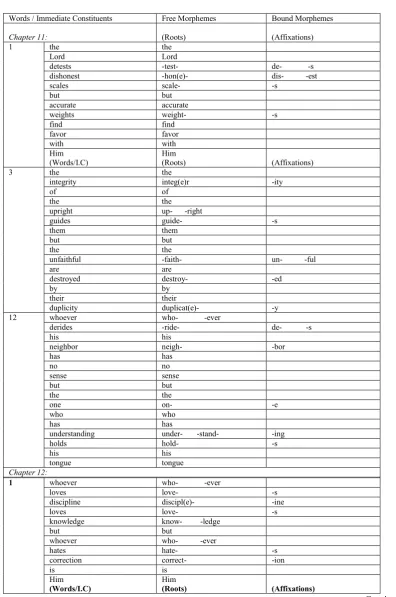
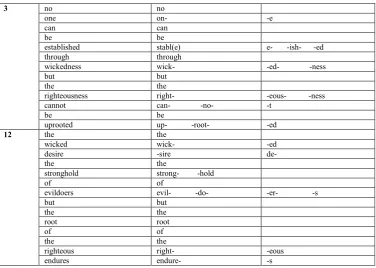
verses in King Solomon’s Book of Proverbs are hereby analytically segmented in terms of free morphemes (roots), and bound morphemes (affixations). Chapter 11:1 contains twelve free morphemes (roots) and six bound morphemes. In the word DETESTS, the free morpheme is TEST, while DE- and -S are the bound morphemes. In the word DISHONEST, the free morpheme is HONE, while DIS- and -EST are the bound morphemes. In the word SCALES, the free morpheme is SCALE, while -S is the bound morpheme. In the word WEIGHTS, the free morpheme is WEIGHT, while -S is the bound morpheme.
morphemes. In the word HATES, the free morpheme is HATE, while -S is the bound morpheme. In the word CORRECTION, the free morpheme is CORRECT, while -ION is the bound morpheme. Chapter 12:3 contains fifteen free morphemes (roots) and eleven bound morphemes (affixes). In the word ONE, the free morpheme is ON, while -E is the bound morpheme. In the word ETABLISHED, the free morpheme is STABLE, while E-, -ISH-, and -ED are the bound morphemes. In the word RIGHTEOUSNESS, the free morpheme is RIGHT, while -TEOUS- and -NESS are the bound morphemes. In the word CANNOT, both CAN and NO are the free morphemes, while -T is the bound morpheme. In the word UPROOTED, the free morphemes are ROOT and UP, while -ED is the bound morpheme. Chapter 12:12 contains sixteen free morphemes (roots) and six bound morphemes (affixes). In the word WICKED, the free morpheme is WICK, while -ED is the bound morpheme. In the word DESIRE, the free morpheme is -SIRE, while DE- is the bound morpheme. In the word STRONGHOLD, both STRONG- and HOLD are the free morphemes. In the word EVILDOERS, both EVIL and DO are the free morphemes, while -ER- and -S are the bound morphemes. In the word RIGHTEOUS, the free morpheme is RIGHT, while -EOUS is the bound morpheme. In the word ENDURES, the free morpheme is ENDURE, while -S is the bound morpheme. Hence, the linear morphologic segmentation of morphemic contents in the six selected verses ofKing Solomon’s Book of Proverbs reveal eighty-nine free morphemes (roots) and forty bound morphemes (affixations).
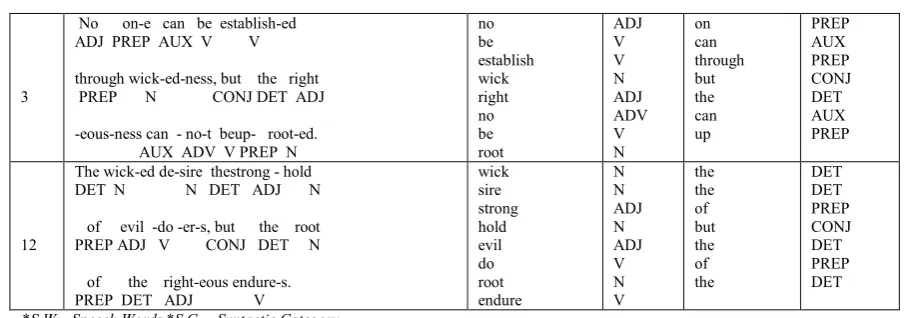
Free Morphemes: Free morphemes can be lexical (Noun, Verb, Adjective, Adverb) and grammatical (Pronoun, Preposition, Determiner, Conjunction, Article, Aux.). The free morphemes extracted from King Solomon’s Book of Proverbs are hereby segmented in terms of lexical and grammatical morpheme. In Chapter 11:1, there are eight lexical morphemes of which four are nouns (Lord, scale, weight, and favor); three are verbs (test, hone, and find); and one is adjective (accurate). As for the grammatical morphemes, there are four of which one is a determiner (the), one conjunction (but), one preposition (with), and one pronoun (Him). In Chapter 11:3, seven lexical morphemes were extracted of which three are nouns (integer, faith, and duplicate); three are verbs (guide, are, and destroy); and one adjective (right). As for the grammatical morphemes, nine were extracted of which three are determiners (the), three prepositions (of, up, and by), one pronoun (them), one conjunction (but), and another determiner (their). In Chapter 11:12, there are ten lexical morphemes of which five are verbs (ride, has, has, stand, and hold), three are nouns (neigh, sense, and tongue), one adverb (ever), and one adjective (no). As for the grammatical morphemes, eight were extracted of which two are pronouns (both who); three are determiners (his, the, and another his); one conjunction (but), and two prepositions (on and under).
In Chapter 12:1, there are eleven lexical morphemes of which five are verbs (love, love, know, hate, and is); two are nouns (disciple and ledge); two adverbs (both ever); and two adjectives (correct and stupid). As for the grammatical morphemes, only three were extracted of which two are pronouns (both who), and one is a conjunction (but). In Chapter 12:3, there are eight lexical morphemes found of which two are adjectives (no and right); three are verbs (be, establish, and another be); two are nouns (wick and root); and one adverb (no). As for the grammatical morphemes, seven were found of which three are prepositions (on, up, and
through); two auxiliary (both can); one conjunction (but); and one determiner (the). In Chapter 12:12, there are eight lexical morphemes found of which four are nouns (wick, sire, hold, and root); two adjectives (strong and evil); and two verbs (do and endure). As for the grammatical morphemes, seven were found of which four are determiners (all the); two prepositions (both OF); and one conjunction (BUT). Hence, the linear morphologic segmentation of morphemic contents in the six selected verses of King Solomon’s Book of Proverbs reveal fifty-two lexical morphemes (content words), and thirty-eight grammatical morphemes (function words).
Bound Morphemes:Bound morphemes (affixations) can be inflectional (plural, possessive, comparative, superlative, present, past, past participle, and present participle form of the verb); and derivational (e.g. –ize, -ful, -ly, anti-, un-, a-, dis-, etc.). The bound morphemes extracted from the six selected verses of King Solomon’s Book of Proverbs are hereby segmented in terms of inflectional and derivational morpheme.
In Chapter 11:1, there are four inflectional morphemes: -S (suffix of present form), -EST (suffix of superlative), and two –S (suffix of plurality). The verse also contains two derivational morphemes; DE- and DIS- (both prefix). In Chapter 11:3, there only two inflectional morphemes: -S (suffix of present), and -ED (suffix of past). The verse has five derivational morphemes: -ITY (suffix), UP- (prefix), UN- (prefix), -FUL (suffix), and –Y (suffix). In Chapter 11:12, there are three inflectional morphemes, in which two are in the present form –S and one is in the present participle -ING.The derivational morphemes extracted from this verse were DE- (prefix), -BOR (suffix), and –E (suffix). In Chapter 12:1, there are three inflectional morphemes, all in the present form –S. There are two derivational morphemes extracted from this verse: -INE and -ION (both suffix). In Chapter 12:3, only two inflectional morphemes were found and were both suffix of past form -ED. As for the derivational morphemes, there were six: E (suffix), ED (infix), NESS (suffix), EOUS (infix), -NESS (suffix), and -T (suffix). In Chapter 12:12, three inflectional morphemes were extracted: -ED (suffix of past form), -S (suffix of plurality), and another -S (suffix of present form). This verse also contains three derivational morphemes: -DE (prefix), -ER- (infix), and -EOUS (suffix). Hence, the linear morphologic segmentation of morphemic contents in the six selected verses of King Solomon’s Book of Proverbs reveal seventeen inflectional morphemes (suffixes), and twenty-three derivational morphemes (affixations).
Lexical Morphemes: Content Words: Lexical morphemes
have a sense in and themselves. Content words (N, V, ADJ, and ADV) are typical of lexical morphemes and may be made up of free (roots) and bound (affixations) morphemes. Their forms can be simple (one free morpheme), compound (two or more free morphemes), complex (one free and one or more bound morphemes), and compound complex (two or more free
morphemes and one or more bound morphemes). The six
Book of Proverbs King Solomon Chapter 11:
1 The Lord detests dishonest scales, but accurate weights find favor with Him.
3 The integrity of the upright guides them, but the unfaithful are destroyed by their duplicity. 12 Whoever derides his neighbor has no sense, but the one who has understanding holds his tongue. Chapter 12:
[image:5.595.106.503.164.762.2]1 Whoever loves discipline loves knowledge, but whoever hates correction is stupid. 3 No one can be established through wickedness, but the righteousness cannot be uprooted. 12 The wicked desire the stronghold of evildoers, but the root of the righteous endures.
Table 1. Morphological Segmentation Analysis
Words / Immediate Constituents Free Morphemes Bound Morphemes
Chapter 11: (Roots) (Affixations)
1 the the
Lord Lord
detests -test- de- -s
dishonest -hon(e)- dis- -est
scales scale- -s
but but
accurate accurate
weights weight- -s
find find
favor favor
with with
Him (Words/I.C)
Him
(Roots) (Affixations)
3 the the
integrity integ(e)r -ity
of of
the the
upright up- -right
guides guide- -s
them them
but but
the the
unfaithful -faith- un- -ful
are are
destroyed destroy- -ed
by by
their their
duplicity duplicat(e)- -y
12 whoever who- -ever
derides -ride- de- -s
his his
neighbor neigh- -bor
has has
no no
sense sense
but but
the the
one on- -e
who who
has has
understanding under- -stand- -ing
holds hold- -s
his his
tongue tongue
Chapter 12:
1 whoever who- -ever
loves love- -s
discipline discipl(e)- -ine
loves love- -s
knowledge know- -ledge
but but
whoever who- -ever
hates hate- -s
correction correct- -ion
is is
Him
(Words/I.C)
Him
(Roots) (Affixations)
3 no no
one on- -e
can can
be be
established stabl(e) e- -ish- -ed
through through
wickedness wick- -ed- -ness
but but
the the
righteousness right- -eous- -ness cannot can- -no- -t
be be
uprooted up- -root- -ed
12 the the
wicked wick- -ed
desire -sire de-
the the
stronghold strong- -hold
of of
evildoers evil- -do- -er- -s
but but
the the
root root
of of
the the
righteous right- -eous
[image:6.595.119.496.70.338.2]endures endure- -s
Table 2. Free Morpheme Segmentation Analysis
FREE MORPHEMES Lexical Morphemes (Content Words) Grammatical Morphemes (Function Words)
Chapter 11: *S.W. *S.C. *S.W. *S.C.
1
The Lord de-test-sdis-hone-st scale-s DET N V V N
butaccurateweight-s findfavor CONJ ADJ N V N with Him.
PREP PRON
Lord test hone scale accurate weight find favor
N V V N ADJ N V N
the but with Him
DET CONJ PREP PRON
3
Theinteg(e)r-ity of theup- DET N PREP DET PREP
-right guide-s them, but the ADJ V PRON CONJ DET un-faith-ful aredestroy-ed by N V V PREP theirduplic(a)t(e)-y.
DET N
integer right guide faith are destroy duplicate
N ADJ V N V V N
the of the up them but the by their
DET PREP DET PREP PRON CONJ DET PREP DET
FREE MORPHEMES
Lexical Morphemes
(Content Words)
Grammatical Morphemes
(Function Words)
12
Who - ever de-ride-s hisneigh-bor PRON ADV V DET N
hasnosense, but the on-e whohas V ADJ N CONJ DET PREP PRON V
under-stand-ing hold-s his tongue. PREP V V DET N
ever ride neigh has no sense has stand hold tongue
ADV V N V ADJ N V V V N
who his but the on who under his
PRON DET CONJ DET PREP PRON PREP DET
Chapter 12: S.W. S.C. S.W. S.C.
1
Who - everlove-s discipl(e)-ine PRON ADV V N
love-s know-ledge, butwho -ever V V N CONJ PRON ADV hate-s correct-ion is stupid.
V AJ V ADJ
everlove disciple love know ledge ever hate correct isstupid
ADV V N V V N ADV V ADJ V ADJ
who but who
PRON CONJ PRON
3
No on-e can be establish-ed ADJ PREP AUX V V
through wick-ed-ness, but the right PREP N CONJ DET ADJ
-eous-ness can - no-t beup- root-ed. AUX ADV V PREP N
no be establish wick right no be root ADJ V V N ADJ ADV V N on can through but the can up PREP AUX PREP CONJ DET AUX PREP 12
The wick-ed de-sire thestrong - hold DET N N DET ADJ N
of evil -do -er-s, but the root PREP ADJ V CONJ DET N
of the right-eous endure-s. PREP DET ADJ V
wick sire strong hold evil do root endure N N ADJ N ADJ V N V the the of but the of the DET DET PREP CONJ DET PREP DET
[image:7.595.68.524.54.213.2]*S.W – Speech Words *S.C. – Syntactic Category
Table 3. Bound Morpheme Segmentation Analysis
BOUND MORPHEMES
Inflectional Morphemes
Derivational Morphemes
Chapter 11: Suffixes Affixations
1 The Lord de-test-sdis-hon(e)-est scale-s but accurate weight-sfind
favor with Him.
-s -est -s -s present superlative plural plural de- dis- prefix prefix
3 The integ(e)r-ity of theup-right guide-sthem, but theun-faith-fulare
destroy-ed by their duplic(a)t(e)-y.
-s -ed present past -ity up- un- -ful -y suffix prefix prefix suffix suffix
12 Who-ever de-ride-s his neigh-borhas no sense, but the on-ewho
has under-stand-ing hold-shis tongue.
-s -ing -s present p. participle present de- -bor -e prefix suffix suffix Chapter 12:
1 Who-ever love-s discipl(e)-ine love-s know-ledge, but who-ever
hate-s correct-ion is stupid.
-s -s -s present present present -ine -ion suffix suffix
3 No on-ecan be e-stabl(e)-ish-ed through wick-ed-ness, but the
right-eous-ness can-no-t be up-root-ed.
-ed -ed past past -e e- -ish- -ed- -ness -eous- -ness -t suffix prefix infix suffix suffix infix suffix suffix
12 The wick-ed de-sire the strong-hold of evil-do-er-s, but the root
of the right-eous endure-s.
[image:7.595.78.520.537.785.2]-ed -s -s past plural present de- -er- -eous prefix infix suffix
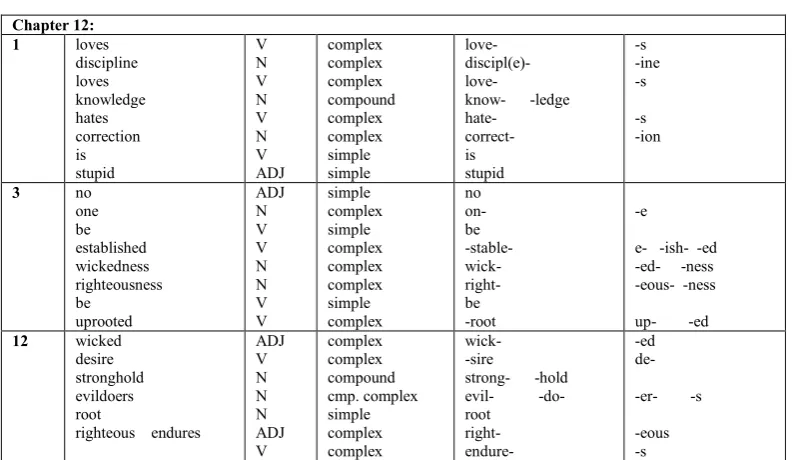
Table 4. Lexical Morpheme Segmentation Analysis
Lexical Morphemes (Content Words) Forms Roots Affixes
Chapter 11:
1 Lord
detests dishonest scales accurate weights find favor N V ADJ N ADJ N V N simple complex complex complex simple complex simple simple Lord -test- hon(e)- scale- accurate weight- find favor
de- -s dis- -est -s
-s
Lexical Morphemes
(Content Words) Forms Roots Affixes
3 integrity
upright guides unfaithful are destroyed duplicity N ADJ V ADJ V V N complex compound complex complex simple complex complex integ(e)r- up- -right guide- -faith- are destroy- duplic(ate)- -ity -s un- -ful
-ed -y
12 derides
neighbor no sense one understanding holds tongue V N ADJ N N N V N complex complex simple simple complex cpd-complex complex simple -ride- neigh- no sense on-
under- -stand- hold-
tongue
de- -s -bor
-e -ing -s
simple form (no, sense, and tongue); one is compound complex form (understanding); and four are complex form (derides, neighbor, one, and holds). Chapter 12:1 has eight lexical morphemes of which two are simple form (is and stupid); one is compound form (knowledge); and five are complex form (loves, discipline, loves, hates, and correction).
Chapter 12:3 has eight lexical morphemes of which three simple form (no, be, and another be); and five are complex form (one, established, wickedness, righteousness, and uprooted). Chapter 12:12 has seven lexical morphemes of which one is simple form (root); one is compound form (stronghold); one is compound complex form (evildoers); and Chapter 12:
1 loves discipline loves knowledge hates correction is stupid V N V N V N V ADJ complex complex complex compound complex complex simple simple love- discipl(e)- love-
know- -ledge hate- correct- is stupid -s -ine -s -s -ion
3 no
one be established wickedness righteousness be uprooted ADJ N V V N N V V simple complex simple complex complex complex simple complex no on- be -stable- wick- right- be -root -e
e- -ish- -ed -ed- -ness -eous- -ness
up- -ed
12 wicked desire stronghold evildoers root
righteous endures
ADJ V N N N ADJ V complex complex compound cmp. complex simple complex complex wick- -sire
strong- -hold evil- -do- root
right- endure-
-ed de-
-er- -s
[image:8.595.103.503.51.281.2]-eous -s
Table 5. Grammatical Morpheme Segmentation Analysis
Grammatical Morphemes
Constituents
Function in the Sentences Chapter 11: 1 the but with Him DET CONJ PREP PRON
number of nouns marker connects phrases and clauses introduces a phrase substitutes a noun 3 3 the of the up them but the by their DET PREP DET PREP PRON CONJ DET PREP DET
number of nouns marker introduces a phrase number of nouns marker introduces a phrase substitutes a noun
connects phrases and clauses number of nouns marker introduces a phrase number of nouns marker 1 112 who his but the on who under his PRON DET CONJ DET PREP PRON PREP DET
substitutes a noun number of nouns marker connects phrases and clauses number of nouns marker introduces a phrase substitutes a noun introduces a phrase number of nouns marker Grammatical Morphemes
Constituents
Function in the Sentences Chapter 12:
11 who but who
PRON CONJ PRON
substitutes a noun
connects phrases and clauses substitutes a noun
3 on can through but the can up PREP AUX PREP CONJ DET AUX PREP
introduces a phrase marker of future tense introduces a phrase connects phrases and clauses number of nouns marker marker of future tense introduces a phrase
12 the the of but the of the DET DET PREP CONJ DET PREP DET
four are complex form (wicked, desire, righteous, and endures). Hence, the linear morphologic segmentation of morphemic contents of the six selected verses of King Solomon’s Book of Proverbs reveal forty-six lexical morphemes of which fourteen are simple, four are compound, twenty-seven are complex, and one is compound complex in linguistic form.
Grammatical Morphemes: Function Words: Grammatical
morphemes, according to Marchand (95), do not really have a sense in and of themselves; instead, they express some sort of relationship between lexical morphemes. Function words (pronouns, prepositions, articles, conjunctions, determiner, and auxiliary) are typical of grammatical morphemes. The six selected verses of King Solomon’s Book of Proverbs contain the following grammatical morphemes:
Chapter 11:1 contains four grammatical morphemes of which one is a determiner (the), one conjunction (but), one preposition (with), and one pronoun (Him). Chapter 11:3 contains nine grammatical morphemes of which four are determiners (the), three prepositions (of, up, and by), one pronoun (them), and one conjunction (but). Chapter 11:12 contains eight grammatical morphemes of which two are pronouns (both who), three determiners (his, the, and his), two prepositions (on and under), and one conjunction (but). Chapter 12:1 contains three grammatical morphemes of which two are pronouns (both who) and one conjunction (but). Chapter 12:3 contains seven grammatical morphemes of which three are prepositions (on, through, and up), two auxiliary (both can), one determiner (the), and one conjunction (but).
Chapter 12:12 contains seven grammatical morphemes of which four are determiners (the), two prepositions (both of), and one conjunction (but). Hence, the linear morphologic segmentation of morphemic contents of the six selected verses of King Solomon’s Book of Proverbs reveal thirty-eight grammatical morphemes of which thirteen are determiners, six are conjunction, eleven are prepositions, six are pronouns, and two are auxiliary.
Phonology: Linearity in Speech Sounds
The linear description of phonologic segmentation in the six selected verses of King Solomon’s Book of Proverbs is focused on the transcription of the segmental and suprasegmental phonemes.
Segmental Phonemes in Linearity: The phonetic
transcriptions of the words in each of the six selected verses of King Solomon’s Book of Proverbs, are as follows:
Chapter 11:1
The Lord detests dishonest scales, /dhe lord dItεsts dIseynest
skeyls but accurate weights find favor with Him. bet akyeret
weyts faynds feyver wIth hIm/
Chapter 11:3
The integrity of the upright guides them, /dheIntεgretiy ev
dheeprayt gayds dhem but the unfaithful are destroyed by their
duplicity. bet dhI enfeythfel ar dIstroyd bay dhǽr doplIsitε/
Chapter 11:12
Whoever derides his neighbor has no sense, /hoεver dIrayds
hIz neyber hes now sεns But the one who has understanding
holds his tongue. bet dhI wen hohas enderstanding howlds hIz
teng/
Chapter 12:1
Whoever loves discipline loves knowledge, /hoεver levs
dIseplen levs nalIj but whoever hates correction is stupid. bet
hoεver heyts kerεkshen Iz stoped/
Chapter 12:3
No one can be established through wickedness, /now wen ken
bI Istablisht throwIkednεs but the righteousness cannot be
uprooted. bet dhe raychesnεs kenot bI eprutεd/
Chapter 12:12
The wicked desire the stronghold of evildoers, /dhe wIked
dIzayr dhe stronghowld iyvelduwers but the root of the
righteous endures. bet dhe rot ev dhe rayches Indyurs/
Suprasegmental Phonemes in Linearity: The phonetic
transcriptions of the stress, pitch, junctures, and intonations are superimposed on the segmentals, as follow
Chapter 11:1
The Lord detests dishonest scales, 3/ 2 dhe lord dItεsts
dIseynest skeyls 2. but accurate weights find favor with Him.
3. 2 bet akyeret weyts faynds feyver wIth hIm # / 1
Chapter 11:3
The integrity of the upright guides them, 3 / 2 dheIntεgretiy ev
dheeprayt gayds dhem 2 but the unfaithful are destroyed by
their duplicity. 3 2 bet dhI enfeythfel ar dIstroyd bay dhǽr
doplIsitε # / 1
Chapter 11:12
Whoever derides his neighbor has no sense, 3/ 2 hoεver
dIrayds hIz neyber hes now sεns 2 but the one who has
understanding holds his tongue. 3 2 bet dhI wen hohas
enderstanding howlds hIz teng # /
Chapter 12:1
Whoever loves discipline loves knowledge, 3 / 2 hoεver levs
dIseplen levs nalIj 2 but whoever hates correction is stupid. 3
2 bet hoεver heyts kerεkshen Iz stoped # / 1
Chapter 12:3
No one can be established through wickedness, 3/ 2 now wen
ken bI Istablisht throwIkednεs 2 but the righteousness cannot
be uprooted. 3 2 bet dhe raychesnεs kenot bIeprutεd # / 1]]
Chapter 12:12
The wicked desire the stronghold of evildoers, 3/ 2 dhe wIked
dIzayr dhe stronghowld iyvelduwers 2 but the root of the
righteous endures. 3 2 bet dhe rot ev dhe rayches Indyurs # /
RESULTS AND DISCUSSION
Synthesis: The linear morphologic segmentation of
Solomon’s Book of Proverbs reveal ninety free morphemes (roots) and forty bound morphemes (affixations). Out of the ninety free morphemes, fifty-two are lexical morphemes (content words), and thirty-eight are grammatical morphemes (function words). Of the fifty-two lexical morphemes, twenty are in simple form, four are compound, twenty-seven are complex, and one is a compound complex in linguistic form. Of the thirty-eight grammatical morphemes, thirteen are determiners, six are conjunction, eleven are prepositions, six are pronouns, and two are auxiliary. Meanwhile, of the forty bound morphemes, seventeen are inflectional morphemes (suffixes), and twenty-three are derivational morphemes (affixations). The linear phonologic segmentation of the phonemic contents of the Book of Proverbs reveal a continuous succession of vowels and consonants speech sounds within the suprasegmental prosody of six rising-sustained intonation of the six verses. All the verses, which are compound in form contain a non-final prosody (2-3-2) for the first main clause, and a final prosody (2-3-1) for the second main clause.
Conclusion
Therefore, it has been proven that the linearity of morphemes and phonemes is revealed in the linguistic structure of the textuality of King Solomon’s Book of Proverbs.
Recommendation
Based on the findings and the conclusion, the following recommendations are hereby offered.
The Book of Proverbs as one of the five poetry books in
the Holy Bible should not only be used for teaching and instruction, but as a good and abundant source for linguistic analysis.
Since we always look at poetry as the epitome of
sophistication in writing, these findings call for earnest efforts to consider introducing slight revisions in the English curriculum to bring into focus not only the basic structure prevailing in literarypieces, but the three structures of grammar: syntax, morphology, and phonology.
Language and Literature students should be taught to
analyze the printed materials in terms of the linearity of words and of speech sounds.
This paper is strongly recommended for publication at the
Naval State University-Journal of Language Researches.
Further Recommendations
The following topics are hereby recommended for future research:
Grammatical Linearity: King David’s Psalms 23, “The
Lord is my Shepherd.”
Phonologic Segmentation Linearity of King Solomon’s
Proverbs 31, “The Wife of Noble Character.”
Morphologic Segmentation Linearity of King David’s
Psalms 91, “Whoever Dwells in the Shelter of the Most High.”
Lexical, Syntactic, and Stress-Pattern Segmentation
Linearity of King Solomon’s Song of Songs 2, “I am a Rose of Sharon, a Lily of the Valleys.”
King Solomon’s Song of Songs 4, “How Beautiful you
are, My Darling! Oh, How Beautiful!: Syntactic Segmentation Analysis.
REFERENCES
Bernstein J. and Franco H. 1997. Speech Recognition by
Computer. In: Lass NJ, editor. Principles of experimental
phonetics. Mosby: St. Louis, MO; 1996. Speech
Segmentation and Word Discovery: A Computational Perspective. Trends in Cognitive Sciences.1999. Journal of Psycholinguistic Research.
Brent MR, Cartwright TA. Distributional Regularity and
Phonotactic Constraints are Useful for Segmentation. Cognition. 1996.
Cole RA., Jakimik J., Cooper WE. 1980. Segmenting speech
into words. Journal of the Acoustical Society of America.
Corder, S. Pit. Introducing Applied Linguistics. Great Britain:
Penguin, 2003.
Encyclopedia.com. Dictionaries, Thesauruses, Pictures, and Press Releases. A Dictionary of Sociology. January 1998. High Beam™ Research, Inc. © Copyright 2015. All rights reserved.
Greenberg, J. 2002. Essays in Linguistics. Chicago: Univ. of
Chicago Press.
Marchand, H. 2009. The Categories and Types of Present-day
English Word-Formation. Munich: Beck.
Marslen-Wilson WD, Welsh A. 1978. Processing Interaction
during Word Recognition in Continuous Speech. Cognitive
Psychology.
Matthews, P. H. 2004. Morphology: An Introduction to the
Theory of Word-Structure: Cambridge, University Press.
Parker, F. and Kathryn R. 2004. Linguistics for Non-Linguists.
Boston: Allyn and Bacon.
Pesirla, A. O. Syntactic Segmentation Linearity in J.G. Villa’s
Divine Poem 59.” University of San Jose Recoletos, Cebu
City, Philippines.
The Holy Bible, New International Version (NIV). Copyright
in 1973, 1978, and 1984 by Biblica, Inc. Used by Permission. All rights reserved worldwide.
Yule, G. 2010. The Study of Language (4th ed.). NY:
Cambridge University Press.