AYURVEDIC APPROACH IN MANAGEMENT OF
ASRIGDAR
(DYSFUNCTIONAL UTERINE BLEEDING), WITH
VASA-GHAN
Dr. Susheela Choudhary1*, Dr. Sushila Sharma2 and Dr. Monika Sharma1
1
M.S. Scholar, Department of Prasuti and Striroga, NIA, Jaipur.
2
Asso. Professor, Department of Prasuti and Striroga, NIA, Jaipur.
ABSTRACT
In present era with the changing role of women in society,
occupational whereabouts and with increased stress the number and
frequency of menstrual cycles have increased. The victimized patients
end up with general debility and anaemia. Aacharya Sushrut says that
when menstruation comes in excess amount, for prolonged period
and/or even without normal period of menstruation (during
menstruation in excessive amount and for prolonged period, but in
intermenstrual period even scanty and for a short duration) and
different from the features of normal menstrual blood or denoting the
feature of specific Dosha is known as Asrigdar. Asrigdar indicates the excessive and
irregularity of menses. Asrigdar can be correlated with abnormal uterine bleeding specially,
dysfunctional uterine bleeding (DUB) on the basis of its description in literature. Present
study is aimed at finding out a method of treatment, which will impart a permanent cure
without any side effect. Vasa-Ghan is taken in present study because of its Tikta rasa, shita
virya and Rakta-pitta shamak property. In the present clinical trial, the study was completed
on 15 patients. Extremely significant results are shown on Intensity, Amount, Duration and
Inter menstrual period, very significant results are shown on Body ache and significant result
on burning sensation.
KEYWORD: Asrigdar, Vasa-ghan.
INTRODUCTION
Improving women’s health matters not only to women but also the health of their families,
communities and societies at large. Despite considerable progress in the past decades,
Volume 6, Issue 16, 789-799. Research Article ISSN 2277–7105
*Corresponding Author
Dr. Susheela Choudhary
M.S. Scholar, Department of
Prasuti and Striroga, NIA,
Jaipur.
Article Received on 14 Oct. 2017,
Revised on 05 Nov. 2017, Accepted on 26 Nov. 2017,
societies continue to fail to meet the health care which is the need of women at key moments
of their lives, particularly in their adolescent years and in older age.
In present era with the changing role of women in society, occupational whereabouts and
with increased stress the number and frequency of menstrual cycles have increased. The
victimized patients end up with general debility and anaemia.
In the aforementioned list of Brihattrayi and Laghutrayi related to number of gynaecological
diseases mentioned in Ayurveda like eight Artavadoshas, twenty yonivyapada, eight
Stanyadoshas, Stanaroga, Vandhyatva, Mudhagarbha, Raktagulma, Makkala, Nagodara etc.
It has been stated in Charak Samhita that due to Pradirana (excessive excretion) of Raja
(menstrual blood), it is named as Pradar and since, there is Dirana (excessive excretion) of
Asrik (menstrual blood) hence, it is known as Asirgdar.
Aacharya Sushrut says that when menstruation comes in excess amount, for prolonged
period and/or even without normal period of menstruation (during menstruation in excessive
amount and for prolonged period, but in intermenstrual period even scanty and for a short
duration) and different from the features of normal menstrual blood or denoting the feature of
specific Dosha is known as Asrigdar.
Asrigdar indicates the excessive and irregularity of menses. Asrigdar can be correlated with
abnormal uterine bleeding specially, dysfunctional uterine bleeding (DUB) on the basis of its
description in literature.
DUB is excessive abnormal uterine bleeding in which organic causes or pelvic pathology
cannot be found. The bleeding may be abnormal in frequency, amount or duration or
combination of these three.
Abnormal uterine bleeding affects 10-30% of reproductive aged woman and up to 50% of
peri-menopausal woman. Pattern and causes of AUB differs in different age group and
reproductive status of the woman. The prevalence of abnormal uterine bleeding due to DUB
was 50.9%, which is more commonly seen in age group 20-40 years. The prevalence of
puberty menorrhagia was 8.2% in general and 51% among age group <20 years. Dangal G
AIMS AND OBJECTIVES OF STUDY
1.
To study the critical review of Ayurvedic literature on Asrigdar.2.
To study the detailed etiopathogenesis of the Asrigdar according to Ayuvedic andmodern literature.
3.
To evaluate the therapeutic efficacy of the Vasa-Ghan.
MATERIAL AND METHODS
Selection of Cases
Total 19 clinically diagnosed and confirmed cases of Asrigdar were registered for the present
clinical trial and Out of which 15 patients completed the course of treatment. The cases were
selected from the O.P.D. / I.P.D. of P.G. Department of Prasuti-Stree Roga, National Institute
of Ayurveda (N.I.A.) Hospital, Jaipur after taking informed consent form.
Criteria for selection of patients
Inclusion Criteria
1. Patient complaining of Asrigdar as a cardinal symptom.
2. Patient aged between 12 to 50 years.
Exclusion Criteria
1.Patient having bleeding due to abortion.
2.Patient having coagulation disorders.
3.Patient having bleeding after menopause.
4.Any type of malignancy.
5.Pregnant women.
6.Positive STDs, HIV, HBsAg.
7.Patient having systemic diseases.
8.Uterine and pelvic pathology like- polyps, endometrial TB, fibroid, adenomyosis, PID etc.
9.Patient using IUCD.
Criteria for withdrawal
1.During the course of trial if any serious condition or any serious adverse effects occurs
and that requires urgent treatment.
2. Subject herself wants to withdraw from the clinical trial.
Informed consent
The purpose of the study, nature of the study drug and the potential risks and benefits were
explained to the patients in detail in non-technical terms. Thereafter their written consent was
taken before starting the procedure.
Patients in trial
In the present clinical trial, 19 patients were registered 04 patients dropped out from trial
before its completion. Hence present study was completed on 15 patients.
Investigations
Laboratory investigations were carried out before treatment to rule out any other pathological
conditions.
Haematological
1. CBC, ESR, CT, BT, VDRL, HIV, HbsAg, LFT, RFT, RBS, Mountoux test (if Needed),
Thyroid profile, (if Needed)
2. Urine: routine and microscopic.
3. USG of uterus and adnexae.
4. Pap smear.
TRIAL DRUGS
1.Vasa-Ghan (Bhavprakash Guduchyadi varg 88-90 )
S.No. Ingredient Scientific name Useful part
1. Vasa Adhatoda vasica Panchang
Administration of Drug
DRUG Vasa-ghan
DOSE 500 mg twice a day with water
ROUTE Oral
DURATION For two consecutive menstrual cycle
Duration for clinical trial
The trial was carried out for two consecutive menstrual cycles.
Follow up study
Cases were followed after one menstrual cycle for 2 consecutive menstrual cycles. Clinical
Criteria of assessment
The improvement in the patient was assessed mainly on the basis of relief in the signs and
symptoms of the disease. To assess the effect of therapy objectively, all the signs and
symptoms were given scoring depending upon their severity.
Clinical assessment
General observation- Various demographic parameters viz Age, Marital status, Religion,
Socio-economic status, Education etc. along with specific features of Dashvidha pareeksha &
Ashtvidha pareeksha viz prakriti, satva, samhanana, etc were analysed in the present trial.
Subjective Assessment
The patients undergone the treatment were assessed for Rakta Sthapaka property on the
basis of symptom rating score for improvement in specific symptomatology of Asrigdar.
The subjective symptoms were Intensity of bleeding, Duration of flow or menstrual period,
Amount of flow, Inter menstrual period (Interval between two periods / cycle), Body ache,
Pallor, Burning sensation in Body (Daha) Scored as following grading’s 0
1 2 3
Criteria for Assessment of overall Effect of Therapy
Data obtained from the parameters of assessment, before & after the therapy was utilized to
evaluate the overall effect of therapy.
Data Analysis
The information gathered on the basis of observation made about various parameters was
subjected to statistical analysis in terms of Mean, Standard Deviation and Standard error
(SE). Graph In Stat Pad 3.1 software (Trial version),
Paired't' test: Applied to independent observation from one sample only when each
individual gives a pair of observation, for parametric assessment. It will be used on objective
Wilcoxon signed rank test- Non parametric test for the case of two related samples or
repeated measurement on a single test. It will be used for the assessment of improvement in
symptoms.
Interpretation of 'p' value
Insignificant or Not significant (NS or NQS) - p>0.05
Significant (S) - p<0.05
More or very Significant - p<0.01
Highly or Extremely Significant - p<0.001
OBSERVATIONS AND RESULTS
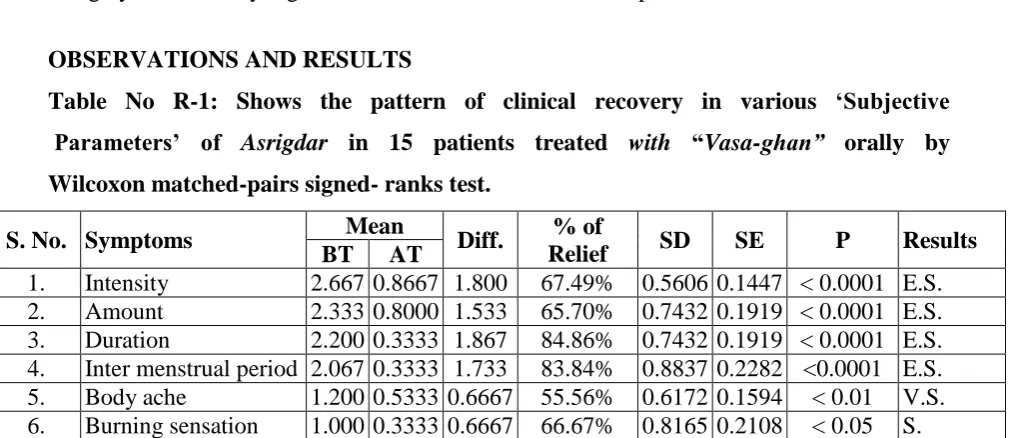
Table No R-1: Shows the pattern of clinical recovery in various ‘Subjective
Parameters’ of Asrigdar in 15 patients treated with “Vasa-ghan” orally by
Wilcoxon matched-pairs signed- ranks test.
S. No. Symptoms Mean Diff. % of
Relief SD SE P Results
BT AT
1. Intensity 2.667 0.8667 1.800 67.49% 0.5606 0.1447 < 0.0001 E.S. 2. Amount 2.333 0.8000 1.533 65.70% 0.7432 0.1919 < 0.0001 E.S. 3. Duration 2.200 0.3333 1.867 84.86% 0.7432 0.1919 < 0.0001 E.S. 4. Inter menstrual period 2.067 0.3333 1.733 83.84% 0.8837 0.2282 <0.0001 E.S. 5. Body ache 1.200 0.5333 0.6667 55.56% 0.6172 0.1594 < 0.01 V.S. 6. Burning sensation 1.000 0.3333 0.6667 66.67% 0.8165 0.2108 < 0.05 S.
Extremely significant results are shown on Intensity, Amount, Duration and Inter menstrual
period. Very significant results are shown on Body ache. Results on Burning sensation were
[image:6.595.48.555.249.468.2]Significant.
Table No R. 2: Shows the pattern of clinical recovery in various ‘Objective Parameter’
of Asrigdar in 15 patients treated with “Vasa-ghan ”orally by Wilcoxon matched-pairs
signed-ranks test.
S. No. Symptoms Mean Diff. % of
Relief SD SE P Results
BT AT
Table No.R-3: Shows the pattern of clinical recovery in various ‘Laboratory
Investigations’ of Asrigdar in 15 patients treated with “Vasa- ghan” orally by Paired ‘t’
test.
S. No. Symptoms Mean Diff. % of Relief SD SE ‘t’ P Results
BT AT
1. Hb(gm%) 10.920 11.420 -0.5000 4.57% 0.5057 0.1306 3.829 <0.01 V.S.
2. TLC 6980.0 6626.7 353.33 5.06% 477.89 123.39 2.864 <0.05 S.
3. ESR 21.800 14.400 7.400 33.94% 8.716 2.251 3.288 <0.01 V.S.
4. CT 5.060 5.070 0.01000 0.19% 0.02070 0.005345 1.871 >0.05 N.S.
5. BT 1.833 1.847 0.01333 0.72% 0.08338 0.02153 0.6193 >0.05 N.S.
6. RBS 85.867 84.933 0.9333 1.08% 2.865 0.7398 1.262 >0.05 N.S.
7. Platelet count 2.647 2.740 0.09333 3.52% 0.1486 0.03838 2.432 <0.05 S. Very significant results are shown on Hb% and ESR while significant results on TLC and
Platelet count. Results on CT, BT and RBS were Non-significant.
DISCUSSION
Probable mode of action of Vasa-ghan
By Rasa-Panchaka
Tikta & Kashaya Rasa: These have Agni Vardhana, Rochana, Deepana, Pachana,
Shodhana and Pitta-kapha-upshoshana actions thereby also help in Ama- pachana and
Dosha-pachana and Dosha-shodhana. The Sanga caused due to Ama, is resolved by Tikta
Rasa. These also does Daha-shamana. These have a special affinity towards Raktavaha
Srotasa, does Rakta Shodhana.
Ruksha- Laghu Guna: It causes Agni-Deepana and Kapha-shamana. As known in the
pathogenesis of Asrigdar, there is increase in Drava or Rasabhava of Pitta (Teja + Jala
Mahabhuta), Laghu- Ruksha Guna do the Shoshana of the increased Jala Mahabhuta.
Katu –Vipaka: It causes Agni-Deepana and Kapha-shamana that improves digestion and
metabolism.
Sheeta Veerya: Sheeta Veerya does Pittashamana, Rakta-samgrahana / Rakta-stambhana
and Dahaprasamana, that corrects burning sensation and excessive blood loss.
ACTION ON SAMPRAPTI GHATAKA
a)Dosha: Predominant Dosha responsible for disease are, vitiated Vata and Pitta. Pitta is
b)Dushya: Vasa is Rakta Sangrahi, Rakta Shodhaka and Rakta Sthapaka, which helps in
Shodhana of Dushita Pitta and Rakta. Further these have Agnivardhana, Deepana, Pachana
properties which played a role in Ama Pachana of Rasa Dhatu by their action on Jatharagni.
c) Adhishthana and Srotasa: Vasa is Shothahara, Ropana and Vedanasthapan which help in
Srotoshodhana and Garbhashaya Shodhana thereby reducing inflammation and uterine
congestion. Presence of Sandhaniya and Vrana-ropana drugs, reduce the fragility of
endometrial capillaries and thus helps in their toning.
Vyadhi Pratyaneeka Chikitsa
Due to above said qualities, this formulation acts as Rakta-samgrahaka /Rakta-sthambhaka,
Raktapittahara, Rakta Shodhaka, Agnideepaka and Vata-anulomaka. Hence its action on the
diseases like Raktapitta, Raktarshas, Pradara etc. can be well understood.
Vasa-Ghan also have Shothahara, Vedanasthapana, Stambhana, Raktashodhaka,
Raktastambhana, Shleshmahara actions, so useful in Atisara, Pravahika, Raktatisara,
Raktapitta, Raktarsha, Raktapradara, Raktavikara.
Vasa-Ghan reduces uterine congestion also by its Shothahara action. It also has
Dahaprashamana action and corrects burning sensation of the body. It is Antispasmodic,
hypotensive, uterine stimulant, antiviral, antiseptic, anti-bacterial. Vasicine also showed
utero-tonic activities.
It also have pharmacological actions like, Smooth muscle depressant, anti-microbial,
antiviral, hypotensive, hepato-protective, spasmolytic, antiulcer, antipyretic, antioxidant,
anti-inflammatory, haemostatic, altering and intellect promoting.
Smooth muscle relaxant and antispasmodic properties of drugs reduces the contraction of
myometrium, thus reduces blood loss. Anti-depressant, nerve tonic like properties of drugs
corrects Manasika-Dushti (psychological status). Antioxidant and free radical scavenging
activity of drugs do Srotoshodhana and hepato-protective property acts on liver to corrects
Flow chart shows mode of action of VASA-GHAN
CONCLUSION
Artava Pravritti is regulated by proper function of Apana and Vyana Vayu, since Apana is
responsible for Raja Pravritti, while Vyana is responsible for blood circulation.
Asrigdar is a disorder which plagues many women at some time or other of their life time.
It may be a result of some psychomotor disturbances acting through the autonomic nervous
system or may be the manifestation of some other underlying disorder.
Excessive and/or prolonged bleeding during menstrual period or even during inter
menstrual period is known as Asrigdar. According to Dalhana scanty menstruation for short
duration during inter menstrual period also considered as Asrigdar. Going through the
modern literature it resembles with abnormal uterine bleeding specially DUB.
The main principle of the management of Asrigdar is Angi-deepana, Dosha -pachana,
Vata-anulomana, Pittashamana, Rakta Sthapna, Rakta-samgrahana, Raktashodhana, and
Garbhashaya-balya Chikitsa. Should be done by Tikta & Kashaya Rasa Pradhana Dravyas.
Deepaniya and pachaniya drugs are essential in the treatment of Asrigdar for proper Agni
and which helps in proper metabolism of estrogen.
The drug selected for this study Vasa-ghan possess all the qualities as mentioned above.
ACKNOWLEDGEMENT
The words are inadequate to express with profound reverence my heartiest gratitude and
indebtedness to my honorable & adorable guide Prof. Sushila sharma, P.G. Department of
me active & experts guidance of every stage of this research work. Her vigilant & valuable
Guidance and for giving moral support at every step of my research work.
REFERENCES AND BIBILIOGRAPHY
1. Agnivesha, Charaka Samhita edited with English translation & critical exposition based
on chakrapani datta’s Ayurveda dipika by Dr.Ram Karan Sharma & Vaidya Bhagwan
Dash Reprint2009 publishers chaukhamba Sanskrit series Office, Varanasi-1.
2. Agnivesha, Charaka, Dridhabala, Charaka Samhita with the Ayurvedadipika Commentary
by Chakrapanidutta, edited by Jadavji Ttrikambaji Aacharya, Choukhamba Surbharati
Prakashana, Varanasi, 2013.
3. Bhavamishra, Bhavaprakasha, edited with Vidyotini Hindi Commentary by Bhishagratna
Pandit Shri Brahma Shankara Mishra, Vol. II, 11th edition, Chaukhamba Orientalia
Varanasi, 2003.
4. Sushruta, Sushruta Samhita with Nibandha Samgraha Commentary by Sri
Dalhanaacharya, edited by Jadavji Trikambaji Achaarya, from the beginning of 9th
Adhyaya of Chikitsa Sthana And the rest byNarayan Ram Acharya Kavyatirtha, edition
2013, Chaukhamba Surbharati Prakashan, Varanasi.
5. Vagbhata, Ashtanga Hridaya, with commenteries of Arunadatta & Hemadri, edited by
Bhishgaacharya Harishastri Paradakara, 9th edition, Choukhamba Orientalia, Varanasi,
2005.
6. Vagbhata, Ashtangahridayam, with Vidyotini Hindi Commentary by Kaviraja Atrideva
Gupta, Edited by Vaidya Yadunandana Upadhyaya, edition 2011, Choukhambha
Prakashan, Varanasi.
7. Vagbhata, Ashtanga Samgraha with Hindi Commentary, by Kaviraj Atrideva Gupta,
edition 2011, Chaukhamba Krishnadas Academy, Varanasi.
8. P V Sharma, Priyanighantu, 1st edition, Chaukhamubha Prakashan, 1983.
9. P.V. Sharma, Dravyaguna Vijnana, Vol.2-3, Chaukhambha Bharti Academy Varanasi,
2005.
10.Hiralal Konar, D.C. Dutta, Text book of Gynaecology, 4th edition, New central book
agency, Calcutta, publications, 2003.
11.Jonathan S. Berek et al., Novak's Gynaecology, 12th edition, Williyams and Willkins
publishers, 1996.
12.Pratap Kumar, Narendra Malhotra, Jeffcoate’s Principles of Gynaecology, 7th edition,
Websites
13.www.emedicine.com.
14.www.women-health.gov./faq/stdpids.com.
15.www.herbalremedies.com.
16.www.charak.com/clinic.asp.
17.www.athealth.com.
18.www.womens-health.co.uk.