EFFECT OF CERTAIN POLYMERS ON THE RELEASE
CHARACTERISTICS OF NIMODIPINE
Esmat E. Zein El Dien1, Nageh A. El Mahdy2 and Wesam Samy3*
1
Professor of Pharmaceutical Technology, Pharmaceutical Technology Dept., Faculty of
Pharmacy, Tanta University, Egypt.
2
Professor of Pharmacology, Pharmacology Dept., Faculty of Pharmacy, Tanta University,
Egypt.
3
Pharmacist at General Mahalla Hospital, El-Mahalla El-Koubra, Egypt.
ABSTRACT
Nimodipine(NMD) is used in the treatment of various cardiovascular
disorders such as angina pectoris, cardiac arrhythmia and hypertension.
The major problem of this drug is its very low solubility in biological
fluids as well as poor bioavailability after oral administration. An
attempt has been made for enhancement of nimodipine dissolution rate
by utilizing solid dispersion technique, the effect of different polymers
on the physicochemical characterstics of the drug was studied, FTIR
and DSC Studies proved that no chemical interaction between drug and
excipients. The formulations prepared with solid dispersion using
(PVP 40, Gelucire 44/14 HPMC E5 and Gelucire44/14) showed complete drug release
between 3 - 9 min. However the formulations prepared with HPMC E5 only, PVP 40 and
Gelucire 44/14 alone solid dispersions did not give drug release in specified time. Among all
formulations NMD prepared with (PVP 40 and Gelucire 44/14) as polymers showed 95%
drug release within 10 minutes. From the results it would be concluded that, nimodipine SD
showing enhanced dissolution will lead to, improved effectiveness and hence better patient
compliance.
KEYWORDS: Nimodipine, PVP 40, Gelucire44/14, HPMCE5, Solid dispersion.
INTRODUCTION
Poor aqueous solubility of drugs is a major limiting factor with many new drugs in their
successful launch in market in spite of their potential pharmacokinetic activity. Poor
7105 – 2277 ISSN Research Article . 183 -171 Volume 5, Issue 7,
*Corresponding Author Wesam Samy
Pharmacist at General
Mahalla Hospital, El-Mahalla
El-Koubra, Egypt. Article Received on 10 May 2016,
Revised on 30 May 2016, Accepted on 20 June 2016
solubility (less than 10%) of a drug, leads to poor dissolution in the gastrointestinal tract
(GIT) hence, incomplete and erratic absorption ultimately limits its clinical utility.
Further, poorly soluble drugs are generally administered at much higher doses than the actual
dose in order to achieve necessary drug plasma levels leading to increased adverse reaction &
cost of therapy and often yields erratic pharmacological response and hence poor patient
compliance.
About 40% of drugs being in the pipeline of pharmaceutical companies are poorly soluble,
which emphasizes the need of a technique to overcome such problems. Poorly water-soluble
drugs are associated with slow drug dissolution followed by slow absorption leading
eventually to inadequate and variable bioavailability. Solubilty, as the dissolution rate is the
most essential factor controlling the rate and extent of drug absorption, a poorly water soluble
compound is defined which gets soluble less than 1part per 10000 part of water.[1]
A poorly water soluble drug, more recently, has been defined in general terms which
requires more time to dissolve in the gastrointestinal fluid than it take to be absorbed in the
gastrointestinal tract.
A greater understanding of dissolution and absorption behaviors of drugs with low aqueous
solubility is required to be successfully formulated into bioavailable drug products.[2]
Nimodipine (NMD), a Calcium channel blocker, was selected as a model drug for this work
as the drug has low aqueous solubility where its GIT absorption is limited by its dissolution
in the gastrointestinal fluids exhibiting a low bioavailability after oral administration.[3] a
number of approaches are practiced to improve theaqueous solubility of poorly soluble drugs
viz., soliddispersion (solvent evaporation method), sphericalagglomeration[4],
microcrystallization[5] and supersaturation.[6] These techniques result into polymorphic
changes or changes in crystal structure or hydrophilicity changes due to formation of a
molecular dispersion. the formulations were evaluated by studying these changes in drugs
along with their dissolution and other properties.[7] the solubility and in vitro study were
evaluated spectrophotometerically in the dissolution media. The polymorphic forms of the
drug was evaluated by the differential scanning calorimetry (DSC) & the crystal structure
determination were done by the powder X-ray diffraction studies (XRD) at the different
angles. In the present work solid dispersion technique of nimodipine with certain polymers
pyrrolidine 40(PVP 40), Hydroxy propyl methyl cellulose (HPMCE5) and Gelucire 44/14, in
pinary and ternary systems.
MATERIALS AND METHODS
Nimodipine (Hangzho Uniwise International Co., Ltd. China)-Polyvinyl pyrrolidine (PVP
40), Hydroxyl propyl methylcelleulose(HPMC)/E5 and Gelucire(44/14) (Sigma- Chem. co.,
USA), Ethanol, dichloromethane, All other chemicals were of extra pure reagent grade and
used as received.
Methods
Preparation of solid dispersion: By solvent evaporation technique NMD(0.25gm) was mixed
with each polymer alone PVP 40, HPMC E5 and Gleucire 44/14 in these ratios (1:1,1:2,1:3)
i.e (0.25:0.25,0.25:0.5,0.25:0.75) drug to polymer respectively to form (F1-F9) in binary
system which are: (Drug:PVP1:1,Drug:PVP1:2, Drug:PVP1:3), (Drug:HPMC1:1,
Drug:HPMC1:2, Drug:HPMC1;3), (Drug:Gelucire1:1;Drug:Gelucire1:2, Drug:Gelucire1:3)
and ternary system (F10-F12) in ratio drug to total polymer (1:1) (NMD,PVP 40 and
Gelucire44/14), (NMD,HPMC E5 and Gelucire 44/14) and (NMD, HPMC E5 and PVP 40)
each formula mixed with ethanol and dichloromethane in ratio 50%:50% and the solvent
were evaporated in open air about 20 minutes untill complete dryness, then the precipitate
was scrapped and ground.
Evaluation and characterization
-(DSC): The DSC thermograms were obtained using DSC-50 differential scanning
calorimeter (shimadzu, seisakusho ltd, Kyoto, japan). Samples (3-4gm) were weighed in
aluminium pans and heated at a scanning rate of 10c /min from 20 to 400 oc in the prescence
of nitrogen at a flow rate of 20ml /min.
Transition temperature (c) and heats of fusion of melting endotherms on the thermograms
were calculated using the DSC t-50 program, wich directly integrates the melting
endothermic peaks giving the heat of fusion (h, joule/g).
-(FT-IR): FT-IR spectra of the drug alone ,and the prepared solid dispersion with FT-IR
Tensor 27 Boker, Germany, was tested at range of 400-4000cm-1. Potassium bromide (KBr)
disc method was used. the samples were ground, mixed thoroughly with KBr and compressed
X- ray Powder Diffractometry: X-ray powder diffraction patterns were recorded on a x-ray
diffractometer (model ysx0104-Holland) using Ni filtered, using a voltage of 39kV, and a
29mA current. The scanning employed was 1minˉˡ over the 4 to 50 diffraction angle (2θ)
range. The relationship used for the calculation of crystallinity was presented by relative
degree of crystallinity.[7]
Drug content determination
Weights equal to 30mg of nimodipine and different weight of the polymers but with different
ratios to form solid dispersion (1:1,1:2,1:3) drug: polymer ratios and mixed with solvent
mixture (ethanol to dichloromethane50:50%) up to 50ml and one ml was taken by
micropipette and completed up to 50 ml with ethanol only and the concentration of the drug
in the solid dispersion was measured with UV apparatus.[8]
In vitro study
1- Dissolution of pure drug as well as solid dispersion of drug were studied using USP,
dissolution apparatusII (Paddle type, Copley, England) accurately weighted amounts of each
formulation equivalent to 60mg of NMD were dispersed over 900ml of the dissolution
medium(Distilled water +0.5%SLS) at 37°c stirred at 50 r.p.m at appropriate intervals,
Samples were withdrawn (5ml aliquot ) over aperiod of 1hour and were replaced by equal
volume of pre warmed medium, the samples were filtered with filter border 0.24µm and
NMD content was determined spectrophot metrically at 237 nm.[8]
2-In vitro dissolution study of capsules of the SD of the optimum formula of ternary
system(NMD,PVP 40 and Gelucire 44/14) were studied using USP, accurately weighted
amounts of each formulation equivalent to 60mg of NMD were kept in capsule and put in
900ml of the dissolution medium(Distilled water +0.5%SLS) at 37°c +0.5 stirred at 50 rpm at
appropriate intervals, samples were withdrawn (5ml aliquot) over a period of 1hour and were
replaced by equal volume of prewarmed medium, the samples were filtered and NMD
content was determined spectrophotmetrically at 237 nm.
All experiments were carried out in triplicate and in the capsule (n=6) and the average was
determined.
RESULTS AND DISCUSSION
Differential scanning calorimetric (DSC)
DSC thermograms of pure drug and corresponding drug polymers system were depicted in
Figure.[8] The DSC curve of Nimodipine shows a sharp endothermic peak (Tpeak =
127.03°C) corresponding to its melting point, indicating its crystalline nature. However, the
characteristic endothermic peak, corresponding to drug melting was broadened and shifted
towards lower temperature, with reduced intensity, in all the formulations used, this could be
attributed to higher polymer concentration and uniform distribution of drug in the polymer,
resulting in complete miscibility of molten drug in polymer. Moreover, the data also indicate
no interaction between the components also suggestes that SD did not induce interaction at
the molecular level and solid dispersion formed is a physical mixture with highly dispersed
drug crystals in a polymer.
FT-IR Study
Figure(9) shows FTIR of NMD alone and its formulations with, PVP 40, HPMC E5, Gelucire
44/14, The distinct bands of NMD appears at characteristic band at3296cmˉ¹, relatedto N-H
stretch, at1694cmˉ¹ associated with the carbonyl bond C=O and at 1496cmˉ¹ representing the
No2group.[10,9]
- FTIR Spectra of PVP 40, the most distinict peak in IR Spectrumof PVP 40 was the
stretching Vibration of the carbonyl gp C=O that would typically appear around
a1650.53cmˉ¹. abroad peak at about 3000- 3700cmˉ¹, (3425cmˉ¹) due to oH stretching
vibration of absorbed water ,2957cm¯¹ due to C—H stretch.
-HPMCE5 alone in which bands were observed at 3443cm-1 (O-H stretching), at
2935cm-1(C---H) stretching, at 1651cm-1(C=O) of the glucose unit and at 1069cm-1(C-O-C
group).[10-9]
-Gelucire 44/14 alone its characteristic peaks at 2923 cm¯¹ and 2862cm¯¹ (C—H stretch),
1736cm¯¹(C=O), 1106cm¯¹ (C---O stretching) and abroad band 3000-4000 due to OH
group.[11]
- F1,F4,F7 shows FTIR of NMD and PVP 40,HPMCE5,Gelucire44/14 in ratio(1:1,) in which
the characteristic peaks of NMD and all polymer were appeared and visible which indicate no
- F10,F11,F12 shows FTIR of NMD and Three polymers in ternary system and in which also
the peaks of all drugs appeared indicate no chemical interaction.
X-ray diffractometry
(XRD) spectra was performed to optimum formula SD (Figure10) of (NMD,PVP 40 and
Gelucire44/14), The x-ray diffractogram of NMD has sharp peaks at diffraction angles (2θ)
6.4°,12.87°,20.28°,17.36° and 19.70,°. It is showing a typical crystalline pattern. However,
the major peaks of drugs were absent with SD this indicates that the drug is converted in to
the amorphous form.
Drug content study
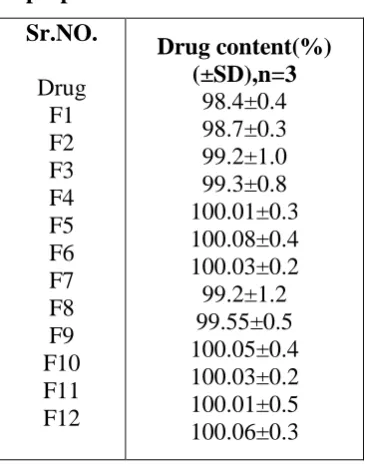
The drug content of the prepared formulations of Nimodipine was observed to be varying
[image:6.595.207.390.353.588.2]from 98-100% showed in table 1.
Table 1: Drug content in the prepared formulations Sr.NO.
Drug F1 F2 F3 F4 F5 F6 F7 F8 F9 F10 F11 F12
Drug content(%) (±SD),n=3
98.4±0.4 98.7±0.3 99.2±1.0 99.3±0.8 100.01±0.3 100.08±0.4 100.03±0.2 99.2±1.2 99.55±0.5 100.05±0.4 100.03±0.2 100.01±0.5 100.06±0.3
In vitro studies
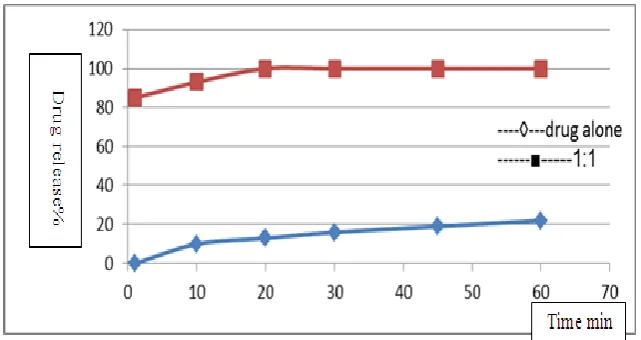
1- Table no(2) and figures (1-6)shows in vitro Release of NMD from its SDs, It was observed
that all formulations show the increase in the % release of the drug with increase in polymer
ratio in binary system, in ternary system the optimum formulation was F10(NMD,PVP 40
and Gelucire 44/14). It was observed that the formulation F-10 showed the most increase in
the %release of the drug from the formulations which is to be kept in the capsule. The
formulation F-12(NMD,PVP -40 and HPMCE5) Showed the lesser % release of the drug in
2-In vitro Release of NMD from its SD kepted in capsule
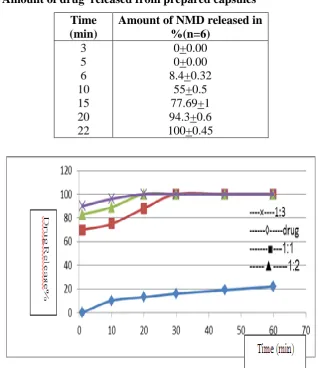
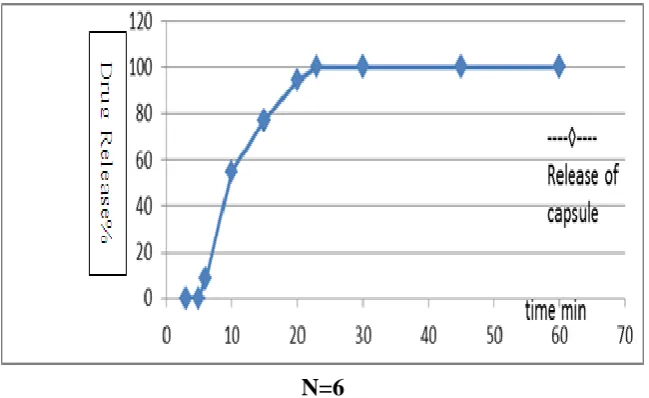
The in vitro release of NMD from prepared capsules (n=6) is presented in table (3) and figure
(7) it is obvious that the release is affected by both the solubilizing effect of PVP 40 and
Gelucire 44/14 on the drug and the percent of polymers in the SD which contriputed to
increased solubility and dissolution in the aqueous medium.
By Polymers (PVP 40 and Gelucire44/14) in this ratio drug to total polymers(1:1)resulted in
rising and increasing the in vitro drug release.to be 94.3% at 20 minutes.
Effect of different Polymers on the dissolution of Nimodipine
SDs were performed include. Incorporation of polymer (HPMCE5, PVP 40, Gelucire 44/14)
enhanced the dissolution rate of nimodipine. in addition the properties of the drug is
improved. The enhancement of dissolution of drug from drug polymer systems can be
ascribed to several factors. The mechanism of dissolution rate improvement from solid
dispersion is lack of crystallinity and particle size reduction considered to be important
factors for dissolution rate enhancement. Mixing of drug with a hydrophilic polymers results
in greater wetting and increase surface available for dissolution by reducing interfacial
tension between the hydrophilic drug and dissolution media. It was noted that drug polymer
system sink immediately, while pure drug keeps floating on the surface for a longer time
interval.[12] The dissolution parameters of drug (nimodipine) solid dispersion with various
polymers (HPMCE5), PVP -40, Gelucire44/14) in same concentration of each polymer. The
dissolution rate of pure drug is low as 22.3% of the drug gets dissolved 60min respectively.
Solid dispersions formulated with all the polymers exhibited significant improvement in the
dissolution parameters of drug. The increase in the dissolution rate of the solid mixtures
might be due to size reduction and increase in the wettability of the drug molecules in
presence of the polymers. Polymers also lowering the surface tension, hence increasing the
solubilizing effect. This kind of technique can be extended for improvement dissolution rate
of drug showing poor dissolution profiles and causing erratic bioavailability.[13] The present
invention often produces particles having reduced crystallinity as compared to the bulk drug,
Table 2: Amount Released of NMD from Different Formulations.
Sr .no Amount released of NMD in (%)(n=3)
Time(m) Drug F1 F2 F3 F4 F5 F6 F7 F8 F9 F10 F11 F12 10 10±0.27 75±0.24 89±1 96±0.3 61±0.23 61±0.4 75±0.5 20±0.32 25±0.65 33±0.31 95±0.38 85±0.4 44±0.5 20 13±0.35 88±0.00 100±.0.26 100±0.5 68±0.3 73±0.39 84±0.2 22±0.6 27±0.32 39±0.20 100. ±0.24 99.60±0.43 64±1 30 16±0.3 100±.0.7 100.13±0.7 100±0.35 69±0.43 87±0.23 95±0.6 24±0.5 28±0.51 42±0.24 100.2±0.22 100.08±0.3 78±0.25 45 19±0.4 100±.0.3 100.48±0.4 100±0.4 71±0.2 89±0.5 98±0.32 26±0.24 29±0.23 43±0.43 100±.0.31 100±0.00 91±0.87 60 22±0.21 100.12±0.45 100.95±0.3 100.79±0.36 78±0.3 96±0.29 99±0.38 31±0.65 31±0.49 44±1 100±0.32 100.91±0.5 99.75±0.23
Table no(3): Amount of drug released from prepared capsules Time
(min)
Amount of NMD released in %(n=6) 3 5 6 10 15 20 22 0+0.00 0+0.00 8.4+0.32 55+0.5 77.69+1 94.3+0.6 100+0.45
Figure (2) Dissolution of NMD and HpmcE5 1in different ratios (1:1,1:2,1:3) in relation to pure Drug
Figure (3) Dissolution NMD and Gelucire44/14in different ratios (1:1,1:2,1:3) in relation to pure Drug
[image:9.595.146.451.75.239.2] [image:9.595.143.456.310.486.2] [image:9.595.137.458.554.724.2]Figure (5): Dissolution NMD and (HPMC E5 & Gelucire 44/14) in relation to pure Drug
Figure (6): Dissolution NMD and (PVP 40 & HPMCE5) in relation to pure Drug
[image:10.595.137.456.75.251.2]
N=6
[image:10.595.143.454.300.476.2] [image:10.595.136.461.522.721.2]Nimodipine
Figure 8: DSC Thermograms of different Formulations of NMD
[image:11.595.148.453.424.698.2]Figure(10) shows X-ray diffraction of :
(A) Nimodipine
(B) PVP 40
(C) Gelucire44/14
(D) Solid dispersion (PVP 40 & Gelucire 44/14)
CONCLUSION
From the present study, it can be concluded that the hydrophilic polymers played an
important role to enhance the dissolution rate. Among all the formulations F10 that contain
PVP 40 and Gelucire44/14 as a carrier was better one shows 95% drug release in 10 minutes.
REFERENCES
1. Speiser P. P., Poorly soluble drugs, a challenge in drug delivery. In: Muller RH, Benita S,
Bohm B Eds Emulsions and nanosuspensions for the formulation of poorly soluble drugs,
Med pharm Scientific Publishers, Stuttgart, 1998; 15-28.
2. Chaudhari P. D., Sharma P. K., Badagale M. M., Dave K. D., Kulkarni P. A., Barhate N.
S., Current trends in solid dispersions technology, Pharma info tech, patent/mun/2006;
200-205.
3. Nimodipine, The Merck Index - An Encyclopedia of Chemistry, Drug & Biological, 12th
edition Merck Research Laboratory, 2001 English book 975-1055.
4. Rasenack N., Hartenhauer H., Müller B.W., Microcrystals for dissolution rate
enhancement of poorly water-soluble drugs, Int. J. Pharm. 2003; 254(2): 137-145.
5. Moser K., Kriwet K., Kalia Y. N., Guy R. H., Stabilization of supersaturated solutions of
6. Reverchon E., Dellaporta G., Spade A., Antonacci A., Griseofulvin micronization and
dissolution rate improvement by super critical assisted atomization, J. Pharm. Pharmacol.,
2004; 56: 1379-1387.
7. Naidu N. B., Choudary K. P. R., Murthy K. V. R., Satyanarana V., Hayman A. R., Becket
G., Physicochemical characterization and dissolution properties of meloxicam–
cyclodextrin binary systems, J. Pharma. Biomed. Anal., 2004; 35: 75-86.
8. Sanjeev Kumar, Pradeep Kumar, Chanderparkash, Shailendra K Sing (Evaluation of
Some Novel Techniques For Dissolution Enhancement of Poorly Water Soluble Drug
Nimodipine) Int. J. Ph. Tech Research CODEN (USA):, Jan-Mar 2010; 2(1): 950-959.`
9. Oliveira, P. R., Bernardi, L. S., Murakami, F. S., Mendes, C., & Silva, M. A. S. Thermal
characterization and compatibility studies of norfloxacin for developent of extended
release tablets. J. Thermal Analysis and Calorimetry, 2009; 97: 741–745.
10.Anuar, N. K., Wui, W. T., Ghodgaonkar, D. K., & Taib, M. T. Characterization of
hydroxypropylmethylcellulose films using microwave non-destructive testing technique.
J. Ph. and Biomedical Analysis, 2007; 43: 549–557.
11.Praneeth Kumar, Suresh Bandari*, Raju Jukanti, (Formulation and Characterization of
Floating Gelucire Matrices of Metoprolol Succinate) Department of Pharmaceutics,
Institute of Pharmaceutical Sciences, Hanamkonda, India, dissolution technologies –
august, 2010; 41: 151-157.
12.Modi A., Tayade P., Enhancement of Dissolution Profile by Solid Dispersion (Kneading)
Technique, AAPS Pharm Sci Tech., 2006; 7(3).
13.Raju Y. P., Garbhapu A., Prasanna S. A. L., Rao B. S., Ramana M. K. V., Studies on
enhancement of dissolution rate of etoposide, Ind. J. Pharm. Sciences, 2007; 69: 269-273.
14.J. hnston; Keith P., Williams; Roberto US Patent (6756062), Preparation of drug particles