RP-HPLC METHOD DEVELOPMENT AND VALIDATION FOR
SIMULTANEOUS ESTIMATION OF GRAZOPREVIR AND ELBASVIR
IN BULK AND ITS DOSAGE FORM WITH STRESS STUDIES
Rupa Lavyanya S.*, Bangaruthalli J.1, M. L. N. Renuka2, P. Akhila3 and
N. Arunkumar4
A.U. College of Pharmaceutical Sciences, Andhra University, Visakhapatnam, India.
ABSTRACT
Objective: The objective of this study was to develop and validate
rapid, specific, sensitive, and precise reverse-phase high performance
liquid chromatography (RP-HPLC) method for the quantitative
determination of Grazoprevir and Elbasvir. No interference from any
component of pharmaceutical dosage form was observed. Methods:
The chromatographic separation was performed on Inertsil ODS
column discovery (4.6 x 250mm, 5 μ particle size) the optimized
mobile phase consists of 0.1% OPA: Methanol (50:50% v/v) with a
flow rate of 1.0 ml/min and ultraviolet (UV) detection at 225 nm.
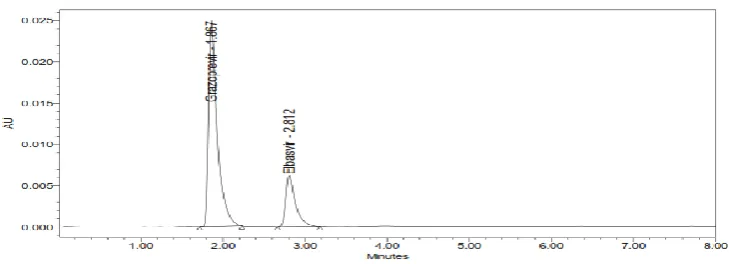
Results: The retention times were 1.867 and 2.812 min for
Grazoprevir and Elbasvir, respectively. Quantification is achieved with PDA detection at 254
nm over the concentration range of 50–150 μg/ml for Grazoprevir and for Elbasvir 25–125
μg/ml, with a correlation coefficient of 0.999 and 0.999, respectively. The developed method
was validated according to the International Conference on Harmonization (ICH) guidelines
with respect to linearity, accuracy, precision, specificity, and robustness. Forced degradation
study was extended out under acidic, alkaline, oxidative, photolytic, and thermal conditions
to demonstrate the stability-indicating capability of the developed HPLC method. The
degradation products were well resolved from the main peak, thus proved the
stability-indicating power of the method. The results of the analysis were validated statistically.
Conclusion: The method is precise, accurate, linear, robust, and fast. The short retention time
allows the analysis of a large number of samples in a short period of time and, therefore,
should be cost-effective for routine analysis in the pharmaceutical industry.
Volume 8, Issue 8, 546-558. Research Article ISSN 2277– 7105
Article Received on 28 April 2019,
Revised on 18 May 2019, Accepted on 07 June 2019,
DOI: 10.20959/wjpr20198-15190
*Corresponding Author
Rupa Lavyanya S.
A.U. College of
Pharmaceutical Sciences,
Andhra University,
KEYWORDS: Grazoprevir, Elbasvir, High performance liquid chromatography,
Development, Validation, Forced degradation.
INTRODUCTION
Hepatitis C virus (HCV) is a single-stranded RNA virus that is estimated to affect 130–150
million people worldwide. HCV is a single-stranded RNA virus that is categorized into nine
distinct genotypes. HCV infection has been associated with both hepatic and extrahepatic
manifestations that increase graft loss and mortality after transplantation. The combination of
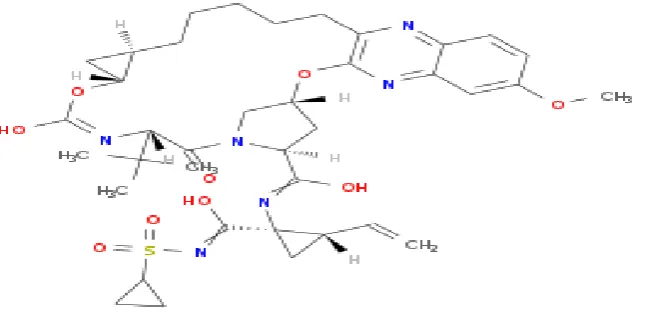
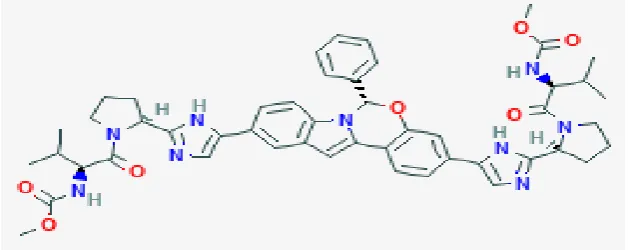
antiviral drugs grazoprevir (Fig. 1), and elbasvir (Fig. 2), is more effective for the treatment
of patients chronically infected with HCV. Elbasvir/grazoprevir (Zepatier) is a combination
product with an FDA-approved indication for the treatment of chronic HCV genotypes (GTs)
1 and 4 in adults.
Grazoprevir
Grazoprevir chemically known as (1R,18R,20R,24S,27S) -N-{(1R,2S) -1
[(cyclopropylsulfonyl) carbamoyl] -2-vinylcyclopropyl} -7-methoxy- 24-(2-methyl-2
propanyl)-22,25-dioxo-2,21-dioxa-4,11,23,26-tetraazapentacyclo[24.2.1.03,12.05,10.0,18,20]
nonacosa-3,5,7,9,11- Benton-27-carboxamide is a direct acting antiviral medication used as a
part of combination therapy to treat chronic hepatitis C, an infectious liver disease caused by
infection with HCV. It is a protease inhibitor of HCV NS3/4A that prevents cleavage of the
[image:2.595.142.466.532.694.2]poly protein necessary for replication.
Elbasvir
Elbasvir chemically known as dimethyl N,N’-([(6S)-6H-indolo[1,2-c]
[1,3]benzoxazine-3,10-diyl]bis{1H-imidazole-5,2-diyl-(2S)-pyrrolidine-2,1-diyl[(2S)-1-oxo-3-methylbutane-1,2
diyl]}) biscarbamate is a NS5A inhibitor, preventing hepatitis C viral RNA replication and
[image:3.595.141.457.193.318.2]virion assembly. Elbasvir is a drug approved by the FDA for the treatment of Hepatitis C.
Fig 2: Elbasvir structure.
METHODS
Instruments and apparatus
The Acquity waters HPLC system equipped with PDA detector and autosampler integrated
with Empower Software was used to perform development and validation of the method. An
Inertsil ODS 4.6 x 250mm column with particle size of 5 μm was used as a stationary phase
for chromatographic separation and determination of grazoprevir and elbasvir. Sartorius
analytical balance was used for all weighings, Metsar pH meter was used for the pH
measurement of buffer solution, and Labman Sonicator was used to dissolve the standard and
samples.
MATERIALS
Working standards of grazoprevir and elbasvir were gifted by spectrum laboratories
(Hyderabad, India). Dosage form ZEPATIER tablets purchased from the market.
HPLC-grade acetonitrile, methanol, and orthophosphoric acid (OPA) purchased from Merck Ltd,
Mumbai, India, were used in the study.
Preparation of solutions
Preparation of 0.1% OPA buffer
1 mL of OPA is taken in 1000 mL of HPLC water; pH was adjusted with 0.1M NaOH upto
Preparation of mobile phase
Accurately measured 100 mL (50%) of above buffer and 100 mL of Methanol HPLC (50%)
were mixed and degassed in an ultrasonic water bath for 10 minutes and then filtered through
0.45 µ filter under vacuum filtration.
Diluent Preparation
The Mobile phase was used as the diluent.
PREPARATION OF THE GRAZOPREVIR & ELBASVIR STANDARD & SAMPLE
SOLUTION
Standard Solution Preparation
Accurately weigh and transfer 100 mg of Grazoprevir and 50 mg of Elbasvir working
standard into a 100 mL clean dry volumetric flask, add about 70 mL of Diluent and sonicate
to dissolve it completely and make volume up to the mark with the same solvent. (Stock
solution).
Further pipette 1.5 mL of the above stock solutions into a 10mL volumetric flask and dilute
up to the mark with diluent.
Sample Solution Preparation
Accurately weigh and transfer 100 mg of Grazoprevir and 50 mg of Elbasvir working
standard into a 100 mL clean dry volumetric flask add about 70 mL of Diluent and sonicate
to dissolve it completely and make volume up to the mark with the same solvent. (Stock
solution).
Further pipette 1.5 mL of the above stock solutions into a 10mL volumetric flask and dilute
up to the mark with diluent.
METHOD VALIDATION
PRECISION
Preparation of stock solution
Accurately weigh and transfer 100 mg of Grazoprevir and 50 mg of Elbasvir working
standard into a 100 mL clean dry volumetric flask add about 70 mL of Diluent and sonicate
to dissolve it completely and make volume up to the mark with the same solvent. (Stock
solution). Further pipette 1.5 mL of the above stock solutions into a 10mL volumetric flask
INTERMEDIATE PRECISION/RUGGEDNESS
To evaluate the intermediate precision (also known as Ruggedness) of the method, Precision
was performed on different day.
Preparation of stock solution
Accurately weigh and transfer 100 mg of Grazoprevir and 50 mg of Elbasvir working
standard into a 100 mL clean dry volumetric flask add about 70 mL of Diluent and sonicate
to dissolve it completely and make volume up to the mark with the same solvent. (Stock
solution). Further pipette 1.5 mL of the above stock solutions into a 10mL volumetric flask
and dilute up to the mark with diluent.
SPECIFICITY
For Specificity Blank and Standard are injected into system. There is no interference of any
peak in blank with the retention time of the analytical peaks.
ACCURACY
Preparation of Standard stock solution
Accurately weigh and transfer 100 mg of Grazoprevir and 50 mg of Elbasvir working
standard into a 100 mL clean dry volumetric flask add about 70 mL of Diluent and sonicate
to dissolve it completely and make volume up to the mark with the same solvent. (Stock
solution).
Further pipette 1.5 mL of the above stock solutions into a 10mL volumetric flask and dilute
up to the mark with diluent.
Preparation Sample solutions
For preparation of 50% solution (With respect to target Assay concentration)
Accurately weigh and transfer 50 mg of Grazoprevir and 25 mg of Elbasvir working standard
into a 100 mL clean dry volumetric flask add about 70 mL of Diluent and sonicate to dissolve
it completely and make volume up to the mark with the same solvent. (Stock solution).
Further pipette 1.5 mL of the above stock solutions into a 10mL volumetric flask and dilute
For preparation of 100% solution (With respect to target Assay concentration)
Accurately weigh and transfer 100 mg of Grazoprevir and 50 mg of Elbasvir working
standard into a 100 mL clean dry volumetric flask add about 70 mL of Diluent and sonicate
to dissolve it completely and make volume up to the mark with the same solvent. (Stock
solution).
Further pipette 1.5 mL of the above stock solutions into a 10mL volumetric flask and dilute
up to the mark with diluent.
For preparation of 150% solution (With respect to target Assay concentration)
Accurately weigh and transfer 150 mg of Grazoprevir and 75 mg of Elbasvir working
standard into a 100 mL clean dry volumetric flask add about 70 mL of Diluent and sonicate
to dissolve it completely and make volume up to the mark with the same solvent. (Stock
solution).
Further pipette 1.5 mL of the above stock solutions into a 10mL volumetric flask and dilute
up to the mark with diluent.
LINEARITY
Preparation of stock solution
Accurately weigh and transfer 100 mg of Grazoprevir and 50 mg of Elbasvir working
standard into a 100 mL clean dry volumetric flask add about 70 mL of Diluent and sonicate
to dissolve it completely and make volume up to the mark with the same solvent. (Stock
solution).
Preparation of Level – I
0.5 mL of above stock solutions has taken in 10mL of volumetric flask, dilute up to the mark
with diluent.
Preparation of Level – II
1 mL of above stock solutions has taken in 10mL of volumetric flask, dilute up to the mark
with diluent.
Preparation of Level – III
1.5 mL of above stock solutions has taken in 10mL of volumetric flask, dilute up to the mark
Preparation of Level – IV
2 mL of above stock solutions has taken in 10mL of volumetric flask, dilute up to the mark
with diluent.
Preparation of Level – V
2.5 mL of above stock solutions has taken in 10mL of volumetric flask, dilute up to the mark
with diluent.
DETECTION LIMIT
LIMIT OF DETECTION: (for Grazoprevir)
Preparation of 1.05µg/mL solution
Accurately weigh and transfer 100 mg of Grazoprevir working standard into a 100 mL clean
dry volumetric flask add about 70 mL of Diluent and sonicate to dissolve it completely and
make volume up to the mark with the same solvent. (Stock solution).
Further pipette 1.5 mL of the above stock solutions into a 10mL volumetric flask and dilute
up to the mark with diluent.
Further pipette 0.07mL of the above stock solution into a 10mL volumetric flask and dilute
up to the mark with diluent.
LIMIT OF QUANTIFICATION
Preparation of 3.60 µg/mL solution
Accurately weigh and transfer 100 mg of Grazoprevir working standard into a 100 mL clean
dry volumetric flask add about 70 mL of Diluent and sonicate to dissolve it completely and
make volume up to the mark with the same solvent. (Stock solution).
Further pipette 1.5 mL of the above stock solutions into a 10mL volumetric flask and dilute
up to the mark with diluent.
Further pipette 0.24 mL of the above stock solution into a 10mL volumetric flask and dilute
LIMIT OF DETECTION: (for Elbasvir)
Preparation of 2.1 µg/mL solution
Accurately weigh and transfer 50 mg of Elbasvir working standard into a 100 mL clean dry
volumetric flask add about 70 mL of Diluent and sonicate to dissolve it completely and make
volume up to the mark with the same solvent. (Stock solution).
Further pipette 1.5 mL of the above stock solutions into a 10mL volumetric flask and dilute
up to the mark with diluent.
Further pipette 0.28 mL of the above stock solution into a 10mL volumetric flask and dilute
up to the mark with diluent.
LIMIT OF QUANTIFICATION
Preparation of 7.05 µg/mL solution
Accurately weigh and transfer 50 mg of Elbasvir working standard into a 100 mL clean dry
volumetric flask add about 70 mL of Diluent and sonicate to dissolve it completely and make
volume up to the mark with the same solvent. (Stock solution).
Further pipette 1.5 mL of the above stock solutions into a 10mL volumetric flask and dilute
up to the mark with diluent.
Further pipette 0.94mL of the above stock solution into a 10mL volumetric flask and dilute
up to the mark with diluent.
DEGRADATION STUDIES
The International Conference on Harmonization (ICH) guideline entitled stability testing of
new drug substances and products requires that stress testing be carried out to elucidate the
inherent stability characteristics of the active substance. The aim of this work was to perform
the stress degradation studies on the Grazoprevir and Elbasvir using the proposed method.
Preparation of stock
Accurately weigh and transfer 100 mg of Grazoprevir and 50 mg of Elbasvir working
standard into a 100 mL clean dry volumetric flask add about 70 mL of Diluent and sonicate
to dissolve it completely and make volume up to the mark with the same solvent. (Stock
Hydrolytic degradation under acidic condition
Pipette 1.5 mL of above solution into a 10mL volumetric flask and 3 mL of 0.1N HCl was
added. Then, the volumetric flask was kept at 60ºC for 24 hours and then neutralized with 0.1
N NaOH and make up to 10mL with diluent. Filter the solution with 0.44µ syringe filters and
place in vials.
Hydrolytic degradation under alkaline condition
Pipette 1.5 mL of above solution into a 10mL volumetric and add 3mL of 0.1N NaOH was
added in 10mL of volumetric flask. Then, the volumetric flask was kept at 60ºC for 24 hours
and then neutralized with 0.1N HCl and make up to 10mL with diluent. Filter the solution
with 0.44 µ syringe filters and place in vials.
Thermal induced degradation
Grazoprevir and Elbasvir sample was taken in Petri dish and kept in Hot air oven at 1100C for
3 hours. Then the sample was taken and diluted with diluents and injected into UPLC and
analyzed.
Oxidative degradation
Pipette 1.5 mL above stock solution into a 10mL volumetric flask and 1mL of 30% w/v of
hydrogen peroxide added in 10 mL of volumetric flask and the volume was made up to the
mark with diluent. The volumetric flask was then kept at room temperature for 15 min filter
the solution with 0.45 µ syringe filters and place in vials.
Photo degradation: Pipette 0.3 mL above stock solution into a 10mL volumetric flask and
expose to sunlight for 24hrs and the volume was made up to the mark with diluent. Filter the
solution with 0.45 µ syringe filters and place in vials.
[image:9.595.113.478.617.749.2]RESULTS
S. No. Name RT (min)
Area (µV sec)
Height (µV)
USP resolution
USP tailing
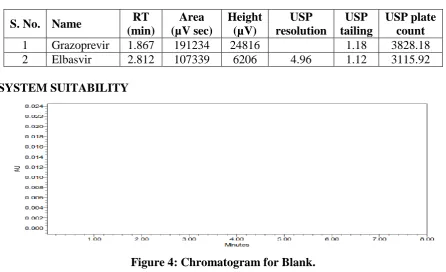
USP plate count 1 Grazoprevir 1.867 191234 24816 1.18 3828.18 2 Elbasvir 2.812 107339 6206 4.96 1.12 3115.92
[image:10.595.74.521.63.335.2]SYSTEM SUITABILITY
Figure 4: Chromatogram for Blank.
Table 1: Results of system suitability parameters.
S. No. Name RT(min) Area
(µV sec)
Height (µV)
USP resolution
USP tailing
USP plate count
1 Grazoprevir 1.867 191234 24816 1.18 3828.18
2 Elbasvir 2.798 107339 6206 4.96 1.12 3115.92
LINEARITY
The linearity range was found to lie from 50µg/ml to 250µg/ml of Grazoprevir, 25µg/ml to
[image:10.595.78.503.532.646.2]125µg/ml 0f Elbasvir and chromatograms are shown below.
Table 2: Area of different concentration of Grazoprevir and Elbasvir.
S. No
Grazoprevir Elbasvir
Concentration (µg/ml) Area Concentration (µg/ml) Area
1 50 65787 25 32441
2 100 131783 50 67728
3 150 194311 75 100630
4 200 256245 100 134448
5 250 317748 125 172463
PRECISION
Precision of the method was carried out for both sample solutions as described under
Table 3: Results of Precision for Grazoprevir and Elbasvir.
Injection Area
Grazoprevir Elbasvir
Injection-1 191345 107339
Injection-2 191232 107232
Injection-3 191671 107131
Injection-4 191999 107399
Injection-5 192898 107018
Injection-6 194679 107089
Average 192304.0 107201.3
Standard Deviation 1308.1 148.4
%RSD 0.7 0.1
ACCURACY
Sample solutions at different concentrations (50%, 100%, and 150%) were prepared and the
% recovery was calculated.
Table 4: Accuracy (recovery) data for Grazoprevir and Elbasvir
%
Concen-tration
Grazoprevir Elbasvir
Area Amount Added (mg) Amount Found (mg) % Recovery Mean
Recovery Area
Amount Added (mg) Amount Found (mg) % Recovery Mean Recovery
50% 95105 40 39.79 99.47
99.40
53846 5 25.06 100.24
99.74
100% 191399 80 79.74 99.67 107344 10 49.96 99.91
150% 285309 120 118.86 99.05 159676 15 74.31 99.08
LIMIT OF DETECTION FOR GRAZOPREVIR AND ELBASVIR
The lowest concentration of the sample was prepared with respect to the base line noise and
measured the signal to noise ratio.
Table 5: Results of LOD.
Drug name Baseline
noise (µV)
Signal obtained (µV)
S/N ratio
Grazoprevir 58 174 3.00
Elbasvir 58 173 2.98
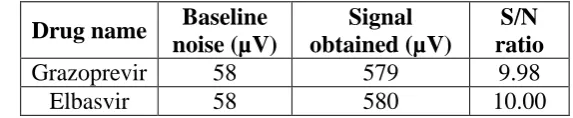
LIMIT OF QUANTIFICATION FOR GRAZOPREVIR AND ELBASVIR
The lowest concentration of the sample was prepared with respect to the base line noise and
[image:11.595.154.442.555.612.2]Table 6: Results of LOQ.
Drug name Baseline
noise (µV)
Signal obtained (µV)
S/N ratio
Grazoprevir 58 579 9.98
Elbasvir 58 580 10.00
ASSAY
Standard and sample solution injected as described under experimental work. The
corresponding chromatograms and results are shown below.
Table 7: Results of Assay for Grazoprevir and Elbasvir.
Label Claim (mg) % Assay
Grazoprevir 100 100.14
Elbasvir 50 99.59
Table 8: Degradation results for Grazoprevir and Elbasvir.
Sample Name
Grazoprevir Elbasvir
Area % Degraded Area % Degraded
Standard 191642 107223
Acid 183252 4.38 98959 7.71
Base 183532 4.23 98921 7.74
Peroxide 183253 4.38 98978 7.69
Thermal 187552 2.13 98851 7.81
Photo 186452 2.71 98789 7.87
CONCLUSION
A rapid and robust method for the analysis of grazoprevir and elbasvir was developed and its
applicability as a method for analyzing stability was checked. The method was found to be
specific, accurate, precise, and reproducible. Force degradation studies confirmed its ability
to determine stability because no interference from degradation products was observed.
Moreover, no influence from excipients was found, allowing it to be used in the final drug
product analysis. The method was also validated in accordance with ICH requirements.
REFERENCES
1. Vander Wal S, Snyder LR. J. Chromatogr, 1983; 225: 463.
2. A Practical Guide to HPLC Detection, Academic Press, San Diego, CA, 1983.
3. Poole CF, Schutte SA. Contemporary Practice of Chromatography, Elsevier, Amsterdam,
1984; 375.
4. Krull IS. In Chromatography and Separation Chemistry: Advances and Developments,
[image:12.595.93.484.313.455.2]5. Li G, Szulc ME, Fischer DH, Krull IS. In Electrochemical Detection in Liquid
Chromatography and Capillary Electrophoresis, Kissinger PT. edn., Chromatography
Science Series, Marcel Dekker, New York, 1997.
6. Kissinger PT, Heineman WR. eds., Laboratory Techniques in Electroanalytical
Chemistry, Chaptor 20, Marcel Dekker, New York, 1984.
7. Swarbrick JC, Boylan James, Encyclopedia of pharmaceutical technology, 1998;
217-224.
8. AOAC Peer-Verified Methods Program, Manual on policies and procedures, Arlington,
Va., USA (1998). http://www.aoac.org/vmeth/PVM.pdf.
9. Winslow PA, Meyer RF. Defining a master plan for the validation of analytical methods,
J Validation Technology, 1997; 361–367.
10. Breaux J, Jones K, Boulas P. Pharmaceutical Technology, Analytical Technology and
Testing, 2003; 6-13.
11. Huber L, George S. Diode-array detection in high-performance liquid chromatography,
New York, Marcel Dekker, ISBN 0-8247-4, 1993.
12. Sumalatha Nallagundla, Nallagundla H S Reddy2, Vishal Vemula, Bharath Kumar,
Analytical Method Development and Validation of Elbasvir and Grazoprevir in Bulk and
Tablet Formulations by Rp- HPLC, International Journal of Pharmaceutical Science
Invention ISSN (Online): 2319 – 6718, ISSN (Print): 2319 – 670X www.ijpsi.org, August
2017; 6(8): 01-05.
13. Padmavathi Sakinala, Mrs.G. Sai Sri Lakshmi, Sravanthi. Gali, T Varalakshmi, RP-HPLC
Method development and validation for the simultaneous estimation of Grazoprevir and
Elbasvir in bulk and pharmaceutical dosage, International Journal of Pharmaceutical
Science Invention ISSN (Online): 2319 – 6718, ISSN (Print): 2319 – 670X
www.ijpsi.org, August 2017; 6(8): 01-05.
14. Syeda Saniya Fatima, R. Vani, Stability indicating analytical method development and
validation for estimation of Ceftazidime and Avibactam in bulk and pharmaceutical