EFFECT OF MANNITOL AND MCC ON RAPIDLY DISINTEGRATING
TABLETS
Bhargav R. Harkare*, Ajit S. Kulkarni, Nagesh H. Aloorkar, Shivprasad H. Majumdar. Department of Pharmaceutics, Satara College of Pharmacy, Satara-415004. (MS) India.
ABSTRACT
The main intention of this research was to develop rapidly disintegrating tablets of Amlodipine besylate for quick action. These tablets rapidly disintegrate in mouth in less than a minute, so no need to swallow whole tablet and no need of water to take it. Tablets were prepared by direct compression technique by using three different superdisintegrants, i.e. Crosspovidone, Sodium starch glycolate and Croscarmellose sodium. The prepared tablets were evaluated for thickness, hardness, weight variation, friability, drug content, In-vitro Disintegration time, wetting time and water absorption ratio and In vitro Dissolution studies. The hardness of all the formulation batch
tablets was ranged from 2.4±0.10 kg/cm2 to 4.2±0.15 kg/cm2 and friability of all formulations was less than 1%, weight variation and drug content were within official limit.In-vitro disintegration time and in-vitro drug release shows that among all the superdisintegrants used Croscarmellose sodium gives the least in-vitro disintegration time and release the maximum amount of drug. The results show that an increase in Croscarmellose sodium concentration leads to a decreases in the in-vitro disintegration time and thus increase in the in-vitro drug release. Thus formulation F11 was selected as best formulation among those examined. Formulation F11 was then studied for accelerated stability studies as per ICH guidelines for 30 days that shows no significant change in the formulation. Therefore no evidence of degradation of drug was observed.
KEY WORDS: Rapidly Disintegrating Tablets, Crosspovidone, Sodium starch glycolate, Croscarmellose sodium.
Volume 3, Issue 6, 1040-1065. Research Article ISSN 2277 – 7105
Article Received on 16 June 2014,
Revised on 11 July 2014, Accepted on 06 August 2014
*Correspondence for
Author
Bhargav R. Harkare
INTRODUCTION
Amongst the various routes of drug delivery, oral route is the most common and preferred route of drug administration both for solid and liquid dosage form by patients and clinicians. However, solid dosage forms are popular because of ease of ingestion, accurate dosing, self medication, pain avoidance, versatility and most importantly, patient compliance. Tablets and capsules are the most popular solid dosage forms. However, many patients find it difficult to swallow tablets and hard gelatin capsules and do not take their medicines as prescribed. The difficulty experienced in particular by pediatrics and geriatrics patients, but this also applies
to the patients who are ill in bed or traveling; rather, this is a general difficulty of all age group patients. Mouth dissolve products (tablets and films) may show greater patient acceptability and convenience. They can be taken with ease at any time by the patient without water.[1-5]
A variety of synonyms of Rapidly disintegrating tablets are Melt in mouth tablets, Rapimelts, Porous tablets, Mouth Dissolving Tablets, Quick dissolving Tablets, Fast disintegrating
tablets, Fast dissolving tablets, Oro dispersible tablets.[6] There is an important role of drinking water in the swallowing of oral dosage forms but some time people experiences an inconvenience in swallowing. The problems can be resolved by means of Mouth Dissolving Tablets (MDTs), when water is not available as during journey, also in case of the motion sickness (kinetosis) and sudden episodes of coughing during the common cold, allergic condition and bronchitis. The major advantage of the RDT formulation is that it combines the advantages of both liquid and conventional tablet formulations.[2,7] United States Food and Drug Administration (FDA) define orally disintegrating tablets as “A solid dosage form
which contain a medicinal substance or active ingredient which disintegrates rapidly within a matter of seconds when placed upon a tongue”. US Food and Drug Administration Center for Drug Evaluation and Research (CDER) defines, in the „Orange Book‟, an RDT as “a solid
dosage form containing medicinal substances, which disintegrates rapidly, usually within a matter of seconds, when placed upon the tongue.[8,9]
providing fast dissolution and pleasant mouth feeling to the patient. Thus such dosage form will be convenient and acceptable to use. [10] Recently, pharmaceutical preparations used for elderly patients have been investigated to improve the treatment, compliance and quality of life of such patients. A tablet which can rapidly disintegrate in saliva (rapidly disintegrating tablet) is an attractive dosage form and a patient-oriented pharmaceutical preparation. The mouth-dissolving tablets have attracted the interest of many researchers. Many elderly patients have difficulty swallowing tablets, capsules, or powders. To alleviate this problem, these tablets are expected to dissolve or disintegrate in the oral cavity without drinking water.
The disintegrated mass can slide down smoothly along the esophagus with the help of saliva, so even people who have swallowing or chewing difficulties can take it with ease. [4]
Desired Criteria For Rapidly Disintegrating Drug Delivery System [11,12] Rapidly Disintegrating Tablets should ideally possess following properties:
1. Should not require water to consume tablet, but it must dissolve or disintegrate in oral cavity within seconds.
2. Should be compatible with taste masking. 3. Should be portable without fragility concern. 4. Should have a pleasurable mouth feel.
5. Should leave slight or no residue in the mouth after oral administration.
6. More fast drug absorption from the pre-gastric part i.e. mouth, pharynx and esophagus which may produce rapid onset of action.
7. Should show signs of low sensitivity towards environmental conditions as humidity and temperature.
8. Should allocate the manufacturing of tablet by using conventional processing and packaging equipment at low price.
9. Should not affect by drug properties.
Advantages of Rapidly Disintegrating Tablets [13,14]
1. Ease of Administration to the patient who cannot swallow, such as the elderly, stroke victims, bedridden patients, patient affected by renal failure and patient who refuse to swallow such as pediatric, geriatric and psychiatric patients.
2. No need of water to consume the dosage form, which is highly suitable aspect for patients who are travelling and do not have instant access to water.
2. Various drugs are absorbed from the mouth, pharynx and esophagus as the saliva passes down into the stomach. In such cases bioavailability of drug is greatly improved.
3. Excellent mouth feel property helps to alter the perception of medication as sour pill mostly in pediatric patient.
4. The risk of chocking or suffocation during oral administration of conventional formulation due to physical obstruction is avoided, thus providing improved safety.
Limitations of Rapidly Disintegrating Tablets [13]
1. The tablets usually have insufficient mechanical strength. therefore, careful handling is essential.
2. The tablets may leave unpleasant taste and/or grittiness in mouth if not formulated properly.
In the present study an attempt will be made to formulate Rapidly disintegrtating tablets of Amlodipine besylate (dihydropyridine class of Anti-hypertensive), used as anti-hypertensive in the management of angina, that inhibits the transmembrane influx of calcium ions into
vascular smooth muscle and cardiac muscle. With a view to develop a convenient means of administration to those patients suffering from difficulties in swallowing, nausea and motion sickness. [15] Hence there is a need to develop rapidly disintegrating tablets, which disintegrates in matter of seconds in the oral cavity, thereby reducing the time of onset of pharmacological action. The present study was intended to select the best possible diluents-disintegrant combination to formulate rapidly disintegrating tablets. Direct compression method was employed to formulate the tablets, because of its cost effectiveness and due to reduced number of manufacturing steps.
MATERIALS AND METHODS Materials
Methods
Compatibility Study between Drug and Excipients
Drug-excipient interaction study was performed by FTIR and DSC studies. IR study was carried out to check purity of drug. It was determined by Fourier Transform Infrared spectrophotometer (FTIR-410, Jasco, Japan). The spectra were scanned over wavelength region of 4000 to 400 cm-1. DSC provides information about the physical properties of the sample as crystalline or amorphous nature and demonstrates a possible interaction between drug and other compounds. [16] Thermal analysis using DSC study was carried out on drug
Amlodipine besylate, physical mixture of drug and superdisintegrant. Indium was used as standard to calibrate the DSC temperature and enthalpy scale. Accurately weighed samples were used for the DSC study. Heating was done at a rate of 10°C/min. [17]
Formulations of rapidly disintegrating tablets
The rapidly disintegrating Amlodipine besylate tablets powder blend was prepared by using formulas given in table. Crospovidone, Sodium Starch Glycolate (SSG) and Croscarmellose
[image:5.595.76.521.491.625.2]Sodium (CCS) were selected as superdisintegrants. The concentrations of each superdisintegrant were selected by referring the Handbook of Pharmaceutical excipients and the Inactive Ingredients (IIG) limit are given in table no. 1. IIG limit indicates the maximum potency per dose of each inactive ingredient.
Table 1: Inactive ingredients limit as per USFDA [18]
Inactive ingredient Route; dosage form Maximum potency
Crospovidone Oral; tablet, orally disintegrating 180mg Sodium starch glycolate Oral; tablet, orally disintegrating 71.43mg Croscarmellose sodium Oral; tablet, orally disintegrating 13mg Cellulose, microcrystalline PH102 Oral; tablet, orally disintegrating 96mg
Mannitol Oral; tablet, orally disintegrating 606.72mg
Aspartame Oral; tablet, orally disintegrating 36mg
Silicon dioxide, colloidal Oral; tablet, orally disintegrating 7.8mg Sodium stearyl fumarate Oral; tablet, orally disintegrating 17.1mg
Table 2: Composition of formulations of Amlodipine besylate RDT (F1-F9)
* All quantities are in mg; Formula for one tablet is shown in table
From the results of F1 to F9 batches the best superdisintegrant and concentration of that superdisintegrant was selected and further batches were formulated as per table no. 3 given
below.
Table 3: Composition of formulations of Amlodipine besylate RDT (F10-F13) Ingredient(s) 100%Mannitol
Mannitol:MCC ratio 80:20
Placebo batch
Control batch (without Superdisintegrant)
F10 F11 F12 F13
Amlodipine Besylate 10 10 - 10
Croscarmellose sodium 7.50 7.50 7.50 -
Microcrystalline cellulose
(Avicel PH-102) - 25.45 25.45 26.95
Mannitol 200SD 127.25 101.80 101.80 107.80
Aspartame 3 3 3 3
Flavour 0.75 0.75 0.75 0.75
Colloidal Silicon dioxide 0.75 0.75 0.75 0.75
Sodium stearyl fumarate 0.75 0.75 0.75 0.75
Total 150 150 140 150
* All quantities are in mg; Formula for one tablet is shown in table
Manufacturing Process
For each batch following manufacturing process has been carried out-
1. Amlodipine Besylate, Mannitol, Microcrystalline cellulose, Crospovidone/ Sodium starch glycolate/ Croscarmellose Sodium, Aspartame and Peppermint flavor were co-sifted through # 30 ASTM sieve.
Ingredient(s) Mannitol:MCC ratio 90:10
F1 F2 F3 F4 F5 F6 F7 F8 F9
Amlodipine Besylate 10 10 10 10 10 10 10 10 10
Crospovidone 3 5.25 7.50 - - - -
Sodium starch glycolate - - - 3 7.5 12 - - -
Croscarmellose sodium - - - 3 5.25 7.50
Microcrystalline cellulose
(Avicel PH-102) 13.17 12.95 12.73 13.17 12.73 12.28 13.17 12.95 12.73 Mannitol 200SD 118.58 116.55 114.53 118.58 114.53 110.48 118.58 116.55 114.53
Aspartame 3 3 3 3 3 3 3 3 3
Flavour 0.75 0.75 0.75 0.75 0.75 0.75 0.75 0.75 0.75
Colloidal Silicon dioxide 0.75 0.75 0.75 0.75 0.75 0.75 0.75 0.75 0.75 Sodium stearyl fumarate 0.75 0.75 0.75 0.75 0.75 0.75 0.75 0.75 0.75
2. Sifted materials of Step 1 were blended in polybag for 10-15 minutes.
3. Colloidal silicon dioxide and Sodium stearyl fumarate was sifted through # 30 ASTM sieve and blended with the blend of, Step 2 for 5-10 minutes.
4. The final blend of Step 3 was compressed into tablets using suitable tooling.
Evaluation of powder blend 1. Angle of Repose ()
Angle of repose is defined as the maximum angle possible between the surface of a pile of the powder and horizontal plane. Angle of repose has been used as indirect methods of qualifying powder flowability, because of their relation with interparticular friction. The frictional force in a loose powder or granules can be measured by angle of repose.
tan = h / r
= tan-1 (h/r)
Where, is the angle of repose
h is height of pile
r is radius of the base of pile
Different ranges of flowability in terms of angle of repose are given in Table
Table 4: Relationship between Angle of Repose () and flow properties Angle of Repose () Flow
<25 25-30 30-40 >40
Excellent Good Passable Very poor
2. Bulk Density
Bulk density is defined as the mass of a powder divided by the bulk volume. The bulk density
of a powder depends primarily on particle size distribution, particle shape, and the tendency of the particles to adhere to one another.
Method
surface from the height of 2.5 cm at 2 seconds interval. The taping was continued until no further change in volume was noted. LBD and TBD were calculated using following formula:
packing of Volume powder the of Weight LBD packing of volume Tapped powder the of Weight TBD
3. Compressibility Index
The compressibility index of the granules was determined by Carr‟s compressibility index.
Grading of the powders for their flow properties according to Carr‟s Index is given in Table
5. (%) Carr‟s Index can be calculated by using the following formula
100 TBD LBD -TBD (%) Index s
Carr'
Table 5: Grading of the powders for their flow properties according to Carr’s Index. % Compressibility range Flow description
5-15 Excellent free flowing 12-16 Good free flowing
18-21 Fair
23-28 Poor (very fluid powder) 28-35 Poor (fluid cohesive powder)
35-38 Very poor
>40 Extremely poor (cohesive) powders)
4. Hausner ratio
Was calculated by by means of following formula Hausner‟s ratio = TBD/ LBD
Table 6: Type of flow and Hausner ratio
Hausners ratio Type of flow Less than 1.25 Good Flow 1.25 – 1.5 Moderate More than 1.5 Poor Flow
5. Drug content uniformity 6. In vitro Disintegration test
7. Wetting time and Water absorption ratio 8. In vitro Dissolution studies
1. Tablet Thickness
The thickness of a tablet is determined by the diameter of die, the amount of fill permitted to enter the die, the compaction characteristics of the fill material, and the force or pressure applied during compaction. The crown thickness of individual tablet may be measured with a micrometer, which permits accurate measurements and provides information on the variation between tablets. The tablet thickness was measured using Vernier caliper.
2. Tablet Hardness
Tablets require a certain amount of strength, or hardness and resistance to friability, to withstand mechanical shocks of handling in manufacture, packaging and shipping. In addition, tablet should be able to withstand reasonable abuse when in hands of consumer. The relationship between hardness to disintegration and perhaps to drug dissolution release rate has become apparent. The hardness of the tablets was determined by means of Monsanto Hardness tester. It is expressed in Kg/cm2. Five tablets were randomly selected from each formulation and the mean and standard deviation values were calculated.
3. Weight variation test
For weight variation test IP procedure was followed. Twenty tablets were taken and their weight was determined individually and collectively using single pan electronic balance. The average weight of the tablets was determined from collective weight. From the individual tablets weight, the range and percentage standard deviation was calculated. Not more than 2 tablets should deviate from the average weight of tablets and the maximum percentage of
deviation allowed. In direct compression of tablet, uniform weight of tablets represents appropriate powder flow and uniform die filling.
4. Friability test
Tablets durability may be determined through the use of a friabilator. This apparatus determines the tablets friability or tendency to crumble, by allowing it to roll and fall within drum. The friability of tablets was determined by using Roche Friabilator. It is expressed in
friabilator. The friabilator was operated at 25 rpm for 4 minutes or run up to 100 revolutions. The tablets were weighed again (Wfinal). The percentage friability was then calculated by
using following formula:
100 W
W -W F %
Final Final
Initial
% Friability of tablets less than 1% is considered acceptable.
5. Drug content uniformity
Twenty tablets were randomly selected, accurately weighed and average weight per tablet calculated. The tablets were ground individually to fine powder. Accurately weighed tablet
powder equivalent to 10 mg drug was transferred to 100 ml volumetric flask. Then 20-30 ml 0.01 N HCl was added into volumetric flask and sonicated for 10-15 min. when the entire drug was dissolved then volume was made up to 100 ml with 0.01 N HCl. After few minutes the solution was filtered. 1 ml of filtrate was taken in a 10 ml volumetric flask and diluted up to the mark with 0.01 N HCl. The absorbance was measured at 239 nm using UV spectrophotometer. The amount of drug present in each tablet was calculated.
6. In vitro Disintegration test
The process of breakdown of a tablet into smaller particles is called as disintegration. Disintegration of RDT was generally occurring due to water uptake by superdisintegrant via capillary action, which results in swelling of superdisintegrants and tablet get disintegrated. In the present study disintegration test was carried out on six tablets using the apparatus specified in IP (Electrolab disintegration apparatus IP). The distilled water at 370C ± 20C was used as a disintegration medium and time in second taken for complete disintegration of the tablet with no palpable mass left behind in the apparatus was measured.
7. Wetting time and Water absorption ratio
8. In vitro Dissolution studies
In vitro release studies were carried out using USP II (Paddle) dissolution test apparatus in
500 ml 0.01 N HCl at 75 rpm at 370C ± 0.50C. The samples were withdrawn at predetermined time intervals for period of 20 min and replaced with the fresh medium. The samples were filtered through 0.45 μm cellulose filter, cool the filtrate and analyzed by using UV
spectrometer at about 239 nm, using dissolution medium as a blank.
Accelerated stability studies
Stability of a drug has been defined as the ability of a particular formulation, in a specific container, to remain within its physical, chemical, therapeutic and toxicological specifications. Stability studies were conducted as per the specified ICH guidelines. The purpose of stability testing is to provide evidence on how the quality of a drug substance or drug product varies with time under the influence of a variety of environmental factors such as temperature, humidity and light and enables recommended storage conditions, re-test periods and shelf lives to be established. Optimized formulation was packed in aluminum
foils because it contain super disintegrant, it swell up easily when they come in contact with the moisture.In the present study, the RDTs were packed in suitable packaging material and stored under the following conditions for a period of 30 days at 400C ± 10C and RH 75% ± 5%. The tablets were withdrawn after period of 30 days and analyzed for visual defects, hardness, disintegration time, dissolution test and drug content.
RESULTS AND DISCUSSION
Compatibility Study between Drug and Excipients
Drug and Excipient compatibility study by FTIR Spectroscopy
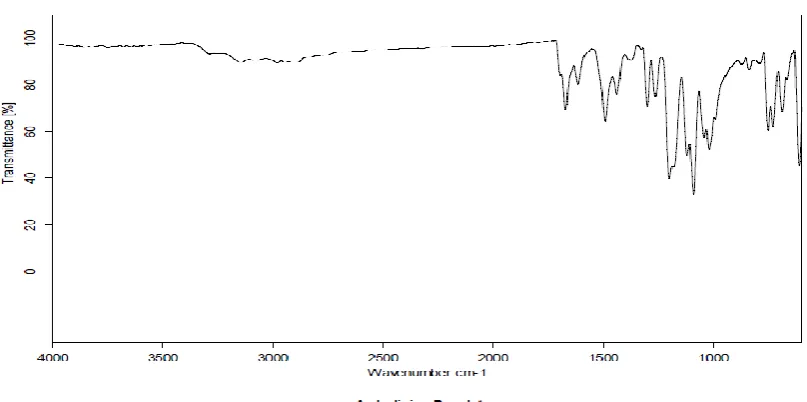
Fig. 1 FTIR spectrum of Amlodipine besylate
Fig. 2 FTIR spectrum of optimized formulation batch
[image:12.595.97.501.93.294.2]For the confirmation of interaction of drug in the formulation the FTIR spectra of excipients were taken and compared with the FTIR spectrum of pure drug. The results revealed that there there was no appearance of any new peaks and disappearance of existing peaks, which indicated that there was no interaction between the drug and polymer used.
Table 7: Characteristic peaks of pure drug and optimized batch
Functional Groups Associated Standard value Observed Wave Number (cm
-1
) Pure Drug Optimized batch
C-Cl stretching 785-540 cm-1 750 748
OH stretching 3400-3200 cm-1 3301 3271 C-H stretching 3190-2900 cm-1 3158,3087 3155,3084
C=O stretching 1680-1630 cm-1 1670 1674
C-N stretching 1360-1180 cm-1 1299,1262 1291,1264
C-O stretching 1300-1000 cm-1 1198 1196
C-S stretching <667cm-1 610 609
All the characteristic peaks of Amlodipine besylate were observed in the IR spectrum of optimized formulation batch during the investigation of compatibility study. Hence IR spectroscopy results showed that the drug was compatible with selected polymer and excipients and was stable in all formulations.
Drug and Excipient compatibility study by DSC Thermogram
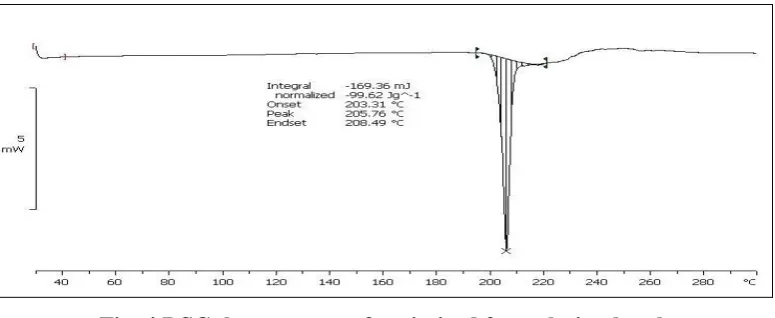
[image:13.595.98.499.436.596.2]The supporting evidence for compatibility between drug and excipients was obtained from DSC studies. As shown in figure the DSC thermogram of Amlodipine besylate showed a sharp endothermic peak at 205.140C corresponding to the melting point of drug. The optimized formulation of Amlodipine besylate showed endothermic peak at 205.760C. In the DSC thermogram of optimized formulation, absence of any significant shift in the endothermic peak of drug represented there was no any interaction between drug and excipients.
Fig. 4 DSC thermogram of optimized formulation batch Results of Pre-compression evaluation parameters
Powder ready for compression containing drug and various excipients were subjected to pre-compression parameters like angle of repose, bulk density, tapped density, compressibility index and hausner‟s ratio. The values for angle of repose were found to be in the range of
13.240 to 16.850. The bulk density was varied in the range of 0.41 gm/ml to 0.47 gm/ml, density range between 0.55 gm/ml to 0.62 gm/ml, compressibility index was varied in the range of 23.00% to 29.68% and Hausner‟s ratio in the range of 1.30 to 1.42. This all
parameters show good flow property and good compressibility.
Table 8: Data for evaluation of pre compression parameters of various powder blends. Formulations Angle of
repose
Bulk density (g/ml)
Tapped Density (g/ml)
Compressibility Index (%)
Hausner’s Ratio
F1 14.38±0.26 0.45±0.01 0.60±0.01 25.86±0.58 1.35±0.01
F2 16.85±0.16 0.47±0.01 0.61±0.01 23.00±0.44 1.30±0.03
F3 13.67±0.23 0.46±0.02 0.62±0.03 25.64±0.51 1.34±0.02
F4 16.38±0.22 0.43±0.01 0.60±0.02 28.19±0.64 1.39±0.01
F5 15.31±0.34 0.42±0.04 0.60±0.02 29.68±0.66 1.42±0.01
F6 15.03±0.86 0.44±0.03 0.60±0.02 25.41±0.48 1.34±0.02
F7 15.39±0.37 0.42±0.02 0.55±0.01 23.66±0.47 1.31±0.03
F8 14.92±0.23 0.42±0.01 0.55±0.01 24.20±0.54 1.32±0.02
F9 14.74±0.57 0.41±0.02 0.55±0.01 23.86±0.52 1.31±0.01
F10 16.32±0.50 0.42±0.01 0.58±0.02 27.12±0.44 1.37±0.02 F11 13.24±0.49 0.42±0.01 0.55±0.02 23.24±0.44 1.30±0.02 F12 13.81±0.22 0.42±0.03 0.58±0.02 26.61±0.41 1.36±0.01 F13 (Control) 15.12±0.30 0.43±0.04 0.58±0.02 25.00±0.59 1.33±0.04
*All values are expressed in Mean ± S.D
Results of Post compression evaluation parameters
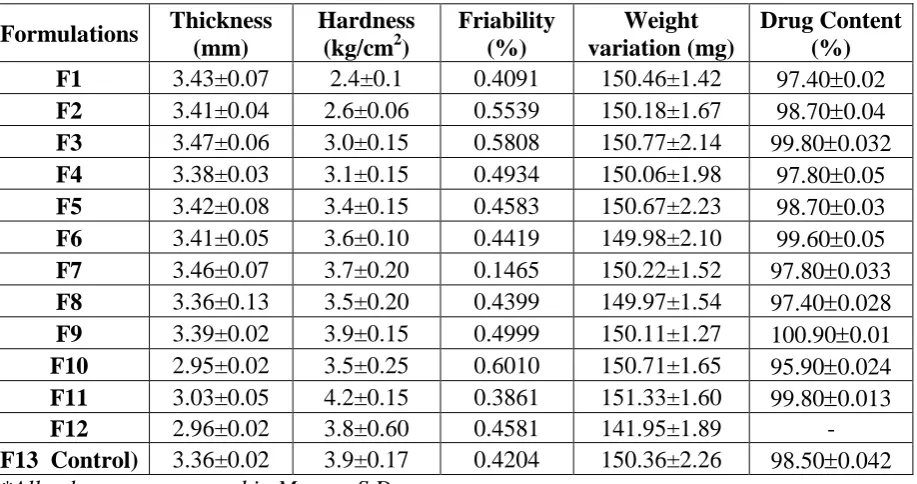
The results of thickness for tablets ranged from 2.950.02 mm to 3.47 0.06 mm. Tablet
[image:14.595.56.541.444.672.2]abrasion or breakage under conditions of storage, transportation and handling before usage, depends on its hardness. The hardness of all the formulation batch tablets was ranged from 2.4±0.10 kg/cm2 to 4.2±0.15 kg/cm2. All tablets passed the weight variation test as the average percentage weight variation was within the pharmacopoeial limits. All the formulations also passed the friability limits which were within 0.3861% to 0.6010% and the drug content of the tablets were found to be 97.40% to 100.90 % of Amlodipine besylate.
Table 9: Data for evaluation of post compression parameters of various powder blends. Formulations Thickness
(mm)
Hardness (kg/cm2)
Friability (%) Weight variation (mg) Drug Content (%) F1 3.43±0.07 2.4±0.1 0.4091 150.46±1.42 97.400.02 F2 3.41±0.04 2.6±0.06 0.5539 150.18±1.67 98.700.04 F3 3.47±0.06 3.0±0.15 0.5808 150.77±2.14 99.800.032 F4 3.38±0.03 3.1±0.15 0.4934 150.06±1.98 97.800.05 F5 3.42±0.08 3.4±0.15 0.4583 150.67±2.23 98.700.03 F6 3.41±0.05 3.6±0.10 0.4419 149.98±2.10 99.600.05 F7 3.46±0.07 3.7±0.20 0.1465 150.22±1.52 97.800.033 F8 3.36±0.13 3.5±0.20 0.4399 149.97±1.54 97.400.028 F9 3.39±0.02 3.9±0.15 0.4999 150.11±1.27 100.900.01 F10 2.95±0.02 3.5±0.25 0.6010 150.71±1.65 95.900.024 F11 3.03±0.05 4.2±0.15 0.3861 151.33±1.60 99.800.013
F12 2.96±0.02 3.8±0.60 0.4581 141.95±1.89 -
F13 Control) 3.36±0.02 3.9±0.17 0.4204 150.36±2.26 98.500.042 *All values are expressed in Mean ± S.D
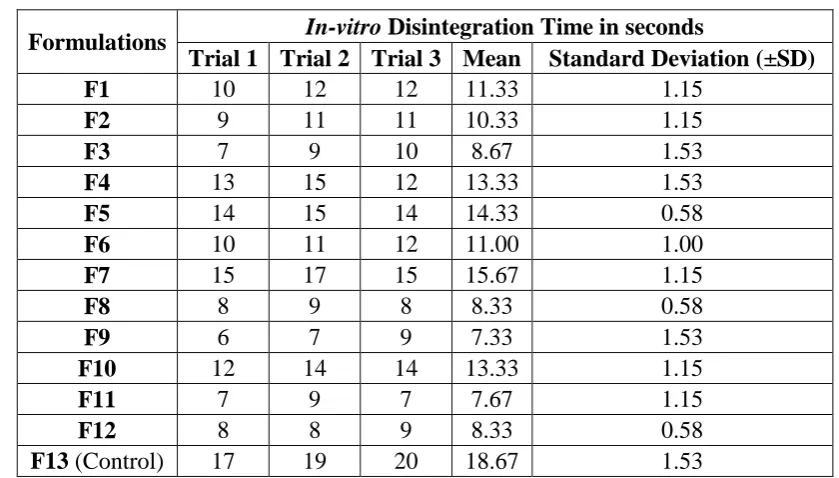
In-vitro disintegration time
Table 10: In-vitro Disintegration Time
Formulations In-vitro Disintegration Time in seconds
Trial 1 Trial 2 Trial 3 Mean Standard Deviation (±SD)
F1 10 12 12 11.33 1.15
F2 9 11 11 10.33 1.15
F3 7 9 10 8.67 1.53
F4 13 15 12 13.33 1.53
F5 14 15 14 14.33 0.58
F6 10 11 12 11.00 1.00
F7 15 17 15 15.67 1.15
F8 8 9 8 8.33 0.58
F9 6 7 9 7.33 1.53
F10 12 14 14 13.33 1.15
F11 7 9 7 7.67 1.15
F12 8 8 9 8.33 0.58
F13 (Control) 17 19 20 18.67 1.53
Wetting time and Water absorption ratio
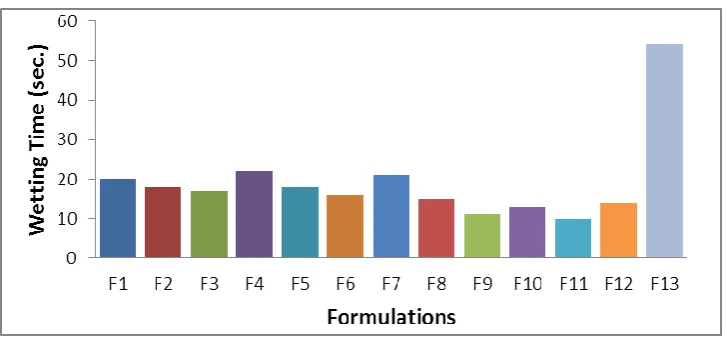
This experiment mimics the action of saliva in contact with the tablet to illustrate the water uptake and subsequent wetting of tablet. Wetting time is closely related to the inner structure of the tablet. From results it was observed that wetting time decreases with increasing concentration of superdisintegrants. This may be due to ability of swelling and also capacity of water absorption. The F11 formulation showed higher water absorption ratio than other formulations due to three dimensional swelling properties of croscarmellose sodium.
Table 11: Wetting time
Formulations Wetting Time* (sec.)
F1 201.34
F2 181.53
F3 171.88
F4 222.82
F5 182.3
F6 161.34
F7 212.44
F8 151.85
F9 111.61
F10 131.38
F11 101.12
F12 141.39
Fig. 5: Wetting Time
Table 12: Water absorption ratio
Formulations Water absorption ratio* (%)
F1 40.240.65
F2 42.981.82
F3 44.671.49
F4 40.862.17
F5 46.730.36
F6 50.740.48
F7 47.271.54
F8 52.231.72
F9 54.241.34
F10 53.840.61
F11 57.930.68
F12 55.451.04
[image:17.595.117.481.544.728.2]F13 (Control) 36.760.22 *All values are expressed in Mean ± S.D. (n=3)
In vitro Dissolution studies
Merely disintegration test is not judicious since all superdisintegrants appear highly efficient, with disintegration times as less than 20 seconds when used in different desired concentrations. However, differences in the particle size generated in the disintegrated tablets could affect drug dissolution since breaking tablets into finer fragments may promote drug dissolution by providing larger total surface areas for drug dissolution to take place.All the formulations were subjected to in-vitro dissolution studies using tablet dissolution tester USP II (Paddle). The dissolution medium 0.01 N HCl was used to study the drug release. The
[image:18.595.113.480.279.477.2]samples were withdrawn at different intervals of time and analyzed at 239 nm using UV spectrophotometer.
Fig. 7 Comparative drug release profile of F1 – F9
In case of tablets prepared by direct compression technique the % drug release increased with increase in the concentration of crospovidone, sodium starch glycolate and croscarmellose sodium. All the formulations showed rapid % drug release due to fast disintegration of tablets. Formulations F1,F2,F3,F4,F5,F6,F7,F8 and F9 showed 90.51%, 91.57%, 91.41%,
Table 13: % Drug release profiles of F1 – F9
Time (min) (%CDR)
F1 F2 F3 F4 F5 F6 F7 F8 F9
0 0 0 0 0 0 0 0 0 0
Table 14: % Drug release profiles of F10, F11 and F13
Time (min) (%CDR)
F10 F11 F13 (Control batch)
0 0 0 0
5 75.400.78 76.771.66 52.781.07
10 78.942.64 82.630.63 59.191.22
15 83.791.06 85.561.87 62.881.24
20 87.981.22 91.011.07 63.941.06
25 90.450.80 96.570.75 65.350.72
30 92.020.83 97.780.38 67.780.89
[image:21.595.117.481.261.458.2]*All values are expressed in Mean ± S.D. (n=3)
Fig. 8 Comparative drug release profile of F10, F11 and F13
Formulations F10, F11 and F13 showed 92.02%, 97.78% and 67.78% drug release respectively. Formulation F11 showed highest drug release than that of formulation F10. Formulation F13 was used as control batch; F13 shows lowest drug release because superdisintegrant was not added in this batch.
For optimization of best batch we had three batches as follows
Sr. No. Formulation Batch Ratio of Mannitol:MCC
1 F9 90:10
2 F10 100% Mannitol; No MCC
Fig. 9 Comparative drug release profile of F9, F10 and F11
Formulation F9, F10 and F11 showed 94.90%, 92.02% and 97.78% drug release respectively, but the rapid drug dissolution was noticed in F11 formulation compared with other formulations. And the sticking of tablet to punch was observed during compression of formulation batch F10 in which no MCC was added. So we may say that the MCC plays an important role to avoid the sticking of tablet to punch. The formulation batch F11 was selected as optimized batch by considering all the parameters.
Comparison of optimized batch with marketed formulation
Optimized batch F11 was compared with the marketed formulation which contains Amlodipine besylate.
Table 15: Evaluation parameters of F11 batch and Marketed formulation
Sr. No. Parameter Optimized batch (F11) Marketed Formulation
1 Disintegration time (sec) 7.67±1.15 7.33±0.58
2 Wetting time (sec) 101.12 8.67±0.58
3 Water absorption ratio (%) 57.930.68 47.76±0.82
4 Assay (%) 99.800.013 101±1
Table 16: % Drug release profiles of F11 batch and Marketed formulation
Time (min) %CDR
Optimized batch (F11) Marketed formulation
0 0 0
5 76.771.66 82.370.38
10 82.630.63 90.560.53
15 85.561.87 96.010.72
20 91.011.07 100.250.53
25 96.570.75 100.70.61
[image:22.595.66.537.514.592.2]Fig. 10 Comparative drug release profile of F11 and Marketed formulation Accelerated stability studies
[image:23.595.44.536.313.402.2]The optimized formulation F11 was withdrawn at the end of 30 days and evaluated for all the parameters.
Table 17: Results of stability study of optimized batch F11 Time Interval
(months)
F11 Formulation Thickness
(mm)
Hardness (kg/cm2)
Disintegration time (sec)
Drug Content (%)
Wetting time (sec) 0 3.03±0.05 4.2±0.15 7.67±1.15 99.800.013 101.12
1 3.04±0.02 4.1±0.31 7.44±0.58 99.25±0.03 10±1.20
*All values are expressed in Mean ± S.D. (n=3)
Table 18: %Drug release profiles of F11 formulation batch during stability study Time
(min)
Cumulative % drug release 0 Month 1 Month
0 0 0
[image:23.595.120.484.375.756.2]Fig. 11 Comparative drug release profile of F11 batch before and after stability study The results of stability study obtained are as follow.
1. There was no change in the physical appearance of the tablet.
2. There was no significant change in the total drug content and in vitro drug release. Therefore no evidence of degradation of drug was observed.
CONCLUSION
The concepts of formulating rapidly disintegrating tablets of Amlodipine besylate offers a suitable and practical approach in serving desired objectives of rapidly disintegration and dissolution characteristics. In the present research work, rapidly disintegrating tablets of Amlodipine besylate were prepared by direct compression technique by using various superdisintegrants like Crospovidone, Sodium starch glycolate and Croscarmellose sodium. The results of DSC and FTIR studies showed that the excipients were compatible with the drug.
The in-vitro disintegration test revealed that the tablets prepared with Croscarmellose sodium show faster disintegration as compared to tablets prepared with rest of superdisintegrants. Even the dissolution studies confirmed that tablets prepared with Croscarmellose sodium, show faster drug release as compared to tablets prepared with rest of superdisintegrants. Rapid wetting and disintegration of dosage form due to high amount of superdisintegrant present in it could be responsible for displaying better dissolution profiles. Direct compression method is the best method for the formulation of RDTs. This method is also
ACKNOWLEDGMENTS
The authors express their gratitude to Hetero drugs Limited and Wockhardt Research Centre for providing the gift samples.
REFERENCES
1. Sumitha CH, Karuna SN, Divya B, Madhavi K, Varma VKM, Charbe NN. Taste masking of Ondansetron hydrochloride by polymer carrier system and formulation of rapid disintegrating films. Int J Chem Res, 2009; 1 (2): 24-27.
2. Bhowmik D, Chiranjib B, Krishnakanth P, Margret RC. Fast dissolving tablet an overview. J Chem Pharma Res, 2009; 1: 163-177.
3. Paramita D and Sabyasachi M. Orodispersible tablets: A new trend in drug delivery. J Nat Sci Bio Med, 2010; 1 (1): 2-5.
4. Ved P, Maan SD, Yadav SK, Jogpal V. Fast disintegrating tablets: Opportunity in drug delivery system. J Adv Pharma Techn Res, 2011; 2(4): 223-235.
5. Ajoy B and Ashish MA. Detailed study of mouth dissolving drug delivery system. Acta Chim Pharm Indica, 2013; 3(1): 65-93.
6. Vummaneni V and Chawla L. Mouth dissolving tablets: A Review. J Pharmtech Res, 2012; 2(3): 29-45.
7. Mathur P, Saroha K, Verma S, Syan N, Kumar A. Mouth dissolving tablets: An overview on future compaction in oral formulation technologies. Der Pharmacia Sinica, 2010; 1 (1): 179-187.
8. Guidance for Industry Orally Disintegrating Tablets; U.S. Department of Health and Human Services. Food and Drug Administration Center for Drug Evaluation and Research (CDER) December 2008.
9. Wagh MK, Kothawade PD, Salunkhe KS, Chavan NV, Daga VR. Techniques used in orally disintegrating drug delivery system. Int J Drug Del, 2010; 2: 98-107.
10.Changoiwala N, Mehta K, Modi SC, Gohel MC, Parikh RK. Formulation, development and optimization of orodispersible tablets of cetirizine hydrochloride. Int J Pharm Res Bio Sci, 2012; 1 (6): 218-238.
11.Sreenivas SA, Dandagi PM, Gadad AP, Godbole AM, Hiremath SP. Orodispersible tablets: New-fangled drug delivery system-A review. Ind J Pharm Edu, 2005; 39 (4): 177. 12.Mehta M, Singh R, Setia A, Kalra S. Fast Disintegrating Drug Delivery Systems: An
13.Prathiba TK, Kavitha K, Kumar SV, Kumar R, Singh J. A Review on Fast Dissolving Drug Delivery Systems - A Pioneering Drug delivery Technology. Am J Pharmtech Res, 2013; 3(4): 56-74.
14.Mishra B, Shukla D, Chakraborty S, Singh S. Mouth Dissolving Tablets: An Overview of Formulation Technology. Sci Pharm, 2009; 76: 309–326.
15.Tripathi KD. Essentials of Medical Pharmacology. 6th ed. Jaypee Brothers Medical Publishers; Delhi: 2008.
16.Ford JL and Timmins P. Pharmaceutical Thermal Analysis: Techniques and Applications.
Ellis Horwood Ltd. Chichester: 1989, pp. 273-284.
17.Florey K. Analytical profiles of drug substances. 2nd ed. New York: Academic Press Elsevier: 2005, pp. 466-479.
![Table 1: Inactive ingredients limit as per USFDA [18]](https://thumb-us.123doks.com/thumbv2/123dok_us/785213.585116/5.595.76.521.491.625/table-inactive-ingredients-limit-as-per-usfda.webp)