www.wjpr.net Vol 4, Issue 11, 2015.
1328
FORMULATION, OPTIMIZATION AND EVALUATION OF
ACECLOFENAC TRANSDERMAL GEL- A NOVEL APPROACH FOR
PENETRATION ENHANCEMENT BY HERBAL EXTRACT
Singh Rampal1*, Juyal Divya1, Singh Vikram1 and Rawat Geeta2
1
Himalayan Institute of Pharmacy and Research, Rajawala, Dehradun.
2
H.N.B.G.U, Department of Pharmaceutical Science, Srinagar Garhwal.
ABSTRACT
The present research has been undertaken with the ambition to formulate, optimize and evaluate the gel containing acorus calamus oil. The gel was prepared by using aceclofenac (API) and optimum ratio of carbopol 941 P and HPMC K15 M and other excipients are propylene glycol, triethanolamine, and methyl paraben. The aceclofenac permeability through stratum corneum occurs by using oil which obtained from the leaves of acorus calmus. The acorus calamus oil was used as a penetration enhancer. All prepared gel formulations were evaluated by pH, spredability, extrudability, viscosity, drug contents, in- vitro permeability studies and drug- polymer
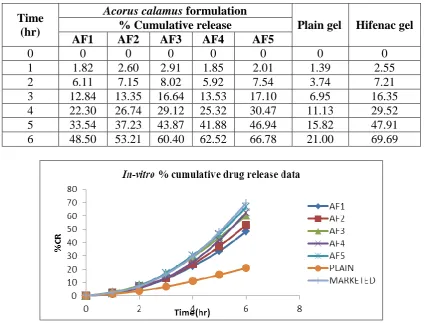
compatibility (FTIR studies). The absorption maxima of aceclofenac were found at 273 nm using ph 6.8 phosphate buffer solutions. The pH values of all formulation was in the range between 6.80 -7.23. Drug content of all formulation ranges from 82.72 - 90.22. The result value of spreadability was range from 11.66 - 14.66(gm. cm / sec). Whereas the extrudability value of gel formulations from the collapsible tube varies range from 250.00 to 444.44(gm.cm2) and the viscosity of formulations ranges from 21023 cps to 22101 cps at 50 rpm. The % cumulative drug release range from 48.50 -66.78% in 6 hr.
KEYWORDS: Acorus calamus, API, FTIR, in- vitro permeability studies.
INTRODUCTION
The Non-steroidal anti-inflammatory Drug (NSAIDs) possesses anti-inflammatory, analgesic and antipyretic activities. Aceclofenac is Non-steroidal Anti-inflammatory drug and chemically it is [(2,6Dichlorophenyl) amino] phenyl acetyloxyacetic acid. It widely used in
Volume 4, Issue 11, 1328-1340. Research Article ISSN 2277– 7105
Article Received on 02 Sep 2015,
Revised on 26 Sep 2015, Accepted on 19 Oct 2015
*Correspondence for
Author
Singh Rampal
Himalayan Institute of
Pharmacy and Research,
www.wjpr.net Vol 4, Issue 11, 2015.
1329 the treatment of pain (headache, back pain, arthritis and joint pain) act by inhibiting prostaglandin synthesis, which is cause of inflammation.[1, 2] Aceclofenac belongs to BCS class-II, it possess solubility problem for drug delivery. Aceclofenac with oral therapy causes dyspepsia, abdominal pain, nausea and diarrhea other rare side-effects include dizziness, constipation, vomiting, ulcerative stomatitis, rash, dermatitis, headache, fatigue.[3, 4]
Acorus calmus also known as sweet flag and buch that belonging from araceae family. [5] The plant has a characteristic essential oil called as the asarone oil. β-asarone (isoasarone) is usually the major constituent (27.4-45.5%) α-Asarone, β-asarone have a relaxing effect on
smooth muscle tissue.[6, 7]
MATERIALS
1. Plant material collection and authentification – plant was collected from pauri garhwal, Uttarakhand at pond side during January month. Plant was identified by comparing with their authentic specimens with the help of taxonomists (Dr. Anup Chandra) Scientist-D, Forest Research Institute [FRI] Dehradun, Uttarakhand.
2. Chemicals- Aceclofenac [Tirupati Medicare Ltd, Paota Sahib (Himanchal Pradesh) India] carbopol 941 and HPMC K15M are propylene glycol, triethanolamine, and methyl paraben [Central Drug House (p) Ltd, New Delhi] Hifenac gel The Madras Pharmaceuticals, Chennai.
METHOD
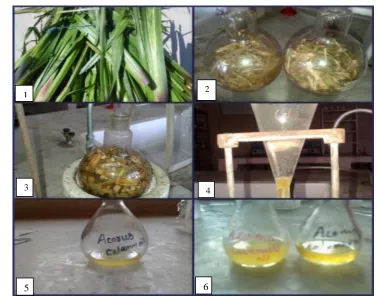
A. EXTRACTION OF OIL -300 gm of dried crushed plant material of acorus calamus was taken in 1000 ml of round bottom flask and extracted with distilled water for 6- 8 hr at 70- 80°C using Clevenger apparatus and added a small porcelain chip to avoid bumping, the oil was collected which was light yellow in colour with sweet volatile odour.[8]
B. PHYTOCHEMICAL TESTS
ACORUS CALAMUS [9]
i. Test for Carbohydrate- Molish test
1ml of test solution with few drops of α-napthol. Add 0.2 ml of concentrated sulphuric
www.wjpr.net Vol 4, Issue 11, 2015.
1330 ii. Protein- Biuret test
take 0.2 ml of test solution in test tube, add few drops of 4% sodium chloride solution and few drops of 1% copper sulphate, violet colour produce that indicate the presence of protein.
iii. Saponins- Forth test
take a pinch of coarsely dried powder of plant in test tube and add distilled water, the mixture was shaken, then the form produce which indicate presence of saponin.
iv. Terpenoids test- libermann-burchard test
few drops of acetic anhydride add into 0.5 ml of plant extract heat, boil and cool, add few drops of concentrated sulphuric acid with drop wise, a red colour was produced due to presence of terpenes.
v. Test of fixed oils and fats- spot test-
a small quantity of plant extract was pressed between two filter paper. Oil stain on the filter paper indicates the presence of oils and fat.
C. DISPERSION METHOD
Disperse the carbopol 941 and HPMC K15 M in distilled water and soaking for 8 hr. dissolve the drug in propylene glycol, and slowly mixed into the polymer solution with continuous stirring and addition of penetration enhancer, methyl paraben then pH adjustifier triethanolamine was added that modify the buffering capacity of gel. [10]
D. EVALUATION PARAMETER OF GEL
a. Measurement of pH-The pH of various gel formulations was determined by using digital pH meter. 1gm of gel was dissolved in 100 ml distilled water and stored for 2 hr. The readings were taken for average of 3 times.[11]
b. Spreadibility-0.5g gel was placed within a circle of 1 cm diameter pre marked on a glass plate over which a second glass plate was placed. A weight of 500 g was allowed to rest on the upper glass plate for 5min. The increase in the diameter due to spreading of the gels was noted.[12]
www.wjpr.net Vol 4, Issue 11, 2015.
1331 was compressed and extrudability of the formulation was determined in terms of weight in grams required to extrude a 0.5 cm. ribbon of gel in 10 seconds.[13]
d. Drug content- A 100 mg of developed gel dissolved in 100 ml of phosphate buffer with pH 6.8. The volumetric flask containing gel solution was shaken for 2 hr on mechanical shaker in order to get complete solubility of drug. This solution was filtered and estimated spectrophotometrically at 273 nm using phosphate buffer (pH 6.8) as blank.[14]
e. Viscosity-The measurement of viscosity of the prepared gel was done with a Brookfield Viscometer. The gels were rotated at 50 rotations per minute. 50 gm of preparation was kept in 50 ml beaker which was set till spindle groove was dipped and rpm was set and dial reading was measured after three minutes. From the reading obtained, viscosity was calculated by using factor. The readings were taken for average of 3 times.[15, 16]
f. In-vitro diffusion studies- The in vitro diffusion studies of prepared gel were carried out
in Franz diffusion cell using through a cellophane membrane 10 ml of phosphate buffer solution (pH 6.8) was used as receptor compartment, then 1 mg of gel was spread
uniformly on the membrane. The donor compartment was kept in contact with a receptor compartment and the temperature was maintained at 37±0.5°C. The solution on the receptor side were stirred by externally driven Teflon coated magnetic bars at predetermined time intervals, pipette out 3ml of solution from the receptor compartment and immediately replaced with the fresh 3ml phosphate buffer for 8 hr. Then the samples were analyzed by spectrophotometrically at 273 nm using phosphate buffer (pH 6.8) as blank for drug release.[17, 18]
g. Stability studies-The stability studies were carried out for all the gel formulation by, by subjecting the product to a temperature at 4° C, 25°C, 40°C for 15 days, The formulation
www.wjpr.net Vol 4, Issue 11, 2015.
1332 RESULTS
A. EXTRACTION OF OIL
Figure 1. Extraction processes of acorus calamus (1. Plant collection, 2. Dried plant sample 3. Extraction of plant 4. Separation of oily portion, 5, 6. Collected oil.)
[image:5.595.104.482.108.404.2]B. PHYTOCHEMICAL TESTS OF ACORUS CALAMUS Table 1. Phytochemical tests of Acorus calamus
S. No. Constituents Tests performed Results
1. Carbohydrate Molisch’s test +
2.. Proteins & amino acid Biuret test +
3. Saponins Forth test +
4. Fixed oil and fat test Spot test +
5. Triterpenoids Libermann burchard test +
1 .
2
3 4
www.wjpr.net Vol 4, Issue 11, 2015.
[image:6.595.119.475.69.334.2]1333 Figure 2. Phytochemical tests of Acorus calamus (1.Forth test 2.Molish test 4.Liberman burchard test 4.Spot test 5.Biuret test 6.Molish test)
C. DRUG IDENTIFICATION
STUDIES-Figure 3. Absorption maxima (λmax) of aceclofenac in phosphate buffer pH 6.8
Figure 4. FTIR spectroscopy of aceclofenac sample
1 .
2 3
[image:6.595.77.463.403.552.2] [image:6.595.140.456.594.742.2]www.wjpr.net Vol 4, Issue 11, 2015.
1334 Figure 5. Calibration curve of aceclofenac in phosphate buffer solution pH 6.8
[image:7.595.157.439.65.227.2]D. COMPATIBILITY STUDY OF GEL BY FTIR (NUJOL METHOD)-
Figure 6. FTIR of aceclofenac gel contain acorus calamus oil
E. PREPARATION AND EVALUATION OF GEL Table 2.Preparation of gel contain acorus calamus
Table 3. Evaluation data of gels containing Acorus calamus
S.NO. INGREDIENTS F1 F2 F3 F4 F5
1. Aceclofenac(gm) 1 1 1 1 1
2. Carbopol 941 P(gm) 1 1 1 1 1
3. HPMC K15(gm) 1.5 1.5 1.5 1.5 1.5
4. Methyl paraben (gm) 0.2 0.2 0.2 0.2 0.2
5. Propylene glycol(ml) 10 10 10 10 10
6. Triethanolamine(ml) 1 1 1 1 1
7. Acorus calamus oil (ml) 1 1.5 2 2.5 3
Formulation
code pH
Spreadability (gm.cm/sec)
Extrudability(g m.cm2)
Drug content (%)
Viscosity (cp)
AF1 6.92 12.33 333.33 89.3% 21023
AF2 6.80 11.66 285.71 86.67% 21786
[image:7.595.128.469.286.452.2]www.wjpr.net Vol 4, Issue 11, 2015.
[image:8.595.86.512.183.506.2]1335 Table 4. Invitro drug release data of developed gel aceclofenac gels in phosphate buffer solution pH 6.8
Figure 7. In-vitro %cumulative drug release data
[image:8.595.124.472.564.737.2]F. IN-VITRO DRUG RELEASE KINETICS STUDIES
Figure 8. Zero order release profile of aceclofenac gel containing acorus calamus
AF4 7.06 13.00 444.44 88.55% 22004
AF5 7.23 14.66 307.69 90.22% 22101
Plain gel 7.02 10.33 400.00 81.39% 23260
Hifenac gel 6.69 11.66 250.00 90.57% 22150
Time (hr)
Acorus calamus formulation
Plain gel Hifenac gel % Cumulative release
AF1 AF2 AF3 AF4 AF5
0 0 0 0 0 0 0 0
1 1.82 2.60 2.91 1.85 2.01 1.39 2.55
2 6.11 7.15 8.02 5.92 7.54 3.74 7.21
www.wjpr.net Vol 4, Issue 11, 2015.
[image:9.595.135.466.74.254.2] [image:9.595.135.461.296.478.2]1336 Figure 9. First order release profile of aceclofenac gel containing acorus calamus
Figure 10. Higuchi diffusion curve of aceclofenac gel containing acorus calamus
[image:9.595.137.461.515.699.2]www.wjpr.net Vol 4, Issue 11, 2015.
[image:10.595.109.484.89.254.2]1337 Table 5. Mathematical modelling and drug release kinetics of aceclofenac gel
[image:10.595.151.443.301.729.2]
G. STABILITY STUDIES
Table 6. Stability studies data of aceclofenac gels after 45 days
Figure 12. Plant authentification certificate of acorus calamus
Formulation code
Acorus calamus
Regression coefficient(R2) Slope (n) value Zero order First order Higuchi’s Korsmeyer-peppas AF1 AF2 AF3 AF4 AF5 0.931 0.925 0.940 0.900 0.927 0.931 0.925 0.939 0.900 0.927 0.944 0.972 0.977 0.938 0.948 0.632 0.632 0.661 0.667 0.692
Marketed 0.912 0.912 0.963 0.680
Plain gel 0.965 0.965 0.924 0.832
Formulation code
Acorus calamus
pH % Drug content
www.wjpr.net Vol 4, Issue 11, 2015.
1338 DISCUSSIONS
The all formulated gels are white or translucent in appearance. The pH value of all formulated gels lies in between 6.80 -7.23. Drug content of all formulation ranges from 82.72 - 90.22%. The result values of spreadability indicate that the gel is easily spread over skin surface by small amount of shear. The result of spreadability range from 11.66 - 14.66 (gm. cm / sec). whereas the extrudability of gel formulations from the collapsible tube varies from 250.00 to 444.44 gm.cm2 and viscosity of formulations ranges from 21023 cps to 22101 cps at 50 rpm. The % cumulative drug release range from 48.50 -66.78% in 6 hr.
CONCLUSSION
In- vitro drug release study results show the formulations containing acorus calamus, the drug releasement are faster as compared to plain formulation of gel which does not contain
acorus calamus. It may be concluded from the results that as the concentration of acorus calamus 1 to 5 ml (48.50-66.78 %CR) increases in the formulations the rate of drug release also increases. Percent drug release data also show the formulation of gel that contains acorus calamus oil (F5-5ml) a best formulation that is similar to marketed formulation (Hifenac gel). In which the drug release 45.78% more after addition of penetration enhancer compare to plain gel in which only 21.00% drug was release. The mathematical kinetic studies is showed the value of correlation coefficient (r2) 0.948 (acorus calamus) in case of higuchi diffusion model and this value was supported by n value i.e. 0.692(acorus calamus)
korsmeyer peppas (in the literature 0.5 n value was perfect fickian diffusion but after in various literature 0.5 to 0.6 believe to be fickian types of diffusion). So we can state that the selected formula of gel release entrapped amount of drug by diffusion way which was more or less ficknian types. It is clear that acorus calamus can significantly enhance the penetration of aceclofenac from gel formulation across the skin. The usage of herbal oil was found to be efficient in releasing of drug.
REFERANCES
1. Ahad A., Formulation and evaluation of once-daily sustained release aceclofenac
prosophis juliflora gum matrix tablets, International Journal of Pharmaceutical Sciences Review and Research., 2010; 1(2): 23-28.
www.wjpr.net Vol 4, Issue 11, 2015.
1339 3. Rajput H S., Use of karanj oil (Pongamia glabra) in topical formulation, Research
Journal of Pharmaceutical, Biological and clinical Science., 2014; 5(3): 547-551.
4. Legrand E., Aceclofenac in the management of inflammatory pain, Expert opinion Pharmacotherapy., 2004; 5(6): 1348-1357.
5. Singh R., Sharma K. P., Malviya R., Pharmacological properties and ayurvedic value of Indian buch plant( Acorus calamus): A short review, Advances in Biological Research., 2011; 5(3): 145-154.
6. Sathiavelu A., Pharmacological activities of Acorus calamus: A review, Asian Journal of Biochemical and Pharmaceutical Research., 2011; 4(1): 57-64.
7. Arasan E.R., Acorus calamus linn: chemistry and biology, Research Journal of Pharmacy and Technology., 2009; 2(2): 256-261.
8. Reddy C.G., A unique water soluble formulation of β-asarone from sweet flag (Acorus
calamus ), Journal of medicinal plant Research Sept., 2011; 5(20): 5132-5137.
9. Saxena M., Phytochemical screening of Acorus calamus and Lantana camara, International Reseach Journal of Pharmacy., 2012; 3(5): 324-326.
10.Prabhjotkaur, Topical formulation and hydro-gel an overview, International Journal of
Advances in pharmacy, biology and chemistry., 2013: 2(1): 201-206.
11.Tahsildar G. A., Hydrogel-a novel technique for preparation of topical gel, World Journal of Pharmacy and Pharmaceutical Science , 2013; 2(6): 4520-4541.
12.Nanda S., Kamal S., Sharma B., Formulation, evaluation and optimization of transdermal gel of ketorolac tromethamine using face centered central composite design, International Journal of Pharmacy and Pharmaceutical Science., 2014; 6(4): 133-139.
13.Kumar L., In-vitro evaluation of topical gel prepared using natural polymer, International Journal of Drug Delivery., 2010; 2(2): 58-63.
14.Shivhare D.U., Formulation development and evaluation of diclofenac sodium gel using water soluble polyacrylamide polymer, Digest Journal of Nanomaterials and Bio structures., 2009; 4(2): 285-290.
15.Trivedi V., Rheological Study of Diclofenac Gel Containing Different Concentration of Carbapol 940,International Journal of Research in Pharmacy and Science., 2013; 3(1): 73-84.
www.wjpr.net Vol 4, Issue 11, 2015.
1340 17.Patel J., Trivedi J., Chudhary S., Formulation and evaluation of diacerein emulgel for psoriatic arthritis, International Journal of Pharmaceutical Research and Bio-science., 2014; 3(2): 625-638.
18.Guleri K T., Formulation and evaluation of topical gel of aceclofenac, Journal of drug delivery and therapeutics., 2013; 3(6): 51-53.
19.Parchri B. D., Shantha G S., Formulation and evaluation of nanoparticulate drug delivery system of acyclovir for topical drug delivery, World Journal of Pharmacy and Pharmaceutical Science., 2013; 2(6): 5602-5617.
20.Aggrawal P., Baajpayee M., Singh P.S., Formulation and evaluation of herbal gel containing boswellia serrata, curcuma longa extract and oil of wintergreen for rheumatoid arthritis, International Bulletin of Drug Research., 2(3): 31-40.