MICROBIOLOGICAL SENSITIVITY PATTERNS IN RESPIRATORY
TRACT INFECTIONS; A PROSPECTIVE OBSERVATIONAL STUDY
Ashok Kumar. D1, Krupa Sagar. N1, B. Sarada1, Mallesh. M1, M. Venkata Subbaiah2 and M.Purushothaman3,
1
Pharm.D Intern, Department of Pharmacy Practice, P. Rami Reddy Memorial College of
Pharmacy, Kadapa, A.P – 516003 2
Assistant Professor, Department of Pharmacy Practice, P. Rami Reddy Memorial College of
Pharmacy, Kadapa, A.P – 516003
3
Principal, P. Rami Reddy Memorial College of Pharmacy, Kadapa, A.P – 516003.
ABSTRACT
A respiratory tract infection is an infection anywhere in the
respiratory tract. This study summarizes that surveillance of the
bacteria isolated from patients over prolonged periods not only
can provide important information for day-to-day decision
making in antimicrobial therapy in individual hospitals . Out of
527 patients 347 (65.84%) were males and 180 (34.15%)
females(34.15%). Minimum of 70 (13.28 %) were in 30 – 40 age
group, 447 (84.81%) were shown growth and 80 (15.18 %) have not
shown growth of any isolates. 93 % of Kp sp. isolated were sensitive to
AZM and 9% were sensitive to AMX. And about 7% of Kp sp.
isolated were resistant to AZM and 91 % were resistant to AMX. Ec
showed 100 % sensitivity to AZM and 100 % resistance to CIP, GEN,
COT, CTX and AMX. Pa showed 100 % sensitivity to GEN and 0%
sensitive to P and AMX. S. p showed about 91% sensitive to CIP and 14% were sensitive to
AMX. And about 8% of S. p isolated was resistance to CIP and 85% resistance to AMX. Sal
showed about 100% sensitive to CTX, P and 0% to AMX. Sau showed about 100% sensitive
to GEN and 0% sensitive to P, AMX. Over all sensitivity and resistance of GEN was 92.78%,
7.22% respectively. Similarly CIP was 84.32%, 15.68%; AZM was 80.54% and 19.46%,
CTX 79.56%, 20.44%; COT 63.42%, 36.58%; P 27.39%, 72.61%; and AMX 9.77%, 90.23%.
Antibiotic therapy was changed in 279(62.41%) of patients after culture report and antibiotic
Volume 4, Issue 8, 2119-2129. Research Article ISSN 2277– 7105
*Correspondence for
Author
Ashok Kumar D.
Pharm D Intern,
Department of Pharmacy
Practice, P. Rami Reddy
Memorial College of
Pharmacy, Kadapa, A.P –
516003.
Article Received on 06 June 2015,
therapy was not changed in 168(37.58%) of patients after culture report. The study provides
important data, which can help to guide physicians to choose the appropriate treatment
regimen for RTI.
Abbreviations
GEN- Gentamicin, CIP- Ciprofloxacin, AZM- Azithromycin, CTX- Cefotaxime, COT-
Co-trimoxazole, P- Penicillin and AMX-Amoxicillin.
Sp - Streptococcus pneumoniae ,Kp - Klebsiella pneumoniae, CONS - Coagulase
Negative Staphylococci, Sau - Staphylococcus aureus, Pa - Pseudomonas aeruginosa, Ec -
E. Coli.
KEYWORDS: Respiratory Diseases, Antibiotic Resistance, Clinical Pharmacist, Pharm. D.
INTRODUCTION
A respiratory tract infection is an infection anywhere in the respiratory tract (i.e. the
nose, throat and lungs) that prevents normal breathing function .[1] According to the
World Health Organization (WHO), respiratory infections kill an estimated 2.6 million
children annually every year worldwide (WHO),[2] causes 3.5 million deaths in
children each year.[3] A better understanding of the pathogens causing these infections
is recognized as a requirement which allows logical approach to treatment. There is a
need in developing countries like India, for timely diagnosis of the major microbial
causes of the respiratory infections.[4] The consequences of increased drug resistance
are far reaching since bacterial infection of respiratory trac t is a major cause of death
due to infectious disease.[5] Antibiotic resistance is a global health problem, and a
major cause for concern. It is associated with the inappropriate, as well as frequent,
use of antibiotics.[6] The last decade of the 20th century and the first decade of the 21st
century have witnessed the emergence and spread of antibiotic resistance in
pathogenic bacteria around the world, and the consequent failure of antibiotic therapy,
especially in intensive care units (ICUs), which has led to hundreds of thousands of
deaths annually.[7] The gradual increase in resistance rates of several important
pathogens, including methicillin-resistant Staphylococcus aureus (MRSA),
vancomycin-resistant Enterococcus (VRE), multidrug-resistant (MDR) Pseudomonas
cephalosporin-resistant Escherichia coli and Klebsiella pneumonia, poses a serious
threat to public health.[8-9] Antibiotic susceptibility charts (Antibiograms) summarizes
the percentage of tests where a particular organism found to be susceptible to a
particular antibiotic. Antibiotic susceptibility charts provide physicians with the
information they need to make the best use of antibiotics .[10] Pharmacists
responsibilities for antimicrobial stewardship and infection prevention and control
include promoting the optimal use of antimicrobial agents, reducing the transmission
of infections, and educating health professionals, patients, and the public .[11] This
study summarizes that surveillance of the bacteria isolated from patients over
prolonged periods not only can provide important information for day -to-day decision
making in antimicrobial therapy in individual hospitals but can also reflect local
trends and shifts in etiology and antimicrobial drug resistance. The knowledge of
prevailing susceptibility patterns is therefore vital to the selection and use of
antimicrobial agents and to the development of appropriate prescribing policies. This
study was therefore conducted to determine the common and clinically significant
bacteria isolates in this environment and their antimicrobial susceptibility pattern.
This is to guide in antibiotic choice as well as in formulation of policy for the rational
and effective use of antimicrobial agents.
METHOD
Study design: Prospective Observational Study
Study period: August 2014 to May 2015 (10 months)
Study population: 527 Patients
Study place: RIMS, an 800 bedded tertiary care teaching hospital, Kadapa.
Department: Department of General Medicine, male and female units
Study Materials: Patient Data Collection Form, Patient Informed Consent Form.
Inclusion criteria: Both the genders of≥13yrs age patients suspected with RTI and advised for culture sensitivity test.
Exclusion criteria: Patients who are not willing for participation, Out patients, Who will stay for left against medical advice in the hospital will exclude in the study, Special Wards.
senstivity test by the physicians, were included in our study then patient data was collected
and Specimens for microbiological examination will be sent to lab for identification of
pathogens in various culture media and their sensitivity pattern to various antibiotics, data
will be reviewed and assessed, subjected to statistical analysis, reporting of results to health
care professionals for better patient outcome.
RESULTS
The prospective observational study was conducted for 10 months (2014 - 15) in South
Indian Tertiary care teaching Hospital RIMS, Kadapa. A total of 934 respiratory tract
infected patients were screened among that 527 patients were recruited under inclusion
criteria and their samples were followed, among the 527 samples Sputum (281), Swab (111)
and Pleural Fluid (55). In that mono isolates were seen in 393 samples, 54 were found to be
shown poly isolates and 80 have not shown the growth of any isolate.
Out of 527 patients 347 (65.84%) were males and females 180 (34.15%). All patients were
fall in age group of 20-75 years which was represented in Table-1.
Table: 1 Patient Distribution Based on Gender
Total no. of Patients No. of Male Patients (%) No. of Female Patients (%)
527 347 (65.84%) 180 (34.15%)
Out of 527 patients 118(22.39) were in 20 – 30 age group in that 76 were male and 42 were
female; 70(13.28 %) were in 30 – 40 age group in that 43 were male and 27 were female;
156 (29.60 %) were in 40 – 50 age group in that 102 were male, 54 were female; 95 (18.04
%) were in 50 – 60 age group in that 61 were male, 34 were female; and 88 (16.69%) were
above 60 age group in that 59 were male and 29 were female.
We have analysed data of 527 samples among only 447 (84.81%) were shown growth and 80
(15.18 %) have not shown growth of any isolates and the distribution of those 447 samples in
respect to type of sample, age and gender was represented in Table.2.
Table: 2. Patient Distribution Based on Age group
20-30 30-40 40-50 50-60 >60
Male 76 43 102 61 59
Among the 447 samples included 281 were sputum, 111 swabs and 55 pleural fluids. In
males sputum samples were 196, swabs were 64, pleura fluid were 37 and in females sputum
were 85, swab were 47, pleural fluid were 18. Out of 447 patients 101 (22.59 %) were in 20 –
30 age group in that 66 were male and 35 were female; 55 (12.30%) were in 30 – 40 age
group in that 38 were male and 17 were female; 135 (30.20 %) were in 40 – 50 age group in
that 92 were male, 43 were female; 81 (18.12%) were in 50 – 60 age group in that 52 were
male, 29 were female; and 75 (16.79 %) were above 60 age group in that 49 were male and
26 were female (Table 3).
Table: 3 Age and Gender Wise Distribution of Growth Positive samples
Age Group Sputum (281) Swab (111) Pleural Fluid (55) Total
M F M F M F Number %
20-30 42 19 21 16 3 0 101 22.59
30-40 27 12 7 3 4 2 55 12.30
40-50 73 27 10 9 9 7 135 30.20
50-60 20 13 17 14 15 2 81 18.12
>60 34 14 9 5 6 7 75 16.79
Total 196 85 64 47 37 18 447 100
Table: 4 gives information about the pattern of bacterial isolations in specimens. Out of 447
positive growth samples 393 (87.91 %) samples were shown mono isolation and 54 (12.09
%) samples were shown poly isolates.
Table: 4: Bacterial Growths in Different Respiratory Specimens
Specimen Pathogens Isolated Non Pathogens Isolated No growth
Sputum(323) 287 26 10
Pleural (115) 64 19 32
Swab (89) 42 9 38
Total (527) 393 54 80
Among 393 bacterial isolates 255 were found to be gram positive and 138 were gram
negative bacteria.
CLASSIFICATION OF ISOLATED BACTERIA Table: 5: Types of Isolated Bacteria
Among the 255 gram positive bacteria isolated, 179 were isolated in sputum, 60 in swab and
16 in pleural fluid. Totally 138 gram negative bacteria were isolated in that 86 were isolated
[image:6.595.170.426.165.258.2]in sputum, 30 in swab and 22 in pleural fluid (Table 6).
Table: 6 Specimen wise distributions of isolated bacteria
Specimen Gram Positive Gram Negative
M F M F
Sputum 130 49 66 20
Swab 36 24 20 10
Pleural 14 2 9 13
Total 180 75 95 43
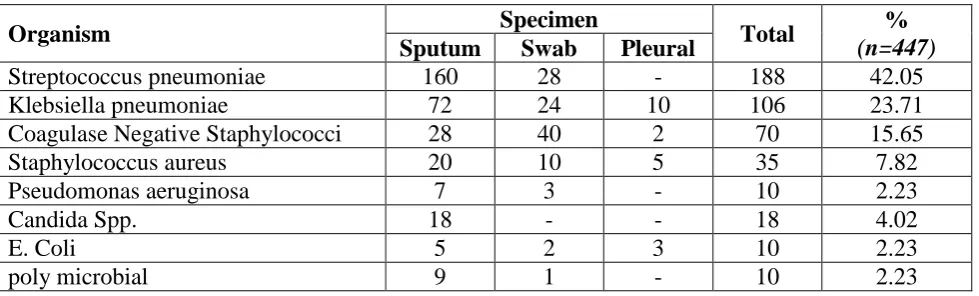
Streptococcus pneumonia was isolated in 188 (42.05%) samples (160 Sp, 28 Sw and none
from Pf), Klebsiella pneumonia in 106 (23.71%) samples (72 Sp, 24 Sw and 10 from Pf),
Coagulase Negative Staphylococci in 70 (15.65%) samples (28 Sp, 40 Sw and 2 from Pf),
Staphylococcus aureus in 35 (7.82%) samples (20 Sp, 10 Sw and 5 from Pf), Pseudomonas
aeruginosa in 10 (2.23%) samples (7 Sp, 3 Sw and none from Pf), E.Coli in 10 (2.23%)
samples (5 Sp, 2 Sw and 3 Pf). Candida Spp. in 18 (4.02%) samples (18 Sp, none from Sw
and Pf) and poly microbia 10 (2.23%) samples (9 Sp, 1 Sw and none from Pf) (Table 7),
Table 7: Prevalence of Isolated Microorganisms in Various Specimens
Organism Specimen Total %
(n=447)
Sputum Swab Pleural
Streptococcus pneumoniae 160 28 - 188 42.05
Klebsiella pneumoniae 72 24 10 106 23.71
Coagulase Negative Staphylococci 28 40 2 70 15.65
Staphylococcus aureus 20 10 5 35 7.82
Pseudomonas aeruginosa 7 3 - 10 2.23
Candida Spp. 18 - - 18 4.02
E. Coli 5 2 3 10 2.23
poly microbial 9 1 - 10 2.23
From the table 8 it was found that about 93 % of Kp sp. isolated were sensitive to AZM and
9% were sensitive to AMX. And about 7% of Kp sp. isolated were resistant to AZM and 91
% were resistant to AMX. Ec showed 100 % sensitivity to AZM and 100 % resistance to
CIP, GEN, COT, CTX and AMX. Pa showed 100 % sensitivity to GEN and 0% sensitive to P
and AMX. S. p showed about 91% sensitive to CIP and 14% were sensitive to AMX. And
about 8% of S. p isolated was resistance to CIP and 85% resistance to AMX. Sal showed
[image:6.595.68.558.447.595.2]Table 8: Antimicrobial Susceptibility Pattern of Pathogens Causing RTI
Antibiotics Used
Pathogens Kp
(n = 106)
Ec (n = 10)
Pa (n = 10)
Sp (n = 188)
CONS (n = 70)
Sau (n = 35)
(%) (%) (%) (%) (%) (%)
S R S R S R S R S R S R
CIP 88 12 0 100 85.7 14.3 91.31 8.69 94.12 5.88 81.82 18.18
AZM 93.3 6..7 100 0 66.7 33.3 80 20 76.93 23.07 80 20
GEN 86.7 13.3 0 100 100 0 93.3 6.7 88.24 11.76 100 0
COT 48 52 0 100 28.57 71.43 61.36 38.64 71.43 28.57 70 30
CTX 75 25 0 100 50 50 78.6 21.4 100 0 88.9 11.1
P 21.43 78.57 Not Tested 0 100 21.05 78.95 100 0 0 100
AMX 9.09 90.91 0 100 0 100 14.28 85.72 0 100 0 100
The overall sensitivity and resistance of GEN was 92.78%, 7.22% respectively. Similarly CIP
was 84.32%, 15.68%; AZM was 80.54% and 19.46%, CTX 79.56%, 20.44%; COT 63.42%,
36.58%; P 27.39%, 72.61%; and AMX 9.77%, 90.23% respectively (Table 9).
Table 9: Overall Susceptibility Pattern of Antimicrobials in RTI
S. No Antibiotic used Sensitivity (%) Resistance (%)
1. GEN 92.78% 7.22%
2. CIP 84.32% 15.68%
3. AZM 80.54% 19.46%
4. CTX 79.56% 20.44%
5. COT 63.42% 36.58%
6. P 27.39% 72.61%
7. AMX 9.77% 90.23%
Antibiotic therapy was changed in 279(62.41%) of patients after culture report and antibiotic
therapy was not changed in 168(37.58%) of patients after culture report (Table 10).
Table: 10 impact on therapy after culture report by using antibiogram Antibiotic therapy
Changed treatment after culture report using antibiogram
No changes after culture report
Number of patients (447) 279 (62.41%) 168(37.58%)
DISCUSSION
This study was conducted among the patients attending GM in RIMS, Kadapa to find out the
current trend of the microbial spectrum causing RTIs. Significant growths giving prevalence
et al[13] (59.4%), Ramana et al[14] (52.83%), and Tamang et al[15] (50.4%) while Siddalingappa
CM et al[16] (84.7%) showed a high prevalence rate.
We found that the most of the samples were of males (65.84%) than females (35.15%). This
indicates prevalence of RTI is more in males than in females. Similar to Siddalingappa CM et
al[16] 54.9% were male and 45.1% were female.
Majorly i.e. 87.91% of samples were shown various bacterial isolates, similar results were
observed in a study conducted by Ramana et al[14] on Aetiology and Antimicrobial
Susceptibility Patterns of Lower Respiratory Tract Infections (LRTI’s) in a Rural Tertiary
Care Teaching Hospital at Karimnagar, South India.
It is demonstrated in several studies that more than one causative pathogen had been
identified in a patient. The exact rate of polymicrobial infection depends on the number of the
pathogens tested for and the laboratory techniques used.
Antimicrobial susceptibility test performed for bacterial isolates in the current study showed
that gentamicin (100%) and ciprofloxacin (90%) was the most effective (100% & 90%
sensitivity) antibiotic against Gram-positive bacteria and Gram-negative bacteria except E.
coli (100% resistance). Penicillin and amoxicillin were the least effective antibiotics (100%
resistance) except for Streptococcus pneumoniae (78.95% and 85.5% respectively) and E.coli
(100% resistance).
Streptococcus pneumoniae was sensitive to gentamycin (93%), ciprofloxacin (913%) and the
moderate sensitive to CTX (78.6%), and cotrimoxazole (61.36).
In the similar study conducted by Shrestha et al,[17] the 100% sensitivity of gentamicin and
ciprofloxacin showed that Streptococcus pneumoniae and the results were disagree with our
moderate sensitive (0% sensitive) of Streptococcus pneumoniae.
In case of Pseudomonas spp gentamycin (100%) and ciprofloxacin (85.7%) was the most
effective (100% sensitivity) antibiotic and Penicillin and amoxicillin were the least effective
antibiotics (100% resistance). Similar to shrestha et al (100%) and siddaligappa et al[16] (73%)
Klebsiella pneumoniae was most sensitive to azithromycin (93.3% sensitivity), ciprofloxacin
(88%), gentamycin (86.7%) and amoxicillin were the least effective one (90% resistance).
The results were similar to a study conducted by shrestha et al[17] and siddalingappa et al,[16]
both studies were showed ciprofloxacin was (64%) sensitive to Klebsiella pneumoniae. In our
study CTX (75%) was showed the moderate sensitivity towards Klebsiella pneumoniae, on
ther hand shrestha et al showed that CTX was (29%) sensitive to Klebsiella pneumoniae.
Coagulase Negative Staphylococci was sensitive to CTX and pencillin (100%) and
amoxicillin was the least effective one (100% resistance).
In our study E.coli was most sensitive to azithromycin (100% sensitivity) and remaining were
the least effective antibiotics (100% resistance). While Staphylococcus aureus was sensitive
to gentamycin (100%), CTX (88.89%) and ciprofloxacin (81.82%) and the moderate sensitive
to cotrimoxazole (70%). Similar to siddaligappa et al[16] COT (56.5%) was moderate sensitive
to Staphylococcus aureus.
CONCLUSION
Our study revealed that etiology of Respiratory tract infection generally cannot be determined
uniquely on the basis of clinical presentation; instead, the physician must rely upon the
laboratory for provision. The benefit of establishing a microbial etiology can therefore be
questioned, particularly in light of the cost of diagnostic testing. However, a number of
reasons can be advanced for attempting an etiologic diagnosis. Identification of an
unexpected pathogen allows narrowing of the initial empirical regimen that decreases
antibiotic selection pressure, reducing the risk of resistance. Finally, without culture and
susceptibility data, trends in resistance cannot be followed accurately, and appropriate
empirical therapeutic regimens are harder to formulate.
The study provides important data, which can help to guide physicians in Andhra Pradesh,
India, to choose the appropriate treatment regimen for RTI. This study does not represent a
surveillance study for other parts of India, since antibiotic sensitivity and resistance of
bacterial pathogens may vary from place to place and time to time.
REFERENCES
1. Respiratory tract infections. Available From
http://www.nps.org.au/conditions/respiratory-problems/respiratory-tract-infections
2. Acute Respiratory Infection. Available From:
http://www.healthline.com/health/acute-respiratory-disease#Overview. Accessed on: 26-05-2014.
3. Baqui, A. H., Rahman, M., Zaman, K., El Arifeen, S.,Chowdhury, H. R., Begum, N.,
Bhattacharya, G.,Chotani, R. A., Yunus, M., Santoshams, M. and Black, R. E. A
population–based study of hospital admission incidence rate and bacterial aetiology of
acute lower respiratory infections in children aged less than five years in Bangladesh.
Journal of Health, Population and Nutrition, 2007;25: 179-188.
4. Gauchan P, Lekhak B, Sherchand JB. The Prevalence of lower respiratory tract infection
in adults visiting Tribhuvan University Teaching Hospital. Journal of Institute of
Medicine, 2006; 28(2): 10-14.
5. Sensitivity pattern of bacteria causing respiratory tract infections in a tertiary care centre.
Available from http://www.scopemed.org/fulltextpdf.php?mno=41198. Accessed on
24-05-2014.
6. Respiratory tract infections. . Available from
http://www.nhs.uk/conditions/respiratory-tract-infection/pages/introduction.aspx accessed on 22-05-2014.
7. Infections of the respiratory tract Available from
http://www.uib.es/depart/dba/microbiologia/ADSenfcomI/material_archivos/infeccion%2
0respiratoria.pdf. accessed on 21-05-2014.
8. Mandell LA et al. IDSA/ATS guidelines. Clin Infect Dis 2007; 44: S27–72
9. World Health Organization. Disease and injury country estimates. Accessed from WHO
website on 12th Septembe r, 2013:
http://www.who.int/healthinfo/global_burden_disease/estimates_country/en/index.html
10. Zwart, S, Ruijs G J, Sachs A P Schellekens J F and De Melke R A (2001): Potentially virulent strains and high colony counts of group A β-haemolytic streptococci in
pharyngitis patients having a delayed recovery or a complication. J. Antimicrob.
Chemother, 2001; 49: 689-691.
11. Kumari, H.B.V., Nagarathna.S., and Chandramuki, A. 2007. Antimicrobial resistance
pattern among aerobic gram negative bacilli of lower respiratory tract specimens of
intensive care unit patients in a neurocentre. Indian. J. Chest. Dis. Allied. Sci., 2007; 49:
19-22. Org. 86,408-416.
12. Preeti S, Kumar P, Nirwan P.S, and Sharma M. Bacteriological Profile And Antibiogram
Pattern of Lower Respiratory Tract Infections In A Teritary Care Hospital In Northern
13. Liu YN, Chen MJ, Zhao TM, et al. A multicentre study on pathogenic agents in 665 adult
patients with community-acquired pneumonia in cities of China. Zhonghua jie He He Xi
Za Zhi 2006; 29: 3-8.
14. Ramana K V, Kalaskar A, Rao M, Rao SD. Aetiology and Antimicrobial Susceptibility Patterns of Lower Respiratory Tract Infection (LRTI’S) in a Rural Teritary Care Teaching
Hospital at Karimnagar, South India. American Journal of infectious Diseases and
Microbiology, 2013; 5(1): 101-105.
15. Tamang MD, Dey S, Makaju RK, Jha BK, Shivananda PG, Bhramadatan KN.Bacterial
aetiology of lower respiratory tract infection in patients attending Manipal Teaching
Hospital. J Nepal Med Lab Sci 2005; 7: 15-29.
16. Siddalingappa CM, Kalpana L, Puli S, Vasudha TK, Acharya A Senstivity pattern of
bacteria causing respiratory tract infections in a teritary care centre. Int J Basic Clin
Pharmacol 2013; 2: 590-595.
17. Shrestha S, Acharya A, Nepal HP, Gautam R. et al. Lower respiratory tract pathogens and
their antimicrobial susceptibility pattern in a medical hospital of central Nepal. IJBAR