FOOD SUPPLEMENTS WITH ANABOLIC AND ANDROGENIC
ACTIVITY - UHPLC ANALYSIS OF FOOD ADDITIVES,
CONTAINING TRIBULUS TERRESTRIS EXTRACT.
S. Ivanova1, K. Ivanov1, R. Mladenov1, S. Papanov1, Stef. Ivanova2, D. Obreshkova2, Реtar Atanasov3
and V. Petkova2*
1
Medical University Plovdiv, Faculty of Pharmacy, Department Pharmacognosy and Pharmaceutical Chemistry, Plovdiv, Bulgaria.
2*
Medical University Sofia, Faculty of Pharmacy, Medical University– Sofia.
3
MPH Porogov.
ABSTRACT
Over the last 50 years AAS have been used by many sportsmen to improve physical endurance and better results in sport. The widespread use of AAS is a problem because of the serious side effects of these medicines. Long-term effects affect the cardiovascular system, mental health, endocrine system. Infertility defects, feminization and masculinization are often irreversible side effects. Rate risk - benefit shows that any kind of AAS abuse is extremely dangerous. AAS can be used legally only like prescribed medicines and only for medical purposes. Many athletes prefer taking food supplements with androgenic effects instead of conventional steroids because of their safety profile. By the end of 2004 Prohormones have been one of the most attractive supplements with anabolic and androgenic effects. In 2005 the use and distribution of the majority of these Prohormones became illegal. Nowadays there is a big interest about food additives, containing extract of Tribulus Terrestris because of their androgenic and anabolic activity. In this work we have demonstrated a UHPLC method of analysis of FA and OTC, containing extract of Tribulus Terrestris with mass spectral detection with high resolution (HRMS) and atmospheric pressure ionization "electrospray". This combination gives as quickly and as efficiently split and the possibility of identifying the separated components of the samples analyzed by the exact weight of their molecular ions.
Volume 5, Issue 3, 6-13. Research Article ISSN 2277– 7105
Article Received on 08 Jan 2016,
Revised on 29 Jan 2016, Accepted on 21 Feb 2016
*Correspondence for
Author
Prof. Dr. Valentina
Petkova
Medical University Sofia,
Faculty of Pharmacy,
Medical University–
KEYWORDS: anabolic androgenic steroid; Tribulus, Tribulus terrestris, steroids; side effects, sport medicine , food additives, androgenic, anabolic, UHPLC, saponins, saponin
Abbreviation: anabolic-androgenic steroids (AAS); ultra high performance liquid chromatography (UHPLC); Tribulus terrestris (TT); Food additive (FA); mass spectral detection with high resolution (HRMS); relative standard deviation (RSD),Over-the-counter (OTC), evaporative light scattering (ELS).
INTRODUCTION
light scattering (ELS) detection[8], thin-layer chromatography (TLC).[9] Biological and colorimetric determinations do not provide accurate data and have to be recognized as approximate. Thin-layer chromatography on normal and reversed-phases (TLC, HPTLC, 2D-TLC) provides excellent qualitative information and in combination with on-line coupling of a computer with dual-wavelength flying-spot scanner and two-dimensional analytical software can be used for routine determination of saponins in plant material. The densitometry of saponins has been very sensitive, however, to plate quality, spraying technique and the heating time and therefore appropriate saponin standards have to be run in parallel with the sample. Gas–liquid chromatography has limited application for determination since saponins are quite big molecules and are not volatile compounds.[10] One of the most effective method for detection of protodioscin is UHPLC. We have analysed protodioscin content in 2 food additives and 1 OTC using UHPLC.
MATERIALS AND METHODS
We have analyzed tree samples (2 FA and 1 OTC): sample 1, sample 2, sample 3. For this purpose we have used UHPLC with mass spectral detection with high resolution (HRMS) and atmospheric pressure ionization "elektospray". This combination gives quickly and efficiently split and the possibility of identifying the separated components of the samples by the exact weight of their molecular ions.
An apparatus for UHPLC- "Accela UHPLC" with mass spectral detector HRMS "Q-Exative" with H-ESI- interface ("Thermo Fisher Scientific", Waltham, MA, USA) and columns "Kynetex" RP C8 50 x 3 mm x 2.6 μm type "core-shell" and "Poroshell" RP CE18 150 x 3 mm x 2,7 μm type "core-shell".
Content of the samples
Sample 1: Capsules 475 mg: Maca extr. 120 mg; Нb. Tribuli terrestris extr.80 mg; L-arginine 110 mg; L-Selenomethionine 30 μg; Epimedium extr. 70 mg; Rad. Panaxi ginsengi 40 mg; Fl. Onopordonis acanthii extr. 40 mg; Vitamine B3 3 mg; Zincum citricum 3,6 mg.
Sample 2: Tablettes 250 mg: Tribulus terrestris herba extractum siccum. Sample 3: Capsules 500 mg: Тribulus terrestris extract 500 mg.
Preparation of solutions of the analyzed samples
Sample 2: 76 mg of the content of the tablet are dissolved in 250 ml of acetonitrile / water (solution has a concentration of 304 μg / ml ).
Sample 3: 168 mg of the contents of the capsule are dissolved in 250 ml acetonitrile / water (solution has a concentration of 672 μg / ml)
RESULTS AND DISCUSSION
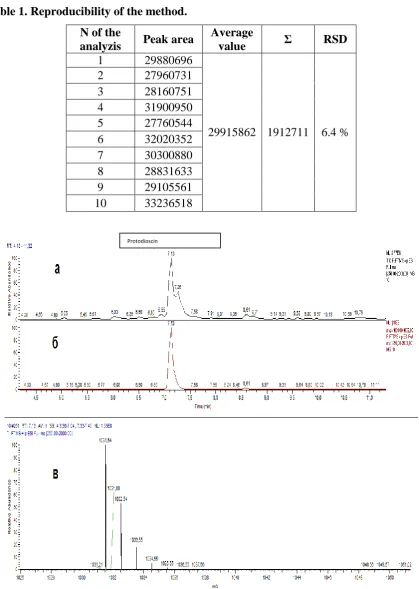
We have used connected in series (to achieve the best possible separation) columns Poroshell 120 EC - C18 150 x 3 mm 2.7 microns and Kinetex 100A C8 50 x 3 mm 2.6 microns. Elution of protodioscin (and the components of the test samples) was performed with a gradient of acetonitrile concentration from 2 to 95% linear % over 20 min with flow rate of 250 μl / min, and as a stimulating ionization modifier is used formic acid in a concentration of 0.08 %. The data show that protodioscin, in the positive ionization mode is ionized with elimination of a molecule of water and a positive ion with a monoisotopic mass 1031.54 (М-H2O+H+)+,
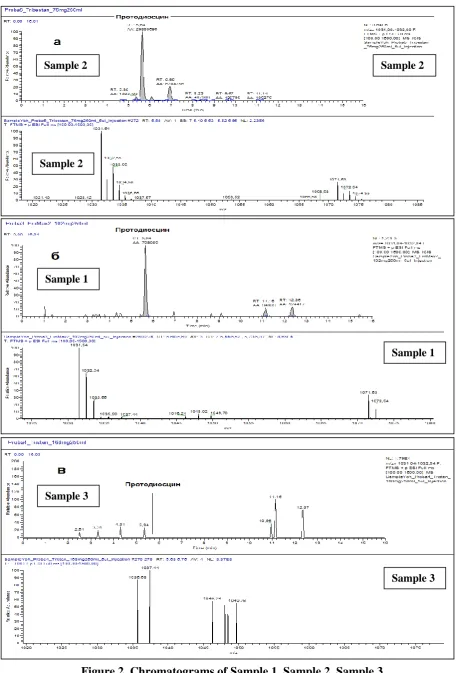
which is suitable for selective detection of protodioscin in the samples. Figure 1 shows chromatograms of protodioscin obtained by separation. We have obtained chromatograms of the samples which are presented in Figure 2. The chromatograms demonstrate that the content of protodioscin in sample 1 is about 40 times lower than that in sample 2. Protodioscin is not detected in sample 3. This analyzes shows again that there is big demand for serious analytical control on qualitative and quantitative composition of food supplements. The analytical control is key for consumer safety.
Table 1. Reproducibility of the method. N of the
analyzis Peak area
Average
value Σ RSD
1 29880696
29915862 1912711 6.4 % 2 27960731
3 28160751 4 31900950 5 27760544 6 32020352 7 30300880 8 28831633 9 29105561 10 33236518
Figure 1: Total ion chromatogram (a) and extracted chromatogram of a solution of protodioscin for monitoring an ion with m / z 1031.54, which mass number corresponds to the ion (M-H2O + H +) +, obtained from the mass spectral detection with high resolution in the monitoring of positive ions; (b) Mass spectrum of the peak at a retention time of 7.13 min, corresponding to the protodioscin.
Figure 2. Chromatograms of Sample 1, Sample 2, Sample 3 Sample 2
Sample 2
Sample 2
Sample 1
Sample 1
Sample 3
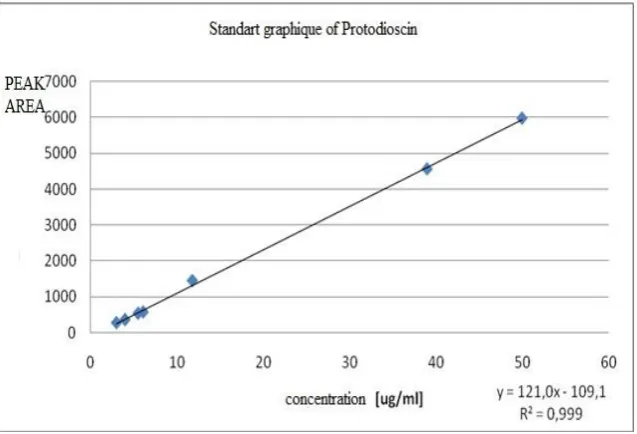
Figure 3. Standart graphique of Protodioscin.
CONCLUSION
The need of analytical strategies for control of food additives is indisputable because of the progressive growth of food additive`s market. Quality control of the food supplements is leading to consumer safety. This paper describes an analytical method suitable for the determination of protodioscin in FA and OTC products. We have established a rapid, sensitive and selective UHPLC method for detection of protodioscin. This method could be applied for the development of analytical procedures about the quality of FA and OTC, containing protodioscin. The practical use of this method will contribute to better security and safety for the consumers of FA.
ACKNOWLEDGEMENT
This work is supported by Medical University of Plovdiv, DP 13/2015
REFERENCES
1. Adimoelja AR, Phytochemicals and the breakthrough of traditional herbs in the management of sexual dysfunctions, International Journal of Andrology, April 2000; 23(S2): 82–84.
2. Gauthaman K, Adaikan PG, Prasad RN, Aphrodisiac properties of Tribulus Terrestris extract (Protodioscin) in normal and castrated rats, Life Sciences, 2002; 71(12): 1385–96. 3. Gauthaman K, Ganesan AP, Prasad RN, Sexual effects of puncturevine (Tribulus
4. Kostova I, Dinchev D, Saponins in Tribulus terrestris – Chemistry and Bioactivity, Phytochemistry Reviews, July 2005; 4(2): 111-137
5. Obreshkova DA, Analytical study and quality control of Bulgarian drugs with antioxidant activity, Pharmacia, 2011; 8(4): 108-114.
6. Zheleva- Dimitrova DI, Obreshkova DA, Nedialkov PA, Antioxidant activity of Tribulus Terrestris – a natural product in infertility therapy, International Journal of Pharmacy and Pharmaceutical Sciences,2012, 4 (4): 508-511.
7. Wang MI, Yaakov TA, Qing-Li Wu, Chee-Kok Chin, Stephen A. Garrison , Simon JA, Quantification of Protodioscin and Rutin in Asparagus Shoots by LC/MS and HPLC Methods, J. Agric. Food Chem., 2003; 51(21): 6132–6136.
8. Ganzera M, Bedir E, Khan A, Determination of steroidal saponins in Tribulus
terrestris by reversed-phase high-performance liquid chromatography and evaporative
light scattering detection, Journal of Pharmaceutical Sciences, November 2001; 90(11): 1752–1758.
9. Ramesh Sane, Menon Sasikumar, Abhijeet Deshpande, Ajay Menezes, Gunesh Gundi, Quantitation of protodioscin in Tribulus terrestris L. fruit powder by reversed-phase high-performance thin-layer chromatography, JPC - Journal of Planar Chromatography - Modern TLC, 2004; 17(5): 5-12.