1, 4-BUTANE DIOL BASED LIQUID CRYSTALLINE RANDOM
COPOLYESTER - SYNTHESIS AND CHARACTERIZATION
N. Mahadevan1, G. Annamalai1, S. Guhanathan2 and G. Elango1*
1
P.G. & Research Department of Chemistry, Government Arts College,
Tiruvannamalai-606603, Tamil Nadu, India.
2
P.G. & Research Department of Chemistry, Muthurangam Government Arts College,
Vellore -632002, Tamilnadu, India.
ABSTRACT
A copolyester was synthesized using 2,5-Ditertarybutrylquinol as one
of the diols with isophthaloyl chloride as an Acidchloride. In addition,
1,4-Butanediol, have also been used as another comonomer for the
synthesis of random copolymer. Formation of copolyester have been
confirmed using various spectral techniques viz., Ultraviolet (UV),
Fourier Transform Spectroscopy Infrared (FTIR), Nuclear Magnetic
Resonance (NMR) spectral techniques. Thermal studies were also
carried out using Differential Scanning Calorimetry (DSC) and
Thermo Gravimetric Analysis (TGA). Elemental analysis further
supports the formations for the copolymer. Morphology of the
copolyester has also been characterized using Scanning Electron
Microscope (SEM) and X-ray Diffraction (XRD) Method. Results of the investigation reveals
that a relatively new entry of copolymer has been suggested into the family of liquid
crystalline copolymers.
KEYWORDS: Copolyester, ultravioletspectroscopy, infraredspectroscopy, nuclearmagnetic
resonance, scanning electron microscope, X-ray Diffraction, characterization.
INTRODUCTION
The importance of thermotropic random copolyester has been recognized and several workers
have reported the synthesis and characterization of various copolyester which exhibit
different mesophase in the melt. Calundann[1] reported the liquid crystalline copolyester compositions based on hydroxy benzoic acid, hydroquione, 2,6 naphthalene diol, and
4,4‟-Volume 7, Issue 8, 420-430. Conference Article ISSN 2277–7105
*Corresponding Author
G. Elango
P.G. & Research
Department of Chemistry,
Government Arts College,
Tiruvannamalai Dt.606601,
Tamilnadu, India. Article Received on 05 March 2018,
Revised on 25 March 2018, Accepted on 15 April 2018
biphenol and also granted a patent for this preparation. Liquid crystalline polyesters have
positional and orientational molecular order which is intermediate between that of molecular
crystals and of liquids. The liquid crystalline polyesters do not melt directly to a liquid phase,
but first pass through a mesomorphic state, which at a higher temperature forms a clear
liquid. The moieties which generate the liquid crystalline organization are called the
mesogenic moieties and can be found either in main or side groups. Polymers which exhibit
liquid crystalline nature in solution are termed as lyotropic and those that exhibit in melt are
called thermotropic.[2] The structural characteristics associated with liquid crystalline behavior have been reviewed by Gray[3].Several thermotropic highly aromatic liquid
crystalline polyesters such as Vectra and Xydar have been commercialized. These polyesters
are thermaly stable and possess high tensile strength and modulus. The application of liquid
crystal polymers are in the area of fibres, films, plastics, holography, photocrosslinkages and
as information storage devices.
MATERIALS AND METHODS
1,2dichlorobenzene (MerkLR), 1,4-ButaneDiol (Loba),2,5-Ditertarybutrylquinol (Loba),
Isopthaloylchloride (Loba). Analarsamples of CHCl3, DMSO, DMF, Acetone, Methanol,
Ether is used as such.
POLYMER SYNTHESIS
Preparation of Random Copolyester P2BID
A 250ml three necked round bottomed flask equipped with a mechanical stirrer, a nitrogen
inlet, a reflex condenser and a thermometer was used. To the flask added
O-dichlorobenzene(150ml), then added 1,4-Butane diol 1.76ml(0.02 mole) followed by
2,5-Ditertarybutrylquinol 2.2g(0.01mole). The mixture was stirred for 20 minutes and
temperature was gradually increased to 120oC. To this reaction mixture, added isopthaloyl chloride 6g (0.03mole). Then the whole mixture was maintained with further stirring and
heating at 120oC-160oC for 52 hours. The reaction mixture was poured into ether with stirring to precipitate the polymer. The precipitated polymer was separated by filteration,
recrystallized by dissolving in acetone and poured in water, filtered and then dried. The
Scheme
Poly [oxy-(2,5-ditertiarybutyl-
1,4-benzene)oxy-co-(1.3-benzenoyl)-co-oxy-(1,4-butane)-oxy
RESULTS AND DISCUSSION
Characterization of random copolyesters
The characterization of the random copolyester viscosity measurements, solubility studies
and spectral data. Thermal studies were also performed on the polyester.
Fourier Transform Infrared spectroscopy spectra
The IR spectra of copolyesters were recorded using Perkin-Elmer spectrophotometer in the
frequency region 4000-500 cm-1. KBr pellet technique was employed for recording the IR spectra of copolyester. The IR Spectrum of random copolyester showed characteristic
absorption at 1740 cm-1 due to ester C = 0 stretching, 1020, 1080 and 1200 cm-1 due to the
ester –C-O stretching and bending indicating that the polyester chain is present in all the
polymer. The –OH absorption at 3435 cm-1 due to end – OH groups is very weak since the
hydroxyl groups are present at the end of long chains. It has been shown that the polymer
with stiff chains attached to a flexible backbone exhibit thermotropic liquid crystalline
behaviour. P2BID contain stiff chains with rigid spacer. This suggests that the ester carbonyl
bond strength decreases with increase in the length of the spacer group and hence rigidity of
the polymer chain decreases. The strong bands at 1082 cm-1,1124 cm-1,1166 cm-1 is due to
the carbonyl stretching of ester group. The three bands at 2958 cm-1,821 cm-1 and 873cm-1
are due to –CH2- stretching and bending vibration. The absorption band at 1608cm-1 is due
to the arylidene keto group present in copolyester. The vibrational frequencies assigned for
500 750 1000 1250 1500 1750 2000 2500 3000 3500 4000 1/cm 0 15 30 45 60 75 90 %T 3 4 3 5 .2 2 3 0 8 0 .3 2 2 9 5 8 .8 0 2 5 5 5 .6
8 23
[image:4.595.151.449.76.288.2]9 3 .6 6 2 2 8 9 .5 0 1 9 3 0 .7 4 1 7 2 4 .3 6 1 6 0 8 .6 3 1 4 6 7 .8 3 1 3 9 4 .5 3 1 2 9 6 .1 6 1 2 3 8 .3 0 1 1 6 6 .9 3 1 1 2 4 .5 0 1 0 8 2 .0 7 9 6 2 .4 8 8 7 3 .7 5 8 2 1 .6 8 5 5 3 .5 7 4 4 3 .6 3
Figure. 1: FTIR Spectram of P2BID.
Table 1: FTIR spectral data of P2BID random copolyester.
UV – VISIBLE Spectrum
The UV-Visible spectra of these polyesters were recorded in Shimadzu-uv-160A
spectrophotometer using acetone as solvent. The UV –Visible spectrum of P2BID show a
The random copolyester reported in the present investigation contains substituted benzene
Chromophore. Therefore, there are two possible electronic transitions, namely π → π* and n
→ π*. On the There are two absorption maxima was noted for the copolyester (Figure 2). It
may be pointed out that the value corresponding to both the absorption maxima are not
influenced by the length of the spacer in the polymer chain, but influenced by the number of
condensed rings present in the polymer chain.
Absorption frequency (cm-1) Assignment
1082,1124,1166, Stretching vibrations of the ester C-O 1740 Carbonyl stretching of the ester group
1276 CH2 – Wagging
720 AliphaticC-H bending 2958,873,821 CH2- Stretching
Figure 2: UV Spectrum of P2BID.
1
H NMR spectral analysis
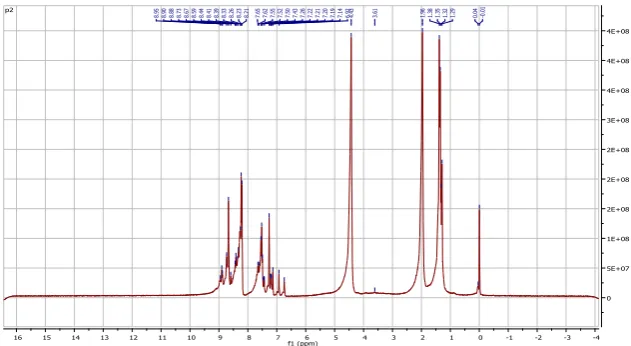
[image:5.595.159.436.72.236.2]A PMR spectrum of the polyester was obtained in CDCl3 solution with TMS as reference in
Figure 3. The peak positions in the spectrum were listed in Table 2. The chemical shift values
can be explained on the basis of structural units present in the polyester.
Figure 3: 1H NMR Spectrum of P2BID.
Table 3: PMR spectral data of random copolyester.
Chemical Shift () (ppm)
Type of protons
2.1 Protons of the ester group 3.6 - CH3 group
6.5 – 8.0 1,3 – phenylene 1,4 – phenylene
Thermo gravimetric analysis (TGA)
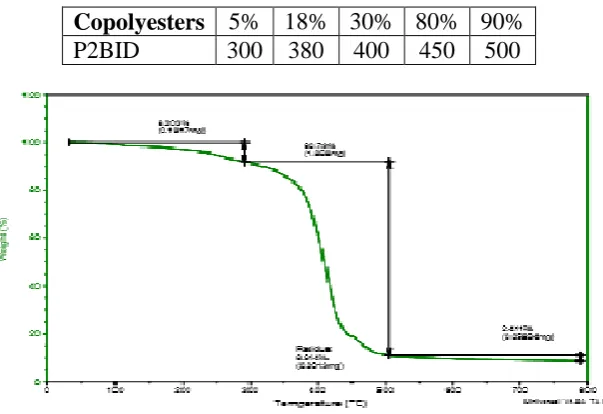
TGA analysis of the polyester P2BID was carried out in SDT Q600V20.9. The experiment
[image:5.595.157.473.372.545.2]sample was used with close packing. It can also be used to determine the kinetic parameters
of degradation of copolyester. The continuous weight loss curve for the thermal degradation
of the co polyester was provided in Figures 4. The degradation of the copolyester was carried
out in nitrogen atmosphere at a heating rate of 20°C/min. The thermogram suggests that the
copolyester was thermally stable up to 300°C with five stage degradation. The first
degradation stage starts around 300°C with 5% of degradation. The second stage of
degradation starts around 380°C with approximately around 18% of the copolyester gets
degraded. Third stage of degradation starts around 400°C with 30% of degradation. Fourth
stage of degradation starts around 450°C with 80% of degradation. Fifith stage of degradation
starts around 500°C with 90% of degradation. Table show that around 5% of the copolyester
degraded at about 300°C For 80% degradation was observed at 450°C. This may be due to
the presence of rigid rod and crank shaft mesogens. It is evident from the degradation
temperature of copolyesters that the copolyester P2BID degraded at lower temperature may
[image:6.595.148.450.393.600.2]be due to the presence of aliphatic mesogens.
Table 4: Thermal stability of copolyester.
Copolyesters 5% 18% 30% 80% 90% P2BID 300 380 400 450 500
Figure 4: TGA thermograms of random copolyester P2BID.
Scanning electron microscopic studies
The characterization of LC polyester by optical polarizing microscopy is the most straight
forward method available and the use of the technique in TLC polymer is limited, because
polymeric materials take longer time to show the recognizable textures at moderately high
temperatures and during that period, the polymers may decompose. In such cases SEM
the film surface. SEM investigations have been made for polyester at different places on the
surface of the film with varying magnifications. The SEM photographs of the random
copolyester were depicted in Figure 5. The rigid and long range orientational order is evident
from the SEM micrographs of the polyester. It has been suggested that the microstructure of
TLC polymeric materials have some evidences of crystallinity embedded within extended
chain structure of the mesophase (Windle et al., 1985; Lin and Winter, 1988; Blundell, 1982;
Kaito et al., 1988; Cheng, 1988; Butzbach et al., 1985). This crystallinity has been described
as a non –periodic layer structure which propagates among adjacent oriented chains. The
SEM photographs of the random copolyester show such crystallinity on their film surface
indicating long range orientational order.
Figure 5: (a). P2BID(5 Kv), 10(b). P2BID (15 Kv).
X-ray Diffraction
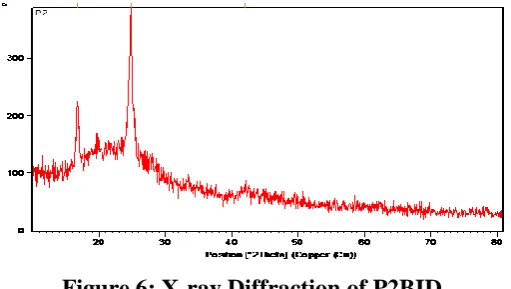
XRD patterns of samples were recorded using XPERT -PRO, Philips, operating at voltage of 40 kV, current -30 mA; scanning speed - 7.5⋅10−3 °/s. The applied radiationfrom target CuKαwas nickel filtered (λ=1.540 Å). The range of scattering angles (2θ) was 5–40°. The
obtained curves havebeen mathematically elaborated using Hpert High Score soft-ware.
[image:7.595.118.486.290.441.2]X-ray diffraction patterns were obtained at room temperature.
[image:7.595.170.426.618.762.2]Table 5: X-ray Diffraction Value of P2BID.
Pos. [°2Th.] Height [cts] FWHM Left [°2Th.] d-spacing [Å] Rel. Int. [%]
16.6960 116.33 0.2460 5.31003 39.27
24.7679 296.20 0.1968 3.59475 100.00
41.9883 16.86 1.1808 2.15182 5.69
CONCLUSION
The reaction pathways for synthesis of high molar mass aliphatic-aromatic polyester were
elaborated. Copolymers obtained by polycondensation process were characterized by a
random chemical structure. The copolyester was soluble in common organic solvents such as
acetone, chloroform and aprotic solvents such as DMF and CCl4. The inherent viscosity is
proportional to polymer molecular weight and molecular weight has a drastic influence on the
phase transition temperature of the polyester. IR and NMR spectral values are in accordance
with functional group and the nature of mesogens present. Thermal analysis infers the glass
transition temperature, melting mesophase formation temperature and isotropisation
temperature respectively. The transition temperatures are useful in determining the liquid
crystalline state. Oriented fibres and plastic of high strength can be obtained at the liquid
crystalline state, when copolyesters can be spun and injection moulded Molecular mass of
liquid crystals have proved that LC state can be directly correlated with constitutions of the
molecule. SEM micrograph of LC polyester film provides useful information regarding the
structure of the film surface.
ACKNOWLEDGEMENT
Authors thank the Principal, Government Arts College, Tiruvannamalai, for providing
necessary facilities to carry out research work.
REFERENCES
1. Calundann., U.S. Pat., 1978; 4: 067-852.
2. Winderlich. B., “Macromolecular Physics”, 1973; 1.
3. Gray, G.W., Academic press., 1978.
4. Billmeyer, F.W. Jr., “Text book of polymer science”, John Wiley and Son New York.,
1970.
5. Y. Tokiwa and T. Suzuki, J. Appl. Polym. Sci., 1981; 26: 441
6. U. Witt and R. J. Muller, W. D. Deckwar, Macromol. Chem. Phys., 1996; 197: 1525.
7. G. Odian, Principles of Polymerization, Mc Graw Hill, New York., 1970.
9. H. G. Elias, New Commercial Polymers, Garden and Branch Science Publishers, New
York., 1977.
10. Abe A “Isotropic (Ni) transitions –contribution in entropy” Macromolecules, 1984; 17:
2280.
11. Lussac JG, Pelouze J Advances in the synthetic macromolecular compounds, Ann., 1833;
7: 40.
12. James J, Malley O, Walter JS Synthesis and characterization of isomeric polyesters based
on sebacic acid and hexanediols. J., 2003.
13. Yiwang C, Yan Y, Jiying S, Licheng T, Yan W “Preparation and characterization of
aliphatic/aromatic copolyesters based on bisphenol-A terephthalate, hexylene
terephthalate and lactide mioties”, Reactive Functional Polymers, 2007; 67(5): 396-407.
14. Bellamy LJ The Infrared Spectra of Complex Molecules, Chapman and Hall, London. P.,
1975; 217.
15. Krighaum WR, Asrar J, Toriumi H, Ciferri A, Presten J Thermotropic Homopolymers III.
Preparation and properties, J. Polym. Sci. Polym. Lett. Ed., 1982; 20: 109.
16. Windle AH, Viney C, Golombok R, Donald AM, Mitchell GR Sequencesegregation in
molten liquid crystalline random copolymers, Faraday Dis., Chem. Soc., 1985; 79: 55.
17. Lin YG, Winter H “High temperature recystallisation and rheology of thermotropic liquid crystalline polymers” “Macromolecules, 1988; 21: 2439.
18. Blundell DJ “Variation of crystallographic parameters in PEEK with heat” Polymer,
1982; 23: 359.
19. Cheng SZD “Electrochemical formation of chiral polyaniline colloid codoped polymers”
Macromolecules, 1988; 21: 2475.
20. Butzbach GD, Wendorff JH, Zimmermann HJ “Pressure dependence of free radical decay
gramma –irradiated main-chain liquid crystalline polymers” Makromol. Chem. Rapid
Commun., 1985; 6: 821.
21. Kaito A, Kyotani M, Nakayana K “Effects of shear rate on the molecular orientation in extruded rods of a thermotropic liquid crystalline polymers” Macromolecules, 1988; 23:
1035.
22. Ki HC, Park Ok O Synthesis, characterization and biodegradability of the biodegradable
aliphatic–aromatic random copolyesters, Polymer, 2001; 42(5): 1849-1861.
23. Licheng T, Yiwang C, Yang W, Weihua Z, Xiaohui H “Melt reaction and structural
analysis based on poly(butylene terephthalate) and oligo(lactic acid) with addition of
24. Liou GS, Kakimoto MA, Imai Y Thermally stable organosoluble binaphthylene based
polymers, J. Polym, Sci: Part A. Polym. Chem., 1994; 32: 597.
25. Nicholas PC „Handbook of Polymer science and Technology; Synthesis and properties”,
1989; 1: 177.
26. Padmanabha N, Arumugasamy E, Ravichandran E, Kannappan EV, Varma IK Formation
and characterization of fibres and films, Mol. Cryst. Liq. Cryst., 1996.
27. Reiji M, Kei W, Takashi O, Yasunari N “Development of novel multifunctional cosmetic
raw materials and their applications.novel emulsifying method with random copolymer of
polyoxyethylene / polyoxypropylene” J. Oleo Sci., 2006; 55(8): 403-411.
28. Roviello A, Sirigu A Advances in macromolecules- perspectives and applications”“Makromol. Chem., 1979; 183: 895.
29. Sachindrapal P, Ramasamy S, Nanjan MJ unsaturated polyamide from 3 amino or 4 –
carboxycinnamic acid, Polymer Bull., 1981; 5: 417.
30. Seymour BR, Krishenbaum GS 'High performance polymers: Their origin and
development', New York, p., 1986; 147.
31. Shibaev VP Advances in Liquid Crystals, Bata, L., Ed., Oxford Bergamon Press,
Budapest, 1980; 2: 869.
32. Shibaev VP, Kostromin SG, Plate NA sidechain liquid crystalline polymers, Europ.
Polym. J., 1982; 8: 651.
33. Skovby MHB, Heilmann CA, Kops J In liquid crystalline polymers, weiss. R.A., Oba.,
1990.
34. C.K., Eds., ACS symposium series American chemical Society, Washington, DC., 435:
46.
35. Whan-Gi K, Hay AS Random block copolyester – characterization, J. Polym. Sci. Part A.
Polym. Chem., 1994; 32: 97-103.
36. Wendorff IH, Finkelmann H, Ringsdorf H ”liquid-crystalline polymethacrylates –by atom transfer radical polymerization” J.Polym.Sci. Polym. Symp., 1978; 63: 245.
37. Zbinden R IR Spectra of High Polymers, Academic Press, New York., 1964; 59.
38. Robinson C “Heterogeneous network polymers-7. cholestric liquid cryslline polymers”
1958.
39. Trans. Faraday Soc., 571 & Robinson, C., Ward, J.C. and Beevers, R.B., Discuss.
Faraday Soc., 1956; 52: 25-29.
41. Lenz RW, Jin JI Liquid Crystals and Ordered Phases, Griffin, and Johnsons, J., Ed.,
Plenum Press, New York, 1985; 328.
42. Strzelecki L, Van Luyen D “Orientation dynamicsof main chain liquid crystalline polymers” Eur. Polym. J., 1980; 16: 299.
43. Halina Kaczmarek Crosslinked blends of poly (lactic acid) and polyacrylates: AFM, DSC