Iterative Viterbi A* Algorithm for
K
-Best Sequential Decoding
Zhiheng Huang†, Yi Chang, Bo Long, Jean-Francois Crespo†, Anlei Dong, Sathiya Keerthi and Su-Lin Wu
Yahoo! Labs
701 First Avenue, Sunnyvale CA 94089, USA
{zhiheng huang,jfcrespo}@yahoo.com†
{yichang,bolong,anlei,selvarak,sulin}@yahoo-inc.com
Abstract
Sequential modeling has been widely used in a variety of important applications including named entity recognition and shallow pars-ing. However, as more and more real time large-scale tagging applications arise, decod-ing speed has become a bottleneck for exist-ing sequential taggexist-ing algorithms. In this pa-per we propose1-best A*,1-best iterative A*, k-best A* andk-best iterative Viterbi A* al-gorithms for sequential decoding. We show the efficiency of these proposed algorithms for five NLP tagging tasks. In particular, we show that iterative Viterbi A* decoding can be sev-eral times or orders of magnitude faster than the state-of-the-art algorithm for tagging tasks with a large number of labels. This algorithm makes real-time large-scale tagging applica-tions with thousands of labels feasible.
1 Introduction
Sequence tagging algorithms including HMMs (Ra-biner, 1989), CRFs (Lafferty et al., 2001), and Collins’s perceptron (Collins, 2002) have been widely employed in NLP applications. Sequential decoding, which finds the best tag sequences for given inputs, is an important part of the sequential tagging framework. Traditionally, the Viterbi al-gorithm (Viterbi, 1967) is used. This alal-gorithm is quite efficient when the label size of problem mod-eled is low. Unfortunately, due to itsO(T L2) time complexity, whereT is the input token size andL
is the label size, the Viterbi decoding can become prohibitively slow when the label size is large (say, larger than 200).
It is not uncommon that the problem modeled consists of more than 200 labels. The Viterbi al-gorithm cannot find the best sequences in tolerable
response time. To resolve this, Esposito and Radi-cioni (2009) have proposed a Carpediem algorithm which opens only necessary nodes in searching the best sequence. More recently, Kaji et al. (2010) pro-posed a staggered decoding algorithm, which proves to be very efficient on datasets with a large number of labels.
What the aforementioned literature does not cover is thek-best sequential decoding problem, which is indeed frequently required in practice. For example to pursue a high recall ratio, a named entity recogni-tion system may have to adoptk-best sequences in case the true entities are not recognized at the best one. Thek-best parses have been extensively stud-ied in syntactic parsing context (Huang, 2005; Pauls and Klein, 2009), but it is not well accommodated in sequential decoding context. To our best knowl-edge, the state-of-the-artk-best sequential decoding algorithm isViterbi A*1. In this paper, we general-ize theiterative processfrom the work of (Kaji et al., 2010) and propose ak-best sequential decoding al-gorithm, namelyiterative Viterbi A*. We show that the proposed algorithm is several times or orders of magnitude faster than the state-of-the-art in all tag-ging tasks which consist of more than 200 labels.
Our contributions can be summarized as follows. (1) We apply the A* search framework to sequential decoding problem. We show that A* with a proper heuristic can outperform the classic Viterbi decod-ing. (2) We propose1-best A*,1-best iterative A* decoding algorithms which are the second and third fastest decoding algorithms among the five decod-ing algorithms for comparison, although there is a significant gap to the fastest 1-best decoding algo-rithm. (3) We proposek-best A* andk-best iterative Viterbi A* algorithms. The latter is several times or orders of magnitude faster than the state-of-the-art
1
Implemented in both CRFPP (http://crfpp.sourceforge.net/) and LingPipe (http://alias-i.com/lingpipe/) packages.
k-best decoding algorithm. This algorithm makes real-time large-scale tagging applications with thou-sands of labels feasible.
2 Problem formulation
In this section, we formulate the sequential decod-ing problem in the context of perceptron algorithm (Collins, 2002) and CRFs (Lafferty et al., 2001). All the discussions apply to HMMs as well. Formally, a perceptron model is
f(y,x) =
T
X
t=1
K
X
k=1
θkfk(yt, yt−1,xt), (1)
and a CRFs model is
p(y|x) = 1 Z(x)exp{
T
X
t=1
K
X
k=1
θkfk(yt, yt−1,xt)}, (2)
wherexandyis an observation sequence and a la-bel sequence respectively,tis the sequence position,
T is the sequence size,fkare feature functions and
Kis the number of feature functions.θkare the
pa-rameters that need to be estimated. They represent the importance of feature functionsfkin prediction. For CRFs, Z(x) is an instance-specific normaliza-tion funcnormaliza-tion
Z(x) =X
y
exp{ T
X
t=1
K
X
k=1
θkfk(yt, yt−1,xt)}. (3)
Ifxis given, the decoding is to find the bestywhich maximizes the score off(y,x)for perceptron or the probability ofp(y|x)for CRFs. AsZ(x) is a con-stant for any given input sequencex, the decoding for perceptron or CRFs is identical, that is,
arg max
y
f(y,x). (4)
To simplify the discussion, we divide the features into two groups: unigram label features and bi-gram label features. Unibi-gram features are of form
fk(yt,xt)which are concerned with the current
la-bel and arbitrary feature patterns from input se-quence. Bigram features are of formfk(yt, yt−1,xt)
which are concerned with both the previous and the current labels. We thus rewrite the decoding prob-lem as
arg max
y T
X
t=1
(
K1
X
k=1
θ1kfk1(yt,xt) + K2
X
k=1
θ2kfk2(yt, yt−1,xt)).
(5)
For a better understanding, one can inter-pret the term PK1
k=1θk1fk1(yt,xt) as node yt’s
score at position t, and interpret the term
PK2
k=1θ2kfk2(yt, yt−1,xt) as edge (yt−1, yt)’s
score. So the sequential decoding problem is cast as a max score pathfinding problem2. In the discussion hereafter, we assume scores of nodes and edges are pre-computed (denoted as n(yt) and e(yt−1, yt)),
and we can thus focus on the analysis of different decoding algorithms.
3 Background
We present the existing algorithms for both 1-best andk-best sequential decoding in this section. These algorithms serve as basis for the proposed algo-rithms in Section 4.
3.1 1-Best Viterbi
The Viterbi algorithm is a classic dynamic program-ming based decoding algorithm. It has the computa-tional complexity ofO(T L2), whereT is the input sequence size andLis the label size3. Formally, the Viterbi computesα(yt), the best score from starting
position to labelyt, as follows. max
yt−1
(αyt−1+e(yt−1, yt)) +n(yt), (6)
wheree(yt−1, yt) is the edge score between nodes
yt−1 and yt, n(yt) is the node score for yt. Note
that the termsαyt−1 ande(yt−1, yt)take value 0 for
t = 0at initialization. Using the recursion defined above, we can compute the highest score at end po-sitionT −1 and its corresponding sequence. The recursive computation ofαyt is denoted as forward pass since the computing traverses the lattice from left to right. Conversely, the backward pass com-putesβyt as the follows.
max
yt+1
(βyt+1+e(yt, yt+1) +n(yt+1)). (7)
Note that βyT−1 = 0 at initialization. The max
score can be computed usingmaxy0(β0 +n(y0)).
We can use either forward or backward pass to compute the best sequence. Table 1 summarizes the computational complexity of all decoding algo-rithms including Viterbi, which has the complexity of T L2 for both best and worst cases. Note that N/A means the decoding algorithms are not applica-ble (for example, iterative Viterbi is not applicaapplica-ble tok-best decoding). The proposed algorithms (see Section 4) are highlighted in bold.
3.2 1-Best iterative Viterbi
Kaji et al. (Kaji et al., 2010) presented an efficient sequential decoding algorithm namedstaggered de-coding. We use the nameiterative Viterbito describe
2
With the constraint that the path consists of one and only one node at each position.
3
this algorithm for the reason that the iterative pro-cess plays a central role in this algorithm. Indeed, this iterative process is generalized in this paper to handlek-best sequential decoding (see Section 4.4). The main idea is to start with a coarse lattice which consists of bothactivelabels anddegenerate
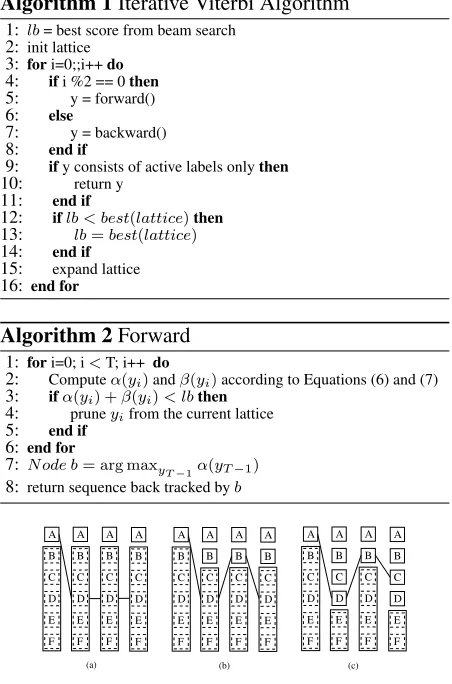
labels. A label is referred to as anactive labelif it is not grouped (e.g., all labels in Fig. 1 (a) and la-belAat each position in Fig. 1 (b)), and otherwise as aninactive label(i.e., dotted nodes). The new la-bel, which is made by grouping the inactive labels, is referred to as adegenerate label(i.e., large nodes covering the dotted ones). Fig. 1 (a) shows a lattice which consists of active labels only and (b) shows a lattice which consists of both active and degener-ate ones. The score of a degenerdegener-ate label is the max score of inactive labels which are included in the de-generate label. Similarly, the edge score between a degenerate labelzand an active labely0 is the max edge score between any inactive labely∈zandy0, and the score of two degenerate labelszandz0is the max edge score between any inactive label y ∈ z
and y0 ∈ z0. Using the above definitions, the best sequence derived from a degenerate lattice would be the upper bound of the sequence derived from the original lattice. If the best sequence does not include any degenerate labels, it is indeed the best sequence for the original lattice.
F A B C D E F A B C D E F A B C D E F A B C D E F A A B C D E F A B C D E F A B C D E F B C D E
Figure 1: (a) A lattice consisting of active labels only. (b) A lattice consisting of both active labels and degener-ate ones. Each position has one active label (A) and one degenerate label (consisting of B, C. D, E, and F).
The pseudo code for this algorithm is shown in Algorithm 1. The lattice is initialized to include one active label and one degenerate label at each position (see Figure 1 (b)). Note that the labels are ranked by the probabilities estimated from the training data. The Viterbi algorithm is applied to the lattice to find the best sequence. If the sequence consists of ac-tive labels only, the algorithm terminates and returns such a sequence. Otherwise, the lower boundlb4of the active sequence in the lattice is updated and the lattice is expanded. The lower bound can be initial-ized to the best sequence score using a beam search (with beam size being 1). After either a forward or a backward pass, the lower bound is assigned with
4
The maximum score of the active sequences found so far.
the best active sequence scorebest(lattice)5 if the former is less than the latter. The expansion of lat-tice ensures that the latlat-tice has twice active labels as before at a given position. Figure 2 shows the column-wise expansion step. The number of active labels in the column is doubled only if the best se-quence of the degenerate lattice passes through the degenerate label of that column.
Algorithm 1Iterative Viterbi Algorithm
1: lb= best score from beam search
2: init lattice
3: fori=0;;i++do 4: ifi %2 == 0then 5: y = forward()
6: else
7: y = backward()
8: end if
9: ify consists of active labels onlythen 10: return y
11: end if
12: iflb < best(lattice)then 13: lb=best(lattice) 14: end if
15: expand lattice
16: end for
Algorithm 2Forward
1: fori=0; i<T; i++ do
2: Computeα(yi)andβ(yi)according to Equations (6) and (7)
3: ifα(yi) +β(yi)< lbthen 4: pruneyifrom the current lattice 5: end if
6: end for
7: N ode b= arg maxyT−1α(yT−1)
8: return sequence back tracked byb
(c) B C D E F B C D E F B C D E F B C D E F A A A A B C D E F B C D E F B C D E F B C D E F A A A A
B C D E F B C D E F B C D E F B C D E F A A A A
[image:3.612.313.539.166.508.2](a) (b)
Figure 2: Column-wise lattice expansion: (a) The best sequence of the initial degenerate lattice, which does not pass through the degenerate label in the first column. (b) Column-wise expansion is performed and the best se-quence is searched again. Notice that the active label in the first column is not expanded. (c) The final result.
Algorithm 2 shows the forward pass in which the node pruning is performed. That is, for any node, if the best score of sequence which passes such a node is less than the lower boundlb, such a node is removed from the lattice. This removal is safe as such a node does not have a chance to form an optimal sequence. It is worth noting that, if a node is removed, it can no longer be added into the lattice.
5
[image:3.612.122.252.389.464.2]This property ensures the efficiency of the iterative Viterbi algorithm. The backward pass is similar to the forward one and it is thus omitted.
The alternative calls of forward and backward passes (in Algorithm 1) ensure the alternative updat-ing/lowering of node forward and backward scores, which makes the node pruning in either forward pass (see Algorithm 2) or backward pass more efficient. The lower boundlbis updated once in each iteration of the main loop in Algorithm 1. While the forward and backwards scores of nodes gradually decrease and the lower bound lb increases, more and more nodes are pruned.
The iterative Viterbi algorithm has computational complexity ofT and T L2 for best and worst cases
respectively. This can be proved as follows (Kaji et al., 2010). At them-th iteration in Algorithm 1, it-erative Viterbi decoding requires order ofT4mtime because there are2m active labels (plus one degen-erate label). Therefore, it hasPm
i=0T4i time
com-plexity if it terminates at them-th iteration. In the best case in whichm= 0, the time complexity isT. In the worst case in whichm=dlog2Le −1(d.eis the ceiling function which maps a real number to the smallest following integer), the time complexity is order ofT L2becausePdlog2Le−1
i=0 T4i <4/3T L2.
3.3 1-Best Carpediem
Esposito and Radicioni (2009) have proposed a novel1-best6 sequential decoding algorithm, Car-pediem, which attempts to open only necessary nodes in searching the best sequence in a given lat-tice. Carpediem has the complexity ofT LlogLand
T L2 for the best and worst cases respectively. We skip the description of this algorithm due to space limitations. Carpediem is used as a baseline in our experiments for decoding speed comparison.
3.4 K-Best Viterbi
In order to produce k-best sequences, it is not enough to store 1-best label per node, as the k -best sequences may include suboptimal labels. The
k-best sequential decoding gives up this 1-best label memorization in the dynamic programming paradigm. It stores up tok-best labels which are nec-essary to formk-best sequences. Thek-best Viterbi algorithm thus has the computational complexity of
KT L2for both best and worst cases.
Once we store thek-best labels per node in a lat-tice, thek-best Viterbi algorithm calls either the for-ward or the backfor-ward passes just in the same way as the1-best Viterbi decoding does. We can compute
6
They did not providek-best solutions.
the k highest score at the end positionT −1and the correspondingk-best sequences.
3.5 K-Best Viterbi A*
To our best knowledge the most efficientk-best se-quence algorithm is the Viterbi A* algorithm as shown in Algorithm 3. The algorithm consists of one forward pass and an A* backward pass. The forward pass computes and stores the Viterbi forward scores, which are the best scores from the start to the cur-rent nodes. In addition, each node stores abacklink
which points to its predecessor.
The major part of Algorithm 3 describes the back-ward A* pass. Before describing the algorithm, we note that each node in the agenda represents a se-quence. So the operations on nodes (push or pop) correspond to the operations on sequences. Initially, the L nodes at position T −1 are pushed to an agenda. Each of theLnodesni,i= 0, . . . , L−1,
represents a sequence. That is, nodeni represents
the best sequence from the start to itself. The best of theLsequences is the globally best sequence. How-ever, thei-th best,i = 2, . . . , k, of theLsequence may not be the globallyi-th best sequence. The pri-ority of each node is set as the score of the sequence which is derived by such a node. The algorithm then goes to a loop ofk. In each loop, the best node is popped off from the agenda and is stored in a setr. The algorithm adds alternative candidate nodes (or sequences) to the agenda via a double nested loop. The idea is that, when an optimal node (or sequence) is popped off, we have to push to the agenda all nodes (sequences) which are slightly worse than the just popped one. The interpretation of slightly worse is to replace one edge from the popped node (se-quence). The slightly worse sequences can be found by the exact heuristic derived from the first Viterbi forward pass.
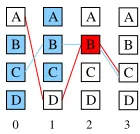
Figure 3 shows an example of the push operations for a lattice ofT = 4,Y = 4. Suppose an optimal node 2:B(in red, standing for nodeBat position 2, representing the sequence of 0:A 1:D 2:B 3:C) is popped off, new nodes of 1:A, 1:B, 1:C and 0:B, 0:C and 0:D are pushed to the agenda according to the double nested for loop in Algorithm 3. Each of the pushed nodes represents a sequence, for ex-ample, node 1:B represents a sequence which con-sists of three parts: Viterb sequence from start to 1:B (0:C 1:B), 2:B and forward link of 2:B (3:C
in this case). All of these pushed nodes (sequences) are served as candidates for the next agenda pop op-eration.
T
B
C
D B
C
D B
C
D B
C
D
A A A A
3
1 2
[image:5.612.155.225.58.125.2]0
Figure 3: Alternative nodes push after popping an opti-mal node.
computation complexity ofT L2+T Lfor both best and worst cases, with the first term accounting for Viterbi forward pass and the second term account-ing for A* backward process. The bottleneck is thus at the Viterbi forward pass.
Algorithm 3K-Best Viterbi A* algorithm
1: forward()
2: pushLbest nodes to agendaq 3: c= 0
4: r={}
5: whilec < Kdo 6: Noden=q.pop()
7: r=r∪n
8: fori=n.t−1;i≥0;i− −do 9: forj= 0;j < L;j+ +do 10: ifj! =n.backlink.ythen
11: create new nodesat positioniand labelj 12: s.f orwardlink=n
13: q.push(s)
14: end if 15: end for 16: n=n.backlink 17: end for
18: c+ + 19:end while
20:returnKbest sequences derived byr
4 Proposed Algorithms
In this section, we propose A* based sequen-tial decoding algorithms that can efficiently handle datasets with a large number of labels. In particular, we first propose the A* and the iterative A* decod-ing algorithm for 1-best sequential decoding. We then extend the1-best A* algorithm to ak-best A* decoding algorithm. We finally apply the iterative process to the Viterbi A* algorithm, resulting in the
iterative Viterbi A*decoding algorithm.
4.1 1-Best A*
A*(Hart et al., 1968; Russell and Norvig, 1995), as a classic search algorithm, has been successfully ap-plied in syntactic parsing (Klein and Manning, 2003; Pauls and Klein, 2009). The general idea of A* is to consider labelsyt which are likely to result in the best sequence using a scorefas follows.
f(y) =g(y) +h(y), (8)
whereg(y)is the score from start to the current node and h(y) is a heuristic which estimates the score
from the current node to the target. A* uses an agenda (based on thefscore) to decide which nodes are to be processed next. If the heuristic satisfies the conditionh(yt−1) ≥ e(yt−1, yt) +h(yt), thenh is
calledmonotoneoradmissible. In such a case, A* is guaranteed to find the best sequence. We start with the naive (but admissible) heuristic as follows
h(yt) =
T−1
X
i=t+1
(maxn(yi) + maxe(yi−1, yi)). (9)
That is, the heuristic of nodeytto the end is the sum
of max edge scores between any two positions and max node scores per position. Similar to (Pauls and Klein, 2009) we explore the heuristic in different coarse levels. We apply the Viterbi backward pass to different degenerate lattices and use the Viterbi backward scores as different heuristics. Different degenerate lattices are generated from different it-erations of Algorithm 1: Them-th iteration corre-sponds to a lattice of(2m+ 1)∗T nodes. A largerm
indicates a more accurate heuristic, which results in a more efficient A* search (fewer nodes being pro-cessed). However, this efficiency comes with the price that such an accurate heuristic requires more computation time in the Viterbi backward pass. In our experiments, we try the naive heuristic and the following values ofm:0,3,6and9.
In the best case, A* expands one node per posi-tion, and each expansion results in the push of all nodes at next position to the agenda. The search is similar to the beam search with beam size being 1. The complexity is thusT L. In the worst case, A* expands every node per position, and each expan-sion results in the push of all nodes at next position to the agenda. The complexity thus becomesT L2.
4.2 1-Best Iterative A*
The iterative process as described in the iterative Viterbi decoding can be used to boost A* algorithm, resulting in theiterative A*algorithm. For simplic-ity, we only make use of the naive heuristic in Equa-tion (9) in the iterative A* algorithm. We initialize the lattice with one active label and one degenerate label at each position (see Figure 1 (b)). We then run A* algorithm on the degenerate lattice and get the best sequence. If the sequence is active we return it. Otherwise we expand the lattice in each iteration until we find the best active sequence. Similar to iterative Viterbi algorithm, iterative A* has the com-plexity ofT and T L2 for the best and worst cases respectively.
4.3 K-Best A*
Table 1: Best case and worst case computational complexity of various decoding algorithms. 1-best decoding K-best decoding
best case worst case best case worst case
beam T L T L KT L KT L
Viterbi T L2 T L2 KT L2 KT L2
iterative Viterbi T T L2 N/A N/A
Carpediem T LlogL T L2 N/A N/A
A* T L T L2 KT L KT L2
iterative A* T T L2 N/A N/A
Viterbi A* N/A N/A T L2+KT L T L2+KT L
iterative Viterbi A* N/A N/A T+KT T L2+KT L
We use either the naive heuristic (Equation (9)) or different coarse level heuristics by settingmto be0, 3,6or9(see Section 4.1). The firstknodes which are popped off the agenda can be used to back track thek-best sequences. Thek-best A* algorithm has the computational complexity ofKT Land KT L2
for best and worst cases respectively.
4.4 K-Best Iterative Viterbi A*
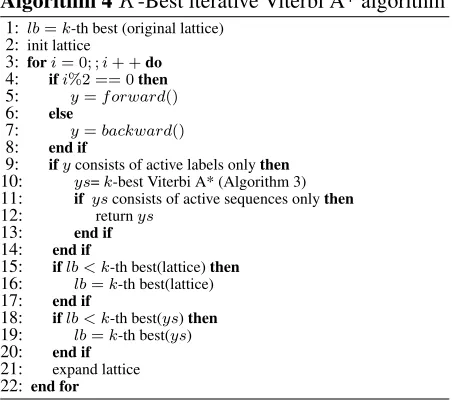
We now present thek-best iterative Viterbi A* algo-rithm (see Algoalgo-rithm 4) which applies the iterative process tok-best Viterbi A* algorithm. The major difference between1-best iterative Viterbi A* algo-rithm (Algoalgo-rithm 1) and this algoalgo-rithm is that the latter calls thek-best Vitebi A* (Algorithm 3) after the best sequence is found. If thek-best sequences are all active, we terminate the algorithm and return thek-best sequences. If we cannot find either the best active sequence or thek-best active sequences, we expand the lattice to continue the search in the next iteration.
As in the iterative Viterbi algorithm (see Section 3.2), nodes are pruned at each position in forward or backward passes. Efficient pruning contributes significantly to speeding up decoding. Therefore, to have a tighter (higher) lower boundlbis important. We initialize the lower boundlb with thek-th best score from beam search (with beam size beingk) at line 1. Note that the beam search is performed on the original lattice which consists ofLactive labels per position. The beam search time is negligible com-pared to the total decoding time. At line 16, we up-datelbas follows. We enumerate the best active se-quences backtracked by the nodes at positionT −1. If the currentlbis less than thek-th active sequence score, we update thelbwith thek-th active sequence score (we do not updatelbif there are less thank ac-tive sequences). At line 19, we use the sequences returned from Viterbi A* algorithm to update thelb
in the same manner. To enable this update, we re-quest the Viterbi A* algorithm to returnk0,k0 > k, sequences (line 10). A larger number ofk0 results in a higher chance to find thek-th active sequence,
which in turn offers a tighter (higher)lb, but it comes with the expense of additional time (the backward A* process takes O(T L) time to return one more sequence). In experiments, we found thelbupdates on line 1 and line 16 are essential for fast decoding. The updating oflbusing Viterbi A* sequences (line 19) can boost the decoding speed further. We exper-imented with differentk0 values (k0 =nk, wheren
is an integer) and selectedk0 = 2k which results in the largest decoding speed boost.
Algorithm 4K-Best iterative Viterbi A* algorithm
1: lb=k-th best (original lattice)
2: init lattice
3: fori= 0; ;i+ +do 4: ifi%2 == 0then 5: y=f orward() 6: else
7: y=backward() 8: end if
9: ifyconsists of active labels onlythen 10: ys=k-best Viterbi A* (Algorithm 3)
11: if ysconsists of active sequences onlythen 12: returnys
13: end if 14: end if
15: iflb < k-th best(lattice)then 16: lb=k-th best(lattice)
17: end if
18: iflb < k-th best(ys)then 19: lb=k-th best(ys)
20: end if 21: expand lattice
22: end for
5 Experiments
We compare aforementioned1-best and k-best se-quential decoding algorithms using five datasets in this section.
5.1 Experimental setting
sections 02-21 of PTB for training and section 23 for testing in POS task. As in (Kaji et al., 2010), we combine the POS tags and chunk tags to form joint tags for CoNLL 2000 dataset, e.g., NN|B-NP. Similarly we combine the POS tags, chunk tags, and named entity tags to form joint tags for CoNLL 2003 dataset, e.g., PRP$|I-NP|O. Note that by such tag joining, we are able to offer different tag decodings (for example, chunking and named entity tagging) simultaneously. This indeed is one of the effective approaches for joint tag decoding problems. The search query NER dataset is an in-house annotated dataset which assigns semantic labels, such as prod-uct,businesstags to web search queries.
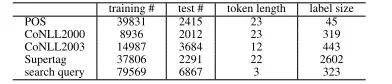
[image:7.612.92.288.352.394.2]Table 2 shows the training and test sets size (sen-tence #), the average token length of test dataset and the label size for the five datasets. POS and su-pertag datasets assign tags to tokens while CoNLL 2000 , CoNLL 2003 and search query datasets as-sign tags to phrases. We use the standard BIO en-coding for CoNLL 2000, CoNLL 2003 and search query datasets.
Table 2: Training and test datasets size, average token length of test set and label size for five datasets.
training # test # token length label size POS 39831 2415 23 45 CoNLL2000 8936 2012 23 319 CoNLL2003 14987 3684 12 443 Supertag 37806 2291 22 2602 search query 79569 6867 3 323
Due to the long CRF training time (days to weeks even for stochastic gradient descent training) for these large label size datasets, we choose the percep-tron algorithm for training. The models are averaged over 10 iterations (Collins, 2002). The training time takes minutes to hours for all datasets. We note that the selection of training algorithm does not affect the decoding process: the decoding is identical for both CRF and perceptron training algorithms. We use the common features which are adopted in previ-ous studies, for example (Sha and Periera, 2003). In particular, we use the unigrams of the current and its neighboring words, word bigrams, prefixes and suf-fixes of the current word, capitalization, all-number, punctuation, and tag bigrams for POS, CoNLL2000 and CoNLL 2003 datasets. For supertag dataset, we use the same features for the word inputs, and the unigrams and bigrams for gold POS inputs. For search query dataset, we use the same features plus gazetteer based features.
5.2 Results
We report the token accuracy for all datasets to facil-itate comparison to previous work. They are 97.00, 94.70, 95.80, 90.60 and 88.60 for POS, CoNLL 2000, CoNLL 2003, supertag, and search query
re-spectively. We note that all decoding algorithms as listed in Section 3 and Section 4 are exact. That is, they produce exactly the same accuracy. The accu-racy we get for the first four tasks is comparable to the state-of-the-art. We do not have a baseline to compare with for the last dataset as it is not pub-licly available7. Higher accuracy may be achieved if more task specific features are introduced on top of the standard features. As this paper is more con-cerned with the decoding speed, the feature engi-neering is beyond the scope of this paper.
Table 3 shows how many iterations in average are required for iterative Viterbi and iterative Viterbi A* algorithms. Although the max iteration size is bounded to dlog2Le for each position (for exam-ple, 9 for CoNLL 2003 dataset), the total iteration number for the whole lattice may be greater than
dlog2Le as different positions may not expand at the same time. Despite the large number of itera-tions used in iterative based algorithms (especially iterative Viterbi A* algorithm), the algorithms are still very efficient (see below).
Table 3: Iteration numbers of iterative Viterbi and itera-tive Viterbi A* algorithms for five datasets.
POS CoNLL2000 CoNLL2003 Supertag search query iter Viter 6.32 8.76 9.18 10.63 6.71 iter Viter A* 14.42 16.40 15.41 18.62 9.48
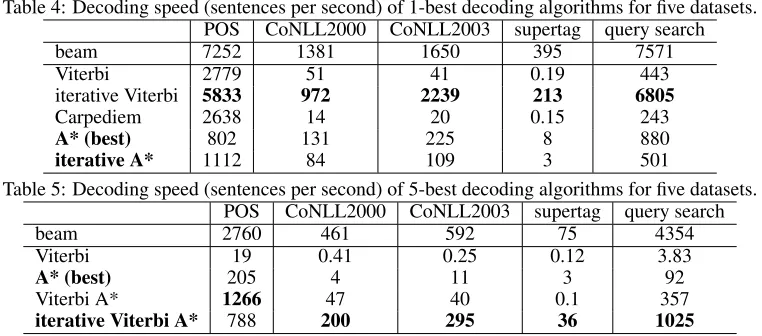
Table 4 and 5 show the decoding speed (sen-tences per second) of1-best and5-best decoding al-gorithms respectively. The proposed decoding algo-rithms and the largest decoding speeds across differ-ent decoding algorithms (other than beam) are high-lighted in bold. We exclude the time for feature ex-traction in computing the speed. The beam search decoding is also shown as a baseline. We note that beam decoding is the only approximate decoding al-gorithm in this table. All other decoding alal-gorithms produce exactly the same accuracy, which is usually much better than the accuracy of beam decoding.
For1-best decoding, iterative Viterbi always out-performs other ones. A* with a proper heuristic de-noted asA* (best), that is, the best A* using naive heuristic or the values ofm being0,3,6or 9(see Section 4.1), can be the second best choice (ex-cept for the POS task), although the gap between iterative Viterbi and A* is significant. For exam-ple, for CoNLL 2003 dataset, the former can de-code 2239 sentences per second while the latter only decodes 225 sentences per second. The iterative process successfully boosts the decoding speed of iterative Viterbi compared to Viterbi, but it slows down the decoding speed of iterative A* compared
7
to A*(best). This is because in the Viterbi case, the iterative process has a node pruning procedure, while it does not have such pruning in A*(best) algorithm. Take CoNLL 2003 data as an exam-ple, the removal of the pruning slows down the 1-best iterative Viterbi decoding from 2239 to 604 sentences/second. Carpediem algorithm performs poorly in four out of five tasks. This can be ex-plained as follows. The Carpediem implicitly as-sumes that the node scores are the dominant factors to determine the best sequence. However, this as-sumption does not hold as the edge scores play an important role.
For 5-best decoding, k-best Viterbi decoding is very slow. A* with a proper heuristic is still slow. For example, it only reaches 11 sentences per second for CoNLL 2003 dataset. The classic Viterbi A* can usually obtain a decent decoding speed, for example, 40 sentences per second for CoNLL 2003 dataset. The only exception is supertag dataset, on which the Viterbi A* decodes 0.1 sentence per second while the A* decodes 3. This indicates the scalability is-sue of Viterbi A* algorithm for datasets with more than one thousand labels. The proposed iterative Viterbi A* is clearly the winner. It speeds up the Viterbi A* to factors of 4, 7, 360, and 3 for CoNLL 2000, CoNLL 2003, supertag and query search data respectively. The decoding speed of iterative Viterbi A* can even be comparable to that of beam search.
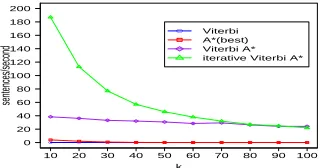
Figure 4 shows k-best decoding algorithms de-coding speed with respect to differentk values for CoNLL 2003 data . The Viterbi A* and iterative Viterbi A* algorithms are significantly faster than the Viterbi and A*(best) algorithms. Although the iterative Viterbi A* significantly outperforms the Viterbi A* fork <30, the speed of the former con-verges to the latter when k becomes 90 or larger. This is expected as thek-best sequences span over the whole lattice: the earlier iteration in iterative Viterbi A* algorithm cannot provide thek-best se-quences using the degenerate lattice. The over-head of multiple iterations slows down the decoding speed compared to the Viterbi A* algorithm.
● ● ● ● ● ● ● ● ● ●
10 20 30 40 50 60 70 80 90 100 0
20 40 60 80 100 120 140 160 180 200
k
sentences/second
[image:8.612.102.263.576.660.2]● Viterbi A*(best) Viterbi A* iterative Viterbi A*
Figure 4: Decoding speed ofk-best decoding algorithms for variouskfor CoNLL 2003 dataset.
6 Related work
The Viterbi algorithm is the only exact algorithm widely adopted in the NLP applications. Esposito and Radicioni (2009) proposed an algorithm which opens necessary nodes in a lattice in searching the best sequence. The staggered decoding (Kaji et al., 2010) forms the basis for our work on iterative based decoding algorithms. Apart from the exact decod-ing, approximate decoding algorithms such as beam search are also related to our work. Tsuruoka and Tsujii (2005) proposed easiest-first deterministic de-coding. Siddiqi and Moore (2005) presented the pa-rameter tying approach for fast inference in HMMs. A similar idea was applied to CRFs as well (Cohn, 2006; Jeong, 2009). We note that the exact algo-rithm always guarantees the optimality which can-not be attained in approximate algorithms.
In terms of k-best parsing, Huang and Chiang (2005) proposed an efficient algorithm which is sim-ilar to thek-best Viterbi A* algorithm presented in this paper. Pauls and Klein (2009) proposed an algo-rithm which replaces the Viterbi forward pass with an A* search. Their algorithm optimizes the Viterbi pass, while the proposed iterative Viterbi A* algo-rithm optimizes both Viterbi and A* passes.
This paper is also related to the coarse to fine PCFG parsing (Charniak et al., 2006) as the degen-erate labels can be treated as coarse levels. How-ever, the difference is that the coarse-to-fine parsing is an approximate decoding while ours is exact one. In terms of different coarse levels of heuristic used in A* decoding, this paper is related to the work of hierarchical A* framework (Raphael, 2001; Felzen-szwalb et al., 2007). In terms of iterative process, this paper is close to (Burkett et al., 2011) as both exploit the search-and-expand approach.
7 Conclusions
We have presented and evaluated the A* and itera-tive A* algorithms for1-best sequential decoding in this paper. In addition, we proposed A* and iterative Viterbi A* algorithm fork-best sequential decoding.
K-best Iterative A* algorithm can be several times or orders of magnitude faster than the state-of-the-art k-best decoding algorithm. It makes real-time large-scale tagging applications with thousands of labels feasible.
Acknowledgments
Table 4: Decoding speed (sentences per second) of 1-best decoding algorithms for five datasets. POS CoNLL2000 CoNLL2003 supertag query search
beam 7252 1381 1650 395 7571
Viterbi 2779 51 41 0.19 443
iterative Viterbi 5833 972 2239 213 6805
Carpediem 2638 14 20 0.15 243
A* (best) 802 131 225 8 880
iterative A* 1112 84 109 3 501
Table 5: Decoding speed (sentences per second) of 5-best decoding algorithms for five datasets. POS CoNLL2000 CoNLL2003 supertag query search
beam 2760 461 592 75 4354
Viterbi 19 0.41 0.25 0.12 3.83
A* (best) 205 4 11 3 92
Viterbi A* 1266 47 40 0.1 357
iterative Viterbi A* 788 200 295 36 1025
References
D. Burkett, D. Hall, and D. Klein. 2011. Optimal graph search with iterated graph cuts. Proceedings of AAAI.
E. Charniak, M. Johnson, M. Elsner, J. Austerweil, D. Ellis, I. Haxton, C. Hill, R. Shrivaths, J. Moore, M. Pozar, and T. Vu. 2006. Multi-level coarse-to-fine PCFG parsing. Proceedings of NAACL.
T. Cohn. 2006. Efficient inference in large conditional random fields. Proceedings of ECML.
M. Collins. 2002. Discriminative training methods for hidden Markov models: Theory and experiments with perceptron algorithms. Proceedings of EMNLP.
R. Esposito and D. P. Radicioni. 2009. Carpediem: Optimizing the Viterbi Algorithm and Applications to Supervised Sequential Learning. Journal of Machine Learning Research.
P. Felzenszwalb and D. McAllester. 2007. The general-ized A* architecture. Journal of Artificial Intelligence Research.
P. E. Hart, N. J. Nilsson, and B. Raphael. 1968. A For-mal Basis for the Heuristic Determination of Minimum Cost Paths. IEEE Transactions on Systems Science and Cybernetics.
L. Huang and D. Chiang. 2005. Betterk-best parsing. Proceedings of the International Workshops on Parsing Technologies (IWPT).
M. Jeong, C. Y. Lin, and G. G. Lee. 2009.Efficient infer-ence of CRFs for large-scale natural language data. Proceedings of ACL-IJCNLP Short Papers.
N. Kaji, Y. Fujiwara, N. Yoshinaga, and M. Kitsuregawa. 2010. Efficient Staggered Decoding for Sequence La-beling. Proceedings of ACL.
D. Klein and C. Manning. 2003. A* parsing: Fast exact Viterbi parse selection. Proceedings of ACL.
J. Lafferty, A. McCallum, and F. Pereira. 2001. Con-ditional random fields: Probabilistic models for seg-menting and labeling sequence data. Proceedings of ICML.
T. Matsuzaki, Y. Miyao, and J. Tsujii. 2007. Efficient HPSG parsing with supertagging and CFG-filtering. Proceedings of IJCAI.
A. Pauls and D. Klein. 2009. K-Best A* Parsing. Pro-ceedings of ACL.
L. R. Rabiner. 1989.A tutorial on hidden Markov models and selected applications in speech recognition. Pro-ceedings of The IEEE.
C. Raphael. 2001. Coarse-to-fine dynamic program-ming. IEEE Transactions on Pattern Analysis and Ma-chine Intelligence.
S. Russell and P. Norvig. 1995.Artificial Intelligence: A Modern Approach.
F. Sha and F. Pereira. 2003.Shallow parsing with condi-tional random fields. Proceedings of HLT-NAACL. S. M. Siddiqi and A. Moore. 2005. Fast inference and
learning in large-state-space HMMs. Proceedings of ICML.
Y. Tsuruoka and J. Tsujii. 2005. Bidirectional in-ference with the easiest-first strategy for tagging se-quence data. Proceedings of HLT/EMNLP.