Explicit and Implicit Syntactic Features for Text Classification
Matt Post1 and Shane Bergsma1,2
1Human Language Technology Center of Excellence 2Center for Language and Speech Processing
Johns Hopkins University Baltimore, MD
Abstract
Syntactic features are useful for many text classification tasks. Among these, tree kernels (Collins and Duffy, 2001) have been perhaps the most robust and effective syntactic tool, appealing for their empirical success, but also be-cause they do not require an answer to the difficult question of which tree features to use for a given task. We compare tree kernels to different ex-plicit sets of tree features on five diverse tasks, and find that explicit features of-ten perform as well as tree kernels on accuracy and always in orders of mag-nitude less time, and with smaller mod-els. Since explicit features are easy to generate and use (with publicly avail-able tools), we suggest they should al-ways be included as baseline compar-isons in tree kernel method evaluations.
1 Introduction
Features computed over parse trees are use-ful for a range of discriminative tasks, in-cluding authorship attribution (Baayen et al., 1996), parse reranking (Collins and Duffy, 2002), language modeling (Cherry and Quirk, 2008), and native-language detection (Wong and Dras, 2011). A major distinction among these uses of syntax is how the features are rep-resented. The implicit approach uses tree kernels (Collins and Duffy, 2001), which make predictions with inner products between tree pairs. These products can be computed effi-ciently with a dynamic program that produces weighted counts of all the shared tree frag-ments between a pair of trees, essentially in-corporating all fragments without representing any of them explicitly. Tree kernel approaches
have been applied successfully in many areas of NLP (Collins and Duffy, 2002; Moschitti, 2004; Pighin and Moschitti, 2009).
Tree kernels were inspired in part by ideas from Data-Oriented Parsing (Scha, 1990; Bod, 1993), which was in turn motivated by uncer-tainty about which fragments to include in a grammar. However, manual and automatic approaches to inducing tree fragments have recently been found to be useful in an ex-plicit approach to text classification, which employs specific tree fragments as features in standard classifiers (Post, 2011; Wong and Dras, 2011; Swanson and Charniak, 2012). These feature sets necessarily represent only a small subset of all possible tree patterns, leav-ing open the question of what further gains might be had from the unusued fragments.
Somewhat surprisingly, explicit and implicit syntactic features have been explored largely independently. Here, we compare them on a range of classification tasks: (1,2) grammati-cal classification (is a sentence written by a hu-man?), (3) question classification (what type of answer is sought by this question?), and (4,5) native language prediction (what is the native language of a text’s author?).
Our main contribution is to show that an ex-plicit syntactic feature set performs as well or better than tree kernels on each tested task, and in orders of magnitude less time. Since explicit features are simple to generate (with publicly available tools) and flexible to use, we recommend they be included as baseline com-parisons in tree kernel method evaluations.
2 Experimental setup
We used the following feature sets:
N-grams All unigrams and bigrams.1
1Experiments with trigrams did not show any
CFG rules Counts of depth-one context-free grammar (CFG) productions obtained from the Berkeley parser (Petrov et al., 2006).
C&J features The parse-tree reranking feature set of Charniak and Johnson (2005), extracted from the Berkeley parse trees.
TSG features We also parsed with a
Bayesian tree substitution grammar (Post and Gildea, 2009, TSG)2 and extracted fragment counts from Viterbi derivations.
We build classifiers with Liblinear3 (Fan
et al., 2008). We divided each dataset into training, dev, and test sets. We then trained an L2-regularized L1-loss support vector ma-chine (-s 3) with a bias parameter of 1 (-B 1), optimizing the regularization parameter (-c) on the dev set over the range{0.0001 . . . 100} by multiples of 10. The best model was then used to classify the test set. A sentence length feature was included for every sentence.
For tree kernels, we used SVM-light-TK4
(Moschitti, 2004; Moschitti, 2006) with the default settings (-t 5 -D 1 -L 0.4),5 which also solves an L2-regularized L1-loss SVM op-timization problem. We tuned the regulariza-tion parameter (-c) on the dev set in the same manner as described above, providing 4 GB of memory to the kernel cache (-m 4000).6 We
used subset tree kernels, which compute the similarity between two trees by implicitly enu-merating all possible fragments of the trees (in contrast with subtree kernels, where all frag-ments fully extend to the leaves).
3 Tasks
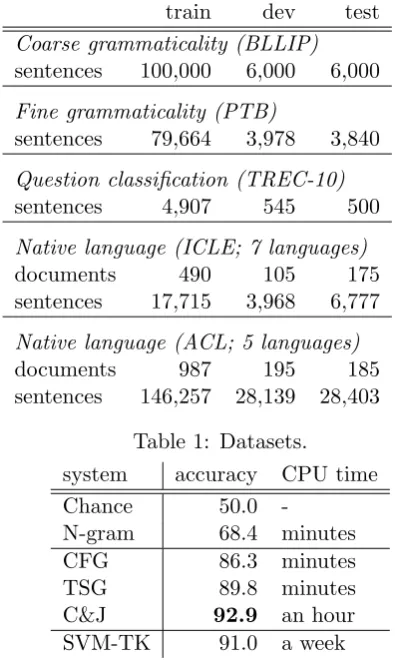
Table 1 summarizes our datasets.
3.1 Coarse grammatical classification
Our first comparison is coarse grammatical classification, where the goal is to distin-guish between human-written sentences and “pseudo-negative” sentences sampled from a trigram language model constructed from
in-provement.
2github.com/mjpost/dptsg 3
www.csie.ntu.edu.tw/~cjlin/liblinear/ 4disi.unitn.it/moschitti/Tree-Kernel.htm 5Optimizing SVM-TK’s decay parameter (-L) did
not improve test-set accuracy, but did increase training time (squaring the number of hyperparameter combi-nations to evaluate), so we stuck with the default.
6Increased from the default of 40 MB, which halves
the running time.
train dev test Coarse grammaticality (BLLIP) sentences 100,000 6,000 6,000
Fine grammaticality (PTB)
sentences 79,664 3,978 3,840
Question classification (TREC-10) sentences 4,907 545 500
Native language (ICLE; 7 languages) documents 490 105 175 sentences 17,715 3,968 6,777
[image:2.595.306.504.63.395.2]Native language (ACL; 5 languages) documents 987 195 185 sentences 146,257 28,139 28,403
Table 1: Datasets.
system accuracy CPU time Chance 50.0
-N-gram 68.4 minutes
CFG 86.3 minutes
TSG 89.8 minutes
C&J 92.9 an hour SVM-TK 91.0 a week
Table 2: Coarse grammaticality. CPU time is for classifier setup, training, and testing.
domain data (Okanohara and Tsujii, 2007). Cherry and Quirk (2008) first applied syn-tax to this task, learning weighted parameters for a CFG with a latent SVM. Post (2011) found further improvements with fragment-based representations (TSGs and C&J) with a regular SVM. Here, we compare their results to kernel methods. We repeat Post’s experi-ments on the BLLIP dataset,7 using his exact data splits (Table 2). To our knowledge, tree kernels have not been applied to this task.
3.2 Fine grammatical classification
Real-world grammaticality judgments require much finer-grained distinctions than the coarse ones of the previous section (for exam-ple, marking dropped determiners or wrong verb inflections). For this task, we too pos-itive examples from all sentences of sections 2–21 of the WSJ portion of the Penn Tree-bank (Marcus et al., 1993). Negative exam-ples were created by inserting one or two errors
system accuracy CPU time Wong & Dras 60.6
-Chance 50.0
-N-gram 61.4 minutes
CFG 64.5 minutes
TSG 67.0 minutes
C&J 71.9 an hour
[image:3.595.318.512.62.233.2]SVM-TK 67.8 weeks
Table 3: Fine-grained classification accuracy (the Wong and Dras (2010) score is the highest score from the last column of their Table 3).
system accuracy CPU time Pighin & Moschitti 86.6
-Bigram 73.2 seconds
CFG 90.0 seconds
TSG 85.6 seconds
C&J 89.6 minutes
[image:3.595.85.279.63.178.2]SVM-TK 87.7 twenty min.
Table 4: Question classification (6 classes).
into the parse trees from the positive data us-ing GenERRate (Foster and Andersen, 2009). An example sentence pair is But the ballplay-ers disagree[ing], where the negative exam-ple incorrectly inflects the verb. Wong and Dras (2010) reported good results with parsers trained separately on the positive and negative sides of the training data and classifiers built from comparisons between the CFG produc-tions of those parsers. We obtained their data splits (described asNoisyWSJ in their paper) and repeat their experiments here (Table 3).
3.3 Question Classification
We look next at question classification (QC). Li and Roth (2002) introduced the TREC-10 dataset,8 a set of questions paired with labels that categorize the question by the type of an-swer it seeks. The labels are organized hi-erarchically into six (coarse) top-level labels and fifty (fine) refinements. An example ques-tion from the ENTY/animal category isWhat was the first domesticated bird?. Table 4 con-tains results predicting just the coarse labels. We compare to Pighin and Moschitti (2009), and also repeat their experiments, finding a slightly better result for them.
8cogcomp.cs.illinois.edu/Data/QA/QC/
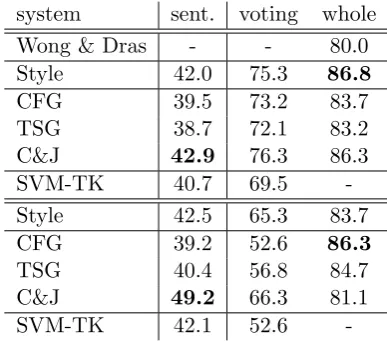
system sent. voting whole Wong & Dras - - 80.0
Style 42.0 75.3 86.8
CFG 39.5 73.2 83.7
TSG 38.7 72.1 83.2
C&J 42.9 76.3 86.3
SVM-TK 40.7 69.5
-Style 42.5 65.3 83.7
CFG 39.2 52.6 86.3
TSG 40.4 56.8 84.7
C&J 49.2 66.3 81.1
SVM-TK 42.1 52.6
-Table 5: Accuracy on ICLE (7 languages, top) and ACL (five, bottom) datasets at the sen-tence and document levels. All documents were signature-stylized (§3.4).
We also experimented with the refined ver-sion of the task, where we directly predict one of the fifty refined categories, and found nearly identical relative results, with the best explicit feature set (CFG) returning an accuracy of 83.6% (in seconds), and the tree kernel system 69.8% (in an hour). For reference, Zhang and Lee (2003) report 80.2% accuracy when train-ing on the full traintrain-ing set (5,500 examples) with an SVM and bag-of-words features.9
3.4 Native language identification
Native language identification (NLI) is the task of determining a text’s author’s native language. This is usually cast as a document-level task, since there are often not enough cues to identify native languages at smaller granularities. As such, this task presents a challenge to tree kernels, which are defined at the level of a single parse tree and have no ob-vious document-level extension. Table 5 there-fore presents three evaluations: (a) sentence-level accuracy, and document-sentence-level accuracy from (b) sentence-level voting and (c) direct, whole-document classification.
We perform these experiments on two datasets. In order to mitigate topic bias10and
other problems that have been reported with
9Pighin and Moschitti (2009) did not report results
on this version of the task.
10E.g., when we train with all words, the keyword
[image:3.595.71.299.230.332.2]the ICLE dataset (Tetreault et al., 2012),11we
preprocessed each dataset into two signature-stylized versions by replacing all words not in a stopword list.12 The first version replaces
non-stopwords with word classes computed from surface-form signatures,13and the second with POS tags.14 N-gram features are then taken
from both stylized versions of the corpus. Restricting the feature representation to be topic-independent is standard-practice in sty-lometric tasks like authorship attribution, gen-der identification, and native-language identi-fication (Mosteller and Wallace, 1984; Koppel et al., 2003; Tomokiyo and Jones, 2001).
3.4.1 ICLE v.2
The first dataset is a seven-language subset of the International Corpus of Learner En-glish, Version 2 (ICLE) (Granger et al., 2009), which contains 3.7 million words of English documents written by people with sixteen dif-ferent native languages. Table 1 contains scores, including one reported by Wong and Dras (2011), who used the CFG and C&J fea-tures, and whose data splits we mirror.15
3.4.2 ACL Anthology Network
We also experimented with native language classification on scientific documents using a version of the ACL Anthology Network (Radev et al., 2009, AAN) annotated for ex-periments in stylemetric tasks, including a native/non-native author judgment (Bergsma et al., 2012). For NLI, we further anno-tated this dataset in a semi-automatic fash-ion for the five most-common native languages of ACL authors in our training era: English, Japanese, German, Chinese, and French. The annotation heuristics, designed to favor pre-cision over recall, provided annotations for 1,959 of 8,483 papers (23%) in the 2001–2009 AAN.16
11Including prompts, characters, and special tokens
that correlate strongly with particular outcomes.
12The stopword list contains the set of 524
SMART-system stopwords used by Tomokiyo and Jones (2001), plus punctuation and Latin abbreviations.
13For example, suffix and capitalization. 14Via CRFTagger (Phan, 2006).
15Tetreault et al. reported accuracies up to 90.1 in a
cross-validation setting that isn’t directly comparable.
16Details and data at old-site.clsp.jhu.edu/ ~sbergsma/Stylo/.
60 70 80 90 100
0 0.01 0.1 1 10 100 1,000
ac
cura
cy
training time (thousands of seconds)
size CFG CFG TSG TSG TSG+ TSG+ C&J C&J SVM-TK SVM-TK uSVM-TK USVM-TK
100 7 62.6 6 61.0 8 73.1 407 72.8 13 62.9 27 62.7
300 7 68.0 6 65.0 8 77.9 412 77.5 46 70.8 174 70.9
1000 7 73.3 6 70.9 9 78.4 433 82.2 227 77.1 1475 77.4
3000 9 75.8 7 77.5 12 82.3 465 87.1 1034 81.4 4394 81.2
10000 13 80.8 11 82.5 32 85.2 708 89.9 8984 85.5 6691 85.3
30000 37 83.5 29 85.8 108 87.7 1276 92.7 72859 88.8 7789 87.8
100000 133 86.3 85 89.1 406 89.8 3152 93.0 873969 91.0 8488 89.0
CFG TSG C&J SVM-TK uSVM-TK
[image:4.595.312.525.65.195.2]uSVM-TK USVM-TK 1010.35 62.7 2628.84 70.9 7264.65 77.4 25447.47 81.2 29298.76 85.3 45938.05 87.8 48570.46 89.0 OLD VALUES
Figure 1: Training time (1000s of seconds) vs. test accuracy for coarse grammaticality, plot-ting test scores from models trained on 100, 300, 1k, 3k, 10k, 30k, and 100k instances.
4 Discussion
Syntactic features improve upon the n-gram baseline for all tasks except whole-document classification for ICLE. Tree kernels are often among the best, but always trail (by orders of magnitude) when runtime is considered. Constructing the multi-class SVM-TK models for the NLI tasks in particular was computa-tionally burdensome, requiring cpu-months of time. The C&J features are similarly often the best, but incur a runtime cost due to the large models. CFG and TSG features balance per-formance, model size, and runtime. We now compare these approaches in more depth.
4.1 Training time versus accuracy
Tree kernel training is quadratic in the size of the training data, and its empirical slowness is known. It is informative to examine learn-ing curves to see how the time-accuracy trade-offs extrapolate. We compared models trained on the first 100, 300, 1k, 3k, 10k, 30k, and 100k data points of the coarse grammaticality dataset, split evenly between positive and neg-ative examples (Figure 1). SVM-TK improves over the TSG and CFG models in the limit, but at an extraordinary cost in training time: 100k training examples is already pushing the bounds of practicality for tree kernel learning, and generating curve’s next point would re-quire severalmonths of time. Kernel methods also produce large models that result in slow test-time performance, a problem dubbed the “curse of kernelization” (Wang et al., 2010).
and Moschitti, 2010). We investigated the uSVM-TK toolkit,17 which enables tuning the tradeoff between training time and accuracy. While faster than SVM-TK, its performance was never better than explicit methods along both dimensions (time and accuracy).
4.2 Overfitting
Overfitting is also a problem for kernel meth-ods. The best models often had a huge number of support vectors, achieving near-perfect ac-curacy on the training set but making many errors on the dev. and test sets. On the ICLE task, close to 75% of all the training exam-ples were used as support vectors. We found only half as many support vectors used for the explicit representations, implying less error (Vapnik, 1998), and saw much lower variance between training and testing performance.
4.3 Which fragments?
Our findings support the observations of Cumby and Roth (2003), who point out that kernels introduce a large number of irrelevant features that may be especially harmful in small-data settings, and that, when possible, it is often better to have a set of explicit, relevant features. In other words, it is better to have the right features than all of them. Tree ker-nels provide a robust, efficiently-computable measure of comparison, but they also skirt the difficult question, Which fragments?
So what are the “right” features? Table 6) presents an intuitive list from the coarse gram-maticality task: phenomena such as balanced parenthetical phrases and quotations are asso-ciated with grammaticality, while small, flat, abstract rules indicate samples from the n-gram model. Similar intuitive results hold for the other tasks. The immediate interpretabil-ity of the explicit formalisms is another ad-vantage, although recent work has shown that weights on the implicit features can also be ob-tained after a kind of linearization of the tree kernel (Pighin and Moschitti, 2009).
Ultimately, which features matter is task-dependent, and skirting the question is ad-vantageous in many settings. But it is also encouraging that methods for selecting frag-ments and other tree features work so well,
17
disi.unitn.it/~severyn/code.html
(TOP (S “ S , ” NP (VP (VBZ says) ADVP) .)) (FRAG (X SYM) VP .)
(PRN (-LRB- -LRB-) S (-RRB- -RRB-)) (PRN (-LRB- -LRB-) NP (-RRB- -RRB-)) (S NP VP .)
(NP (NP DT CD (NN %)) PP) (NP DT)
(PP (IN of))
(TOP (NP NP PP PP .)) (NP DT JJ NNS)
Table 6: The highest- and lowest-weighted TSG features (coarse grammaticality).
yielding quick, light-weight models that con-trast with the heavy machinery of tree kernels.
5 Conclusion
Tree kernels provide a robust measure of com-parison between trees, effectively making use of all fragments. We have shown that for some tasks, it is sufficient (and advantageous) to instead use an explicitly-represented subset of them. In addition to their flexibility and interpetability, explicit syntactic features of-ten outperformed tree kernels in accuracy, and even where they did not, the cost wasmultiple orders of magnitude increase in both training and testing time. These results were consistent across a range of task types, dataset sizes, and classification arities (binary and multiclass).
References
Harald Baayen, Hans Van Halteren, and Fiona Tweedie. 1996. Outside the cave of shadows: Using syntactic annotation to enhance author-ship attribution. Literary and Linguistic Com-puting, 11(3):121.
Shane Bergsma, Matt Post, and David Yarowsky. 2012. Stylometric analysis of scientific arti-cles. In Proc. of NAACL-HLT, pages 327–337, Montr´eal, Canada, June. Association for Com-putational Linguistics.
Rens Bod. 1993. Using an annotated corpus as a stochastic grammar. In Proc. of ACL, Colum-bus, Ohio, USA, June.
Eugene Charniak and Mark Johnson. 2005. Coarse-to-fine n-best parsing and MaxEnt dis-criminative reranking. In Proc. of ACL, pages 173–180, Ann Arbor, Michigan, USA, June.
Colin Cherry and Chris Quirk. 2008. Discrimi-native, syntactic language modeling through la-tent SVMs. InProc. of AMTA, Waikiki, Hawaii, USA, October.
Michael Collins and Nigel Duffy. 2001. Convolu-tion kernels for natural language. In Proc. of NIPS.
Michael Collins and Nigel Duffy. 2002. New rank-ing algorithms for parsrank-ing and taggrank-ing: kernels over discrete structures, and the voted percep-tron. InProc. of ACL, pages 173–180, Philadel-phia, Pennsylvania, USA, July.
Aron Culotta and Jeffrey Sorensen. 2004. Depen-dency tree kernels for relation extraction. In
Proc. of ACL, pages 423–429.
Rong-En Fan, Kai-Wei Chang, Cho-Jui Hsieh, Xiang-Rui Wang, and Chih-Jen Lin. 2008. LIB-LINEAR: A library for large linear classification.
Journal of Machine Learning Research, 9:1871– 1874.
Jennifer Foster and Øistein E. Andersen. 2009. GenERRate: Generating errors for use in gram-matical error detection. In Proceedings of the fourth workshop on innovative use of NLP for building educational applications, pages 82–90.
Sylviane Granger, Estelle Dagneaux, Fanny Me-unier, and Magali Paquot. 2009. The Inter-national Corpus of Learner English. Version 2. Handbook and CD-Rom.
Moshe Koppel, Shlomo Argamon, and Anat Rachel Shimoni. 2003. Automatically categorizing written texts by author gender. Literary and Linguistic Computing, 17(4):401–412.
Xin Li and Dan Roth. 2002. Learning question classifiers. In Proc. of COLING, pages 1–7.
Ding Liu and Daniel Gildea. 2005. Syntactic fea-tures for evaluation of machine translation. In
Proceedings of the ACL Workshop on Intrinsic and Extrinsic Evaluation Measures for Machine Translation and/or Summarization, pages 25– 32.
Mitchell P. Marcus, Mary Ann Marcinkiewicz, and Beatrice Santorini. 1993. Building a large an-notated corpus of English: The Penn Treebank.
Computational Linguistics, 19(2):330.
Alessandro Moschitti, Silvia Quarteroni, Roberto Basili, and Suresh Manandhar. 2007. Exploit-ing syntactic and shallow semantic kernels for question answer classification. InProc. of ACL, pages 776–783, Prague, Czech Republic, June.
Alessandro Moschitti. 2004. A study on convo-lution kernels for shallow semantic parsing. In
Proc. of ACL.
Alessandro Moschitti. 2006. Making tree kernels practical for natural language learning. InProc. of EACL, volume 6, pages 113–120.
Frederick Mosteller and David L. Wallace. 1984.
Applied Bayesian and Classical Inference: The Case of the Federalist Papers. Springer-Verlag.
Daisuke Okanohara and Jun’ichi Tsujii. 2007. A discriminative language model with pseudo-negative samples. In Proc. of ACL, Prague, Czech Republic, June.
Slav Petrov, Leon Barrett, Romain Thibaux, and Dan Klein. 2006. Learning accurate, compact, and interpretable tree annotation. In Proc. of ACL, Sydney, Australia, July.
Xuan-Hieu Phan. 2006. CRFTagger: CRF En-glish POS Tagger. crftagger.sourceforge.net.
Daniele Pighin and Alessandro Moschitti. 2009. Reverse engineering of tree kernel feature spaces. InProc. of EMNLP, pages 111–120, Singapore, August.
Matt Post and Daniel Gildea. 2009. Bayesian learning of a tree substitution grammar. In
Proc. of ACL (short paper track), Suntec, Sin-gapore, August.
Matt Post. 2011. Judging grammaticality with tree substitution grammar derivations. InProc. of ACL, Portland, Oregon, USA, June.
Dragomir R. Radev, Pradeep Muthukrishnan, and Vahed Qazvinian. 2009. The ACL anthology network corpus. In Proc. of ACL Workshop on Natural Language Processing and Information Retrieval for Digital Libraries, pages 54–61.
Aliaksei Severyn and Alessandro Moschitti. 2010. Large-scale support vector learning with struc-tural kernels. In Proc. of ECML/PKDD, pages 229–244.
Libin Shen and Aravind K. Joshi. 2003. An SVM-based voting algorithm with application to parse reranking. In Proc. of CoNLL, pages 9–16.
Jun Suzuki, Hideki Isozaki, and Eisaku Maeda. 2004. Convolution kernels with feature selection for natural language processing tasks. In Proc. of ACL, pages 119–126.
Benjamin Swanson and Eugene Charniak. 2012. Native language detection with tree substitu-tion grammars. InProc. of ACL (short papers), pages 193–197, Jeju Island, Korea, July.
Joel Tetreault, Daniel Blanchard, Aoife Cahill, and Martin Chodorow. 2012. Native tongues, lost and found: Resources and empirical evaluations in native language identification. In Proc. of COLING, pages 2585–2602, Mumbai, India, De-cember.
Laura Mayfield Tomokiyo and Rosie Jones. 2001. You’re not from ’round here, are you? Naive Bayes detection of non-native utterances. In
Proc. of NAACL.
Vladimir N. Vapnik. 1998. Statistical Learning Theory. John Wiley & Sons.
Zhuang Wang, Koby Crammer, and Slobodan Vucetic. 2010. Multi-class pegasos on a bud-get. In ICML, pages 1143–1150.
Sze-Meng Jojo Wong and Mark Dras. 2010. Parser features for sentence grammaticality classifica-tion. In Proceedings of the Australasian Lan-guage Technology Association Workshop, Mel-bourne, Australia, December.
Sze-Meng Jojo Wong and Mark Dras. 2011. Ex-ploiting parse structures for native language identification. InProc. of EMNLP, pages 1600– 1610, Edinburgh, Scotland, UK., July.
Xiaofeng Yang, Jian Su, and Chew Lim Tan. 2006. Kernel-based pronoun resolution with structured syntactic knowledge. In Proc. of Coling-ACL, pages 41–48.
Dell Zhang and Wee Sun Lee. 2003. Question classification using support vector machines. In