A Java Framework for Multilingual Definition and Hypernym Extraction
Stefano Faralli and Roberto Navigli
Dipartimento di Informatica Sapienza Universit`a di Roma
{faralli,navigli}@di.uniroma1.it
Abstract
In this paper we present a demonstra-tion of a multilingual generalizademonstra-tion of Word-Class Lattices (WCLs), a super-vised lattice-based model used to identify textual definitions and extract hypernyms from them. Lattices are learned from a dataset of automatically-annotated defini-tions from Wikipedia. We release a Java API for the programmatic use of multilin-gual WCLs in three languages (English, French and Italian), as well as a Web ap-plication for definition and hypernym ex-traction from user-provided sentences. 1 Introduction
Electronic dictionaries and domain glossaries are definition repositories which prove very useful not only for lookup purposes, but also for automatic tasks such as Question Answering (Cui et al., 2007; Saggion, 2004), taxonomy learning (Navigli et al., 2011; Velardi et al., 2013), domain Word Sense Disambiguation (Duan and Yates, 2010; Faralli and Navigli, 2012), automatic acquisition of semantic predicates (Flati and Navigli, 2013), relation extraction (Yap and Baldwin, 2009) and, more in general, knowledge acquisition (Hovy et al., 2013). Unfortunately, constructing and updat-ing such resources requires the effort of a team of experts. Moreover, they are of no help when deal-ing with new words or usages, or, even worse, new domains. Nonetheless, raw text often contains several definitional sentences, that is, it provides within itself formal explanations for terms of inter-est. Whilst it is not feasible to search texts manu-ally for definitions in several languages, the task of extracting definitional information can be autom-atized by means of Machine Learning (ML) and Natural Language Processing (NLP) techniques.
Many approaches (Snow et al., 2004; Kozareva and Hovy, 2010, inter alia) build upon lexico-syntactic patterns, inspired by the seminal work of Hearst (1992). However, these methods suf-fer from two signifiicant drawbacks: on the one hand, low recall (as definitional sentences occur in highly variable syntactic structures), and, on the
other hand, noise (because the most frequent def-initional pattern – X is a Y – is inherently very noisy). A recent approach to definition and hyper-nym extraction, called Word-Class Lattices (Nav-igli and Velardi, 2010, WCLs), overcomes these issues by addressing the variability of definitional sentences and providing a flexible way of automat-ically extracting hypernyms from them. To do so, lattice-based classifiers are learned from a training set of textual definitions. Training sentences are automatically clustered by similarity and, for each such cluster, a lattice classifier is learned which models the variants of the definition template de-tected. A lattice is a directed acyclic graph, a subclass of non-deterministic finite state automata. The purpose of the lattice structure is to preserve (in a compact form) the salient differences among distinct sequences.
In this paper we present a demonstration of Word-Class Lattices by providing a Java API and a Web application for online usage. Since multi-linguality is a key need in today’s information so-ciety, and because WCLs have been tested over-whelmingly only with the English language, we provide experiments for three different languages, namely English, French and Italian. To do so, in contrast to Navigli and Velardi (2010), who cre-ated a manually annotcre-ated training set of defini-tions, we provide a heuristic method for the au-tomatic acquisition of reliable training sets from Wikipedia, and use them to determine the robust-ness and generalization power of WCLs. We show high performance in definition and hypernym ex-traction for our three languages.
2 Word-Class Lattices
In this section we briefly summarize Word-Class Lattices, originally introduced by Navigli and Ve-lardi (2010).
2.1 Definitional Sentence Generalization WCL relies on a formal notion of textual defi-nition. Specifically, given a definition, e.g.: “In computer science, a closure is a first-class func-tion with free variables that are bound in the lex-ical environment”, we assume that it contains the
[In geography, acountry]DF [is]V F [a politicaldivision]GF .
[In finance, abond]DF [is]V F [a negotiablecertificate]GF [that that acknowledges. . .]REST .
[image:2.595.157.441.136.209.2][In poetry, afoot]DF [is]V F [ameasure]GF [, consisting. . .]REST.
Table 1: Example definitions (defined terms are marked in bold face, their hypernyms in italics).
In
geography finance poetry
NN1 , a hTARGETi
foot bond country
a political negotiable
JJ NN2
division certificate
measure
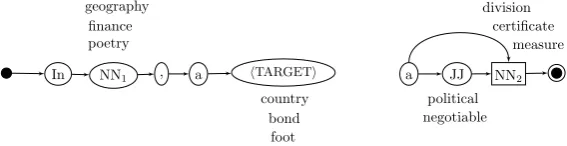
Figure 1: The DF and GF Word-Class Lattices for the sentences in Table 1.
following fields (Storrer and Wellinghoff, 2006):
definiendum (DF), definitor (VF),definiens (GF) and rest (REST), where DF is the part of the definition including the word being defined (e.g., “In computer science, a closure”), VF is the verb phrase used to introduce the definition (e.g., “is”), GF usually includes the hypernym (e.g., “a first-class function”, hypernym marked in italics) and RF includes additional clauses (e.g., “with free variables that are bound in the lexical environ-ment”).
Consider a set of training sentences T, each
of which is automatically part-of-speech tagged and manually bracketed with the DF, VF, GF and REST fields (examples are shown in Table 1). We first identify the set of most frequent words F
(e.g., the, a, is, of, refer, etc.). Then we add the symbolhTARGETitoF and replace inT the
terms being defined withhTARGETi. We then use the set of frequent wordsF to generalize words to
“word classes”.
We define a word class as either a word itself or its part of speech. Given a sentence s = w1, w2, . . . , w|s|, where wi is the i-th word of s,
we generalize its wordswi to word classes ωi as
follows:
ωi =
wi ifwi ∈F
P OS(wi) otherwise
that is, a wordwiis left unchanged if it occurs
fre-quently in the training corpus (i.e.,wi ∈ F) or is
transformed to its part of speech tag(P OS(wi))
otherwise. As a result, we obtain a generalized sentence s0 = ω1, ω2, . . . , ω|s|. For instance,
given the first sentence in Table 1, we obtain the corresponding generalized sentence: “In NN, a hTARGETiis a JJ NN”, where NN and JJ indicate the noun and adjective classes, respectively.
2.2 Learning
The WCL learning algorithm consists of 3 steps: • Star patterns: each sentence in the training
set is preprocessed and generalized to a star
pattern by replacing with * all the wordswi6∈
F, i.e., non-frequent words. For instance, “In
geography, a country is a political division” is transformed to “In *, ahTARGETiis a *”;
• Sentence clustering: the training sentences are then clustered based on the star patterns they belong to;
• Word-Class Lattice construction: for each sentence cluster, a WCL is created separately for each DF, VF and GF field by means of a greedy alignment algorithm. In Figure 1 we show the resulting lattices for the DF and GF fields built for the cluster of sentences of Ta-ble 1. Note that during the construction of the lattice the nodes associated with the hyper-nym words in the learning sentences (i.e., di-vision,certificateandmeasure) are marked as hypernyms in order to determine the hyper-nym of a test sentence at classification time (see (Navigli and Velardi, 2010) for details).
2.3 Classification
Once the learning process is over, a set of WCLs is produced for the DF, VF and GF fields. Given a test sentences, we consider all possible
combi-nations ofdefiniendum,definitoranddefiniens lat-tices and select the combination of the three WCLs that best fits the sentence, if such a combination exists. In fact, choosing the most appropriate combination of lattices impacts the performance of hypernym extraction. The best combination of WCLs is selected by maximizing the follow-ing confidence score: score(s, lDF, lV F, lGF) =
coverage·log(support+ 1)wheresis the
candi-date sentence,lDF,lV F andlGF are three lattices
# Wikipedia pages # definitions extracted
English (EN) 3,904,360 1,552,493
French (FR) 1,617,359 447,772
[image:3.595.79.288.62.107.2]Italian (IT) 1,008,044 291,259
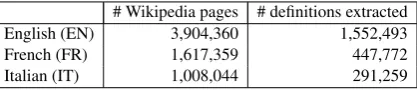
Table 2: The number of Wikipedia pages and the resulting automatically annotated definitions.
selecting the words in the input sentence that are marked as hypernyms in the WCL selected for GF.
3 Multilingual Word-Class Lattices In order to enable multilinguality, thereby extract-ing definitions and hypernyms in many languages, we provide here a heuristic method for the creation of multilingual training datasets from Wikipedia, that we apply to three languages: English, French and Italian. As a result, we are able to fully au-tomatize the definition and hypernym extraction by utilizing collaboratively-curated encyclopedia content.
3.1 Automatic Learning of Multilingual WCLs
The method consists of four steps:
1. candidate definition extraction: we iterate through the collection of Wikipedia pages for the language of interest. For each article we extract the first paragraph, which usually, but not always, contains a definitional sentence for the concept expressed by the page title. We discard all those pages for which the title corresponds to a special page (i.e., title in the form “List of [. . . ]”, “Index of [. . . ]”, “[. . . ] (disambiguation)” etc.).
2. part-of-speech tagging and phrase chunk-ing: for each candidate definition we per-form part-of-speech tagging and chunking, thus automatically identifying noun, verb, and prepositional phrases (we use TreeTag-ger (Schmid, 1997)).
3. automatic annotation:we replace all the oc-currences in the candidate definition of the target term (i.e., the title of the page) with the markerhTARGETi, we then tag as hyper-nym the words associated with the first hy-perlink occurring to the right ofhTARGETi. Then we tag as VF (i.e., definitor field, see Section 2.1) the verb phrase found be-tweenhTARGETiand the hypernym, if such a phrase exists. Next we tag as GF (i.e., definiens field) the phrase which contains the hypernym and as DF (i.e., definiendum field) the phrase which starts at the beginning of the sentence and ends right before the start of the VP tag. Finally we mark as REST the
remaining phrases after the phrase already tagged as GF. For example, given the sen-tence “Albert Einstein was a German-born theoretical physicist.”, we produce the fol-lowing sentence annotation: “[Albert
Ein-stein]DF [was]V F [a German-born
theoreti-cal physicist]GF .” (target term marked in
bold and hypernym in italics).
4. filtering:we finally discard all the candidate definitions for which not all fields could be found during the previous step (i.e., either the hTARGETi, hypernym or any DF, VF, GF, REST tag is missing).
We applied the above four steps to the En-glish, French and Italian dumps of Wikipedia1.
The numbers are shown in Table 2: starting with 3,904,360 Wikipedia pages for English, 1,617,359 for French and 1,008,044 for Italian (first column), we obtained 1,552,493, 447,772, and 291,259 au-tomatically tagged sentences, respectively, for the three languages (second column in the Table). Since we next had to use these sentences for train-ing our WCLs, we took out a random sample of 1000 sentences for each language which we used for testing purposes. We manually annotated each of these sentences as definitional or non-definitional2 and, in the case of the former, also
with the correct hypernym.
3.2 Evaluation
We tested the newly acquired training dataset against two test datasets. The first dataset was our random sampling of 1000 Wikipedia test sen-tences which we had set aside for each language (no intersection with the training set, see previous section). The second dataset was the same one used in Navigli and Velardi (2010), made up of sentences from the ukWaC Web corpus (Ferraresi et al., 2008) and used to estimate the definition and hypernym extraction performance on an open text corpus.
3.3 Results
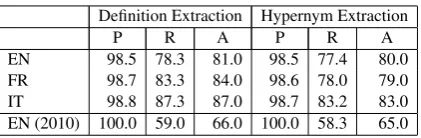
Table 3 shows the results obtained on definition (column 2-4) and hypernym extraction (column 5-7) in terms of precision (P), recall (R) and accu-racy (A) on our first dataset. Note that accuaccu-racy also takes into account candidate definitions in the test set which were tagged as non-definitional (see Section 3.1). In the Table we compare the performance of our English WCL trained from Wikipedia sentences using our automatic proce-dure against the original performance of WCL
1We used the 2012 (EN), 17-09-2012 (FR), 21-09-2012 (IT) dumps.
Definition Extraction Hypernym Extraction
P R A P R A
EN 98.5 78.3 81.0 98.5 77.4 80.0
FR 98.7 83.3 84.0 98.6 78.0 79.0
IT 98.8 87.3 87.0 98.7 83.2 83.0
[image:4.595.78.289.60.129.2]EN (2010) 100.0 59.0 66.0 100.0 58.3 65.0
Table 3: Precision (P), recall (R) and accuracy (A) of definition and hypernym extraction when testing on our dataset of 1000 randomly sam-pled Wikipedia first-paragraph sentences. EN (2010) refers to the WCL learned from the origi-nal manually-curated training set from Navigli and Velardi (2010), while EN, FR and IT refer to WCL trained, respectively, with one of the three training sets automatically acquired from Wikipedia.
P R
EN 98.9 57.6
EN (2010) 94.8 56.5
Table 4: Estimated WCL definition extraction precision (P) and recall (R), testing a sample of ukWaC sentences.
trained on 1,908 manually-selected training sen-tences3. It can be seen that the automatically
ac-quired training set considerably improves the per-formance, as it covers higher variability. We note that the recall in both definition and hypernym ex-traction is higher for French and Italian. We at-tribute this behavior to the higher complexity and, again, variability of English Wikipedia pages, and specifically first-sentence definitions. We remark that the presented results were obtained without any human effort, except for the independent col-laborative editing and hyperlinking of Wikipedia pages, and that the overall performances can be improved by manually checking the automatically annotated training datasets.
We also replicated the experiment carried out by Navigli and Velardi (2010), testing WCLs with a subset (over 300,000 sentences) of the ukWaC Web corpus. As can be seen in Table 4, the estimated precision and recall for WCL defini-tion extracdefini-tion with the 2010 training set were 94.8% and 56.5%, respectively, while with our au-tomatically acquired English training set we ob-tained a higher precision of 98.9% and a recall of 57.6%. This second experiment shows that learn-ing WCLs from hundreds of thousands of defini-tion candidates does not overfit to Wikipedia-style definitional sentences.
After looking at the automatically acquired training datasets, we noted some erroneous an-notations mainly due to the following factors: i) some Wikipedia pages do not start with
defini-3Available fromhttp://lcl.uniroma1.it/wcl
1 // select the language of interest
2 Language targetLanguage = Language.EN;
3 // open the training set
4 Dataset ts =newAnnotatedDataset(
5 trainingDatasetFile,
6 targetLanguage);
7 // obtain an instance of the WCL classifier
8 WCLClassifier c =newWCLClassifier(targetLanguage);
9 c.train(ts);
10 // create a sentence to be tested
11 Sentence sentence = Sentence.createFromString(
12 "WCL",
13 "WCL is a kind of classifier.",
14 targetLanguage);
15 // test the sentence
16 SentenceAnnotation sa = c.test(sentence);
17 // print the hypernym
18 if(sa.isDefinition())
[image:4.595.307.528.64.236.2]19 System.out.println(sa.getHyper());
Figure 2: An example of WCL API usage.
tional sentences; ii) they may contain more than one verbal phrase between the defined term and the hypernym; iii) the first link after the verbal phrase does not cover, or partially covers, the correct hypernym. The elimination of the above wrongly acquired definitional patterns can be im-plemented with some language-dependent heuris-tics or can be done by human annotators. In any case, given the presence of a high number of cor-rect annotated sentences, these wrong definitional patterns have a very low impact on the definition and hypernym extraction precision as shown in the above experiments (see Table 3 and Table 4).
4 Multilingual WCL API
Together with the training and test sets of the above experiments, we also release here our im-plementation of Word-Class Lattices, available as a Java API. As a result the WCL classifier can eas-ily be used programmatically in any Java project. In Figure 2 we show an example of the API usage. After the selection of the target language (line 2), we load the training dataset for the target language (line 4). Then an instance ofWCLClassifieris created (line 8) and the training phase is launched on the input training corpora (line 9). Now the classifier is ready to be tested on any given sen-tence in the target language (lines 11-16). If the classifier output is positive (line 18) we can print the extracted hypernym (line 19). The output of the presented code is the string “classifier” which corresponds to the hypernym extracted by WCL for the input sentence “WCL is a kind of classi-fier”.
4.1 Web user interface
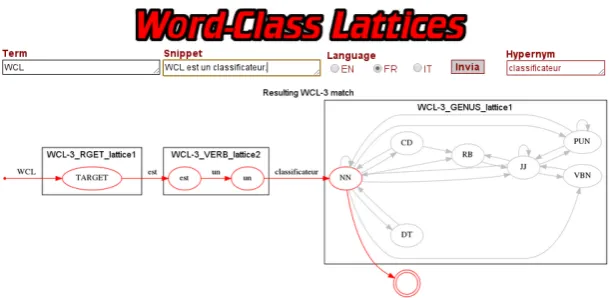
Figure 3: A screenshot of the WCL Web interface.
term of interest, the candidate definition, select the language of interest and, after submission, in the case of positive response from WCL, obtain the corresponding hypernym and a graphical rep-resentation of the lattices matching the given sen-tence, as shown in the bottom part of the Figure.
The graphical representation shows the concate-nation of the learned lattices which match the DF, VF, GF parts of the given sentence (see Section 2). We also allow the user not to provide the term of interest: in this case all the nouns in the sen-tence are considered as candidate defined terms. The Web user interface is part of a client-server ap-plication, created with the JavaServer Pages tech-nology. The server side produces an HTML page (like the one shown in Figure 3), using the WCL API (see Section 4) to process and test the submit-ted definition candidate.
5 Related Work
A great deal of work is concerned with the lan-guage independent extraction of definitions. Much recent work uses symbolic methods that depend on lexico-syntactic patterns or features, which are manually created or semi-automatically learned as recently done in (Zhang and Jiang, 2009; Wester-hout, 2009). A fully automated method is, instead, proposed by Borg et al. (2009), where higher performance (around 60-70% F1-measure) is ob-tained only for specific domains and patterns. Ve-lardi et al. (2008), in order to improve precision while keeping pattern generality, prune candidates using more refined stylistic patterns and lexical fil-ters. Cui et al. (2007) propose the use of prob-abilistic lexico-semantic patterns, for definitional question answering in the TREC contest4.
How-ever, the TREC evaluation datasets cannot be con-sidered true definitions, but rather text fragments providing some relevant fact about a target term.
4Text REtrieval Conferences: http://trec.nist. gov
Hypernym extraction methods vary from simple lexical patterns (Hearst, 1992; Oakes, 2005) to sta-tistical and machine learning techniques (Agirre et al., 2000; Caraballo, 1999; Dolan et al., 1993; Sanfilippo and Poznanski, 1992; Ritter et al., 2009). Extraction heuristics can be adopted in many languages (De Benedictis et al., 2013), where given a definitional sentence the hypernym is identified as the first occuring noun after the defined term. One of the highest-coverage meth-ods is proposed by Snow et al. (2004). They first search sentences that contain two terms which are known to be in a taxonomic relation (term pairs are taken from WordNet (Miller et al., 1990)); then they parse the sentences, and automatically ex-tract patterns from the parse trees. Finally, they train a hypernym classifier based on these features. Lexico-syntactic patterns are generated for each sentence relating a term to its hypernym, and a de-pendency parser is used to represent them.
6 Conclusion
In this demonstration we provide three main con-tributions: 1) a general method for obtaining large training sets of annotated definitional sentences for many languages from Wikipedia, thanks to which we can release three new training sets for English, French and Italian; 2) an API to program-matically use WCLs in Java projects; 3) a Web ap-plication which enables online use of multilingual WCLs:http://lcl.uniroma1.it/wcl/.
Acknowledgments
References
Eneko Agirre, Olatz Ansa, Eduard H. Hovy, and David Mart´ınez. 2000. Enriching very large ontologies using the WWW. InECAI Workshop on Ontology Learning, Berlin, Germany.
Claudia Borg, Mike Rosner, and Gordon Pace. 2009. Evo-lutionary algorithms for definition extraction. In Proceed-ings of the 1st Workshop on Definition Extraction, pages 26–32, Borovets, Bulgaria.
Sharon A. Caraballo. 1999. Automatic construction of a hypernym-labeled noun hierarchy from text. In Proceed-ings of the 37thAnnual Meeting of the Association for Computational Linguistics: Proceedings of the Confer-ence, pages 120–126, Maryland, USA.
Hang Cui, Min-Yen Kan, and Tat-Seng Chua. 2007. Soft pat-tern matching models for definitional question answering.
ACM Transactions on Information Systems, 25(2):1–30. Flavio De Benedictis, Stefano Faralli, and Roberto Navigli.
2013. GlossBoot: Bootstrapping Multilingual Domain Glossaries from the Web. InProceedings of 51st Annual Meeting of the Association for Computational Linguistics, Sofia, Bulgaria.
William Dolan, Lucy Vanderwende, and Stephen D. Richard-son. 1993. Automatically deriving structured knowledge bases from on-line dictionaries. In Proceedings of the First Conference of the Pacific Association for Computa-tional Linguistics, pages 5–14, Vancouver, Canada. Weisi Duan and Alexander Yates. 2010. Extracting glosses
to disambiguate word senses. InProceedings of Human Language Technologies: The 11th Annual Conference of the North American Chapter of the Association for Com-putational Linguistics, pages 627–635, Los Angeles, CA, USA.
Stefano Faralli and Roberto Navigli. 2012. A new minimally-supervised framework for Domain Word Sense Disambiguation. InProceedings of the 2012 Joint Con-ference on Empirical Methods in Natural Language Pro-cessing and Computational Natural Language Learning, pages 1411–1422, Jeju, Korea.
Adriano Ferraresi, Eros Zanchetta, Marco Baroni, and Silvia Bernardini. 2008. Introducing and evaluating ukWaC, a very large web-derived corpus of English. InProceedings of the 4th Web as Corpus Workshop (WAC-4), pages 47– 54, Marrakech, Morocco.
Tiziano Flati and Roberto Navigli. 2013. SPred: Large-scale Harvesting of Semantic Predicates. InProceedings of 51st Annual Meeting of the Association for Computational Lin-guistics, Sofia, Bulgaria.
Marti A. Hearst. 1992. Automatic acquisition of hyponyms from large text corpora. InProceedings of the 15th Inter-national Conference on Computational Linguistics, pages 539–545, Nantes, France.
Eduard Hovy, Roberto Navigli, and Simone Paolo Ponzetto. 2013. Collaboratively built semi-structured content and artificial intelligence: The story so far. Artificial Intelli-gence, 194:2–27.
Zornitsa Kozareva and Eduard Hovy. 2010. Learning argu-ments and supertypes of semantic relations using recur-sive patterns. InProceedings of the 48th Annual Meeting of the Association for Computational Linguistics (ACL), Uppsala, Sweden, pages 1482–1491, Uppsala, Sweden. George A. Miller, R.T. Beckwith, Christiane D. Fellbaum,
D. Gross, and K. Miller. 1990. WordNet: an online
lexical database. International Journal of Lexicography, 3(4):235–244.
Roberto Navigli and Paola Velardi. 2010. Learning Word-Class Lattices for definition and hypernym extraction. In
Proceedings of the 48th Annual Meeting of the Associa-tion for ComputaAssocia-tional Linguistics, pages 1318–1327, Up-psala, Sweden.
Roberto Navigli, Paola Velardi, and Stefano Faralli. 2011. A graph-based algorithm for inducing lexical taxonomies from scratch. InProceedings of the 22th International Joint Conference on Artificial Intelligence, pages 1872– 1877, Barcelona, Spain.
Michael P. Oakes. 2005. Using Hearst’s rules for the auto-matic acquisition of hyponyms for mining a pharmaceu-tical corpus. InRANLP Text Mining Workshop’05, pages 63–67, Borovets, Bulgaria.
Alan Ritter, Stephen Soderland, and Oren Etzioni. 2009. What is this, anyway: Automatic hypernym discovery. InProceedings of the 2009 AAAI Spring Symposium on Learning by Reading and Learning to Read, pages 88–93, Palo Alto, California.
Horacio Saggion. 2004. Identifying definitions in text col-lections for question answering. In Proceedings of the Fourth International Conference on Language Resources and Evaluation, pages 1927–1930, Lisbon, Portugal. Antonio Sanfilippo and Victor Poznanski. 1992. The
ac-quisition of lexical knowledge from combined machine-readable dictionary sources. InProceedings of the third Conference on Applied Natural Language Processing, pages 80–87, Trento, Italy.
Helmut Schmid. 1997. Probabilistic part-of-speech tagging using decision trees. In Daniel Jones and Harold Somers, editors,New Methods in Language Processing, Studies in Computational Linguistics, pages 154–164. UCL Press, London, GB.
Rion Snow, Daniel Jurafsky, and Andrew Y. Ng. 2004. Learning syntactic patterns for automatic hypernym dis-covery. In Lawrence K. Saul, Yair Weiss, and L´eon Bot-tou, editors,Proc. of NIPS 2004, pages 1297–1304, Cam-bridge, Mass. MIT Press.
Angelika Storrer and Sandra Wellinghoff. 2006. Automated detection and annotation of term definitions in German text corpora. InLREC 2006, pages 275–295, Genoa, Italy. Paola Velardi, Roberto Navigli, and Pierluigi D’Amadio. 2008. Mining the Web to create specialized glossaries.
IEEE Intelligent Systems, 23(5):18–25.
Paola Velardi, Stefano Faralli, and Roberto Navigli. 2013. OntoLearn Reloaded: A graph-based algorithm for taxon-omy induction. Computational Linguistics, 39(3). Eline Westerhout. 2009. Definition extraction using
linguis-tic and structural features. InProceedings of the RANLP 2009 Workshop on Definition Extraction, page 61–67, Borovets, Bulgaria.
Willy Yap and Timothy Baldwin. 2009. Experiments on pattern-based relation learning. InProceedings of the 18th ACM Conference on Information and Knowledge Man-agement (CIKM 2009), pages 1657–1660, Hong Kong, China, 2009.