Generalizing Image Captions for Image-Text Parallel Corpus
Polina Kuznetsova, Vicente Ordonez, Alexander Berg, Tamara Berg and Yejin Choi
Department of Computer Science Stony Brook University Stony Brook, NY 11794-4400
{pkuznetsova,vordonezroma,aberg,tlberg,ychoi}@cs.stonybrook.edu
Abstract
The ever growing amount of web images and their associated texts offers new op-portunities for integrative models bridging natural language processing and computer vision. However, the potential benefits of such data are yet to be fully realized due to the complexity and noise in the align-ment between image content and text. We address this challenge with contributions in two folds: first, we introduce the new task ofimage caption generalization, for-mulated as visually-guided sentence com-pression, and present an efficient algo-rithm based on dynamic beam search with dependency-based constraints. Second, we release a new large-scale corpus with 1 million image-caption pairs achieving tighter content alignment between images and text. Evaluation results show the in-trinsic quality of the generalized captions and the extrinsic utility of the new image-text parallel corpus with respect to a con-crete application of image caption transfer.
1 Introduction
The vast number of online images with accom-panying text raises hope for drawing synergistic connections between human language technolo-gies and computer vision. However, subtleties and complexity in the relationship between image con-tent and text make exploiting paired visual-textual data an open and interesting problem.
Some recent work has approached the prob-lem of composing natural language descriptions for images by using computer vision to retrieve images with similar content and then transferring
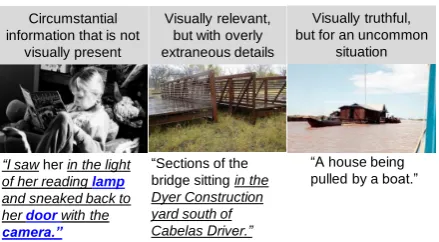
“A house being pulled by a boat.” “I saw her in the light
of her reading lamp
and sneaked back to her doorwith the
camera.”
“Sections of the bridge sitting in the Dyer Construction yard south of Cabelas Driver.” Circumstantial
information that is not visually present
Visually relevant, but with overly extraneous details
Visually truthful, but for an uncommon
[image:1.595.307.527.245.366.2]situation
Figure 1: Examples of captions that are not readily applicable to other visually similar images.
text from the retrieved samples to the query im-age (e.g. Farhadi et al. (2010), Ordonez et al. (2011), Kuznetsova et al. (2012)). Other work (e.g. Feng and Lapata (2010a), Feng and Lapata (2010b)) uses computer vision to bias summariza-tion of text associated with images to produce de-scriptions. All of these approaches rely on ex-isting text that describes visual content, but many times existing image descriptions contain signifi-cant amounts of extraneous, non-visual, or other-wise non-desirable content. The goal of this paper is to develop techniques to automatically clean up visually descriptive text to make it more directly usable for applications exploiting the connection between images and language.
As a concrete example, consider the first image in Figure 1. This caption was written by the photo owner and therefore contains information related to the context of when and where the photo was taken. Objects such as “lamp”, “door”, “camera” are not visually present in the photo. The second image shows a similar but somewhat different is-sue. Its caption describes visible objects such as
“bridge” and “yard”, but “Cabelas Driver” are overly specific and not visually detectable. The
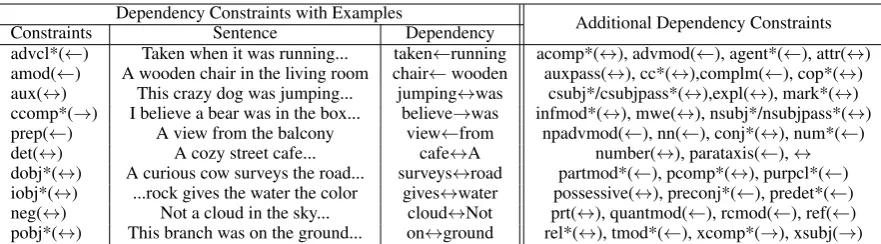
Dependency Constraints with Examples Additional Dependency Constraints
Constraints Sentence Dependency
[image:2.595.78.519.61.183.2]advcl*(←) Taken when it was running... taken←running acomp*(↔), advmod(←), agent*(←), attr(↔) amod(←) A wooden chair in the living room chair←wooden auxpass(↔), cc*(↔),complm(←), cop*(↔) aux(↔) This crazy dog was jumping... jumping↔was csubj*/csubjpass*(↔),expl(↔), mark*(↔) ccomp*(→) I believe a bear was in the box... believe→was infmod*(↔), mwe(↔), nsubj*/nsubjpass*(↔) prep(←) A view from the balcony view←from npadvmod(←), nn(←), conj*(↔), num*(←) det(↔) A cozy street cafe... cafe↔A number(↔), parataxis(←),↔ dobj*(↔) A curious cow surveys the road... surveys↔road partmod*(←), pcomp*(↔), purpcl*(←) iobj*(↔) ...rock gives the water the color gives↔water possessive(↔), preconj*(←), predet*(←) neg(↔) Not a cloud in the sky... cloud↔Not prt(↔), quantmod(←), rcmod(←), ref(←) pobj*(↔) This branch was on the ground... on↔ground rel*(↔), tmod*(←), xcomp*(→), xsubj(→)
Table 1: Dependency-based Constraints
text of the third image,“A house being pulled by a boat”, pertains directly to the visual content of the image, but is unlikely to be useful for tasks such as caption transfer because the depiction is unusual.1 This phenomenon of information gap between the visual content of the images and their correspond-ing narratives has been studied closely by Dodge et al. (2012).
The content misalignment between images and text limits the extent to which visual detectors can learn meaningful mappings between images and text. To tackle this challenge, we introduce the new task ofimage caption generalizationthat rewrites captions to be more visually relevant and more readily applicable to other visually similar images. Our end goal is to convert noisy image-text pairs in the wild (Ordonez et al., 2011) into pairs with tighter content alignment, resulting in new simplified captions over 1 million images. Evaluation results show both the intrinsic quality of the generalized captions and the extrinsic util-ity of the new image-text parallel corpus. The new parallel corpus will be made publicly available.2
2 Sentence Generalization as Constraint Optimization
Casting the generalization task asvisually-guided
sentence compression with lightweight revisions, we formulate a constraint optimization problem that aims to maximize content selection and lo-cal linguistic fluency while satisfying constraints driven from dependency parse trees. Dependency-based constraints guide the generalized caption
1Open domain computer vision remains to be an open
problem, and it would be difficult to reliably distinguish pic-tures of subtle visual differences, e.g., picpic-tures of“a water front house with a docked boat”from those of“a floating house pulled by a boat”.
2Available athttp://www.cs.stonybrook.edu/
˜ychoi/imgcaption/
to be grammatically valid (e.g., keeping articles in place, preventing dangling modifiers) while re-maining semantically compatible with respect to a given image-text pair (e.g., preserving predicate-argument relations). More formally, we maximize the following objective function:
F(y;x) = Φ(y;x, v) + Ψ(y;x)
subject to C(y;x, v)
wherex = {xi}is the input caption (a sentence),
v is the accompanying image, y = {yi} is the
output sentence,Φ(y;x, v)is the content selection
score,Ψ(y;x) is the linguistic fluency score, and C(y;x, v)is the set of hard constraints. Letl(yi)
be the index of the word inxthat is selected as the
i’th word in the outputyso thatxl(yi)=yi. Then,
we factorizeΦ(·)andΨ(·)as:
Φ(y;x, v) = X
i
φ(yi, x, v) =
X
i
φ(xl(yi), v)
Ψ(y;x) = X
i
ψ(yi, ..., yi−K)
= X
i
ψ(xl(yi), ..., xl(yi−K))
whereKis the size of local context.
Content Selection – Visual Estimates:
(a) (b)
0 1 2 3 4 5 6 7 8 0
200 400 600 800
#
o
f
se
n
te
n
ce
s
(i
n
t
h
o
u
sa
nd
s)
0 1 2 3 4
0 400 800 1200
#
o
f
se
n
te
n
ce
s
(i
n
t
h
o
u
sa
nd
[image:3.595.71.291.62.150.2]s)
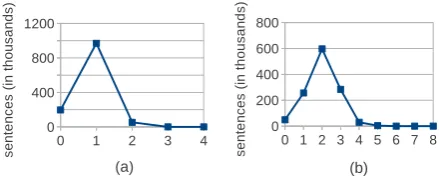
Figure 2: Number of sentences (y-axis) for each
average (x-axis in (a)) and maximum (x-axis in (b)) number of words with future dependencies
Models are linear SVMs followed by a sigmoid to produce probability for each node.3
Content Selection – Salient Topics:
We consider Tf.Idf driven scores to favor salient topics, as those are more likely to generalize across many different images. Additionally, we assign a very low content selection score (−∞) for proper nouns and numbers and a very high score (larger then maximum idf or visual score) for the 2k most frequent words in our corpus.
Local Linguistic Fluency:
We model linguistic fluency with 3-gram condi-tional probabilities:
ψ(xl(yi), xl(yi−1), xl(yi−2)) (1)
=p(xl(yi)|xl(yi−2), xl(yi−1))
We experiment with two different ngram statis-tics, one extracted from the Google Web 1T cor-pus (Brants and Franz., 2006), and the other com-puted from the 1M image-caption corpus (Or-donez et al., 2011).
Dependency-driven Constraints:
Table 1 defines the list of dependencies used as constraints driven from the typed dependen-cies (de Marneffe and Manning, 2009; de Marn-effe et al., 2006). The direction of arrows indi-cate the direction of inclusion requirements. For example,dep(X ←− Y), denotes that “X” must
be included whenever “Y” is included. Similarly,
dep(X ←→ Y) denotes that “X” and “Y” must
either be included together or eliminated together. We determine the uni- or bi-directionality of these constraints by manually examining a few example sentences corresponding to each of these typed de-pendencies. Note that some dependencies such as det(←→) would hold regardless of the particular
3Code was provided by Deng et al. (2012).
Method-1 (M1) v.s. Method-2 (M2) M1 winsover M2
SALIENCY ORIG 76.34%
VISUAL ORIG 81.75%
VISUAL SALIENCY 72.48%
VISUAL VISUAL W/OCONSTR 83.76%
VISUAL NGRAM-ONLY 90.20%
VISUAL HUMAN 19.00%
Table 2: Forced Choice Evaluation (LM Corpus = Google)
lexical items, while others, e.g., dobj(←→) may
or may not be necessary depending on the context. Those dependencies that we determine as largely context dependent are marked with * in Table 1.
One could consider enforcing all dependency constraints in Table 1 as hard constraints so that the compressed sentence must not violate any of those directed dependency constraints. Doing so would lead to overly conservative compression with least compression ratio however. Therefore, we relax those that are largely context dependent as soft constraints (marked in Table 1 with *) by introducing a constant penalty term in the objec-tive function. Alternaobjec-tively, the dependency based constraints can be learned statistically from the training corpus of paired original and compressed sentences. Since we do not have such in-domain training data at this time, we leave this exploration as future research.
Dynamic Programming with Dynamic Beam: The constraint optimization we formulated corre-sponds to an NP-hard problem. In our work, hard constraints are based only on typed dependencies, and we find that long range dependencies occur in-frequently in actual image descriptions, as plotted in Figure 2. With this insight, we opt for decoding based on dynamic programming with dynamically adjusted beam.4 Alternatively, one can find an ap-proximate solution using Integer Linear Program-ming (e.g., Clarke and Lapata (2006), Clarke and Lapata (2007), Martins and Smith (2009)).
3 Evaluation
Since there is no existing benchmark data for im-age caption generalization, we crowdsource evalu-ation using Amazon Mechanical Turk (AMT). We empirically compare the following options:
4The required beam size at each step depends on how
many words have dependency constraints involving any word following the current one – beam size is at most2p, wherep
[image:3.595.313.521.62.149.2]Big elm tree over the house is no their anymore.
Tree over the house.
Abandonned
houses in the
forest.
Houses in the forest.
A woman paints a tree in bloom near the duck pond in the Boston Public Garden, April 15, 2006.
A tree in bloom .
Pillbox in field behind a pub car park.
Pub car.
Flowering tree in mixed forest at Wakehurst.
Flowering tree in forest.
The insulbrick matches the yard. This is outside of medina ohio near the tonka truck house.
The yard. This is outside the house.
[image:4.595.74.527.67.184.2]Query Image Retrieved Images
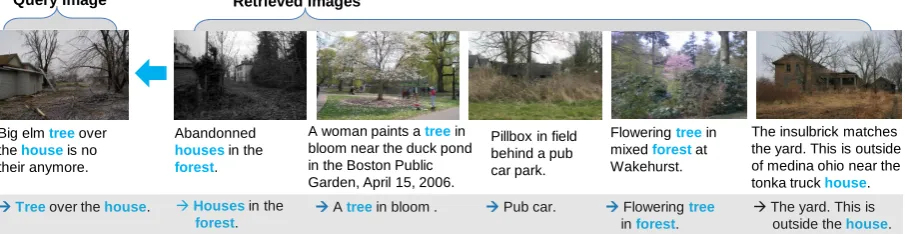
Figure 3: Example Image Caption Transfer
Method CorpusLM BLEU strict matchingP R F BLEU semantic matchingP R F
ORIG N/A 0.063 0.064 0.139 0.080 0.215 0.220 0.508 0.276
SALIENCY Image Corpus 0.060 0.074 0.077 0.068 0.302 0.411 0.399 0.356
VISUAL Image Corpus 0.060 0.075 0.075 0.068 0.305 0.422 0.397 0.360
SALIENCY Google Corpus 0.064 0.070 0.101 0.074 0.286 0.337 0.459 0.340
VISUAL Google Corpus 0.065 0.071 0.098 0.075 0.296 0.354 0.457 0.350
Table 3: Image Description Transfer: performance in BLEU and F1 withstrict&semanticmatching.
•ORIG: original uncompressed captions •HUMAN: compressed by humans (See§3.2)
•SALIENCY: linguistic fluency + saliency-based
content selection + dependency constraints
• VISUAL: linguistic fluency + visually-guided
content selection + dependency constraints
•xW/O CONSTR: methodxwithout dependency constraints
•NGRAM-ONLY: linguistic fluency only
3.1 Intrinsic Evaluation: Forced Choice Turkers are provided with an image and two cap-tions (produced by different methods) and are asked to select a better one, i.e., the most relevant and plausible caption that contains the least extra-neous information. Results are shown in Table 2. We observe thatVISUAL(full model with visually
guided content selection) performs the best, being selected over SALIENCY (content-selection
with-out visual information) in 72.48% cases, andeven over the original image caption in 81.75% cases.
This forced-selection experiment between VI
-SUAL andORIGdemonstrates the degree of noise
prevalent in the image captions in the wild. Of course, if compared against human-compressed captions, the automatic captions are preferred much less frequently – in 19% of the cases. In those 19% cases when automatic captions are pre-ferred over human-compressed ones, it is some-times that humans did not fully remove informa-tion that is not visually present or verifiable, and other times humans overly compressed. To
ver-ify the utility of dependency-based constraints, we also compare two variations of VISUAL, with
and without dependency-based constraints. As ex-pected, the algorithm with constraints is preferred in the majority of cases.
3.2 Extrinsic Evaluation: Image-based Caption Retrieval
We evaluate the usefulness of our new image-text parallel corpus for automatic generation of image descriptions. Here the task is to produce, for a query image, a relevant description, i.e., a visu-ally descriptive caption. Following Ordonez et al. (2011), we produce a caption for a query image by finding top k most similar images within the 1M image-text corpus (Ordonez et al., 2011) and then transferring their captions to the query im-age. To compute evaluation measures, we take the average scores of BLEU(1) and F-score (unigram-based with respect to content-words) overk = 5
candidate captions.
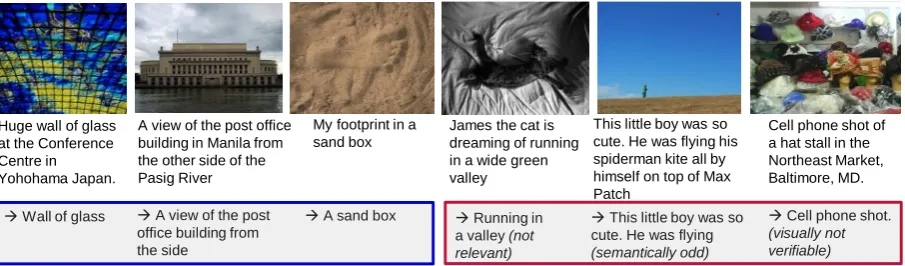
im-Huge wall of glass at the Conference Centre in Yohohama Japan.
Wall of glass
My footprint in a sand box
A sand box
James the cat is dreaming of running in a wide green valley
Running in a valley (not relevant)
This little boy was so cute. He was flying his spiderman kite all by himself on top of Max Patch
This little boy was so cute. He was flying (semantically odd) A view of the post office
building in Manila from the other side of the Pasig River
A view of the post office building from the side
Cell phone shot of a hat stall in the Northeast Market, Baltimore, MD.
[image:5.595.74.527.62.195.2] Cell phone shot. (visually not verifiable)
Figure 4: Good (left three, in blue) and bad examples (right three, in red) of generalized captions
ages in the whole dataset using an unweighted sum of gist similarity and tiny image similarity.
Gold standard (human compressed) captions are obtained using AMT for 1K images. The results are shown in Table 3. Strict matchinggives credit only to identical words between the gold-standard caption and the automatically produced caption. However, words in the original caption of the query image (and its compressed caption) do not overlap exactly with words in the retrieved cap-tions, even when they are semantically very close, which makes it hard to see improvements even when the captions of the new corpus are more gen-eral and transferable over other images. Therefore, we also report scores based onsemantic matching, which gives partial credits to word pairs based on their lexical similarity.5 The best performing
ap-proach with semantic matching is VISUAL (with
LM = Image corpus), improving BLEU, Precision, F-score substantially over those ofORIG,
demon-strating the extrinsic utility of our newly gener-ated image-text parallel corpus in comparison to the original database. Figure 3 shows an example of caption transfer.
4 Related Work
Several recent studies presented approaches to automatic caption generation for images (e.g., Farhadi et al. (2010), Feng and Lapata (2010a), Feng and Lapata (2010b), Yang et al. (2011), Kulkarni et al. (2011), Li et al. (2011), Kuznetsova et al. (2012)). The end goal of our work differs in that we aim to revise original image captions into
5We take Wu-Palmer Similarity as similarity
mea-sure (Wu and Palmer, 1994). When computing BLEU with semantic matching, we look for the match with the highest similarity score among words that have not been matched be-fore. Any word matched once (even with a partial credit) will be removed from consideration when matching next words.
descriptions that are more general and align more closely to the visual image content.
In comparison to prior work on sentence com-pression, our approach falls somewhere between unsupervised to distant-supervised approach (e.g., Turner and Charniak (2005), Filippova and Strube (2008)) in that there is not an in-domain train-ing corpus to learn generalization patterns directly. Future work includes exploring more direct su-pervision from human edited sample generaliza-tion (e.g., Knight and Marcu (2000), McDonald (2006)) Galley and McKeown (2007), Zhu et al. (2010)), and the inclusion of edits beyond dele-tion, e.g., substitutions, as has been explored by e.g., Cohn and Lapata (2008), Cordeiro et al. (2009), Napoles et al. (2011).
5 Conclusion
We have introduced the task of image caption gen-eralization as a means to reduce noise in the paral-lel corpus of images and text. Intrinsic and extrin-sic evaluations confirm that the captions in the re-sulting corpus align better with the image contents (are often preferred over the original captions by people), and can be practically more useful with respect to a concrete application.
Acknowledgments
References
Thorsten Brants and Alex Franz. 2006. Web 1t 5-gram version 1. InLinguistic Data Consortium.
James Clarke and Mirella Lapata. 2006. Constraint-based sentence compression: An integer program-ming approach. In Proceedings of the COL-ING/ACL 2006 Main Conference Poster Sessions, pages 144–151, Sydney, Australia, July. Association for Computational Linguistics.
James Clarke and Mirella Lapata. 2007. Modelling compression with discourse constraints. In Pro-ceedings of the 2007 Joint Conference on Empirical Methods in Natural Language Processing and Com-putational Natural Language Learning (EMNLP-CoNLL), pages 1–11, Prague, Czech Republic, June. Association for Computational Linguistics.
Trevor Cohn and Mirella Lapata. 2008. Sentence compression beyond word deletion. InProceedings of the 22nd International Conference on Compu-tational Linguistics (Coling 2008), pages 137–144, Manchester, UK, August. Coling 2008 Organizing Committee.
Joao Cordeiro, Gael Dias, and Pavel Brazdil. 2009. Unsupervised induction of sentence compression rules. In Proceedings of the 2009 Workshop on Language Generation and Summarisation (UC-NLG+Sum 2009), pages 15–22, Suntec, Singapore, August. Association for Computational Linguistics.
Marie-Catherine de Marneffe and Christopher D. Man-ning. 2009. Stanford typed dependencies manual.
Marie-Catherine de Marneffe, Bill Maccartney, and Christopher D. Manning. 2006. Generating typed dependency parses from phrase structure parses. InLanguage Resources and Evaluation Conference 2006.
Jia Deng, Wei Dong, Richard Socher, Li-Jia Li, Kai Li, and Li Fei-Fei. 2009. ImageNet: A Large-Scale Hi-erarchical Image Database. InConference on Com-puter Vision and Pattern Recognition.
Jia Deng, Jonathan Krause, Alexander C. Berg, and L. Fei-Fei. 2012. Hedging your bets: Optimizing accuracy-specificity trade-offs in large scale visual recognition. InConference on Computer Vision and Pattern Recognition.
Jesse Dodge, Amit Goyal, Xufeng Han, Alyssa Men-sch, Margaret Mitchell, Karl Stratos, Kota Yam-aguchi, Yejin Choi, Hal Daume III, Alex Berg, and Tamara Berg. 2012. Detecting visual text. In Pro-ceedings of the 2012 Conference of the North Amer-ican Chapter of the Association for Computational Linguistics: Human Language Technologies, pages 762–772, Montr´eal, Canada, June. Association for Computational Linguistics.
Ali Farhadi, Mohsen Hejrati, Mohammad Amin Sadeghi, Peter Young1, Cyrus Rashtchian, Julia
Hockenmaier, and David Forsyth. 2010. Every pic-ture tells a story: generating sentences for images. InEuropean Conference on Computer Vision. Christiane D. Fellbaum, editor. 1998. WordNet: an
electronic lexical database. MIT Press.
Yansong Feng and Mirella Lapata. 2010a. How many words is a picture worth? automatic caption genera-tion for news images. InAssociation for Computa-tional Linguistics.
Yansong Feng and Mirella Lapata. 2010b. Topic mod-els for image annotation and text illustration. In Hu-man Language Technologies.
Katja Filippova and Michael Strube. 2008. Depen-dency tree based sentence compression. In Proceed-ings of the Fifth International Natural Language Generation Conference, INLG ’08, pages 25–32, Stroudsburg, PA, USA. Association for Computa-tional Linguistics.
Michel Galley and Kathleen McKeown. 2007. Lex-icalized Markov grammars for sentence compres-sion. In Human Language Technologies 2007: The Conference of the North American Chapter of the Association for Computational Linguistics; Pro-ceedings of the Main Conference, pages 180–187, Rochester, New York, April. Association for Com-putational Linguistics.
Kevin Knight and Daniel Marcu. 2000. Statistics-based summarization - step one: Sentence compres-sion. InAAAI/IAAI, pages 703–710.
Girish Kulkarni, Visruth Premraj, Sagnik Dhar, Sim-ing Li, Yejin Choi, Alexander C Berg, and Tamara L Berg. 2011. Babytalk: Understanding and gener-ating simple image descriptions. InConference on Computer Vision and Pattern Recognition.
Polina Kuznetsova, Vicente Ordonez, Alexander Berg, Tamara Berg, and Yejin Choi. 2012. Collective gen-eration of natural image descriptions. In Proceed-ings of the 50th Annual Meeting of the Association for Computational Linguistics (Volume 1: Long Pa-pers), pages 359–368, Jeju Island, Korea, July. As-sociation for Computational Linguistics.
Svetlana Lazebnik, Cordelia Schmid, and Jean Ponce. 2006. Beyond bags of features: Spatial pyramid matching. In Conference on Computer Vision and Pattern Recognition, June.
Siming Li, Girish Kulkarni, Tamara L. Berg, Alexan-der C. Berg, and Yejin Choi. 2011. Composing simple image descriptions using web-scale n-grams. InProceedings of the Fifteenth Conference on Com-putational Natural Language Learning, pages 220– 228, Portland, Oregon, USA, June. Association for Computational Linguistics.
Andre Martins and Noah A. Smith. 2009. Summariza-tion with a joint model for sentence extracSummariza-tion and compression. In Proceedings of the Workshop on Integer Linear Programming for Natural Language Processing, pages 1–9, Boulder, Colorado, June. As-sociation for Computational Linguistics.
Ryan T. McDonald. 2006. Discriminative sentence compression with soft syntactic evidence. InEACL 2006, 11st Conference of the European Chapter of the Association for Computational Linguistics, Pro-ceedings of the Conference, April 3-7, 2006, Trento, Italy. The Association for Computer Linguistics.
Courtney Napoles, Chris Callison-Burch, Juri Ganitke-vitch, and Benjamin Van Durme. 2011. Paraphras-tic sentence compression with a character-based metric: Tightening without deletion. In Proceed-ings of the Workshop on Monolingual Text-To-Text Generation, pages 84–90, Portland, Oregon, June. Association for Computational Linguistics.
Aude Oliva and Antonio Torralba. 2001. Modeling the shape of the scene: a holistic representation of the spatial envelope. International Journal of Computer Vision.
Vicente Ordonez, Girish Kulkarni, and Tamara L. Berg. 2011. Im2text: Describing images using 1 million captioned photographs. InNeural Information Pro-cessing Systems (NIPS).
Antonio Torralba, Rob Fergus, and William T. Free-man. 2008. 80 million tiny images: a large dataset for non-parametric object and scene recognition. Pattern Analysis and Machine Intelligence, 30.
Jenine Turner and Eugene Charniak. 2005. Super-vised and unsuperSuper-vised learning for sentence com-pression. InProceedings of the 43rd Annual Meet-ing of the Association for Computational LMeet-inguis- Linguis-tics (ACL’05), pages 290–297, Ann Arbor, Michi-gan, June. Association for Computational Linguis-tics.
Jinjun Wang, Jianchao Yang, Kai Yu, Fengjun Lv, T. Huang, and Yihong Gong. 2010. Locality-constrained linear coding for image classification. In Conference on Computer Vision and Pattern Recognition (CVPR).
Zhibiao Wu and Martha Palmer. 1994. Verbs seman-tics and lexical selection. InProceedings of the 32nd annual meeting on Association for Computational Linguistics, ACL ’94, pages 133–138, Stroudsburg, PA, USA. Association for Computational Linguis-tics.
Yezhou Yang, Ching Teo, Hal Daume III, and Yiannis Aloimonos. 2011. Corpus-guided sentence genera-tion of natural images. InProceedings of the 2011 Conference on Empirical Methods in Natural Lan-guage Processing, pages 444–454, Edinburgh, Scot-land, UK., July. Association for Computational Lin-guistics.