Closing the Gap: Learning-Based Information Extraction Rivaling
Knowledge-Engineering Methods
Hai Leong Chieu
DSO National Laboratories
20 Science Park Drive
Singapore 118230
[email protected]
Hwee Tou Ng
Department of Computer Science
National University of Singapore
3 Science Drive 2
Singapore 117543
[email protected]
Yoong Keok Lee
DSO National Laboratories
20 Science Park Drive
Singapore 118230
[email protected]
Abstract
In this paper, we present a learning ap-proach to the scenario template task of information extraction, where information filling one template could come from mul-tiple sentences. When tested on the MUC-4 task, our learning approach achieves accuracy competitive to the best of the MUC-4 systems, which were all built with manually engineered rules. Our analy-sis reveals that our use of full parsing and state-of-the-art learning algorithms have contributed to the good performance. To our knowledge, this is the first re-search to have demonstrated that a learn-ing approach to the full-scale informa-tion extracinforma-tion task could achieve per-formance rivaling that of the knowledge-engineering approach.
1
Introduction
The explosive growth of online texts written in natu-ral language has prompted much research into
infor-mation extraction (IE), the task of automatically
ex-tracting specific information items of interest from natural language texts. The extracted information is used to fill database records, also known as
tem-plates in the IE literature.
Research efforts on IE tackle a variety of tasks. They include extracting information from semi-structured texts, such as seminar announcements, rental and job advertisements, etc., as well as from free texts, such as newspaper articles (Soderland, 1999). IE from semi-structured texts is easier than from free texts, since the layout and format of a semi-structured text provide additional useful clues
AYACUCHO, 19 JAN 89 – TODAY TWO PEOPLE WERE WOUNDED WHEN A BOMB EXPLODED IN SAN JUAN BAUTISTA MUNICIPALITY. OFFICIALS SAID THAT SHINING PATH MEMBERS WERE RESPONSIBLE FOR THE ATTACK ... ... POLICE SOURCES STATED THAT THE BOMB ATTACK INVOLVING THE SHINING PATH CAUSED SERIOUS DAMAGES ... ...
Figure 1: Snippet of a MUC-4 document
to aid in extraction. Several benchmark data sets have been used to evaluate IE approaches on semi-structured texts (Soderland, 1999; Ciravegna, 2001; Chieu and Ng, 2002a).
For the task of extracting information from free texts, a series of Message Understanding Confer-ences (MUC) provided benchmark data sets for eval-uation. Several subtasks for IE from free texts have been identified. The named entity (NE) task extracts person names, organization names, location names, etc. The template element (TE) task extracts infor-mation centered around an entity, like the acronym, category, and location of a company. The template relation (TR) task extracts relations between enti-ties. Finally, the full-scale IE task, the scenario tem-plate (ST) task, deals with extracting generic infor-mation items from free texts. To tackle the full ST task, an IE system needs to merge information from multiple sentences in general, since the information needed to fill one template can come from multiple sentences, and thus discourse processing is needed. The full-scale ST task is considerably harder than all the other IE tasks or subtasks outlined above.
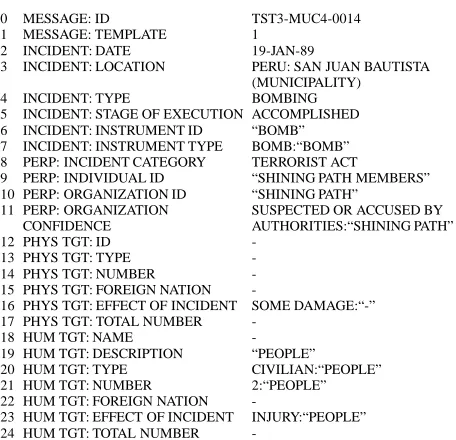
ap-0 MESSAGE: ID TST3-MUC4-0014 1 MESSAGE: TEMPLATE 1
2 INCIDENT: DATE 19-JAN-89
3 INCIDENT: LOCATION PERU: SAN JUAN BAUTISTA (MUNICIPALITY)
4 INCIDENT: TYPE BOMBING 5 INCIDENT: STAGE OF EXECUTION ACCOMPLISHED 6 INCIDENT: INSTRUMENT ID “BOMB” 7 INCIDENT: INSTRUMENT TYPE BOMB:“BOMB” 8 PERP: INCIDENT CATEGORY TERRORIST ACT
9 PERP: INDIVIDUAL ID “SHINING PATH MEMBERS” 10 PERP: ORGANIZATION ID “SHINING PATH”
11 PERP: ORGANIZATION SUSPECTED OR ACCUSED BY CONFIDENCE AUTHORITIES:“SHINING PATH” 12 PHYS TGT: ID
-13 PHYS TGT: TYPE -14 PHYS TGT: NUMBER -15 PHYS TGT: FOREIGN NATION
-16 PHYS TGT: EFFECT OF INCIDENT SOME DAMAGE:“-” 17 PHYS TGT: TOTAL NUMBER
-18 HUM TGT: NAME -19 HUM TGT: DESCRIPTION “PEOPLE” 20 HUM TGT: TYPE CIVILIAN:“PEOPLE” 21 HUM TGT: NUMBER 2:“PEOPLE” 22 HUM TGT: FOREIGN NATION
-23 HUM TGT: EFFECT OF INCIDENT INJURY:“PEOPLE” 24 HUM TGT: TOTAL NUMBER
-Figure 2: Example of a MUC-4 template
proach, where manually engineered rules were used for IE. More recently, machine learning approaches have been used for IE from semi-structured texts (Califf and Mooney, 1999; Soderland, 1999; Roth and Yih, 2001; Ciravegna, 2001; Chieu and Ng, 2002a), named entity extraction (Chieu and Ng, 2002b), template element extraction, and template relation extraction (Miller et al., 1998). These ma-chine learning approaches have been successful for these tasks, achieving accuracy comparable to the knowledge-engineering approach.
However, for the full-scale ST task of generic IE from free texts, the best reported method to date is still the knowledge-engineering approach. For ex-ample, almost all participating IE systems in MUC used the knowledge-engineering approach for the full-scale ST task. The one notable exception is the work of UMass at MUC-6 (Fisher et al., 1995). Unfortunately, their learning approach did consider-ably worse than the best MUC-6 systems. Soder-land (1999) and Chieu and Ng (2002a) attempted machine learning approaches for a scaled-down ver-sion of the ST task, where it was assumed that the information needed to fill one template came from one sentence only.
In this paper, we present a learning approach to the full-scale ST task of extracting information from free texts. The task we tackle is considerably more complex than that of (Soderland, 1999; Chieu
and Ng, 2002a), since we need to deal with merg-ing information from multiple sentences to fill one template. We evaluated our learning approach on the MUC-4 task of extracting terrorist events from free texts. We chose the MUC-4 task since man-ually prepared templates required for training are available.1 When trained and tested on the official benchmark data of MUC-4, our learning approach achieves accuracy competitive with the best MUC-4 systems, which were all built using manually engi-neered rules. To our knowledge, our work is the first learning-based approach to have achieved perfor-mance competitive with the knowledge-engineering approach on the full-scale ST task.
2
Task Definition
The task addressed in this paper is the Scenario Tem-plate (ST) task defined in the Fourth Message Un-derstanding Conference (MUC-4).2 The objective of
this task is to extract information on terrorist events occurring in Latin American countries from free text documents. For example, given the input document in Figure 1, an IE system is to extract information items related to any terrorist events to fill zero or more database records, or templates. Each distinct terrorist event is to fill one template. An example of an output template is shown in Figure 2. Each of the 25 fields in the template is called a slot, and the string or value that fills a slot is called a slot fill.
Different slots in the MUC-4 template need to be treated differently. Besides slot 0 (MESSAGE: ID) and slot 1 (MESSAGE: TEMPLATE), the other 23 slots have to be extracted or inferred from the text document. These slots can be divided into the fol-lowing categories:
String Slots. These slots are filled using strings
extracted directly from the text document (slot 6, 9, 10, 12, 18, 19).
Text Conversion Slots. These slots have to be
inferred from strings in the document (slot 2, 14, 17, 21, 24). For example, INCIDENT: DATE has to be inferred from temporal expressions such as
“TO-1
http://www.itl.nist.gov/iaui/894.02/related projects/muc/ muc data/muc data index.html
2
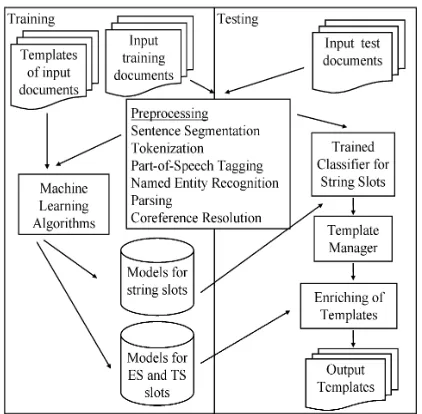
[image:2.612.74.302.66.286.2]Figure 3: ALICE: our information extraction system
DAY”, “LAST WEEK”, etc.
Set Fill Slots. This category includes the rest of
the slots. The value of a set fill slot comes from a finite set of possible values. They often have to be inferred from the document.
3
The Learning Approach
Our supervised learning approach is illustrated in Figure 3. Our system, called ALICE (Automated
Learning-based Information Content Extraction), requires manually extracted templates paired with their corresponding documents that contain terrorist events for training. After the training phase, ALICE
is then able to extract relevant templates from new documents, using the model learnt during training.
In the training phase, each input training docu-ment is first preprocessed through a chain of prepro-cessing modules. The outcome of the preproprepro-cessing is a full parse tree for each sentence, and corefer-ence chains linking various coreferring noun phrases both within and across sentences. The core of AL
-ICE uses supervised learning to build one classifier for each string slot. The candidates to fill a template slot are base (non-recursive) noun phrases. A noun phrase
that occurs in a training document and fills a template slot is used to generate one positive training example for the classifier of slot . Other noun phrases in the training document are neg-ative training examples for the classifier of slot .
The features of a training example generated from
are the verbs and other noun phrases (serving roles like agent and patient) related to
in the same sentence, as well as similar features for coreferring noun phrases of
. Thus, our features for a tem-plate slot classifier encode semantic (agent and pa-tient roles) and discourse (coreference) information. Our experimental results in this paper demonstrate that such features are effective in learning what to fill a template slot.
During testing, a new document is preprocessed through the same chain of preprocessing modules. Each candidate noun phrase
generates one test example, and it is presented to the classifier of a tem-plate slot to determine whether
fills the slot . A separate template manager decides whether a new template should be created to include slot , or slot
should fill the existing template.
3.1 Preprocessing
All the preprocessing modules of ALICE were built with supervised learning techniques. They include sentence segmentation (Ratnaparkhi, 1998), part-of-speech tagging (Charniak et al., 1993), named en-tity recognition (Chieu and Ng, 2002b), full parsing (Collins, 1999), and coreference resolution (Soon et al., 2001). Each module performs at or near state-of-the-art accuracy, but errors are unavoidable, and later modules in the preprocessing chain have to deal with errors made by the previous modules.
3.2 Features in Training and Test Examples
As mentioned earlier, the features of an example are generated based on a base noun phrase (denoted as baseNP), which is a candidate for filling a template slot. While most strings that fill a string slot are base noun phrases, this is not always the case. For in-stance, consider the two examples in Figure 4. In the first example, “BOMB” should fill the string slot IN-CIDENT: INSTRUMENT ID, while in the second example, “FMLN” should fill the string slot PERP: ORGANIZATION ID. However, “BOMB” is itself not a baseNP (the baseNP is “A BOMB EXPLO-SION”). Similarly for “FMLN”.
EXPLO-(1) ONE PERSON WAS KILLED TONIGHT AS THE RE-SULT OF A BOMB EXPLOSION IN SAN SALVADOR. (2) FORTUNATELY, NO CASUALTIES WERE REPORTED AS A RESULT OF THIS INCIDENT, FOR WHICH THE FMLN GUERRILLAS ARE BEING HELD RESPONSIBLE.
Figure 4: Sentences illustrating string slots that can-not be filled by baseNPs.
(1) MEMBERS OF THAT SECURITY GROUP ARE COMB-ING THE AREA TO DETERMINE THE FINAL OUTCOME OF THE FIGHTING.
(2) A BOMB WAS THROWN AT THE HOUSE OF FRE-DEMO CANDIDATE FOR DEPUTY MIGUEL ANGEL BARTRA BY TERRORISTS.
Figure 5: Sample sentences for the illustration of features
SION”) to generate the training example features. During training, a list of such words is compiled for slots 6 and 10 from the training templates. During testing, these words are also used as candidates for generating test examples for slots 6 and 10, in addi-tion to base NPs.
The features of an example are derived from the treebank-style parse tree output by an implementa-tion of Collins' parser (Collins, 1999). In particular, we traverse the full parse tree to determine the verbs, agents, patients, and indirect objects related to a noun phrase candidate
. While a machine learning approach is used in (Gildea and Jurafsky, 2000) to determine general semantic roles, we used a simple rule-based traversal of the parse tree instead, which could also reliably determine the generic agent and patient role of a sentence, and this suffices for our current purpose.
Specifically, for a given noun phrase candidate
, the following groups of features are used:
Verb of Agent NP (VAg) When
is an agent in a sentence, each of its associated verbs is a VAg feature. For example, in sentence (1) of Figure 5, if
is MEMBERS, then its VAg features are COMB and DETERMINE.
Verb of Patient NP (VPa) When
is a patient in a sentence, each of its associated verbs is a VPa feature. For example, in sentence (2) of Figure 5, if
is BOMB, then its VPa feature is THROW.
Verb-Preposition of NP-in-PP (V-Prep) When
is the NP in a prepositional phrase PP, then this feature is the main verb and the preposition of PP. For example, in sentence (2) of Figure 5, if
is HOUSE, its V-Prep feature is THROW-AT.
VPa and related NPs/PPs (VPaRel) If is a patient in a sentence, each of its VPa may have its own agents (Ag) and prepositional phrases (Prep-NP). In this case, the tuples (VPa, Ag) and (VPa, Prep-NP) are used as features. For example, in
“GUARDS WERE SHOT TO DEATH”, if
is GUARDS, then its VPa SHOOT, and the preposi-tional phrase TO-DEATH form the feature (SHOOT, TO-DEATH).
VAg and related NPs/PPs (VAgRel) This is
sim-ilar to VPa above, but for VAg.
V-Prep and related NPs (V-PrepRel) When is the NP in a prepositional phrase PP, then the main verb (V) may have its own agents (Ag) and pa-tients (Pa). In this case, the tuples (Ag, V-Prep) and (V-Prep, Pa) are used as features. For example, HOUSE in sentence (2) of Figure 5 will have the fea-tures (TERRORIST, THROW-AT) and (THROW-AT, BOMB).
Noun-Preposition (N-Prep) This feature aims at
capturing information in phrases such as “MUR-DER OF THE PRIESTS”. If
is PRIESTS, this feature will be MURDER-OF.
Head Word (H) The head word of each
is also used as a feature. In a parse tree, there is a head word at each tree node. In cases where a phrase does not fit into a parse tree node, the last word of the phrase is used as the head word. This feature is useful as the system has no information of the semantic class of
. From the head word, the system can get some clue to help decide if
is a possible candidate for a slot. For example, an
with head word PEASANT is more likely to fill the human target slot compared to another
with head word CLASH.
Named Entity Class (NE) The named entity
class of
is used as a feature.
Real Head (RH) For a phrase that does not fit into
a parse node, the head word feature is taken to be the last word of the phrase. The real head word of its encompassing parse node is used as another feature. For example, in the NP “FMLN GUERRILLAS”, “FMLN” is a positive example for slot 10, with head word “FMLN” and real head “GUERRILLA”.
by our coreference resolution module based on de-cision tree learning are used to determine the noun phrases that corefer with
. In particular, we use the two noun phrases
and
, where
(
) is the noun phrase that corefers with and immediately precedes (follows)
. If such a pre-ceding (or following) noun phrase
exists, we generate the following features based on
: VAg, VPa, and N-Prep.
To give an idea of the informative features used in the classifier of a slot, we rank the features used for a slot classifier according to their correlation met-ric values (Chieu and Ng, 2002a), where informa-tive features are ranked higher. Table 1 shows the top-ranking features for a few feature groups and template slots. The bracketed number behind each feature indicates the rank of this feature for that slot classifier, ordered by the correlation metric value. We observed that certain feature groups are more useful for certain slots. For example, DIE is the top VAg verb for the human target slot, and is ranked 12 among all features used for the human target slot. On the other hand, VAg is so unimportant for the physical target slot that the top VAg verb is due to a preprocessing error that made MONSERRAT a verb.
3.3 Supervised Learning Algorithms
We evaluated four supervised learning algorithms.
Maximum Entropy Classifier (Alice-ME)
The maximum entropy (ME) framework is a re-cent learning approach which has been successfully used in various NLP tasks such as sentence segmen-tation, part-of-speech tagging, and parsing (Ratna-parkhi, 1998). However, to our knowledge, ours is the first research effort to have applied ME learn-ing to the full-scale ST task. We used the imple-mentation of maximum entropy modeling from the opennlp.maxent package.3.
Support Vector Machine (Alice-SVM) The
Support Vector Machine (SVM) (Vapnik, 1995) has been successfully used in many recent applications such as text categorization and handwritten digit recognition. The learning algorithm finds a hyper-plane that separates the training data with the largest margin. We used a linear kernel for all our experi-ments.
3
http://maxent.sourceforge.net
Naive Bayes (Alice-NB) The Naive Bayes (NB)
algorithm (Duda and Hart, 1973) assumes the inde-pendence of features given the class and assigns a test example to the class which has the highest pos-terior probability. Add-one smoothing was used.
Decision Tree (Alice-DT) The decision tree (DT)
algorithm (Quinlan, 1993) partitions training exam-ples using the feature with the highest information gain. It repeats this process recursively for each par-tition until all examples in each parpar-tition belong to one class.
We used the WEKA package4for the
implemen-tation of SVM, NB, and DT algorithms.
A feature cutoff is used for each algorithm: fea-tures occurring less than times are rejected. For all experiments, is set to 3. For ME and SVM, no other feature selection is applied. For NB and DT, the top 100 features as determined by chi-square are selected. While not trying to do a serious compari-son of machine learning algorithms, ME and SVM seem to be able to perform well without feature selection, whereas NB and DT require some form of feature selection in order to perform reasonably well.
3.4 Template Manager
As each sentence is processed, phrases classified as positive for any of the string slots are sent to the Template Manager (TM), which will decide if a new template should be created when it receives a new slot fill.
The system first attempts to attach a date and a lo-cation to each slot fill
. Dates and locations are first attached to their syntactically nearest verb, by traversing the parse tree. Then, for each string fill
, we search its syntactically nearest verb in the same manner and assign the date and location at-tached to to
.
When a new slot fill is found, the Template Man-ager will decide to start a new template if one of the following conditions is true:
Date The date attached to the current slot fill is
different from the date of the current template.
Location The location attached to the current slot
fill is not compatible with the location of the current template (one location does not contain the other).
4
Slot VAg VPa V-Prep N-Prep
[image:6.612.82.530.69.134.2]Human Target DIE(12) KILL(2) IDENTIFY-AS(47) MURDER-OF(3) Perpetrator Individual KIDNAP(5) IMPLICATE(17) ISSUE-FOR(73) WARRANT-FOR(64) Physical Target MONSERRAT(420) DESTROY(1) THROW-AT(32) ATTACK-ON(11) Perpetrator Organization KIDNAP(16) BLAME(25) SUSPEND-WITH(87) GUERRILLA-OF(31) Instrument ID EXPLODE(4) PLACE(5) EQUIP-WITH(31) EXPLOSION-OF(17)
Table 1: The top-ranking feature for each group of features and the classifier of a slot
Incident Type Seed Words
ATTACK JESUIT, MURDER, KILL, ATTACK
BOMBING BOMB, EXPLOS, DYNAMIT, EXPLOD, INJUR KIDNAPPING KIDNAP, ELN, RELEAS
Table 2: Stemmed seed words for each incident type
This is determined by using location lists provided by the MUC-4 conference, which specify whether one location is contained in another. An entry in this list has the format of “PLACE-NAME1:PLACE-NAME2”, where PLACE-NAME2 is contained in PLACE-NAME1 (e.g., CUBA: HAVANA (CITY)).
Seed Word The sentence of the current slot fill
contains a seed word for a different incident type. A number of seed words are automatically learned for each of the incident types ATTACK, BOMBING, and KIDNAPPING. They are automatically derived based on the correlation metric value used in (Chieu and Ng, 2002a). For the remaining incident types, there are too few incidents in the training data for seed words to be collected. The seeds words used are shown in Table 2.
3.5 Enriching Templates
In the last stage before output, the template content is further enriched in the following manner:
Removal of redundant slot fills For each slot in
the template, there might be several slot fills refer-ring to the same thing. For example, for HUM TGT: DESCRIPTION, the system might have found both “PRIESTS” and “JESUIT PRIESTS”. A slot fill that is a substring of another slot fill will be removed from the template.
Effect/Confidence and Type Classifiers are also
trained for effect and confidence slots 11, 16, and 23 (ES slots), as well as type slots 7, 13, and 20 (TS slots). ES slots used exactly the same features as string slots, while TS slots used only head words and adjectives as features. For such slots, each entry refers to another slot fill. For example, slot 23 may contain the entry “DEATH” : “PRIESTS”, where
“PRIESTS” fills slot 19. During training, each train-ing example is a fill of a reference slot (e.g., for slot 23, the reference slots are slot 18 and 19). For slot 23, for example, each instance will have a class such as DEATH or INJURY, or if there is no entry in slot 23, UNKNOWN EFFECT. During testing, slot fills of reference slots will be classified to determine if they should have an entry in an ES or a TS slot.
Date and Location. If the system is unable to fill
the DATE or LOCATION slot of a template, it will use as default value the date and country of the city in the dateline of the document.
Other Slots. The remaining slots are filled with
default values. For example, slot 5 has the default value “ACCOMPLISHED”, and slot 8 “TERROR-IST ACT” (except when the perpetrator contains strings such as “GOVERNMENT”, in which case it will be changed to “STATE-SPONSORED VIO-LENCE”). Slot 15, 17, 22, and 24 are always left unfilled.
4
Evaluation
There are 1,300 training documents, of which 700 are relevant (i.e., have one or more event templates). There are two official test sets, i.e., TST3 and TST4, containing 100 documents each. We trained our sys-tem ALICE using the 700 documents with relevant templates, and then tested it on the two official test sets. The output templates were scored using the scorer provided on the official website.
TST3 TST4
R P F R P F
GE 55 54 54 GE 60 54 57
GE-CMU 43 52 47 GE-CMU 48 52 50 Alice-ME 41 51 45 Alice-ME 44 49 46 Alice-SVM 41 45 43 Alice-SVM 45 44 44
SRI 37 51 43 NYU 42 45 43
UMASS 36 49 42 SRI 39 49 43
Alice-DT 31 51 39 Alice-DT 36 50 42
NYU 35 43 39 UMASS 42 42 42
Alice-NB 41 30 35 Alice-NB 51 32 39
UMICH 32 36 34 BBN 35 42 38
[image:7.612.71.305.69.203.2]BBN 22 40 28 UMICH 32 34 33
Table 3: Accuracy of string slots on the TST3 and TST4 test set
TST3 TST4
R P F R P F
GE 58 54 56 GE 62 53 57
GE-CMU 48 55 51 GE-CMU 53 53 53
UMASS 45 56 50 SRI 44 51 47
Alice-ME 46 51 48 Alice-ME 46 46 46
SRI 43 54 48 NYU 46 46 46
Alice-SVM 45 46 45 UMASS 47 45 46 Alice-DT 38 53 44 Alice-SVM 47 40 43 NYU 40 46 43 Alice-DT 41 46 43
UMICH 40 39 39 BBN 40 43 41
Alice-NB 45 34 39 Alice-NB 52 33 40
BBN 29 43 35 UMICH 36 34 35
Table 4: Accuracy of all slots on the TST3 and TST4 test set
on the official web site). The same history file down-loaded from the official web site is uniformly used for scoring the output templates of all systems (the history file contains the arbitration decisions for am-biguous cases).
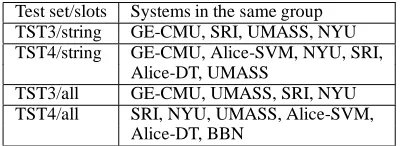
We conducted statistical significance test, using the approximate randomization method adopted in MUC-4. Table 5 shows the systems that are not sig-nificantly different from Alice-ME.
Our system ALICE-ME, using a learning ap-proach, is able to achieve accuracy competitive to the best of the MUC-4 participating systems, which were all built using manually engineered rules. We also observed that ME and SVM, the more recent machine learning algorithms, performed better than DT and NB.
Full Parsing. To illustrate the benefit of full
pars-ing, we conducted experiments using a subset of fea-tures, with and without full parsing. We used ME as the learning algorithm in these experiments. The re-sults on string slots are summarized in Table 6. The
Test set/slots Systems in the same group TST3/string GE-CMU, SRI, UMASS, NYU TST4/string GE-CMU, Alice-SVM, NYU, SRI,
Alice-DT, UMASS
TST3/all GE-CMU, UMASS, SRI, NYU TST4/all SRI, NYU, UMASS, Alice-SVM,
[image:7.612.327.527.71.144.2]Alice-DT, BBN
Table 5: Systems whose F-measures are not signif-icantly different from Alice-ME at the 0.10 signifi-cance level with 0.99 confidence
TST3 TST4
System R P F R P F
H + NE 23 44 30 18 30 23
H + NE + V (w/o parsing) 26 42 32 28 40 33 H + NE + V (with parsing) 38 49 43 40 45 42
Table 6: Accuracy of string slots with and without full parsing
baseline system used only two features, head word (H) and named entity class (NE). Next, we added three features, VAg, VPa, and V-Prep. Without full parsing, these verbs were obtained based on the im-mediately preceding (or following) verb of a noun phrase, and the voice of the verb. With full pars-ing, these verbs were obtained based on traversing the full parse tree. The results indicate that verb fea-tures contribute to the performance of the system, even without full parsing. With full parsing, verbs can be determined more accurately, leading to better overall performance.
5
Discussion
Although the best MUC-4 participating systems, GE/GE-CMU, still outperform ALICE-ME, it must
be noted that for GE, “10 1/2 person months” were spent on MUC-4 using the GE NLTOOLSET , af-ter spending “15 person months” on MUC-3 (Rau et al., 1992). With a learning approach, IE systems are more portable across domains.
[image:7.612.315.545.200.253.2] [image:7.612.72.301.249.376.2]example for the human target slot. However, ALICE
does not have access to such information, since the MUC-4 training documents are not annotated (i.e., only templates are provided, but the text strings in a document are not marked). Thus, ALICE currently
uses all occurrences of “OQUELI COLINDRES” as positive training examples, which introduces noise in the training data. We believe that annotating the string occurrences in training documents will pro-vide higher quality training data for the learning ap-proach and hence further improve accuracy.
Although part-of-speech taggers often boast of accuracy over 95%, the errors they make can be fatal to the parsing of sentences. For example, they often tend to confuse “VBN” with “VBD”, which could change the entire parse tree. The MUC-4 corpus was provided as uppercase text, and this also has a negative impact on the named entity recognizer and part-of-speech tagger, which both make use of case information.
Learning approaches have been shown to perform on par or even outperform knowledge-engineering approaches in many NLP tasks. However, the full-scale scenario template IE task was still dom-inated by knowledge-engineering approaches. In this paper, we demonstrate that using both state-of-art learning algorithms and full parsing, learning approaches can rival knowledge-engineering ones, bringing us a step closer to building full-scale IE systems in a domain-independent fashion with state-of-the-art accuracy.
Acknowledgements
We thank Kian Ming Adam Chai for the implemen-tation of the full parser.
References
M. E. Califf and R. J. Mooney. 1999. Relational learning of pattern-match rules for information extraction. In
Proceedings of AAAI99, pages 328–334.
E. Charniak, C. Hendrickson, N. Jacobson, and
M. Perkowitz. 1993. Equations for part-of-speech tag-ging. In Proceedings of AAAI93, pages 784–789.
H. L. Chieu and H. T. Ng. 2002a. A maximum en-tropy approach to information extraction from semi-structured and free text. In Proceedings of AAAI02, pages 786–791.
H. L. Chieu and H. T. Ng. 2002b. Named entity recog-nition: A maximum entropy approach using global in-formation. In Proceedings of COLING02, pages 190– 196.
F. Ciravegna. 2001. Adaptive information extraction
from text by rule induction and generalisation. In
Pro-ceedings of IJCAI01, pages 1251–1256.
M. Collins. 1999. Head-driven statistical models for
natural language parsing. Ph.D. thesis, Department
of Computer and Information Science, University of Pennsylvania.
R. O. Duda and P. E. Hart. 1973. Pattern Classification
and Scene Analysis. Wiley, New York.
D. Fisher, S. Soderland, J. McCarthy, F. Feng, and W. Lehnert. 1995. Description of the UMass system as used for MUC-6. In Proceedings of MUC-6, pages 127–140.
D. Gildea and D. Jurafsky. 2000. Automatic labelling of semantic roles. In Proceedings of ACL00, pages 512– 520.
S. Miller, M. Crystal, H. Fox, L. Ramshaw, R. Schwartz, R. Stone, R. Weischedel, and the Annotation Group.
1998. Algorithms that learn to extract information
BBN: Description of the SIFT system as used for MUC-7. In Proceedings of MUC-7.
J. R. Quinlan. 1993. C4.5: Programs for Machine
Learning. Morgan Kaufmann, San Francisco.
A. Ratnaparkhi. 1998. Maximum Entropy Models for
Natural Language Ambiguity Resolution. Ph.D.
the-sis, Department of Computer and Information Science, University of Pennsylvania.
L. Rau, G. Krupka, and P. Jacobs. 1992. GE
NL-TOOLSET: MUC-4 test results and analysis. In
Pro-ceedings of MUC-4, pages 94–99.
D. Roth and W. Yih. 2001. Relational learning via propo-sitional algorithms: An information extraction case study. In Proceedings of IJCAI01, pages 1257–1263.
S. Soderland. 1999. Learning information
extrac-tion rules for semi-structured and free text. Machine
Learning, 34(1/2/3):233–272.
W. M. Soon, H. T. Ng, and D. C. Y. Lim. 2001. A ma-chine learning approach to coreference resolution of noun phrases. Computational Linguistics, 27(4):521– 544.
V. N. Vapnik. 1995. The Nature of Statistical Learning