Munich Personal RePEc Archive
Finite-sample and asymptotic analysis of
generalization ability with an application
to penalized regression
Xu, Ning and Hong, Jian and Fisher, Timothy
School of Economics, University of Sydney, School of Economics,
University of Sydney, School of Economics, University of Sydney
10 September 2016
Finite-sample and asymptotic analysis of generalization ability with an
application to penalized regression
✩Ning Xu
School of Economics, University of Sydney
Jian Hong
School of Economics, University of Sydney
Timothy C.G. Fisher
School of Economics, University of Sydney
Abstract
In this paper, we study the performance of extremum estimators from the perspective of
generalization ability (GA): the ability of a model to predict outcomes in new samples from the
same population. By adapting the classical concentration inequalities, we derive upper bounds on the empirical out-of-sample prediction errors as a function of the in-sample errors, in-sample data
size, heaviness in the tails of the error distribution, and model complexity. We show that the error
bounds may be used for tuning key estimation hyper-parameters, such as the number of foldsKin cross-validation. We also show howKaffects the bias-variance trade-off for cross-validation. We demonstrate that theL2-norm difference between penalized and the corresponding un-penalized
regression estimates is directly explained by the GA of the estimates and the GA of empirical moment conditions. Lastly, we prove that all penalized regression estimates areL2-consistent for
both then>pand then<pcases. Simulations are used to demonstrate key results.
Keywords: generalization ability, upper bound of generalization error, penalized regression,
cross-validation, bias-variance trade-off,L2difference between penalized and unpenalized regression,
lasso, high-dimensional data.
✩The authors would like to thank Mike Bain, Colin Cameron, Peter Hall and Tsui Shengshang for valuable comments
on an earlier draft. We would also like to acknowledge participants at the 12th International Symposium on Econometric Theory and Applications and the 26th New Zealand Econometric Study Group as well as seminar participants at Utah, UNSW, and University of Melbourne for useful questions and comments. Fisher would like to acknowledge the financial support of the Australian Research Council, grant DP0663477.
Email addresses:♥✳①✉❅s②❞♥❡②✳❡❞✉✳❛✉(Ning Xu),❥✐❛♥✳❤♦♥❣❅s②❞♥❡②✳❡❞✉✳❛✉(Jian Hong),
Finite-sample and asymptotic analysis of generalization ability with an
application to penalized regression
1. Introduction
Traditionally in econometrics, an estimation method is implemented on sample data in order to infer patterns in a population. Put another way, inference centers on generalizing to the population
the pattern learned from the sample and evaluating how well the sample pattern fits the population.
An alternative perspective is to consider how well a sample pattern fits another sample. In this paper, we study the ability of a model estimated from a given sample to fit new samples from
the same population, referred to as thegeneralization ability(GA) of the model. As a way of
evaluating the external validity of sample estimates, the concept of GA has been implemented in recent empirical research. For example, in the policy evaluation literature (Belloni et al., 2013;
Gechter, 2015; Dolton, 2006; Blundell et al., 2004), the central question is whether any treatment
effect estimated from a pilot program can be generalized to out-of-sample individuals. Similarly, for economic forecasting, Stock and Watson (2012) used GA as a criterion to pick optimal weight
coefficients for model averaging predictors. Generally speaking, a model with higher GA will be
more appealing for policy analysis or prediction.
With a new sample at hand, GA is easily measured using validation or cross-validation to
measure the goodness of fit of an estimated model on out-of-sample data. Without a new sample,
however, it can be difficult to measure GAex ante. In this paper, we demonstrate how to quantify the GA of an in-sample estimate when only a single sample is available by deriving upper bounds
on the empirical out-of-sample errors. The upper bounds on the out-of-sample errors depend on
the sample size, an index of the complexity of the model, a loss function, and the distribution of the underlying population. As it turns out, the bounds serve not only as a measurement of GA, but
also illustrate the trade-off between in-sample fit and out-of-sample fit. By modifying and adapting
the bounds, we are also able to analyze the performance ofK-fold cross-validation and penalized regression. Thus, the GA approach yields insight into the finite-sample and asymptotic properties
of penalized regression as well as cross-validation.
As well as being an out-of-sample performance indicator, GA may also be used for model selection. Arguably, model selection is coming to the forefront in empirical work given the
increasing prevalence of high-dimensional data in economics and finance. We often desire a smaller set of predictors in order to gain insight into the most relevant relationships between outcomes and
covariates. Model selection based on GA not only offers improved interpretability of an estimated
model, but, critically, it also improves the bias-variance trade-off relative to the traditional extremum estimation approach.
1.1. Traditional approach to the bias-variance trade-off
Without explicitly introducing the concept of GA, the classical econometrics approach to model
selection focusses on the bias-variance trade-off, yielding methods such as the information criteria (IC), cross-validation, and penalized regression. For example, an IC may be applied to linear
regression
whereY ∈Rnis a vector of outcome variables,X∈Rn×pis a matrix of covariates andu∈Rnis a
vector of i.i.d. random errors. The parameter vectorβ ∈Rpmay be sparse in the sense that many
of its elements are zero. Model selection typically involves using a score or penalty function that
depends on the data (Heckerman et al., 1995), such as the Akaike information criterion (Akaike, 1973), Bayesian information criterion (Schwarz, 1978), cross-validation errors (Stone, 1974, 1977)
or the mutual information score among variables (Friedman et al., 1997, 2000).
An alternative approach to model selection is penalized regression, implemented through the objective function:
min
bλ
1
n(kY−X bλk2)
2+
λkbλkγ (1)
wherek · kγ is theLγ norm andλ >0 is a penalty parameter. One way to derive the penalized
regression estimatesbλ is through validation, summarized in Algorithm 1.
Algorithm 1: Penalized regression estimation under validation
1. Setλ=0.
2. Partition the sample into a training setT and a test setS. Standardize all variables (to ensure the penalized regression residualesatisfiesE(e) =0 inT andS).
3. Compute the penalized regression estimatebλ onT. Usebλ to calculate the prediction error onS.
4. Increaseλ by a preset step size. Repeat 2 and 3 untilbλ=0.
5. Selectbpento be thebλthat minimizes the prediction error onS.
As shown in Algorithm 1, validation works by solving the constrained minimization problem in
eq. (1) for each value of the penalty parameterλ to derive abλ. When the feasible range ofλ is exhausted, the estimate that produces the smallest out-of-sample error among all the estimated
{bλ}is chosen as the penalized regression estimate,bpen.
Note in eq. (1) that ifλ =0, the usual OLS estimator is obtained. The IC can be viewed as special cases withλ =1 andγ=0. The lasso (Tibshirani, 1996) corresponds to the case with γ=1 (anL1penalty). Whenγ=2 (anL2penalty), we have the familiar ridge estimator (Hoerl and Kennard, 1970). For anyγ >1, we have the bridge estimator (Frank and Friedman, 1993), proposed as a generalization of the ridge.
A range of consistency properties have been established for the IC and penalized regression.
Shao (1997) proves that various IC and cross-validation are consistent in model selection. Breiman (1995); Chickering et al. (2004) show that the IC have drawbacks: they tend to select more variables
than necessary and are sensitive to small changes in the data. Zhang and Huang (2008); Knight
and Fu (2000); Meinshausen and Bühlmann (2006); Zhao and Yu (2006) show thatL1-penalized regression is consistent in different settings. Huang et al. (2008); Hoerl and Kennard (1970) show
the consistency of penalized regression withγ>1. Zou (2006); Caner (2009); Friedman et al. (2010)
propose variants of penalized regression in different scenarios and Fu (1998) compares different penalized regressions using a simulation study. Alternative approaches to model selection, such as
high-dimensional data.1
1.2. Major results and contribution
A central idea in this paper is that the analysis of GA is closely connected to the bias-variance
trade-off. We show below that, loosely speaking, a model with superior GA typically achieves
a better balance between bias and variance. Put another way, GA can be though of as a way to understand the properties of model selection methods. By the same token, model selection can
be thought of as a tool for GA: if the goal is to improve the GA of a model, model selection is necessary. From the joint perspective of GA and model selection, we unify the class of penalized
regressions withγ>0, and show that the finite-sample and asymptotic properties of penalized
regression are closely related to the concept of GA.
Thefirst contributionof this paper is to derive an upper bound for the prediction error on
out-of-sample data based on the in-sample prediction error of the extremum estimator and to characterize
the trade-off between in-sample fit and out-of-sample fit. As shown in Vapnik and Chervonenkis (1971a,b); McDonald et al. (2011); Smale and Zhou (2009); Hu and Zhou (2009), the classical
concentration inequalities underlying GA analysis focus on the relation between the population
error and the empirical in-sample error. In contrast, we quantify a bound for the prediction error of the extremum estimate from in-sample data on any out-of-sample data. The bound also highlights
that the finite-sample and asymptotic properties of many penalized estimators can be framed in
terms of GA. Classical methods to improve GA involve computing discrete measures of model complexity, such as the VC dimension, Radamacher dimension or Gaussian complexity. Discrete
complexity measures are hard to compute and often need to be estimated. In contrast, we show that
finite-sample GA analysis is easy to implement via validation or cross-validation and possesses desirable finite-sample and asymptotic properties for model selection.
Asecond contributionof the paper is to show that GA analysis may be used to choose the
tuning hyper-parameter for validation (i.e., the ratio of training sample size to test sample size) or cross-validation (i.e., the number of foldsK). Existing research has studied cross-validation for parametric and nonparametric model estimation (Hall and Marron, 1991; Hall et al., 2011; Stone,
1974, 1977). In contrast, by adapting the classical error bound inequalities that follow from GA analysis, we derive the optimal tuning parameters for validation and cross-validation in a model-free
setting. We also show howKaffects the bias-variance trade-off for cross-validation: a higherK
increases the variance and lowers the bias.
Athird contributionof the paper is use GA analysis to derive the finite-sample and asymptotic
properties, in particular that ofL2-consistency, for any penalized regression estimate. Various properties for penalized regression estimators have previously been established, such as probabilistic
consistency or the oracle property (Knight and Fu, 2000; Zhao and Yu, 2006; Candes and Tao,
2007; Meinshausen and Yu, 2009; Bickel et al., 2009). GA analysis reveals that similar properties can be established more generally for a wider class of estimates from penalized regression. We also
1Chickering et al. (2004) point out that the best subset selection method is unable to deal with a large number of
show that theL2-difference between the OLS estimate and any penalized regression estimate can be quantified by their respective GAs.
Lastly, afourth contributionof the paper is that our results provide a platform to extend GA
analysis to time series, panel data and other non-i.i.d. data. The literature has demonstrated that the major tools of GA analysis can be extended to non-i.i.d. data: many researchers have generalized
the VC inequality (Vapnik and Chervonenkis, 1971a,b)—one of the major tools in this paper to
analyze i.i.d. data—to panel data and times series. Other studies show a number of ways to control for heterogeneity, which guarantees the validity of GA analysis. In addition, other tools used in this
paper, such as the Glivenko-Cantelli theorem, the Hoeffding and von Bahr-Esseen bounds, have
been shown to apply to non-i.i.d. data.2Hence, by implementing our framework with the techniques listed above, we can extend the results in this paper to a rich set of data types and scenarios.
The paper is organized as follows. In Section 2 we review the concept of GA, its connection
to validation and cross-validation and derive upper bounds for the finite-sample GA of extremum estimates. In Section 3, we implement the results in the case of penalized regression and show
that properties of penalized regression estimates can be explained and quantified by their GA.
We also prove theL2-consistency of penalized regression estimates for both p6nand p>n
cases. Further, we establish the finite-sample upper bound for theL2-difference between penalized
and unpenalized estimates based on their respective GAs. In Section 4, we use simulations to demonstrate the ability of penalized regression to control for overfitting. Section 5 concludes with
a brief discussion of our results. Proofs are contained in Appendix 1 and graphs of the simulations
are in Appendix 2.
2. Generalization ability and the upper bound for finite-sample generalization errors
2.1. Generalization ability, generalization error and overfitting
In econometrics, choosing the best approximation to data often involves measuring a loss
function,Q(b|yi,xi), defined as a functional that depends on the estimateband the sample points
(yi,xi). The population error functional is defined as
R(b|Y,X) =
Z
Q(b|y,x)dF(y,x)
whereF(y,x)is the joint distribution ofyandx. Without knowing the distributionF(y,x)a priori, we define the empirical error functional as follows
Rn(b|Y,X) =1
n
n
∑
i=1
Q(b|yi,xi).
For example, in the regression case, b is the estimated parameter vector and Rn(b|Y,X) =
1
n∑
n
i=1(yi−yˆi)2.
When estimation involves minimizing the in-sample empirical error, we have the extremum
estimator (Amemiya, 1985). In many settings, however, minimizing the in-sample empirical error
does not guarantee a reliable model. In regression, for example, often theR2is used to measure goodness-of-fit for in-sample data.3 However, an estimate with a high in-sampleR2may fit out-of-sample data poorly, a feature commonly referred to asoverfitting: the in-sample estimate is too
tailored for the sample data, compromising its out-of-sample performance. As a result, in-sample fit may not be a reliable indicator of the general applicability of the model.
Thus, Vapnik and Chervonenkis (1971a) refer to thegeneralization ability(GA) of a model;
a measure of how an extremum estimator performs on out-of-sample data. GA can be measured several different ways. In the case whereX andY are directly observed, GA is a function of the difference between the actual and predictedY for out-of-sample data. In this paper, GA is measured by the out-of-sample empirical error functional.
Definition 2.1(Subsamples, empirical training error and empirical generalization error).
1. Let(y,x)denote a sample point fromF(y,x), whereF(y,x)is the joint distribution of(y,x). Given a sample(Y,X), thetraining set(Yt,Xt)∈Rnt×prefers to data used for the estimation
of band thetest set(Ys,Xs)∈Rns×p refers to datanot used for the estimation ofb. Let
e
n=min{ns,nt}. Theeffective sample sizefor the training set, test set and the total sample,
respectively, isnt/p,ns/pandn/p.
2. LetΛdenote the space of all models. Theloss functionfor a modelb∈ΛisQ(b|yi,xi),i=
1, . . . ,n. Thepopulation error functionalforb∈ΛisR(b|Y,X) =RQ(b|y,x)dF(y,x). The empirical error functionalisRn(b|Y,X) = 1
n ∑
n
i=1 Q(b|yi,xi).
3. Letbtrain∈Λdenote an extremum estimator. Theempirical training error (eTE)forbtrain
is minbRnt(b|Yt,Xt) =Rnt(btrain|Yt,Xt), wherebtrainminimizesRnt(b|Yt,Xt). Theempirical
generalization error (eGE)forbtrainisRns(btrain|Ys,Xs). The population error forbtrainis
R(btrain|Y,X).
4. ForK-fold cross-validation, denote the training set and test set in theqth round, respectively, as(Xtq,Ytq)and(Xsq,Ysq). In each round, the sample size for the training set isnt=n(K−1)/K
and the sample size for the test set isns=n/K.
The most important assumptions for the analysis in this section of the paper are as follows.
Assumptions
A1. In the probability space(Ω,F,P), we assumeF-measurability of the lossQ(b|y,x), the population errorR(b|Y,X)and the empirical errorRn(b|Y,X), for anyb∈Λand any sample point(y,x). All loss distributions have a closed-form, first-order moment.
A2. The sample(Y,X)is independently distributed and randomly chosen from the population. In cases with multiple random samples, both the training set and the test set are randomly sampled from the population. In cases with a single random sample, both the training set and
the test set are randomly partitioned from the sample.
3For regression,R2=1−R
A3. For any sample, the extremum estimator btrain ∈Λexists. The in-sample error for btrain
converges in probability to the minimal population error asn→∞.
A few comments are in order for assumptions A1–A3. The loss distribution assumption A1 is merely to simplify the analysis. The existence and convergence assumption A3 is standard (see,
for example, Newey and McFadden (1994)). The independence assumption in A2 is not essential
because GA analysis is valid for both i.i.d. and non-i.i.d. data. While the original research in Vapnik and Chervonenkis (1974a,b) imposes the i.i.d. restriction on GA, subsequent work has
generalized their results to cases where the data are dependent or not identically distributed.4
Others have shown that if heterogeneity is due to an observed random variable, the variable may be added to the model to control for the heterogeneity while if the heterogeneity is related to a
latent variable, various approaches—such as the hidden Markov model, mixture modelling or factor
modelling—are available for heterogeneity control.5 Either way, GA analysis is valid owing to the controls for heterogeneity. In this paper, due to the different measure-theory setting for dependent
data, we focus on the independent case as a first step. In a companion paper (Xu et al., 2016), we
specify the time series mixing type and the types of heterogeneity across individuals to generalize the results in this paper to time series and panel data. Lastly, given A1–A3, both the eGE and eTE
converge to the population error:
limne→∞Rnt(btrain|Yt,Xt) =limne→∞Rns(btrain|Ys,Xs) =R(btrain|Y,X)
Typically two methods are implemented to compute the eGE of an estimate: validation and cross-validation. For validation when only one sample is available, the sample is randomly
partitioned into a training set and a test set; if multiple samples are available, some are chosen as
test sets and others as training sets. Either way, we use training set(s) for estimation and test set(s) to compute the eGE for the estimated model, yielding the validated eGE.
K-fold validation may be thought of as ‘averaged multiple-round validation’. For cross-validation, the full sample is randomly partitioned intoKsubsamples or folds.6One fold is chosen to be the test set and the remainingK−1 folds comprise the training set. Following extremum estimation on the training set, the fitted model is applied to the test set to compute the eGE. The process is repeatedKtimes, with each of theKfolds getting the chance to play the role of the test set while the remainingK−1 folds are used as the training set. In this way, we obtainKdifferent estimates of the eGE for the fitted model. TheKestimates of the eGE are averaged, yielding the cross-validated eGE.
Cross-validation uses each data point in both the training and test sets. Cross-validation also
reduces resampling error by running the validationK times over different training and test sets. Intuitively this suggests that cross-validation is more robust to resampling error and should perform
4See, for example, Yu (1994); Cesa-Bianchi et al. (2004); McDonald et al. (2011); Smale and Zhou (2009); Mohri
and Rostamizadeh (2009); Kakade and Tewari (2009).
5See Michalski and Yashin (1986); Skrondal and Rabe-Hesketh (2004); Wang and Feng (2005); Yu and Joachims
(2009); Pearl (2015).
at least as well as validation. In Section 3, we study the generalization ability of penalized extremum estimators in both the validation and cross-validation cases and discuss the difference between them
in more detail.
2.2. The upper bound for the empirical generalization error
The traditional approach to model selection in econometrics is to use the AIC, BIC or HQIC, which involves minimizing the eTE and applying a penalty term to choose among alternative models.
Based on a broadly similar approach, Vapnik and Chervonenkis (1971a,b) consider model selection from the perspective of generalization ability. Vapnik and Chervonenkis (1971a,b) posit there are
essentially two reasons why a model estimated on one sample may have a weak generalization
ability on another: the two samples may have different sampling errors, or the complexity of the model estimated from the original sample may have been chosen inappropriately.
To improve the generalization ability of a model, Vapnik and Chervonenkis (1971a,b) propose
minimizing the upper bound of the population error of the estimate as opposed to minimizing the eTE. The balance between in-sample fit and out-of-sample fit is formulated by Vapnik and
Chervonenkis (1974b) using the Glivenko-Cantelli theorem and Donsker’s theorem for empirical
processes. Specifically, the relation between Rn(b|Y,X) and R(b|Y,X) is summarized by the so-calledVC inequality(Vapnik and Chervonenkis, 1974b) as follows.
Lemma 2.1(The upper bound of the population error (the VC inequality)). UnderA1toA3, the following inequality holds with probability1−η,∀b∈Λ, and∀n∈N+,
R(b|Y,X)6Rn
t(b|Yt,Xt) +
√
ε
1−√εRnt(b|Yt,Xt) (2)
where R(b|Y,X) is the population error, Rn
t(b|Yt,Xt) is the training error from the model b,
ε= (1/nt)[hln(nt/h) +h−ln(η)], and h is theVC dimension.
A few comments are in order for the VC inequality, eq. (2).
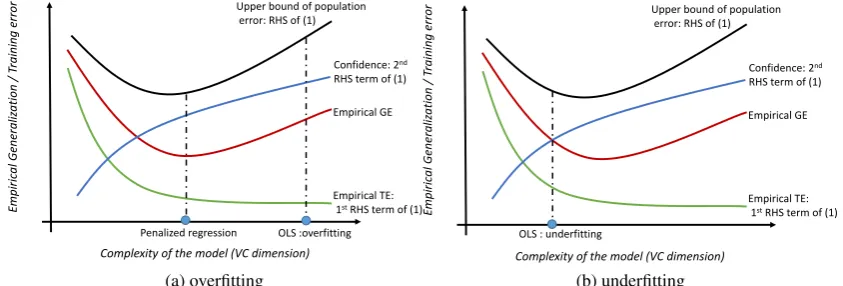
1. As shown in Figure 1, the RHS of eq. (2) establishes an upper bound for the population error
based on the eTE and the VC dimensionh. When the effective sample size for the training set (nt/h) is very large,εis very small, the second term on the RHS of (2) becomes small,
and the eTE is close to the population error. In this case the extremum estimator has a good
GA. However, if the effective sample sizent/his small (i.e., the model is very complicated),
the second term on the RHS of (2) becomes larger. In such situations a small eTE does not
guarantee a good GA, and overfitting becomes more likely.
2. The VC dimensionhis a more general measure of model complexity than the number of parameters, p, which does not readily extend to nonlinear or non-nested models. Whileh
reduces to pdirectly for generalized linear models,hcan also be used to partially order the complexity of nonlinear or non-nested models by summarizing their geometric complexity.7
Complexity of the model (VC dimension)
Upper bound of population error: RHS of (1)
Empirical GE
Empirical TE: 1stRHS term of (1) Confidence: 2nd RHS term of (1)
E
mpi
ri
cal
Genera
li
zati
on
/ T
rai
n
ing
error
OLS :overfitting Penalized regression
(a) overfitting
Complexity of the model (VC dimension)
Upper bound of population error: RHS of (1)
Empirical GE
Empirical TE: 1stRHS term of (1)
Confidence: 2nd
RHS term of (1)
E
mpi
ri
cal
Genera
li
zati
on
/ T
rai
n
ing
error
OLS : underfitting
[image:11.595.86.508.94.237.2](b) underfitting
Figure 1: The VC inequality and eGE
As a result, eq. (2) can be implemented as a tool for both nonlinear and non-nested model
selection.
3. Eq. (2) can be generalized to non-i.i.d. cases. While the VC inequality focuses on the
relation between the population error and the eTE in the i.i.d. case, McDonald et al. (2011)
generalizes the VC inequality forα- andβ-mixing stationery time series while Smale and Zhou (2009) generalizes the VC inequality for panel data. Moreover, Michalski and Yashin
(1986); Skrondal and Rabe-Hesketh (2004); Wang and Feng (2005); Yu and Joachims (2009);
Pearl (2015) show that heterogeneity can be controlled by implementing the latent variable model or by adding the variable causing heterogeneity into the model, implying eq. (2) is
valid.
Based on the VC inequality, Vapnik and Chervonenkis (1971a) propose that minimizing the
RHS of (2), the upper bound of the population error, reduces overfitting and improves the GA of
the extremum estimator. However, this may be hard to implement because it can be difficult to calculate the VC dimension for anything other than linear models. In practice, statisticians have
implemented GA analysis by minimizing the eGE using validation or cross-validation. For example, cross-validation is used to implement many penalty methods, such as the lasso-type estimators,
ridge regression or bridge estimators. Clearly, however, the eGE and the population error are not
the same thing. Thus, the properties of the minimum eGE, such as its variance, consistency and convergence rate are of particular interest in the present context. By adapting and modifying eq. (2),
we propose the following inequalities that analyze the relation between the eGE and the eTE in
finite samples.
Theorem 2.1(The upper bound of the finite-sample eGE for the extremum estimator). UnderA1to
A3, the following upper bound for the eGE holds with probability at leastϖ(1−1/nt),∀ϖ∈(0,1).
Rn
s(btrain|Ys,Xs)6
Rn
t(btrain|Yt,Xt)
(1−√ε) +ς, (3)
whereRn
s(btrain|Ys,Xs)is the eGE andRnt(btrain|Yt,Xt)the eTE for the extremum estimator btrain,
εis defined in Lemma 2.1,
ς =
ν
√
2τ(E[Q(btrain|Ys,Xs)])/(√ν1
−ϖ·ns1−1/ν) ifν∈(1,2]
B nsln
p
2/(1−ϖ) if Q(·)∈(0,B]and B is bounded
var[Q(btrain|y,x)]/(n(1−ϖ)) ifν∈(2,∞)
and
τ>sup[
R
(Q(b|y,x))νdF(y,x)]1/ν R
Q(b|y,x)dF(y,x) .
A few comments follow from Theorem 2.1.
• (Upper bound of the finite-sample GA) eq. (3) establishes the upper bound of the eGE from any out-of-sample data of sizensbased on the eTE from any in-sample data of sizent. Unlike
the classical bound in Lemma 2.1, which captures the relation between the population error and the eTE, eq. (3) establishes inequalities to quantify the upper bound of the finite sample
eGE. Usually, we need to use validation or cross-validation to measure the eGE of a model
with new data. However, because the RHS of eq. (3) is directly computable it may be used as a measure of finite-sample eGE, avoiding the need for validation.
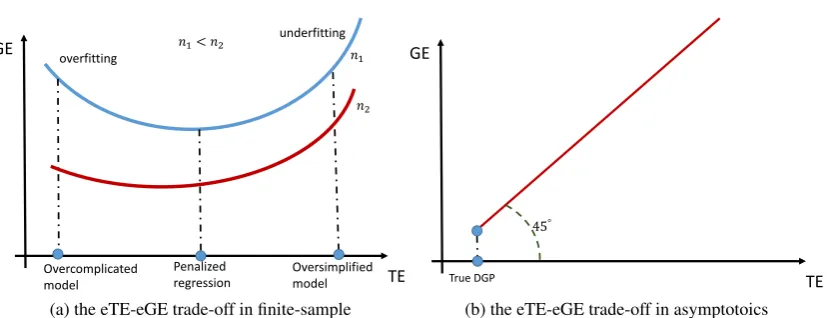
• (The eGE-eTE trade-off in model selection) eq. (3) also characterizes the trade-off between eGE and eTE for model selection in both the finite sample and asymptotic cases. In Figure 2b,
the population eGE, population eTE and population error are expected to be identical in
asymptotic case. Hence, minimizing eTE can directly lead to the true DGP in the population. In contrast, as illustrated in Figure 2a, in finite samples, an overcomplicated model with
lownt/hwould have a small eTE for the data whereas eq. (3) show that the upper bound
of the eGE on new data will be large. Hence, the overcomplicated model willoverfit the in-sample data and typically have a poor GA. In contrast, an oversimplified model with high
nt/h, typically cannot adequately recover the DGP and the upper bound of the eGE will also
be large. As a result, the oversimplified model willunderfit, fitting both the in-sample and out-of-sample data poorly. Thus, the complexity of a model introduces a trade-off between
the eTE and eGE in model selection.
• (GA and distribution tails) eq. (3) also shows how the tail of the error distribution affects the upper bound of the eGE. If the loss distributionQ(·)is bounded or light-tailed, the second term of eq. (3),ς, is mathematically simple and converges to zero at the rate 1/ns. If the loss
GE
TE
underfitting
Overcomplicated model
Penalized regression overfitting
Oversimplified model
𝑛1
𝑛2 𝑛1< 𝑛2
(a) the eTE-eGE trade-off in finite-sample
GE
TE 45°
True DGP
[image:13.595.93.508.87.246.2](b) the eTE-eGE trade-off in asymptotoics
Figure 2: Schematic diagram of the trade-off between eGE and eTE
that is a closed-form for the loss distribution,8can be used to measure the heaviness of the
loss distribution tail, a smaller ν implying a heavier tail. In the case of a heavy tail, the second term of eq. (3),ς, becomes mathematically complicated and its convergence rate
decreases to 1/n1s−1/ν. Hence, eq. (3) shows that the heavier the tail of the loss distribution,
the higher the upper bound of the eGE and the harder it is to control GA in finite samples. In the extreme case withν=1, there is no way to adapt eq. (3).
Essentially, validation randomly partitions the data into a training set and a test set, yielding an estimate on the training set that is used to compute the eGE of the test set. Eq. (3) measures the
upper bound the eGE on the test set from the model estimated on the training set with a given eTE
andh. In other words, eq. (3) directly measure GA using validation. Furthermore, a similar bound to eq. (3) can be established forK-fold cross-validation.
Theorem 2.2 (The upper bound of the finite-sample eGE for the extremum estimator under
cross-validation). UnderA1toA3, the following upper bound for the eGE holds with probability at leastϖ(1−1/K),∀ϖ∈(0,1).
1
K
K
∑
j=1
Rn
s(btrain|Y
j s,Xsj)6
1
K∑
K
q=1Rnt(btrain|Y
q t ,X
q t )
(1−√ε) +ςcv, (4)
whereRn
s(btrain|Y
j
s,Xsj)is the eGE of btrainin jth round of validations,Rnt(btrain|Y
q t ,X
q t )is the
eTE of btrainin qth round of validations, and
ςcv=
ν
√
2τR(btrain|Y,X)/(√ν
1−ϖ·ns1−1/ν) ifν∈(1,2]
Blnp2/(1−ϖ)/ns if Q(·)∈(0,B]and B is bounded
var[Q(btrain|y,x)]/(n2s(1−ϖ)) ifν∈(2,∞)
8It is closed-form because owing toA1, which guarantees closed-form, first-order moments for all loss distribution in
The errors generated by cross-validation are affected both by sampling randomness from the population and by sub-sampling randomness that arises from partitioning the sample into folds.
Thus, the errors from cross-validation are potentially more volatile than the usual errors from
estimation. Theorem 2.2 provides an upper bound for the average eGE under cross-validation, which offers a way to characterize the effect of sub-sampling randomness and suggests a method to
approximate the GA from cross-validation. The following comments summarize the implications
of eq. (4).
1. (The upper bound of the eGE) Similar to eq. (3), eq. (4) serves as the upper bound of the averaged eGE generated by cross-validation. Both equations show the eTE-eGE trade-off and reveal the effect of a heavy tail on GA.
2. (Tuning the cross-validation hyperparameter K) Eq. (4) characterizes how the hyperparameter
Kaffects the averaged eGE from cross-validation (also called the cross-validation error in the literature). As explained above, the random partitioning in cross-validation introduces
sub-sampling randomness. With a given sample and fixedK, sub-sampling randomness will produce a different averaged eGE each time cross-validation is performed. WhenKchanges, the size of each fold changes, implying the training and test sets also change. WhenKis large, the test sets become small, increasing sub-sampling randomness. WhenKis small, the training sets become small, increasing sub-sampling randomness. For extremum estimators like OLS, the bias-variance trade-off is straightforward to analyze for different pbecause the sample is fixed. In contrast, the sub-sampling randomness introduced by cross-validation, the bias-variance trade-off for averaged eGE of cross-validation cannot be studied with the
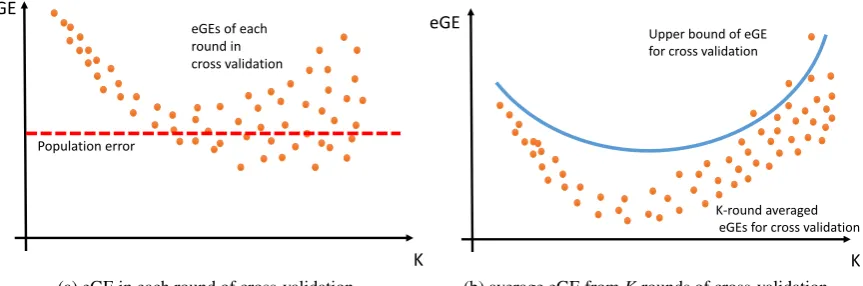
given training and test set whenKchanges. As a result, in order to characterize and control for the influence of sub-sampling randomness, we establish the bias-variance trade-off for cross-validation by its upper bound, after running cross validation multiple times, as is
illustrated in Figure 3.
(a) (Large bias, small variance)WhenKis small,nt is smaller in each round of in-sample
estimation. Hence, as shown in Figure 3a, the eTE in each round,Rn
t(btrain|Y
q
t ,Xtq)/(1−
√
ε), is more biased from the population error. As shown in Figure 3b, theK-round averaged eTE, K1∑Kq=1Rn
t(btrain|Y
q t ,X
q t )/(1−
√
ε), is more biased away from the true population error asKgets smaller. As a result, the RHS of eq. (4) suffers more from finite-sample bias. However, since small Kimplies that more data is used for eGE calculation in each round (nsis not very small), in each round the eGE on the test set
should not be very volatile. Thus, theK-round averaged eGE for cross-validation is not very volatile, which is shown by the fact thatςcvis not very large in eq. (4).
(b) (Small bias, large variance)WhenKis large,nsis small and the test set in each round
is small. Hence, with largeK, the eGE in each round may be hard to bound from above, which implies that the averaged eGE fromKrounds is more volatile. As a result,ςcv
tends to be large. However, with largeK, the RHS termK1∑Kq=1Rn
t(btrain|Y
q t ,X
q t )/(1−
√
eGE
K eGEs of each
round in cross validation
Population error
(a) eGE in each round of cross-validation
eGE
K
K-round averaged eGEs for cross validation Upper bound of eGE
for cross validation
[image:15.595.92.524.92.235.2](b) average eGE fromKrounds of cross-validation
Figure 3: Representation of the bias-variance trade-off for cross-validation eGE
As shown in Figure 3b, the averaged eGE from cross-validation follows a typical
bias-variance trade-off by value ofK. IfKis small, the averaged eGE is computationally cheap and less volatile but more biased away from the population error. AsK gets larger, the averaged eGE becomes computationally expensive and more volatile but less biased away
from the population error. This result exactly matches the Kohavi et al. (1995) simulation study. More specifically, by tuning K to the lowest upper bound, we can find theK that maximizes the GA from cross-validation.
Theorems 2.1 and 2.2 establish the finite-sample and asymptotic properties of GA analysis
for any extremum estimator. In finite-sample analysis, the results capture the trade-off between eGE and eTE, which can be used to measure the GA of an econometric model. In asymptotic
analysis, eGE minimization is consistent. As a result, GA can be implemented as a criterion for
model selection, and directly connects to the theoretical properties for model selection methods such as penalized extremum estimation, the various information criteria and maximum a posteriori
(MAP) estimation. Minimizing eGE works especially well for penalized regression. As shown in
Algorithm 1, penalized regression estimation returns abλ for eachλ. Each value ofλ generates a
different model and a different eGE. Intuitively, Theorems 2.1 and 2.2 guarantee that the model
with the minimum eGE from{bλ}has the best empirical generalization ability. In the next section, we study the finite-sample and asymptotic properties of eGE for all penalized regressions.
3. Finite-sample and asymptotic properties of eGE for penalized regression
Using the classical concentration inequalities in Section 2, we established the upper bound for
the finite-sample eGE of the extremum estimator given any random sample of any size. We also revealed the trade-off between eTE and eGE for model selection and derived the properties of eGE
under validation and cross-validation. In this section, we apply the framework and results from
3.1. Definition of penalized regression
Firstly, we formally define penalized regression and its two most popular variants: ridge
regression (L2-penalized regression) and the lasso (L1-penalized regression).
Definition 3.1(Penalized regression,L2-eGE andL2-eTE).
1. (General form) The general form of the objective function for penalized regression is as follows
min
bλ
1
n(kY−X bλk2)
2
+λPenalty(kbλkγ). (5)
where Penalty(k · kγ)stands for the penalty term, which is a function of theLγ norm of the
bλ.
2. (bλ and bpen) We denote bλ to be the solution of eq. (5) given the value of the penalty
parameter λ while bpen is defined to be the model with the minimum eGE among all
alternative{bλ}, as in Algorithm 1 in Section 1.
3. (Lasso and ridge) The objective functions for lasso (L1penalty) and ridge regression (L2 penalty), respectively, are
min
bλ
1
n(kY−X bλk2)
2+
λkbλk1, (6)
and
min
bλ
1
n(kY−X bλk2)
2
+λkbλk2. (7)
4. (L2error for regression)the eTE and eGE for regression are defined inL2form respectively as follows:
Rn
t(btrain|Yt,Xt) =
1
nt k
Yt−Xtbtraink22
Rn
s(btrain|Ys,Xs) =
1
nsk
Ys−Xsbtraink22
The idea behind penalized regression is illustrated in Figure 4 wherebλ refers to the penalized
regression estimates for someλ and bOLS refers to the OLS estimates. As shown in Figure 4a,
differentLγ norms correspond to different boundaries for the estimation feasible set. For theL1
penalized regression (lasso), the feasible set is a diamond since each coefficient is equally penalized by theL1norm. The feasible area shrinks under aL0.5penalty. Hence, as shown in Figure 4a,
given the sameλ, the smaller isγ, the more likelybλ is to be a corner solution. Hence, given the sameλ, under theL0.5penalty variables are more likely to be dropped than with theL1orL2 penalty.9 In special cases whenγ=0 andλ is fixed at 2 (lnnt), theL0penalized regression is
identical to the Akaike (Bayesian) information criterion.
9For 0<γ<1, the penalized regression may be a non-convex programming problem. While general algorithms have
not been found for non-convex optimization, Strongin and Sergeyev (2013), Yan and Ma (2001) and Noor (2008) have
developed functioning algorithms. Forγ=0, the penalized regression becomes a discrete programming problem, which
𝑏2
𝑏1 𝐿∞ 𝐿2 𝐿1 𝐿0.5
(a) boundaries forL0,L0.5,L1,L2and
L∞penalties
𝑏2
𝑏1 𝑏𝑂𝐿𝑆
𝑏𝜆 Level sets of 𝐿2error
(b)L1penality (lasso)
𝑏2
𝑏1
𝑏𝑂𝐿𝑆
𝑏𝜆
[image:17.595.88.533.94.268.2](c)L0.5penality
Figure 4: Illustration of various penalized regressions
The last important comment is that penalized regression primarily focuses on overfitting. By contrast, OLS minimizes the eTE without any penalty, typically causing a large eGE (as shown in
Figure 1a). There is also the possibility that OLS predicts the data poorly, causing both the eTE
and eGE to be large. The latter refers to underfitting and is shown in Figure 1b. We are more capable of dealing with overfitting than underfitting despite the fact that it possible to quantify GA
or the eGE.10Typically overfitting in OLS is caused by including too many variables, which we can
resolve by reducingp. However, underfitting in OLS is typically due to a lack of data (variables) and the only remedy is to collect additional relevant variables.
3.2. Schematics and assumptions for eGE minimization with penalized regression
As shown in Section 2, eGE minimization improves finite-sample GA, implying the estimator has a lower eGE on out-of-sample data. In this section, we implement the schematics of eGE
minimization on penalized regression. We demonstrate: (1) specific error bounds for any penalized
regression, (2) a generalL2consistency property for penalized regression estimates, (3) that the upper bound for theL2difference betweenbpenandbOLSis a function of the eGE, the tail property of the loss distribution and sample exogeneity.
The classic route to derive asymptotic or finite-sample properties for regression is through analyzing the properties of the estimate in the space of the eTE. In contrast, to study how penalized
regression improves GA or eGE and balances the in-sample and out-of-sample fit, we reformulate
the asymptotic and finite-sample problems in the space of the eGE. We show that, under the framework of eGE minimization, a number of finite-sample properties of penalized regression can
be explained by eGE or the finite-sample GA.
In asymptotic analysis, consistency is typically considered to be one of the most fundamental properties. To ensure that eGE minimization is a reliable estimation approach, we prove that the
penalized regression, which is a specific form of the eGE minimizer, converges to the true DGP as
Λ: a `class’ of
models, where true DGP 𝛽exists
True DGP
Space of eGE Space of models
𝒃𝒑𝒆𝒏
Finite sample
Asymptotic
Minimal eGE among all other
alternative 𝑏𝜆
Theorem 2
Minimal population GE
Proposition 1 OLS: eTE
[image:18.595.151.448.87.277.2]minimizer
Figure 5: Outline of proof strategy
n→∞. Essentially, we show that penalized regression bijectively mapsbpento the minimal eGE
among{bλ}on the test set. To bridge between the finite sample and asymptotic results we need to
show that if
• the true DGPβ is bijectively assigned to the minimal eGE in population, and
• minb∈bλ 1
ns∑
ns
i=1kYs−Xsbk22→minb
R
ky−xTbk22dF(y,x),
thenbpenis consistent in probability orL2, or
bpen=argmin{eGEs of{bλ}}
PorL2
→ argmin
b
Z
kys−xTsbk22dF(y,x) =β.
At the outset, we stress that each variable in(Y,X)must be standardized before implementing penalized regression. Without standardization, as shown by (Tibshirani, 1996), the penalized
regression may be influenced by the magnitude (units) of the variables. After standardization, of
course,X andY are unit- and scale-free.
To ensure the consistency of penalized regression, we require the following three additional
assumptions.
Further assumptions
A4. The true DGP isY=Xβ+u. A5. E uTX=0.
A6. No perfect collinearity inX.
The assumptions A4to A6restrict the true DGPβ to be identifiable. Otherwise, there might exist another model that is not statistically different from the true DGP. The assumptions are quite
3.3. Necessary propositions for final results
Under assumptionsA1toA6, we show that the true DGP is the most generalizable model,
yielding Proposition 3.1.
Proposition 3.1(Identification ofβ in the space of eGE). Under assumptionsA1toA6, the true DGP, Y =Xβ+u, is the one and only one offering the minimal eGE asen→∞.
Proposition 3.1 states that there is a bijective mapping betweenβ and the global minimum eGE
in the population. IfA5orA6are violated, there may exist variables in the sample that render the true DGP not to be the model with minimum eGE in population. As shown in Algorithm 1,
penalized regression picks the model with the minimum eGE in{bλ}to bebpen. As a result, we
also need to prove that, when the sample size is large enough, the true DGP is included in{bλ}, the
list of models from which validation or cross-validation selects. This is shown in Proposition 3.2.
Proposition 3.2(Existence ofL2consistency). Under assumptionsA1toA6and Proposition 3.1,
there exists at least oneeλ such thatlimen→∞kbeλ−βk2=0.
𝑏2
𝑏1
𝑏𝑂𝐿𝑆
𝑏𝜆
𝛽
(a) under-shrinkage
𝑏2
𝑏1
𝑏𝑂𝐿𝑆
𝑏𝜆
𝛽
(b) perfect shrinkage
𝑏2
𝑏1
𝑏𝑂𝐿𝑆
𝑏𝜆
𝛽
[image:19.595.89.532.353.515.2](c) over-shrinkage
Figure 6: Various types of shrinkage under anL1penalty
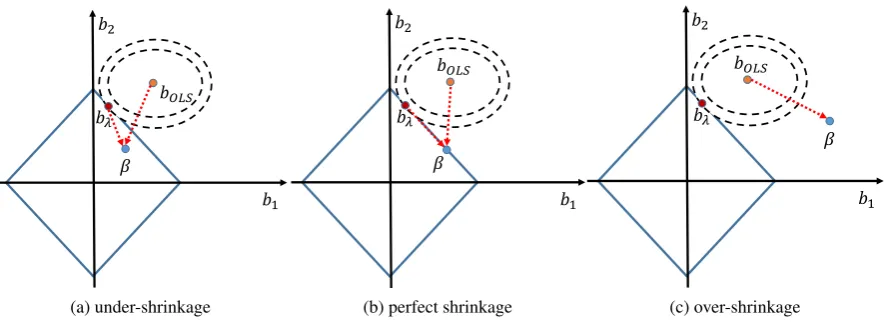
Since the penalized regression can be sketched as a constrained minimization of the empirical
error, we can illustrate Proposition 3.1 and 3.2 in Figure 6 using lasso as the example of a penalized regression. In Figure 6, the parallelogram-shaped feasible sets are determined by theLγ penalty,
bλ refers to the solution of eq. (5),β refers to the true DGP, andbOLSrefers to the OLS estimates.
Different values forλ imply different areas for the feasible set of the constrained minimization; the area of the feasible set gets smaller as the value ofλ gets larger. Hence, one of three cases may
occur: (i) as shown in Figure 6a, for a small value ofλ,β lies in the feasible set (under-shrinkage)
and offers the minimum eTE in the population; (ii) as shown in Figure 6b, for the oracleλ,β is located precisely on the boundary of the feasible set (perfect-shrinkage) and still offers the
minimum eTE in the population; (iii) as shown in Figure 6c, for a large value ofλ,β lies outside
the feasible set (over-shrinkage). In cases (i) and (ii), the constraints become inactive asne→∞, so limen→∞bλ =limne→∞bOLS =β. However, in case (iii), limne→∞bλ6=β. Therefore, tuning the
3.4. Main results for penalized regression estimates
As shown above, intuitively the penalized regression estimate is expected be consistent in some
norm or measure as long as we can be sure that for a specificλ,β lies in the feasible set and offers the minimum eTE in population. However, in practice we may not know a priori whichλ causes
over-shrinkage and which does not, especially when the number of variables,p, is not fixed. As a result, we need to a method such as cross-validation or validation to tune the value ofλ. Thus,
as a direct application of eGE minimization in Section 2, we use GA/eGE analysis to show that
eGE minimization guarantees the model selected by penalized regression,bpen, asymptotically
converges inL2to the true DGP.
In the following section we analyze the finite-sample and asymptotic properties of the penalized
regression estimate in two scenarios:n>pandn<p. In the case wheren>p, OLS is feasible, so we take the OLS estimate for the unpenalized regression estimate. However, whenn<p, OLS is not feasible, and we use forward stagewise regression (FSR) for the unpenalized regression
estimate. Hereafter,bOLSis the OLS estimate from the training set.
3.4.1. Case: n>p
Firstly, by specifying eq. (3) and (4) in the context of regression, we can establish the upper
bound of the eGE, as shown in Lemma 3.1.
Lemma 3.1(Upper bound of the eGE for the OLS estimate). UnderA1 to A6, if we assume u∼Gaussian(0,var(u)),
1. (Validation) The following bound for the eGE holds with probability at leastϖ(1−1/nt)for
bOLS,∀ϖ∈(0,1).
1
ns
(kesk2)26
(ketk2)2
nt(1−√ε)
+2(var(u)) 2
ns√1−ϖ
, (8)
where esis the OLS eGE, et is the OLS eTE, andεis defined in Lemma 2.1.
2. (K-fold cross-validation) The following bound for the eGE holds with probability at least
ϖ(1−1/K)for bOLS,∀ϖ∈(0,1).
1
K
K
∑
j=1
(kesjk2)2
n/K 6
n(K−1)∑Kq=1(ketqk2)2
K2(1−√ε) +
2(var(u))2
√
1−ϖ·(n/K)2, (9)
where esjis the eGE of OLS estimate in the jth round, eqt is the eTE of OLS in the qth round,
whileε andς are defined in Lemma 2.1.
Eq. (8) and (9) show that the higher the variance ofuin true DGP, the higher the upper bound of the eGE in validation and cross-validation. Based on eq. (9), the lowest upper bound of the
cross-validation eGE is determined by minimizing the expectation of the RHS of eq. (9), yielding
Corollary 3.1 (The optimal K for penalized regression). Under A1 to A6 and eq. (9) from Lemma 3.1, if we assume the OLS error term u∼Gaussian(0,var(u)), the optimal K for cross-validation in regression (the minimum expected upper bound of eGE) is defined:
K∗=argmin
K
var(u)
1−√ε+
4(var(u))2
√
1−ϖ(n/K)2
Similar to eq. (3), eq. (8) and (9) respectively measure the upper bound of the eGE for the
OLS estimate using validation and cross-validation. In standard practice, neither validation nor
cross-validation are implemented as part of OLS estimation and hence the eGE of the OLS estimate is rarely computed. Eq. (8) and (9) show that eGE can be computed without having to carry out
validation or cross-validation.
In penalized regression, the penalty parameterλ can be tuned by validation orK-fold cross-validation. ForK>2, we haveKdifferent test sets for tuningλ andKdifferent training sets for estimation. Based on eq. (8) and (9), an upper bound for theL2predicted difference betweenbOLS andbpencan be established under validation and cross-validation, as shown below.
Proposition 3.3(L2distance between the penalized and unpenalized predicted values). UnderA1
toA6and based on Lemma 3.1, Proposition 3.1, and Proposition 3.2,
1. (Validation) The following bound holds for the validated bpenwith probabilityϖ(1−1/nt)
1
ns
(kXsbOLS−X bpenk2)26
1
nt
ketk22
1−√ε− 1
nsk
esk22
+ 4
nsk
eTsXsk∞kbOLSk1+ς (10)
whereς is defined in Lemma 3.1.
2. (K-fold cross validation) The following bound holds for the K-fold cross-validated bpenwith
probabilityϖ(1−1/nt)
1
K
K
∑
q=1
1
ns
(kXsqbqOLS−Xsqbqpenk2)2 6
1 nt 1 K∑ K q=1
eqt22
1−√ε −
1
K
K
∑
q=1
1
nsk
eqsk22 (11) + 1 K K
∑
q=1
4
ns
(eqs)TXsq
∞bqOLS1+ςcv.
where eqt is the eTE of the OLS estimate in the qth round of cross-validation, e q
s is the eGE of
the OLS estimate in the q round of cross-validation and bqOLS is the OLS estimate in the qth round of cross-validation.
We can now derive the upper bound ofkbOLS−bpenk2, as shown in Theorem 3.1.
Theorem 3.1(L2distance between the penalized and unpenalized estimates). UnderA1toA6
and based on Propositions 3.1, 3.2, and 3.3,
1. (Validation) The following bound holds with probabilityϖ(1−1/nt):
kbOLS−bpenk26
s
1 ρnt
ketk22 (1−√ε)−
1 ρnsk
esk22
+ s 4 ρnsk
eT
sXsk∞kbOLSk1+
whereρis the minimal eigenvalue of XTX andς is defined in Lemma 3.1.
2. (K-fold cross validation) The following bound holds with probabilityϖ(1−1/nt):
1
K
K
∑
q=1
(kbqOLS−bqpenk2)2 6
K1∑
K q=1nt1·ρ
keqtk
2 2
1−√ε −
1
K∑
K q=1ns·1ρ¯
eqs
2
2
+K1∑Kq=1n4
s·ρ¯
(eqs)TXsq
∞bqOLS1+ρς¯ (13)
whereρ¯ is defined asmin
n
ρq|ρqis the minimal eigenvalue of Xsq
T
Xsq,∀q
o .
Some important remarks apply to Theorem 3.1. The LHS of eq. (12) essentially measures how
much the penalized regression estimate differs from the OLS estimate under validation. The RHS of eq. (12) essentially captures the maximumL2difference betweenbOLSandbpen. As shown in eq. (12), the maximum difference depends on the GA of the true DGP and the GA of the OLS model in several different forms.
• The first term on the RHS of eq. (12) (ignoring 1/ρ) is the difference between the eGE from OLS and the upper bound of the population error for the OLS estimate, or, equivalently,how far the GA of the OLS estimate is from its maximum. The larger the GA ofbOLS, the less
overfitting OLS generates, the closer the eGE ofbOLSis to the upper bound of the population
error, and the smaller the first term on the RHS of eq. (12).
• The second term on the RHS of eq. (12) (ignoring 4/ρ) measures the empirical endogeneity of the error term of the OLS estimate on the test set. On the training seteTt Xs=0, but in general
eTsXs6=0 on the test set. Hence, n1skeTsXsk∞kbOLSk1 measures the GA for the empirical
moment condition of the OLS estimate on out-of-sample data.11 The more generalizable the OLS estimate, the closereT
sXsis to zero on out-of-sample data, and the smaller the second
term on the RHS of eq. (12).
• The third term on the RHS of eq. (12) is affected byς, whichmeasures the heaviness of the tail in the loss distribution for the OLS estimate. Similar to the comments of Theorem 2.1, the OLS loss distribution affects the GA of the OLS estimate. The heavier the loss tail, the
more volatile the eGE on out-of-sample data, and the more difficult it is to bound the eGE
for OLS.
• All three RHS terms in eq. (12) are affected byρ, the minimum eigenvalue ofXxTXs, which
can be thought of as a measure of the curvature of the objective function for penalized regression. The larger the minimum eigenvalue, the more convex the objective function. Put another way, it is easier to identify the true DGPβ from the alternatives asnget larger.
The interpretation of eq. (13) is similar to eq. (12) adjusting for cross-validation. Hence, the
first term on the RHS of eq. (13) (ignoring 1/ρ) stands for how far away theaverageGA of OLS
11Because we standardize the test and training data, the moment conditionE(e
𝑏𝑂𝐿𝑆
𝑏𝑝𝑒𝑛 𝑏2
𝑏1 𝑏𝑂𝐿𝑆
𝑏𝑝𝑒𝑛 𝑏𝑝𝑒𝑛 𝑏𝑂𝐿𝑆
𝑛1/𝑝 𝑛2/𝑝
𝑛3/𝑝
𝑛3/𝑝 > 𝑛2/𝑝 > 𝑛1/𝑝
(a)L1penalty
𝑏𝑂𝐿𝑆
𝑏𝑝𝑒𝑛 𝑏2
𝑏1 𝑏𝑂𝐿𝑆
𝑏𝑝𝑒𝑛 𝑏𝑝𝑒𝑛 𝑏𝑂𝐿𝑆
𝑛1/𝑝 𝑛2/𝑝
𝑛3/𝑝
𝑛3/𝑝 > 𝑛2/𝑝 > 𝑛1/𝑝
[image:23.595.92.508.91.276.2](b)L0.5penalty
Figure 7: Illustration of the relation betweenbOLSandbpen
estimate is from its maximum inKrounds of validation. The second term on the RHS of eq. (13) (ignoring 4/ρ) indicateson averagehow generalizable the empirical moment condition of the OLS estimate is with out-of-sample data inKrounds of validation. Similarly,ς indicateson average
the heaviness in the tail of the loss distribution inKrounds of validation. As a direct result of Theorem 3.1, theL2consistency for the penalized regression estimate is established as follows.
Corollary 3.2(L2consistency for the penalized regression estimate whenn>p). UnderA1to
A6and Propositions 3.1, 3.2, and 3.3, if we assume the error term u∼Gaussian(0,var(u)), then bpenconverges in theL2norm to the true DGP if limn→∞p/ne=0
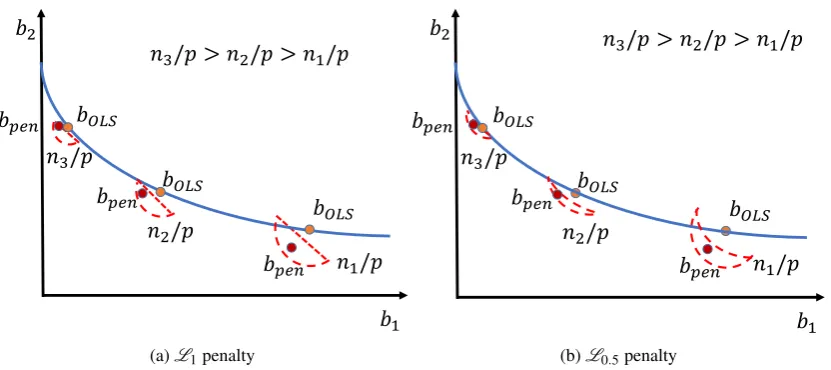
Theorem 3.1 and Corollary 3.2 are illustrated in Figure 7. Typically, due to the poor GA of the
OLS estimate, the penalized regression estimatebpenwill not lie on the same convergence path as
the OLS estimate. However, Theorem 3.1 shows that the deviation ofbpenfrom the convergence
path is bounded. Furthermore,bpentypically lies within anε-ball centered onbOLSwhose radius is
a function of the eGEs of the OLS estimate and the true DGP. Also, as shown in Figures 6a and 6b,
bpenalways lies within the feasible set parameterized byλkbkγ. Hence, as shown in Figures 7a and
7b,bpentypically is located in the small area at the intersection of theLγ feasible area andε-ball.
Unless the optimalλ from validation or cross-validation is 0, the OLS estimate will never be in the
feasible area of the penalized regression estimate, which is why the intersection region is always
below thebOLS. Asn/pincreases, theε-ball becomes smaller, the penalized regression estimate
gets closer to the OLS estimate, and both converge toβ.
3.4.2. Case: n<p
Typically, to ensurebOLS can identify the true DGPβ, we require that(kek2)2 is strongly
convex, or that the minimal eigenvalue ofXTX, ρ, is strictly larger than 0. However, if p>n, ρ=0 and the space of(kek2)2is flat in some direction. As a result, thekbOLSk1is not closed-form,
the true DGPβ cannot be identified and Eqs. (12) and (13) are trivial.
Put another way, we need to ensure that the strong convexity of the space(kek2)2is still reserved
for thep>ncase andβ is still identifiable. This is guaranteed by the sparse eigenvalue condition (Bickel et al., 2009; Meinshausen and Yu, 2009; Zhang, 2010)—see the proof of Proposition 3.4
(below) in Appendix 1 for the details.
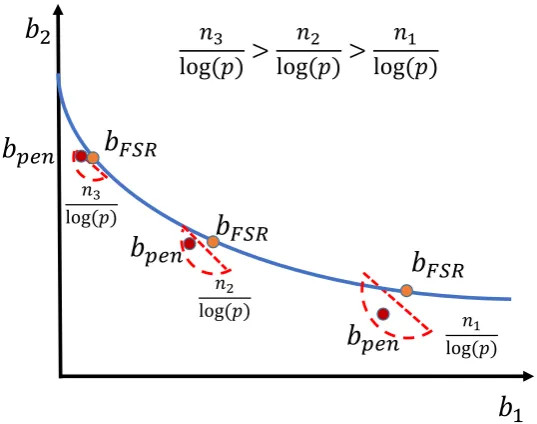
Regression can at most estimate max(p,n)coefficients. When p>n, penalized regression has to drop some variables to make it estimable, implying thatγ>1 does not apply to thep>ncase. Hence, for thep>ncase, we focus only on theL1penalized regression, i.e., the lasso. As shown by Efron et al. (2004); Zhang (2010), lasso may be thought of as a forward stagewise regression
(FSR) with anL1norm constraint.12 Hence, lasso regression can be treated as a form of GA/eGE
control for FSR whenp>n. As shown by Zhang (2010), even though FSR is a greedy algorithm that may result in overfitting in finite samples, it is stillL2consistent under the sparse eigenvalue
condition
Thus, forp>n, we set the FSR estimate,bFSR, to be the unpenalized regression estimate, and
theL1penalized regression estimate,bpen, to be the penalized regression estimate. In Proposi-tion 3.4 and Corollary 3.3, we show that the lasso preserves the properties and interpretaProposi-tions of the
n>pcase by reducing the overfitting inherent in FSR.
Proposition 3.4(L2distance between theL1penalized and unpenalized FSR estimates). Under
A1toA6and based on Lemma 3.1, Propositions 3.1, and 3.2 and the sparse eigenvalue condition,
1. (Validation) The following bound holds with probabilityϖ(1−1/nt)
kbFSR−bpenk2 6
r ρre1nt
ketk22 (1−√ε)−
1
ρrenskesk 2 2
+qρ4 renske
T
sXsk∞kbFSRk1+
ς ρre 1 2 (14)
whereρreis the minimum of the sparse eigenvalues of XTX and bFSRis the FSR estimate.
2. (K-fold cross-validation) The following bound holds with probabilityϖ(1−1/nt)
1
K
K
∑
q=1
bqFSR−bqpen22 6
K1∑
K q=1nt·1ρ¯re
keqtk
2 2
1−√ε −
1
K∑
K q=1ns1·ρ¯re
eqs
2 2
+K1∑Kq=1n4
s·ρ¯re
eqs
T
Xsq
∞kbFSRk1+
ς
¯
ρre (15)
whereρ¯reis defined asmin
h
ρreq |ρreq is the minimal restricted eigenvalue of Xsq
T
Xsq,∀q
i
and bqFSRis the FSR estimator in the qth round of valid