Property-Control of Ti Compacts in Spark Sintering Process
Kazuhiro Matsugi
1,+, Akinori Hiraiwa
1, Yong-Bum Choi
1, Gen Sasaki
1and Hideaki Kuramoto
2 1Department of Mechanical Science and Engineering, Graduate School of Engineering, Hiroshima University,Higashi-Hiroshima 739-8527, Japan
2Hiroshima City Industrial Promotion Center, Hiroshima 7300052, Japan
Neck-seeds among pure titanium powders were homogeneously caused by the pulse discharge as an early stage in spark sintering. Their compacts showed some characteristic microstructures by the adjustment of process parameters such as temperature-history, -amplitude and applied pressure in the following continuous current discharge. Such property-controls might be carried out on the basis of the micro phenomena caused in or between powders. The allotropic transformation of¡and¢phases was utilized for achievement of full density and microstructure control, as case study of property-controls on Ti compacts. Both nearly full density and characteristic microstructures were achieved by the control of heat and cool cycles in temperature-ranges below and above¢transus, due to excellent thermal and load control-ability in the spark sintering equipment. The 0.2%proof and tensile strength were increased, only by rising of relative densities. In contrast, the tensile elongation and reduction of area were affected by both relative densities and microstructures. The relation among mechanical properties, density and microstructures was investigated on obtained compacts, and one method for their property-controls was proposed on the basis of this result.
[doi:10.2320/matertrans.MC201214]
(Received September 21, 2012; Accepted December 13, 2012; Published January 19, 2013)
Keywords: microstructural control, solid transformation,¢transus, cyclic heating and cooling, relative density control
1. Introduction
Titanium is one of uniquely industrial and biocompatible metals having high specific strength and toughness or shape memory ability. Sintering of titanium based powders, as well as aluminum based powders, is difficult even when the vacuum sintering technique is employed, because its affinity with oxygen is strong.1) In contrast, the spark sintering
method2)is a rapid densification process, which leads to the
benefit even for practical and experimental applications of powders having a low sinterability.
The sintering techniques using electric energy are classified into three groups according to the period of current
flow, ti.3) They are as follows: (1) Resistance sintering: ti=10104s,4) (2) Pulse resistance sintering: ti=10¹3
10 s,5) (3) Electric discharge sintering: ti=10¹610¹3s.6)
The spark sintering equipment in this study has an electric source with the function of both (1) and (2) mentioned above. Further, K. Inoue had proposed not only spark sintering equipments but also the control-methods of properties in compacts utilizing micro-phenomena in particles by the adjustment of their process parameters.7) These spark
sintering techniques has developed into new ones such as plasma activated or spark plasma sintering (hereafter called spark sintering in this paper).2) It has been revealed in
previous study, that spark sintering has the potential to minimize grain growth by enhancing sinter-ability through both dielectric breakdown of an oxide film between powder particle surfaces by the pulse discharge process8)and rapid heating by unsteady heat flow in the following continuous current discharge process.9)
The high performance of titanium compacts is achieved by their properties-control which is caused by the optimization of the manufacturing process. Also in the spark sintering, the properties-control in various compacts may be successfully
achieved by control of its process parameters, because its equipment has their excellent control ability. In particular, it is considered that the properties-control is carried out by the utilization of the micro phenomena caused in or between powders. The solid transformation between ¡ and ¢phases in titanium may be utilized for achievement of full density and microstructural control. In this study, microstructural and mechanical properties in pure titanium compacts were controlled by utilization of micro phenomena such as the solid transformation between ¡ and ¢phases in or between particles, as the case study of their property-control. The micro phenomena could be caused by the control of cyclic heating and cooling conditions in the range of temperatures around ¢transus, in spark sintering process.
2. Experimental Procedures
The pure titanium powder particles with the mean size of 35 µm were used in this study. The titanium powder was poured into the graphite die, and the die was plugged at both ends with graphite punches. As shown in Fig. 1, the spark sintering consisted of pulse discharge and continuous current discharge process. The electric current pulse of rectangular waves was discharged from the upper electrode to the lower one. The temperatures were measured by thermocouples at the fixed position at some applied pressures and current densities. The powders were electrically discharged for 0.9 ks with a pulse current of 300 A, a pulse-discharge time and -cut time of 100 ms, and punch pressure of 5 MPa. The current density on the top surface of the graphite punch was 0.5 A/mm2in the pulse current discharge process. As seen in Fig. 1, in the following continuous current discharge process, the compacts were resistance-heated to fixed maximum temperatures (1243, 1293, 1343, 1393, 1443 and 1493 K) and were held at these temperatures for 0.9 and 2.7 ks under an applied uniaxial punch pressure of 9 and 19 MPa. The temperature of a compact was estimated from that of the die, +Corresponding author, E-mail: matsugi@hiroshima-u.ac.jp
Special Issue on Recent Advances in Research and Development of Titanium and Its Alloys
by the method that had been reported earlier,10) and the
estimated temperatures on compacts were used in this paper. The current densities were 0.53.2 A/mm2 at the fixed
maximum temperatures. Both the pulse discharging and continuous current discharging processes were carried out under vacuum conditions (<10¹2Pa).
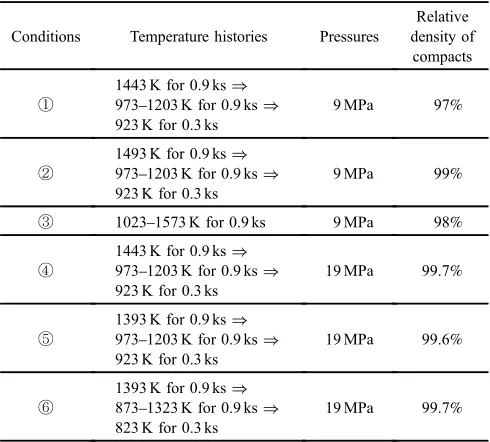
Further, the cyclic heating and cooling were also conducted on selected compacts at temperatures below and above ¢ transus. Some conditions for cyclic heating and cooling are listed in Table 1, and the typical heating histories are also shown in Fig. 2.
The mean density throughout the rectangular shaped compacts with 12©12©52 mm was measured according to Archimedes’ principle. Tensile tests were conducted on selected specimens with the gauge diameters of 8 mm and gauge lengths of 28 mm, at room temperature under an initial strain rate of 4.1©10¹4s¹1in air. Three tensile samples were
prepared by machining from compacts sintered at the same conditions. The microstructures on tensile samples were classified in two groups (1) only equiaxed and (2) mixture of equiaxed and elongated grains with¡phase, as described in detail in section 3.2.
3. Results and Discussion
3.1 Relative densities
It has been reported in our previous works1113) that the
densification of metallic powders consists of following three stages in the spark sintering process. 1st stage: Melting and vaporization is caused by local heat generation at the interparticle contacts by the pulse discharge process. 2nd
stage: Local plastic deformation near the interparticle contacts and/or uniform plastic deformation throughout powders are caused on unsteady heat flow conditions. 3rd stage: Disappearance of isolated pores is caused by the mechanism of power law creep. The 2nd and 3rd stages are caused in the continuous current discharging process. It has been understood through experience that both process are effective in sintering for obtaining high quality compacts in short time. However, the phenomena caused in the inside and
Time,
t
/s
T
emperatur
e,
T
/K
Pulse discharge
Cooling
Pressure 5MPa
0.9ks
Max fixed Temp
1243 – 1493K
V
oltage,
E
/V
Pr
essur
e,
P
/MP
a
Curr
ent,
I
/A
Continuous current discharge
Holding
Time 100ms, Current 300A
Voltage < some 10V
Current 300-2000A
Voltage < 6V
Max Temp 473K
Current density
0.5-3.2 A/mm
Pressure 9, 19 MPa
Pressure
Temp.
Voltage
Current
2
0.5A/mm2
Under vacuumm < 10 Pa
-2
Spark sintering process
0.3-0.5 ks
0.9, 2.7 ks
Heating
[image:2.595.90.508.68.359.2]Fig. 1 Voltage, applied pressure, current and temperature profiles in the spark sintering process. Abscissa and ordinate are presented with arbitrary scales.
Table 1 Some conditions for cyclic heating and cooling.
Conditions Temperature histories Pressures
Relative density of compacts
①
1443 K for 0.9 ks) 9731203 K for 0.9 ks) 923 K for 0.3 ks
9 MPa 97%
②
1493 K for 0.9 ks) 9731203 K for 0.9 ks) 923 K for 0.3 ks
9 MPa 99%
③ 10231573 K for 0.9 ks 9 MPa 98%
④
1443 K for 0.9 ks) 9731203 K for 0.9 ks) 923 K for 0.3 ks
19 MPa 99.7%
⑤
1393 K for 0.9 ks) 9731203 K for 0.9 ks) 923 K for 0.3 ks
19 MPa 99.6%
⑥
1393 K for 0.9 ks) 8731323 K for 0.9 ks) 823 K for 0.3 ks
[image:2.595.305.550.433.654.2]surface in powders are uncertain during this process. The stable sintering of pure titanium compacts was achieved in continuous current discharge after the pulse discharge for 0.9 ks. Where, it is considered that randomly dispersed metallic contact parts by pulse discharge were acted as seeds of the neck in sintering, and the stable sintering or enhancement of sinterability were caused through compacts in following continuous current discharge.
The relative density increased on compacts produced at the
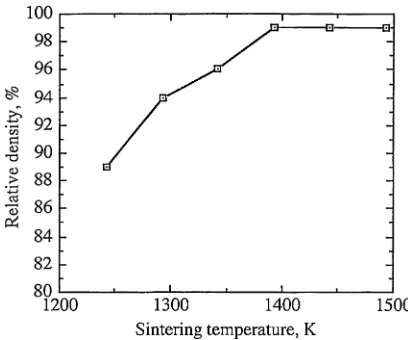
fixed maximum temperatures of 1243 to 1493 K and punch pressure of 9 MPa, as those temperatures increased to 1393 K and then its value became to be constant above 1393 K, as shown in Fig. 3. The compacts were exposed for 2.7 ks even atfixed maximum temperature above 1393 K, which meant the necessity of such long periods for the achievement of high level in density. The short period at lower temperature is necessary in the industrial applications in the point of the energy conservation.
The cyclic heating and cooling in the range of temperatures below and above ¢ transus were carried out for the achievement of high density, which might lead to short exposed periods at higher temperatures. The higher values
(99.699.7%) in relative density were obtained from the conditions④,⑤and ⑥listed in Table 1. This result meant the large effect of the high applied pressure of 19 MPa and the holding for 0.9 ks at fixed temperatures of 13931443 K as the early stage before the cyclic conditions, regardless of temperature amplitudes in the heat cycles. The high values more than 99% in density on compacts produced at the conditions②,④,⑤and ⑥, were shown in Table 1. These values were same or higher level, compared with those of compacts sintered for 2.7 ks atfixed maximum temperatures above 1393 K, as seen in Fig. 3. Transformation between ¡ and ¢ phases was caused by cyclic heating and cooling around ¢transus, which might be suggested the increase in compact-density by the formation of newly transformed phases on particle surfaces at higher applied pressures. High densification rate according to the mechanism at 3rd stage mentioned above1113)was caused by higher applied pressure at high temperatures. Further, the effect of both high temperature and pressure might correspond to the large amounts in high temperature deformation and allotropic transformation depending on the matrix-size. The suppres-sion of grain coarsening in matrix can be prompted by the increase in applied pressures,14)which also agrees with this
result obtained from applied pressures of 9 and 19 MPa. In contrast, the fullness of pores among particles in compacts was caused by the expansion and contraction in volumes due to the solid transformation under the condition of thermal unsteady state in cyclic heating and cooling process at the applied pressures. The supposed reasons for this behavior in allotropic transformation are as follows: After the exposure of compacts at maximum temperatures of 13931493 K for 0.9 ks, the heterogeneity in temperature was microscopically caused among inside, surface and neck of grains by three dimensional heat release and generation at thermal unsteady state in cyclic cooling and heating process, respectively.15) The pores were formed among grains in compacts during sintering. The surface of grains touching to pores shows large amount of heat release, thereby increasing the temperature gradient, compared with the inside of grains. In contrast, the electric current and heat generation concentrate in the contact parts among grains showing as their boundaries in the heating
@ 1443K
@ 923K 973 –
1203 K
( ΔT 230 K )
Applied pressure: 9, 19 MPa
1023 –1573 K
( ΔT 550 K ) for 0.9 ks
Applied pressure: 9 MPa
(a)
(b)
Fig. 2 Typical examples showing the (a)①and④, (b)③conditions listed in Table 1, for cyclic heating and cooling histories around¢ transus in the continuous current discharge.
[image:3.595.85.512.70.241.2] [image:3.595.65.269.300.470.2]process. Also the pores neighbor on the contact parts among grains. The allotropic transformation is predominantly caused in the corner, edge and surface of grains, for the point of surface diffusion. Therefore, the surfaces on grains which neighbor on pores are predominantly acted as the site of allotropic transformation showing¡to¢and¢to¡phases. It is considered that the values in relative density were decided depending on the parameters such as the applied pressure, application of cyclic heating and cooling around ¢ transus and holding period at fixed maximum temperatures.
3.2 Microstructural characteristics
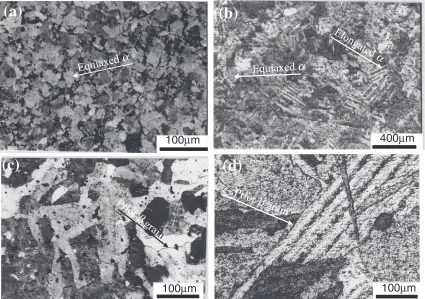
The equiaxed grains were observed in compacts produced at the fixed maximum temperatures below 1343 K, and the value of their relative density was below 96%, as shown in Fig. 3. Figure 4(a) shows the characteristic microstructure on the compact sintered at 1243 K for 0.9 ks. The grain size was same as that (35 µm) of as-received powders. The size of equiaxed grains increased, as the fixed temperatures in-creased in sintering. In contrast, both equiaxed and elongated grains were observed on compacts sintered at the maximum
fixed temperatures above 1393 K, and their compacts showed the relative density of approximately 99%. As an example, Fig. 4(b) shows the elongated grains with irregular and aligned shapes on compacts produced at 1393 K, and the equiaxed grains are also presented in ones. The elongated grains increased on compacts produced above 1393 K, as the
fixed temperatures increased in sintering.
In contrast, for the cyclic heated and cooled compacts at temperatures around ¢ transus, the equiaxed and elongated
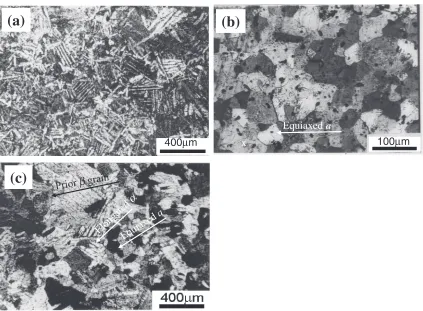
grains were observed, and elongated grains increased with increasing upper temperatures in the cyclic heat. Figure 5 shows microstructures on the compacts produced at the conditions①and④applied the pressures of 9 and 19 MPa, respectively. The fully elongated grains were observed on compacts by the holding at 1443 K for 0.9 ks as the early stage in the cycle heating, as seen in Fig. 5(a). The equiaxed grains were formed by cooling to temperatures below ¢ transus in the cycle condition after the holding at 1443 K for 0.9 ks. This result agrees with that obtained by both treatments of hot working and recrystallization in the temperature range below ¢ transus, because of the effects of the simultaneous application of uniaxial pressure and electric current discharge in this spark sintering. Again, elongated grains were formed in equiaxed grains on compacts produced at higher pressure of 19 MPa, compared with those of 9 MPa, which meant the large effect of applied pressure. The nucleation site of ¡ grains is prior ¢ grain boundaries, which corresponds to one of the predominant sites of allotropic transformation, as described in section 3.1. Figure 6 shows the microstructure of aligned shaped grains on the compacts produced at the condition③and⑥listed in Table 1. The cyclic heating and cooling profile at condition ③is shown in Fig. 2(b). Thefinal microstructure was mainly decided by the heating in temperature-range above¢transus even on cyclic heated and cooled compacts without holding at the maximum temperature, as seen in Figs. 6(a) and 6(b). This sintering process at condition ③ led to lower relative density of 98%because of short exposed period at maximum temperatures. In contrast, the holding at fixed maximum
100
μ
m
(a)
400
μ
m
(b)
100
μ
m
(d)
100
μ
m
(c)
[image:4.595.86.511.71.370.2]temperature of 1393 K and upper temperature in the cycle at 1323 K, led to the formation of aligned grains, as shown in Fig. 6(b). Also, Fig. 6(b) is same as Fig. 4(d), which means the decision of microstructure by the exposed maximum temperature in the heat histories. These elongated grains were coarsened as the temperature amplitude and applied pressure were increased and decreased, respectively, in the heat cycles. Also, the irregularly elongated grains were newly formed in coarse equiaxed grains, because of the induced micro-structure by the solid transformation between¡and¢phases. It is considered that the microstructures depended on the applied pressure, maximum temperatures in cyclic heat and cool histories and temperature-amplitude in cyclic heating.
3.3 Mechanical properties
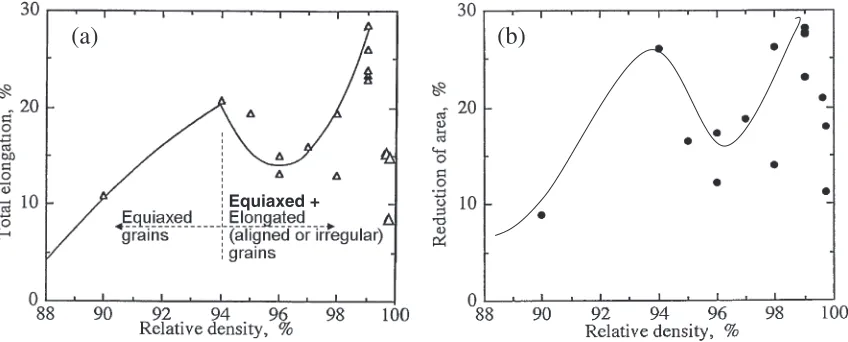
Figure 7 shows the relation between the relative density and 0.2%proof stress or ultimate tensile strength. It is found roughly that both strength properties were increased linearly, as the density was increased, regardless of microstructural characteristics. In contrast, Fig. 8 shows the relation between the relative density and total elongation or reduction of area. The microstructural characteristics of compacts are also shown in thisfigure. The linear relation between the relative density and ductility were shown among the compacts having equiaxed grains and relative densities of less than 94%. Both the elongation and reduction of area showed an increasing trend as the density was increased, although the compacts
(c)
100μm
(b)
400μm
(a)
x
Equiaxed a
Fig. 5 Microstructures of compacts cyclic heated and cooled at (b)①and (c)④conditions listed in Table 1, (a) after the holding at 1443 K for 0.9 ks as early stage in the cycles.
100
μ
m
(b)
(a)
400
μ
m
[image:5.595.88.511.67.378.2] [image:5.595.87.511.425.593.2]with highest density more than 99.7% had their low values. They showed the large amount of irregularly elongated grains. The microstructure consisting of elongated ¡ grains shows small plastic region near these grains and easy nucleation of voids at the tensile stress, compared with equiaxed¡grains.16)This leads to poor ductility on Ti or its
alloys of elongated ¡ grains, which corresponds to these results as shown in Fig. 7. However, values of approximately 10%in the elongation and reduction of area were guaranteed even on their compacts having elongated¡ grains.
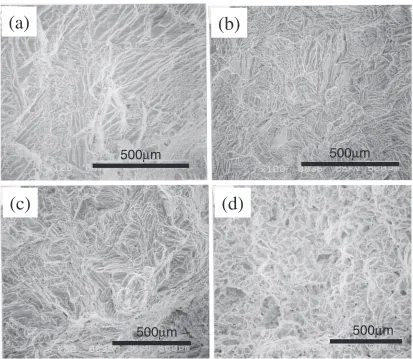
The limited fracture surfaces are shown in Fig. 9. The homogeneous deformation was caused in compacts with large amounts of equiaxed grains, as shown in Figs. 9(a) and 9(b). The homogeneous deformation was suppressed in grains due to the large amounts of irregularly elongated grains, as seen in Fig. 9(c), although the highest relative density of 99.7% was shown in the compacts produced at condition ⑥ listed in Table 1. In contrast, the insufficient bonding between particles was obtained on the compacts with 98%relative density produced at condition③, as shown in Fig. 9(d). It is considered that the ductility depended on microstructural characteristics and equiaxed grains were promising for high ductility. Thefixed maximum temperature below 1443 K, narrow temperature amplitude below 230 K
and lower applied pressure of 9 MPa, were recommended as one example for the good ductility properties.
4. Conclusions
The control of properties such as microstructure, density, strength and elongation, on Ti compacts was successfully achieved by the optimization of process parameters in spark sintering. The relative density and microstructures depended on the applied pressure, the application or temperature amplitude of the cyclic heating and cooling around¢transus and the holding time at fixed maximum temperatures. In particular, the achievement of high density and characteristic microstructures could be carried out by the application of cyclic heating and cooling in the range at temperatures below and above¢transus at high pressure, due to excellent thermal and pressure control-ability in the spark sintering equipment. The 0.2%proof and tensile strength were increased, only by rising of relative densities. In contrast, the tensile elongation and reduction of area were affected by both relative densities and microstructures. There was good correlation among the mechanical properties, microstructural characteristics and relative density. Their optimization could be also achieved by the control of process parameters, utilizing the micro
(a)
(b)
Fig. 7 Relation between the relative density and, (a) 0.2%proof stress or (b) ultimate tensile strength on compacts produced by some conditions.
Equiaxed +
(a)
(b)
[image:6.595.87.512.68.237.2] [image:6.595.87.511.290.461.2]phenomena in or between powders such as the solid transformation between ¡and¢phases, which led to a case study for the properties-control of Ti compacts in the spark sintering.
REFERENCES
1) G. S. Upadhyaya: Sintered Metallic and Ceramic Materials, (John Wiley and Sons, Ltd., West Sussex, England, 1999) pp. 249408. 2) O. Yanagisawa, T. Hatayama and K. Matsugi:Materia Japan33(1994)
14891496.
3) G. A. Weissler: Int. J. Powder Metall.17(1981) 107118. 4) F. V. Lenel: J. Metals7(1955) 158167.
5) L. A. Shepard and W. F. Croft: Powder Metall. Int.7(1975) 3338. 6) S. Clyens, S. T. S. Al-Hassani and W. Johnson:Int. J. Mech. Sci.18
(1976) 3744.
7) K. Inoue: US Patent No. 3, 241, 956 March, (1962).
8) K. Matsugi, T. Hatayama and O. Yanagisawa: J. Japan Inst. Metals59
(1995) 740745.
9) J. R. Groza:J. Mater. Eng. Perform.2(1993) 283290.
10) K. Matsugi, T. Hatayama and O. Yanagisawa: J. Japan Inst. Metals60
(1996) 301310.
11) H. Kuramoto, K. Matsugi, T. Hatayama and O. Yanagisawa: J. Japan Inst. Metals65(2001) 868873.
12) H. Kuramoto, K. Matsugi and O. Yanagisawa: J. Japan Inst. Metals66
(2002) 621626.
13) K. Matsugi, G. Sasaki and O. Yanagisawa:J. Jpn. Soc. Powder Powder Metall.56(2009) 355370.
14) K. Matsugi, N. Ishibashi, T. Hatayama and O. Yanagisawa:
Intermetallics4(1996) 457467.
15) K. Matsugi, M. Konishi, O. Yanagisawa and M. Kiritani:J. Mater. Proc. Tech.150(2004) 300308.
16) T. Kobayashi:Materials Toughness Theory, (Agne Technical Center, Tokyo, 2000) pp. 217238.
500
μ
m
500
μ
m
500
μ
m
500
μ
m
(a)
(b)
(c)
(d)
[image:7.595.92.505.68.427.2]