Single Document Summarization based on Nested Tree Structure
Yuta Kikuchi† Tsutomu Hirao‡ Hiroya Takamura††Tokyo Institute of technology
4295, Nagatsuta, Midori-ku, Yokohama, 226-8503, Japan {kikuchi,takamura,oku}@lr.pi.titech.ac.jp
‡NTT Communication Science Laboratories, NTT Corporation
2-4, Hikaridai, Seika-cho, Soraku-gun, Kyoto, 619-0237, Japan {hirao.tsutomu,nagata.masaaki}@lab.ntt.co.jp
Manabu Okumura† Masaaki Nagata‡
Abstract
Many methods of text summarization combining sentence selection and sen-tence compression have recently been pro-posed. Although the dependency between words has been used in most of these methods, the dependency between sen-tences, i.e., rhetorical structures, has not been exploited in such joint methods. We used both dependency between words and dependency between sentences by con-structing a nested tree, in which nodes in the document tree representing depen-dency between sentences were replaced by a sentence tree representing dependency between words. We formulated a sum-marization task as a combinatorial opti-mization problem, in which the nested tree was trimmed without losing impor-tant content in the source document. The results from an empirical evaluation re-vealed that our method based on the trming of the nested tree significantly im-proved the summarization of texts.
1 Introduction
Extractive summarization is one well-known ap-proach to text summarization and extractive meth-ods represent a document (or a set of documents) as a set of some textual units (e.g., sentences, clauses, and words) and select their subset as a summary. Formulating extractive summarization as a combinational optimization problem greatly improves the quality of summarization (McDon-ald, 2007; Filatova and Hatzivassiloglou, 2004; Takamura and Okumura, 2009). There has re-cently been increasing attention focused on ap-proaches that jointly optimize sentence extraction and sentence compression (Tomita et al., 2009;
Qian and Liu, 2013; Morita et al., 2013; Gillick and Favre, 2009; Almeida and Martins, 2013; Berg-Kirkpatrick et al., 2011). We can only ex-tract important content by trimming redundant parts from sentences.
However, as these methods did not include the discourse structures of documents, the generated summaries lacked coherence. It is important for generated summaries to have a discourse struc-ture that is similar to that of the source docu-ment. Rhetorical Structure Theory (RST) (Mann and Thompson, 1988) is one way of introduc-ing the discourse structure of a document to a summarization task (Marcu, 1998; Daum´e III and Marcu, 2002; Hirao et al., 2013). Hirao et al. recently transformed RST trees into dependency trees and used them for single document summa-rization (Hirao et al., 2013). They formulated the summarization problem as a tree knapsack prob-lem with constraints represented by the depen-dency trees.
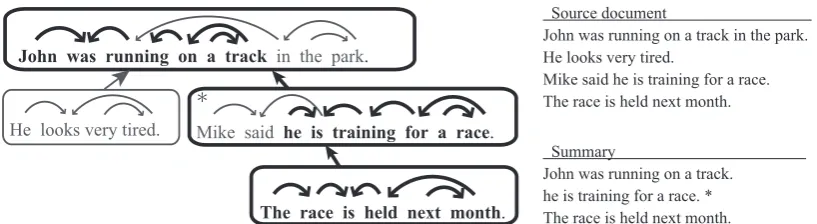
We propose a method of summarizing a single document that utilizes dependency between sen-tences obtained from rhetorical structures and de-pendency between words obtained from a depen-dency parser. We have explained our method with an example in Figure 1. First, we represent a doc-ument as anested tree, which is composed of two types of tree structures: a document tree and a sentence tree. The document tree is a tree that has sentences as nodes and head modifier relationships between sentences obtained by RST as edges. The sentence tree is a tree that has words as nodes and head modifier relationships between words obtained by the dependency parser as edges. We can build the nested tree by regarding each node of the document tree as a sentence tree. Finally, we formulate the problem of single document sum-marization as that of combinatorial optimization, which is based on the trimming of the nested tree.
John was running on a track in the park.
He looks very tired. Mike said he is trainning for a race.
The race is held on next month.
*
Source document John was running on a track in the park. He looks very tired.
Mike said he is training for a race. The race is held on next month.
Summary John was running on a track.
he is training for a race. * The race is held on next month.
EDU選択 提案手法 文選択 参照要約
0 2 4 6 8 10 12 14 16
EDU
selsection
sentence subtree
selection
selection
sentence
reference
summary
Number of selected sentences
from source document
John was running on a track in the park.
He looks very tired. Mike said he is training for a race.
The race is held next month.
*
Source document John was running on a track in the park. He looks very tired.
Mike said he is training for a race. The race is held next month.
Summary John was running on a track.
[image:2.595.94.503.64.176.2]he is training for a race. * The race is held next month.
Figure 1: Overview of our method. The source document is represented as a nested tree. Our method simultaneously selects a rooted document subtree and sentence subtree from each node.
Our method jointly utilizes relations between sen-tences and relations between words, and extracts a rooted document subtree from a document tree whose nodes are arbitrary subtrees of the sentence tree.
Elementary Discourse Units (EDUs) in RST are defined as the minimal building blocks of dis-course. EDUs roughly correspond to clauses. Most methods of summarization based on RST use EDUs as extraction textual units. We converted the rhetorical relations between EDUs to the re-lations between sentences to build the nested tree structure. We could thus take into account both relations between sentences and relations between words.
2 Related work
Extracting a subtree from the dependency tree of words is one approach to sentence compression (Tomita et al., 2009; Qian and Liu, 2013; Morita et al., 2013; Gillick and Favre, 2009). However, these studies have only extracted rooted subtrees from sentences. We allowed our model to extract a subtree that did not include the root word (See the sentence with an asterisk∗in Figure 1). The method of Filippova and Strube (2008) allows the model to extract non-rooted subtrees in sentence compression tasks that compress a single sentence with a given compression ratio. However, it is not trivial to apply their method to text summariza-tion because no compression ratio is given to sen-tences. None of these methods use the discourse structures of documents.
Daum´e III and Marcu (2002) proposed a noisy-channel model that used RST. Although their method generated a well-organized summary, no optimality of information coverage was guaran-teed and their method could not accept large texts because of the high computational cost. In
addi-- The scare over Alar, a growth regulator - that makes apples redder and crunchier - but may be carcinogenic,
- made consumers shy away from the Delicious, - though they were less affected than the McIntosh.
Figure 2: Example of one sentence. Each line cor-responds to one EDU.
tion, their method required large sets of data to cal-culate the accurate probability. There have been some studies that have used discourse structures locally to optimize the order of selected sentences (Nishikawa et al., 2010; Christensen et al., 2013).
3 Generating summary from nested tree 3.1 Building Nested Tree with RST
A document in RST is segmented into EDUs and adjacent EDUs are linked with rhetorical relations to build an RST-Discourse Tree (RST-DT) that has a hierarchical structure of the relations. There are 78 types of rhetorical relations between two spans, and each span has one of two aspects of a nu-cleus and a satellite. The nunu-cleus is more salient to the discourse structure, while the other span, the satellite, represents supporting information. RST-DT is a tree whose terminal nodes correspond to EDUs and whose nonterminal nodes indicate the relations. Hirao et al. converted RST-DTs into dependency-based discourse trees (DEP-DTs) whose nodes corresponded to EDUs and whose edges corresponded to the head modifier relation-ships of EDUs. See Hirao et al. for details (Hirao et al., 2013).
max. ∑n
i
mi
∑
j
wijzij
s.t. ∑ni ∑mi
j zij ≤L; (1)
xparent(i)≥xi; ∀i (2)
zparent(i,j)−zij+rij ≥0; ∀i, j (3)
xi≥zij; ∀i, j (4)
∑mi
j z∑ij ≥min(θ,len(i))xi; ∀i (5)
mi
j rij =xi; ∀i (6)
∑
j /∈Rc(i)rij = 0; ∀i (7)
rij ≤zij; ∀i, j (8)
rij +zparent(i,j)≤1; ∀i, j (9)
riroot(i)=ziroot(i); ∀i (10)
∑
j∈sub(i)zij ≥xi; ∀i (11)
∑
[image:3.595.93.292.72.307.2]j∈obj(i)zij ≥xi; ∀i (12)
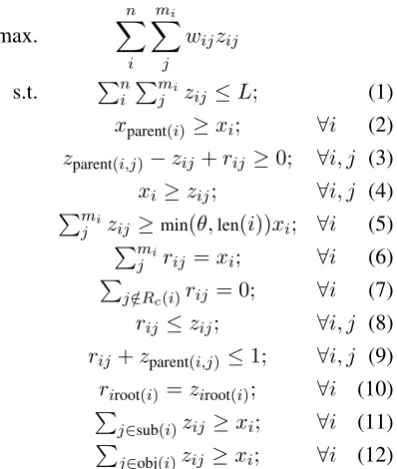
Figure 3: ILP formulation (xi, zij, rij ∈ {0,1})
EDU in another sentence. Hence, we can deter-mine the parent-child relations between sentences. As a result, we obtain a tree that represents the parent-child relations of sentences, and we can use it as a document tree. After the document tree is obtained, we use a dependency parser to obtain the syntactic dependency trees of sentences. Finally, we obtain a nested tree.
3.2 ILP formulation
Our method generates a summary by trimming a nested tree. In particular, we extract a rooted docu-ment subtree from the docudocu-ment tree, and sentence subtrees from sentence trees in the document tree. We formulate our problem of optimization in this section as that of integer linear programming. Our model is shown in Figure 3.
Let us denote by wij the term weight of word
ij (word j in sentence i). xi is a variable that
is one if sentence i is selected as part of a sum-mary, and zij is a variable that is one if word ij
is selected as part of a summary. According to the objective function, the score for the resulting sum-mary is the sum of the term weightswij that are
included in the summary. We denote by rij the
variable that is one if wordij is selected as a root of an extracting sentence subtree. Constraint (1) guarantees that the summary length will be less than or equal to limit L. Constraints (2) and (3) are tree constraints for a document tree and sen-tence trees.rijin Constraint (3) allows the system
to extract non-rooted sentence subtrees, as we pre-viously mentioned. Function parent(i)returns the parent of sentence iand function parent(i, j) re-turns the parent of wordij. Constraint (4) guaran-tees that words are only selected from a selected sentence. Constraint (5) guarantees that each se-lected sentence subtree has at leastθwords. Func-tion len(i)returns the number of words in sentence i. Constraints (6)-(10) allow the model to extract subtrees that have an arbitrary root node. Con-straint (6) guarantees that there is only one root per selected sentence. We can set the candidate for the root node of the subtree by using constraint (7). TheRc(i)returns a set of the nodes that are
the candidates of the root nodes in sentencei. It returned the parser’s root node and the verb nodes in this study. Constraint (8) maintains consistency betweenzij andrij. Constraint (9) prevents the
system from selecting the parent node of the root node. Constraint (10) guarantees that the parser’s root node will only be selected when the system extracts a rooted sentence subtree. The root(i) re-turns the word index of the parser’s root. Con-straints (11) and (12) guarantee that the selected sentence subtree has at least one subject and one object if it has any. Thesub(i)andobj(i)return the word indices whose dependency tag is “SUB” and “OBJ”.
3.3 Additional constraint for grammaticality We added two types of constraints to our model to extract a grammatical sentence subtree from a dependency tree:
zik = zil, (13)
∑
k∈s(i,j)
zik = |s(i, j)|xi. (14)
Equation (13) means that wordszikandzilhave
Table 1: ROUGE score of each model. Note that the top two rows are both our proposals.
ROUGE-1
Sentence subtree 0.354
Rooted sentence subtree 0.352
Sentence selection 0.254
EDU selection (Hirao et al., 2013) 0.321
LEADEDU 0.240
LEADsnt 0.157
4 Experiment
4.1 Experimental Settings
We experimentally evaluated the test collection for single document summarization contained in the RST Discourse Treebank (RST-DTB) (Carlson et al., 2001) distributed by the Linguistic Data Con-sortium (LDC)1. The RST-DTB Corpus includes 385 Wall Street Journal articles with RST anno-tations, and 30 of these documents also have one manually prepared reference summary. We set the length constraint, L, as the number of words in each reference summary. The average length of the reference summaries corresponded to approxi-mately 10% of the length of the source document. This dataset was first used by Marcu et al. for evaluating a text summarization system (Marcu, 1998). We used ROUGE (Lin, 2004) as an eval-uation criterion.
We compared our method (sentence subtree) with that of EDU selection (Hirao et al., 2013). We examined two other methods, i.e.,rooted sen-tence subtreeandsentence selection. These two are different from our method in the way that they select a sentence subtree. Rooted sentence subtree only selects rooted sentence subtrees2. Sentence selection does not trim sentence trees. It simply selects full sentences from a document tree3. We built all document trees from the RST-DTs that were annotated in the corpus.
We set the term weight,wij, for our model as:
wij = logdepth(1 +(tfi)2ij), (15)
where tfij is the term frequency of word ij in a
document and depth(i) is the depth of sentence
1http://www.ldc.upenn.edu/Catalog/CatalogEntry.jsp?
catalogId=LDC2002T07
2We achieved this by making Rc(i) only return the
parser’s root node in Figure 7.
3We achieved this by settingθto a very large number.
i within the sentence-level DEP-DT that we de-scribed in Section 3.1. For Constraint (5), we set θto eight.
4.2 Results and Discussion 4.2.1 Comparing ROUGE scores
We have summarized the Recall-Oriented Under-study for Gisting Evaluation (ROUGE) scores for each method in Table 1. The score for sentence selection is low (0.254). However, introducing sentence compression to the system greatly im-proved the ROUGE score (0.354). The score is also higher than that with EDU selection, which is a state-of-the-art method. We applied a multi-ple test by using Holm’s method and found that our method significantly outperformed EDU se-lection and sentence sese-lection. The difference be-tween the sentence subtree and the rooted sentence subtree methods was fairly small. We therefore qualitatively analyzed some actual examples that will be discussed in Section 4.2.2. We also exam-ined the ROUGE scores of two LEAD4 methods with different textual units: EDUs (LEADEDU) and sentences (LEADSNT). Although LEAD works well and often obtains high ROUGE scores for news articles, the scores for LEADEDU and LEADSNTwere very low.
4.2.2 Qualitative Evaluation of Sentence Subtree Selection
This subsection compares the methods of subtree selection and rooted subtree selection. Figure 4 has two example sentences for which both meth-ods selected a subtree as part of a summary. The
{·}indicates the parser’s root word. The[·] indi-cates the word that the system selected as the root of the subtree. Subtree selection selected a root in both examples that differed from the parser’s root. As we can see, subtree selection only selected im-portant subtrees that did not include the parser’s root, e.g., purpose-clauses and that-clauses. This capability is very effective because we have to contain important content in summaries within given length limits, especially when the compres-sion ratio is high (i.e., the method has to gener-ate much shorter summaries than the source docu-ments).
4LEAD methods simply take the firstKtextual units from
Original sentence : John Kriz, a Moody’s vice president,{said}Boston Safe Deposit’s performance has been hurt this year by a mismatch in the maturities of its assets and liabilities.
Rooted subtree selection : John Kriz a Moody’s vice president [{said}] Boston Safe Deposit’s performance has been hurt this year
Subtree selection : Boston Safe Deposit’s performance has [been] hurt this year
Original sentence : Recent surveys by Leo J. Shapiro & Associates, a market research firm in Chicago, {suggest}that Sears is having a tough time attracting shoppers because it hasn’t yet done enough to improve service or its selection of merchandise.
Rooted subtree selection : surveys [{suggest}] that Sears is having a time Subtree selection : Sears [is] having a tough time attracting shoppers
[image:5.595.315.515.197.319.2]Figure 4: Example sentences and subtrees selected by each method.
Table 2: Average number of words that individual extracted textual units contained.
Subtree Sentence EDU
15.29 18.96 9.98
4.2.3 Fragmentation of Information
Many studies that have utilized RST have simply adopted EDUs as textual units (Mann and Thomp-son, 1988; Daum´e III and Marcu, 2002; Hirao et al., 2013; Knight and Marcu, 2000). While EDUs are textual units for RST, they are too fine grained as textual units for methods of extractive summa-rization. Therefore, the models have tended to se-lect small fragments from many sentences to max-imize objective functions and have led to frag-mented summaries being generated. Figure 2 has an example of EDUs. A fragmented summary is generated when small fragments are selected from many sentences. Hence, the number of sen-tences in the source document included in the re-sulting summary can be an indicator to measure the fragmentation of information. We counted the number of sentences in the source document that each method used to generate a summary5. The average for our method was 4.73 and its me-dian was four sentences. In contrast, methods of EDU selection had an average of 5.77 and a median of five sentences. This meant that our method generated a summary with a significantly smaller number of sentences6. In other words, our method relaxed fragmentation without decreasing the ROUGE score. There are boxplots of the num-bers of selected sentences in Figure 5. Table 2 lists the number of words in each textual unit extracted by each method. It indicates that EDUs are shorter than the other textual units. Hence, the number of sentences tends to be large.
5Note that the number for the EDU method is not equal to
selected textual units because a sentence in the source docu-ment may contain multiple EDUs.
6We used the Wilcoxon signed-rank test (p <0.05).
John was running on a track in the park.
He looks very tired. Mike said he is trainning for a race.
The race is held on next month.
Source document John was running on a track in the park. He looks very tired.
Mike said he is training for a race. The race is held on next month. Summary John was running on a track. he is training for a race. The race is held on next month.
EDU選択 提案手法 文選択 参照要約
0 2 4 6 8 10 12 14 16
EDU
selsectionsentence subtreeselection sentenceselection reference summary
Number of selected sentences
from source document
Figure 5: Number of sentences that each method selected.
5 Conclusion
We proposed a method of summarizing a sin-gle document that included relations between sen-tences and relations between words. We built a nested tree and formulated the problem of summa-rization as that of integer linear programming. Our method significantly improved the ROUGE score with significantly fewer sentences than the method of EDU selection. The results suggest that our method relaxed the fragmentation of information. We also discussed the effectiveness of sentence subtree selection that did not restrict rooted sub-trees. Although ROUGE scores are widely used as evaluation metrics for text summarization sys-tems, they cannot take into consideration linguis-tic qualities such as human readability. Hence, we plan to conduct evaluations with people7.
We only used the rhetorical structures between sentences in this study. However, there were also rhetorical structures between EDUs inside individ-ual sentences. Hence, utilizing these for sentence compression has been left for future work. In addi-tion, we used rhetorical structures that were man-ually annotated. There have been related studies on building RST parsers (duVerle and Prendinger, 2009; Hernault et al., 2010) and by using such parsers, we should be able to apply our model to other corpora or to multi-document settings.
7For example, the quality question metric from the
References
Miguel Almeida and Andre Martins. 2013. Fast and robust compressive summarization with dual de-composition and multi-task learning. InACL, pages 196–206, August.
Taylor Berg-Kirkpatrick, Dan Gillick, and Dan Klein. 2011. Jointly learning to extract and compress. In
ACL, pages 481–490, Portland, Oregon, USA, June. Lynn Carlson, Daniel Marcu, and Mary Ellen Okurowski. 2001. Building a discourse-tagged cor-pus in the framework of rhetorical structure theory. InSIGDIAL, pages 1–10.
Janara Christensen, Mausam, Stephen Soderland, and Oren Etzioni. 2013. Towards coherent multi-document summarization. In NAACL:HLT, pages 1163–1173.
Hal Daum´e III and Daniel Marcu. 2002. A noisy-channel model for document compression. ACL, pages 449–456.
David duVerle and Helmut Prendinger. 2009. A novel discourse parser based on support vector machine classification. InIJCNLP, pages 665–673.
Elena Filatova and Vasileios Hatzivassiloglou. 2004. A formal model for information selection in multi-sentence text extraction. InCOLING.
Katja Filippova and Michael Strube. 2008. Depen-dency tree based sentence compression. In INLG, pages 25–32.
Dan Gillick and Benoit Favre. 2009. A scalable global model for summarization. InILP, pages 10–18. Hugo Hernault, Helmut Prendinger, David duVerle,
and Mitsuru Ishizuka. 2010. Hilda: A discourse parser using support vector machine classification.
Dialogue & Discourse, 1(3):1–30.
Tsutomu Hirao, Yasuhisa Yoshida, Masaaki Nishino, Norihito Yasuda, and Masaaki Nagata. 2013. Single-document summarization as a tree knapsack problem. InEMNLP, pages 1515–1520.
Kevin Knight and Daniel Marcu. 2000. Statistics-based summarization - step one: Sentence compres-sion. In National Conference on Artificial Intelli-gence (AAAI), pages 703–710.
Chin-Yew Lin. 2004. Rouge: A package for automatic evaluation of summaries. InProc. ACL workshop on Text Summarization Branches Out, pages 74–81. William C. Mann and Sandra A. Thompson. 1988.
Rhetorical structure theory: Toward a functional the-ory of text organization. Text, pages 243–281. Daniel Marcu. 1998. Improving summarization
through rhetorical parsing tuning. InIn Proc. of the 6th Workshop on Very Large Corpora, pages 206– 215.
Ryan T. McDonald. 2007. A study of global infer-ence algorithms in multi-document summarization. InECIR, pages 557–564.
Hajime Morita, Ryohei Sasano, Hiroya Takamura, and Manabu Okumura. 2013. Subtree extractive sum-marization via submodular maximization. In ACL, pages 1023–1032.
Hitoshi Nishikawa, Takaaki Hasegawa, Yoshihiro Mat-suo, and Genichiro Kikui. 2010. Opinion summa-rization with integer linear programming formula-tion for sentence extracformula-tion and ordering. In COL-ING, pages 910–918.
Xian Qian and Yang Liu. 2013. Fast joint compres-sion and summarization via graph cuts. InEMNLP, pages 1492–1502.
Hiroya Takamura and Manabu Okumura. 2009. Text summarization model based on the budgeted median problem. InCIKM, pages 1589–1592.