Learning a Lexical Simplifier Using Wikipedia
Colby Horn, Cathryn ManducaandDavid Kauchak
Computer Science Department Middlebury College
{chorn,cmanduca,dkauchak}@middlebury.edu
Abstract
In this paper we introduce a new lexical simplification approach. We extract over 30K candidate lexical simplifications by identifying aligned words in a sentence-aligned corpus of English Wikipedia with Simple English Wikipedia. To apply these rules, we learn a feature-based ranker us-ing SVMrank trained on a set of labeled simplifications collected using Amazon’s Mechanical Turk. Using human simplifi-cations for evaluation, we achieve a preci-sion of 76% with changes in 86% of the examples.
1 Introduction
Text simplification is aimed at reducing the read-ing and grammatical complexity of text while re-taining the meaning (Chandrasekar and Srinivas, 1997). Text simplification techniques have a broad range of applications centered around increasing data availability to both targeted audiences, such as children, language learners, and people with cognitive disabilities, as well as to general readers in technical domains such as health and medicine (Feng, 2008).
Simplifying a text can require a wide range of transformation operations including lexical changes, syntactic changes, sentence splitting, deletion and elaboration (Coster and Kauchak, 2011; Zhu et al., 2010). In this paper, we ex-amine a restricted version of the text simplifica-tion problem, lexical simplificasimplifica-tion, where text is simplified by substituting words or phrases with simpler variants. Even with this restriction, lexi-cal simplification techniques have been shown to positively impact the simplicity of text and to im-prove reader understanding and information reten-tion (Leroy et al., 2013). Addireten-tionally, restrict-ing the set of transformation operations allows for
more straightforward evaluation than the general simplification problem (Specia et al., 2012).
Most lexical simplification techniques rely on transformation rules that change a word or phrase into a simpler variant with similar meaning (Bi-ran et al., 2011; Specia et al., 2012; Yatskar et al., 2010). Two main challenges exist for this type of approach. First, the lexical focus of the trans-formation rules makes generalization difficult; a large number of transformation rules is required to achieve reasonable coverage and impact. Second, rules do not apply in all contexts and care must be taken when performing lexical transformations to ensure local cohesion, grammaticality and, most importantly, the preservation of the original mean-ing.
In this paper, we address both of these issues. We leverage a data set of 137K aligned sentence pairs between English Wikipedia and Simple En-glish Wikipedia to learn simplification rules. Pre-vious approaches have used unaligned versions of Simple English Wikipedia to learn rules (Biran et al., 2011; Yatskar et al., 2010), however, by using the aligned version we are able to learn a much larger rule set.
To apply lexical simplification rules to a new sentence, a decision must be made about which, if any, transformations should be applied. Previous approaches have used similarity measures (Biran et al., 2011) and feature-based approaches (Specia et al., 2012) to make this decision. We take the lat-ter approach and train a supervised model to rank candidate transformations.
2 Problem Setup
We learn lexical simplification rules that consist of a word to be simplified and a list of candidate simplifications:
w→c1, c2, ..., cm
Consider the two aligned sentence pairs in Table
The first school wasestablishedin 1857. The first school wasstartedin 1857.
The district wasestablishedin 1993 by merging the former districts of Bernau and Eberswalde. The district wasmadein 1993 by joining the old districts of Bernau and Eberswalde.
Table 1: Two aligned sentence pairs. The bottom sentence is a human simplified version of the top sentence. Bold words are candidate lexical simpli-fications.
1. The bottom sentence of each pair is a simpli-fied variant of the top sentence. By identifying aligned words within the aligned sentences, can-didate lexical simplifications can be learned. The bold words show two such examples, though other candidates exist in the bottom pair. By examining aligned sentence pairs we can learn a simplifica-tion rule. For example, we might learn:
established→began, made, settled, started
Given a sentence s1, s2, ..., sn, a simplification rule applies if the left hand side of the rule can be found in the sentence (si = w, for somei). If a rule applies, then a decision must be made about which, if any, of the candidate simplifications should be substituted for the word wto simplify the sentence. For example, if we were attempting to simplify the sentence
The ACL was established in 1962.
using the simplification rule above, some of the simplification options would not apply because of grammatical constraints, e.g. began, while others would not apply for semantic reasons, e.g.
settled. This does not mean that these are not good simplifications forestablishedsince in other contexts, they might be appropriate. For example, in the sentence
The researcher established a new paper writing routine.
beganis a reasonable option.
3 Learning a Lexical Simplifier
We break the learning problem into two steps: 1) learn a set of simplification rules and 2) learn a ranking function for determining the best simpli-fication candidate when a rule applies. Each of these steps are outlined below.
3.1 Rule Extraction
To extract the set of simplification rules, we use a sentence-aligned data set of English Wikipedia sentences (referred to asnormal) aligned to Sim-ple English Wikipedia sentences (referred to as
simple) (Coster and Kauchak, 2011). The data set contains 137K such aligned sentence pairs.
Given a normal sentence and the corresponding aligned simple sentence, candidate simplifications are extracted by identifying a word in the simple sentence that corresponds to a different word in the normal sentence. To identify such pairs, we au-tomatically induce a word alignment between the normal and simple sentence pairs using GIZA++ (Och and Ney, 2000). Words that are aligned are considered as possible candidates for extraction. Due to errors in the sentence and word alignment processes, not all words that are aligned are actu-ally equivalent lexical variants. We apply the fol-lowing filters to reduce such spurious alignments:
• We remove any pairs where the normal word occurs in a stoplist. Stoplist words tend to be simple already and stoplist words that are be-ing changed are likely either bad alignments or are not simplifications.
• We require that the part of speeches (POS) of the two words be the same. The parts of speech were calculated based on a full parse of the sentences using the Berkeley parser (Petrov and Klein, 2007).
• We remove any candidates where the POS is labeled as a proper noun. In most cases, proper nouns should not be simplified.
All other aligned word pairs are extracted. To generate the simplification rules, we collect all candidate simplifications (simple words) that are aligned to the same normal word.
3.2 Lexical Simplification as a Ranking Problem
A lexical simplification example consists of three parts: 1) a sentence, s1, s2, ..., sn, 2), a word in that sentence, si, and 3) a list of candidate sim-plifications forsi,c1, c2, ..., cm. A labeled
exam-ple is an examexam-ple where the rank of the candidate simplifications has been specified. Given a set of labeled examples, the goal is to learn a ranking function that, given an unlabeled example (exam-ple without the candidate simplifications ranked), specifies a ranking of the candidates.
To learn this function, features are extracted from a set of labeled lexical simplification exam-ples. These labeled examples are then used to train a ranking function. We use SVMrank (Joachims, 2006), which uses a linear support vector machine. Besides deciding which of the candidates is most applicable in the context of the sentence, even if a rule applies, we must also decide if any simplification should occur. For example, there may be an instance where none of the can-didate simplifications are appropriate in this con-text. Rather than viewing this as a separate prob-lem, we incorporate this decision into the ranking problem by adding w as a candidate simplifica-tion. For each rule,w→c1, c2, ..., cmwe add one additional candidate simplification which does not change the sentence,w→c1, c2, ..., cm, w. Ifwis ranked as the most likely candidate by the ranking algorithm, then the word is not simplified.
3.2.1 Features
The role of the features is to capture information about the applicability of the word in the context of the sentence as well as the simplicity of the word. Many features have been suggested previ-ously for use in determining the simplicity of a word (Specia et al., 2012) and for determining if a word is contextually relevant (Biran et al., 2011; McCarthy and Navigli, 2007). Our goal for this paper is not feature exploration, but to examine the usefulness of a general framework for feature-based ranking for lexical simplification. The tures below represent a first pass at candidate fea-tures, but many others could be explored.
Candidate Probability
p(ci|w): in the sentence-aligned Wikipedia data, when w is aligned to some candidate simplifica-tion, what proportion of the time is that candidate
ci.
Frequency
The frequency of a word has been shown to cor-relate with the word’s simplicity and with peo-ple’s knowledge of that word (Leroy and Kauchak, 2013). We measured a candidate simplification’s frequency in two corpora: 1) Simple English Wikipedia and 2) the web, as measured by the un-igram frequency from the Google n-gram corpus (Brants and Franz, 2006).
Language Models
n-gram language models capture how likely a par-ticular sequence is and can help identify candidate simplifications that are not appropriate in the con-text of the sentence. We included features from four different language models trained on four dif-ferent corpora: 1) Simple English Wikipedia, 2) English Wikipedia, 3) Google n-gram corpus and 4) a linearly interpolated model between 1) and 2) with λ = 0.5, i.e. an even blending. We used the SRI language modeling toolkit (Stolcke, 2002) with Kneser-Kney smoothing. All models were trigram language models except the Google n-gram model, which was a 5-gram model.
Context Frequency
As another measure of the applicability of a can-didate in the context of the sentence, we also cal-culate the frequency in the Google n-grams of the candidate simplification in the context of the sen-tence with context windows of one and two words. If the word to be substituted is at positioniin the sentence (w = si), then the one word window frequency for simplificationcj is the trigram fre-quency ofsi−1cj si+1and the two word window
the 5-gram frequency ofsi−2si−1cjsi+1si+2.
4 Data
For training and evaluation of the models, we col-lected human labelings of 500 lexical simplifica-tion examples using Amazon’s Mechanical Turk (MTurk)1. MTurk has been used extensively for
annotating and evaluating NLP tasks and has been shown to provide data that is as reliable as other forms of human annotation (Callison-Burch and Dredze, 2010; Zaidan and Callison-Burch, 2011).
Figure 1 shows an example of the task we asked annotators to do. Given a sentence and a word to be simplified, the task is to suggest a simpler variant of that word that is appropriate in the con-text of the sentence. Candidate sentences were
Enter asimpler word that could be substituted for the red, bold word in the sentence. A simpler
word is one that would be understood by more people or people with a lower reading level (e.g. children).
Food isprocuredwith its suckers and then crushed using its tough “beak” of chitin.
Figure 1: Example task setup on MTurk soliciting lexical simplifications from annotators.
lected from the sentence-aligned Wikipedia cor-pus where a word in the normal sentence is be-ing simplified to a different word in the simple sentence, as identified by the automatically in-duced word alignment. The normal sentence and the aligned word were then selected for annota-tion. These examples represent words that other people (those that wrote/edited the Simple En-glish Wikipedia page) decided were difficult and required simplification.
We randomly selected 500 such sentences and collected candidate simplifications from50 people per sentence, for a total of 25,000 annotations. To participate in the annotation process, we required that the MTurk workers live in the U.S. (for En-glish proficiency) and had at least a 95% accep-tance rate on previous tasks.
The simplifications suggested by the annotators were then tallied and the resulting list of simpli-fications with frequencies provides a ranking for training the candidate ranker. Table 2 shows the ranked list of annotations collected for the exam-ple in Figure 1. This data set is available online.2
Since these examples were selected from En-glish Wikipedia they, and the corresponding aligned Simple English Wikipedia sentences, were removed fromall resources used during both the rule extraction and the training of the ranker.
5 Experiments 5.1 Other Approaches
We compared our lexical simplification approach (rank-simplify) to two other approaches. To un-derstand the benefit of the feature-based ranking algorithm, we compared against a simplifier that uses the same rule set, but ranks the candidates only based on their frequency in Simple English Wikipedia (frequency). This is similar to base-lines used in previous work (Biran et al., 2011).
To understand how our extracted rules com-pared to the rules extracted by Biran et al., we
2http://www.cs.middlebury.edu/˜dkauchak/simplification/
used their rules withourranking approach ( rank-Biran). Their approach also extracts rules from a corpus of English Wikipedia and Simple En-glish Wikipedia, however, they do not utilize a sentence-aligned version and instead rely on con-text similarity measures to extract their rules.
5.2 Evaluation
We used the 500 ranked simplification examples to train and evaluate our approach. We employed 10-fold cross validation for all experiments, training on 450 examples and testing on 50.
We evaluated the models with four different metrics:
precision: Of the words that the system changed, what percentage were found inanyof the human annotations.
precision@k: Of the words that the system changed, what percentage were found in the top
khuman annotations, where the annotations were ranked by response frequency. For example, if we were calculating the precision@1 for the example in Table 2, only “obtained” would be considered correct.
accuracy: The percentage of the test examples where the system made a change to one of the annotations suggested by the human annotators. Note that unlike precision, if the system does not suggest a change to a word that was simplified it still gets penalized.
changed: The percentage of the test examples where the system suggested some change (even if it wasn’t a “correct” change).
5.3 Results
word frequency word frequency word frequency
obtained 17 made 2 secured 1
gathered 9 created 1 found 1
gotten 8 processed 1 attained 1
grabbed 4 received 1 procured 1
[image:5.595.135.463.62.146.2]acquired 2 collected 1 aquired 1
Table 2: Candidate simplifications generated using MTurk for the examples in Figure 1. The frequency is the number of annotators that suggested that simplification.
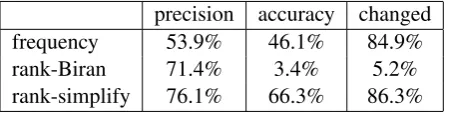
precision accuracy changed
frequency 53.9% 46.1% 84.9%
rank-Biran 71.4% 3.4% 5.2%
[image:5.595.72.297.204.261.2]rank-simplify 76.1% 66.3% 86.3%
Table 3: Precision, accuracy and percent changed for the three systems, averaged over the 10 folds.
examples. For our approach, the extracted rules had very good coverage, applying in over 85% of the examples.
This difference in coverage can be partially at-tributed to the number of rules learned. We learned simplifications for 14,478 words with an average of 2.25 candidate simplifications per word. In con-trast, the rules from Biran et al. only had simpli-fications for 3,598 words with an average of 1.18 simplifications per word.
The precision of both of the approaches that utilized the SVM candidate ranking were sig-nificantly better than the frequency-based ap-proach. To better understand the types of sug-gestions made by the systems, Figure 2 shows the precision@k for increasing k. On average, over the 500 examples we collected, people suggested 12 different simplifications, though this varied de-pending on the word in question and the sentence. As such, at aroundk=12, the precision@kof most of the systems has almost reached the final preci-sion. However, even atk = 5, which only counts correct an answer in the top 5 human suggested results, our system still achieved a precision of around 67%.
6 Future Work
In this paper we have introduced a new rule ex-traction algorithm and a new feature-based rank-ing approach for applyrank-ing these rules in the con-text of different sentences. The number of rules learned is an order of magnitude larger than any previous lexical simplification approach and the
0.3 0.35 0.4 0.45 0.5 0.55 0.6 0.65 0.7 0.75 0.8
0 5 10 15 20 25 30 35 40 45 50
precision
k
rank-simplify rank-Biran frequency
Figure 2: Precision@kfor varyingkfor the three different approaches averaged over the 10 folds.
quality of the resulting simplifications after apply-ing these rules is better than previous approaches.
[image:5.595.311.516.208.352.2]References
Or Biran, Samuel Brody, and Noe ´mie Elhadad. 2011. Putting it simply: A context-aware approach to lexi-cal simplification. InProceedings of ACL.
Thorsten Brants and Alex Franz. 2006. Web 1T 5-gram version 1. Linguistic Data Consortium, Philadelphia.
Philip R. Burns. 2013. Morphadorner v2: A Java li-brary for the morphological adornment of english language texts.
Chris Callison-Burch and Mark Dredze. 2010. Cre-ating speech and language data with Amazon’s
Me-chanical Turk. InProceedings of NAACL-HLT 2010
Workshop on Creating Speech and Language Data with Amazon’s Mechanical Turk.
Raman Chandrasekar and Bangalore Srinivas. 1997. Automatic induction of rules for text simplification. InKnowledge Based Systems.
William Coster and David Kauchak. 2011. Simple En-glish Wikipedia: A new text simplification task. In
Proceedings of ACL.
Lijun Feng. 2008. Text simplification: A survey. CUNY Technical Report.
Thorsten Joachims. 2006. Training linear svms in lin-ear time. InProceedings of KDD.
Gondy Leroy and David Kauchak. 2013. The effect of word familiarity on actual and perceived text
dif-ficulty. Journal of American Medical Informatics
Association.
Gondy Leroy, James E. Endicott, David Kauchak, Obay Mouradi, and Melissa Just. 2013. User evalu-ation of the effects of a text simplificevalu-ation algorithm using term familiarity on perception, understanding, learning, and information retention. Journal of Med-ical Internet Research (JMIR).
Diana McCarthy and Roberto Navigli. 2007. Semeval-2007 task 10: English lexical substitution task. In
Proceedings of SEMEVAL.
F. J. Och and H. Ney. 2000. Improved statistical
align-ment models. InACL.
Slav Petrov and Dan Klein. 2007. Improved inference
for unlexicalized parsing. In Proceedings of
HTL-NAACL.
Lucia Specia, Sujay Kumar Jauhar, and Rada Mihal-cea. 2012. Semeval-2012 task 1: English lexical
simplification. InJoint Conference on Lexical and
Computerational Semantics (*SEM).
Andreas Stolcke. 2002. SRILM - an extensible
lan-guage modeling toolkit. In Proceedings of the
In-ternational Conference on Statistical Language Pro-cessing.
Mark Yatskar, Bo Pang, Cristian Danescu-Niculescu-Mizil, and Lillian Lee. 2010. For the sake of sim-plicity: Unsupervised extraction of lexical
simplifi-cations from Wikipedia. InNAACL/HLT.
Omar F. Zaidan and Chris Callison-Burch. 2011. Crowdsourcing translation: Professional quality from non-professionals. InProceedings of ACL. Zhemin Zhu, Delphine Bernhard, and Iryna Gurevych.