Unsupervised Alignment of Privacy Policies using Hidden Markov Models
Rohan Ramanath Fei Liu Norman Sadeh Noah A. Smith
School of Computer Science Carnegie Mellon University Pittsburgh, PA 15213, USA
{rrohan,feiliu,sadeh,nasmith}@cs.cmu.edu
Abstract
To support empirical study of online pri-vacy policies, as well as tools for users with privacy concerns, we consider the problem of aligning sections of a thousand policy documents, based on the issues they address. We apply an unsupervised HMM; in two new (and reusable) evaluations, we find the approach more effective than clus-tering and topic models.
1 Introduction
Privacy policy documents are verbose, often eso-teric legal documents that many people encounter as clients of companies that provide services on the web. McDonald and Cranor (2008) showed that, if users were to read the privacy policies of every website they access during the course of a year, they would end up spending a substantial amount of their time doing just that and would often still not be able to answer basic questions about what these policies really say. Unsurpris-ingly, many people do not read them (Federal Trade Commission, 2012).
Such policies therefore offer an excellent op-portunity for NLP tools that summarize or ex-tract key information that (i) helps users under-stand the implications of agreeing to these poli-cies and (ii) helps legal analysts understand the contents of these policies and make recommenda-tions on how they can be improved or made more clear. Past applications of NLP have sought to parse privacy policies into machine-readable rep-resentations (Brodie et al., 2006) or extract sub-policies from larger documents (Xiao et al., 2012). Machine learning has been applied to assess cer-tain attributes of policies (Costante et al., 2012; Ammar et al., 2012; Costante et al., 2013; Zim-meck and Bellovin, 2013).
This paper instead analyzes policies in aggre-gate, seeking to align sections of policies. This
task is motivated by an expectation that many poli-cies will address similar issues,1 such as
collec-tion of a user’s contact, locacollec-tion, health, and fi-nancial information, sharing with third parties, and deletion of data. This expectation is supported by recommendation by privacy experts (Gellman, 2014) and policymakers (Federal Trade Commis-sion, 2012); in the financial services sector, the Gramm-Leach-Bliley Act requires these institu-tions to address a specific set of issues. Aligning policy sections is a first step toward our aforemen-tioned summarization and extraction goals.
We present the following contributions:
• A new corpus of over 1,000 privacy policies gathered from widely used websites, manually segmented into subtitled sections by crowdwork-ers (§2).
• An unsupervised approach to aligning the policy sections based on the issues they discuss. For example, sections that discuss “user data on the company’s server” should be grouped together. The approach is inspired by the application of hidden Markov models to sequence alignment in computational biology (Durbin et al., 1998;§3). • Two reusable evaluation benchmarks for the
re-sulting alignment of policy sections (§4). We demonstrate that our approach outperforms na¨ıve methods (§5).
Our corpus and benchmarks are available at http://usableprivacy.org/data.
2 Data Collection
We collected 1,010 unique privacy policy documents from the top websites ranked by Alexa.com.2 These policies were collected during
a period of six weeks during December 2013 and January 2014. They are a snapshot of privacy policies of mainstream websites covering fifteen
1Personal communication, Joel Reidenberg. 2http://www.alexa.com
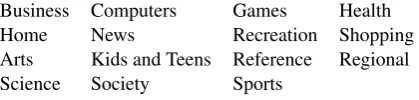
Business Computers Games Health
Home News Recreation Shopping
Arts Kids and Teens Reference Regional
[image:2.595.80.290.64.114.2]Science Society Sports
Table 1: Fifteen website categories provided by Alexa.com. We collect privacy policies from the top 100 websites in each.
of Alexa.com’s seventeen categories (Table 1).3
Finding a website’s policy is not trivial. Though many well-regulated commercial websites provide a “privacy” link on their homepages, not all do. We found university websites to be exceptionally unlikely to provide such a link. Even once the pol-icy’s URL is identified, extracting the text presents the usual challenges associated with scraping doc-uments from the web. Since every site is differ-ent in its placemdiffer-ent of the documdiffer-ent (e.g., buried deep within the website, distributed across several pages, or mingled together with Terms of Service) and format (e.g., HTML, PDF, etc.), and since we wish to preserve as much document structure as possible (e.g., section labels), full automation was not a viable solution.
We therefore crowdsourced the privacy policy document collection using Amazon Mechanical Turk. For each website, we created a HIT in which a worker was asked to copy and paste the following privacy policy-related information into text boxes: (i) privacy policy URL; (ii) last up-dated date (or effective date) of the current privacy policy; (iii) privacy policy full text; and (iv) the section subtitles in the top-most layer of the pri-vacy policy. To identify the pripri-vacy policy URL, workers were encouraged to go to the website and search for the privacy link. Alternatively, they could form a search query using the website name and “privacy policy” (e.g., “Amazon.com privacy policy”) and search in the returned results for the most appropriate privacy policy URL. Given the privacy policy full text and the section subtitles, we partition the full privacy document into differ-ent sections, delimited by the section subtitles. A privacy policy is then converted into XML.
Each HIT was completed by three workers, paid $0.05, for a total cost of $380 (including Ama-zon’s surcharge).
3The “Adult” category was excluded; the “World” cate-gory was excluded since it contains mainly popular websites in different languages, and we opted to focus on policies in English in this first stage of research, though mulitlingual pol-icy analysis presents interesting challenges for future work.
3 Approach
Given the corpus of privacy policies described in §2, we designed a model to efficiently infer an alignment of policy sections. While we expect that different kinds of websites will likely address dif-ferent privacy issues, we believe that many poli-cies will discuss roughly the same set of issues. Aligning the policies is a first step in a larger effort to (i) automatically analyze policies to make them less opaque to users and (ii) support legal experts who wish to characterize the state of privacy on-line and make recommendations (Costante et al., 2012; Ammar et al., 2012; Costante et al., 2013).
We are inspired by multiple sequence alignment methods in computational biology (Durbin et al., 1998) and by Barzilay and Lee (2004), who de-scribed a hidden Markov model (HMM) for doc-ument content where each state corresponds to a distinct topic and generates sentences relevant to that topic according to a language model. We estimate an HMM-like model on our corpus, ex-ploiting similarity across privacy policies to the extent it is evident in the data. In our formula-tion, each hidden state corresponds to an issue or topic, characterized by a distribution over words and bigrams appearing in privacy policy sections addressing that issue. The transition distribution captures tendencies of privacy policy authors to organize these sections in similar orders, though with some variation.
The generative story for our model is as follows. LetSdenote the set of hidden states.
1. Choose a start state y1 fromS according to the
start-state distribution.
2. Fort= 1,2, . . ., untilytis the stopping state:
(a) Sample the tth section of the document by drawing a bag of terms, ot, according to the
emission multinomial distribution for stateyt.
Note the difference from traditional HMMs, in which a single observation symbol is drawn at each time step. ot is generated by
repeat-edly sampling from a distribution over terms that includes all unigrams and bigrams except those that occur in fewer than 5% of the doc-uments and in more than 98% of the docu-ments. This filtering rule was designed to eliminate uninformative stopwords as well as company-specific terms (e.g., the name of the company).4
Websites with Unique privacy Unique privacy Ave. sections Ave. tokens Category privacy URL policies policies w/ date per policy per policy
Arts 94 80 72 11.1 (±3.8) 2894 (±1815)
Business 100 95 75 10.1 (±4.9) 2531 (±1562)
Computers 100 78 62 10.7 (±4.9) 2535 (±1763)
Games 92 80 51 10.2 (±4.9) 2662 (±2267)
Health 92 86 57 10.0 (±4.4) 2325 (±1891)
Home 100 84 68 11.5 (±3.8) 2493 (±1405)
Kids and Teens 96 86 62 10.3 (±4.5) 2683 (±1979)
News 96 91 68 10.7 (±3.9) 2588 (±2493)
Recreation 98 97 67 11.9 (±4.5) 2678 (±1421)
Reference 84 86 55 9.9 (±4.1) 2002 (±1454)
Regional 98 91 72 11.2 (±4.2) 2557 (±1359)
Science 71 75 49 9.2 (±4.1) 1705 (±1136)
Shopping 100 99 84 12.0 (±4.1) 2683 (±1154)
Society 96 94 65 10.2 (±4.6) 2505 (±1587)
Sports 96 62 38 10.9 (±4.0) 2222 (±1241)
[image:3.595.118.483.61.264.2]Average 94.2 85.6 63.0 10.7 (±4.3) 2471 (±1635)
Table 2: Statistics of each website category, including (i) the number of websites with an identified privacy policy link; (ii) number of unique privacy policies in each category (note that in rare cases, multiple unique privacy policies were identified for the same website, e.g., a website that contains links to both new and old versions of its privacy policy); (iii) number of websites with an identified privacy modification date; (iv) average number of sections per policy; (v) average number of tokens per policy.
(b) Sample the next state, yt+1, according to the
transition distribution overS.
This model can nearly be understood as a hid-densemi-Markov model (Baum and Petrie, 1966), though we treat the section lengths as observable. Indeed, our model does not even generate these lengths, since doing so would force the states to “explain” the length of each section, not just its content. The likelihood function for the model is shown in Figure 1.
The parameters of the model are almost iden-tical to those of a classic HMM (start state dis-tribution, emission distributions, and transition distributions), except that emissions are char-acterized by multinomial rather than a cate-gorical distributions. These are learned us-ing Expectation-Maximization, with a forward-backward algorithm to calculate marginals (E-step) and smoothed maximum likelihood estima-tion for the M-step (Rabiner, 1989). After learn-ing, the most probable assignment of a policy’s sections to states can be recovered using a variant of the Viterbi algorithm.
We consider three HMM variants. “Vanilla” al-lows all transitions. The other two posit an order-ing on the states S = {s1, s2, . . . , sK}, and
re-strict the set of transitions that are possible, impos-ing bias on the learner. “All Forward” only allows
models (e.g., a bigram may be generated by as many as three draws from the emission distribution: once for each unigram it contains and once for the bigram).
skto transition to{sk, sk+1, . . . , sK}. “Strict
For-ward” only allowsskto transition toskorsk+1.
4 Evaluation
Developing a gold-standard alignment of privacy policies would either require an interface that al-lows each annotator to interact with the entire cor-pus of previously aligned documents while read-ing the one she is annotatread-ing, or the definition (and likely iterative refinement) of a set of categories for manually labeling policy sections. These were too costly for us to consider, so we instead pro-pose two generic methods to evaluate models for sequence alignment of a collection of docu-ments with generally similar content. Though our model (particularly the restricted variants) treats the problem as one ofalignment, our evaluations consider groupingsof policy sections. In the se-quel, a grouping on a setX is defined as a collec-tion of subsetsXi ⊆ X; these may overlap (i.e.,
there might bex∈Xi∩Xj) and need not be
ex-haustive (i.e., there might bex∈X\SiXi).
4.1 Evaluation by Human QA
Pπ,η,γ(hyt,otint=1 | h`tint=1) =π(y1) n Y
t=1 `t
Y
i=1
η(ot,i |yi) !
γ(yt+1|yt)
Figure 1: The likelihood function for the alignment model (one privacy policy).ytis the hidden state for thetth section,otis
the bag of unigram and bigram terms observed in that section, and`tis the size of the bag. Start-state, emission, and transition
distributions are denoted respectively byπ,η, andγ.yn+1is the silent stopping state.
third parties, and deletion of data.5 The questions
were inspired primarily by the substantive interest of these domain experts—not by this particular al-gorithmic study.
For thirty policies, we obtained answers from each of six domain experts who were not involved in designing the questions. For the purposes of this study, the experts’ answers are not important. In addition to answering each question for each pol-icy, we also asked each expert to copy and paste the text of the policy that contains the answer. Experts were allowed to select as many sections for each question as they saw fit, since answering some questions may require synthesizing informa-tion from different secinforma-tions.
For each of the nine questions, we take the union of all policy sections that contain text se-lected by any annotator as support for her answer. This results in nine groups of policy sections, which we call answer-sets denoted A1, . . . , A9.
Our method allows these to overlap (63% of the sections in anyAioccurred in more than oneAi),
and they are not exhaustive (since many sections of the policies were not deemed to contain answers to any of the nine questions by any expert).
Together, these can be used as a gold standard grouping of policy sections, against which we can compare our system’s output. To do this, we define the set of sectionpairs that are grouped together in answer sets,G = |{ha, bi | ∃Ai 3 a, b}|, and
a similar set of pairsHfrom a model’s grouping. From these sets, we calculate estimates of preci-sion (|G∩H|/|H|) and recall (|G∩H|/|G|).
One shortcoming of this approach, for which the second evaluation seeks to compensate, is that a very small, and likely biased, subset of the policy sections is considered.
4.2 Evaluation by Direct Judgment
We created a separate gold standard of judgments of pairs of privacy policy sections. The data se-lected for judgment was a sample of pairs stratified 5The questions are available in an online appendix at http://usableprivacy.org/data.
by a simple measure of text similarity. We derived unigram tfidf vectors for each section in each of 50 randomly sampled policies per category. We then binnedpairs of sections by cosine similarity (into four bins bounded by 0.25, 0.5, and 0.75). We sampled 994 section pairs uniformly across the 15 categories’ four bins each.
Crowdsourcing was used to determine, for each pair, whether the two sections should be grouped together. A HIT consisted of a pair of policy sec-tions and a multiple choice question, “After read-ing the two sections given below, would you say that they broadly discuss the same topic?” The possible answers were:
1. Yes, both the sections essentially convey the same message in a privacy policy.
2. Although, the sections do not convey the same message, the broadly discuss the same topic. (For ease of understanding, some examples of content on “the same topic” were included.) 3. No, the sections discuss two different topics.
The first two options were considered a “yes” for the majority voting and for defining a gold stan-dard. Every section-pair was annotated by at least three annotators (as many as 15, increased until an absolute majority was reached). Turkers with an acceptance rate greater than 95% with an ex-perience of at least 100 HITs were allowed and paid $0.03 per annotation. The total cost includ-ing some initial trials was $130. 535 out of the 994 pairs were annotated to be similar in topic. An example is shown in Figure 2.
As in§4.1, we calculate precision and recall on pairs. This does not penalize the model for group-ing together a “no” pair; we chose it nonetheless because it is interpretable.
5 Experiment
Section 5 ofclassmates.com:
[46 words] . . . You may also be required to use a password to access certain pages on the Services where certain types of your personal information can be changed or deleted. . . . [113 words]
Section 2 of192.com:
[image:5.595.71.294.198.324.2][50 words] . . . This Policy sets out the means by which You can have Your Personal Information removed from the Service. 192.com is also committed to keeping Personal Information of users of the Service secure and only to use it for the purposes set out in this Policy and as agreed by You. . . . [24 words]
Figure 2: Selections from sections that discuss the issue of “deletion of personal information” and were labeled as discussing the same issue by crowdworkers. Both na¨ıve grouping and LDA put them in two different groups, but the Strict Forward variant of our model correctly groups them together.
Precision Recall F1
Mean S.D. Mean S.D. Mean S.D.
Clust. 0.63 – 0.30 – 0.40 –
LDA 0.56 0.03 0.20 0.05 0.29 0.06
Vanilla 0.62 0.04 0.41 0.04 0.49 0.03 All F. 0.63 0.03 0.47 0.12 0.53 0.06 Strict F. 0.62 0.05 0.46 0.18 0.51 0.07
Clust. 0.62 – 0.23 – 0.34 –
LDA 0.57 0.03 0.18 0.01 0.28 0.02
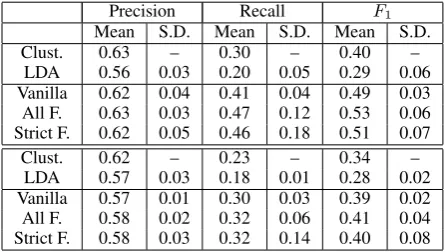
Vanilla 0.57 0.01 0.30 0.03 0.39 0.02 All F. 0.58 0.02 0.32 0.06 0.41 0.04 Strict F. 0.58 0.03 0.32 0.14 0.40 0.08 Table 3: Evaluation by human QA (above) and direct judg-ment (below), aggregated across ten independent runs where appropriate (see text). Vanilla, All F(orward), and Strict F(orward) are three variants of our HMM.
Baselines. Our first baseline is a greedy divisive
clustering algorithm6 to partition the policy
sec-tions into ten clusters. In this method, the de-sired K-way clustering solution is computed by performing a sequence of bisections. The imple-mentation uses unigram features and cosine simi-larity. Our second baseline is latent Dirichlet allo-cation (LDA; Blei et al., 2003), with ten topics and online variational Bayes for inference (Hoffman et al., 2010).7 To more closely match our models,
LDA is given access to the same unigram and bi-gram tokens.
Results. Table 3 shows the results. For LDA
and the HMM variants (which use random initial-ization), we report mean and standard deviation across ten independent runs. All three variants of the HMM improve over the baselines on both tasks, in terms of F1. In the human QA
evalu-ation, this is mostly due to recall improvements (i.e., more pairs of sections relevant to the same policy question were grouped together).
The three variants of the model performed sim-ilarly on average, though Strict Forward had very high variance. Its maximum performance across 6As implemented in CLUTO,http://glaros.dtc. umn.edu/gkhome/cluto/cluto/overview
7As implemented in gensim ( ˇReh˚uˇrek and Sojka, 2010).
ten runs was very high (67% and 53%F1 on the
two tasks), suggesting the potential benefits of good initialization or model selection.
6 Conclusion
We considered the task of aligning sections of a collection of roughly similarly-structured legal documents, based on the issues they address. We introduced an unsupervised model for this task along with two new (and reusable) evaluations. Our experiments show the approach to be more ef-fective than clustering and topic models. The cor-pus and evaluation data have been made available athttp://usableprivacy.org/data. In future work, policy section alignments will be used in automated analysis to extract useful infor-mation for users and privacy scholars.
Acknowledgments
The authors gratefully acknowledge helpful com-ments from Lorrie Cranor, Joel Reidenberg, Flo-rian Schaub, and several anonymous reviewers. This research was supported by NSF grant SaTC-1330596.
References
Waleed Ammar, Shomir Wilson, Norman Sadeh, and Noah A. Smith. 2012. Automatic categorization of privacy policies: A pilot study. Technical Report CMU-LTI-12-019, Carnegie Mellon University. Regina Barzilay and Lillian Lee. 2004. Catching the
drift: Probabilistic content models, with applications to generation and summarization. InProc. of HLT-NAACL.
Leonard E. Baum and Ted Petrie. 1966. Statistical inference for probabilistic functions of finite state Markov chains. Annals of Mathematical Statistics, 37:1554–1563.
Carolyn A. Brodie, Clare-Marie Karat, and John Karat. 2006. An empirical study of natural language pars-ing of privacy policy rules uspars-ing the SPARCLE pol-icy workbench. InProc. of the Symposium on Us-able Privacy and Security.
Elisa Costante, Yuanhao Sun, Milan Petkovi´c, and Jerry den Hartog. 2012. A machine learning solu-tion to assess privacy policy completeness. InProc. of the ACM Workshop on Privacy in the Electronic Society.
Elisa Costante, Jerry Hartog, and Milan Petkovi. 2013. What websites know about you. In Roberto Pietro, Javier Herranz, Ernesto Damiani, and Radu State, editors, Data Privacy Management and Au-tonomous Spontaneous Security, volume 7731 of
Lecture Notes in Computer Science, pages 146–159. Springer Berlin Heidelberg.
Richard Durbin, Sean R. Eddy, Anders Krogh, and Graeme Mitchison. 1998. Biological Sequence Analysis: Probabilistic Models of Proteins and Nu-cleic Acids. Cambridge University Press.
Federal Trade Commission. 2012. Protecting con-sumer privacy in an era of rapid change: Recom-mendations for businesses and policymakers. Robert Gellman. 2014. Fair information
prac-tices: a basic history (v. 2.11). Available at http://www.bobgellman.com/rg-docs/ rg-FIPShistory.pdf.
Matthew D Hoffman, David M Blei, and Francis R Bach. 2010. Online learning for latent Dirichlet al-location. InNIPS.
Aleecia M. McDonald and Lorrie Faith Cranor. 2008. The cost of reading privacy policies. I/S: A Journal of Law and Policy for the Information Society, 4(3). Lawrence Rabiner. 1989. A tutorial on hidden Markov models and selected applications in speech recogni-tion. Proceedings of the IEEE, 77(2):257–286. Radim ˇReh˚uˇrek and Petr Sojka. 2010. Software
frame-work for topic modelling with large corpora. In
Proc. of the LREC Workshop on New Challenges for NLP Frameworks.
Xusheng Xiao, Amit Paradkar, Suresh Thum-malapenta, and Tao Xie. 2012. Automated ex-traction of security policies from natural-language software documents. InProc. of the ACM SIGSOFT International Symposium on the Foundations of Software Engineering.