C O O K I N G U P R E F E R R I N G
E X P R E S S I O N S
Robert DaleCentre for Cognitive Science, University of Edinburgh 2 Buccleuch Place, Edinburgh EH8 9LW, Scotland email: rda~uk, a c . ed. epJ.stemi~nss, c s. u c l . ac. uk
A B S T R A C T
This paper describes the referring expression generation mechanisms used in EPICURE, a com- puter program which produces natural language descriptions of cookery recipes. Major features of the system include: an underlying ontology which permits the representation of non-singular entities; a notion of diacriminatory power, to determine what properties should be used in a description; and a PATR-like unification grammar to produce surface linguistic strings.
I N T R O D U C T I O N
EPICURE (Dale 1989a, 1989b) is a natural lan- guage generation system whose principal concern is the generation of referring expressions which pick out complex entities in connected discourse. In particular, the system generates natural lan- guage descriptions of cookery recipes. Given a top level goal, the program first decomposes that goal recursively to produce a plan consisting of oper- ations at a level of detail commensurate with the assumed knowledge of the hearer. In order to de- scribe the resulting plan, EPICURE then models its execution, so that the processes which produce referring expressions always have access to a rep- resentation of the ingredients in the state they are in at the time of description.
This paper describes that part of the system responsible for the generation of subsequent refer- ring expressions, i.e., references to entities which have already been mentioned in the discourse. The most notable features of the approach taken here are as follows: (a) the use of a sophisticated un- derlying ontology, to permit the representation of non-singular entities; (b) the use of two levels of se- mantic representation, in conjunction with a model of the discourse, to produce appropriate anaphoric referring expressions; (c) the use of a notion of dis- crimiaatory power, to determine what properties should be used in describing an entity; and (d) the use of a PATR-1ike unification grammar (see, for ex- ample, K a r t t u n e n (1986); Shieber (1986)) to pro-
duce surface linguistic strings from input semantic structures.
T H E R E P R E S E N T A T I O N
O F
I N G R E D I E N T S
In most natural language systems, it is assumed that all the entities in the domain of discourse are singular individuals. In more complex domains, such as recipes, this simplification is of limited value, since a large proportion of the objects we find are masses or sets, such as those described by the noun phrases two ounces of salt and three pounds of carrots respectively.
In order to permit the representation of enti- ties such as these, EPICURE makes use of a notion of a generalized physical object or physob]. This permits a consistent representation of entities irre- spective of whether they are viewed as individuals, masses or sets, by representing each as a knowledge base entity (KBE) with an appropriate structure at. tribute. T h e knowledge base entity corresponding to three pounds of carrots, for example, is that shown in figure 1.
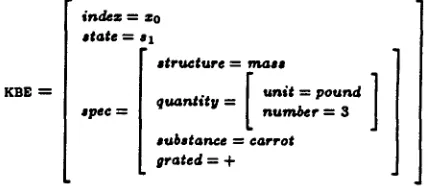
A knowledge base entity models a physobj in a particular state. An entity may change during the course of a recipe, as processes are applied to it: in particular, apart from gaining new properties such as being peeled, chopped, etc., an ingredient's structure m a y change, for example, from set to mass. Each such change of state results in the creation of a new knowledge base entity. Suppose, for example, a grating event is applied to our three pounds of carrots between states so and sl: the entity shown in figure i will then become a mass of grated carrot, represented in state sl by the KBE shown in figure 2.
B U I L D I N G A R E F E R R I N G
E X P R E S S I O N
KBE
- ~indus
= ZOstate
= s ostructure = set
q u a n t i t y =
[
num~erUnit = pound= 3 ] speC = structure = i n d i v i d u a lsubstance = carrot
-,--
packaging =[
e h a p e = carrot]
• = regular
[image:2.612.114.557.96.236.2] [image:2.612.218.438.288.381.2]8| Ze
Figure 1: T h e knowledge base entity corresponding to three pounds o f carrots
KBE
=irides = zo state ---- Sl
s t r t ~ | u r c = m~8o
q u 4 n t i t y =
[
u n i t = pound ]spec = n u m b e r =
3
substar~e = carrot grated = +
Figure 2: T h e knowledge base entity corresponding to three pound8 of grated carrot
mantic structure which specifies the semantic con- tent of the noun phrase to be generated. W e call this the recoverable semantic content, since it con- sists of just that information the hearer should be able to derive from the corresponding utter- ance, even if that information is not stated explic- itly: in particular, elided elements and instances of oae-anaphora are represented in the deep seman- tic structure by their more semantically complete counterparts, as w e will see below.
F r o m the deep semantic structure, a surface semantic structure is then constructed. Unlike the deep semantic structure, this closely matches the syntactic structure of the resulting noun phrase, and is suitable for passing directly to a PATR-like unification grammar. It is at the level of surface semantic structure that processes such as elision and one-anaphora take place.
P R O N O M I N A L I Z A T I O N
W h e n an entity is to be referred to, w e first check to see if pronominalisation is possible. S o m e pre- vious approaches to the pronominalization deci.
the previous operation described. Thus, after an utterance like
Soak the butterbeaa.s
the centre is the entity described by the noun phrasethe but-
terbeans. Subsequent references to the centre can be pronominalized, so t h a t the next instruction in the recipe might then beDrain and
dnsetltem.
Following Grosz, Joshi and Weinstein (1983), references to other entities present in cache m e m - ory m a y also be pronominalized, provided the cen- tre is pronominalized. 1
If the intended referent is the current centre, then this is marked as part of the
status
infor- mation in the deep semantic structure being con- structed, and a null value is specified for the struc- ture's descriptive content. In addition, the verb case frame used to construct the utterance speci- fies whether or not the linguistic realization of the entity filling each case role is obligatory: as we will see below, this allows us to model a common linguistic phenomenon in recipes(recipe contezt
empty objects,
after M a s s a m and Roberge (1989)).For a case role whose surface realization is obliga-
tory, the resulting deep semantic structure is then
as follows:
D$ =
i n d e : : :
[ N~en = +
statttm : e.cntrs : ts e m : oblig -~ +
"Pec = [ "PC=q) I
This will be realized as either a pronoun or an elided NP, generated from a surface semantic struc- ture which is constructed in accordance with the following rules:
• If the
status
includes the features[centre, +]
and [oblig, +], then there should be a cor- responding element in the surface semantic structure, with a null value specified for the descriptive content of the noun phrase to be generated;t W e do n o t p e r m i t p r o n o m i n a l reference to e n t i t i e s last m e n t i o n e d before t h e p r e v i o u s u t t e r a n c e : s u p p o r t for t h i s r e s t r i c t i o n c o m e s f r o m a s t u d y b y H o b b s , who, in a s a m - ple of one h u n d r e d c o n s e c u t i v e e~.amples o f p r o n o u n s f r o m e a c h of t h r e e v e r y different t e x t s , f o u n d t h a t 98% of a n - t e c e d e n t s were either in t h e s a m e o r p r e v i o u s s e n t e n c e ( H o b b s 1978:322-323). However, see Dale (1988) for a s u g - gestion as to how t h e few i n s t a n c e s of/onc-dbt~a.e pronom-
inalimtion t h a t do exist m i g h t b e e x p l a i n e d b y m e a n s of a t h e o r y of discourse s t r u c t u r e like t h a t s u g g e s t e d b y G r o s s a n d Sidner (1986).
• If the
status
includes the features [centre, +] and[oblig,-],
then this participant should be o m i t t e d from the surface semantic struc- ture altogether.In the former case, this will result in a pronominal reference as in Remove them, where the surface se- mantic structure corresponding to the pronominal form is as follows:
i n d ~ z = z
s t a t u s : [
SS =
"1
g i v e n = + |
J
c e n t r e = ~r oblig = +
[ n u ~ = pl a g r
8p~ ~--- C CG$~ = GCC
& * c =
However, if the participant is marked as non-obligatory, then reference to the entity is omitted, as in the following:
Fry the onions. Add the garlic ~b.
Here, the case frame for
add
specifies t h a t the in- direct object is non-obllgatory; since the entity which fills this case role is also the centre, the complete prepositional phraseto the onions
can be elided. Note, however, t h a t the entity corre- sponding to theonions
still figures in the deep semantic structure; thus, it is integrated into the discourse model, and is deemed to be p a r t of the semantic content recoverable by the hearer.F U L L D E F I N I T E N O U N P H R A S E
R E F E R E N C E
If pronominalization is ruled out, we have to build an a p p r o p r i a t e description of the intended refer- ent. In EPICURE, the process of constructing a description is driven by two principles, very like Gricean conversational m a x i m s (Grice 1975). The p~'nciple
of adequacy
requires t h a t a referring ex- pression should identify the intended referent un- ambiguously, and provide sufficient information to serve the purpose of the reference; and theprinci-
ple of e~ciency,
pulling in the opposite direction, requires t h a t the referring expression used must not contain more information t h a n is necessary for the task at hand. 2D S ~---
inde= ..~ =
status =.
[
g i v e n = + u n i q u e = +e e l ' n ~ -
o p e c =
agr
=tvpe=
I
countable = + ]
J
n u m b e r =pl
category
:olive
$ize : regular
props
= [image:4.612.181.486.98.237.2]pitted
= +
Figure 3: T h e deep semantic structure corresponding to the pitted olives
#tat*t.
=epee
=a/yen= + ]
unique = +
[countable
:-~
]
agr
= n u m b e r = pl ]head = olive
dee¢ =
mad= [ head = pltted ]
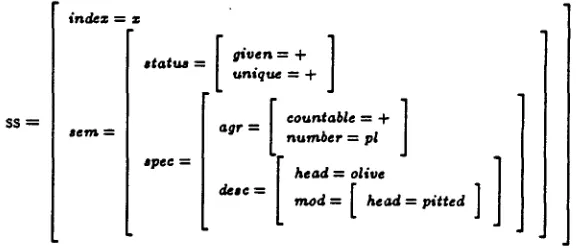
Figure 4: T h e surface semantic structure corresponding to the pitted olives
by means of a notion of discriminatory power. Sup-
pose that w e have a set of entities U such that
U = { z l , z 2 , . . . , x , }
and that w e wish to distinguish one of these en- tities, zl, from all the others. Suppose, also, that
the domain includes a n u m b e r of attributes (a I, a~,
and so on), and that each attribute has a n u m b e r of permissible values {v,,t, v,,2, and so on}; and that each entity is described by a set of attribute- value pairs. In order to distinguish z~ from the other entities in U, w e need to find some set of attribute-value pairs which are together true of zl, but of no other entity in U. This set of attribute-
value pairs constitutes a
distinguishing
descriptior,of xl with respect to the ,~ontext U. A mini-
mal
distinguishing description is
then a set of such attribute-value pairs, where the cardinality of that set is such that there are no other sets of attribute- value pairs of lesser cardinality which are sufficientto distinguish the intended referent.
We find a minimal distinguishing description by observing that different attribute-value pairs
differ in the effectiveness with which they distin- guish an entity from a set of entities. Suppose U has N elements, where N > I. Then, any attribute-value pair true of the intended referent zl will be true of n entities in this set, where n >_ i. For any attribute-value pair < a, v > that is true of the intended referent, w e can compute the discriminatory power (notated here as F) of that attribute-value pair with respect to U as fol- lows"
~'(< ~,v>, U ) = ~-'~ l < n < N
[image:4.612.183.472.289.413.2]D S -~-
i n d e z = z 2
s t a t u s =
SSf~t
SpSC - ~
[ #/uen=
+]
unique = +
n u m b e r = s g a g r = c o u n t a b l e ---- +
t y p e =
]
c a t e g o r l ! = c a p s i c u m r
I eolour = red properties
L
s i z e = s m a l lF i g u r e 5: T h e d e e p s e m a n t i c s t r u c t u r e c o r r e s p o n d i n g to the small red capsicum
S S =
i n d e z = z 2
, u n i q u e = +
i
Jpsc =
_ ~ nu,n~sr= so ]
[image:5.612.168.503.89.239.2] [image:5.612.142.496.290.440.2]agr- [ countable
= + J
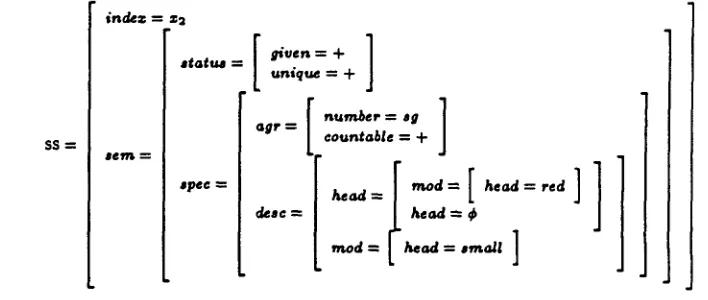
Figure 6: T h e surface semantic structure corresponding to the small red one
0 indicates that the attribute-value pair is of no
assistance in singling out the intended referent.
Given an intended referent a n d a set of entities
from which the intended referent m u s t be distin-
guished, this notion is used to determine which set
of properties should be used in building a descrip-
tion w h i c h is both adequate a n d efficient. 3 There
remains the question of h o w the constituency of the set U of entities is determined: in the present
work, w e take the context always to consist of the
working set. This is the set of distinguishable enti- sstrictly speaking, this mechanism is only applicable in the form described here to those properties of an entity which are realizable by what are known as abJolute (or t~- tereect/ee or pred~tiee) adjectives (see, for example, K a m p (1975), Keenan and FaRm (1978)). This is acceptable in the current domain, where many of the adjectives used are derived from the verbs used to describe processes applied to entities.
ties in the d o m a i n at a n y given point in time: the
constituency of this set changes as a recipe pro-
ceeds, since entities m a y be created or destroyed. 4
Suppose, for example, w e determine that w e
m u s t identify a given object as being a set of olives
which have been pitted (in a context, for example,
where there are also olives which have not been
pitted}; the corresponding deep semantic struc- ture is then as in figure 3.
Note that this deep semantic structure can
be realized in at least t w o ways: as either the
olives which have been pitted or the pitted olives.
i n d e z = z
~ t a t t ~ =
.[
]
number = pl
agr = "ountable = +
D S = ~.nuant 8 p e c =
8 u b s t =
]
t number---
3 ]
agr = countable = +
tltpe -- categorlt = pound ]
number = pl l
agr = countable = +
J
type = category = carrot ]
[image:6.612.165.491.100.290.2]J
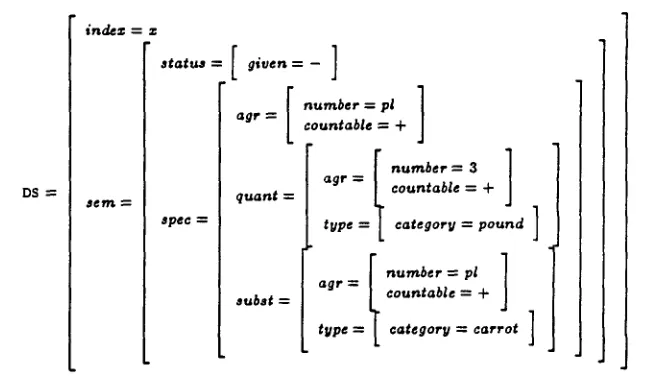
Figure 7: T h e deep semantic structure corresponding to three pounds of carrots
Both forms are possible, although they correspond to different surface semantic structures. Thus, the generation algorithm is non-deterministic in this respect (although one might imagine there are other factors which determine which of the two re- alizations is preferrable in a given context}. T h e surface semantic structure for the simpler of the two noun phrase structures is as shown in figure 4.
O N E A N A P H O R A
T h e algorithms employed in E P I C U R E also permit the generation of onc-anaphora, as in
Slice the large green capsicum.
N o w remove the top of the small red one.
T h e deep semantic structure corresponding to the noun phrase the small red one is as shown in fig- ure 5.
T h e mechanisms which construct the surface semantic structure determine whether one-anaphora is possible by comparing the deep semantic struc- ture corresponding to the previous utterance with that corresponding to the current utterance, to identify any elements they have in c o m m o n . T h e two distinct levels of semantic representation play an important role here: in the deep semantic struc- ture, only the basic semantic category of the de• scription has special status (this is similar to Wel>- her's (1979) use of restricted quantification), whereas the embedding of the surface semantic structure's
dcsc feature closely matches that of the noun phrase to be generated. For one-anaphora to be possi- ble, the two deep semantic structures being com- pared must have the same value for the feature addressed by the path <sere spec type category>.
Rules which specify the relative ordering of ad- jectives in the surface form are then used to build an appropriately nested surface semantic structure which, w h e n unified with the grammar, will result in the required one-anaphoric noun phrase. In the present example, this results in the surface seman- tic structure in figure 6.
P S E U D O - P A R T I T I ' V E
N P S
Partitive and pseudo-partitive noun phrases, ex- emplified by h a l f o f the carrots and three p o u n d s o f
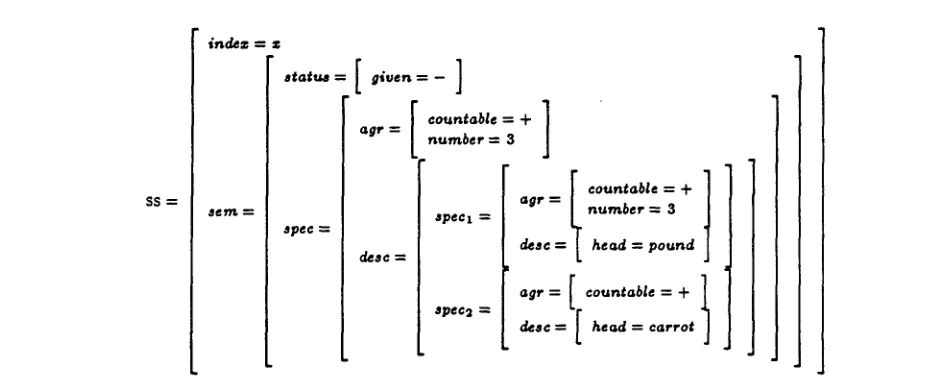
carrots respectively, are very c o m m o n in recipes; E P I C U R E is capable of generating both. So, for example, the pseudo-partitive noun phrase three pounds of carrots (as represented by the knowledge base entity shown in figure 1) is generated from the deep semantic structure shown in figure 7 via the surface semantic structure shown in figure 8.
T h e generation of partitive noun phrases re- quires slightly different semantic structures, de- scribed in greater detail in Dale
(1989b).
$S =
i n d . = = z
a t a t u a =
8 e r a
epee =
. [ g i u e n = -- ]
countable
=+
a g r = n u m b e r = 3
e p e c I =
& s o =
$ p ¢ c 2 =
]
t countable
= +age
=number
=3
d e s c =
head
=pound
agr= [[eountab|e=+
d¢8c =
head
=carrot
Figure 8: The surface semantic structure corresponding to three pounds of carrots
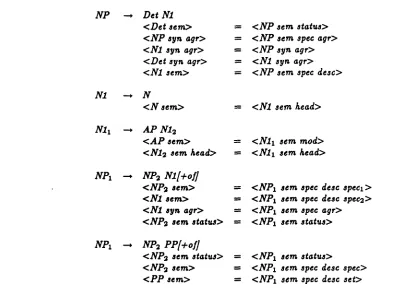
grammar. In EPICURE, the grammar consists of phrase structure rules annotated with path equa- tions which determine the relationships between semantic units and syntactic units: t h e path equa- tions specify arbitrary constituents (either com- plex or atomic) of feature structures.
There is insufficient space here to show the en- tire NP grammar, but we provide some representa- tive rules in figure 9 (although these rules are ex- pressed here in a PATR-Iike formalism, within EPI- CURE they are encoded as PROLOG definite clause grammar (DCG) rules (Clocksin and Mellish 1981)). Applying these rules to the surface semantic struc- tures described above results in the generation of the appropriate surface linguistic strings.
C O N C L U S I O N
In this paper, we have described the processes used in EPICURE to produce noun phrase referring ex- pressions. EPICURE is implemented in C-PROLOG running under UNIX. The algorithms used in the system permit the generation of a wide range of pronominal forms, one-anaphoric forms and full noun phrase structures, including partitives and pseudo-partitives.
A C K N O W L E D G E M E N T S
The work described here has benefited greatly from discussions with Ewan Klein, Graeme Ritchie, :Ion
Oberlander, and Marc Moens, and from Bonnie Webber's encouragement.
R E F E R E N C E S
Appelt, Douglas E. (1985) Planning English Refer- ring Expressions. Artificial Intelligence, 26, 1-33. Clocksin, William F. and Melllsh, Christopher S. (1981) Programming in Prolog. Berlin: Springer- Verlag.
Dale, Robert (1988) The Generation of Subsequent Referring Expressions in Structured Discourses. Chapter 5 in Zock, M. and Sabah, G. (eds.) Ad- uances in Natural Language Generation: An Inter- disciplinary Perspective, Volume 2, pp58-75. Lon- don: Pinter Publishers Ltd.
Dale, Robert (1989a) Generating Recipes: An Over- view of EPICURE. Extended Abstracts of the Sec- ond European Natural Language Generation Work- shop, Edinburgh, April 1989.
Dale, Robert (1989b) Generating Referring Ex- pressions in a Domain of Objects and Processes. PhD Thesis, Centre for Cognitive Science, Univer- sity of Edinburgh.
Grice, H. Paul (1975) Logic and Conversation. In Cole, P. and Morgan, J. L. (eds.) Syntax and Se- mantics, Volume 3: Speech Acts, pp41-58. New York: Academic Press.
[image:7.612.82.548.93.288.2]N P
N2
N l l
NPx
NPI ---4.
Dee N1 <Dee sere> < N P 8yn agr> <N1 syn agr> <Dee syn agr> <N1 sere>
N
< N sent> A P NI2 < A P sere>
<NI~ sere head>
<NP2 sere> < N 1 s e r e >
< N I 8yn ayr> <NPa 8 e r a statuJ>
<NP2 sere status> <NPa 8era> < P P 8era>
= < N P sere status> = < N P sere spec agr> = < N P syn agr> = <N1 syn agr> = < N P sere spec desc>
= <N1 sent head>
= < N l l sere rood> -- < N l x sere head>
= <NPx sere spec desc specx > = <NPx sere spec desc spe¢2> = <NPx sere spec agr> = <NPz sere status>
= <NPx sere status>
= <NPx sere spec desc spec> = <NPx sere spec desc set>
Figure 9: A fragment of the noun phrase grammar
S R I International, Menlo Park, Ca., July, 1977. Grosz, Barbara J., Joshi, Aravind K. and Wein- stein, Scott (1983) Providing a Unified Account of Definite Noun Phrases in Discourse. In Proceed- ings of the ~lst Annual Meeting
o/the
Associa- tion for Computational Linguistics, Massachusetts Institute of Technology, Cambridge, Mass., 15-17 June, 1983, pp44-49.Grosz, Barbara J. and Sidner, Candace L. (1986) Attention, Intentions, and the Structure of Dis- course. Computational Linguistics, 12, 175-204. Hobbs, Jerry R. (1978) Resolving Pronoun Refer- ences. Lingua, 44, 311-338.
Kamp, Hans (1975) Two Theories about Adjec- tives. In Keenan, E. L. (ed.) Formal Semantics of Natural Language: Papers from a colloquium spon- sored by King's College Research Centre, Cam- bridge, pp123-155. Cambridge: Cambridge Uni- versity Press.
Karttunen, Lauri (1986) D-PATR: A Development Environment for Unification-Based Grammars. In
Proceedings of the 11th International Conference on Computational Linguistics, Bonn, 25-29 Au- gust, 1986, pp74-80.
Keenan, Edward L. and Faltz, Leonard M. (1978) Logical Types for Natural Language. UCLA Occa- sional Papers in Linguistics, No. 3.
McDonald, David D. (1980) Natural Language Gen- eration as a Process of Decision-Making under Con- straints. PhD Thesis, Department of Computer Science and Electrical Engineering, MIT.
Massam, Diane and Roberge, Yves (1989) Recipe Context Null Objects in English. Linguistic In- quiry, 20, 134--139.
Shieber, Stuart M. (1980) A n Introduction to Unification- based Approaches to Grantmar. Chicago, Illinois: The University of Chicago Press.
[image:8.612.87.503.99.389.2]