The Role of Syntax in Vector Space Models of Compositional Semantics
Karl Moritz Hermann and Phil Blunsom Department of Computer Science
University of Oxford Oxford, OX1 3QD, UK
{karl.moritz.hermann,phil.blunsom}@cs.ox.ac.uk
Abstract
Modelling the compositional process by which the meaning of an utterance arises from the meaning of its parts is a funda-mental task of Natural Language Process-ing. In this paper we draw upon recent advances in the learning of vector space representations of sentential semantics and the transparent interface between syntax and semantics provided by Combinatory Categorial Grammar to introduce Com-binatory Categorial Autoencoders. This model leverages the CCG combinatory op-erators to guide a non-linear transforma-tion of meaning within a sentence. We use this model to learn high dimensional em-beddings for sentences and evaluate them in a range of tasks, demonstrating that the incorporation of syntax allows a con-cise model to learn representations that are both effective and general.
1 Introduction
Since Frege stated his ‘Principle of Semantic Compositionality’ in 1892 researchers have pon-dered both how the meaning of a complex expres-sion is determined by the meanings of its parts, and how those parts are combined. (Frege, 1892; Pelletier, 1994). Over a hundred years on the choice of representational unit for this process of compositional semantics, and how these units combine, remain open questions.
Frege’s principle may be debatable from a lin-guistic and philosophical standpoint, but it has provided a basis for a range of formal approaches to semantics which attempt to capture meaning in logical models. The Montague grammar (Mon-tague, 1970) is a prime example for this, build-ing a model of composition based on lambda-calculus and formal logic. More recent work
in this field includes the Combinatory Categorial Grammar (CCG), which also places increased em-phasis on syntactic coverage (Szabolcsi, 1989).
Recently those searching for the right represen-tation for compositional semantics have drawn in-spiration from the success of distributional mod-els of lexical semantics. This approach represents single words as distributional vectors, implying that a word’s meaning is a function of the envi-ronment it appears in, be that its syntactic role or co-occurrences with other words (Pereira et al., 1993; Sch¨utze, 1998). While distributional se-mantics is easily applied to single words, spar-sity implies that attempts to directly extract distri-butional representations for larger expressions are doomed to fail. Only in the past few years has it been attempted to extend these representations to semantic composition. Most approaches here use the idea of vector-matrix composition to learn larger representations from single-word encodings (Baroni and Zamparelli, 2010; Grefenstette and Sadrzadeh, 2011; Socher et al., 2012b). While these models have proved very promising for com-positional semantics, they make minimal use of linguistic information beyond the word level.
In this paper we bridge the gap between recent advances in machine learning and more traditional approaches within computational linguistics. We achieve this goal by employing the CCG formal-ism to consider compositional structures at any point in a parse tree. CCG is attractive both for its transparent interface between syntax and seman-tics, and a small but powerful set of combinatory operators with which we can parametrise our non-linear transformations of compositional meaning.
We present a novel class of recursive mod-els, the Combinatory Categorial Autoencoders (CCAE), which marry a semantic process pro-vided by a recursive autoencoder with the syn-tactic representations of the CCG formalism. Through this model we seek to answer two
tions: Can recursive vector space models be recon-ciled with a more formal notion of compositional-ity; and is there a role for syntax in guiding seman-tics in these types of models? CCAEs make use of CCG combinators and types by conditioning each composition function on its equivalent step in a CCG proof. In terms of learning complexity and space requirements, our models strike a balance between simpler greedy approaches (Socher et al., 2011b) and the larger recursive vector-matrix models (Socher et al., 2012b).
We show that this combination of state of the art machine learning and an advanced linguistic for-malism translates into concise models with com-petitive performance on a variety of tasks. In both sentiment and compound similarity experiments we show that our CCAE models match or better comparable recursive autoencoder models.1
2 Background
There exist a number of formal approaches to lan-guage that provide mechanisms for composition-ality. Generative Grammars (Jackendoff, 1972) treat semantics, and thus compositionality, essen-tially as an extension of syntax, with the generative (syntactic) process yielding a structure that can be interpreted semantically. By contrast Montague grammar achieves greater separation between the semantic and the syntactic by using lambda calcu-lus to express meaning. However, this greater sep-aration between surface form and meaning comes at a price in the form of reduced computability. While this is beyond the scope of this paper, see e.g. Kracht (2008) for a detailed analysis of com-positionality in these formalisms.
2.1 Combinatory Categorial Grammar In this paper we focus on CCG, a linguistically expressive yet computationally efficient grammar formalism. It uses a constituency-based structure with complex syntactic types (categories) from which sentences can be deduced using a small number of combinators. CCG relies on combi-natory logic (as opposed to lambda calculus) to build its expressions. For a detailed introduction and analysis vis-`a-vis other grammar formalisms see e.g. Steedman and Baldridge (2011).
CCG has been described as having a transpar-ent surface between the syntactic and the
seman-1A C++ implementation of our models is available at http://www.karlmoritz.com/
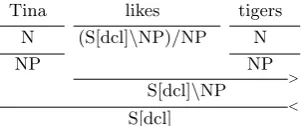
Tina likes tigers N (S[dcl]\NP)/NP N
NP NP
> S[dcl]\NP
[image:2.595.340.491.61.124.2]< S[dcl]
Figure 1: CCG derivation forTina likes tigerswith forward (>) and backward application (<).
tic. It is this property which makes it attractive for our purposes of providing a conditioning struc-ture for semantic operators. A second benefit of the formalism is that it is designed with computa-tional efficiency in mind. While one could debate the relative merits of various linguistic formalisms the existence of mature tools and resources, such as the CCGBank (Hockenmaier and Steedman, 2007), the Groningen Meaning Bank (Basile et al., 2012) and the C&C Tools (Curran et al., 2007) is another big advantage for CCG.
CCG’s transparent surface stems from its cate-gorial property: Each point in a derivation corre-sponds directly to an interpretable category. These categories (or types) associated with each term in a CCG govern how this term can be combined with other terms in a larger structure, implicitly making them semantically expressive.
For instance in Figure 1, the wordlikeshas type (S[dcl]\NP)/NP, which means that it first looks for a typeNPto its right hand side. Subsequently the expressionlikes tigers(as typeS[dcl]\NP) re-quires a secondNP on its left. The final type of the phraseS[dcl]indicates a sentence and hence a complete CCG proof. Thus at each point in a CCG parse we can deduce the possible next steps in the derivation by considering the available types and combinatory rules.
2.2 Vector Space Models of Semantics
Vector-based approaches for semantic tasks have become increasingly popular in recent years.
Distributional representations encode an ex-pression by its environment, assuming the context-dependent nature of meaning according to which one “shall know a word by the company it keeps” (Firth, 1957). Effectively this is usually achieved by considering the co-occurrence with other words in large corpora or the syntactic roles a word per-forms.
rep-resentations have then successfully been applied to a number of tasks including word sense disam-biguation (Sch¨utze, 1998) and selectional prefer-ence (Pereira et al., 1993; Lin, 1999).
While it is theoretically possible to apply the same mechanism to larger expressions, sparsity prevents learning meaningful distributional repre-sentations for expressions much larger than single words.2
Vector space models of compositional seman-tics aim to fill this gap by providing a methodol-ogy for deriving the representation of an expres-sion from those of its parts. While distributional representations frequently serve to encode single words in such approaches this is not a strict re-quirement.
There are a number of ideas on how to de-fine composition in such vector spaces. A gen-eral framework for semantic vector composition was proposed in Mitchell and Lapata (2008), with Mitchell and Lapata (2010) and more recently Bla-coe and Lapata (2012) providing good overviews of this topic. Notable approaches to this issue in-clude Baroni and Zamparelli (2010), who com-pose nouns and adjectives by representing them as vectors and matrices, respectively, with the com-positional representation achieved by multiplica-tion. Grefenstette and Sadrzadeh (2011) use a sim-ilar approach with matrices for relational words and vectors for arguments. These two approaches are combined in Grefenstette et al. (2013), produc-ing a tensor-based semantic framework with ten-sor contraction as composition operation.
Another set of models that have very success-fully been applied in this area are recursive autoen-coders (Socher et al., 2011a; Socher et al., 2011b), which are discussed in the next section.
2.3 Recursive Autoencoders
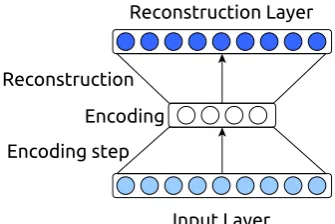
Autoencoders are a useful tool to compress in-formation. One can think of an autoencoder as a funnel through which information has to pass (see Figure 2). By forcing the autoencoder to reconstruct an input given only the reduced amount of information available inside the funnel it serves as a compression tool, representing high-dimensional objects in a lower-high-dimensional space. Typically a given autoencoder, that is the func-tions for encoding and reconstructing data, are
[image:3.595.333.501.64.176.2]2The experimental setup in (Baroni and Zamparelli, 2010) is one of the few examples where distributional representa-tions are used for word pairs.
Figure 2: A simple three-layer autoencoder. The input represented by the vector at the bottom is being encoded in a smaller vector (middle), from which it is then reconstructed (top) into the same dimensionality as the original input vector.
used on multiple inputs. By optimizing the two functions to minimize the difference between all inputs and their respective reconstructions, this au-toencoder will effectively discover some hidden structures within the data that can be exploited to represent it more efficiently.
As a simple example, assume input vectors
xi ∈ Rn, i ∈ (0..N), weight matrices Wenc ∈
R(m×n), Wrec ∈ R(n×m) and biasesbenc ∈ Rm, brec ∈Rn. The encoding matrix and bias are used
to create an encodingeifromxi:
ei =fenc(xi) =Wencxi+benc (1)
Subsequentlye ∈ Rm is used to reconstructx as x0 using the reconstruction matrix and bias:
x0i =frec(ei) =Wrecei+brec (2)
θ = (Wenc, Wrec, benc, brec)can then be learned
by minimizing the error function describing the difference betweenx0andx:
E= 1 2
N X
i x0i−xi
2
(3)
Now, if m < n, this will intuitively lead to ei
encoding a latent structure contained in xi and
shared across allxj, j ∈ (0..N), withθencoding
and decoding to and from that hidden structure. It is possible to apply multiple autoencoders on top of each other, creating a deep autoencoder (Bengio et al., 2007; Hinton and Salakhutdinov, 2006). For such a multi-layered model to learn anything beyond what a single layer could learn, a non-linear transformationgneeds to be applied at
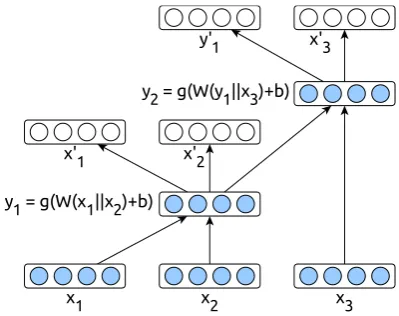
Figure 3: RAE with three inputs. Vectors with filled (blue) circles represent input and hidden units; blanks (white) denote reconstruction layers.
or hyperbolic tangent (tanh) function is used for g(LeCun et al., 1998).
fenc(xi) =g(Wencxi+benc) (4) frec(ei) =g(Wrecei+brec)
Furthermore, autoencoders can easily be used as a composition function by concatenating two input vectors, such that:
e=f(x1, x2) =g(W(x1kx2) +b) (5)
(x01kx02) =g W0e+b0
Extending this idea, recursive autoencoders (RAE) allow the modelling of data of variable size. By setting the n = 2m, it is possible to recursively combine a structure into an autoencoder tree. See Figure 3 for an example, wherex1, x2, x3 are re-cursively encoded intoy2.
The recursive application of autoencoders was first introduced in Pollack (1990), whose recursive auto-associative memories learn vector represen-tations over pre-specified recursive data structures. More recently this idea was extended and applied to dynamic structures (Socher et al., 2011b).
These types of models have become increas-ingly prominent since developments within the field of Deep Learning have made the training of such hierarchical structures more effective and tractable (LeCun et al., 1998; Hinton et al., 2006). Intuitively the top layer of an RAE will encode aspects of the information stored in all of the input vectors. Previously, RAE have successfully been applied to a number of tasks including sentiment analysis, paraphrase detection, relation extraction
Model CCG Elements CCAE-A parse
CCAE-B parse + rules
CCAE-C parse + rules + types CCAE-D parse + rules + child types
Table 1: Aspects of the CCG formalism used by the different models explored in this paper.
and 3D object identification (Blacoe and Lapata, 2012; Socher et al., 2011b; Socher et al., 2012a).
3 Model
The models in this paper combine the power of recursive, vector-based models with the linguistic intuition of the CCG formalism. Their purpose is to learn semantically meaningful vector represen-tations for sentences and phrases of variable size, while the purpose of this paper is to investigate the use of syntax and linguistic formalisms in such vector-based compositional models.
We assume a CCG parse to be given. LetC
de-note the set of combinatory rules, and T the set
of categories used, respectively. We use the parse tree to structure an RAE, so that each combina-tory step is represented by an autoencoder func-tion. We refer to these models Categorial Com-binatory Autoencoders (CCAE). In total this pa-per describes four models making increasing use of the CCG formalism (see table 1).
As an internal baseline we use model CCAE-A, which is an RAE structured along a CCG parse tree. CCAE-A uses a single weight matrix each for the encoding and reconstruction step (see Table 2. This model is similar to Socher et al. (2011b), ex-cept that we use a fixed structure in place of the greedy tree building approach. As CCAE-A uses only minimal syntactic guidance, this should al-low us to better ascertain to what degree the use of syntax helps our semantic models.
Our second model (CCAE-B) uses the compo-sition function in equation (6), withc∈C.
fenc(x, y, c) =g(Wencc (xky) +bcenc) (6) frec(e, c) =g(Wrecc e+bcrec)
This means that for every combinatory rule we de-fine an equivalent autoencoder composition func-tion by parametrizing both the weight matrix and bias on the combinatory rule (e.g. Figure 4).
[image:4.595.327.507.62.130.2]Model Encoding Function
CCAE-A f(x, y)=g(W(xky) +b)
CCAE-B f(x, y, c)=g(Wc(xky) +bc)
CCAE-C f(x, y, c, t)=gPp∈{c,t}(Wp(xky) +bp)
CCAE-D f(x, y, c, tx, ty)=g Wc Wtxx+Wtyy+bc
Table 2: Encoding functions of the four CCAE models discussed in this paper.
α: X/Y β: Y >
αβ:X g(W
>
[image:5.595.153.446.65.152.2]enc(αkβ) +b>enc)
Figure 4: Forward application as CCG combinator and autoencoder rule respectively.
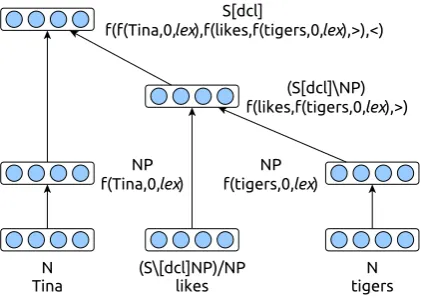
Figure 5: CCAE-B applied to Tina likes tigers. Next to each vector are the CCG category (top) and the word or function representing it (bottom). lex describes the unary type-changing operation.
>and<are forward and backward application.
composition step. For the remainder of this paper we will focus on the composition step and drop the use ofencandrecin variable names where it isn’t explicitly required. Figure 5 shows model CCAE-B applied to our previous example sentence.
While CCAE-B uses only the combinatory rules, we want to make fuller use of the linguis-tic information available in CCG. For this pur-pose, we build another model CCAE-C, which parametrizes on both the combinatory rulec ∈ C
and the CCG category t ∈ T at every step (see
Figure 2). This model provides an additional de-gree of insight, as the categories T are
semanti-cally and syntactisemanti-cally more expressive than the CCG combinatory rules by themselves. Summing over weights parametrised oncandtrespectively,
adds an additional degree of freedom and also
al-lows for some model smoothing.
An alternative approach is encoded in model CCAE-D. Here we consider the categories not of the element represented, but of the elements it is generated from together with the combinatory rule applied to them. The intuition is that in the first step we transform two expressions based on their syntax. Subsequently we combine these two con-ditioned on their joint combinatory rule.
4 Learning
In this section we briefly discuss unsupervised learning for our models. Subsequently we de-scribe how these models can be extended to allow for semi-supervised training and evaluation.
Let θ = (W,B, L) be our model parameters
andλa vector with regularization parameters for
all model parameters. W represents the set of all weight matrices,Bthe set of all biases andLthe
set of all word vectors. LetNbe the set of training
data consisting of tree-nodesnwith inputsxn, yn
and reconstructionrn. The error givennis:
E(n|θ) = 1 2
rn−(xnkyn)
2 (7)
The gradient of the regularised objective func-tion then becomes:
∂J ∂θ =
1 N
N X
n
∂E(n|θ)
∂θ +λθ (8)
We learn the gradient using backpropagation through structure (Goller and K¨uchler, 1996), and minimize the objective function using L-BFGS.
For more details about the partial derivatives used for backpropagation, see the documentation accompanying our model implementation.3
[image:5.595.76.287.282.431.2]4.1 Supervised Learning
The unsupervised method described so far learns a vector representation for each sentence. Such a representation can be useful for some tasks such as paraphrase detection, but is not sufficient for other tasks such as sentiment classification, which we are considering in this paper.
In order to extract sentiment from our models, we extend them by adding a supervised classifier on top, using the learned representationsvas input
for a binary classification model:
pred(l=1|v, θ) =sigmoid(Wlabelv+blabel) (9)
Given our corpus of CCG parses with label pairs
(N, l), the new objective function becomes:
J = 1 N
X
(N,l)
E(N, l, θ) + λ 2||θ||
2 (10)
Assuming each node n ∈ N contains children xn, yn, encodingenand reconstructionrn, so that n={x, y, e, r}this breaks down into:
E(N, l, θ) = (11)
X
n∈N
αErec(n, θ) + (1−α)Elbl(en, l, θ)
Erec(n, θ) = 1 2
[xnkyn]−rn
2 (12)
Elbl(e, l, θ) = 1
2kl−ek
2 (13)
This method of introducing a supervised aspect to the autoencoder largely follows the model de-scribed in Socher et al. (2011b).
5 Experiments
We describe a number of standard evaluations to determine the comparative performance of our model. The first task of sentiment analysis allows us to compare our CCG-conditioned RAE with similar, existing models. In a second experiment, we apply our model to a compound similarity eval-uation, which allows us to evaluate our models against a larger class of vector-based models (Bla-coe and Lapata, 2012). We conclude with some qualitative analysis to get a better idea of whether the combination of CCG and RAE can learn se-mantically expressive embeddings.
In our experiments we use the hyperbolic tan-gent as nonlinearityg. Unless stated otherwise we
use word-vectors of size 50, initialized using the embeddings provided by Turian et al. (2010) based on the model of Collobert and Weston (2008).4
We use the C&C parser (Clark and Curran, 2007) to generate CCG parse trees for the data used in our experiments. For models CCAE-C and CCAE-D we use the 25 most frequent CCG cate-gories (as extracted from the British National Cor-pus) with an additional general weight matrix in order to catch all remaining types.
5.1 Sentiment Analysis
We evaluate our model on the MPQA opinion corpus (Wiebe et al., 2005), which annotates ex-pressions for sentiment.5 The corpus consists of
10,624 instances with approximately 70 percent describing a negative sentiment. We apply the same pre-processing as (Nakagawa et al., 2010) and (Socher et al., 2011b) by using an additional sentiment lexicon (Wilson et al., 2005) during the model training for this experiment.
As a second corpus we make use of the sentence polarity (SP) dataset v1.0 (Pang and Lee, 2005).6
This dataset consists of 10662 sentences extracted from movie reviews which are manually labelled with positive or negative sentiment and equally distributed across sentiment.
Experiment 1: Semi-Supervised Training In the first experiment, we use the semi-supervised training strategy described previously and initial-ize our models with the embeddings provided by Turian et al. (2010). The results of this evalua-tion are in Table 3. While we achieve the best per-formance on the MPQA corpus, the results on the SP corpus are less convincing. Perhaps surpris-ingly, the simplest model CCAE-A outperforms the other models on this dataset.
When considering the two datasets, sparsity seems a likely explanation for this difference in results: In the MPQA experiment most instances are very short with an average length of 3 words, while the average sentence length in the SP corpus is 21 words. The MPQA task is further simplified through the use or an additional sentiment lexicon. Considering dictionary size, the SP corpus has a dictionary of 22k words, more than three times the size of the MPQA dictionary.
4http://www.metaoptimize.com/projects/ wordreprs/
5http://mpqa.cs.pitt.edu/
Method MPQA SP Voting with two lexica 81.7 63.1 MV-RNN (Socher et al., 2012b) - 79.0 RAE (rand) (Socher et al., 2011b) 85.7 76.8 TCRF (Nakagawa et al., 2010) 86.1 77.3 RAE (init) (Socher et al., 2011b) 86.4 77.7 NB (Wang and Manning, 2012) 86.7 79.4
CCAE-A 86.3 77.8
CCAE-B 87.1 77.1
CCAE-C 87.1 77.3
[image:7.595.72.301.61.211.2]CCAE-D 87.2 76.7
Table 3: Accuracy of sentiment classification on the sentiment polarity (SP) and MPQA datasets. For NB we only display the best result among a larger group of models analysed in that paper.
This issue of sparsity is exacerbated in the more complex CCAE models, where the training points are spread across different CCG types and rules. While the initialization of the word vectors with previously learned embeddings (as was previously shown by Socher et al. (2011b)) helps the mod-els, all other model variables such as composition weights and biases are still initialised randomly and thus highly dependent on the amount of train-ing data available.
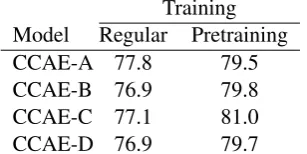
Experiment 2: Pretraining Due to our analy-sis of the results of the initial experiment, we ran a second series of experiments on the SP corpus. We follow (Scheible and Sch¨utze, 2013) for this sec-ond series of experiments, which are carried out on a random 90/10 training-testing split, with some data reserved for development.
Instead of initialising the model with external word embeddings, we first train it on a large amount of data with the aim of overcoming the sparsity issues encountered in the previous exper-iment. Learning is thus divided into two steps:
The first, unsupervised training phase, uses the British National Corpus together with the SP cor-pus. In this phase only the reconstruction signal is used to learn word embeddings and transforma-tion matrices. Subsequently, in the second phase, only the SP corpus is used, this time with both the reconstruction and the label error.
By learning word embeddings and composition matrices on more data, the model is likely to gen-eralise better. Particularly for the more complex models, where the composition functions are con-ditioned on various CCG parameters, this should
Training Model Regular Pretraining CCAE-A 77.8 79.5 CCAE-B 76.9 79.8 CCAE-C 77.1 81.0 CCAE-D 76.9 79.7
Table 4: Effect of pretraining on model perfor-mance on the SP dataset. Results are reported on a random subsection of the SP corpus; thus numbers for the regular training method differ slightly from those in Table 3.
help to overcome issues of sparsity.
If we consider the results of the pre-trained ex-periments in Table 4, this seems to be the case. In fact, the trend of the previous results has been reversed, with the more complex models now per-forming best, whereas in the previous experiments the simpler models performed better. Using the Turian embeddings instead of random initialisa-tion did not improve results in this setup.
5.2 Compound Similarity
In a second experiment we use the dataset from Mitchell and Lapata (2010) which contains sim-ilarity judgements for adjective-noun, noun-noun and verb-object pairs.7 All compound pairs have
been ranked for semantic similarity by a number of human annotators. The task is thus to rank these pairs of word pairs by their semantic similarity.
For instance, the two compounds vast amount andlarge quantityare given a high similarity score by the human judges, whilenorthern region and early ageare assigned no similarity at all.
We train our models as fully unsupervised au-toencoders on the British National Corpus for this task. We assume fixed parse trees for all of the compounds (Figure 6), and use these to compute compound level vectors for all word pairs. We subsequently use the cosine distance between each compound pair as our similarity measure. We use Spearman’s rank correlation coefficient (ρ) for evaluation; hence there is no need to rescale our scores (-1.0 – 1.0) to the original scale (1.0 – 7.0). Blacoe and Lapata (2012) have an extensive comparison of the performance of various vector-based models on this data set to which we compare our model in Table 5. The CCAE models
[image:7.595.341.495.65.142.2]Verb Object
VB NN
(S\NP)/NP N NP
> S\NP
Noun Noun NN NN N/N N
> N
Adjective Noun
JJ NN
N/N N > N
Figure 6: Assumed CCG parse structure for the compound similarity evaluation.
Method Adj-N N-N V-Obj
Human 0.52 0.49 0.55
(Blacoe and Lapata, 2012)
/+ 0.21 - 0.48 0.22 - 0.50 0.18 - 0.35
RAE 0.19 - 0.31 0.24 - 0.30 0.09 - 0.28
CCAE-B 0.38 0.44 0.34
CCAE-C 0.38 0.41 0.23
CCAE-D 0.41 0.44 0.29
Table 5: Correlation coefficients of model predic-tions for the compound similarity task. Numbers show Spearman’s rank correlation coefficient (ρ).
Higher numbers indicate better correlation.
form the RAE models provided by Blacoe and La-pata (2012), and score towards the upper end of the range of other models considered in that paper.
5.3 Qualitative Analysis
To get better insight into our models we also per-form a small qualitative analysis. Using one of the models trained on the MPQA corpus, we gener-ate word-level representations of all phrases in this corpus and subsequently identify the most related expressions by using the cosine distance measure. We perform this experiment on all expressions of length 5, considering all expressions with a word length between 3 and 7 as potential matches.
As can be seen in Table 6, this works with vary-ing success. Linkvary-ing expressions such as convey-ing the message of peaceandsafeguard(ing) peace and security suggests that the model does learn some form of semantics.
On the other hand, the connection between ex-pressed their satisfaction and support and ex-pressed their admiration and surprise suggests that the pure word level content still has an impact on the model analysis. Likewise, the expressions is a story of success and is a staunch supporter have some lexical but little semantic overlap. Fur-ther reducing this link between the lexical and the semantic representation is an issue that should be addressed in future work in this area.
6 Discussion
Overall, our models compare favourably with the state of the art. On the MPQA corpus model CCAE-D achieves the best published results we are aware of, whereas on the SP corpus we achieve competitive results. With an additional, unsuper-vised training step we achieved results beyond the current state of the art on this task, too.
Semantics The qualitative analysis and the ex-periment on compounds demonstrate that the CCAE models are capable of learning semantics. An advantage of our approach—and of autoen-coders generally—is their ability to learn in an unsupervised setting. The pre-training step for the sentiment task was essentially the same train-ing step as used in the compound similarity task. While other models such as the MV-RNN (Socher et al., 2012b) achieve good results on a particu-lar task, they do not allow unsupervised training. This prevents the possiblity of pretraining, which we showed to have a big impact on results, and fur-ther prevents the training of general models: The CCAE models can be used for multiple tasks with-out the need to re-train the main model.
Expression Most Similar
convey the message of peace safeguard peace and security keep alight the flame of keep up the hope
has a reason to repent has no right
a significant and successful strike a much better position it is reassuring to believe it is a positive development
expressed their satisfaction and support expressed their admiration and surprise is a story of success is a staunch supporter
are lining up to condemn are going to voice their concerns more sanctions should be imposed charges being leveled
[image:9.595.117.487.61.214.2]could fray the bilateral goodwill could cause serious damage
Table 6: Phrases from the MPQA corpus and their semantically closest match according to CCAE-D.
Complexity
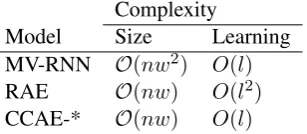
Model Size Learning MV-RNN O(nw2) O(l) RAE O(nw) O(l2)
CCAE-* O(nw) O(l)
Table 7: Comparison of models. nis dictionary
size,wembedding width,lis sentence length. We can assumel n w. Additional factors such
as CCG rules and types are treated as small con-stants for the purposes of this analysis.
worse in comparison with the simpler ones. We were able to overcome this issue by using addi-tional training data. Beyond this, it would also be interesting to investigate the relationships between different types and to derive functions to incorpo-rate this into the learning procedure. For instance model learning could be adjusted to enforce some mirroring effects between the weight matrices of forward and backward application, or to support similarities between those of forward application and composition.
CCG-Vector Interface Exactly how the infor-mation contained in a CCG derivation is best ap-plied to a vector space model of compositionality is another issue for future research. Our investi-gation of this matter by exploring different model setups has proved somewhat inconclusive. While CCAE-D incorporated the deepest conditioning on the CCG structure, it did not decisively outperform the simpler CCAE-B which just conditioned on the combinatory operators. Issues of sparsity, as shown in our experiments on pretraining, have a significant influence, which requires further study.
7 Conclusion
In this paper we have brought a more formal no-tion of semantic composino-tionality to vector space models based on recursive autoencoders. This was achieved through the use of the CCG formalism to provide a conditioning structure for the matrix vector products that define the RAE.
We have explored a number of models, each of which conditions the compositional operations on different aspects of the CCG derivation. Our ex-perimental findings indicate a clear advantage for a deeper integration of syntax over models that use only the bracketing structure of the parse tree.
The most effective way to condition the compo-sitional operators on the syntax remains unclear. Once the issue of sparsity had been addressed, the complex models outperformed the simpler ones. Among the complex models, however, we could not establish significant or consistent differences to convincingly argue for a particular approach.
While the connections between formal linguis-tics and vector space approaches to NLP may not be immediately obvious, we believe that there is a case for the continued investigation of ways to best combine these two schools of thought. This paper represents one step towards the reconciliation of traditional formal approaches to compositional se-mantics with modern machine learning.
Acknowledgements
[image:9.595.107.261.262.329.2]References
Marco Baroni and Roberto Zamparelli. 2010. Nouns are vectors, adjectives are matrices: Representing adjective-noun constructions in semantic space. In Proceedings of EMNLP, pages 1183–1193.
Valerio Basile, Johan Bos, Kilian Evang, and Noortje Venhuizen. 2012. Developing a large semantically annotated corpus. In Proceedings of LREC, pages 3196–3200, Istanbul, Turkey.
Yoshua Bengio, Pascal Lamblin, Dan Popovici, and Hugo Larochelle. 2007. Greedy layer-wise training of deep networks. InAdvances in Neural Informa-tion Processing Systems 19, pages 153–160. William Blacoe and Mirella Lapata. 2012. A
com-parison of vector-based representations for seman-tic composition. InProceedings of EMNLP-CoNLL, pages 546–556.
Stephen Clark and James R. Curran. 2007. Wide-coverage efficient statistical parsing with ccg and log-linear models.CL, 33(4):493–552, December.
Ronan Collobert and Jason Weston. 2008. A unified architecture for natural language processing: Deep neural networks with multitask learning. In Pro-ceedings of ICML.
James Curran, Stephen Clark, and Johan Bos. 2007. Linguistically motivated large-scale nlp with c&c and boxer. InProceedings of ACL Demo and Poster Sessions, pages 33–36.
J. R. Firth. 1957. A synopsis of linguistic theory 1930-55. 1952-59:1–32.
Gottfried Frege. 1892. ¨Uber Sinn und Bedeutung. In Mark Textor, editor,Funktion - Begriff - Bedeutung, volume 4 of Sammlung Philosophie. Vandenhoeck & Ruprecht, G¨ottingen.
Christoph Goller and Andreas K¨uchler. 1996. Learn-ing task-dependent distributed representations by backpropagation through structure. InProceedings of the ICNN-96, pages 347–352. IEEE.
Edward Grefenstette and Mehrnoosh Sadrzadeh. 2011. Experimental support for a categorical composi-tional distribucomposi-tional model of meaning. In Proceed-ings of EMNLP, pages 1394–1404.
Edward Grefenstette, Georgiana Dinu, Yao-Zhong Zhang, Mehrnoosh Sadrzadeh, and Marco Baroni. 2013. Multi-step regression learning for composi-tional distribucomposi-tional semantics.
G. E. Hinton and R. R. Salakhutdinov. 2006. Reduc-ing the dimensionality of data with neural networks. Science, 313(5786):504–507.
Geoffrey E. Hinton, Simon Osindero, Max Welling, and Yee Whye Teh. 2006. Unsupervised discovery of nonlinear structure using contrastive backpropa-gation. Cognitive Science, 30(4):725–731.
Julia Hockenmaier and Mark Steedman. 2007. CCG-bank: A Corpus of CCG Derivations and Depen-dency Structures Extracted from the Penn Treebank. CL, 33(3):355–396, September.
Ray Jackendoff. 1972. Semantic Interpretation in Generative Grammar. MIT Press, Cambridge, MA.
Marcus Kracht. 2008. Compositionality in Montague Grammar. In Edouard Machery und Markus Wern-ing Wolfram Hinzen, editor,Handbook of Composi-tionality, pages 47 – 63. Oxford University Press.
Yann LeCun, Leon Bottou, Genevieve Orr, and Klaus-Robert Muller. 1998. Efficient backprop. In G. Orr and Muller K., editors, Neural Networks: Tricks of the trade. Springer.
Dekang Lin. 1999. Automatic identification of non-compositional phrases. In Proceedings of ACL, pages 317–324.
Jeff Mitchell and Mirella Lapata. 2008. Vector-based models of semantic composition. InIn Proceedings of ACL, pages 236–244.
Jeff Mitchell and Mirella Lapata. 2010. Composition in distributional models of semantics. Cognitive Sci-ence, 34(8):1388–1429.
R. Montague. 1970. Universal grammar. Theoria, 36(3):373–398.
Tetsuji Nakagawa, Kentaro Inui, and Sadao Kurohashi. 2010. Dependency tree-based sentiment classifica-tion using crfs with hidden variables. In NAACL-HLT, pages 786–794.
Bo Pang and Lillian Lee. 2005. Seeing stars: exploit-ing class relationships for sentiment categorization with respect to rating scales. InProceedings of ACL, pages 115–124.
Francis Jeffry Pelletier. 1994. The principle of seman-tic compositionality. Topoi, 13:11–24.
Fernando Pereira, Naftali Tishby, and Lillian Lee. 1993. Distributional clustering of english words. In Proceedings of ACL, ACL ’93, pages 183–190.
Jordan B. Pollack. 1990. Recursive distributed repre-sentations.Artificial Intelligence, 46:77–105.
Christian Scheible and Hinrich Sch¨utze. 2013. Cutting recursive autoencoder trees. InProceedings of the International Conference on Learning Representa-tions.
Hinrich Sch¨utze. 1998. Automatic word sense dis-crimination.CL, 24(1):97–123, March.
Richard Socher, Jeffrey Pennington, Eric H. Huang, Andrew Y. Ng, and Christopher D. Manning. 2011b. Semi-supervised recursive autoencoders for predict-ing sentiment distributions. In Proceedings of EMNLP, pages 151–161.
Richard Socher, Brody Huval, Bharath Bhat, Christo-pher D. Manning, and Andrew Y. Ng. 2012a. Convolutional-Recursive Deep Learning for 3D Ob-ject Classification. InAdvances in Neural Informa-tion Processing Systems 25.
Richard Socher, Brody Huval, Christopher D. Man-ning, and Andrew Y. Ng. 2012b. Semantic com-positionality through recursive matrix-vector spaces. In Proceedings of EMNLP-CoNLL, pages 1201– 1211.
Mark Steedman and Jason Baldridge, 2011. Combina-tory Categorial Grammar, pages 181–224. Wiley-Blackwell.
Anna Szabolcsi. 1989. Bound Variables in Syntax: Are There Any? In Renate Bartsch, Johan van Ben-them, and Peter van Emde Boas, editors,Semantics and Contextual Expression, pages 295–318. Foris, Dordrecht.
Joseph Turian, Lev Ratinov, and Yoshua Bengio. 2010. Word representations: a simple and general method for semi-supervised learning. In Proceedings of ACL, pages 384–394.
Sida Wang and Christopher D. Manning. 2012. Base-lines and bigrams: simple, good sentiment and topic classification. InProceedings of ACL, pages 90–94.
Janyce Wiebe, Theresa Wilson, and Claire Cardie. 2005. Annotating expressions of opinions and emo-tions in language. Language Resources and Evalu-ation, 39(2-3):165–210.