On the Predictability of Human Assessment: when Matrix Completion
Meets NLP Evaluation
Guillaume Wisniewski Universit´e Paris Sud
LIMSI–CNRS Orsay, France
Abstract
This paper tackles the problem of collect-ing reliable human assessments. We show that knowing multiple scores for each ex-ample instead of a single score results in a more reliable estimation of a system quality. To reduce the cost of collect-ing these multiple ratcollect-ings, we propose to use matrix completion techniques to pre-dict some scores knowing only scores of other judges and some common ratings. Even if prediction performance is pretty low, decisions made using the predicted score proved to be more reliable than de-cision based on a single rating of each ex-ample.
1 Introduction
Human assessment is often considered as the best, if not the only, way to evaluate ‘subjective’ NLP tasks like MT or speech generation. However, human evaluations are doomed to be noisy and, sometimes, even contradictory as they depend on individual perception and understanding of the score scale that annotators generally use in re-markably different ways (Koehn and Monz, 2006). Moreover, annotation is known to be a long and frustrating process and annotator fatigue has been identified as another source of noise (Pighin et al., 2012).
In addition to defining and enforcing stricter guidelines, several solutions have been proposed to reduce the annotation effort and produce more reliable ratings. For instance, to limit the impact of the score scale interpretation, in the WMT eval-uation campaign (Callison-Burch et al., 2012), an-notators are asked to rank translation hypotheses
from best to worst instead of providing absolute scores (e.g. in terms of adequacy or fluency). Gen-eralizing this approach, several works (Pighin et al., 2012; Lopez, 2012) have defined novel annota-tion protocols to reduce the number of judgments that need to be collected. However, all these meth-ods suffer from several limitations: first, they pro-vide no interpretable information about the quality of the system (only a relative comparison between two systems is possible); second, (Koehn, 2012) has recently shown that the ranking they induce is not reliable.
In this work, we study an alternative approach to the problem of collecting reliable human as-sessments. Our basic assumption, motivated by the success of ensemble methods, is that hav-ing several judgments for each example, even if they are noisy, will result in a more reliable de-cision than having a single judgment. An evalu-ation campaign should therefore aim at gathering ascore matrix, in which each example is rated by all judges instead of having each judge rate only a small subset of examples, thereby minimizing redundancy. Obviously, the former approach re-quires a large annotation effort and is, in practice, not feasible. That is why, to reduce the number of judgments that must be collected, we propose to investigate the possibility of using matrix com-pletion techniques to recover the entire score ma-trix from a sample of its entries. The question we try to answer is whether the missing scores of one judge can be predicted knowing only scores of other judges and some shared ratings.
The contributions of this paper are twofold: i) we show how knowing the full score matrix in-stead of a single score for each example provides a more reliable estimation of a system quality (Sec-tion 3); ii) we present preliminary experiments
showing that missing data techniques can be used to recover the score matrix from a sample of its entries despite the low inter-rater agreement (Sec-tion 4).
2 Matrix Completion
The recovering of a matrix from a sampling of its entries is a task of considerable interest (Cand`es and Recht, 2012). It can be used, for instance, in recommender systems: rows of the matrix repre-sent users that are rating movies (columns of the matrix); the resulting matrix is mostly unknown (each user only rates a few movies) and the task consists in completing the matrix so that movies that any user is likely to like can be predicted.
Matrix completion generally relies on the low rank hypothesis: because of hidden factors be-tween the observations (the columns of the ma-trix), the matrix has a low rank. For instance, in recommender systems it is commonly believed that only a few factors contribute to an individual’s tastes. Formally, recovering a matrixMamounts at solving:
minimize rankX
subject to Xij =Mij (i, j)∈Ω
(1)
whereXis the decision variable andΩis the set of known entries. This optimization problem seeks the simplest explanation fitting the observed data.
Solving the rank minimization problem has been proved to be NP-hard (Chistov and Grigor’ev, 1984). However several convex relax-ations of this program have been proposed. In this work, we will consider the relaxation of the rank by the nuclear norm1 that can be efficiently
solved by semidefinite programming (Becker et al., 2011). This relaxation enjoys many theoret-ical guarantees with respect to the optimality of its solution (under mild assumptions its solution is also the solution of the original problem), the con-ditions under which the matrix can be recovered and the number of entries that must be sampled to recover the original matrix. In our experiments we used TFOCS,2 a free implementation of this
method.
1The nuclear norm of a matrix is the sum of its singular
values; the relation between rank an nuclear norm is similar to the one between`0and`1norms.
2http://cvxr.com/tfocs/
3 Corpora
For our experiments we considered two publicly available corpora in which multiple human ratings (i.e. scores on an ordinal scale) were available.
The CE Corpus The first corpus of human
judg-ments we have considered has been collected for the WMT12 shared task on quality estima-tion (Callison-Burch et al., 2012).3 The data set is
made of2,254English sentences and their
auto-matic translations in Spanish predicted by a stan-dard Moses system. Each sentence pair is accom-panied by three estimates in the range 1 to 5 of its translation quality expressed in terms of post-editing effort. These human grades are in the range 1 to 5, the latter standing for a very good trans-lation that hardly requires post-editing, while the former identifies very poor automatic translations that are not deemed to be worth the post-editing effort.
As pointed out by the task organizers, despite the special care that was taken to ensure the quality of the data, the inter-raters agreement was much lower than what is typically observed in NLP tasks (Artstein and Poesio, 2008): the weighted
κranged from 0.39 to 0.50 depending on the pair
of annotators considered4; the Fleiss coefficient (a
generalization of κ to multi-raters) was 0.25 and the Kendall τb correlation coefficient5 between
0.64 and 0.68, meaning that, on average, two raters do not agree on the relative order of two transla-tions almost two out of five times. In fact, as of-ten observed for the senof-tence level human evalua-tion of MT outputs, the different judges have used the score scale differently: the second judge had a clear tendency to give more ‘medium’ scores than the others, and the variance of her scores was low. Because theirs distributions are differ-ent, standardizing the scores has only a very lim-ited impact on the agreement.
If, as in many manual evaluations, each exam-ple had been rated by a single judge chosen ran-domly, the resulting scores would have been only moderately correlated with the average of the three scores which is, intuitively, a better estimate of the ‘true’ quality: the 95% confidence interval of the
3The corpus is available fromhttp://www.statmt.
org/wmt12/quality-estimation-task.html
4The weightedκis a generalization of theκto ordinal
data; a linear weighting schema was used.
5Note that, in statistics, agreement is a stronger notion
τb between the averaged scores and the ‘sampled’
score is 0.754–0.755.
TIDES The second corpus considered was
col-lected for the DARPA TIDES program: a team of human judges provided multiple assessments of adequacy and fluency for Arabic to English and Chinese to English automatic translations.6 For
space reasons, only results on the Chinese to En-glish fluency corpus will be presented; similar re-sults were achieved on the other corpora.
In the considered corpus, 31 sets of automatic translations, generated by three systems, have been rated by two judges on a scale of 1 to 5. The inter-rater agreement is very low: depending on the pair of judges, the weightedκis between -0.05
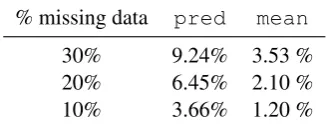
and 0.2, meaning that agreement occurs less of-ten than predicted by chance alone. More impor-tantly, if the ratings of a pair of judges were used to decide which is the best system among two, the two judges will disagree 36% of the time. This ‘agreement’ score is computed as follows: ifmA,i
is the mean of the scores given to system A by
the i-th annotator, we say that there is no
agree-ment in a pairwise comparison if mA,i > mB,i
andmA,j < mB,j, i.e. if two judges rank two
sys-tems in a different order; the score is then the per-centage of agreement when considering all pairs of systems and judges.
Considering the full scoring matrix instead of single scores has a large impact: if each example is rated by a single judge (chosen randomly), the re-sulting comparison between the two systems will be different from the decision made by averaging the two scores of the full score matrix in almost 20% of the comparisons.
4 Experimental Results
4.1 Testing the Low-Rank Hypothesis
Matrix completion relies on the hypothesis that the matrix has a low rank. We first propose to test this hypothesis on simulated data, using a method similar to the one proposed in (Mathet et al., 2012), to evaluate the impact of noise in human judgments on the score matrix rank. Ar-tificial ratings are generated as follows: a MT system is producing n translations the quality of
which, qi, is estimated by a continuous value,
that represents, for instance, a hTER score. This
6These corpora are available from LDC under the
refer-encesldc2003t17andldc2003t18
value is drawn from N µ, σ2. Based on this
‘intrinsic’ quality, two ratings, ai and bi, are
generated according to three strategies: in the first, ai and bi are sampled from N (qi, θ); in
the second, ai ∼ N qi+2θ, σ02 and bi ∼
N qi−θ2, σ02and in the third,ai ∼ N qi, σ02
and the bi is drawn from a bimodal
distribu-tion 1
2 N qi−θ2, σ02
+N qi+ θ2, σ02 (with
σ02 < θ
2).θdescribes the noise level.
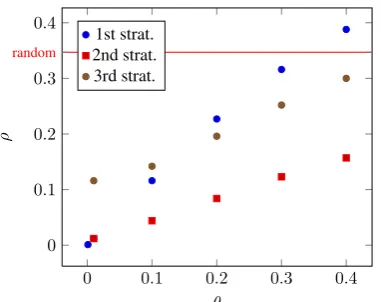
Each of these strategies models a different kind of noise that has been observed in different evalua-tion campaigns (Koehn and Monz, 2006): the first one describes random noise in the ratings; the sec-ond a systematic difference in the annotators’ in-terpretation of the score scale and the third, the sit-uation in which one annotator gives medium score while the other one tend to commit more strongly to whether she considered the translation good or bad. Stacking all these judgments results in an×2
score matrix. To test whether this matrix has a low rank or not, we assess how close it is to its ap-proximation by a rank 1 matrix. A well-known result (Lawson and Hanson, 1974) states that the Frobenius norm of the difference of these matri-ces is equal to the 2nd singular value of the orig-inal matrix; the quality of the approximation can thus be estimated byρ, defined as the 2nd
eigen-value of the matrix normalized by its norm (Leon, 1994). Intuitively, the smallerρ, the better the
ap-proximation.
Figure 1 represents the impact of the noise level on the condition number. As a baseline, we have also representedρfor a random matrix. All values
are averaged over100simulations. As it could be
expected,ρis close to 0 for small noise level; but
even for moderate noise level, the second eigen-value continue to be small, suggesting that the ma-trix can still be approximated by a mama-trix of rank 1 without much loss of information. As a compari-son, on average,ρ= 0.08for the CE score matrix, in spite of the low inter-rater agreement.
4.2 Prediction Performance
We conducted several experiments to evaluate the possibility to use matrix completion to recover a score matrix. Experiments consist in choosing randomlyk%of the entries of a matrix; these
en-tries are considered unknown and predicted using the method introduced in Section 2 denotedpred in the following. In our experimentskvaries from
exper-0 0.1 0.2 0.3 0.4 0
0.1 0.2 0.3 0.4 random
θ
ρ
1st strat. 2nd strat. 3rd strat.
Figure 1: Evolution of the condition number ρ
with the noise level θ for the different strategies (see text for details)
iments, only two judges are involved, k = 50%
would mean that each example is rated by a sin-gle judge. Two simple methods for handling miss-ing data are used as baselines: in the first one, de-notedrand, missing scores are chosen randomly; the second one, denotedmean, predicts for all the missing scores of a judge the mean of her known scores.
We propose to evaluate the quality of the recov-ery, first by comparing the predicted score to their true value and then by evaluating the decision that will be made when considering the recovered ma-trix instead of the full mama-trix.
Prediction Performance Comparing the
com-pleted matrix to the original score matrix can be done in terms of Mean Absolute Error (MAE) de-fined as 1
N
PN
i=1|yi−yˆi|whereyˆiis the predicted
value and yi the corresponding ‘true’ value; the
sum runs over all unknown values of the matrix. Table 1 presents the results achieved by the dif-ferent methods. All reported results are averaged over 10 runs (i.e.: sampling of the score matrix and prediction of the missing scores) and over all pairs of judges. All tables also report the 95% con-fidence interval. The MAE of therandmethod is almost constant, whatever the number of samples is. Performance of the matrix completion tech-nique is not so good: predicted scores are quite different than true scores. In particular, perfor-mance falls quickly when the number of missing data increases. This observation is not surprising: when 40% of the scores are missing, only a few examples have more than a single score and many have no score at all. In these conditions recovering
missing data pred mean
40% 0.78±6.21×10⁻³ 0.72±8.86×10⁻³
30% 0.83±3.19×10⁻³ 0.80±5.42×10⁻³
20% 0.88±2.49×10⁻³ 0.87±3.54×10⁻³
[image:4.595.89.280.59.210.2]10% 0.93±1.76×10⁻³ 0.92±1.51×10⁻³
Table 2: Correlation between the rankings induced by the recovered matrix and the original score ma-trix for the CE corpus
the matrix is almost impossible. The performance of the simple mean technique is, comparatively, pretty good, especially when only a few entries are known. However, the pred method always outperform the randmethod showing that there are dependencies between the two ratings even if statistical measures of agreement are low.
Impact on the Decision The negative results of
the previous paragraph only provide indirect mea-sure of the recovery quality as it is not the value of the score that is important but the decision that it will support. That is why, we also evaluated ma-trix recovery in a more task-oriented way by com-paring the decision made when considering the re-covered score matrix instead of the ‘true’ score matrix.
For the CE corpus, a task-oriented evaluation can be done by comparing the rankings induced by the recovered matrix and by the original matrix when examples are ordered according to their av-eraged score. Such a ranking can be used by a MT user to set a quality threshold granting her con-trol over translation quality (Soricut and Echihabi, 2010). Table 2 shows the correlation between the two rankings as evaluated byτb. The two rankings
appear to be highly correlated, the matrix comple-tion technique outperforming slightly the mean baseline. More importantly, even when 40% of the data are missing, the ranking induced by the true scores is better correlated to the ranking in-duced by the predicted scores than to the ranking induced when each example is only rated once: as reported in Section 3, theτbis, in this case,0.75.
QE TIDES
k pred mean rand pred mean rand
40% 1.14±2.9·10−2 0.78±6.6·10−3 1.45 — — —
30% 0.94±2.9·10−2 0.78±7.4·10−3 1.44 0.95±2.7·10−2 0.43±2.6·10−2 1.37
20% 0.77±3.4·10−2 0.78±1.0·10−2 1.45 0.76±2.6·10−2 0.41±2.5·10−2 1.38
[image:5.595.96.502.65.161.2]10% 0.65±2.1·10−2 0.79±1.9·10−2 1.47 0.48±3.0·10−2 0.41±2.5·10−2 1.36
Table 1: Completion performance as evaluated by the MAE for the three prediction methods and the three corpora considered.
random samples of the examples: the number of disagreement falls from 20% (Sect. 3) to less than 4%. While the mean method outperforms the predmethod, this result shows that, even in case of low inter-rater agreement, there is still enough information to predict the score of one annotator knowing only the score of the others.
For the tasks considered, decisions based on a recovered matrix are therefore more similar to de-cisions made considering the full score matrix than decisions based on a single rating of each example.
5 Conclusion
This paper proposed a new way of collecting reli-able human assessment. We showed, on two cor-pora, that knowing multiple scores for each exam-ple instead of a single score results in a more reli-able estimation of the quality of a NLP system. We proposed to used matrix completion techniques to reduce the annotation effort required to collect these multiple ratings. Our experiments showed that while scores predicted using these techniques are pretty different from the true scores, decisions considering them are more reliable than decisions based on a single score.
Even if it can not predict scores accurately, we believe that the connection between NLP evalua-tion and matrix compleevalua-tion has many potential ap-plications. For instance, it can be applied to iden-tify errors made when collecting scores by com-paring the predicted and actual scores.
6 Acknowledgments
This work was partly supported by ANR project Trace (ANR-09-CORD-023). The author would like to thank Franc¸ois Yvon and Nicolas P´echeux for their helpful questions and comments on the various drafts of this work.
% missing data pred mean 30% 9.24% 3.53 % 20% 6.45% 2.10 % 10% 3.66% 1.20 %
Table 3: Disagreements in a pairwise comparison of two systems of the TIDES corpus, when the systems are evaluated using the predicted scores and the true scores
References
Ron Artstein and Massimo Poesio. 2008. Inter-coder agreement for computational linguistics. Comput. Linguist., 34(4):555–596, December.
Stephen R. Becker, Emmanuel J. Cand`es, and Michael C. Grant. 2011. Templates for convex cone problems with applications to sparse signal recovery.
Math. Prog. Comput., 3(3):165–218.
Chris Callison-Burch, Philipp Koehn, Christof Monz, Matt Post, Radu Soricut, and Lucia Specia. 2012. Findings of the 2012 workshop on statistical ma-chine translation. In Proc. of WMT, pages 10–51, Montr´eal, Canada, June. ACL.
Emmanuel Cand`es and Benjamin Recht. 2012. Exact matrix completion via convex optimization. Com-mun. ACM, 55(6):111–119, June.
A. Chistov and D. Grigor’ev. 1984. Complexity of quantifier elimination in the theory of algebraically closed fields. In M. Chytil and V. Koubek, editors,
Math. Found. of Comp. Science, volume 176, pages 17–31. Springer Berlin / Heidelberg.
Philipp Koehn and Christof Monz. 2006. Manual and automatic evaluation of machine translation between european languages. InProc. WMT, pages 102–121, New York City, June. ACL.
Philipp Koehn. 2012. Simulating human judgment in machine translation evaluation campaigns. InProc. of IWSLT.
[image:5.595.334.498.217.281.2]Stephen J: Leon. 1994. Linear Algebra with Applica-tions. Macmillan,.
Adam Lopez. 2012. Putting human assessments of machine translation systems in order. In Proc. of WMT, pages 1–9, Montr´eal, Canada, June. ACL.
Yann Mathet, Antoine Widlcher, Kar¨en Fort, Claire Franc¸ois, Olivier Galibert, Cyril Grouin, Juliette Kahn, Sophie Rosset, and Pierre Zweigenbaum. 2012. Manual corpus annotation: Giving meaning to the evaluation metrics. In Proceedings of COL-ING 2012: Posters, pages 809–818, Mumbai, India, December.
Daniele Pighin, Llu´ıs Formiga, and Llu´ıs M`arquez. 2012. A graph-based strategy to streamline trans-lation quality assessments. InProc. of AMTA.
Matthew Snover, Nitin Madnani, Bonnie Dorr, and Richard Schwartz. 2009. Fluency, adequacy, or HTER? Exploring different human judgments with a tunable MT metric. InProc. of WMT, pages 259– 268, Athens, Greece, March. ACL.