Munich Personal RePEc Archive
Application of Factor and Cluster
Analysis for an evaluation of Business
Practices Models of Foreign Banks.
Edurkar, Ashok and Chougule, Dr.Dattatrya G.
Commerce Management Department, Shivaji University Kolhapur,
India
14 July 2016
Online at
https://mpra.ub.uni-muenchen.de/73536/
Title of Research Paper:-
Application of Factor and Cluster Analysis for an
evaluation of Business Practices Models of Foreign
Banks Post RBI Road MAP 2005 and during the period
2003 to 2013 with reference to India’s Foreign Trade.
Author's name: Mr.Ashok Edurkar, Dr. Dattatrya
G.Chougule
First Author’s Designation: - Management Consultant,
Stork International GmbH, Vienna, Austria
Research Centre Name: - Commerce & Management
Department Shivaji University Kolhapur, Maharashtra
State.
First Author’s Postal address: - 35, Ganga Vishnu
Heights, Near Alankar Police Station, Karvenagar Pune,
PIN-411052
Application of Factor and Cluster Analysis for an evaluation of
Business Practices Models of Foreign Banks Post RBI Road MAP
2005 and during the period 2003 to 2013 with reference to India’s
Foreign Trade.
Abstract-
The aim of this paper is to assess business practices models of 24 foreignbanks operating in India post RBI Road Map 2005 and during the period 2003 to 2013
through the use of publicly available information. Business practices models have
been evaluated by the application of factor analysis followed by cluster analysis. 23
variables related to working of foreign banks supported with 5 variables related to
India’s foreign trade were reduced into 8 factors by using factor analysis. Using these
8 factors cluster analysis was carried out to group 24 foreign banks into 3 clusters
leading to three distinct business practices models. The dataset for analysis was for
the period for financial years 2003-04 to 2012-13 and the focus is on post RBI Road
Map-2005 for foreign banks.The foreign banks’ sample consists of consistently operating 24 number foreign banks out of the universe consisting of 43 FBs operating
in India between 2003-04 and 2012-13(ten years observation period).This study
broadly covers foreign banks having legal entity and financial roots primarily in home
country and entered in India for tapping Indian financial market in the form of term
loans, cash credit, bridge loans, investments and funding for business activities
(business financing operations) .
Key Words- Foreign Banks, Finance, Models, Foreign Trade, Financing
1Introduction: - Foreign banks are developing their Indian business along with
increasing their client base and implementing potential opportunities for massive entry
into the market. Most of the foreign banks have the greatest experience in working with
private depositors, and also lending actively to the real and various business sectors.
Foreign banks desire to enter the Indian market is understandable. Bilateral trade with
various countries has been growing rapidly as economies are recovering from the global
financial crisis. Foreign banks’ principal focus is on promoting bilateral trade by offering finance at various stages of business cycle like product development,
production, and marketing, import-export credit at pre-shipment and post-shipment
stages, investment abroad and import of technology. Foreign banks operate a wide
range of lending programs. Financial packages offered by the Foreign banks are
economy. It is the dominant provider of capital in the form of advances & investments
to various sectors like construction, automobile, energy, machinery industry covering
also priority sectors including agriculture, MSE, weaker section and exports plus
imports.
1.1 Foreign banks’ their Current Scenario: - During the last two decades, India has seen an unprecedented degree of globalization especially in financial services. Foreign
trade, financial system, technological advances, deregulation impact, industry and its
major players’ growth were identified as industry shaping milestones that gradually
formed the today’s foreign banks’ models. As of March 2013, there are 43 foreign banks from 26 countries operating as branches and 43 foreign banks from 22 countries
operating as representative offices in India. In addition, a number of foreign banks have
also entered India via the Non-Banking Financial Company (NBFC) route, while a
considerable number have set up captive centers in the country.
1.2 Significance of study: - Knowing under what models foreign banks operate for
financing India’s Foreign Trade and how models change in perspective to time or the foreign banks’ operative approach can provide valuable insight into the whole financial
system. Foreign banks are to develop commercially viable relationships with a target
set of externally business oriented companies in India and their host countries by
offering them comprehensive range of products and services, aimed at enhancing their
internationalization efforts with the application of specific models.
1.3 Criticism against foreign banks: - It is observed that foreign banks operating in
various developing countries are focused on a section of credit worthy customers and
are involved in taking out cream of credit market. While carrying out financing
operations these institutions in general neglect small or marginal customers. (Mandira
Sarma and Anjali Prashad 2014). It has become hard to forecast, monitor or even follow
how foreign banks conduct their business.
1.4 Foreign banks andRural Regions in India: - It is argued that the developmental
needs of rural regions in India may not be met by foreign banks. In India, out of
approximately 600 districts, the number of districts without financial facility is nearly
400. Foreign banks are not going to enhance the reach of the financial system to millions
of rural Indians manufacturers/service providers / businesses /citizens who do not have
2. Research Methodology: -
2.1 This research study is mainly based on secondary data.
2.1.1 First of all published literature relating to the Foreign Trade of India and financing
of Foreign Trade was collected and consulted with special reference to FBs.
2.1.2 Secondly full advantage was taken of consultation with the faculty of various
institutes related to Foreign Trade. For example, Indian Institute of Foreign Trade
(IIFT), EXIM Bank, NIBM, Foreign Trade Organizations, Commerce wing in Indian
High Commissions in various countries.
2.1.3 Thirdly a broad view was obtained on the role of FBs on the growth of Foreign
Trade of India and financial models applied by FFIs while operating in India.
2.1.4 Lastly an analysis of the total operations of the FBs and their functional variables
will be undertaken to find out how far FBs are able to achieve their objectives.
2.2 Data and Source of Data:-
The present study is predominantly empirical in nature and based on secondary
data. This study involved basically published literature searches and various internet
web site searches related to Foreign Trade and Foreign banks for obtaining secondary
data.
2.3 Sample Design & selection of FFIs:-
For this study foreign banks are selected by random sampling method but belong to
major countries related to India’s Foreign Trade, a home country of foreign banks having a sizable bilateral trade with India and non-interrupted operation as indicated by
profile of banks as per RBI.
2.4 Sampling Plan:
A sample of 24 FBs is selected among 43 FBs (Universe) satisfying various conditions
as per sampling design. This corresponds to (24/43) = 55.81 % of total universe value.
The study is conducted on the FBs operating in India during the financial year 2003-04
to 2012-13.
2.5 Data analysis techniques:-
For effective analysis of data secondary data, various statistical tools like trend analysis,
averages, etc. software like IBM SPSS are used. Data analysis activity begins with
the period 2003-04 to 2012-13. This is processed for calculation of Mean, Standard
Deviation, Min, Max, Standard Error etc. The processed data is used to generate input
for factor and cluster analysis.
2.6:-Scope of the Study:-This study broadly covers foreign banks having legal entity
and financial roots primarily in home country and entered in India for tapping Indian
market in the form of term loans, cash credit, bridge loans, equity participation and
funding for business activities .
2.7 Limitations of the Study: - This study is limited to determination of effect of
funding by foreign banks to Indian businesses/manufacturing/service operations and
trading involving term loan or cash credit in the form of advances.
3.1 Review of Literature in short:-
The foreign banks model analysis offers a wide range of applications. Several authors
already employed this type of analysis, generating promising results. The concept is
used as an educative and analytical tool to explain and understand how foreign banks
function. The term model is widely applied and capable of including a range of financial
business aspects. Financial business objectives, core customers, product management,
financial business strategies, organization infrastructure and many other strategic and
operational business processes fit in foreign banks model term. Because of this
capability to explain so much, foreign banks model term suffers an “identity crisis”. While scholars do not agree what a model is, certain patterns are available and
definitions emerge (Pedrotti (2014)) and (Osterwalder, Pigneur 2010). For the purpose
of a more tangible applicability and necessary foreign banks model comparability, a
work by Zott and Amit is used as a definition core for the model (Zott, Amit 2008).
Applying similar conceptualization in the foreign bank business, the acquisition of
necessary funds, loan service provisions and implied risk-taking can be interpreted as a
base financial product market strategy, as these are the same products/services that
foreign banks are competing for in the financial market The evolutionary logic of the
foreign bank model is addressed by sympathizing with G. George’s and A. Bock’s thinking that organizations adjust and redesign their models under the effects of a
changed operational environment (George, Bock 2011). The ability to adjust or
transform the model is regarded as one of the major features in the financial business
3.2 Research Gap Analysis:-
3.2.1 Scope of Review: - The effect of opening of economy on growth of a country and
various models of foreign bank has been critically covered. In general, researchers point
out that foreign bank is an important factor for the GDP growth. Openness to foreign
banks policy yields access to finance at a competitive rate.
3.2.2 Limitations of Review: - The effect of external financing from foreign banks on
working of domestic institutions is not examined. There is no unanimous acceptance
amongst researchers about specific models of foreign banks operating in host and home
countries.
3.2.3 Scope for further review work: - Effect of external financing from foreign banks
on working of domestic institutions may be reviewed in detail along with priority sector
financing.
4.1 Analysis and Interpretation of
Data:-World over no bank is confined to a specific theoretical model. Although institutions
operating in Europe, such as BNP Paribas, Deutsche Bank or Société Générale define
themselves as retail-oriented institutions for marketing purposes, the research provides
evidence that their business model is in fact closer to investment banking (Ayadi et.al.
2012). Similarly, the 24 selected foreign banks operating in India, are not relying on
any specific theoretical model but making use of best of all business opportunities
available.
4.2 Profile of selected foreign banks for study purpose and variables
4.2.1 During the year2003-04 to 2012-13 (ten years observation period) there are only
twenty four of FFIs operating consistently in India. These foreign banks are selected
for this research to generate models of foreign banks.
Annexure-1shows the details of these twenty four foreign banks including their
respective case number allotted along with business, advances, investment.
4.2.2 Annexure-2 shows List of Variables and Factor/Component Score Coefficient
Matrix.
4.2.3 The analysis for Foreign Trade Variables, is conducted using annual data for each foreign bank operating in India.
Based on the above, case wise calculation of values of eight factors was performed which served as an input for conducting cluster analysis to yield three clusters which are termed as Model-A, Model-B and Model-C. Annexure-3 Case wise calculations of values of 8 number factors.
4.3Five variables pertaining to foreign trade: - These are derived based on gravity equations used in the research of foreign trade. The variables included in the export and import volume equations are real exports contribution by foreign bank, real imports contribution by foreign bank , real gross domestic product contribution by foreign bank (CTGDP ), Modified export demand (M-EXDEM) because of foreign bank, and trade finance (FIN). For the export volume equation, export demand represents market share and is computed as the ratio of imports to total exports, specifically
M-EXDEM = Sum of 𝑖𝑚𝑝𝑜𝑟𝑡𝑠 /Sum of 𝑒𝑥𝑝𝑜𝑟𝑡𝑠 (4.3.1)
Where 𝑖𝑚𝑝𝑜𝑟𝑡𝑠 is considered total imports into India.
𝐸𝑥𝑝𝑜𝑟𝑡𝑠 represents total exports to all countries by India.
To examine how financial development and foreign trade finance influence trade flows, econometric models similar to those found in Arize (1996), Asafu-Adjeye (1999), and Ozturk and Kalyoncu (2009) were referred. Also, research work by Daniel Perez Liston, Lawrence McNeil (2013) was referred.
The proposed export volume equation is as follows:
Log (𝑒𝑥𝑝𝑜𝑟𝑡𝑠) = A0 +A1log (M-𝐸𝑋𝐷𝐸𝑀) + A2𝐹𝐼𝑁 +A3𝐹𝐼𝑁 (4.3.2)
Where exports are real exports contribution by foreign bank, M-EXDEM is a proxy for export demand contribution by foreign bank, FIN is the trade finance proxy contribution by FFI. Now, Imports are modeled as follows:
Log (𝑖𝑚𝑝𝑜𝑟𝑡𝑠) = A0 +A1log (M𝐺𝐷𝑃) +A2𝐹𝐼𝑁 (4.3.3)
Where imports, are real imports contribution by foreign bank and M-GDP is the real gross domestic product contribution by foreign bank. A0, A1, A2 are constants. From profile of foreign banks it is observed that foreign banks’ Business is equal to number of Employees multiplied by Business per Employee. The definition of Proposed Modified Formulae for Foreign Trade Variables are as follows:-
(A) M-EXDEM =Modified variable for export demand as per foreign bank’s
financing= (Total Imports/Total Exports)*(Investments by foreign bank)*(Advances
by foreign bank) where, (foreign bank’s Business) = ('No. of Employees* 'Business /Employee')
(C) EIR=Effective Interest Rate ==100*(Interest Income by foreign bank/Advances by foreign bank)
(D) Log (M-FT) =Log ((((Average FT)/ (Investments!*Advances!)))
(E) Log (CTGDP) =Log ((Investments!*Advances!)*('No. of Employees'!*'Business
per Employee'!))
Based on the above definition values of foreign trade variables have been computed
and used in working of factor analysis followed by cluster analysis.
4.4 Scree plot graph:-The scree plot graphs the eigen value against the factor number.
Graph 4.4.1:- Scree plot graph:-
Graph 4.4.1 shows Eigen values which are given in the first two columns of the table
number 5.6 immediately above. From the eighth factor on, it is observed that the line
is almost flat, meaning the each successive factor is accounting for smaller and smaller
amounts of the total variance.
For determining the number of factors to retain we have used Cattell’s (1966) scree test, which involves eye-balling the plot of the eigenvalues for a break or hinge (also referred
to as an “elbow”). The rationale for this test is based on the idea that a few major factors
will account for the most variance, resulting in a “cliff”, followed by a shallow “scree”
depicting the consistently small and relatively shallow error variance described by
minor factors. Annexure- 2 indicates Component Score Coefficient Matrix. For a
wise values of factors 1 to 8. Annexure 3 shows mean or average values of variables
for the period 2003-04 to 2012-13. For example, for the variable ‘Advances’ the value of Factor 1 is 0.06. For case 1, the mean value for Advances is 0.07515. Then for the
case 1, the value of Factor1 for a variable ‘Advances’ is equal to 0.06 multiply 0.07515= 0.004509. Using this method, the value of Factor1 is calculated for all variables 1 to 28
and the sum of these values is the value of Factor1 for case1. These case wise values of
factors 1 to 8 are given in Annexure-4.
4.5 Cluster analysis:-
For this research study, cluster analysis is carried out as follows:-
4.5.1 Case (Foreign bank) wise computation of values of 8 factors which are generated
using factor analysis.
4.5.2 Case (Foreign bank) wise calculation and recording of 8 factors in tabular format.
After processing the data for Cluster Analysis using SPSS, details related to Cluster
[image:10.595.213.420.370.762.2]Membership are as under:-
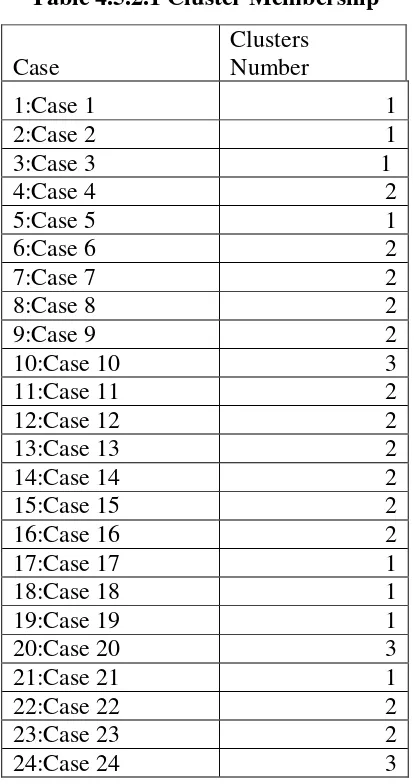
Table 4.5.2.1 Cluster Membership
Case
Clusters Number
1:Case 1 1
2:Case 2 1
3:Case 3 1
4:Case 4 2
5:Case 5 1
6:Case 6 2
7:Case 7 2
8:Case 8 2
9:Case 9 2
10:Case 10 3
11:Case 11 2
12:Case 12 2
13:Case 13 2
14:Case 14 2
15:Case 15 2
16:Case 16 2
17:Case 17 1
18:Case 18 1
19:Case 19 1
20:Case 20 3
21:Case 21 1
22:Case 22 2
23:Case 23 2
Table 4.5.2.1 shows to which cluster a particular case is belonging. For example, case
number 17 is in cluster number 1, case number 13 is in cluster number 2 and case
number 24 is in cluster number 3.
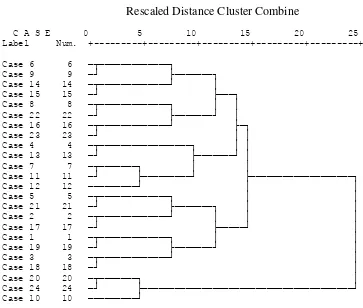
Graph 4.5.1 shows “Dendrogram”. In Greek language the word ‘ Dendro’ means tree.
Here the cases in 3 number clusters are presented in a ‘Tree shape’ or called as a
Dendrogram. The branching-type-nature of the Dendrogram allows the researcher to
trace backward or forward to any individual case or cluster at any level. It, in addition,
gives an idea of how great the distance was between cases or groups that are clustered
in a particular step, using a 0 to 25 scale along the top of the chart. While it is difficult
to interpret distance in the early clustering phases (the extreme left of the graph), as you
move to the right relative distance become more apparent. The bigger the distances
before two clusters are joined, the bigger the differences in these clusters. To find a
membership of a particular cluster simply trace backwards down the branches to the
name.
Graph 4.5.1 Dendrogram using Centroid Method
Rescaled Distance Cluster Combine
C A S E 0 5 10 15 20 25 Label Num. +---+---+---+---+---+
Case 6 6 ─┬─────────────┐
Case 9 9 ─┘ ├───────┐ Case 14 14 ─┬─────────────┘ │ Case 15 15 ─┘ ├───┐ Case 8 8 ─┬─────────────┐ │ │ Case 22 22 ─┘ ├───────┘ │ Case 16 16 ─┬─────────────┘ ├─┐ Case 23 23 ─┘ │ │ Case 4 4 ─┬─────────────────┐ │ │ Case 13 13 ─┘ ├───────┘ │ Case 7 7 ─┬───────┐ │ │
Case 11 11 ─┘ ├─────────┘ ├───────────────────┐ Case 12 12 ─────────┘ │ │ Case 5 5 ─┬─────────────┐ │ │ Case 21 21 ─┘ ├───────┐ │ │ Case 2 2 ─┬─────────────┘ │ │ │ Case 17 17 ─┘ ├─────┘ │ Case 1 1 ─┬─────────────┐ │ │ Case 19 19 ─┘ ├───────┘ │ Case 3 3 ─┬─────────────┘ │ Case 18 18 ─┘ │ Case 20 20 ─┬───────┐ │ Case 24 24 ─┘ ├───────────────────────────────────────┘ Case 10 10 ─────────┘
4.6 Characteristics of Foreign Banks’- 3 Models: - This part of the research determines and discusses specific characteristics of the three models derived by the
are expressed in terms values of eight factors which are either positive or negative
values.
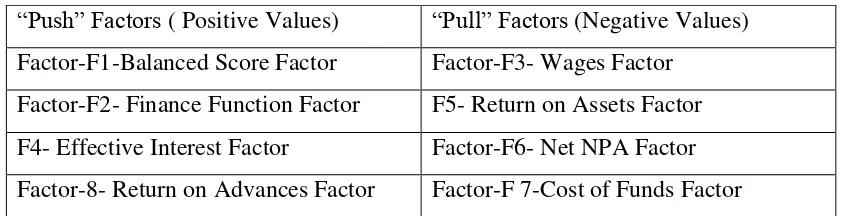
4.6.1 Identification of Factors based on positive or negative scores: - Two distinct
groups of all 8 factors are formed based on positive or negative value of factors with
respect to 24 cases used in this research. Positive values are considered as positive push
and negative values are considered as negative pull for the operational activities of
foreign banks.
Table 4.6.1 Identification of Factors based on positive /negative scores
“Push” Factors ( Positive Values) “Pull” Factors (Negative Values) Factor-F1-Balanced Score Factor Factor-F3- Wages Factor
Factor-F2- Finance Function Factor F5- Return on Assets Factor
F4- Effective Interest Factor Factor-F6- Net NPA Factor
Factor-8- Return on Advances Factor Factor-F 7-Cost of Funds Factor
4.6.2 Absolute Mean Values:-These values are actual or real mean values of eight
factors with respect to specific Model either Model-A or model-B or Model-C. Models
are segregated based on ascending order of mean values. Table 5.35 indicates ascending
order of Models A to B to C and also furnishing mean values of eight factors with
[image:12.595.105.527.235.343.2]respect to specific model.
Table 4.6.2 Absolute Mean Values:-
Model
F1
F2
F3
F4
F5
F6
F7
F8
A 1190.752 114.5553
-218.467
560.8069
-142.191
-569.374 -570.518 549.0386
B 11419.46 991.8395
-1746.84
5168.439
-749.443
-5498.83 -5081.52 5539.352
C 119204.2 9457.528
-25604.8
53612.01
-14242.7
-60862.1 -59923.1 34007.19
4.6.3 Percentage Values: - These values are percentage of mean values of eight factors
with respect to specific Model either Model-A or model-B or Model-C. Models are
order of Models A to B to C and also furnishing percentage of mean values of eight
factors with respect to specific model Table 4.6.3 Percentage Mean Values
Model
F1
F2
F3
F4
F5
F6
F7
F8
A 0.903 1.084 0.792 0.945 0.939 0.850 0.870 1.369
B 8.663 9.388 6.335 8.709 4.951 8.215 7.749 13.815
C 90.43 89.52 92.87 90.345 94.108 90.933 91.380 84.815
4.6.4 Grouping of Factors based on Positive Push & Negative Pull is carried out based
on positive value or negative value of absolute mean value of factors and further
converting it into percentage value. Table 4.6.4 shows above mentioned grouping.
Factor F1, F2, F4 F8 represent Positive Push group whereas Factor F3, F5, F6, F7
represent Negative Pull group. Models are placed in ascending order of percentage
[image:13.595.25.542.415.505.2]values of eight factors.
Table 4.6.4 Grouping of Factors based on Positive Push / Negative Pull: - Positive
Push is in blue color whereas Negative Pull is in red color
Model % F1 % F2 % F4 % F8 % F3 % F5 % F6 % F7
A 0.903 1.08440 0.94505 1.36932 0.79240 0.939527 0.8506966 0.870021974
B 8.6632 9.388931 8.709689 13.81536 6.3359 4.9519362 8.2157595 7.7491580
C 90.433 89.52666 90.34525 84.81530 92.87160 94.10853 90.93354 91.38081
4.6.5 Model A: - This is basically cluster 1. It includes eight cases out of 24 cases
analyzed during the research. Table 4.6.5 indicates eight cases along with values of
eight factors with respect to specific case. This table also shows maximum values,
minimum values, mean value and value of standard deviation of eight factors with
respect to cases involved in this research. Here, both absolute mean values and
percentages mean values of eights factors are at the minimum or the least level. Hence
this model is termed as “Also Ran Low End Economy model” of the foreign banks,
meaning foreign banks covered under this model are just maintaining their existence by
carrying out their operational activities while operating in India. These foreign banks
lack initiative to tap various business opportunities available under the RBI roadmap
with the application of variables like advances, investment, EIR etc.to widen their
Table 4.6.5 Model A – 8 Cases Case No. Factor- F1 Factor- F2 Factor- F3 Factor- F4 Factor- F5 Factor- F6 Factor- F7 Factor- F8
1 153.19 15.65 -8.74 93.12 -7.61 -55.33 -66.94 101.85
2 1454.31 142.33
-397.18
698.33
-323.27
-758.98 -816.36 267.57
3 831 77.16
-110.63
373.25 -0.37 -353.76 -354.63 781.64
5 1098.7 101.91
-239.53
514.67
-181.21
-549.23 -564.5 327.67
17 1681.87 166.83
-302.51
792.36
-181.97
-809.67 -812.95 867.27
18 3051.33 283.78
-489.79
1407.18
-299.84 -1452.44 -1363.34 1360.89
19 70.58 5.77 7.55 50.89 -16.47 -24.49 -41.6 5.31
21 1185.04 123
-206.89
556.66 -126.8 -551.09 -543.83 680.11
Max 3051.33 283.78 7.55 1407.18 -0.37 -24.49 -41.6 1360.89
Min 70.58 5.77
-489.79
50.89
-323.27 -1452.44 -1363.34 5.31
Mean 1190.75 114.56
-218.47
560.81
-142.19
-569.37 -570.52 549.04
S.Deviation 883.29 83.21 165.79 403.88 119.9 430.39 407.51 426.54
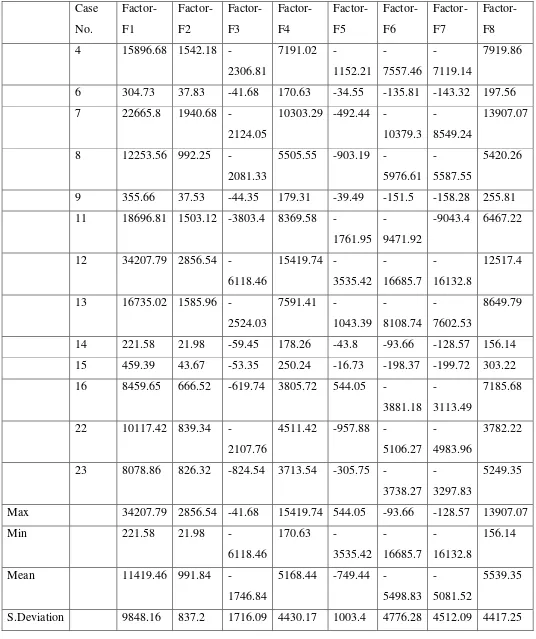
4.6.6 Model B: - This is basically cluster 2. It includes thirteen cases out of 24 cases
analyzed during the research. Table 4.6.6 indicates thirteen cases along with values of
eight factors with respect to specific case. This table also shows maximum values,
minimum values, mean value and value of standard deviation of eight factors with
respect to cases involved in this research. . Here, both absolute mean values and
percentages mean values of eights factors are at the moderate or the medium level.
Hence this model is termed as “Progressive Medium End model” of the foreign banks,
meaning foreign banks covered under this model are pushing their presence by carrying
out their operational activities while operating in India. These foreign banks possess
the application of variables like advances, investment, EIR etc.to widen their
[image:15.595.12.548.133.772.2]prospective customer base and increase income plus appropriate profitability.
Table 4.6.6 Model B- 13 Cases
Case No. Factor- F1 Factor- F2 Factor- F3 Factor- F4 Factor- F5 Factor- F6 Factor- F7 Factor- F8
4 15896.68 1542.18
-2306.81
7191.02
-1152.21 -7557.46 -7119.14 7919.86
6 304.73 37.83 -41.68 170.63 -34.55 -135.81 -143.32 197.56
7 22665.8 1940.68
-2124.05
10303.29 492.44
-10379.3
-8549.24
13907.07
8 12253.56 992.25
-2081.33
5505.55 903.19
-5976.61
-5587.55
5420.26
9 355.66 37.53 -44.35 179.31 -39.49 -151.5 -158.28 255.81
11 18696.81 1503.12 -3803.4 8369.58
-1761.95
-9471.92
-9043.4 6467.22
12 34207.79 2856.54
-6118.46
15419.74
-3535.42 -16685.7 -16132.8 12517.4
13 16735.02 1585.96
-2524.03
7591.41
-1043.39 -8108.74 -7602.53 8649.79
14 221.58 21.98 -59.45 178.26 -43.8 -93.66 -128.57 156.14
15 459.39 43.67 -53.35 250.24 -16.73 -198.37 -199.72 303.22
16 8459.65 666.52 -619.74 3805.72 544.05
-3881.18
-3113.49
7185.68
22 10117.42 839.34
-2107.76
4511.42 957.88
-5106.27
-4983.96
3782.22
23 8078.86 826.32 -824.54 3713.54 305.75
-3738.27
-3297.83
5249.35
Max 34207.79 2856.54 -41.68 15419.74 544.05 -93.66 -128.57 13907.07
Min 221.58 21.98
-6118.46
170.63
-3535.42 -16685.7 -16132.8 156.14
Mean 11419.46 991.84
-1746.84
5168.44 749.44
-5498.83
-5081.52
5539.35
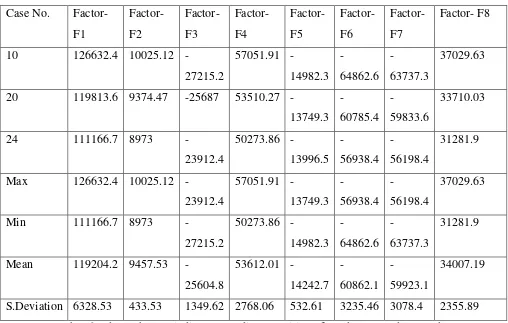
4.6.7 Model C: - This is basically cluster 3. It includes three cases out of 24 cases
analyzed during the research. Table 4.6.7 indicates three cases along with values of
eight factors with respect to specific case. This table also shows maximum values,
minimum values, mean value and value of standard deviation of eight factors with
respect to cases involved in this research. Here, both absolute mean values and
percentages mean values of eights factors are at the maximum or at the highest level.
Hence this model is termed as “High End Star model” of the foreign banks, meaning foreign banks covered under this model are leaving no chance for pushing their
presence at the highest level by carrying out their operational activities while operating
in India. These foreign banks possess proactive initiative to tap various business
opportunities available under the RBI roadmap with the application of variables like
advances, investment, EIR etc.to widen their prospective customer base and increase
[image:16.595.62.570.356.679.2]income plus appropriate profitability
Table 4.6.7 Model C- 3 Cases
Case No. Factor-
F1 Factor- F2 Factor- F3 Factor- F4 Factor- F5 Factor- F6 Factor- F7 Factor- F8
10 126632.4 10025.12
-27215.2
57051.91
-14982.3 -64862.6 -63737.3 37029.63
20 119813.6 9374.47 -25687 53510.27
-13749.3 -60785.4 -59833.6 33710.03
24 111166.7 8973
-23912.4
50273.86
-13996.5 -56938.4 -56198.4 31281.9
Max 126632.4 10025.12
-23912.4
57051.91
-13749.3 -56938.4 -56198.4 37029.63
Min 111166.7 8973
-27215.2
50273.86
-14982.3 -64862.6 -63737.3 31281.9
Mean 119204.2 9457.53
-25604.8
53612.01
-14242.7 -60862.1 -59923.1 34007.19
S.Deviation 6328.53 433.53 1349.62 2768.06 532.61 3235.46 3078.4 2355.89
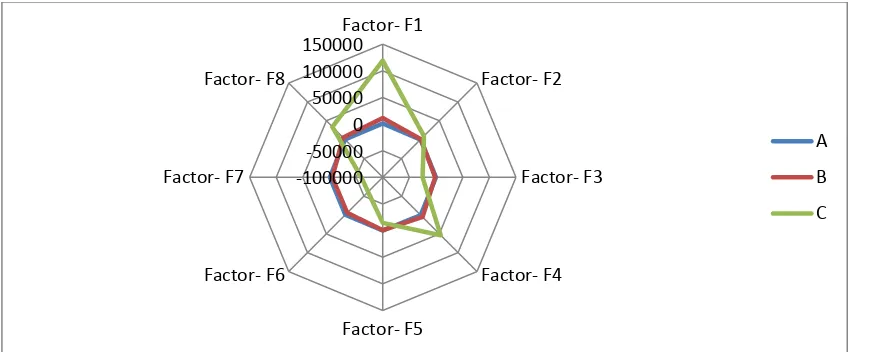
Graph 4.6.7 drawn below, indicate co-ordinate position of Model-A, Model-B and
Model-C. As shown by this graph, Model- A covers least or minimum area, Model-B
covers area at moderate or medium level whereas Model-C covers the maximum or
factors of these models. Graph 4.6.7 Simple Radar type graph indicating
co-ordinate position of models: - Graph 5.3 simple radar type indicates position of
[image:17.595.71.507.143.319.2]models by drawing simple lines.
Table 4.6.7 Intensity of Positive Push and Negative Pull amongst models
Model Positive Push Negative Pull
A Minimum emphasis on F1,F2,F4 and F8 Minimum emphasis on F3,F5,F6 and F7
B More emphasis on F1,F2,F4 and F8 More emphasis on F3,F5,F6 and F7
C Highest emphasis on F1,F2,F4 and F8 Highest emphasis on F3,F5,F6 and F7
Graph 4.6.8 Filled Radar type graph indicating co-ordinate position of models: - Graph
4.6.8 filled radar type indicates position of models by highlighting areas covered by
respective model.
-100000 -50000 0 50000 100000 150000
Factor- F1
Factor- F2
Factor- F3
Factor- F4
Factor- F5 Factor- F6
Factor- F7 Factor- F8
A
B
C
-100000 -50000 0 50000 100000 150000
F1
F2
F3
F4
F5 F6
F7 F8
A
B
4.7 Testing of Hypothesis: -
Hypothesis Number 1:
-H1: Foreign banks (FBs) provide services to Indian companies at a very
competitive and concessional cost.
HO: Foreign banks (FBs) do not provide services to Indian companies at a very
competitive and concessional cost.
This hypothesis tested using statistical test, table supported with graph by comparing
A)Foreign banks’ cost of funds, B) Return on advances and C) Return on assets against State Bank of India (SBI) since in India SBI is the lead financial institution for
providing advances to manufacturing & trading.
Here we are comparing Foreign banks’cost of funds against SBI’s cost of funds since in India SBI is the lead financial institution for providing advances to manufacturing &
trading.
Table 4.7.1 FBs’ Cost of Funds - Comparison with State Bank of India
FBs (24) N
Average
SBI-Average
Year Cost of Funds Year Cost of Funds
2003-04 3.80 2003-04 5.74
2004-05 3.56 2004-05 4.90
2005-06 4.39 2005-06 4.88
2006-07 4.12 2006-07 4.55
2007-08 4.28 2007-08 5.64
2008-09 4.41 2008-09 5.72
2009-10 2.95 2009-10 5.14
2010-11 2.90 2010-11 4.67
2011-12 3.67 2011-12 5.35
2012-13 3.93 2012-13 5.63
Average= 3.80 Average= 5.22
Statistical Test: - Here x bar= 5.22, µo =3.80, σ= 0.43109, n=24
= (5.22-3.80)/ (0.43109/ (24^0.5)) = (1.42)/ (0.43109)/ 4.8989 =1.42/0.0879 =16.15
Distribution of test statistic is N (0, 1). So critical value for right tailed test and for 5%
level of significance is 1.645. Since, computed value > critical value at 5% level of
significance, we reject Ho at 5%level of significance in favor of H1 and conclude that
Foreign banks provide services to Indian companies at a very competitive and
concessional cost because FBs’cost of Funds is lower than SBI’s Cost of Funds.
Graph 4.7.1 FBs’ Cost of Funds- Comparison with State Bank of India (SBI)
From above table and graph it is observed that FBs cost of Funds is lower than SBI’s Cost of Funds during the observation period. Hence H1 is acceptable whereas HO is
rejected.
B) Here we are now, comparing FBs return on advances against SBI’s return on advances since in India SBI is the lead financial institution for providing advances to
manufacturing & trading 0
1 2 3 4 5 6 7
2003-04 2004-05 2005-06 2006-07 2007-08 2008-09 2009-10 2010-11 2011-12
Cost of Funds
Table 4.7.2 FBs’ Returns on Advances – Comparison with State Bank of India (SBI)
FBs 24(N) Average SBI-Average
Year Return on Advances Year Return on Advances
2003-04 4.27 2003-04 1.88
2004-05 3.66 2004-05 2.34
2005-06 3.08 2005-06 2.74
2006-07 5.16 2006-07 3.74
2007-08 4.96 2007-08 3.70
2008-09 6.57 2008-09 3.95
2009-10 5.35 2009-10 3.48
2010-11 4.74 2010-11 3.97
2011-12 5.04 2011-12 4.63
2012-13 4.72 2012-13 3.83
Average= 4.75 Average= 3.42
Statistical Test: - Here x bar= 4.75, µo =3.43, σ= 0. 0.90339, n=24
𝑍𝑐 =x bar − µo σ/√𝑛
= (4.75-3.43)/ (0.90339/ (24^0.5)) = (1.32)/ (0.90339)/ 4.8989 =1.32/0.1844 =7.15
Distribution of test statistic is N (0, 1). So critical value for right tailed test and for 5%
level of significance is 1.645. Since, computed value > critical value at 5% level of
significance, we reject Ho at 5%level of significance in favor of H1 and conclude that
FFIs provide services to Indian companies at a very competitive and concessional cost
because FBs’Return on Advances is higher than SBI’s Return on Advances.
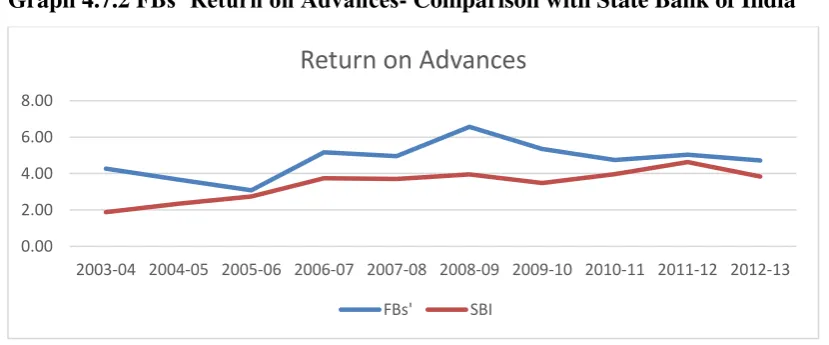
Graph 4.7.2 FBs’ Return on Advances- Comparison with State Bank of India
0.00 2.00 4.00 6.00 8.00
2003-04 2004-05 2005-06 2006-07 2007-08 2008-09 2009-10 2010-11 2011-12 2012-13
Return on Advances
[image:20.595.104.519.580.752.2]From above statistical tests, tables and graph it is observed that FBs’ return on advances
is higher than SBI’s return on advances during the observation period. Hence H1 is
acceptable whereas HO is rejected.
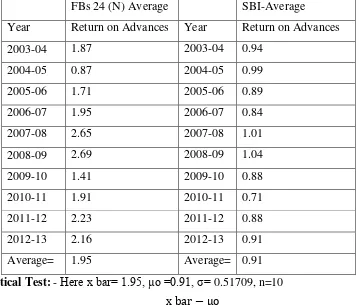
C) Here we are now, comparing FBs return on assets against SBI’s return on assets since in India SBI is the lead financial institution for providing advances to
[image:21.595.101.460.280.585.2]manufacturing & trading.
Table 4.7.3 FBs’ Returns on Assets - Comparison with State Bank of India
FBs 24 (N) Average SBI-Average
Year Return on Advances Year Return on Advances
2003-04 1.87 2003-04 0.94
2004-05 0.87 2004-05 0.99
2005-06 1.71 2005-06 0.89
2006-07 1.95 2006-07 0.84
2007-08 2.65 2007-08 1.01
2008-09 2.69 2008-09 1.04
2009-10 1.41 2009-10 0.88
2010-11 1.91 2010-11 0.71
2011-12 2.23 2011-12 0.88
2012-13 2.16 2012-13 0.91
Average= 1.95 Average= 0.91
Statistical Test: - Here x bar= 1.95, µo =0.91, σ= 0.51709, n=10
𝑍𝑐 =x bar − µo σ/√𝑛
= (1.95-0.91)/ (0.51709/ (24^0.5)) = (1.04)/ (0.51709)/ 4.8989 =1.04/0.0.1055 = 9.85
Distribution of test statistic is N (0, 1). So critical value for right tailed test and for 5%
level of significance is 1.645. Since, computed value > critical value at 5% level of
significance, we reject Ho at 5%level of significance in favor of H1 and conclude that
FBs provide services to Indian companies at a very competitive and concessional cost
Graph 4.7.3 FBs’ Return on Assets- Comparison with State Bank of India (SBI)
From above statistical test, table and graph it is observed that FBs return on assets is
higher than SBI’s return on assets during the observation period. Hence H1 is
acceptable whereas HO is rejected.
Hypothesis Number 2: -
4.7.2 H1: Foreign Banks (FBs) provide advisory and promotional services to
Indian exporters and importers which results in enhancing Foreign Trade.
4.7.2.1 HO: Foreign Banks (FBs) provide advisory and promotional services to
Indian exporters and importers which do not result in enhancing Foreign Trade.
This hypothesis is tested using statistical test-regression analysis and table supported
with graph by comparing
A) FBs’ Operating Expenses - Independent Variable B) FBIs’ Total Expenses - Independent Variable C) Foreign Trade (FT) - Dependent Variable
Statistical Test using Regression Analysis: - y= a + bx
x = Operating Expenses, independent variable, y = Foreign Trade (FT), dependent
variable,
0.00 0.50 1.00 1.50 2.00 2.50 3.00
2003-04 2004-05 2005-06 2006-07 2007-08 2008-09 2009-10 2010-11 2011-12 2012-13
Return on Assets
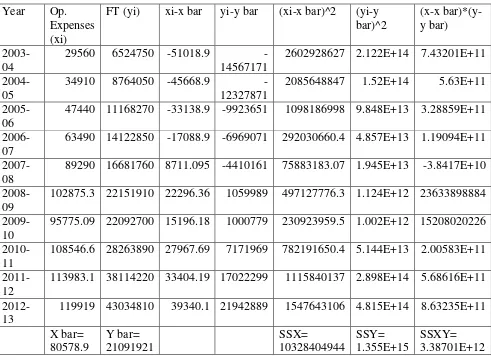
Table 4.7.4 India’s Foreign Trade and FBs’ Op. Expenses INR million
Year Op. Expenses (xi)
FT (yi) xi-x bar yi-y bar (xi-x bar)^2 (yi-y bar)^2
(x-x bar)*(y-y bar)
2003-04
29560 6524750 -51018.9 -14567171
2602928627 2.122E+14 7.43201E+11
2004-05
34910 8764050 -45668.9 -12327871
2085648847 1.52E+14 5.63E+11
2005-06
47440 11168270 -33138.9 -9923651 1098186998 9.848E+13 3.28859E+11
2006-07
63490 14122850 -17088.9 -6969071 292030660.4 4.857E+13 1.19094E+11
2007-08
89290 16681760 8711.095 -4410161 75883183.07 1.945E+13 -3.8417E+10
2008-09
102875.3 22151910 22296.36 1059989 497127776.3 1.124E+12 23633898884
2009-10
95775.09 22092700 15196.18 1000779 230923959.5 1.002E+12 15208020226
2010-11
108546.6 28263890 27967.69 7171969 782191650.4 5.144E+13 2.00583E+11
2011-12
113983.1 38114220 33404.19 17022299 1115840137 2.898E+14 5.68616E+11
2012-13
119919 43034810 39340.1 21942889 1547643106 4.815E+14 8.63235E+11
X bar= 80578.9 Y bar= 21091921 SSX= 10328404944 SSY= 1.355E+15 SSXY= 3.38701E+12
b=SSXY/SSX = 3.38701E+12 /10328404944=327.9315653 and a= y bar –b * x bar = 21091921 – (327.9315653*80578.9) = -5332443.807 Value b =327.9315653 is the change in the value of Y for a unit change in the value of X. The intercept is a
constant or the value of Y when X is zero. The values of a and b obtained using least
square method are called as least square estimates (LSE) of a and b. The values of a
and b obtained using least square method are called as least square estimates (LSE) of
a and b. Also the relation between the correlation coefficient for X and Y (r) and LSE
of b is given as under:-
𝒓 = 𝒃√(∫ (𝒙𝒊 − 𝒙𝒃𝒂𝒓)^𝟐)/(∫ 𝒚𝒊 − 𝒚𝒃𝒂𝒓)^𝟐)𝒊=𝒏 𝒊=𝟏
𝒊=𝒏
𝒊=𝟏
[image:23.595.76.567.151.511.2]=327.9315653 * (10328404944 /1.355E+15 )^0.5 = 0.905378554 In the above model
Y=a + Bx + error , if b = 0 , then the model cannot be considered as a linear model.
Therefore, here we test Ho: b=0 against Ha: b≠0, the test statistic is 𝑻𝒄 = 𝒃𝒃𝒂𝒓
√𝑺𝑺𝒀/(𝒏−𝟐)𝑺𝑺𝑿
= (327.9315653) / ((1.355E+15)/(( 24-2)*( 10328404944 )))^0.5
= 4.246601837
At 5% level of significance and 22 d.f., the critical value using t distribution is 2.074
which is smaller than the computed value. Therefore, at 5% level of significance we
reject the null hypothesis and conclude that there is an evidence of linear relationship
between the independent variable-Op. Expenses and the dependent variable-FT
Graph 4.7.4 Operating Expenses Vs FT- Scattered Plot
Using SPSS the calculated value of ‘R’ is 0.905 and ‘R square’ is 0.819. Also the calculated value of standardised coefficient ‘Beta’ is 0.905. Since these values are closer to 1, it is concluded that there exists linear correlation between independent
variable ‘Operating Expenses’ and dependent variable ‘Foreign Trade’. This means that regression explains most of the variability in the dependent variable and the fitted model
is good.
0 5000000 10000000 15000000 20000000 25000000 30000000 35000000 40000000 45000000 50000000
0 20000 40000 60000 80000 100000 120000 140000
FT
-De
p
e
n
d
e
n
t
Vari
a
b
le
Op.Expences-Independent Variable
Table 4.7.5 India’s Foreign Trade and FBs’ Total Expenses INR million : - Statistical Test using Regression Analysis: - y= a + bx
x = Total Expenses, independent variable y = Foreign Trade (FT), dependent variable
Year Total Expenses (xi)
FT (yi) xi-x bar yi-y bar (xi-x bar)^2 (yi-y bar)^2 (x-x bar)*(y-y bar)
2003-04
64670 6524750 101342.089
-14567171
10270219003 2.12202E+14 1.47627E+12
2004-05
68030 8764050 -97982.089
-12327871
9600489765 1.51976E+14 1.20791E+12
2005-06
88920 11168270 -77092.089 -9923651 5943190186 9.84788E+13 7.65035E+11
2006-07
126360.8805 14122850
-39651.20852
-6969071 1572218337 4.8568E+13 2.76332E+11
2007-08
179156.2976 16681760 13144.20862 4410161 172770220.2 1.94495E+13
-57968076220
2008-09
214029.0414 22151910 48016.95243 1059989 2305627721 1.12358E+12 50897441391
2009-10
176456.7485 22092700 10444.65947 1000779 109090911.3 1.00156E+12 10452795855
2010-11
204374.008 28263890 38361.919 7171969 1471636829 5.14371E+13 2.7513E+11
2011-12
248835.414 38114220 82823.325 17022299 6859703164 2.89759E+14 1.40984E+12
2012-13
289288.5 43034810 123276.411 21942889 15197073509 4.8149E+14 2.70504E+12
X bar= 166012.089 Y bar= 21091921 SSX= 53502019646 SSY= 1.35549E+15 SSXY= 8.11894E+12 b=SSXY/SSX =8.11894E+12 /53502019646 = 151.7501592 and a= y bar –b * x bar
=21091921 - 151.7501592 *166012.089 = -4100439.935. The value b =151.7501592
is the change in the value of Y for a unit change in the value of X. The intercept is a
constant or the value of Y when X is zero. The values of a and b obtained using least
square method are called as least square estimates (LSE) of a and b. Also the relation
between the correlation coefficient for X and Y (r) and LSE of b is given as under:-
𝒓 = 𝒃√(∫ (𝒙𝒊 − 𝒙𝒃𝒂𝒓)^𝟐)/(∫ 𝒚𝒊 − 𝒚𝒃𝒂𝒓)^𝟐)𝒊=𝒏 𝒊=𝟏
𝒊=𝒏
𝒊=𝟏
= b√((SSX)/SSY)
[image:25.595.59.583.173.541.2]In the above model Y=a + Bx + error , if b = 0 , then the model can not be considered
as a linear model. Therefore, here we test Ho: b=0 against Ha: b≠0, the test statistic is
𝑻𝒄 =√𝑺𝑺𝒀/(𝒏−𝟐)𝑺𝑺𝑿𝒃𝒃𝒂𝒓
= (151.7501592) / ((1.35549E+15)/(( 24-2)*( 53502019646 )))^0.5
= 4.471749067 At 5% level of significance and 22 d.f., the critical value using t
distribution is 2.074 which is smaller than the computed value. Therefore, at 5% level
of significance we reject the null hypothesis and conclude that there is an evidence of
linear relationship between the independent variable- Total Expences and the
dependent variable-Foreign Trade FT
Graph 4.7.5 Total Expenses Vs FT- Scattered Plot
Graph 4.7.6 India’s Foreign Trade and FBs’ Yearly Expenses
Values for FT in INR million x 1000 whereas
Values for Op. Expenses & Total Expenses in INR million
0 5000000 10000000 15000000 20000000 25000000 30000000 35000000 40000000 45000000 50000000
0 50000 100000 150000 200000 250000 300000 350000
FT
-De
p
e
n
d
e
n
t
Vari
a
b
le
Total Expences-Independent Variable
Total Expenses Vs FT
Scattered Plot
0 10000 20000 30000 40000 50000
2003-04 2004-05 2005-06 2006-07 2007-08 2008-09 2009-10 2010-11 2011-12 2012-13
FT &FBs Yearly Expenses
Using SPSS the calculated value of ‘R’ is 0.953 and ‘R square’ is 0.909. Also the calculated value of standardised coefficient ‘Beta’ is 0.953. Since these values are closer to 1, it is concluded that there exists linear correlation between independent
variable ‘Total Expenses’ and dependent variable ‘Foreign Trade’. This means that regression explains most of the variability in the dependent variable and the fitted model
is good. Advisory and promotional services are part of operating expenses and total
expenses. From above statistical tests, tables and graphs it is observed that with increase
in operating expenses or total expenses there is increase in foreign trade. There exists a
linear relationship between an independent variable and a dependent variable. This
follows the equation y=a +bx. Hence H1 is acceptable whereas HO is rejected.
4.8 Conclusions: -Conclusionsemerging out on the basis of the research are as under:
4.8.1 Dependency: - The present study reveals that the three models of foreign banks
covering financing of foreign trade depends on the indicators covered under Factor F1,
Factor F2, Factor F4, Factor F8 involving variables in principle like M-EXDEM, log
(M-FT), Net Profit, FIN, Profit per Employee, EIR, Return on Advances, Profit per
Employee, Business per Employee which are termed as “PositivePush” having positive values.
4.8.2 Enhancing probability of financing: - So to enhance the probability of the foreign
banks for financing covering foreign trade, the other aspects should be taken care of
which are covered under Factor F3, Factor F5, Factor F6 and Factor F7.
4.8.3 It is concluded that there is no authentic declaration of self – defined model by any foreign banks operating in India.
4.8.4 Covering Basic Elements: - Although all 24 cases of foreign banks are covering
elements of basic business models like interest model, investment model, retail
financing model or profitability model etc., emphasis on these basic elements varies
from institution to institution. Hence, these foreign banks are grouped into three clusters
possessing totally different values for all eight number factors as indicated by the graph.
4.8.5 Least & Medium Values:-We can very well conclude that ‘Low End Also Ran
‘Model-A possesses least values for eight factors indicating that these foreign banks are carrying out minimum acceptable level of business including financing of foreign trade
as indicated by the values of factors whereas, ‘Progressive Medium End Economic’
4.8.6 Highest Level:-It is conclude that ‘High End Star ‘Model-C possesses highest level for eight factors indicating that these FFIs are carrying out excellent level of
business including financing of foreign trade as indicated by the values of eight factors.
4.8.7 Since, the contribution of foreign banks in overall credit allocation amounts to a
small figure of mere 5.75 percent it is concluded that the foreign banks are not
effectively using their available resources to counter the challenges posed by the other
financial institutions especially for the allocation of advances to manufacturing /trading.
4.8.8 Since, the contribution of foreign banks in overall investment allocation amounts
to a non-significant figure of mere 7.84 percent it is concluded that the foreign banks
are not taking full advantage of the buoyancy in economic growth and not expanding
financial activities in all segments including priority sector.
4.8.9 Based on the research findings it is concluded that the foreign banks are not
initiating efforts on adopting the new technologies in order to improve their customer
service levels and provide new delivery platforms to them, especially in the rural area
other than metro cities and urban area.
4.8.10On the basis of the study, we conclude that only Model-C possesses prominent
values for eight Factors considering involved positive push or negative pull for
financing of foreign trade for foreign banks during the observation period. This trend is
followed by Model-B and further by Model-A with drastic decrease in values for eight
Factors. Positive push effect of Factors indicates that the foreign banks maintain the
proper balance in financial/foreign trade variables and able to minimize the financial
burden on it, which directly enhances the profitability and foreign banks’ survival in stiff competition with grace. Thus, it is concluded that this research is helpful to the
BIBLIOGRAPHY
1 Amit R., Zott C.(2001) “Value Creation in E-Business”. Strategic Management Journal, 22(6/7), pp. 493.
2 Amit. R, Zott C. (2011) “The business model”Journal of management, 37(4), pp. 1019
3 A.Afuah (2004) “Business models: a strategic management approach”. Boston: McGraw-Hill/Irwin.
4 AYADI, R., ARBAK, E. and DE GROEN, W.P., 2011. BUSINESS MODELS IN
EUROPEAN BANKING: A PRE-AND POST-CRISIS SCREENING. Centre for
European Policy Studies: Centre for European Policy Studies.
5 AYADI, R., ARBAK, E. and DE GROEN, W.P., 2012. REGULATION OF
EUROPEAN BANKS AND BUSINESS MODELS: TOWARDS A NEW
PARADIGM? Centre for European Policy Studies: Centre for European Policy
Studies.
6 Adrian Blundell-Wignall and Caroline Roulet (2013) “Business models of banks, leverage and the distance-to-default” OECD Journal: Financial Market Trends Volume 2012/2
7 Adrian Blundell-Wignall, Paul Atkinson and Caroline Roulet (2014) “Bank
business models and the Basel system Complexity and interconnectedness” OECD
Journal: Financial Market Trends Volume: 2013, Issue: 2Pages 43–68
8 Benson Kunjukunju(2006) “Reforms in Banking Sector and Their Impact in Banking Services,” SAJOSPS, July-December 2006, pp.77-81
9 Christian Weller, (1999) “The Connection between More Multinational Banks and Less Real Credit in Transition Economies, Working Paper B8, Center for European
Integration Studies, Bonn, 1999”
10 Daniel Perez Liston and Lawrence McNeil-Prairie View A&M University (2013)
“The impact of trade finance on international trade: Does financial development matter?” Research in Business and Economics Journal -2013
11 GEORGE, G. and BOCK, A.J., (2011) The Business Model in Practice and its
Implications for Entrepreneurship Research. Entrepreneurship Theory and Practice,
35(1), pp. 83.
12 Gaurav Shard and Namratha Swamy 2014 “Impact of Foreign Banks on the Indian
13 Joydeep Bhattachrya (1994) “The Role of Foreign Banks in Developing Countries:
A Survey of the Evidence” Department of Economics, IOWA State University USA.
14 Kavaljit Singh (2006) “Entry of Foreign Banks in India and China: A Brief Note: was prepared by the author in March 2006 for discussion among activists and
campaigners associated with BankTrack.
15 Liston and Prairie (2013) “The impact of trade finance on international trade: Does
financial development matter?” Research in Business and Economics Journal -2013 16 Mandira Sarma and Anjali Prashad (2014) “Do Foreign Banks in India Indulge in
Cream Skimming?” Paper presented at the Annual International Studies Convention,
Jawaharlal Nehru University, and New Delhi. 10–12 December
17 Osterwalder A., Pigneur Y. et al. (2005) “Clarifying Business Models: Origins,
Present, and Future of the Concept”. Communications of the Association for
Information Systems, 16, pp.
18 Osterwalder A. and Y. Pigneur Y. (2010) “Business model generation.” Wiley - LA English.
19 Pinches GE et al. (1973) , Mingo KA, Caruthers JK (1973) The stability of
financial patterns in industrial organizations. J Finance 28(3):389–396
20 Pedrotti (2014) A Model for the Interest Margin of a Risk-neutral Bank. The Role
of the Bank Orientation, Journal of Entrepreneurial and Organizatinal Diversity ,
Publication date: 17 June 2014 | Vol.3, Issue 1 (2014) 167-180
21 Zott, C. and Amit, R., 2007. Business Model Design and the Performance of
Annexure 1:-Performance of Selected FFIs (which are operating consistently as
per profile of banks RBI during 2003-2013 (Values in INR Million))
Case
No
Name of FFI Business Advances Investment
1 AB Bank Limited 689.20 374.33 127.86
2 Abu Dhabi Commercial Bank Limited 7597.23 2021.00 4178.72
3 Antwerp Diamond Bank N.V. 5592.99 5399.19 1603.60
4 Bank of America NA 81790.70 42689.60 43381.06
5 Bank of Bahrain and Kuwait B.S.C. 8109.92 3580.48 2139.22
6 Bank of Ceylon 1717.35 586.24 408.86
7 Barclays Bank PLC 71792.28 51374.34 62156.03
8 BNP Paribas 71871.31 37821.67 26126.57
9 CTBC Bank Co.,Ltd. 2651.91 1637.60 401.47
10 Citibank N.A. 757288.94 345373.51 230106.83
11 DBS Bank Ltd. 70173.18 46119.61 67793.86
12 Deutsche Bank AG 243959.31 92063.16 69540.06
13 JPMorgan Chase Bank 35019.65 17135.28 70139.71
14 Krung Thai Bank Public Company Ltd. 917.28 114.91 282.61
15 Mashreq bank psc 618.35 355.27 739.81
16 Mizuho Bank Ltd. 19109.32 16092.98 3969.87
17 Shinhan Bank 8699.00 4332.52 1887.69
18 Societe Generale 15232.36 5664.84 14498.80
19 Sonali Bank Ltd. 353.18 89.93 56.04
20 Standard Chartered Bank 758245.01 369421.38 170748.12
21 State Bank of Mauritius Ltd. 7215.56 3994.01 2201.44
22 The Bank of Nova Scotia 66185.25 44802.37 19798.60
23 The Bank of Tokyo-Mitsubishi UFJ, Ltd. 42134.03 30815.38 13493.78
24 The Hong-Kong and Shanghai Banking Corpn.Ltd. 651544.67 241832.05 260351.51
Source: - https://www.rbi.org.in/Scripts/Publications.aspx?publication=Annual
Annexure 1 indicates that there are 24 number FFIs operating in India consistently
during the period 2003-04 to 2012-13, i.e. there is no break in allocation of advances,
investment or their business. Also there is substantial increase in their business,
Annexure 2:-List of Variables and Factor/Component Score Coefficient Matrix
F-1 F-2 F-3 F-4 F-5 F-6 F7 -F-8 M-EXDEM 0.079 0.003 -0.073 0.045 -0.044 -0.091 -0.1 -0.091 log(M-FT) -0.001 -0.061 -0.05 0.079 -0.019 -0.133 -0.184 -0.268 log(CTGDP) 0 0.035 0.045 -0.075 0.011 0.138 0.169 0.31 FIN 0.037 0.59 0.091 0.051 -0.075 -0.188 0.096 -0.706 EIR 0.051 0.147 0.023 0.806 -0.307 -0.028 -0.003 0.346 Advances 0.06 -0.037 -0.039 -0.025 0.054 0.017 -0.005 -0.038 Interest
Income 0.066 0.005 -0.017 0.024 -0.011 -0.028 -0.021 -0.03 Net Profit 0.074 0.011 -0.091 0.002 -0.008 -0.048 -0.122 -0.108 Net Worth 0.05 0.027 0.055 0.036 0.001 0 0.023 0.151 Deposits 0.072 0.009 -0.039 0.038 -0.047 -0.05 -0.066 -0.057 Investments 0.069 0.111 0.03 0.115 -0.155 -0.116 -0.068 0.045 Other
Income 0.061 -0.007 -0.008 0.013 0.008 -0.005 -0.03 0.009 Total
Income 0.065 0.002 -0.015 0.021 -0.006 -0.023 -0.024 -0.02 Interest
Expended 0.067 0.022 -0.007 0.017 -0.004 -0.026 0.021 -0.085 Operating
Expenses 0.057 -0.023 0.022 0.028 0 0.005 0.011 0.059 Total
Expenses 0.062 -0.002 0.007 0.022 -0.002 -0.008 0.014 -0.015 Cost of
Funds -0.025 0.002 0.104 0.006 0.223 0.073 0.982 -0.035 Return on
Advances -0.036 -0.152 0.437 0.051 0.127 0.001 0.224 0.746 Return on
Assets -0.011 0.007 -0.074 -0.194 0.961 0.071 0.215 0.083 CRAR 0.003 -0.139 -0.122 0.248 0.21 0.138 -0.038 -0.091 Net NPA 0.045 0.228 -0.104 -0.015 -0.124 -1.044 -0.11 0.181
Total Assets
6.10E-02 0.002 -0.008 0.026 0.008 -0.03 -0.024 0.05 Operating
Profit
7.10E-02
2.00E-02 -0.045 0.032 -0.033 -0.055 -0.085 -0.029 Profit per
Employee
-1.00E-02
3.71E-01 -0.02 0.12 0.131 -0.197 -0.066 0.511 Business per
Employee
-2.20E-02
-2.00E-02 -0.336 -0.065 -0.136 0.013 -0.31 0.489 No. of
Employees
6.70E-02
-2.70E-02 -0.003 -0.019 0.025 0.041 0.03 -0.213 No. of
Offices
6.30E-02
-5.10E-02 -0.028 -0.088 0.118 0.101 0.095 -0.361 Wages as %
of TE
-3.10E-02
1.38E-01 0.565 -0.076 -0.267 0.136 -0.118 -0.219
Extraction Method: Principal Component Analysis.
Annexure 3:- Mean or average values of variables for a period 2003-04 to 2012-13.
1 2 3 4 5 6 7 8 9
Case
Interest Net NetNo.
MEXDEM log(MFT) log(CTGDP)FIN EIR Advances Income Profit Worth1
0.011302 8.520946 0.716171 0.728676 11.7043 0.075151 43.8134 47.93819 531.56552
1.993978 6.274364 4.005062 0.81605 29.5134 0.405733 596.4668 144.6181 1433.9423
2.044258 6.263548 3.882866 1.252066 6.986132 1.083933 377.1952 86.5328 1819.674
437.2524 3.933352 7.378122 1.052328 14.47222 8.570286 6178.131 3443.636 25838.45
1.808457 6.316776 3.991011 0.705273 13.39842 0.718812 479.7283 111.3826 1295.6536
0.056594 7.821317 1.812312 0.579443 22.19721 0.117693 130.1293 85.73568 876.33677
753.9447 3.696745 7.558103 1.581373 17.64512 10.31382 9065.067 -439.026 35880.328
233.3098 4.206151 7.049174 0.88976 12.99163 7.593009 4913.651 1366.48 13033.789
0.155231 7.383107 2.439222 0.768909 11.47449 0.328762 187.9065 13.712 910.336910
18764.13 2.300756 9.977276 0.759922 15.56539 69.33656 53758.74 16679.69 99661.9911
738.2202 3.705898 7.539043 1.623319 18.09345 9.258889 8344.631 2310.356 13996.9612
1511.579 3.394653 8.391434 0.662419 15.37398 18.48243 14153.77 5001.229 39262.513
283.7692 4.121119 6.821963 2.492172 31.29069 3.440048 5361.748 3264.549 24558.3514
0.007668 8.6894 0.671873 0.433381 71.51781 0.02307 82.1844 21.0976 443.565315
0.062057 7.781292 1.408714 1.77097 36.58039 0.071324 129.9595 82.2996 839.757716
15.08425 5.39556 5.284455 1.049899 7.917961 3.230798 1274.236 594.851 13221.2117
1.931007 6.2883 4.049939 0.71505 15.82302 0.869791 685.5371 213.9429 2814.71318
19.39233 5.286454 5.295083 1.323737 25.75065 1.137264 1458.734 298.1882 4359.76719
0.00119 9.498512 -0.55174 0.413322 15.96035 0.018055 14.3541 9.499031 62.421220
14893.19 2.401096 9.877483 0.712394 13.99471 74.16436 51699.46 18836.64 92940.921
2.075999 6.256857 4.000183 0.858625 14.86414 0.801832 593.6765 85.40633 2273.81322
209.4332 4.253039 6.966492 0.976063 8.902914 8.994443 3988.717 1584.072 8600.66323
98.17731 4.582073 6.44133 1.051624 9.293006 6.18644 2863.675 1060.98 16126.01Annexure 3 continued: - Mean or average values of variables for a period 2003-04
to 2012-13.
10 11 12 13 14 15 16 17 18
Return
Case
Other Total Interest Operating Total Cost of onNo.
Deposits InvestmentsIncome Income Expended Expenses Expenses Funds Advances1
417.1836 0.100436 94.0111 137.8245 5.2742 51.8309 57.1051 1.592846 6.3543552
7750.156 3.282207 123.4759 668.2895 619.1629 200.8647 498.5562 5.725984 3.2306533
629.8798 1.25956 108.4462 483.2839 162.062 96.7826 271.1048 2.224303 2.8928334
41952.85 34.07395 3427.549 9605.212 2302.402 2203.741 4506.562 3.166396 4.4906035
4782.346 1.680269 90.7858 569.6926 256.1434 149.5937 405.7836 4.464146 4.703486
951.2952 0.321147 57.6074 188.2314 42.8481 33.923 76.22146 4.18408 6.6470477
45184.81 48.82088 2625.642 11689.79 4546.924 4413.386 8796.007 5.193408 9.2050748
35091.98 20.52129 1626.03 5986.015 2189.788 2063.796 4247.156 5.077408 3.3290569
995.5634 0.315342 29.0727 216.229 64.6503 89.2132 157.1371 4.340328 4.73743410
447915.7 180.739 17177.3 70935.49 19982.92 21144.78 41128.27 3.317731 6.87336711
59807.56 53.24915 1044.025 9388.656 4701.185 1731.285 6432.47 4.594502 2.83032912
112327.7 54.62072 7744.555 21899.64 4553.562 8116.914 12665.88 3.233051 5.9005613
43242.6 55.09172 2836.417 8204.067 2252.027 1219.237 3470.678 2.615328 2.29487514
866.9246 0.221984 14.1611 96.314 28.7083 30.9674 59.3 3.157066 5.26696115
955.5095 0.581091 114.1018 241.6044 70.6079 69.2621 137.5054 3.384267 3.3498816
6288.849 3.118168 396.0624 1670.584 296.2555 348.1234 644.0441 3.490809 3.85529117
5578.31 1.482705 93.8473 782.2434 278.2324 134.0562 412.228 3.425068 4.94330918
9648.415 11.38818 271.6336 1730.336 851.7249 482.903 1334.35 4.239087 3.90691319
294.5599 0.04402 48.3475 63.14486 9.0565 37.0362 45.39638 1.885575 8.14936320
416442.7 134.1153 20082.57 71852.82 21533.57 19433.5 40966.16 3.978731 6.4873121
3641.168 1.729137 75.862 670.1248 381.7894 83.5198 465.6713 7.224513 2.02162422
32306.82 15.55095 1274.11 5262.895 2393.521 500.8424 2894.537 4.258191 2.03430323
17542.37 10.59878 820.067 3683.498 1019.768 648.711 1668.142 2.739569 4.286336Annexure 3 continued: - Mean or average values of variables for a period 2003-04
to 2012-13.
19
20
21
22
23
24
25
26
27
28
Return
Profit
Business
Wages
Case
on
Total
Operating Per
Per
No.of
No.of
as a
No.
Assets
CRAR
Net NPA Assets
Profit
Employee Employee Employee Offices
% of TE
1
4.704
61.474
3.313 1004.768 82.4107
1.576 24.7026
27.9
1 18.07216
2
1.039
43.026
5.98 10274.44 169.7357 1.09029 168.4531
45.1
2 12.11498
3
0.89
36.901
2.267 9474.317 257.1901
3.2758 256.5594
21.8
1 18.36223
4
2.797
18.058
0 148290.5 6094.65
9.1727 263.7559
310.1
5 25.01976
5
0.658
24.114
3.439 8819.033
192.91
0.41
89.12
91
2 16.09609
6
2.927
57.625
7.832 2316.229 131.009
2.2425 58.0186
29.6
1 14.29878
7
1.901
19.875
1.481 240573.3 3527.787
6.6371 101.7176
705.8
5 31.57544
8
1.26
13.386
0.093
121104 2951.904
3.02 216.5451
331.9
9.1 21.58325
9
-0.392
37.548
2.926 3049.052 59.0937 -0.3512 94.7111
28
1.1 19.39872
10
2.479
13.689
1.395 1138294 37331.23
3.0513 174.6354
4336.4
39.3 16.20449
11
1.012
24.428
0.488 180835.9 5230.27
3.0249 192.6776
364.2
6.4 17.18687
12
1.871
14.251
0.235
302167 10628.74
3.7534 164.8151
1480.2
11 26.88934
13
2.706
20.401
0.844 167094.7 6107.39 13.7328 219.0097
159.9
1 24.44333
14
1.788
91.214
0 1815.272 39.0304
1.9135 89.0565
10.3
1 13.40693
15
4.535
72.071
0 4663.985 120.098
5.3007 45.8039
13.5
1.7 26.32301
16
2.227
46.5
0.25 113444.4 1131.529
3.9013 170.619
112
1.7 23.23686
17
1.962
53.25
0.08 15428.12 411.0154
3.8496 183.9114
47.3
2 13.89535
18
1.276
32.079
0.137 27607.41 485.9805
2.5831 158.3406
96.2
2.1 19.39847
19
2.18
46.447
4.579 476.9954 17.72746
0.2133
9.5456
37
1.7 48.85536
20
2.465
11.219
1.105 1068690 35833.66
2.1989 107.8953
7027.6
89.2 19.22794
21
1.166
39.378
1.988 10555.3 195.3515
2.1
211.6
34.1
3 6.989311
22
1.609
15.07
1.36 97942.94 2747.365
6.5996 343.2845
192.8
5 7.167538
23
2.118
40.831
0.011 83137.66 2212.355
4.3942 229.4882
183.6
3.1 22.46892
Annexure-4 Case wise calculations of values of 8 number factors:- Case No Factor-1 Factor-2 Factor-3 Factor-4 Factor-5 Factor-6 Factor-7 Factor-8
1 153.19 16.65 -8.74 93.12 -7.61 -55.33 -66.94 101.85
2 1454.31 144.33 -397.18 698.33 -323.27 -758.98 -816.36 267.57
3 831.00 80.16 -110.63 373.25 -0.37 -353.76 -354.63 781.64
4 15896.68 1546.18 -2306.81 7191.02 -1152.21 -7557.46 -7119.14 7919.86
5 1098.70 106.91 -239.53 514.67 -181.21 -549.23 -564.50 327.67
6 304.73 43.83 -41.68 170.63 -34.55 -135.81 -143.32 197.56
7 22665.80 1947.68 -2124.05 10303.29 -492.44
-10379.32
-8549.24 13907.07
8 12253.56 1000.25 -2081.33 5505.55 -903.19 -5976.61 -5587.55 5420.26
9 355.66 46.53 -44.35 179.31 -39.49 -151.50 -158.28 255.81
10 126632.3
7
10035.12
-27215.16
57051.91
-14982.28 -64862.55 -63737.27 37029.63
11 18696.81 1514.12 -3803.40 8369.58 -1761.95 -9471.92 -9043.40 6467.22
12 34207.79 2868.54 -6118.46 15419.74 -3535.42
-16685.74
-16132.75
12517.40
13 16735.02 1598.96 -2524.03 7591.41 -1043.39 -8108.74 -7602.53 8649.79
14 221.58 35.98 -59.45 178.26 -43.80 -93.66 -128.57 156.14
15 45