An Error-Driven Word-Character Hybrid Model
for Joint Chinese Word Segmentation and POS Tagging
Canasai Kruengkrai†‡ and Kiyotaka Uchimoto‡ and Jun’ichi Kazama‡Yiou Wang‡ and Kentaro Torisawa‡ and Hitoshi Isahara†‡ †Graduate School of Engineering, Kobe University
1-1 Rokkodai-cho, Nada-ku, Kobe 657-8501 Japan
‡National Institute of Information and Communications Technology
3-5 Hikaridai, Seika-cho, Soraku-gun, Kyoto 619-0289 Japan
{canasai,uchimoto,kazama,wangyiou,torisawa,isahara}@nict.go.jp Abstract
In this paper, we present a discriminative word-character hybrid model for joint Chi-nese word segmentation and POS tagging. Our word-character hybrid model offers high performance since it can handle both known and unknown words. We describe our strategies that yield good balance for learning the characteristics of known and unknown words and propose an error-driven policy that delivers such balance by acquiring examples of unknown words from particular errors in a training cor-pus. We describe an efficient framework for training our model based on the Mar-gin Infused Relaxed Algorithm (MIRA), evaluate our approach on the Penn Chinese Treebank, and show that it achieves supe-rior performance compared to the state-of-the-art approaches reported in the litera-ture.
1 Introduction
In Chinese, word segmentation and part-of-speech (POS) tagging are indispensable steps for higher-level NLP tasks. Word segmentation and POS tag-ging results are required as inputs to other NLP tasks, such as phrase chunking, dependency pars-ing, and machine translation. Word segmenta-tion and POS tagging in a joint process have re-ceived much attention in recent research and have shown improvements over a pipelined fashion (Ng and Low, 2004; Nakagawa and Uchimoto, 2007; Zhang and Clark, 2008; Jiang et al., 2008a; Jiang et al., 2008b).
In joint word segmentation and the POS tag-ging process, one serious problem is caused by unknown words, which are defined as words that are not found in a training corpus or in a
sys-tem’s word dictionary1. The word boundaries and
the POS tags of unknown words, which are very difficult to identify, cause numerous errors. The word-character hybrid model proposed by Naka-gawa and Uchimoto (NakaNaka-gawa, 2004; NakaNaka-gawa and Uchimoto, 2007) shows promising properties for solving this problem. However, it suffers from structural complexity. Nakagawa (2004) described a training method based on a word-based Markov model and a character-based maximum entropy model that can be completed in a reasonable time. However, this training method is limited by the generatively-trained Markov model in which in-formative features are hard to exploit.
In this paper, we overcome such limitations concerning both efficiency and effectiveness. We propose a new framework for training the word-character hybrid model based on the Margin Infused Relaxed Algorithm (MIRA) (Crammer, 2004; Crammer et al., 2005; McDonald, 2006). We describek-best decoding for our hybrid model and design its loss function and the features appro-priate for our task.
In our word-character hybrid model, allowing the model to learn the characteristics of both known and unknown words is crucial to achieve optimal performance. Here, we describe our strategies that yield good balance for learning these two characteristics. We propose an error-driven policy that delivers this balance by acquir-ing examples of unknown words from particular errors in a training corpus. We conducted our ex-periments on Penn Chinese Treebank (Xia et al., 2000) and compared our approach with the best previous approaches reported in the literature. Ex-perimental results indicate that our approach can achieve state-of-the-art performance.
1A system’s word dictionary usually consists of a word
list, and each word in the list has its own POS category. In this paper, we constructed the system’s word dictionary from a training corpus.
Figure 1: Lattice used in word-character hybrid model.
Tag Description
B Beginning character in a multi-character word
I Intermediate character in a multi-character word
E End character in a multi-character word
S Single-character word
Table 1: Position-of-character (POC) tags.
The paper proceeds as follows: Section 2 gives background on the word-character hybrid model, Section 3 describes our policies for correct path selection, Section 4 presents our training method based on MIRA, Section 5 shows our experimen-tal results, Section 6 discusses related work, and Section 7 concludes the paper.
2 Background
2.1 Problem formation
In joint word segmentation and the POS tag-ging process, the task is to predict a path of word hypotheses y = (y1, . . . , y#y) = (hw1, p1i, . . . ,hw#y, p#yi) for a given character
sequence x = (c1, . . . , c#x), wherew is a word,
p is its POS tag, and a “#” symbol denotes the number of elements in each variable. The goal of our learning algorithm is to learn a mapping from inputs (unsegmented sentences)x∈ X to outputs (segmented paths)y ∈ Y based on training sam-ples of input-output pairsS ={(xt,yt)}Tt=1.
2.2 Search space representation
We represent the search space with a lattice based on the word-character hybrid model (Nakagawa and Uchimoto, 2007). In the hybrid model, given an input sentence, a lattice that consists of word-level and character-level nodes is con-structed. Word-level nodes, which correspond to
words found in the system’s word dictionary, have regular POS tags. Character-level nodes have spe-cial tags where position-of-character (POC) and POS tags are combined (Asahara, 2003; Naka-gawa, 2004). POC tags indicate the word-internal positions of the characters, as described in Table 1.
Figure 1 shows an example of a lattice for a
Chi-nese sentence: “ ” (Chongming is
China’s third largest island). Note that some nodes and state transitions are not allowed. For example,
IandEnodes cannot occur at the beginning of the lattice (marked with dashed boxes), and the transi-tions fromItoBnodes are also forbidden. These nodes and transitions are ignored during the lattice construction processing.
In the training phase, since several paths (marked in bold) can correspond to the correct analysis in the annotated corpus, we need to se-lect one correct pathytas a reference for training.2
The next section describes our strategies for deal-ing with this issue.
With this search space representation, we can consistently handle unknown words with character-level nodes. In other words, we use word-level nodes to identify known words and character-level nodes to identify unknown words. In the testing phase, we can use a dynamic pro-gramming algorithm to search for the most likely path out of all candidate paths.
2A machine learning problem exists called structured
3 Policies for correct path selection
In this section, we describe our strategies for se-lecting the correct path yt in the training phase. As shown in Figure 1, the paths marked in bold can represent the correct annotation of the seg-mented sentence. Ideally, we need to build a word-character hybrid model that effectively learns the characteristics of unknown words (with character-level nodes) as well as those of known words (with word-level nodes).
We can directly estimate the statistics of known words from an annotated corpus where a sentence is already segmented into words and assigned POS tags. If we select the correct path yt that corre-sponds to the annotated sentence, it will only con-sist of word-level nodes that do not allow learning for unknown words. We therefore need to choose character-level nodes as correct nodes instead of word-level nodes for some words. We expect that those words could reflect unknown words in the future.
Baayen and Sproat (1996) proposed that the characteristics of infrequent words in a training corpus resemble those of unknown words. Their idea has proven effective for estimating the statis-tics of unknown words in previous studies (Ratna-parkhi, 1996; Nagata, 1999; Nakagawa, 2004).
We adopt Baayen and Sproat’s approach as the baseline policy in our word-character hybrid model. In the baseline policy, we first count the frequencies of words3 in the training corpus. We
then collect infrequent words that appear less than or equal tortimes.4 If these infrequent words are
in the correct path, we use character-level nodes to represent them, and hence the characteristics of unknown words can be learned. For example, in Figure 1 we select the character-level nodes of the word “ ” (Chongming) as the correct nodes. As a result, the correct pathytcan contain both word-level and character-word-level nodes (marked with as-terisks (*)).
To discover more statistics of unknown words, one might consider just increasing the threshold value r to obtain more artificial unknown words. However, our experimental results indicate that our word-character hybrid model requires an ap-propriate balance between known and artificial
un-3We consider a word and its POS tag a single entry. 4In our experiments, the optimal threshold valueris
se-lected by evaluating the performance of joint word segmen-tation and POS tagging on the development set.
known words to achieve optimal performance. We now describe our new approach to lever-age additional examples of unknown words. In-tuition suggests that even though the system can handle some unknown words, many unidentified
unknown words remain that cannot be recovered by the system; we wish to learn the characteristics of such unidentified unknown words. We propose the following simple scheme:
• Divide the training corpus into ten equal sets and perform 10-fold cross validation to find the errors.
• For each trial, train the word-character hybrid model with the baseline policy (r = 1) us-ing nine sets and estimate errors usus-ing the re-maining validation set.
• Collect unidentified unknown words from each validation set.
Several types of errors are produced by the baseline model, but we only focus on those caused by unidentified unknown words, which can be eas-ily collected in the evaluation process. As de-scribed later in Section 5.2, we measure the recall on out-of-vocabulary (OOV) words. Here, we de-fine unidentified unknown words as OOV words in each validation set that cannot be recovered by the system. After ten cross validation runs, we get a list of the unidentified unknown words de-rived from the whole training corpus. Note that the unidentified unknown words in the cross val-idation are not necessary to be infrequent words, but some overlap may exist. Finally, we obtain the artificial unknown words that combine the uniden-tified unknown words in cross validation and in-frequent words for learning unknown words. We refer to this approach as theerror-driven policy.
4 Training method
4.1 Discriminative online learning
LetYt = {y1t, . . . ,yKt } be a lattice consisting of candidate paths for a given sentence xt. In the word-character hybrid model, the lattice Yt can contain more than 1000 nodes, depending on the length of the sentencextand the number of POS tags in the corpus. Therefore, we require a learn-ing algorithm that can efficiently handle large and complex lattice structures.
Algorithm 1Generic Online Learning Algorithm Input: Training setS={(xt,yt)}
T t=1 Output: Model weight vectorw
1: w(0)=0;v=0;i= 0
2: foriter= 1toNdo
3: fort= 1toT do
4: w(i+1)= updatew(i)according to(x t,yt)
5: v=v+w(i+1)
6: i=i+ 1
7: end for
8: end for
9: w=v/(N×T)
within a few iterations (McDonald, 2006). Algo-rithm 1 outlines the generic online learning algo-rithm (McDonald, 2006) used in our framework.
4.2 k-best MIRA
We focus on an online learning algorithm called MIRA (Crammer, 2004), which has the de-sired accuracy and scalability properties. MIRA combines the advantages of margin-based and perceptron-style learning with an optimization scheme. In particular, we use a generalized ver-sion of MIRA (Crammer et al., 2005; McDonald, 2006) that can incorporatek-best decoding in the update procedure. To understand the concept of k-best MIRA, we begin with a linear score function:
s(x,y;w) =hw,f(x,y)i, (1)
wherewis a weight vector andf is a feature rep-resentation of an inputxand an outputy.
Learning a mapping between an input-output pair corresponds to finding a weight vectorwsuch that the best scoring path of a given sentence is the same as (or close to) the correct path. Given a training example (xt,yt), MIRA tries to estab-lish a margin between the score of the correct path s(xt,yt;w) and the score of the best candidate paths(xt,ˆy;w)based on the current weight vector wthat is proportional to a loss functionL(yt,ˆy).
In each iteration, MIRA updates the weight vec-tor w by keeping the norm of the change in the weight vector as small as possible. With this framework, we can formulate the optimization problem as follows (McDonald, 2006):
w(i+1) =argminwkw−w(i)k (2)
s.t.∀ˆy∈bestk(xt;w(i)) :
s(xt,yt;w)−s(xt,ˆy;w)≥L(yt,ˆy),
where bestk(xt;w(i))∈ Y
trepresents a set of top k-best paths given the weight vector w(i). The
above quadratic programming (QP) problem can be solved using Hildreth’s algorithm (Yair Cen-sor, 1997). Replacing Eq. (2) into line 4 of Al-gorithm 1, we obtaink-best MIRA.
The next question is how to efficiently gener-ate bestk(xt;w(i)). In this paper, we apply a
dy-namic programming search (Nagata, 1994) to k-best MIRA. The algorithm has two main search steps: forward and backward. For the forward search, we use Viterbi-style decoding to find the best partial path and its score up to each node in the lattice. For the backward search, we use A∗ -style decoding to generate the topk-best paths. A complete path is found when the backward search reaches the beginning node of the lattice, and the algorithm terminates when the number of gener-ated paths equalsk.
In summary, we usek-best MIRA to iteratively updatew(i). The final weight vectorwis the av-erage of the weight vectors after each iteration. As reported in (Collins, 2002; McDonald et al., 2005), parameter averaging can effectively avoid overfitting. For inference, we can use Viterbi-style decoding to search for the most likely pathy∗for a given sentencexwhere:
y∗ =argmax
y∈Y
s(x,y;w). (3)
4.3 Loss function
In conventional sequence labeling where the ob-servation sequence (word) boundaries are fixed, one can use the 0/1 loss to measure the errors of a predicted path with respect to the correct path. However, in our model, word boundaries vary based on the considered path, resulting in a dif-ferent numbers of output tokens. As a result, we cannot directly use the 0/1 loss.
We instead compute the loss function through false positives (F P) and false negatives (F N). Here,F P means the number of output nodes that are not in the correct path, and F N means the number of nodes in the correct path that cannot be recognized by the system. We define the loss function by:
L(yt,ˆy) =F P +F N . (4)
ID Template Condition
W0 hw0i for word-level
W1 hp0i nodes
W2 hw0, p0i
W3 hLength(w0), p0i
A0 hAS(w0)i ifw0is a
single-A1 hAS(w0), p0i character word
A2 hAB(w0)i for word-level
A3 hAB(w0), p0i nodes
A4 hAE(w0)i
A5 hAE(w0), p0i
A6 hAB(w0), AE(w0)i
A7 hAB(w0), AE(w0), p0i
T0 hTS(w0)i ifw0is a
single-T1 hTS(w0), p0i character word
T2 hTB(w0)i for word-level
T3 hTB(w0), p0i nodes
T4 hTE(w0)i
T5 hTE(w0), p0i
T6 hTB(w0), TE(w0)i
T7 hTB(w0), TE(w0), p0i
C0 hcji, j∈[−2,2]×p0 for
character-C1 hcj, cj+1i, j∈[−2,1]×p0 level nodes
C2 hc−1, c1i ×p0
C3 hT(cj)i, j∈[−2,2]×p0
C4 hT(cj), T(cj+1)i, j∈[−2,1]×p0
C5 hT(c−1), T(c1)i ×p0
[image:5.595.73.307.59.353.2]C6 hc0, T(c0)i ×p0
Table 2: Unigram features.
4.4 Features
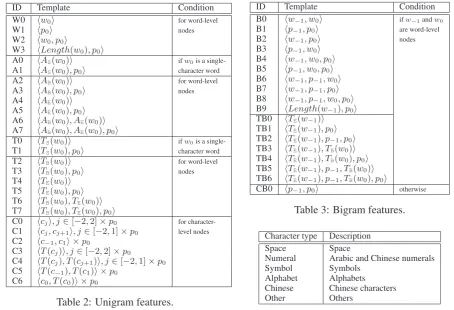
This section discusses the structure off(x,y). We broadly classify features into two categories: uni-gram and biuni-gram features. We design our feature templates to capture various levels of information about words and POS tags. Let us introduce some notation. We write w−1 and w0 for the surface
forms of words, where subscripts −1 and 0 in-dicate the previous and current positions, respec-tively. POS tagsp−1 andp0can be interpreted in
the same way. We denote the characters bycj. Unigram features: Table 2 shows our unigram features. Templates W0–W3 are basic word-level unigram features, whereLength(w0)denotes the
length of the word w0. Using just the surface
forms can overfit the training data and lead to poor predictions on the test data. To alleviate this prob-lem, we use two generalized features of the sur-face forms. The first is the beginning and end characters of the surface (A0–A7). For example, hAB(w0)i denotes the beginning character of the
current word w0, andhAB(w0), AE(w0)i denotes the beginning and end characters in the word. The second is the types of beginning and end charac-ters of the surface (T0–T7). We define a set of general character types, as shown in Table 4.
Templates C0–C6 are basic character-level
un-ID Template Condition B0 hw−1, w0i ifw−1andw0
B1 hp−1, p0i are word-level
B2 hw−1, p0i nodes
B3 hp−1, w0i
B4 hw−1, w0, p0i
B5 hp−1, w0, p0i
B6 hw−1, p−1, w0i
B7 hw−1, p−1, p0i
B8 hw−1, p−1, w0, p0i
B9 hLength(w−1), p0i
TB0 hTE(w−1)i
TB1 hTE(w−1), p0i
TB2 hTE(w−1), p−1, p0i
TB3 hTE(w−1), TB(w0)i
TB4 hTE(w−1), TB(w0), p0i
TB5 hTE(w−1), p−1, TB(w0)i
TB6 hTE(w−1), p−1, TB(w0), p0i
CB0 hp−1, p0i otherwise
Table 3: Bigram features.
Character type Description Space Space
Numeral Arabic and Chinese numerals Symbol Symbols
Alphabet Alphabets Chinese Chinese characters Other Others
Table 4: Character types.
igram features taken from (Nakagawa, 2004). These templates operate over a window of ±2
characters. The features include characters (C0), pairs of characters (C1–C2), character types (C3), and pairs of character types (C4–C5). In addi-tion, we add pairs of characters and character types (C6).
Bigram features: Table 3 shows our bigram features. Templates B0-B9 are basic word-level bigram features. These features aim to capture all the possible combinations of word and POS bigrams. Templates TB0-TB6 are the types of characters for bigrams. For example, hTE(w−1), TB(w0)i captures the change of
char-acter types from the end charchar-acter in the previ-ous word to the beginning character in the current word.
[image:5.595.66.521.61.371.2](a) Experiments on small training corpus
Data set CTB chap. IDs # of sent. # of words Training 1-270 3,046 75,169 Development 301-325 350 6,821 Test 271-300 348 8,008
# of POS tags 32
OOV (word) 0.0987 (790/8,008)
OOV (word & POS) 0.1140 (913/8,008)
(b) Experiments on large training corpus
Data set CTB chap. IDs # of sent. # of words Training 1-270, 18,089 493,939
400-931, 1001-1151
Development 301-325 350 6,821 Test 271-300 348 8,008
# of POS tags 35
OOV (word) 0.0347 (278/8,008)
OOV (word & POS) 0.0420 (336/8,008)
Table 5: Training, development, and test data statistics on CTB 5.0 used in our experiments.
5 Experiments
5.1 Data sets
Previous studies on joint Chinese word segmen-tation and POS tagging have used Penn Chinese Treebank (CTB) (Xia et al., 2000) in experiments. However, versions of CTB and experimental set-tings vary across different studies.
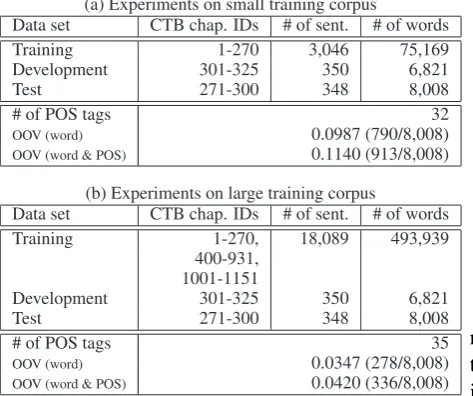
In this paper, we used CTB 5.0 (LDC2005T01) as our main corpus, defined the training, develop-ment and test sets according to (Jiang et al., 2008a; Jiang et al., 2008b), and designed our experiments to explore the impact of the training corpus size on our approach. Table 5 provides the statistics of our experimental settings on the small and large train-ing data. The out-of-vocabulary (OOV) is defined as tokens in the test set that are not in the train-ing set (Sproat and Emerson, 2003). Note that the development set was only used for evaluating the trained model to obtain the optimal values of tun-able parameters.
5.2 Evaluation
We evaluated both word segmentation (Seg) and joint word segmentation and POS tagging (Seg & Tag). We used recall (R), precision (P), and F1 as evaluation metrics. Following (Sproat and
Emerson, 2003), we also measured the recall on OOV (ROOV) tokens and in-vocabulary (RIV)
to-kens. These performance measures can be calcu-lated as follows:
Recall(R) = # of correct tokens
# of tokens in test data
P recision(P) = # of correct tokens
# of tokens in system output
F1 = 2·R·P
R+P
ROOV = # of OOV tokens in test data# of correct OOV tokens
RIV= # of IV tokens in test data# of correct IV tokens
For Seg, a token is considered to be a cor-rect one if the word boundary is corcor-rectly iden-tified. For Seg & Tag, both the word boundary and its POS tag have to be correctly identified to be counted as a correct token.
5.3 Parameter estimation
Our model has three tunable parameters: the num-ber of training iterations N; the number of top k-best paths; and the threshold r for infrequent words. Since we were interested in finding an optimal combination of word-level and character-level nodes for training, we focused on tuning r. We fixed N = 10 and k = 5 for all experiments. For the baseline policy, we varied r in the range of[1,5]and found that settingr = 3yielded the best performance on the development set for both the small and large training corpus experiments. For the error-driven policy, we collected unidenti-fied unknown words using 10-fold cross validation on the training set, as previously described in Sec-tion 3.
[image:6.595.70.513.62.273.2]5.4 Impact of policies for correct path selection
Table 6 shows the results of our word-character hybrid model using the error-driven and baseline policies. The third and fourth columns indicate the numbers of known and artificial unknown words in the training phase. The total number of words is the same, but the different policies yield differ-ent balances between the known and artificial un-known words for learning the hybrid model. Op-timal balances were selected using the develop-ment set. The error-driven policy provides addi-tional artificial unknown words in the training set. The error-driven policy can improveROOVas well
as maintain goodRIV, resulting in overallF1
[image:6.595.72.309.65.263.2](a) Experiments on small training corpus
# of words in training (75,169)
Eval type Policy kwn. art. unk. R P F1 ROOV RIV
Seg error-drivenbaseline 63,99764,999 11,17210,170 0.95870.9572 0.95090.9489 0.95480.9530 0.73040.7557 0.98090.9820
Seg & Tag error-drivenbaseline 63,99764,999 11,17210,170 0.89290.8897 0.88570.8820 0.88920.8859 0.52460.5444 0.93770.9367
(b) Experiments on large training corpus
# of words in training (493,939)
Eval Type Policy kwn. art. unk. R P F1 ROOV RIV
[image:7.595.103.496.70.218.2]Seg error-driven 442,423 51,516 0.9829 0.9746 0.9787 0.7698 0.9906 baseline 449,679 44,260 0.9821 0.9736 0.9779 0.7590 0.9902 Seg & Tag error-drivenbaseline 442,423449,679 51,51644,260 0.94070.9401 0.93280.9319 0.93670.9360 0.59520.5982 0.95570.9552
Table 6: Results of our word-character hybrid model using error-driven and baseline policies.
Method Seg Seg & Tag
Ours(error-driven) 0.9787 0.9367 Ours(baseline) 0.9779 0.9360 Jiang08a 0.9785 0.9341 Jiang08b 0.9774 0.9337 N&U07 0.9783 0.9332
Table 7: Comparison ofF1 results with previous studies on CTB 5.0.
Seg Seg & Tag
N&U07 Z&C08 Ours N&U07 Z&C08 Ours
Trial (base.) (base.)
1 0.9701 0.9721 0.9732 0.9262 0.9346 0.9358 2 0.9738 0.9762 0.9752 0.9318 0.9385 0.9380 3 0.9571 0.9594 0.9578 0.9023 0.9086 0.9067 4 0.9629 0.9592 0.9655 0.9132 0.9160 0.9223 5 0.9597 0.9606 0.9617 0.9132 0.9172 0.9187 6 0.9473 0.9456 0.9460 0.8823 0.8883 0.8885 7 0.9528 0.9500 0.9562 0.9003 0.9051 0.9076 8 0.9519 0.9512 0.9528 0.9002 0.9030 0.9062 9 0.9566 0.9479 0.9575 0.8996 0.9033 0.9052 10 0.9631 0.9645 0.9659 0.9154 0.9196 0.9225
[image:7.595.95.269.258.323.2]Avg. 0.9595 0.9590 0.9611 0.9085 0.9134 0.9152
Table 8: Comparison ofF1 results of our baseline model with Nakagawa and Uchimoto (2007) and Zhang and Clark (2008) on CTB 3.0.
Method Seg Seg & Tag
Ours(baseline) 0.9611 0.9152
Z&C08 0.9590 0.9134 N&U07 0.9595 0.9085 N&L04 0.9520
-Table 9: Comparison of averaged F1 results (by 10-fold cross validation) with previous studies on CTB 3.0.
5.5 Comparison with best prior approaches
In this section, we attempt to make meaning-ful comparison with the best prior approaches re-ported in the literature. Although most previous studies used CTB, their versions of CTB and
ex-perimental settings are different, which compli-cates comparison.
Ng and Low (2004) (N&L04) used CTB 3.0. However, they just showed POS tagging results on a per character basis, not on a per word basis. Zhang and Clark (2008) (Z&C08) generated CTB 3.0 from CTB 4.0. Jiang et al. (2008a; 2008b) (Jiang08a, Jiang08b) used CTB 5.0. Shi and Wang (2007) used CTB that was distributed in the SIGHAN Bakeoff. Besides CTB, they also used HowNet (Dong and Dong, 2006) to obtain seman-tic class features. Zhang and Clark (2008) indi-cated that their results cannot directly compare to the results of Shi and Wang (2007) due to different experimental settings.
We decided to follow the experimental settings of Jiang et al. (2008a; 2008b) on CTB 5.0 and Zhang and Clark (2008) on CTB 4.0 since they reported the best performances on joint word seg-mentation and POS tagging using the training ma-terials only derived from the corpora. The perfor-mance scores of previous studies are directly taken from their papers. We also conducted experiments using the system implemented by Nakagawa and Uchimoto (2007) (N&U07) for comparison.
Our experiment on the large training corpus is identical to that of Jiang et al. (Jiang et al., 2008a; Jiang et al., 2008b). Table 7 compares theF1
re-sults with previous studies on CTB 5.0. The result of our error-driven model is superior to previous reported results for both Seg and Seg & Tag, and the result of our baseline model compares favor-ably to the others.
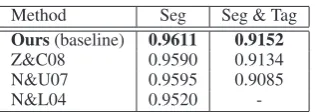
[image:7.595.104.262.569.625.2]vali-dation. Unfortunately, Zhang and Clark’s exper-imental setting did not allow us to use our error-driven policy since performing 10-fold cross val-idation again on each main cross valval-idation trial is computationally too expensive. Therefore, we used our baseline policy in this setting and fixed r = 3 for all cross validation runs. Table 8 com-pares the F1 results of our baseline model with
Nakagawa and Uchimoto (2007) and Zhang and Clark (2008) on CTB 3.0. Table 9 shows a sum-mary of averaged F1 results on CTB 3.0. Our
baseline model outperforms all prior approaches for both Seg and Seg & Tag, and we hope that our error-driven model can further improve perfor-mance.
6 Related work
In this section, we discuss related approaches based on several aspects of learning algorithms and search space representation methods. Max-imum entropy models are widely used for word segmentation and POS tagging tasks (Uchimoto et al., 2001; Ng and Low, 2004; Nakagawa, 2004; Nakagawa and Uchimoto, 2007) since they only need moderate training times while they pro-vide reasonable performance. Conditional random fields (CRFs) (Lafferty et al., 2001) further im-prove the performance (Kudo et al., 2004; Shi and Wang, 2007) by performing whole-sequence normalization to avoid label-bias and length-bias problems. However, CRF-based algorithms typ-ically require longer training times, and we ob-served an infeasible convergence time for our hy-brid model.
Online learning has recently gained popularity for many NLP tasks since it performs comparably or better than batch learning using shorter train-ing times (McDonald, 2006). For example, a per-ceptron algorithm is used for joint Chinese word segmentation and POS tagging (Zhang and Clark, 2008; Jiang et al., 2008a; Jiang et al., 2008b). Another potential algorithm is MIRA, which in-tegrates the notion of the large-margin classifier (Crammer, 2004). In this paper, we first intro-duce MIRA to joint word segmentation and POS tagging and show very encouraging results. With regard to error-driven learning, Brill (1995) pro-posed a transformation-based approach that ac-quires a set of error-correcting rules by comparing the outputs of an initial tagger with the correct an-notations on a training corpus. Our approach does
not learn the error-correcting rules. We only aim to capture the characteristics of unknown words and augment their representatives.
As for search space representation, Ng and Low (2004) found that for Chinese, the character-based model yields better results than the word-based model. Nakagawa and Uchimoto (2007) provided empirical evidence that the character-based model is not always better than the word-based model. They proposed a hybrid approach that exploits both the word-based and character-based models. Our approach overcomes the limi-tation of the original hybrid model by a discrimi-native online learning algorithm for training.
7 Conclusion
In this paper, we presented a discriminative word-character hybrid model for joint Chinese word segmentation and POS tagging. Our approach has two important advantages. The first is ro-bust search space representation based on a hy-brid model in which word-level and character-level nodes are used to identify known and un-known words, respectively. We introduced a sim-ple scheme based on the error-driven concept to effectively learn the characteristics of known and unknown words from the training corpus. The sec-ond is a discriminative online learning algorithm based on MIRA that enables us to incorporate ar-bitrary features to our hybrid model. Based on ex-tensive comparisons, we showed that our approach is superior to the existing approaches reported in the literature. In future work, we plan to apply our framework to other Asian languages, includ-ing Thai and Japanese.
Acknowledgments
We would like to thank Tetsuji Nakagawa for his helpful suggestions about the word-character hy-brid model, Chen Wenliang for his technical assis-tance with the Chinese processing, and the anony-mous reviewers for their insightful comments.
References
Masayuki Asahara. 2003. Corpus-based Japanese morphological analysis. Nara Institute of Science and Technology, Doctor’s Thesis.
Eric Brill. 1995. Transformation-based error-driven learning and natural language processing: A case study in part-of-speech tagging.Computational Lin-guistics, 21(4):543–565.
Michael Collins. 2002. Discriminative training meth-ods for hidden markov models: Theory and exper-iments with perceptron algorithms. InProceedings of EMNLP, pages 1–8.
Koby Crammer, Ryan McDonald, and Fernando Pereira. 2005. Scalable large-margin online learn-ing for structured classification. InNIPS Workshop on Learning With Structured Outputs.
Koby Crammer. 2004. Online Learning of Com-plex Categorial Problems. Hebrew Univeristy of Jerusalem, PhD Thesis.
Zhendong Dong and Qiang Dong. 2006. Hownet and the Computation of Meaning. World Scientific.
Kuzman Ganchev, Koby Crammer, Fernando Pereira, Gideon Mann, Kedar Bellare, Andrew McCallum, Steven Carroll, Yang Jin, and Peter White. 2007. Penn/umass/chop biocreative ii systems. In Pro-ceedings of the Second BioCreative Challenge Eval-uation Workshop.
Wenbin Jiang, Liang Huang, Qun Liu, and Yajuan L¨u. 2008a. A cascaded linear model for joint chinese word segmentation and part-of-speech tagging. In
Proceedings of ACL.
Wenbin Jiang, Haitao Mi, and Qun Liu. 2008b. Word lattice reranking for chinese word segmentation and part-of-speech tagging. InProceedings of COLING.
Taku Kudo, Kaoru Yamamoto, and Yuji Matsumoto. 2004. Applying conditional random fields to japanese morphological analysis. InProceedings of EMNLP, pages 230–237.
John Lafferty, Andrew McCallum, and Fernando Pereira. 2001. Conditional random fields: Prob-abilistic models for segmenting and labeling se-quence data. InProceedings of ICML, pages 282– 289.
Ryan McDonald, Femando Pereira, Kiril Ribarow, and Jan Hajic. 2005. Non-projective dependency pars-ing uspars-ing spannpars-ing tree algorithms. InProceedings of HLT/EMNLP, pages 523–530.
Ryan McDonald. 2006. Discriminative Training and Spanning Tree Algorithms for Dependency Parsing. University of Pennsylvania, PhD Thesis.
Masaki Nagata. 1994. A stochastic japanese mor-phological analyzer using a forward-DP backward-A* n-best search algorithm. In Proceedings of the 15th International Conference on Computational Linguistics, pages 201–207.
Masaki Nagata. 1999. A part of speech estimation method for japanese unknown words using a statis-tical model of morphology and context. In Proceed-ings of ACL, pages 277–284.
Tetsuji Nakagawa and Kiyotaka Uchimoto. 2007. A hybrid approach to word segmentation and pos tag-ging. InProceedings of ACL Demo and Poster Ses-sions.
Tetsuji Nakagawa. 2004. Chinese and japanese word segmentation using word-level and character-level information. In Proceedings of COLING, pages 466–472.
Hwee Tou Ng and Jin Kiat Low. 2004. Chinese part-of-speech tagging: One-at-a-time or all-at-once? word-based or character-based? InProceedings of EMNLP, pages 277–284.
Adwait Ratnaparkhi. 1996. A maximum entropy model for part-of-speech tagging. In Proceedings of EMNLP, pages 133–142.
Yanxin Shi and Mengqiu Wang. 2007. A dual-layer crfs based joint decoding method for cascaded seg-mentation and labeling tasks. InProceedings of IJ-CAI.
Richard Sproat and Thomas Emerson. 2003. The first international chinese word segmentation bakeoff. In
Proceedings of the 2nd SIGHAN Workshop on Chi-nese Language Processing, pages 133–143.
Kiyotaka Uchimoto, Satoshi Sekine, and Hitoshi Isa-hara. 2001. The unknown word problem: a morpho-logical analysis of japanese using maximum entropy aided by a dictionary. InProceedings of EMNLP, pages 91–99.
Fei Xia, Martha Palmer, Nianwen Xue, Mary Ellen Okurowski, John Kovarik, Fu dong Chiou, and Shizhe Huang. 2000. Developing guidelines and ensuring consistency for chinese text annotation. In
Proceedings of LREC.
Stavros A. Zenios Yair Censor. 1997. Parallel Op-timization: Theory, Algorithms, and Applications. Oxford University Press.
Yue Zhang and Stephen Clark. 2008. Joint word seg-mentation and pos tagging on a single perceptron. In