Exemplar-Based Models for Word Meaning In Context
Katrin Erk
Department of Linguistics University of Texas at Austin [email protected]
Sebastian Pad´o
Institut f¨ur maschinelle Sprachverarbeitung Stuttgart University
Abstract
This paper describes ongoing work on dis-tributional models for word meaning in context. We abandon the usual one-vector-per-word paradigm in favor of an exemplar model that activates only relevant occur-rences. On a paraphrasing task, we find that a simple exemplar model outperforms more complex state-of-the-art models.
1 Introduction
Distributional models are a popular framework for representing word meaning. They describe a lemma through a high-dimensional vector that
records co-occurrence with context features over a
large corpus. Distributional models have been used in many NLP analysis tasks (Salton et al., 1975; McCarthy and Carroll, 2003; Salton et al., 1975), as well as for cognitive modeling (Baroni and Lenci, 2009; Landauer and Dumais, 1997; McDonald and
Ramscar, 2001). Among their attractive properties
are their simplicity and versatility, as well as the fact that they can be acquired from corpora in an unsupervised manner.
Distributional models are also attractive as a model of word meaning in context, since they do not have to rely on fixed sets of dictionary sense with their well-known problems (Kilgarriff, 1997; McCarthy and Navigli, 2009). Also, they can be used directly for testing paraphrase applicabil-ity (Szpektor et al., 2008), a task that has recently become prominent in the context of textual entail-ment (Bar-Haim et al., 2007). However, polysemy is a fundamental problem for distributional models. Typically, distributional models compute a single “type” vector for a target word, which contains co-occurrence counts for all the co-occurrences of the target in a large corpus. If the target is
polyse-mous, this vector mixes contextual features for all
the senses of the target. For example, among the
top 20 features forcoach, we getmatchandteam
(for the “trainer” sense) as well asdriverandcar
(for the “bus” sense). This problem has typically been approached by modifying the type vector for a target to better match a given context (Mitchell and Lapata, 2008; Erk and Pado, 2008; Thater et´ al., 2009).
In the terms of research on human concept rep-resentation, which often employs feature vector representations, the use of type vectors can be un-derstood as aprototype-based approach, which uses a single vector per category. From this angle, com-puting prototypes throws away much interesting distributional information. A rival class of mod-els is that ofexemplar models, which memorize each seen instance of a category and perform cat-egorization by comparing a new stimulus to each remembered exemplar vector.
We can address the polysemy issue through an exemplar model by simply removing all exem-plars that are “not relevant” for the present con-text, or conversely activating only the relevant ones. For the coachexample, in the context of a text about motorways, presumably an instance
like “The coach drove a steady 45 mph” would be
activated, while “The team lost all games since the new coach arrived” would not.
In this paper, we present an exemplar-based dis-tributional model for modeling word meaning in context, applying the model to the task of decid-ing paraphrase applicability. With a very simple vector representation and just using activation, we outperform the state-of-the-art prototype models. We perform an in-depth error analysis to identify stable parameters for this class of models.
2 Related Work
Among distributional models of word, there are some approaches that address polysemy, either by inducing a fixed clustering of contexts into senses (Sch¨utze, 1998) or by dynamically
fying a word’s type vector according to each given sentence context (Landauer and Dumais, 1997; Mitchell and Lapata, 2008; Erk and Pad´o, 2008; Thater et al., 2009). Polysemy-aware approaches also differ in their notion ofcontext. Some use a bag-of-words representation of words in the cur-rent sentence (Sch¨utze, 1998; Landauer and Du-mais, 1997), some make use of syntactic con-text (Mitchell and Lapata, 2008; Erk and Pad´o, 2008; Thater et al., 2009). The approach that we present in the current paper computes a representa-tion dynamically for each sentence context, using a simple bag-of-words representation of context.
In cognitive science, prototype models predict degree of category membership through similar-ity to a single prototype, while exemplar theory represents a concept as a collection of all previ-ously seen exemplars (Murphy, 2002). Griffiths et al. (2007) found that the benefit of exemplars over
prototypes grows with the number of available
ex-emplars. The problem of representing meaning in context, which we consider in this paper, is closely related to the problem ofconcept combinationin
cognitive science, i.e., the derivation of
representa-tions for complex concepts (such as “metal spoon”) given the representations of base concepts (“metal” and “spoon”). While most approaches to concept combination are based on prototype models, Voor-spoels et al. (2009) show superior results for an exemplar model based on exemplaractivation.
In NLP, exemplar-based (memory-based) mod-els have been applied to many problems
(Daele-mans et al., 1999). In the current paper, we use an
exemplar model for computing distributional repre-sentations for word meaning in context, using the
context toactivaterelevant exemplars. Comparing
representations of context, bag-of-words (BOW) representations are more informative and noisier, while syntax-based representations deliver sparser and less noisy information. Following the
hypothe-sis that richer, topical information is more suitable
for exemplar activation, we use BOW representa-tions of sentential context in the current paper.
3 Exemplar Activation Models
We now present an exemplar-based model for meaning in context. It assumes that each target
lemma is represented by a set of exemplars, where
an exemplar is a sentence in which the target occurs, represented as a vector. We use lowercase letters for individual exemplars (vectors), and uppercase
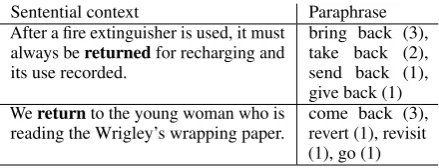
Sentential context Paraphrase
After a fire extinguisher is used, it must always bereturnedfor recharging and
its use recorded.
bring back (3), take back (2), send back (1),
give back (1)
Wereturnto the young woman who is
reading the Wrigley’s wrapping paper.
come back (3), revert (1), revisit
[image:2.595.308.528.61.145.2](1), go (1)
Table 1: The Lexical Substitution (LexSub) dataset.
letters for sets of exemplars.
We model polysemy byactivatingrelevant ex-emplars of a lemmaEin a given sentence context s. (Note that we useE to refer to both a lemma and its exemplar set, and thatscan be viewed as just another exemplar vector.) In general, we define activationof a setEby exemplarsas
act(E, s) ={e∈E|sim(e, s)> θ(E, s)}
whereEis an exemplar set,sis the “point of com-parison”, sim is some similarity measure such as Cosine or Jaccard, andθ(E, s)is a threshold. Ex-emplars belong to the activated set if their similarity tosexceedsθ(E, s).1 We explore two variants of activation. In kNN activation, the kmost simi-lar exempsimi-lars tosare activated by settingθto the similarity of thek-th most similar exemplar. In q-percentage activation, we activate the top q% ofEby settingθto the (100-q)-th percentile of the sim(e, s)distribution. Note that, while in the kNN activation scheme the number of activated exem-plars is the same for every lemma, this is not the case for percentage activation: There, a more fre-quent lemma (i.e., a lemma with more exemplars) will have more exemplars activated.
Exemplar activation for paraphrasing. A para-phrases is typically only applicable to a particular sense of a target word. Table 1 illustrates this on two examples from the Lexical Substitution (Lex-Sub) dataset (McCarthy and Navigli, 2009), both featuring the targetreturn. The right column lists appropriate paraphrases ofreturnin each context (given by human annotators).2 We apply the ex-emplar activation model to the task of predicting paraphrase felicity: Given a target lemmaT in a particular sentential contexts, and given a list of
1In principle, activation could be treated not just as binary
inclusion/exclusion, but also as a graded weighting scheme. However, weighting schemes introduce a large number of
parameters, which we wanted to avoid.
potential paraphrases ofT, the task is to predict which of the paraphrases are applicable ins.
Previous approaches (Mitchell and Lapata, 2008; Erk and Pad´o, 2008; Erk and Pad´o, 2009; Thater et al., 2009) have performed this task by modify-ing the type vector forT to the contextsand then comparing the resulting vectorT0 to the type vec-tor of a paraphrase candidateP. In our exemplar setting, we select a contextually adequate subset of contexts in whichT has been observed, using T0 =act(T, s)as a generalized representation of meaning of targetT in the context ofs.
Previous approaches used all of P as a repre-sentation for a paraphrase candidateP. However, P includes also irrelevant exemplars, while for a paraphrase to be judged as good, it is sufficient that one plausible reading exists. Therefore, we use P0 =act(P, s)to represent the paraphrase.
4 Experimental Evaluation
Data. We evaluate our model on predicting para-phrases from the Lexical Substitution (LexSub) dataset (McCarthy and Navigli, 2009). This dataset consists of 2000 instances of 200 target words in sentential contexts, with paraphrases for each tar-get word instance generated by up to 6 participants. Paraphrases are ranked by the number of annota-tors that chose them (cf. Table 1). Following Erk and Pad´o (2008), we take the list of paraphrase can-didates for a target as given (computed by pooling all paraphrases that LexSub annotators proposed for the target) and use the models to rank them for any given sentence context.
As exemplars, we create bag-of-words co-occurrence vectors from the BNC. These vectors represent instances of a target word by the other words in the same sentence, lemmatized and POS-tagged, minus stop words. E.g., if the lemma
gnurgeoccurs twice in the BNC, once in the sen-tence “The dog will gnurge the other dog”, and
once in “The old windows gnurged”, the exemplar
set forgnurgecontains the vectors[dog-n: 2,
other-a:1]and[old-a: 1, window-n: 1]. For exemplar similarity, we use the standard Cosine similarity, and for the similarity of two exemplar sets, the Cosine of their centroids.
Evaluation. The model’s prediction for an item is a list of paraphrases ranked by their predicted goodness of fit. To evaluate them against a weighted list of gold paraphrases, we follow Thater et al. (2009) in using Generalized Average
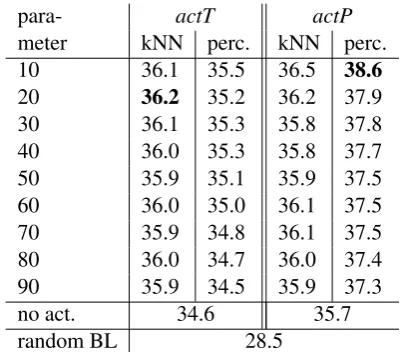
Preci-para- actT actP
meter kNN perc. kNN perc.
10 36.1 35.5 36.5 38.6
20 36.2 35.2 36.2 37.9
30 36.1 35.3 35.8 37.8
40 36.0 35.3 35.8 37.7
50 35.9 35.1 35.9 37.5
60 36.0 35.0 36.1 37.5
70 35.9 34.8 36.1 37.5
80 36.0 34.7 36.0 37.4
90 35.9 34.5 35.9 37.3
no act. 34.6 35.7
[image:3.595.315.517.61.237.2]random BL 28.5
Table 2: Activation ofT orP individually on the full LexSub dataset (GAP evaluation)
sion (GAP), which interpolates the precision values of top-nprediction lists for increasingn. LetG= hq1, . . . , qmi be the list of gold paraphrases with
gold weightshy1, . . . , ymi. LetP =hp1, . . . , pni
be the list of model predictions as ranked by the model, and let hx1, . . . , xnibe the goldweights
associated with them (assumexi = 0ifpi 6∈ G),
whereG⊆P. LetI(xi) = 1ifpi ∈G, and zero
otherwise. We writexi = 1i Pik=1xk for the
av-erage gold weight of the firstimodel predictions, and analogouslyyi. Then
GAP(P, G) = Pm 1
j=1I(yj)yj n
X
i=1
I(xi)xi
Since the model may rank multiple paraphrases the
same, we average over 10 random permutations of
equally ranked paraphrases. We report mean GAP over all items in the dataset.
Results and Discussion. We first computed two models that activate either the paraphrase or the target, but not both. Model 1,actT, activates only the target, using the completePas paraphrase, and
ranking paraphrases bysim(P, act(T, s)). Model
2,actP, activates only the paraphrase, usingsas the target word, ranking bysim(act(P, s), s).
The results for these models are shown in Ta-ble 2, with both kNN and percentage activation:
kNN activation with a parameter of 10 means that
TheactT “no act” result (34.6) corresponds to a prototype-based model that ranks paraphrase can-didates by the distance between their type vectors and the target’s type vector. Virtually all exem-plar models outperform this prototype model. Note also that bothactT andactPshow the best results for small values of the activation parameter. This indicates paraphrases can be judged on the basis of a rather small number of exemplars. Neverthe-less,actTandactPdiffer with regard to the details of their optimal activation. ForactT, a small ab-solute number of activated exemplars (here, 20) works best , whileactPyields the best results for a small percentage of paraphrase exemplars. This can be explained by the different functions played byactTandactP(cf. Section 3): Activation of the paraphrase must allow a guess about whether there is reasonable interpretation ofP in the contexts.
This appears to require a reasonably-sized sample
fromP. In contrast, target activation merely has to counteract the sparsity ofs, and activation of too many exemplars fromT leads to oversmoothing.
We obtained significances by computing 95% and 99% confidence intervals with bootstrap re-sampling. As a rule of thumb, we find that 0.4% difference in GAP corresponds to a significant dif-ference at the 95% level, and 0.7% difdif-ference in GAP to significance at the 99% level. The four activation methods (i.e., columns in Table 2) are significantly different from each other, with the ex-ception of the pairactT/kNN andactP/kNN (n.s.), so that we get the following order:
actP/perc>actP/kNN≈actT/kNN>actT/perc
where>means “significantly outperforms”. In par-ticular, the best method (actT/kNN) outperforms all other methods at p<0.01. Here, the best param-eter setting (10% activation) is also significantly better than the next-one one (20% activation). With the exception ofactT/perc, all activation methods significantly outperform the best baseline (actP, no activation).
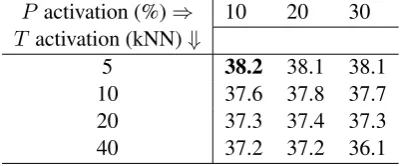
Based on these observations, we computed a third model,actTP, that activates bothT (by kNN) and P (by percentage), ranking paraphrases by sim(act(P, s), act(T, s)). Table 3 shows the re-sults. We find the overall best model at a similar location in parameter space as foractT andactP
(cf. Table 2), namely by setting the activation pa-rameters to small values. The sensitivity of the parameters changes considerably, though. When
P activation (%)⇒ 10 20 30 T activation (kNN)⇓
5 38.2 38.1 38.1
10 37.6 37.8 37.7
20 37.3 37.4 37.3
[image:4.595.316.517.63.146.2]40 37.2 37.2 36.1
Table 3: Joint activation of P and T on the full LexSub dataset (GAP evaluation)
we fix theactPactivation level, we find compara-tively large performance differences between the T activation settingsk=5 andk=10 (highly
signif-icant for 10%actP, and significant for 20% and 30%actP). On the other hand, when we fix the
actT activation level, changes in actPactivation generally have an insignificant impact.
Somewhat disappointingly, we are not able to surpass the best result foractPalone. This indicates that – at least in the current vector space – the sparsity ofsis less of a problem than the “dilution” ofsthat we face when we representing the target
word by exemplars ofT close tos. Note, however,
that the numerically worse performance of the best actTPmodel is still not significantly different from the bestactPmodel.
Influence of POS and frequency. An analysis
of the results by target part-of-speech showed that the globally optimal parameters also yield the best
results for individual POS, even though there are substantial differences among POS. ForactT, the best results emerge for all POS with kNN activation withkbetween 10 and 30. Fork=20, we obtain a GAP of 35.3 (verbs), 38.2 (nouns), and 35.1 (adjec-tives). ForactP, the best parameter for all POS was activation of 10%, with GAPs of 36.9 (verbs), 41.4 (nouns), and 37.5 (adjectives). Interestingly, the results foractTP(verbs: 38.4, nouns: 40.6, adjec-tives: 36.9) are better thanactPfor verbs, but worse for nouns and adjectives, which indicates that the sparsity problem might be more prominent than for the other POS. In all three models, we found a clear
effect of target and paraphrase frequency, with
de-teriorating performance for the highest-frequency targets as well as for the lemmas with the highest average paraphrase frequency.
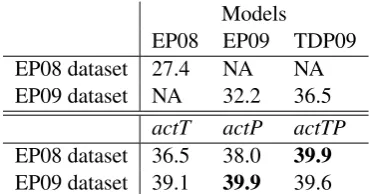
Models
EP08 EP09 TDP09 EP08 dataset 27.4 NA NA EP09 dataset NA 32.2 36.5
actT actP actTP EP08 dataset 36.5 38.0 39.9
[image:5.595.88.273.62.159.2]EP09 dataset 39.1 39.9 39.6
Table 4: Comparison to other models on two sub-sets of LexSub (GAP evaluation)
datapoints) and Erk and Pad´o (2009, EP09, 100 dat-apoints). The second set was also used by Thater et al. (2009, TDP09). The results in Table 4 compare these models against our best previous exemplar models and show that our models outperform these models across the board.3Due to the small sizes of these datasets, statistical significance is more difficult to attain. On EP09, the differences among our models are not significant, but the difference between them and the original EP09 model is.4 On EP08, all differences are significant except foractP vs.actTP.
We note that both the EP08 and the EP09 datasets appear to be simpler to model than the complete Lexical Substitution dataset, at least by our exemplar-based models. This underscores an old insight: namely, that direct syntactic neighbors, such as arguments and modifiers, provide strong clues as to word sense.
5 Conclusions and Outlook
This paper reports on work in progress on an ex-emplar activation model as an alternative to one-vector-per-word approaches to word meaning in context. Exemplar activation is very effective in handling polysemy, even with a very simple (and sparse) bag-of-words vector representation. On both the EP08 and EP09 datasets, our models sur-pass more complex prototype-based approaches (Tab. 4). It is also noteworthy that the exemplar activation models work best when few exemplars are used, which bodes well for their efficiency.
We found that the best target representations
re-3Since our models had the advantage of being tuned on
the dataset, we also report the range of results across the parameters we tested. On the EP08 dataset, we obtained 33.1– 36.5 foractT; 33.3–38.0 foractP; 37.7-39.9 foractTP. On the EP09 dataset, the numbers were 35.8–39.1 foractT; 38.1–39.9
foractP; 37.2–39.8 foractTP.
4We did not have access to the TDP09 predictions to do significance testing.
sult from activating a low absolute number of exem-plars. Paraphrase representations are best activated with a percentage-based threshold. Overall, we found that paraphrase activation had a much larger impact on performance than target activation, and that drawing on target exemplars other thansto represent the target meaning in context improved over usingsitself only for verbs (Tab. 3). This sug-gests the possibility of consideringT’s activated paraphrase candidates as the representation ofT in the contexts, rather than some vector ofT itself, in the spirit of Kintsch (2001).
While it is encouraging that the best parameter settings involved the activation of only few exem-plars, computation with exemplar models still re-quires the management of large numbers of vectors. The computational overhead can be reduced by us-ing data structures that cut down on the number
of vector comparisons, or by decreasing vector
di-mensionality (Gorman and Curran, 2006). We will experiment with those methods to determine the tradeoff of runtime and accuracy for this task.
Another area of future work is to move beyond bag-of-words context: It is known from WSD that syntactic and bag-of-words contexts provide complementary information (Florian et al., 2002; Szpektor et al., 2008), and we hope that they can be integrated in a more sophisticated exemplar model.
Finally, we will to explore task-based evalua-tions. Relation extraction and textual entailment in particular are tasks where similar models have been used before (Szpektor et al., 2008).
Acknowledgements. This work was supported in part by National Science Foundation grant IIS-0845925, and by a Morris Memorial Grant from the New York Community Trust.
References
R. Bar-Haim, I. Dagan, I. Greental, and E. Shnarch.
2007. Semantic inference at the lexical-syntactic
level. InProceedings of AAAI, pages 871–876,
Van-couver, BC.
M. Baroni and A. Lenci. 2009. One distributional
memory, many semantic spaces. InProceedings of
the EACL Workshop on Geometrical Models of Nat-ural Language Semantics, Athens, Greece.
W. Daelemans, A. van den Bosch, and J. Zavrel. 1999. Forgetting exceptions is harmful in language learn-ing. Machine Learning, 34(1/3):11–43. Special Is-sue on Natural Language Learning.
model for word meaning in context. InProceedings of EMNLP, pages 897–906, Honolulu, HI.
K. Erk and S. Pad´o. 2009. Paraphrase assessment in structured vector space: Exploring parameters and
datasets. InProceedings of the EACL Workshop on
Geometrical Models of Natural Language
Seman-tics, Athens, Greece.
R. Florian, S. Cucerzan, C. Schafer, and D. Yarowsky. 2002. Combining classifiers for word sense
disam-biguation. Journal of Natural Language
Engineer-ing, 8(4):327–341.
J. Gorman and J. R. Curran. 2006. Scaling
distribu-tional similarity to large corpora. InProceedings of
ACL, pages 361–368, Sydney.
T. Griffiths, K. Canini, A. Sanborn, and D. J. Navarro. 2007. Unifying rational models of categorization
via the hierarchical Dirichlet process. In
Proceed-ings of CogSci, pages 323–328, Nashville, TN.
A. Kilgarriff. 1997. I don’t believe in word senses. Computers and the Humanities, 31(2):91–113.
W. Kintsch. 2001. Predication. Cognitive Science,
25:173–202.
T. Landauer and S. Dumais. 1997. A solution to Platos problem: the latent semantic analysis theory of ac-quisition, induction, and representation of
knowl-edge. Psychological Review, 104(2):211–240.
D. McCarthy and J. Carroll. 2003. Disambiguating nouns, verbs, and adjectives using automatically
ac-quired selectional preferences. Computational
Lin-guistics, 29(4):639–654.
D. McCarthy and R. Navigli. 2009. The English
lexi-cal substitution task. Language Resources and
Eval-uation, 43(2):139–159. Special Issue on Compu-tational Semantic Analysis of Language: SemEval-2007 and Beyond.
S. McDonald and M. Ramscar. 2001. Testing the dis-tributional hypothesis: The influence of context on
judgements of semantic similarity. InProceedings
of CogSci, pages 611–616.
J. Mitchell and M. Lapata. 2008. Vector-based models
of semantic composition. In Proceedings of ACL,
pages 236–244, Columbus, OH.
G. L. Murphy. 2002. The Big Book of Concepts. MIT
Press.
G Salton, A Wang, and C Yang. 1975. A
vector-space model for information retrieval. Journal of the
American Society for Information Science, 18:613– 620.
H. Sch¨utze. 1998. Automatic word sense
discrimina-tion. Computational Linguistics, 24(1):97–124.
I. Szpektor, I. Dagan, R. Bar-Haim, and J. Goldberger.
2008. Contextual preferences. In Proceedings of
ACL, pages 683–691, Columbus, OH.
S. Thater, G. Dinu, and M. Pinkal. 2009. Ranking
paraphrases in context. InProceedings of the ACL
Workshop on Applied Textual Inference, pages 44– 47, Singapore.
W. Voorspoels, W. Vanpaemel, and G. Storms. 2009. The role of extensional information in conceptual