Error Detection for Statistical Machine
Translation Using Linguistic Features
Deyi Xiong, Min Zhang, Haizhou Li
Human Language Technology Institute for Infocomm Research
1 Fusionopolis Way, #21-01 Connexis, Singapore 138632.
{dyxiong, mzhang, hli}@i2r.a-star.edu.sg
Abstract
Automatic error detection is desired in the post-processing to improve machine translation quality. The previous work is largely based on confidence estimation us-ing system-based features, such as word posterior probabilities calculated fromN -best lists or word lattices. We propose to incorporate two groups of linguistic fea-tures, which convey information from out-side machine translation systems, into er-ror detection: lexical and syntactic fea-tures. We use a maximum entropy clas-sifier to predict translation errors by inte-grating word posterior probability feature and linguistic features. The experimen-tal results show that 1) linguistic features alone outperform word posterior probabil-ity based confidence estimation in error detection; and 2) linguistic features can further provide complementary informa-tion when combined with word confidence scores, which collectively reduce the clas-sification error rate by 18.52% and im-prove the F measure by 16.37%.
1 Introduction
Translation hypotheses generated by a statistical machine translation (SMT) system always contain both correct parts (e.g. words, n-grams, phrases matched with reference translations) and incor-rect parts. Automatically distinguishing incorincor-rect parts from correct parts is therefore very desir-able not only for post-editing and interactive ma-chine translation (Ueffing and Ney, 2007) but also for SMT itself: either by rescoring hypotheses in the N-best list using the probability of correct-ness calculated for each hypothesis (Zens and Ney, 2006) or by generating new hypotheses usingN -best lists from one SMT system or multiple
sys-tems (Akibay et al., 2004; Jayaraman and Lavie, 2005).
In this paper we restrict the “parts” to words. That is, we detect errors at the word level for SMT. A common approach to SMT error detection at the word level is calculating the confidence at which a word is correct. The majority of word confidence estimation methods follows three steps:
1) Calculate features that express the correct-ness of words either based on SMT model (e.g. translation/language model) or based on SMT system output (e.g. N-best lists, word lattices) (Blatz et al., 2003; Ueffing and Ney, 2007).
2) Combine these features together with a clas-sification model such as multi-layer percep-tron (Blatz et al., 2003), Naive Bayes (Blatz et al., 2003; Sanchis et al., 2007), or log-linear model (Ueffing and Ney, 2007).
3) Divide words into two groups (correct trans-lations and errors) by using a classification threshold optimized on a development set.
Sometimes the step 2) is not necessary if only one effective feature is used (Ueffing and Ney, 2007); and sometimes the step 2) and 3) can be merged into a single step if we directly output predicting results from binary classifiers instead of making thresholding decision.
Various features from different SMT models and system outputs are investigated (Blatz et al., 2003; Ueffing and Ney, 2007; Sanchis et al., 2007; Raybaud et al., 2009). Experimental results show that they are useful for error detection. However, it is not adequate to just use these features as dis-cussed in (Shi and Zhou, 2005) because the infor-mation that they carry is either from the inner com-ponents of SMT systems or from system outputs. To some extent, it has already been considered by SMT systems. Hence finding external information
sources from outside SMT systems is desired for error detection.
Linguistic knowledge is exactly such a good choice as an external information source. It has al-ready been proven effective in error detection for speech recognition (Shi and Zhou, 2005). How-ever, it is not widely used in SMT error detection. The reason is probably that people have yet to find effective linguistic features that outperform non-linguistic features such as word posterior proba-bility features (Blatz et al., 2003; Raybaud et al., 2009). In this paper, we would like to show an effective use of linguistic features in SMT error detection.
We integrate two sets of linguistic features into a maximum entropy (MaxEnt) model and develop a MaxEnt-based binary classifier to predict the cat-egory (correct or incorrect) for each word in a generated target sentence. Our experimental re-sults show that linguistic features substantially im-prove error detection and even outperform word posterior probability features. Further, they can produce additional improvements when combined with word posterior probability features.
The rest of the paper is organized as follows. In Section 2, we review the previous work on word-level confidence estimation which is used for error detection. In Section 3, we introduce our linguistic features as well as the word posterior probability feature. In Section 4, we elaborate our MaxEnt-based error detection model which combine lin-guistic features and word posterior probability fea-ture together. In Section 5, we describe the SMT system which we use to generate translation hy-potheses. We report our experimental results in Section 6 and conclude in Section 7.
2 Related Work
In this section, we present an overview of confi-dence estimation (CE) for machine translation at the word level. As we are only interested in error detection, we focus on work that uses confidence estimation approaches to detect translation errors. Of course, confidence estimation is not limited to the application of error detection, it can also be used in other scenarios, such as translation predic-tion in an interactive environment (Grandrabur and Foster, 2003) .
In a JHU workshop, Blatz et al. (2003) investi-gate using neural networks and a naive Bayes clas-sifier to combine various confidence features for
confidence estimation at the word level as well as at the sentence level. The features they use for word level CE include word posterior probabil-ities estimated from N-best lists, features based on SMT models, semantic features extracted from WordNet as well as simple syntactic features, i.e. parentheses and quotation mark check. Among all these features, the word posterior probability is the most effective feature, which is much better than linguistic features such as semantic features, ac-cording to their final results.
Ueffing and Ney (2007) exhaustively explore various word-level confidence measures to label each word in a generated translation hypothe-sis as correct or incorrect. All their measures are based on word posterior probabilities, which are estimated from 1) system output, such as word lattices or N-best lists and 2) word or phrase translation table. Their experimental re-sults show that word posterior probabilities di-rectly estimated from phrase translation table are better than those from system output except for the Chinese-English language pair.
Sanchis et al. (2007) adopt a smoothed naive Bayes model to combine different word posterior probability based confidence features which are estimated from N-best lists, similar to (Ueffing and Ney, 2007).
Raybaud et al. (2009) study several confi-dence features based on mutual information be-tween words and n-gram and backward n-gram language model for word-level and sentence-level CE. They also explore linguistic features using in-formation from syntactic category, tense, gender and so on. Unfortunately, such linguistic features neither improve performance at the word level nor at the sentence level.
Our work departs from the previous work in two major respects.
• We exploit various linguistic features and show that they are able to produce larger im-provements than widely used system-related features such as word posterior probabilities. This is in contrast to some previous work. Yet another advantage of using linguistic features is that they are system-independent, which therefore can be used across different sys-tems.
di-rectly output prediction results from our dis-criminatively trained classifier without opti-mizing a classification threshold on a distinct development set beforehand.1 Most previous
approaches make decisions based on a pre-tuned classification thresholdτ as follows
class= {
correct, Φ(correct, θ)> τ incorrect, otherwise
whereΦis a classifier or a confidence mea-sure andθis the parameter set ofΦ. The per-formance of these approaches is strongly de-pendent on the classification threshold.
3 Features
We explore two sets of linguistic features for each word in a machine generated translation hypoth-esis. The first set of linguistic features are sim-ple lexical features. The second set of linguistic features are syntactic features which are extracted from link grammar parse. To compare with the previously widely used features, we also investi-gate features based on word posterior probabili-ties.
3.1 Lexical Features
We use the following lexical features.
• wd: word itself
• pos: part-of-speech tag from a tagger trained on WSJ corpus.2
For each word, we look at previous n words/tags and next nwords/tags. They together form a word/tag sequence pattern. The basic idea of using these features is that words in rare pat-terns are more likely to be incorrect than words in frequently occurring patterns. To some extent, these two features have similar function to a tar-get language model or pos-based tartar-get language model.
3.2 Syntactic Features
High-level linguistic knowledge such as syntac-tic information about a word is a very natural and promising indicator to decide whether this word is syntactically correct or not. Words occurring in an
1
This does not mean we do not need a development set. We do validate our feature selection and other experimental settings on the development set.
2Available via http://www-tsujii.is.s.u-tokyo.ac.jp/
∼tsuruoka/postagger/
ungrammatical part of a target sentence are prone to be incorrect. The challenge of using syntac-tic knowledge for error detection is that machine-generated hypotheses are rarely fully grammati-cal. They are mixed with grammatical and un-grammatical parts, which hence are not friendly to traditional parsers trained on grammatical sen-tences because ungrammatical parts of a machine-generated sentence could lead to a parsing failure. To overcome this challenge, we select theLink Grammar(LG) parser3as our syntactic parser to generate syntactic features. The LG parser pro-duces a set of labeled links which connect pairs of words with a link grammar (Sleator and Temper-ley, 1993).
The main reason why we choose the LG parser is that it provides a robustness feature: null-link scheme. The null-link scheme allows the parser to parse a sentence even when the parser can not fully interpret the entire sentence (e.g. including un-grammatical parts). When the parser fail to parse the entire sentence, it ignores one word each time until it finds linkages for remaining words. After parsing, those ignored words are not connected to any other words. We call themnull-linked words. Our hypothesis is that null-linked words are prone to be syntactically incorrect. We hence straightforwardly define a syntactic feature for a wordwaccording to its links as follows
link(w) = {
yes, w has links no, otherwise
In Figure 1 we show an example of a generated translation hypothesis with its link parse. Here links are denoted with dotted lines which are an-notated with link types (e.g., Jp, Op). Bracketed words, namely “,” and “including”, are null-linked words.
3.3 Word Posterior Probability Features
Our word posterior probability is calculated onN -best list, which is first proposed by (Ueffing et al., 2003) and widely used in (Blatz et al., 2003; Ueff-ing and Ney, 2007; Sanchis et al., 2007).
Given a source sentencef, let{en}N1 be theN
-best list generated by an SMT system, and letei nis thei-th word inen. The major work of calculating word posterior probabilities is to find the Leven-shtein alignment (LevenLeven-shtein, 1966) between the best hypothesis e1 and its competing hypothesis
Figure 1: An example of Link Grammar parsing results.
enin theN-best list{en}N1 . We denote the
align-ment between them asℓ(e1, en). The word in the hypothesisenwhichei1 is Levenshtein aligned to
is denoted asℓi(e1, en).
The word posterior probability ofei1is then cal-culated by summing up the probabilities over all hypotheses containing ei
1 in a position which is
Levenshtein aligned toei1.
pwpp(ei1) = ∑
en:ℓi(e1,en)=ei1p(en)
∑N
1 p(en)
To use the word posterior probability in our er-ror detection model, we need to make it discrete. We introduce a feature for a wordwbased on its word posterior probability as follows
dwpp(w) =⌊−log(pwpp(w))/df⌋
wheredf is the discrete factor which can be set to 1, 0.1, 0.01 and so on. “⌊ ⌋” is a rounding oper-ator which takes the largest integer that does not exceed−log(pwpp(w))/df. We optimize the dis-crete factor on our development set and find the optimal value is 1. Therefore a feature “dwpp = 2” represents that the logarithm of the word poste-rior probability is between -3 and -2;
4 Error Detection with a Maximum
Entropy Model
As mentioned before, we consider error detec-tion as a binary classificadetec-tion task. To formal-ize this task, we use a feature vector ψ to rep-resent a word w in question, and a binary vari-able cto indicate whether this word is correct or not. In the feature vector, we look at 2 words before and 2 words after the current word posi-tion (w−2, w−1, w, w1, w2). We collect features {wd, pos, link, dwpp}for each word among these words and combine them into the feature vector ψ forw. As such, we want the feature vector to capture the contextual environment, e.g., pos se-quence pattern, syntactic pattern, where the word woccurs.
For classification, we employ the maximum entropy model (Berger et al., 1996) to predict whether a wordwis correct or incorrect given its feature vectorψ.
p(c|ψ) = exp( ∑
iθifi(c, ψ))
∑
c′exp(
∑
iθifi(c′, ψ))
where fi is a binary model feature defined on c and the feature vector ψ. θi is the weight offi. Table 1 shows some examples of our binary model features.
In order to learn the model feature weightsθfor probability estimation, we need a training set of m samples {ψi, ci}m1 . The challenge of collect-ing traincollect-ing instances is that the correctness of a word in a generated translation hypothesis is not intuitively clear (Ueffing and Ney, 2007). We will describe the method to determine the correctness of a word in Section 6.1, which is broadly adopted in previous work.
We tune our model feature weights using an off-the-shelf MaxEnt toolkit (Zhang, 2004). To avoid overfitting, we optimize the Gaussian prior on the development set. During test, if the proba-bilityp(correct|ψ)is larger thanp(incorrect|ψ)
according the trained MaxEnt model, the word is labeled as correct otherwise incorrect.
5 SMT System
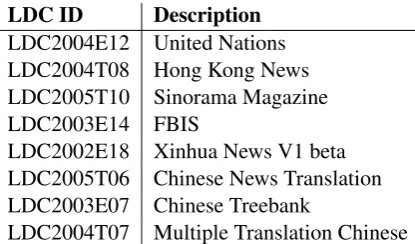
To obtain machine-generated translation hypothe-ses for our error detection, we use a state-of-the-art phrase-based machine translation system MOSES (Koehn et al., 2003; Koehn et al., 2007). The translation task is on the official NIST Chinese-to-English evaluation data. The training data con-sists of more than 4 million pairs of sentences (in-cluding 101.93M Chinese words and 112.78M En-glish words) from LDC distributed corpora. Table 2 shows the corpora that we use for the translation task.
Feature Example
wd f(c, ψ) = {
1, ψ.w.wd= ”.”, c=correct
0, otherwise
pos f(c, ψ) = {
1, ψ.w2.pos= ”N N”, c=incorrect
0, otherwise
link f(c, ψ) = {
1, ψ.w.link=no, c=incorrect
0, otherwise
dwpp f(c, ψ) = {
1, ψ.w−2.dwpp= 2, c=correct
[image:5.595.150.447.65.174.2]0, otherwise
Table 1: Examples of model features.
LDC ID Description LDC2004E12 United Nations LDC2004T08 Hong Kong News LDC2005T10 Sinorama Magazine LDC2003E14 FBIS
LDC2002E18 Xinhua News V1 beta LDC2005T06 Chinese News Translation LDC2003E07 Chinese Treebank
LDC2004T07 Multiple Translation Chinese
Table 2: Training corpora for the translation task.
on Xinhua section of the English Gigaword cor-pus (181.1M words). For minimum error rate tun-ing (Och, 2003), we use NIST MT-02 as the de-velopment set for the translation task. In order to calculate word posterior probabilities, we gen-erate 10,000 best lists for NIST MT-02/03/05 re-spectively. The performance, in terms of BLEU (Papineni et al., 2002) score, is shown in Table 4.
6 Experiments
We conducted our experiments at several levels. Starting with MaxEnt models with single linguis-tic feature or word posterior probability based fea-ture, we incorporated additional features incre-mentally by combining features together. In do-ing so, we would like the experimental results not only to display the effectiveness of linguistic fea-tures for error detection but also to identify the ad-ditional contribution of each feature to the task.
6.1 Data Corpus
For the error detection task, we use the best trans-lation hypotheses of NIST MT-02/05/03 generated by MOSES as our training, development, and test corpus respectively. The statistics about these cor-pora is shown in Table 3. Each translation hypoth-esis has four reference translations.
Corpus Sentences Words Training MT-02 878 24,225 Development MT-05 1082 31,321
[image:5.595.77.285.220.342.2]Test MT-03 919 25,619
Table 3: Corpus statistics (number of sentences and words) for the error detection task.
To obtain the linkage information, we run the LG parser on all translation hypotheses. We find that the LG parser can not fully parse 560 sen-tences (63.8%) in the training set (MT-02), 731 sentences (67.6%) in the development set (MT-05) and 660 sentences (71.8%) in the test set (MT-03). For these sentences, the LG parser will use the the null-link scheme to generate null-linked words.
To determine the true class of a word in a gen-erated translation hypothesis, we follow (Blatz et al., 2003) to use the word error rate (WER). We tag a word as correct if it is aligned to itself in the Levenshtein alignment between the hypothesis and the nearest reference translation that has min-imum edit distance to the hypothesis among four reference translations. Figure 2 shows the Lev-enshtein alignment between a machine-generated hypothesis and its nearest reference translation. The “Class” row shows the label of each word ac-cording to the alignment, where “c” and “i” repre-sentcorrectandincorrectrespectively.
[image:5.595.313.523.221.276.2]China Unicom net profit rose up 38% last year China Unicom last year net profit rose up 38%
Hypothesis
Reference
China/c Unicom/c last/i year/inet/c profit/c rose/c up/c 38%/c
[image:6.595.92.501.70.133.2]Class
Figure 2: Tagging a word as correct/incorrect according to the Levenshtein alignment.
[image:6.595.98.263.194.249.2]Corpus BLEU (%) RCW (%) MT-02 33.24 47.76 MT-05 32.03 47.85 MT-03 32.86 47.57
Table 4: Case-insensitive BLEU score and ratio of correct words (RCW) on the training, develop-ment and test corpus.
metric corresponds to them-WERused in (Ueff-ing and Ney, 2007), which is stricter than PER and Set. It is also stricter than normal WER metric which compares each hypothesis to all references, rather than the nearest reference.
Table 4 shows the case-insensitive BLEU score and the percentage of words that are labeled as cor-rect according to the method described above on the training, development and test corpus.
6.2 Evaluation Metrics
To evaluate the overall performance of the error detection, we use the commonly used metric, clas-sification error rate (CER) to evaluate our classi-fiers. CER is defined as the percentage of words that are wrongly tagged as follows
CER= # of wrongly tagged words
Total # of words
The baseline CER is determined by assuming the most frequent class for all words. Since the ra-tio of correct words in both the development and test set is lower than 50%, the most frequent class is “incorrect”. Hence the baseline CER in our ex-periments is equal to the ratio of correct words as these words are wrongly tagged as incorrect.
We also use precision and recall on errors to evaluate the performance of error detection. Let ngbe the number of words of which the true class is incorrect,ntbe the number of words which are tagged as incorrect by classifiers, and nm be the number of words tagged as incorrect that are in-deed translation errors. The precision P reis the
percentage of words correctly tagged as transla-tion errors.
P re= nm
nt
The recallRecis the proportion of actual transla-tion errors that are found by classifiers.
Rec= nm
ng
F measure, the trade-off between precision and re-call, is also used.
F = 2×P re×Rec
P re+Rec 6.3 Experimental Results
Table 5 shows the performance of our experiments on the error detection task. To compare with pre-vious work using word posterior probabilities for confidence estimation, we carried out experiments using wpp estimated from N-best lists with the classification thresholdτ, which was optimized on our development set to minimize CER. A relative improvement of 9.27% is achieved over the base-line CER, which reconfirms the effectiveness of word posterior probabilities for error detection.
We conducted three groups of experiments us-ing the MaxEnt based error detection model with various feature combinations.
Combination Features CER (%) Pre (%) Rec (%) F (%)
Baseline - 47.57 - -
-Thresholdingwpp - 43.16 58.98 58.07 58.52
MaxEnt (dwpp) 44 43.07 56.12 81.86 66.59
MaxEnt (wd) 19,164 41.57 58.25 73.11 64.84
MaxEnt (pos) 199 39.90 58.88 79.23 67.55
MaxEnt (link) 19 44.31 54.72 89.72 67.98
[image:7.595.320.528.286.458.2]MaxEnt (wd+pos) 19,363 39.43 59.36 78.60 67.64 MaxEnt (wd+pos+link) 19,382 39.79 58.74 80.97 68.08 MaxEnt (dwpp+wd) 19,208 41.04 57.18 83.75 67.96 MaxEnt (dwpp+wd+pos) 19,407 38.88 59.87 78.38 67.88 MaxEnt (dwpp+wd+pos+link) 19,426 38.76 59.89 78.94 68.10
Table 5: Performance of the error detection task.
• The second group of experiments concerns with the combination of linguistic features without word posterior probability feature. The combination of lexical features improves both CER and precision over single lexical feature (wd, pos). The addition of syntactic featurelinkmarginally undermines CER but improves recall by a lot.
• The last group of experiments concerns about the additional contribution of linguistic fea-tures to error detection with word posterior probability. We added linguistic features in-crementally into the feature pool. The best performance was achieved by using all fea-tures, which has a relative of improvement of 18.52% over the baseline CER.
The first two groups of experiments show that linguistic features, individually (except for link) or by combination, are able to produce much better performance than word posterior probability fea-tures in both CER and F measure. The best com-bination of linguistic features achieves a relative improvement of 8.64% and 15.58% in CER and F measure respectively over word posterior prob-ability thresholding.
The Table 5 also reveals how linguistic fea-tures improve error detection. The lexical feafea-tures (pos, wd) improve precision when they are used. This suggests that lexical features can help the sys-tem find errors more accurately. Syntactic features (link), on the other hand, improve recall whenever they are used, which indicates that they can help the system find more errors.
We also show the number of features in each combination in Table 5. Except for thewdfeature,
0 200 400 600 800 1000
38.6 38.8 39.0 39.2 39.4 39.6 39.8 40.0 40.2 40.4 40.6
CER (%)
Number of Training Sentences
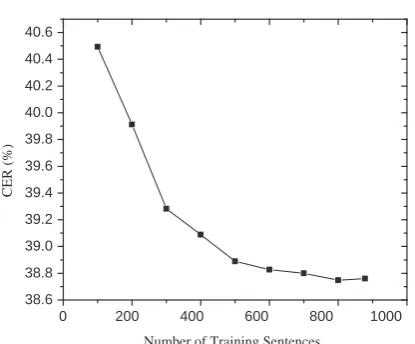
Figure 3: CER vs. the number of training sen-tences.
the pos has the largest number of features, 199, which is a small set of features. This suggests that our error detection model can be learned from a rather small training set.
Figure 3 shows CERs for the feature combina-tion MaxEnt (dwpp +wd+pos +link) when the number of training sentences is enlarged incre-mentally. CERs drop significantly when the num-ber of training sentences is increased from 100 to 500. After 500 sentences are used, CERs change marginally and tend to converge.
7 Conclusions and Future Work
systems. We incorporate two sets of linguistic features together with word posterior probability based features into error detection.
Our experiments validate that linguistic features are very useful for error detection: 1) they by themselves achieve a higher improvement in terms of both CER and F measure than word posterior probability features; 2) the performance is further improved when they are combined with word pos-terior probability features.
The extracted linguistic features are quite com-pact, which can be learned from a small train-ing set. Furthermore, The learned ltrain-inguistic fea-tures are system-independent. Therefore our ap-proach can be used for other machine translation systems, such as rule-based or example-based sys-tem, which generally do not produceN-best lists. Future work in this direction involve detect-ing particular error types such as incorrect po-sitions, inappropriate/unnecessary words (Elliott, 2006) and automatically correcting errors.
References
Yasuhiro Akibay, Eiichiro Sumitay, Hiromi Nakaiway, Seiichi Yamamotoy, and Hiroshi G. Okunoz. 2004. Using a Mixture of N-best Lists from Multiple MT Systems in Rank-sum-based Confidence Measure for MT Outputs. InProceedings of COLING.
Adam L. Berger, Stephen A. Della Pietra andVincent J. Della Pietra. 1996. A Maximum Entropy Ap-proach to Natural Language Processing. Computa-tional Linguistics, 22(1): 39-71.
John Blatz, Erin Fitzgerald, George Foster, Simona Gandrabur, Cyril Goutte, Alex Kulesza, Alberto Sanchis, Nicola Ueffing. 2003. Confidence estima-tion for machine translaestima-tion. final report, jhu/clsp summer workshop.
Debra Elliott. 2006 Corpus-based Machine Transla-tion EvaluaTransla-tion via Automated Error DetecTransla-tion in Output Texts. Phd Thesis, University of Leeds.
Simona Gandrabur and George Foster. 2003. Confi-dence Estimation for Translation Prediction. In Pro-ceedings of HLT-NAACL.
S. Jayaraman and A. Lavie. 2005. Multi-engine Ma-chine Translation Guided by Explicit Word Match-ing. InProceedings of EAMT.
Philipp Koehn, Franz Joseph Och, and Daniel Marcu. 2003. Statistical Phrase-based Translation. In Pro-ceedings of HLT-NAACL.
Philipp Koehn, Hieu Hoang, Alexandra Birch, Chris Callison-Burch, Marcello Federico, Nicola Bertoldi,
Brooke Cowan, Wade Shen, Christine Moran, Richard Zens, Chris Dyer, Ondrej Bojar, Alexandra Constrantin, and Evan Herbst. 2007. Moses: Open source toolkit for statistical machine translation. In Proceedings of ACL, Demonstration Session.
V. I. Levenshtein. 1966. Binary Codes Capable of Cor-recting Deletions, Insertions and Reversals. Soviet Physics Doklady, Feb.
Franz Josef Och. 2003. Minimum Error Rate Training in Statistical Machine Translation. InProceedings of ACL 2003.
Kishore Papineni, Salim Roukos, Todd Ward and Wei-Jing Zhu. 2002. BLEU: a Method for Automatically Evaluation of Machine Translation. InProceedings of ACL 2002.
Sylvain Raybaud, Caroline Lavecchia, David Langlois, Kamel Sma¨ıli. 2009. Word- and Sentence-level Confidence Measures for Machine Translation. In Proceedings of EAMT 2009.
Alberto Sanchis, Alfons Juan and Enrique Vidal. 2007. Estimation of Confidence Measures for Machine Translation. InProcedings of Machine Translation Summit XI.
Daniel Sleator and Davy Temperley. 1993. Parsing En-glish with a Link Grammar. InProceedings of Third International Workshop on Parsing Technologies.
Yongmei Shi and Lina Zhou. 2005. Error Detec-tion Using Linguistic Features. In Proceedings of HLT/EMNLP 2005.
Andreas Stolcke. 2002. SRILM - an Extensible Lan-guage Modeling Toolkit. InProceedings of Interna-tional Conference on Spoken Language Processing, volume 2, pages 901-904.
Nicola Ueffing, Klaus Macherey, and Hermann Ney. 2003. Confidence Measures for Statistical Machine Translation. InProceedings. of MT Summit IX.
Nicola Ueffing and Hermann Ney. 2007. Word-Level Confidence Estimation for Machine Transla-tion. Computational Linguistics, 33(1):9-40.
Richard Zens and Hermann Ney. 2006. N-gram Pos-terior Probabilities for Statistical Machine Transla-tion. InHLT/NAACL: Proceedings of the Workshop on Statistical Machine Translation.
Le Zhang. 2004. Maximum Entropy Model-ing Tooklkit for Python and C++. Available at http://homepages.inf.ed.ac.uk/s0450736