A Feedback-Augmented Method for Detecting Errors in the Writing of
Learners of English
Ryo Nagata
Hyogo University of Teacher Education 6731494, Japan
Atsuo Kawai
Mie University 5148507, Japan
Koichiro Morihiro
Hyogo University of Teacher Education 6731494, Japan
Naoki Isu
Mie University 5148507, Japan
Abstract
This paper proposes a method for detect-ing errors in article usage and sdetect-ingular plu-ral usage based on the mass count distinc-tion. First, it learns decision lists from training data generated automatically to distinguish mass and count nouns. Then, in order to improve its performance, it is augmented by feedback that is obtained from the writing of learners. Finally, it de-tects errors by applying rules to the mass count distinction. Experiments show that it achieves a recall of 0.71 and a preci-sion of 0.72 and outperforms other meth-ods used for comparison when augmented by feedback.
1 Introduction
Although several researchers (Kawai et al., 1984; McCoy et al., 1996; Schneider and McCoy, 1998; Tschichold et al., 1997) have shown that rule-based methods are effective to detecting gram-matical errors in the writing of learners of En-glish, it has been pointed out that it is hard to write rules for detecting errors concerning the ar-ticles and singular plural usage. To be precise, it is hard to write rules for distinguishing mass and count nouns which are particularly important in detecting these errors (Kawai et al., 1984). The major reason for this is that whether a noun is a mass noun or a count noun greatly depends on its meaning or its surrounding context (refer to Al-lan (1980) and Bond (2005) for details of the mass count distinction).
The above errors are very common among Japanese learners of English (Kawai et al., 1984; Izumi et al., 2003). This is perhaps because the
Japanese language does not have a mass count dis-tinction system similar to that of English. Thus, it is favorable for error detection systems aiming at Japanese learners to be capable of detecting these errors. In other words, such systems need to some-how distinguish mass and count nouns.
This paper proposes a method for distinguishing mass and count nouns in context to complement the conventional rules for detecting grammatical errors. In this method, first, training data, which consist of instances of mass and count nouns, are automatically generated from a corpus. Then, decision lists for distinguishing mass and count nouns are learned from the training data. Finally, the decision lists are used with the conventional rules to detect the target errors.
The proposed method requires a corpus to learn decision lists for distinguishing mass and count nouns. General corpora such as newspaper ar-ticles can be used for the purpose. However, a drawback to it is that there are differences in character between general corpora and the writ-ing of non-native learners of English (Granger, 1998; Chodorow and Leacock, 2000). For in-stance, Chodorow and Leacock (2000) point out that the wordconcentrateis usually used as a noun in a general corpus whereas it is a verb 91% of the time in essays written by non-native learners of English. Consequently, the differences affect the performance of the proposed method.
In order to reduce the drawback, the proposed method is augmented by feedback; it takes as feed-back learners’ essays whose errors are corrected by a teacher of English (hereafter, referred to as the feedback corpus). In essence, the feedback corpus could be added to a general corpus to gen-erate training data. Or, ideally training data could be generated only from the feedback corpus just as
from a general corpus. However, this causes a se-rious problem in practice since the size of the feed-back corpus is normally far smaller than that of a general corpus. To make it practical, this paper discusses the problem and explores its solution.
The rest of this paper is structured as follows. Section 2 describes the method for detecting the target errors based on the mass count distinction. Section 3 explains how the method is augmented by feedback. Section 4 discusses experiments con-ducted to evaluate the proposed method.
2 Method for detecting the target errors
2.1 Generating training data
First, instances of the target noun that head their noun phrase (NP) are collected from a corpus with their surrounding words. This can be simply done by an existing chunker or parser.
Then, the collected instances are tagged with mass or count by the following tagging rules. For example, the underlinedchicken:
... are a lot ofchickens in the roost ... is tagged as
... are a lot ofchickens/count in the roost ... because it is in plural form.
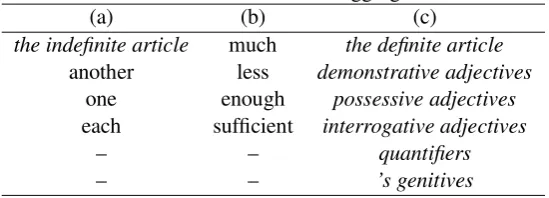
We have made tagging rules based on linguistic knowledge (Huddleston and Pullum, 2002). ure 1 and Table 1 represent the tagging rules. Fig-ure 1 shows the framework of the tagging rules. Each node in Figure 1 represents a question ap-plied to the instance in question. For example, the root node reads “Is the instance in question plu-ral?”. Each leaf represents a result of the classi-fication. For example, if the answer is yesat the root node, the instance in question is tagged with count. Otherwise, the question at the lower node is applied and so on. The tagging rules do not classify instances as mass or count in some cases. These unclassified instances are tagged with the symbol “?”. Unfortunately, they cannot readily be included in training data. For simplicity of imple-mentation, they are excluded from training data1.
Note that the tagging rules can be used only for generating training data. They cannot be used to distinguish mass and count nouns in the writing of learners of English for the purpose of detecting
1According to experiments we have conducted,
approxi-mately 30% of instances are tagged with “?” on average. It is highly possible that performance of the proposed method will improve if these instances are included in the training data.
the target errors since they are based on the articles and the distinction between singular and plural.
Finally, the tagged instances are stored in a file with their surrounding words. Each line of it con-sists of one of the tagged instances and its sur-rounding words as in the abovechickenexample.
2.2 Learning Decision Lists
In the proposed method, decision lists are used for distinguishing mass and count nouns. One of the reasons for the use of decision lists is that they have been shown to be effective to the word sense disambiguation task and the mass count distinc-tion is highly related to word sense as we will see in this section. Another reason is that rules for dis-tinguishing mass and count nouns are observable in decision lists, which helps understand and im-prove the proposed method.
A decision list consists of a set of rules. Each rule matches the template as follows:
Ifa condition is true, thena decision (1)
To define the template in the proposed method, let us have a look at the following two examples:
1. I read thepaper.
2. Thepaperis made of hemp pulp.
The underlined papers in both sentences cannot simply be classified as mass or count by the tag-ging rules presented in Section 2.1 because both are singular and modified by the definite article. Nevertheless, we can tell that the former is a count noun and the latter is a mass noun from the con-texts. This suggests that the mass count distinc-tion is often determined by words surrounding the target noun. In example 1, we can tell that the pa-per refers to something that can be read such as a newspaper or a scientific paper from read, and therefore it is a count noun. Likewise, in exam-ple 2, we can tell that thepaperrefers to a certain substance frommadeandpulp, and therefore it is a mass noun.
Taking this observation into account, we define the template based on words surrounding the tar-get noun. To formalize the template, we will use a random variable
that takes either or to denote that the target noun is a mass noun or a count noun, respectively. We will also use
and
yes
yes
yes
yes no
no
no
no
yes no
COUNT modified bya little?
?
COUNT
MASS
? MASS
plural?
modified by one of the words in Table 1(a)? modified by one of the words
in Table 1(b)? modified by one of the words
[image:3.595.135.470.62.206.2]in Table 1(c)?
Figure 1: Framework of the tagging rules
Table 1: Words used in the tagging rules
(a) (b) (c)
the indefinite article much the definite article another less demonstrative adjectives
one enough possessive adjectives each sufficient interrogative adjectives
– – quantifiers
– – ’s genitives
three types of
:
, , and that denote the
contexts consisting of the noun phrase that the tar-get noun heads, words to the left of the noun
phrase, and words to its right, respectively. Then
the template is formalized by:
If word
appears in context
of the target noun, then it is distinguished as
Hereafter, to keep the notation simple, it will be abbreviated to
(2)
Now rules that match the template can be ob-tained from the training data. All we need to do is to collect words in
from the training data. Here, the words in Table 1 are excluded. Also, function words (except prepositions), cardinal and quasi-cardinal numerals, and the target noun are excluded. All words are reduced to their mor-phological stem and converted entirely to lower case when collected. For example, the following tagged instance:
She ate friedchicken/mass for dinner. would give a set of rules that match the template:
"!#
$&%('*),+
$
%.-#
. /10
2
%.-#
for the target nounchickenwhen4365 .
In addition, a default rule is defined. It is based on the target noun itself and used when no other applicable rules are found in the decision list for the target noun. It is defined by
7 8
major (3)
where
and
major denote the target noun and the majority of 8
in the training data, respec-tively. Equation (3) reads “If the target noun ap-pears, then it is distinguished by the majority”.
The log-likelihood ratio (Yarowsky, 1995) de-cides in which order rules are applied to the target noun in novel context. It is defined by2
9
.: <;
8>= <?
<; 8>=
<? (4)
where 8
is the exclusive event of
and
@; A=
7?
is the probability that the target noun is used as 8
when
appears in the context
. It is important to exercise some care in estimat-ing @;
8>= ?
. In principle, we could simply
2For the default rule, the log-likelihood ratio is defined by
replacingB2C andDFE withG andDFE
[image:3.595.162.437.256.355.2]count the number of times that
appears in the context
of the target noun used as
in the training data. However, this estimate can be unre-liable, when
does not appear often in the con-text. To solve this problem, using a smoothing pa-rameter H (Yarowsky, 1996),
<; 8>=
7?
is esti-mated by3
<; 8>=
<?
3
$
;IKJ
?
LH
$
;I <? MFH
(5)
where$ ;I 7?
and $ ;I J
?
are occurrences of
appearing in
and those in
of the target noun used as 8
, respectively. The constant is the
number of possible classes, that is,N3O (P
or ) in our case, and introduced to satisfy
@; A=
7?
@; A=
Q?
3R . In this paper,H is
set to 1.
Rules in a decision list are sorted in descending order by the log-likelihood ratio. They are tested on the target noun in novel context in this order. Rules sorted below the default rule are discarded4
because they are never used as we will see in Sec-tion 2.3.
[image:4.595.99.265.490.613.2]Table 2 shows part of a decision list for the tar-get noun chicken that was learned from a subset of the BNC (British National Corpus) (Burnard, 1995). Note that the rules are divided into two columns for the purpose of illustration in Table 2; in practice, they are merged into one.
Table 2: Rules in a decision list
Mass Count
LLR
LLR
0
ST !#
1.49 !#
1.49
$
0
.U !#
1.28 & V
-#
1.32
/10 U
!#
1.23
0
:
)+
1.23
.
0
-#
1.23 % !#
1.23
% W
-#
1.18 :X: ),+
1.18 target noun: chicken,43Y5
LLR (Log-Likelihood Ratio)
On one hand, we associate the words in the left half with food or cooking. On the other hand, we associate those in the right half with animals or birds. From this observation, we can say that chicken in the sense of an animal or a bird is a count noun but a mass noun when referring to food
3The probability for the default rule is estimated just as
the log-likelihood ratio for the default rule above.
4It depends on the target noun how many rules are
dis-carded.
or cooking, which agrees with the knowledge pre-sented in previous work (Ostler and Atkins, 1991).
2.3 Distinguishing mass and count nouns To distinguish the target noun in novel context, each rule in the decision list is tested on it in the sorted order until the first applicable one is found. It is distinguished according to the first applicable one. Ties are broken by the rules below.
It should be noted that rules sorted below the default rule are never used because the default rule is always applicable to the target noun. This is the reason why rules sorted below the default rule are discarded as mentioned in Section 2.2.
2.4 Detecting the target errors
The target errors are detected by the following three steps. Rules in each step are examined on each target noun in the target text.
In the first step, any mass noun in plural form is detected as an error5. If an error is detected in this
step, the rest of the steps are not applied.
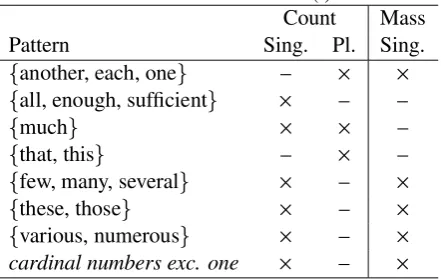
In the second step, errors are detected by the rules described in Table 3. The symbol “Z ” in
Ta-ble 3 denotes that the combination of the corre-sponding row and column is erroneous. For exam-ple, the fifth row denotes that singular and plural count nouns modified bymuchare erroneous. The symbol “–” denotes that no error can be detected by the table. If one of the rules in Table 3 is applied to the target noun, the third step is not applied.
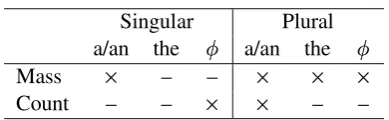
In the third step, errors are detected by the rules described in Table 4. The symbols “Z ” and “–”
are the same as in Table 3.
[image:4.595.309.531.587.727.2]In addition, the indefinite article that modifies other than the head noun is judged to be erroneous
Table 3: Detection rules (i)
Count Mass Pattern Sing. Pl. Sing.
[
another, each, one\ – Z Z
[
all, enough, sufficient\ Z – –
[
much\ Z Z –
[
that, this\ – Z –
[
few, many, several\ Z – Z
[
these, those\ Z – Z
[
various, numerous\ Z – Z
cardinal numbers exc. one Z – Z
5Mass nouns can be used in plural in some cases.
Table 4: Detection rules (ii) Singular Plural a/an the ] a/an the ]
Mass Z – – Z Z Z
Count – – Z Z – –
(e.g., *an expensive). Likewise, the definite article that modifies other than the head noun or adjective is judged to be erroneous (e.g., *the them). Also, we have made exceptions to the rules. The follow-ing combinations are excluded from the detection in the second and third steps: head nouns modified by interrogative adjectives (e.g., what), possessive adjectives (e.g., my), ’s genitives, “some”, “any”, or “no”.
3 Feedback-augmented method
As mentioned in Section 1, the proposed method takes the feedback corpus6as feedback to improve
its performance. In essence, decision lists could be learned from a corpus consisting of a general cor-pus and the feedback corcor-pus. However, since the size of the feedback corpus is normally far smaller than that of general corpora, so is the effect of the feedback corpus on@;
A= ^ ?
. This means that the feedback corpus hardly has effect on the per-formance.
Instead, @; A=
7?
can be estimated by in-terpolating the probabilities estimated from the feedback corpus and the general corpus accord-ing to confidences of their estimates. It is favor-able that the interpolated probability approaches to the probability estimated from the feedback cor-pus as its confidence increases; the more confident its estimate is, the more effect it has on the inter-polated probability. Here, confidence
of ratio
is measured by the reciprocal of variance of the ratio (Tanaka, 1977). Variance is calculated by
@; R_
?
(6)
where
denotes the number of samples used for calculating the ratio. Therefore, confidence of the estimate of the conditional probability used in the proposed method is measured by
3
$
;I ?
@; 8>=
7? ; R_
@; A=
Q?`? (7)
6The feedback corpus refers to learners’ essays whose
er-rors are corrected as mentioned in Section 1.
To formalize the interpolated probability, we will use the symbols aSb
, dc
, TaSb
, and c
to de-note the conditional probabilities estimated from the feedback corpus and the general corpus, and their confidences, respectively. Then, the interpo-lated probability&e
is estimated by7
e
3
f
c gihkj
gml ;n&aTb
c ? J TaTb_opqc
&aSbqJ TaTb_rp c (8)
In Equation (8), the effect ofsaTb
on e
becomes large as its confidence increases. It should also be noted that when its confidence exceeds that of c
, the general corpus is no longer used in the inter-polated probability.
A problem that arises in Equation (8) is that2aTb
hardly has effect on&e
when a much larger general corpus is used than the feedback corpus even iftaTb
is estimated with a sufficient confidence. For ex-ample,&aSb
estimated from 100 samples, which are a relatively large number for estimating a proba-bility, hardly has effect onue
when c
is estimated from 10000 samples; roughly,saSb
has a RVvPRTw*w
ef-fect of
c
one
.
One way to prevent this is to limit the effect of
c
to some extent. It can be realized by taking the log of,c
in Equation (8). That is, the interpolated probability is estimated by
e
3
f
c
xgih`j y{z`|
gl ;n&aTb
c.?
J}TaTb~o4*
c
&aSbqJ}TaTb~r4*qc (9)
It is arguable what base of the log should be used. In this paper, it is set to 2 so that the effect of c
on the interpolated probability becomes large when the confidence of the estimate of the conditional probability estimated from the feedback corpus is small (that is, when there is little data in the feed-back corpus for the estimate)8.
In summary, Equation (9) interpolates between the conditional probabilities estimated from the feedback corpus and the general corpus in the feedback-augmented method. The interpolated probability is then used to calculate the log-likelihood ratio. Doing so, the proposed method takes the feedback corpus as feedback to improve its performance.
7In general, the interpolated probability needs to be
nor-malized to satisfy *s . In our case, however, it is
al-ways satisfied without normalization since h`j
DFEB C~
h`j
DEB C and
l
DFEB C~
l
DEB C
are satisfied.
8We tested several bases in the experiments and found
4 Experiments
4.1 Experimental Conditions
A set of essays9 written by Japanese learners of
English was used as the target essays in the exper-iments. It consisted of 47 essays (3180 words) on the topic traveling. A native speaker of English who was a professional rewriter of English recog-nized 105 target errors in it.
The written part of the British National Corpus (BNC) (Burnard, 1995) was used to learn deci-sion lists. Sentences the OAK system10, which
was used to extract NPs from the corpus, failed to analyze were excluded. After these operations, the size of the corpus approximately amounted to 80 million words. Hereafter, the corpus will be referred to as the BNC.
As another corpus, the English concept explica-tion in the EDR English-Japanese Bilingual dic-tionary and the EDR corpus (1993) were used; it will be referred to as the EDR corpus, hereafter. Its size amounted to about 3 million words.
Performance of the proposed method was eval-uated by recall and precision. Recall is defined by
No. of target errors detected correctly
No. of target errors in the target essays (10) Precision is defined by
No. of target errors detected correctly
No. of detected errors (11) 4.2 Experimental Procedures
First, decision lists for each target noun in the tar-get essays were learned from the BNC11. To
ex-tract noun phrases and their head nouns, the OAK system was used. An optimal value for (window
size of context) was estimated as follows. For 25 nouns shown in (Huddleston and Pullum, 2002) as examples of nouns used as both mass and count nouns, accuracy on the BNC was calculated us-ing ten-fold cross validation. As a result of set-ting small (M35 ), medium (M3NRTw ), and large
(M3(w ) window sizes, it turned out that 35
maximized the average accuracy. Following this result,A3Y5 was selected in the experiments.
Second, the target nouns were distinguished whether they were mass or count by the learned
9http://www.eng.ritsumei.ac.jp/lcorpus/.
10OAK System Homepage: http://nlp.cs.nyu.edu/oak/. 11If no instance of the target noun is found in the
gen-eral corpora (and also in the feedback corpus in case of the feedback-augmented method), the target noun is ignored in the error detection procedure.
decision lists, and then the target errors were de-tected by applying the detection rules to the mass count distinction. As a preprocessing, spelling er-rors were corrected using a spell checker. The re-sults of the detection were compared to those done by the native-speaker of English. From the com-parison, recall and precision were calculated.
Then, the feedback-augmented method was evaluated on the same target essays. Each target essay in turn was left out, and all the remaining target essays were used as a feedback corpus. The target errors in the left-out essay were detected us-ing the feedback-augmented method. The results of all 47 detections were integrated into one to cal-culate overall performance. This way of feedback can be regarded as that one uses revised essays previously written in a class to detect errors in es-says on the same topic written in other classes.
Finally, the above two methods were compared with their seven variants shown in Table 5. “DL” in Table 5 refers to the nine decision list based methods (the above two methods and their seven variants). The words in brackets denote the cor-pora used to learn decision lists; the symbol “+FB” means that the feedback corpus was simply added to the general corpus. The subscripts $*
and
$,
indicate that the feedback was done by using Equation (8) and Equation (9), respectively.
In addition to the seven variants, two kinds of earlier method were used for comparison. One was one (Kawai et al., 1984) of the rule-based methods. It judges singular head nouns with no determiner to be erroneous since missing articles are most common in the writing of Japanese learn-ers of English. In the experiments, this was imple-mented by treating all nouns as count nouns and applying the same detection rules as in the pro-posed method to the countability.
The other was a web-based method (Lapata and Keller, 2005)12for generating articles. It retrieves
web counts for queries consisting of two words preceding the NP that the target noun head, one of the articles ([
a/an, the, ]\ ), and the core NP
to generate articles. All queries are performed as exact matches using quotation marks and submit-ted to the Google search engine in lower case. For example, in the case of “*She is good student.”, it retrieves web counts for “she is a good student”,
12There are other statistical methods that can be used for
“she is the good student”, and “she is good stu-dent”. Then, it generates the article that maxi-mizes the web counts. We extended it to make it capable of detecting our target errors. First, the singular/plural distinction was taken into account in the queries (e.g., “she is a good students”, “she is the good students”, and “she is good students” in addition to the above three queries). The one(s) that maximized the web counts was judged to be correct; the rest were judged to be erroneous. Sec-ond, if determiners other than the articles modify head nouns, only the distinction between singu-lar and plural was taken into account (e.g., “he has some book” vs “he has some books”). In the case of “much/many”, the target noun in singular form modified by “much” and that in plural form modified by “many” were compared (e.g., “he has much furniture” vs “he has many furnitures). Fi-nally, some rules were used to detect literal errors. For example, plural head nouns modified by “this” were judged to be erroneous.
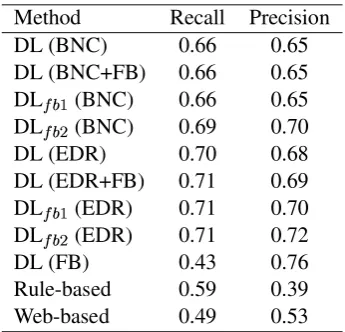
4.3 Experimental Results and Discussion Table 5 shows the experimental results. “Rule-based” and “Web-“Rule-based” in Table 5 refer to the rule-based method and the web-based method, re-spectively. The other symbols are as already ex-plained in Section 4.2.
[image:7.595.95.268.592.758.2]As we can see from Table 5, all the decision list based methods outperform the earlier methods. The rule-based method treated all nouns as count nouns, and thus it did not work well at all on mass nouns. This caused a lot of false-positives and false-negatives. The web-based method suffered a lot from other errors than the target errors since
Table 5: Experimental results Method Recall Precision DL (BNC) 0.66 0.65 DL (BNC+FB) 0.66 0.65 DLaTb
(BNC) 0.66 0.65 DLaTb
(BNC) 0.69 0.70 DL (EDR) 0.70 0.68 DL (EDR+FB) 0.71 0.69 DLaTb
(EDR) 0.71 0.70 DLaTb
(EDR) 0.71 0.72 DL (FB) 0.43 0.76 Rule-based 0.59 0.39 Web-based 0.49 0.53
it implicitly assumed that there were no errors ex-cept the target errors. Contrary to this assumption, not only did the target essays contain the target er-rors but also other erer-rors since they were written by Japanese learners of English. This indicate that the queries often contained the other errors when web counts were retrieved. These errors made the web counts useless, and thus it did not perform well. By contrast, the decision list based meth-ods did because they distinguished mass and count nouns by one of the words around the target noun that was most likely to be effective according to the log-likelihood ratio13; the best performing
de-cision list based method (DLaTb
(EDR)) is sig-nificantly superior to the best performing14
non-decision list based method (Web-based) in both re-call and precision at the 99% confidence level.
Table 5 also shows that the feedback-augmented methods benefit from feedback. Only an exception is “DLaTb
(BNC)”. The reason is that the size of BNC is far larger than that of the feedback cor-pus and thus it did not affect the performance. This also explains that simply adding the feed-back corpus to the general corpus achieved little or no improvement as “DL (EDR+FB)” and “DL (BNC+FB)” show. Unlike these, both “DLaTb
(BNC)” and “DLaTb
(EDR)” benefit from feed-back since the effect of the general corpus is lim-ited to some extent by the log function in Equa-tion (9). Because of this, both benefit from feed-back despite the differences in size between the feedback corpus and the general corpus.
Although the experimental results have shown that the feedback-augmented method is effective to detecting the target errors in the writing of Japanese learners of English, even the best per-forming method (DLaTb
(EDR)) made 30 false-negatives and 29 false-positives. About 70% of the false-negatives were errors that required other sources of information than the mass count dis-tinction to be detected. For example, extra def-inite articles (e.g., *the traveling) cannot be de-tected even if the correct mass count distinction is given. Thus, only a little improvement is expected in recall however much feedback corpus data be-come available. On the other hand, most of the
13Indeed, words around the target noun were effective. The
default rules were used about 60% and 30% of the time in “DL (EDR)” and “DL (BNC)”, respectively; when only the default rules were used, “DL (EDR)” (“DL (BNC)”) achieved 0.66 (0.56) in recall and 0.58 (0.53) in precision.
14“Best performing” here means best performing in terms
false-positives were due to the decision lists them-selves. Considering this, it is highly possible that precision will improve as the size of the feedback corpus increases.
5 Conclusions
This paper has proposed a feedback-augmented method for distinguishing mass and count nouns to complement the conventional rules for detect-ing grammatical errors. The experiments have shown that the proposed method detected 71% of the target errors in the writing of Japanese learn-ers of English with a precision of 72% when it was augmented by feedback. From the results, we conclude that the feedback-augmented method is effective to detecting errors concerning the ar-ticles and singular plural usage in the writing of Japanese learners of English.
Although it is not taken into account in this pa-per, the feedback corpus contains further useful in-formation. For example, we can obtain training data consisting of instances of errors by compar-ing the feedback corpus with its original corpus. Also, comparing it with the results of detection, we can know performance of each rule used in the detection, which make it possible to increase or decrease their log-likelihood ratios according to their performance. We will investigate how to ex-ploit these sources of information in future work.
Acknowledgments
The authors would like to thank Sekine Satoshi who has developed the OAK System. The authors also would like to thank three anonymous review-ers for their useful comments on this paper.
References
K. Allan. 1980. Nouns and countability. J. Linguistic Society of America, 56(3):541–567.
F. Bond. 2005. Translating the Untranslatable. CSLI publications, Stanford.
L. Burnard. 1995. Users Reference Guide for the
British National Corpus. version 1.0. Oxford Uni-versity Computing Services, Oxford.
M. Chodorow and C. Leacock. 2000. An unsupervised method for detecting grammatical errors. InProc. of 1st Meeting of the North America Chapter of ACL, pages 140–147.
Japan electronic dictionary research institute ltd. 1993.
EDR electronic dictionary specifications guide.
Japan electronic dictionary research institute ltd, Tokyo.
S. Granger. 1998. Prefabricated patterns in advanced EFL writing: collocations and formulae. In A. P. Cowie, editor, Phraseology: theory, analysis, and applications, pages 145–160. Clarendon Press.
R. Huddleston and G.K. Pullum. 2002. The
Cam-bridge Grammar of the English Language. Cam-bridge University Press, CamCam-bridge.
E. Izumi, K. Uchimoto, T. Saiga, T. Supnithi, and H. Isahara. 2003. Automatic error detection in the Japanese learners’ English spoken data. InProc. of 41st Annual Meeting of ACL, pages 145–148. A. Kawai, K. Sugihara, and N. Sugie. 1984. ASPEC-I:
An error detection system for English composition.
IPSJ Journal (in Japanese), 25(6):1072–1079. M. Lapata and F. Keller. 2005. Web-based models for
natural language processing. ACM Transactions on Speech and Language Processing, 2(1):1–31. J. Lee. 2004. Automatic article restoration. InProc. of
the Human Language Technology Conference of the North American Chapter of ACL, pages 31–36. K.F. McCoy, C.A. Pennington, and L.Z. Suri. 1996.
English error correction: A syntactic user model based on principled “mal-rule” scoring. In Proc. of 5th International Conference on User Modeling, pages 69–66.
G. Minnen, F. Bond, and A. Copestake. 2000.
Memory-based learning for article generation. In
Proc. of CoNLL-2000 and LLL-2000 workshop, pages 43–48.
N. Ostler and B.T.S Atkins. 1991. Predictable mean-ing shift: Some lmean-inguistic properties of lexical impli-cation rules. InProc. of 1st SIGLEX Workshop on Lexical Semantics and Knowledge Representation, pages 87–100.
D. Schneider and K.F. McCoy. 1998. Recognizing syntactic errors in the writing of second language learners. InProc. of 17th International Conference on Computational Linguistics, pages 1198–1205.
Y. Tanaka. 1977. Psychological methods (in
Japanese). University of Tokyo Press.
C. Tschichold, F. Bodmer, E. Cornu, F. Grosjean, L. Grosjean, N. Kubler, N. L ewy, and C. Tschumi.
1997. Developing a new grammar checker for En-glish as a second language. InProc. of the From Re-search to Commercial Applications Workshop, pages 7–12.
D. Yarowsky. 1995. Unsupervised word sense disam-biguation rivaling supervised methods. InProc. of 33rd Annual Meeting of ACL, pages 189–196.
D. Yarowsky. 1996. Homograph Disambiguation in