Munich Personal RePEc Archive
Model Averaging in Predictive
Regressions
Liu, Chu-An and Kuo, Biing-Shen
Academia Sinica, National Chengchi University
18 March 2016
Model Averaging in Predictive Regressions
∗
Chu-An Liu
†and Biing-Shen Kuo
‡Mar 2016
Abstract
This paper considers forecast combination in a predictive regression. We con-struct the point forecast by combining predictions from all possible linear regression models given a set of potentially relevant predictors. We derive the asymptotic risk of least squares averaging estimators in a local asymptotic framework. We then de-velop a frequentist model averaging criterion, an asymptotically unbiased estimator of the asymptotic risk, to select forecast weights. Monte Carlo simulations show that our averaging estimator compares favorably with alternative methods such as weighted AIC, weighted BIC, Mallows model averaging, and jackknife model aver-aging. The proposed method is applied to stock return predictions.
JEL Classification: C52, C53
Keywords: Forecast combination, Local asymptotic theory, Plug-in estimators.
∗We thank the co-editor, two referees, Bruce Hansen, and Jack Porter for many constructive comments
and suggestions. We are also grateful to Sheng-Kai Chang, Jau-er Chen, Serena Ng, Tatsushi Oka, Liangjun Su, Denis Tkachenko, Aman Ullah, and conference participants of CMES 2013, the Tsinghua International Conference in Econometrics, SETA 2013, AMES 2013, EEA-ESEM 2013, CFE-ERCIM 2013, and EEA-ESEM 2014 for their discussions and suggestions. All errors remain the authors’.
†Institute of Economics, Academia Sinica. Email: [email protected].
1
Introduction
The challenge of empirical studies on forecasting practice is that one does not know exactly what predictors should be included in the true model. In order to address the model uncertainty, forecast combination has been widely used in economics and statistics; see Granger (1989), Clemen (1989), Timmermann (2006), and Stock and Watson (2006) for literature reviews. Although there is plenty of empirical evidence to support the success of forecast combination, there is no unified view on selecting the forecast weights in a general framework.
The main goal of this paper is to provide a data-driven approach to weight selection for forecast combination. Building on the idea of the focused information criterion (FIC) proposed by Claeskens and Hjort (2003), we introduce a frequentist model averaging criterion to select the weights for candidate models and study its properties. More recently, FIC has been extended to several models, including the general semiparametric model (Claeskens and Carroll, 2007), the generalized additive partial linear model (Zhang and Liang, 2011), the Tobin model with a nonzero threshold (Zhang, Wan, and Zhou, 2012), the generalized empirical likelihood estimation (Sueishi, 2013), the generalized method of moments estimation (DiTraglia, 2015), and the propensity score weighted estimation of the treatment effects (Lu, 2015; Kitagawa and Muris, 2015). Despite the growing literature on FIC, little work has been done on forecast combination.
Following Hjort and Claeskens (2003), Hansen (2014), and Liu (2015), we examine the asymptotic risk of least squares averaging estimators in a local asymptotic framework where the regression coefficients of potentially relevant predictors are in a local T−1/2
neighborhood of zero. This local-to-zero framework ensures the consistency of the av-eraging estimator while in general presents an asymptotic bias. The local asymptotic framework has an advantage of yielding the same stochastic order of squared biases and variances. Thus, the optimal forecast combination is the one that achieves the best trade-off between bias and variance in this context.
estimate of the asymptotic risk. Therefore, the data-driven weights that minimize the model averaging criterion are expected to close to the optimal weights that minimize the asymptotic risk.
To illustrate the proposed forecast combination approach, we study the predictability of U.S. stock returns. Following Welch and Goyal (2008) and Rapach, Strauss, and Zhou (2010), we use U.S. quarterly data to investigate the out-of-sample equity premium. We find strong evidence that the performance of the proposed approach is better than the historical average benchmark. In particular, our forecast combination approach achieves lower cumulative squared prediction error than those produced by other averaging meth-ods such as weighted AIC, weighted BIC, Mallows model averaging, and jackknife model averaging. Our results support the findings of Rapach, Strauss, and Zhou (2010) and El-liott, Gargano, and Timmermann (2013) that forecast combinations consistently achieve significant gains on out-of-sample predictions.
We now discuss the related literature. There is a large body of literature on forecast combination, including both Bayesian and frequentist model averaging. Since the seminal work of Bates and Granger (1969), many forecast combination methods are proposed, including Granger and Ramanathan (1984), Min and Zellner (1993), Raftery, Madigan, and Hoeting (1997), Buckland, Burnham, and Augustin (1997), Yang (2004), Zou and Yang (2004), Hansen (2008), Hansen (2010), Elliott, Gargano, and Timmermann (2013), and Cheng and Hansen (2015). There are also many alternative approaches to combine or shrink forecasts, for example, bagging (Breiman, 1996; Inoue and Kilian, 2008), the LASSO (Tibshirani, 1996), the adaptive LASSO (Zou, 2006), and the model confidence set (Hansen, Lunde, and Nason, 2011), among others.
Our paper is closely related to Hansen (2008), who proposes to select the forecast weights by minimizing the Mallows model averaging (MMA) criterion. The MMA crite-rion approximates the mean squared forecast error (MSFE) by the sum of squared errors and a penalty term. Hence, the MMA criterion addresses the trade-off between the model fit and model complexity. Hansen (2008) shows that the MMA criterion is an asymptot-ically unbiased estimator of the MSFE in a homoskedastic linear regression model. Like the MMA criterion, our model averaging criterion is also asymptotically unbiased for the MSFE. We, however, employ a drifting asymptotic framework to approximate the MSFE, and do not restrict model errors to be homoskedastic. In this paper, we show that the pro-posed plug-in averaging estimator is a generalized Mallows’ Cp-type averaging estimator
in most simulations.
One popular model averaging approach is the simple equal-weighted average. The simple equal-weighted average is appropriate to use if all the candidate models have similar prediction powers. Recently, Elliott, Gargano, and Timmermann (2013) extend the idea of the simple equal-weighted average to complete subset regressions. They construct the forecast combination by using equal-weighted combination based on all possible models that keep the number of predictors fixed. Instead of choosing the weights, the subset regression combinations have to choose the number of predictors κ, and the data-driven method for κ still needs further investigation. Monte Carlo shows that the performance of complete subset regressions is sensitive to the choice ofκ, while the performance of our model averaging criterion is relatively robust in most simulations.
There is a large literature on the asymptotic optimality of model selection. Shibata (1980) and Ing and Wei (2005) demonstrate that model selection estimators based on the Akaike information criterion or the final prediction criterion asymptotically achieve the lowest possible MSFE in homoskedastic autoregressive models. Li (1987) shows the asymptotic optimality of the Mallows criterion in homoskedastic linear regression models. Andrews (1991) extends the asymptotic optimality to the heteroskedastic linear regression models. Shao (1997) provides a general framework to discuss the asymptotic optimality of various model selection procedures.
The existing literature on the asymptotic optimality of model averaging is compara-tively small. Hansen (2007) introduces the MMA estimator and demonstrates the asymp-totic optimality of the MMA estimator for nested and homoskedastic linear regression models. Wan, Zhang, and Zou (2010) extend the asymptotic optimality of the MMA estimator for continuous weights and a non-nested setup. Hansen and Racine (2012) propose the jackknife model averaging estimator and demonstrate the asymptotic op-timality in heteroskedastic linear regression models. Liu and Okui (2013) propose the heteroskedasticity-robust Cp estimator and demonstrate its optimality in the linear
re-gression models with heteroskedastic errors. Zhang, Zou, and Liang (2014) propose a Mallows-type model averaging estimator for the linear mixed-effects models and establish the asymptotic optimality. These asymptotic theories, however, are limited to the ran-dom sample and hence are not directly applicable to forecast combination for dependent data. In a recent paper, Zhang, Wan, and Zou (2013) show the asymptotic optimality of the jackknife model averaging estimator in the presence of lagged dependent variables. They assume that the dependent variable follows the stationary AR(∞) process. A more general theory needs to be developed in a future study.
describes the averaging estimator. Section 3 presents the asymptotic framework and the plug-in averaging estimator for forecast combination and discusses the relationship between the plug-in averaging estimator and the Mallows’ Cp-type averaging estimator.
Section 4 evaluates the finite sample performance of the plug-in averaging estimator and other averaging estimators in two simulation experiments. Section 5 applies the plug-in forecast combination to the predictability of U.S. stock returns. Section 6 concludes the paper. Proofs and figures are included in the Appendix.
2
Model and Estimation
Suppose we have observations (yt,xt,zt) fort = 1, ..., T. The goal is to construct a point
forecast of yT+1 given (xT,zT) using the one-step-ahead forecasting model
yt+1 =x′tβ+z′tγ+et+1, (2.1)
E(htet+1) = 0, (2.2)
where yt+1 is a scalar dependent variable, ht = (x′t,zt′)′, xt (p×1) and zt (q ×1) are
vectors of predictors, and et is an unobservable error term. Here, xt is a set of
“must-have” predictors, which must be included in the model based on theoretical grounds, while
zt is a set of “potentially relevant” predictors, which may or may not be included in the
model. Note that xt is allowed to be an empty matrix or include only a constant term.
The potentially relevant predictors could be lags ofyt, deterministic terms, any nonlinear
transformations of the original predictors, or the interaction terms between the predictors. The error term is allowed to be heteroskedastic, and there is no further assumption on the distribution of the error term. We assume throughout that 1≤ p+q ≤ T −1, and we do not let the number of predictors p and q increase with the sample size T.
We now consider a set of M approximating models indexed by m = 1, ..., M, where the mth model includes all must-have predictors xt and a subset of potentially relevant
predictors zt. The mth model has p+qm predictors. We do not place any restrictions
on the model space. The set of models could be nested or non-nested. If we consider a sequence of nested models, then M = q + 1. If we consider all possible subsets of potentially relevant predictors, thenM = 2q.
Let y = (y1, y2, ..., yT)′, X = (x0,x1, ...,xT−1)′, Z = (z0,z1, ...,zT−1)′, and e =
(e1, e2, ..., eT)′. In matrix notation, the model (2.1) can be written as
where H= (X,Z) and θ = (β′,γ′)′.
Let Πm be a qm ×q selection matrix that selects the included potentially relevant
predictors in themth model. LetI denote an identity matrix and0 a zero matrix. Also,
Sm =
Ip 0p×qm
0q×p Π′m
!
is a selection matrix of dimension (p+q)×(p+qm).
The unconstrained least squares estimator ofθ in the full model is θb= (H′H)−1
H′y,
and the least squares estimator in the mth submodel is θbm = (H′mHm)−1H′my, where
Hm = (X,Zm) = (X,ZΠ′m) = HSm. The predicted value is by(m) = Hmθbm =HSmθbm.
Thus, the one-step-ahead forecast given information up to periodT from this mth model is
b
yT+1|T(m) =h′TSmθbm. (2.4)
Let w = (w1, ..., wM)′ be a weight vector with wm ≥ 0 and PMm=1wm = 1. That is,
w ∈ HM where HM =w∈ [0,1]M :PM
m=1wm = 1 . The one-step-ahead combination
forecast is
b
yT+1|T(w) = M
X
m=1
wmybT+1|T(m) = M
X
m=1
wmh′TSmθbm =h′Tθb(w), (2.5)
where θb(w) =PMm=1wmSmθbm is an averaging estimator of θ.
3
Forecast Combinations
3.1
Local Asymptotic Framework
In a constant parameter model, i.e., nonzero and fixed values of γ, the least squares estimators for all possible models except the full model have omitted variable bias. The risk of these models tends to infinity with the sample size, and hence the asymptotic approximations break down. To obtain a useful approximation, we follow Hjort and Claeskens (2003), Hansen (2014), and Liu (2015), and use a local-to-zero asymptotic framework to approximate the in-sample MSE. More precisely, the parameters γ are modeled as being in a local T−1/2
neighborhood of zero. This local-to-zero framework is similar to that used in weak instrument theory (Staiger and Stock, 1997).
Assumption 1. γ =γT =δ/
√
T, where δ is an unknown vector.
Assumption 2. {yt+1,ht}is a strictly stationary and ergodic time series with finiter >4
moments and E(et+1|Ft) = 0, where Ft=σ(ht,ht−1, ...;et, et−1, ...).
Assumption 1 assumes thatγ is local to zero, and it ensures that the asymptotic mean squared error of the averaging estimator remains finite. The local asymptotic framework is a technical device commonly used to analyze the asymptotic and finite sample prop-erties of the model selection and averaging estimator, for example, Claeskens and Hjort (2003), Leeb and P¨otscher (2005), P¨otscher (2006), and Elliott, Gargano, and Timmer-mann (2013). Note that the O(T−1/2
) framework gives squared model biases of the same orderO(T−1
) as estimator variances. Hence, in this context the optimal forecast combina-tion is the one that achieves the best trade-off between bias and variance. Alternatively, Assumption 1 could be replaced by imposing the i.i.d. normal assumption on the error term; see Hansen (2014) for a discussion.
Assumption 2 states that data is strictly stationary, and it implies that et+1 is
con-ditionally unpredictable at time t. Assumption 2 is similar to Assumption 1 of Hansen (2014) and Assumptions R(i)-(ii) of Cheng and Hansen (2015). Assumption 2 is sufficient to imply that T−1
H′H−→p Q and T−1/2
H′e −→d R ∼ N(0,Ω) where Q = E (h
th′t) >0
and Ω = E hth′te
2
t+1
. Note that if the error term is i.i.d. and homoskedastic, then Ω
can be simplified asΩ=σ2
Q. Since the selection matrixSm is nonrandom with elements
either 0 or 1, for themth model we haveT−1
H′
mHm p
−→Qm whereQm =S′mQSm is
Theorem 1. Suppose that Assumptions 1–2 hold. As T → ∞, we have
√
T θb(w)−θ−→d N A(w)δ,V(w)
A(w) =
M
X
m=1
wm(PmQ−Ip+q)S0
V(w) =
M
X
m=1
w2
mPmΩPm+ 2
X X
m6=ℓ
wmwℓPmΩPℓ
where Pm =SmQ−m1S′m and S0 = (0q×p,Iq)′.
Theorem 1 shows the asymptotic normality of the averaging estimator with nonrandom weights. We use this result to compute the asymptotic risk of the averaging estimator. If we assign the whole weight to the full model, i.e., all predictors are included in the model, it is easy to see that we have a conventional asymptotic distribution with mean zero (zero bias) and sandwich-form variance Q−1
ΩQ−1
. Note that A(w)δ represents the asymptotic bias term of the averaging estimatorθb(w). The magnitude of the asymptotic bias is determined by the covariance matrixQand the local parameterδ. The asymptotic variance of the averaging estimator V(w) has two components. The first component is the weighted average of the variance of each model, and the second component is the weighted average of the covariance between any two models.
3.2
MSE and MSFE
We first show that the one-step-ahead MSFE approximately equals the in-sample MSE when the observations are strictly stationary. Thus, the weight vector that minimizes the in-sample MSE is expected to minimize the one-step-ahead MSFE.
Let σ2
= E(e2
t) and µt = x′tβ +z′tγ be the conditional mean. Then, we rewrite
the model (2.1) as yt+1 = µt +et+1. Similarly, for any fixed-weight vector, we write
b
µt(w) = PMm=1wmh ′
tSmθbm =h′tθb(w).
Following common practice, we consider the quadratic loss function and define the in-sample MSE as
MSE(w) = E 1 T
T
X
t=1
(µt−µbt(w))
2
!
. (3.1)
(2015), we have
MSF E(w) = E yT+1−ybT+1|T(w)
2
= E e2
T+1+ (µT −µbT(w)) 2
≃E e2
t+1+ (µt−µbt(w)) 2
=σ2
+MSE(w), (3.2)
where the second equality holds since eT+1 is uncorrelated with µbT(w) by Assumption 2
and the approximation in the third line is valid for stationary (yt,ht).1
Let the optimal weight vector be the value that minimizes MSE(w) over w ∈ HM.
Since σ2
is a constant and not related to the weight vector w, Equation (3.2) implies that the optimal weight vector that minimizes the MSE(w) is expected to minimize the MSF E(w).
We follow Hansen (2014) to define the asymptotic trimmed risk or weighted MSE of an estimator ˜θ for θ as
R( ˜θ,θ) = lim
ζ→∞lim infT→∞ E min{T( ˜θ−θ) ′Q( ˜θ
−θ), ζ}. (3.3)
Note that E(( ˜θ−θ)′Q( ˜θ−θ)) is the risk of an estimator ˜θ under the weighted squared
error loss function, which may not be finite unless ˜θ has sufficient finite moments. Thus, we use ζ to bound the expectation when the risk does not exist for finite T. We choose the covariance matrix Q as a weight matrix, so that the weighted MSE function (3.3) plus σ2
corresponds to one-step-ahead MSFE.2
Thus, it is natural to use the asymptotic risk to approximate the MSE. The asymptotic risk is well-defined and straightforward to calculate when the estimator ˜θ has an asymptotic distribution.
3.3
Weighted Focused Information Criterion
The model selection estimator is a special case of the model averaging estimator. If we consider the unit weight vector w1,m, where the mth element is one and the others
1Hansen (2008) shows that the MSFE approximately equals the MSE in a homoskedastic linear re-gression model with stationary time series data. Elliott, Gargano, and Timmermann (2013) also have a similar argument for complete subset regressions.
2For any estimator, the one-step-ahead MSFE is E(y
T+1 −h′Tθ˜)
2 = E(e2
T+1 + (h
′
T(θ −θ˜))
2)
≃
σ2+E(( ˜
θ−θ)hTh′T( ˜θ−θ)), where the first equality holds by Assumption 2 and the second approximation
is valid for stationary (yt,ht). Thus, we chooseQas a weight matrix, so thatR( ˜θ,θ) plusσ2corresponds
are zeros, then the averaging estimator simplifies to a selection estimator. Let θb(m) =
Smθbm =θb(w1,m) be the least squares estimator of θ in the mth submodel.
Theorem 2. Suppose that Assumptions 1–2 hold. We have
R(θb(m),θ) = tr (QCmδδ′C′m) + tr (QPmΩPm) (3.4)
where Cm = (PmQ−Ip+q)S0.
Theorem 2 presents the asymptotic trimmed risk of the least squares estimators in the mth model under the local asymptotic framework. We can use (3.4) to select a best approximating model, and this is the idea of the weighted focused information criterion (wFIC) proposed by Claeskens and Hjort (2008). Let mb be the model that minimizes (3.4). Combining Theorem 2 with (3.2), we deduce that mb is expected to be the model that minimizes the MSFE.
To use (3.4) for model selection, we need to estimate the unknown parameters Q,
Ω, Cm, Pm, and δ. Let Qb = T1 PTt=1hth ′
t. Then we have Qb p
−→ Q under Assumption 2. The covariance matrix Ω can be consistently estimated by the heteroskedasticity-consistent covariance matrix estimator proposed by White (1980). The estimator is Ωb =
1
T
PT t=1hth
′
tbe
2
t+1, where bet+1 =yt+1−h′tθbis the least squares residual for the full model.
If the error term is i.i.d. and homoskedastic, then Ω can be consistently estimated by
1
Tbσ
2PT
t=1hth ′
t, where bσ
2
= 1
T
PT t=1be
2
t+1. Note that both Cbm and Pbm are functions of Q
and selection matrices, which can also be consistently estimated by the sample analogue under Assumption 2.
Unlike other unknown parameters, the consistent estimator for the local parameter δ
is not available due to the local asymptotic framework. We can, however, construct an asymptotically unbiased estimator ofδ by using the estimator from the full model. That is,δb=√Tγb. Theorem 1 and the delta method show that
b
δ =√Tγb−→d Rδ =δ+S′0Q−1R∼N(δ,S′0Q−1ΩQ−1S0). (3.5)
As shown above,δbis an asymptotically unbiased estimator forδ. Since the mean ofRδR′δ
isδδ′+S′ 0Q−
1
ΩQ−1
S0, we construct the asymptotically unbiased estimator of δδ′ as
c
δδ′ =δbδb′−S′
0Qb −1b
ΩQb−1
Following Claeskens and Hjort (2008), we define the wFIC of the mth submodel as
wFIC(m) = trQbCbm
b
δδb′−S′0Qb −1b
ΩQb−1
S0
b
C′m+ trQbPbmΩbPbm
, (3.7)
which is an asymptotically unbiased estimator of R(θb(m),θ). We then select the model with the lowest wFIC.
3.4
Plug-In Averaging Estimator
We now extend the idea of the weighted focused information criterion to model averaging.3
The following theorem presents the asymptotic trimmed risk of the averaging estimator in the local asymptotic framework.
Theorem 3. Suppose that Assumptions 1–2 hold. We have
R(θb(w),θ) =w′ψw (3.8)
where ψ is an M ×M matrix with the (m, ℓ)th element
ψm,ℓ= tr (QCmδδ′Cℓ′) + tr (QPmΩPℓ). (3.9)
Note that the mth diagonal element of ψ characterizes the bias and variance of the mth model while the off-diagonal elements measure the product of biases and covariance between different models. Theorem 3 is a more general statement than Theorem 2 of Elliott, Gargano, and Timmermann (2013). First, we do not restrict the setup to i.i.d. data. Second, we allow any arbitrary combination between models. Third, we do not restrict the weights to be equal.
From Theorem 3, we define the optimal weight vector as the value that minimizes the asymptotic risk over w∈ HM:
wo = argmin
w∈HM
w′ψw. (3.10)
Combining Theorem 3 with (3.2), we deduce that wo is nearly equivalent to the opti-mal weight vector that minimizes the MSFE. Note that the objection function is
quadratic inw, which means the optimal weight vector can be computed numerically via quadratic programming.
The optimal weights, however, are infeasible, since they depend on the unknown pa-rameter ψ. Similar to Liu (2015), we propose a plug-in estimator to estimate the optimal weights for the forecasting model. We first estimate the asymptotic risk by plugging in an asymptotically unbiased estimator. We then choose the data-driven weights by minimiz-ing the sample analog of the asymptotic risk and use these estimated weights to construct the one-step-ahead forecast combination.
Let ψb be a sample analog of ψ with the (m, ℓ)th element
b
ψm,ℓ = tr
b
QCbmδδc′Cb′ℓ
+ trQbPbmΩbPbℓ
, (3.11)
whereδδc′ is defined in (3.6). The data-driven weights based on the plug-in estimator are
defined as
b
w= argmin
w∈HM
w′ψbw, (3.12)
where w′ψbw is an asymptotically unbiased estimator of w′ψw.4
Similar to the opti-mal weight vector, the data-driven weights can also be found numerically via quadratic programming.5
The plug-in one-step-ahead combination forecast is
b
yT+1|T(wb) =h′Tθb(wb). (3.13)
As mentioned by Hjort and Claeskens (2003), we can also estimate ψ by inserting δb
for δ. The alternative estimator ofψm,ℓ is
e
ψm,ℓ = tr
b
QCbmδbδb′Cb′ℓ
+ trQbPbmΩbPbℓ
. (3.14)
Althoughψem,ℓ is not an asymptotically unbiased estimator, the simulation shows that the
estimator (3.14) has better finite sample performance than the estimator (3.11) in most ranges of the parameter space.6
4Claeskens and Hjort (2008) suggest estimating the first term ofψ
m,ℓ by max0,tr QbCbmδδc′Cb′ℓ to
avoid the negative estimate for the squared bias term. However, our simulations show that this modified estimator is not a stable estimator forψm,ℓ. Therefore, we focus on the estimator (3.11) in this paper.
5Note that when M > 2, there is no closed-form solution to (3.12). When M = 2, the closed-form solution to (3.12) is w1b = we and w2b = 1−w, wheree we = (ψ2b,2−ψ1b,2)/(ψ1b,1+ψ2b,2−2ψ1b,2) if
b
ψ1,2<min{ψ1b,1,ψ2b,2},we= 1 ifψ1b,1≤ψ1b,2<ψ2b,2, orwe= 0 ifψ2b,2≤ψ1b,2<ψ1b,1.
6
It is quite easy to model the heteroskedasticity by the plug-in method since the esti-mated weights depend on the covariance matrix estimator Ωb. Another advantage of the plug-in method is that the correlations between different models are taken into account in the data-driven weights.
The proposed forecast combination method is the prediction counterpart to the plug-in averaging estimator proposed in Liu (2015). Similar to Liu (2015), we employ a drifting asymptotic framework and use the asymptotic risk to approximate the finite sample MSE. We, however, focus attention on the global fit of the model instead of a scalar function of parameters. Furthermore, we characterize the optimal weights under the weighted quadratic loss function instead of a pointwise loss function as in Liu (2015).7
Theorem 4. Letwb be the plug-in weights defined in (3.11) and (3.12). AssumeΩˆ −→p Ω. Suppose that Assumptions 1–2 hold. We have
R(θb(wb),θ) = E ((A(w∗)δ+P(w∗)R)′Q(A(w∗)δ+P(w∗)R)), (3.15)
where
A(w∗) =
M
X
m=1
w∗m(PmQ−Ip+q)S0, (3.16)
P(w∗) =
M
X
m=1
w∗mPm, (3.17)
w∗ = argmin
w∈HM
w′ψ∗w, (3.18)
and ψ∗ is anM ×M matrix with the (m, ℓ)th element
ψm,ℓ∗ = tr QCm(RδR′δ−S′0Q −1
ΩQ−1
S0)C′ℓ
+ tr (QPmΩPℓ) (3.19)
with Rδ =δ+S′0Q−1R and R∼N(0,Ω).
asymptotic risk than the unrestricted estimator. We might follow Hansen (2014) and apply Stein’s Lemma to investigate the asymptotic risk of the estimators (3.11) and (3.14). A rigorous demonstration is beyond the scope of this paper and is left for future research.
7Liu (2015) considers a smooth real-valued function µ(β,γ) as the parameter of interest. Suppose that we setµ(β,γ) =yT+1|T =x′Tβ+z′Tγ. Then the plug-in averaging estimator proposed by Liu (2015)
isµ(b wb) =PMm=1wbmbµm=ybT+1|T(wb), where wb = argminw∈HMw
′Ψwˆ and the (m, ℓ)th element ofΨˆ is
b
Ψm,ℓ=h′T(Cbmδδc′Cb′ℓ+PbmΩbPbℓ)hT, which is different from the proposed estimator defined in Equation
(3.11). Note that the above estimator depends heavily on the covariate valueshT, and simulations show
Theorem 4 presents the asymptotic trimmed risk of the plug-in averaging estimator. Unlike the averaging estimator with fixed weights, the asymptotic trimmed risk of the plug-in averaging estimator depends on the normal random vector R. Note that the limiting distribution of the plug-in averaging estimator is a nonlinear function ofRinstead of a normal distribution. For the alternative estimator of ψm,ℓ defined in (3.14), the
asymptotic trimmed risk of the plug-in averaging estimator is the same except (3.19) is replaced byψ∗
m,ℓ= tr (QCmRδR′δC′ℓ) + tr (QPmΩPℓ).
3.5
Relationship between the Plug-In Averaging Estimator and
the Mallows’
C
p-type Averaging Estimator
In this section we discuss the relationship between the plug-in averaging estimator and the Mallows’ Cp-type averaging estimator. Suppose that δδ′ is estimated by the
asymp-totically unbiased estimator (3.6). Then, the equation (3.11) can be rewritten as
b
ψm,ℓ = tr
b QCbm
b
δδb′−S′0Qb −1b
ΩQb−1
S0
b
C′ℓ+ trQbPbmΩbPbℓ
= trQbCbmδbδb′Cb′ℓ
−trQbCbmS′0Qb −1b
ΩQb−1
S0Cb′ℓ−QbPbmΩbPbℓ
= (be′mbeℓ−be′be) + tr(Qb−m1Ωbm+Qb−ℓ1Ωbℓ−Qb−1Ωb), (3.20)
wherebe =y−Hθb,ebm =y−Hmθbm,Qbm =S′mQSb m, andΩbm =S′mΩSb m; see the appendix
for the derivation of (3.20). Therefore, the criterion function for the plug-in averaging estimator is
w′ψbw=w′ξbw−be′be−tr(Qb−1b
Ω) (3.21)
where the (m, ℓ)th element of ξbis
b
ξm,ℓ=be′mbeℓ+ tr(Qbm−1Ωbm) + tr(Qb−ℓ1Ωbℓ). (3.22)
Since be′be and tr(Qb−1b
Ω) are not related to the weight vector w, minimizing w′ψbw over w= (w1, ..., wM) is equivalent to minimizing w′ξbw.
Let be(w) = y−Hθb(w) be the averaging residuals vector. Let k = (k1, ..., kM)′ and
km =p+qm. If the error term is i.i.d. and homoskedastic, then the covariance matrix Ω
can be consistently estimated by 1
Tbσ
2PT
t=1hth′t. In this case, tr(Qb−
1
m Ωbm) =σb2km. Define
for the plug-in averaging estimator is
w′ξbw=be(w)′be(w) +bσ2
w′Σw=be(w)′be(w) + 2bσ2
k′w, (3.23)
which is the Mallows criterion proposed by Hansen (2007). Note that the last equality of (3.23) holds by the fact that w′Σw=w′(k1′+1k′)w= 2k′w, where 1= (1, ...,1)′ is an
M ×1 vector. The first term of the Mallows criterion measures the model fit, while the second term of the criterion measures the effective number of parameters and serves as a penalty term. Therefore, we can interpret the MMA criterion as a measure of model fit and model complexity.
If the error term is serially uncorrelated and identically distributed, then Ω can be consistently estimated by Ωb = 1
T
PT
t=1hth′tbe
2
t+1. Let hm,t =S′mht. In this case,
tr(Qb−1
m Ωbm) = tr
T
X
t=1
hm,th′m,t !−1
T
X
t=1
hm,th′m,tbe2
t+1
!
≡ekm. (3.24)
Define Σe as an M ×M matrix whose (m, ℓ)th element is ekm +ekℓ. Then, the criterion
function for the plug-in averaging estimator is
w′ξbw=be(w)′be(w) +w′Σwe =be(w)′be(w) + 2ek′w, (3.25)
where ke = (ek1, ...,ekM)′. Therefore, the criterion function (3.25) is equivalent to the
heteroskedasticity-robust Cp criterion proposed by Liu and Okui (2013).
As shown in (3.23) and (3.25), the proposed plug-in averaging estimator is a generalized Mallows’ Cp-type averaging estimator. When δδ′ is estimated by the asymptotically
unbiased estimator (3.6), the plug-in averaging estimator is equivalent to the Mallows model averaging estimator if the covariance matrix estimator Ωb = 1
Tσb
2PT
t=1hth′t is used,
and is equivalent to the heteroskedasticity-robustCp averaging estimator if the covariance
matrix estimator Ωb = 1
T
PT
t=1hth′tbe
2
t+1 is used.
4
Finite Sample Investigation
4.1
Six Forecast Combination Methods
In the simulations, we consider the following forecast combination approaches: (1) smoothed Akaike information criterion model averaging estimator (labeled S-AIC), (2) smoothed Bayesian information criterion model averaging estimator (labeled S-BIC), (3) Mallows model averaging estimator (labeled MMA), (4) jackknife model averaging estimator (la-beled JMA), (5) the complete subset regressions approach, (6) the plug-in averaging estimator based on (3.11) (labeled PIA(1)), and the plug-in averaging estimator based on (3.14) (labeled PIA(2)). For PIA(1) and PIA(2), the covariance matrix Ω is estimated by Ωb = 1
T
PT
t=1hth′tbe
2
t+1 in all simulations. 8
We briefly discuss each method below. The S-AIC estimator is proposed by Buckland, Burnham, and Augustin (1997), and suggests assigning the weights of each candidate model by using the exponential Akaike information criterion. The weight is proportional to the likelihood of the model and is defined as wbm = exp(−12AICm)/
PM
j=1exp(− 1
2AICj), where AICm = T log(σb 2
m) + 2(p+
qm), bσm2 =
1
T
PT t=1be
2
m,t+1, and bem,t are the least squares residuals from the model m.
The S-BIC estimator is a simplified form of Bayesian model averaging. By assum-ing diffuse priors, the Bayesian model averagassum-ing weights approximately equal wbm =
exp(−1
2BICm)/
PM
j=1exp(− 1
2BICj), where BICm =T log(σb 2
m) + log(T)(p+qm).
Hansen (2007) proposes the MMA estimator for homoskedastic linear regression mod-els. The MMA estimator selects the weights by minimizing a Mallows criterion defined in (3.23). The idea behind the Mallows criterion is to approximate the mean squared error by the sum of squared errors and a penalty term. Hansen (2008) shows that the MMA criterion is an unbiased estimate of the in-sample mean squared error plus a constant term for stationary dependent observations.
Hansen and Racine (2012) propose the JMA estimator for non-nested and heteroskedas-tic linear regression models. The weights of the JMA estimator are chosen by minimizing a leave-one-out cross-validation criterion CV(w) = w′˜e′˜ew, where ˜e = (˜e
1, ...,˜eM) is
the T ×M matrix of leave-one-out least squares residuals and˜em are the residuals of the
modelmobtained by least squares estimation without thetth observation. The MMA and JMA estimators are asymptotically optimal in the sense of achieving the lowest possible expected squared error in homoskedastic and heteroskedastic settings, respectively. The optimality, however, is limited to the random sample and hence is not directly applicable to forecast combination for time series data.
For the above four averaging estimators and the plug-in averaging estimator, the
step-ahead combination forecast is computed as
b
yT+1|T(wb) = M
X
m=1
b
wmbyT+1|T(m), (4.1)
where wbm is determined by S-AIC, S-BIC, MMA, JMA, PIA(1), or PIA(2).
Unlike previous methods, the complete subset regression method proposed by Elliott, Gargano, and Timmermann (2013) assigns equal weights to a set of models. Letk =p+q be the number predictors used in the full model andκthe number of predictors used in all subset regressions. For a given set of potential predictors, the complete subset regression method constructs the forecast combination by using equal-weighted combination based on all possible models that includeκpredictors. Letnκ,k=k!/((k−κ)!κ!) be the number
of models considered based on κ subset regressions. The one-step-ahead combination forecast based on the complete subset regression method is
b
yT+1|T(κ) =
1 nκ,k
nκ,k
X
m=1
h′TSmθbm s.t. tr(SmS′m) =κ. (4.2)
Instead of choosing the weights w, the complete subset regression method has to choose the number of predictors κ for all models.9
We follow Ng (2013) and compare these estimators based on the relative risk. Let
b
yT+1|T(m) be the prediction based on the model m, where m = 1, ..., M. Let ybT+1|T(wb)
be the prediction based on the S-AIC, S-BIC, MMA, JMA, complete subset regressions, and plug-in averaging estimators. The relative risk is computed as the ratio of the risk based on the forecast combination method relative to the lowest risk among the candidate models:
1
S
PS
s=1 ys,T+1|T −ybs,T+1|T(wb)
2
min
m∈{1,...,M} 1
S
PS
s=1 ys,T+1|T −ybs,T+1|T(m)
2,
where S is the number of simulations. We set S = 5000 for all experiments. The lower relative risk means better performance on predictions. When the relative risk exceeds one, it indicates that the forecast combination method does not outperform the best possible prediction among the candidate models.
4.2
Linear Regression Models
The data generation process for the first design is
yt+1 =
k
X
j=1
βjxjt+et+1, (4.3)
xjt=ρxxjt−1+ujt, forj ≥2. (4.4)
We setx1t= 1 to be the intercept and the remainingxjtare AR(1) processes withρx = 0.5
and 0.9. The predictors xjt are correlated and all are potentially relevant. We generate
(u2t, ..., ukt)′ from a joint normal distribution N(0,Qu), where the diagonal elements of
Qu are 1, and off-diagonal elements areρu. We setρu = 0.25,0.5,0.75, and 0.9. The error
termethas mean zero and variance one. For the homoskedastic simulation, the error term
is generated from a standard normal distribution. For the heteroskedastic simulation, we first generate an AR(1) process ǫt = 0.5ǫt−1+ηt, where ηt ∼N(0,0.75). Then, the error
term is constructed by et= 3−1/2(1−ρ2x)x
2
ktǫt.
The regression coefficients are determined by the rule
β = √c
T
1,k−1 k , ...,
1 k
′
,
and the local parameters are determined by δj =
√
T βj = c(k −j + 1)/k for j ≥ 2.
The parameter c is selected to vary the population R2
= β˜′Q
xβ˜/(1 +β˜′Qxβ˜), where
˜
β= (β2, ..., βk)′ and Qx = (1−ρ2x)−
1
Qu andR2 varies on a grid between 0.1 and 0.9. We
set the sample size toT = 200 and set k= 5. We consider all possible models, and hence the number of models is M = 32 for S-AIC, S-BIC, MMA, JMA, PIA(1), and PIA(2). For the complete subset regression method, the numbers of models are 5, 10, 10, 5, and 1 forκ= 1, 2, 3, 4, and 5, respectively.
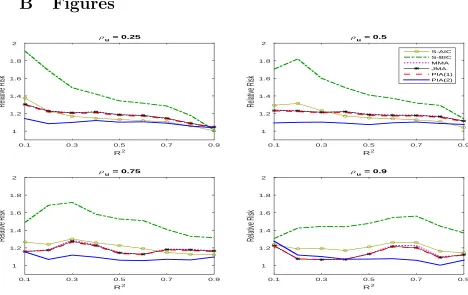
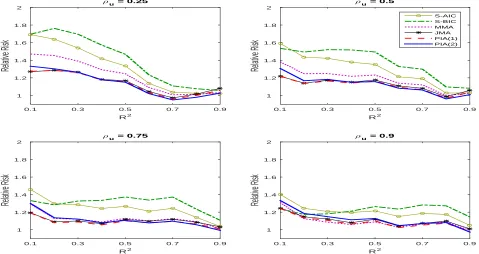
Figures 1–4 show the relative risk for the first simulation setup. In each figure, the relative risk is displayed for ρu = 0.25,0.5,0.75, and 0.9, respectively. We first compare
the relative risk when the AR(1) coefficient of the predictor equals 0.5. Figures 1 and 2 show that both plug-in averaging estimators perform well and PIA(2) dominates other estimators in most ranges of the parameter space. The relative risk of MMA and JMA estimators is indistinguishable in the homoskedastic simulation, but JMA has lower rela-tive risk than MMA for ρu = 0.25 and 0.5 in the heteroskedastic simulation. The S-AIC
simulations.
Figure 3 compares the relative risk between the plug-in averaging estimator and the complete subset regressions in heteroskedastic simulations. The performance of the subset regression approach is sensitive to the choice of the number of the predictors κ. As R2
increases, the optimal value ofκtends to be larger. Unlike the complete subset regressions, the performance of the plug-in averaging estimator is quite robust to different values of R2
. In most cases, the plug-in averaging estimator has much lower relative risk than the complete subset regressions with different κ.
Figure 4 displays the relative risk for the large AR(1) coefficient. The relative perfor-mance of six estimators depends strongly onR2
andρu. Overall, the ranking of estimators
is quite similar to that forρx = 0.5. However, PIA(1) performs slightly better than PIA(2)
for the heteroskedastic simulation when R2
is small.
4.3
Moving Average Model with Exogenous Inputs
The second design is similar to that of Ng (2013). The data generation process is a moving average model with exogenous inputs
yt=xt+ 0.5xt−1+et+βet−1, (4.5)
xt= 0.5xt−1+ut. (4.6)
The exogenous regressor xt is an AR(1) process, and ut is generated from a standard
normal distribution. The error term et is generated from a normal distribution N(0, σ2t),
where σ2
t = 1 +x
2
t. The parameter β is varied on a grid from −0.5 to 0.5. The sample
size is varied between T = 100, 200, 500, and 1000.
We consider a sequence of nested models based on regressors:
{1, yt−1, xt, yt−2, xt−1, yt−3, xt−2},
where the constant term is included in all models. The number of models is M = 7 for S-AIC, S-BIC, MMA, JMA, PIA(1), and PIA(2). For β 6= 0, the true model is infinite dimensional, and there is no true model among these seven candidate models. Forβ = 0, the true model size, or the number of regressors of the data generation process, is two. However, all seven models are wrong. In this setup, we do not compute the complete subset regression because it cannot be applied when the candidate models are nested.
forecast combination approaches, except S-BIC, have similar relative risk in most ranges of the parameter space, but PIA(2) has lower relative risk than other estimators whenT and |β| are large. S-BIC has much lower relative risk for large T and small|β|. In most cases, however, S-BIC has quite poor performance relative to other methods. Similar results for the AIC and BIC model selection estimators are also found in Yang (2007) and Ng (2013).
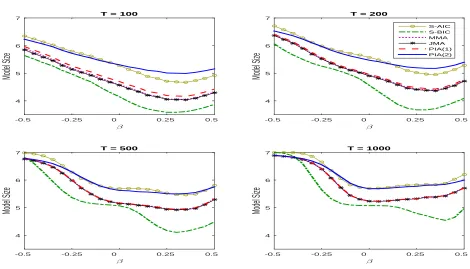
Figure 6 compares the average model size of six estimators.10
As we expected, the average model size of S-BIC is smaller than those of other estimators. S-AIC and PIA(2) have similar average model sizes, and they tend to select the larger models compared to MMA, JMA, and PIA(1). An interesting observation is that the average model size is not symmetric around zero nor monotone inβ.
5
Empirical Application
In this section, we apply the forecast combination method to stock return predictions. The challenge of empirical research on equity premium prediction is that one does not know exactly what variables are the good predictors of the stock return. Different studies suggest different economic variables and models for the equity premium prediction; see Rapach and Zhou (2012) for a literature review. Results from some studies contradict the findings of others. Welch and Goyal (2008) argue that numerous economic variables have poor out-of-sample predictions and these forecasting models are unable to provide forecasting gain relative to the historical average consistently. In order to take into account the model uncertainty, Rapach, Strauss, and Zhou (2010) and Elliott, Gargano, and Timmermann (2013) propose an equal-weighted forecast combination approach to the subset predictive regression. They find that forecast combinations achieve significant gains on out-of-sample predictions relative to the historical average. We apply the forecast combination with data-driven weights instead of equal weights to the U.S. stock market.
5.1
Data
We estimate the following predictive regression rt+1 = β+z′tγ+et+1, where rt+1 is the
equity premium, zt are the economic variables, and et+1 is an unobservable disturbance
term. The goal is to select weights to achieve the lowest cumulative squared prediction error.
10We compute the average model size by computing averages across 5000 simulation draws, that is, 1
S
PS
s=1
PM
The quarterly data are taken from Welch and Goyal (2008) and are up to date through 2011.11
The total sample size is 260 over the period 1947–2011. The stock returns are measured as the difference between the continuously compounded return on the S&P 500 index including dividends and the Treasury bill rate. We consider 10 economic variables and a total of 1025 possible models, including a null model.12
The 10 economic variables are as follows: dividend price ratio, dividend yield, earnings price ratio, book-to-market ratio, net equity expansion, Treasury bill, long-term return, default yield spread, default return spread, and inflation; see Welch and Goyal (2008) for a detailed description of the data and their source.
We follow Welch and Goyal (2008) and calculate the out-of-sample forecast of the equity premium using a recursively expanding estimation window. We first divide the total sample into an in-sample period (1947:1–1964:4) and an out-of-sample evaluation period (1965:1–2011:4). The first sample forecast is for 1965:1, while the last out-of-sample forecast is for 2011:4. For each out-of-out-of-sample forecast, we estimate the predictive regression based on all available samples up to that point. That is, for the first out-of-sample forecast, we calculate different combination forecast methods based on the out-of-sample 1947:1–1964:4. We then expand the estimation window to the sample 1947:1–1965:1 and construct the combination forecast for 1965:2 and so on. Note that we re-estimate the data-driven weights for each scheme.
5.2
Out-Of-Sample Forecasting Results
We follow Welch and Goyal (2008) and use the historical average of the equity premium as a benchmark. As shown in Welch and Goyal (2008) and Rapach, Strauss, and Zhou (2010), none of the forecasts based on the individual economics variable consistently outperforms the forecast based on the historical average.
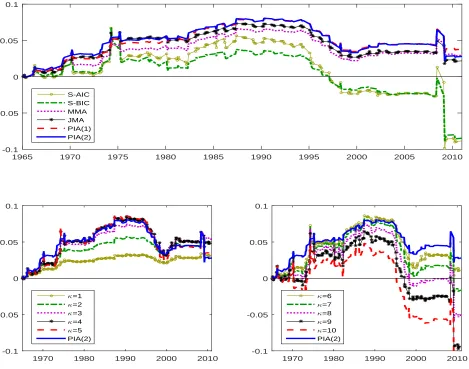
Figure 7 presents the time series plots of the differences between the cumulative squared prediction error of the historical average benchmark forecast and the cumulative squared prediction error of the forecast combinations based on different model averaging approaches. When the curve in each panel is greater than zero, the forecast combination method outperforms the historical average.
The upper panel of Figure 7 shows that MMA, JMA, PIA(1), and PIA(2) consistently beat the historical average in terms of MSFE. S-AIC and S-BIC have a smaller
cumula-11The data are available at http://www.hec.unil.ch/agoyal/. 12
tive squared prediction error than the historical average before 1997, but neither estimator outperforms the historical average after 1997. It is clear to see that PIA(1) and PIA(2) perform similarly and both estimators achieve smaller cumulative squared prediction er-rors as compared to other estimators. Note that JMA performs better than MMA, which is consistent with the finding in our simulations. One interesting observation is that the ranking of estimators almost remains the same in the out-of-sample evaluation period.
The two lower panels of Figure 7 compare the cumulative squared prediction error of PIA(2) to those of the complete subset regressions. As we can see from these two panels, the complete subset regressions that useκ= 4 or 5 predictors produce the lowest cumulative squared prediction error. Our finding of the optimal value ofκis slightly larger than that in Elliott, Gargano, and Timmermann (2013). PIA(2) has similar performance to the complete subset regressions withκ= 4 or 5, and PIA(2) outperforms the complete subset regressions when κ < 4 or κ > 5. It is clear to see that the choice of κ has a great influence on the performance of the complete subset regressions, and in practice the optimal choice of κ is unknown. Examining these three panels in Figure 7, there is no one forecast combination method that uniformly dominates the others.
For a formal comparison between the plug-in forecast combination and the historical average benchmark, we compute the out-of-sampleR2
statistics.13
The out-of-sample R2
value of PIA(2) is 2.23% with the associated p-value 0.0253, which means PIA(2) has a significantly lower MSFE than the historical average benchmark forecast. Therefore, our results support the findings of Rapach, Strauss, and Zhou (2010) and Elliott, Gargano, and Timmermann (2013) that forecast combinations provide significant gains on equity premium predictions relative to the historical average.
6
Conclusion
This paper studies the weight selection for forecast combination in a predictive regression when the goal is minimizing the asymptotic risk. We derive the asymptotic distribution and asymptotic risk of the averaging estimator in a local asymptotic framework without the i.i.d. normal assumption. We then develop a frequentist model averaging criterion, an asymptotically unbiased estimator of the asymptotic risk, to select forecast weights. While this paper has focused on the one-step-ahead forecasting model, the proposed
13Let ¯r
τ+1|τ =
1
τ
Pτ
t=1rt be the historical average and brT+1|T(wb) the equity premium
fore-cast based on forefore-cast combination. The out-of-sample R2 value is computed as R2
OOS = 1 −
PT−1
τ=τ0 rτ+1−rbτ+1|τ(wb)
2
/PTτ=−τ10 rτ+1−r¯τ+1|τ
2
. The associated p-value is based on Clark and West (2007) to test the null hypothesis thatR2
plug-in averaging method can be easily extended to theh-step-ahead forecasting model.14
Simulations show that the proposed estimator achieves lower MSFE relative risk than other existing model averaging methods in most cases.
Appendix
A
Proofs
The following Lemma (Lemma 1 in Liu (2015)) shows the asymptotic distributions of the least squares estimators in the mth model. Let θm = (β′,γm′ )
′
= (β′,γ′Π′
m)
′
=S′
mθ.
Lemma 1. [Liu (2015)] Suppose that Assumptions 1–2 hold. As T → ∞, we have
√
T θbm−θm
d
−→Amδ+BmR∼N Amδ, Q−
1
m ΩmQ−
1
m
,
where Am =Q−m1S′mQS0(Iq−Π′mΠm) and Bm =Q−m1S′m.
Proof of Theorem 1: Recall that θb(w) = PMm=1wmSmθbm. Let Pm = SmQ −1
m S′m.
By Lemma 1, we have
√
TSm
b
θm−θm
d
−→Sm Q−
1
m S′mQS0(Iq−Π′mΠm)δ+Q−
1
m S′mR
=PmQS0(Iq−Π′mΠm)δ+PmR.
Also, by Assumption 1, it follows that√T(Smθm −θ) = S0(Π′mΠm−Iq)δ, where S0 =
(0q×p,Iq)′. Therefore, by Assumptions 1–2 and the application of Slutsky’s theorem, we
14Consider an h-step-ahead forecasting model: y
t+h = x′tβ+z′tγ +et+h and E(htet+h) = 0. The
h-step-ahead forecast from the mth model isybT+h|T(m) =h′TSmθbm where θb= (H′H)−1H′y, and the
h-step-ahead combination forecast is ybT+h|T(w) =h′Tθb(w), where θb(w) =
PM
m=1wmSmθbm. We now modify Assumption 2 as follows: Assumption 2’. {yt+h,ht} is a strictly stationary and ergodic time
series with finite r > 4 moments and E(et+h|Ft) = 0, where Ft =σ(ht,ht−1, ...;et, et−1, ...). Suppose
that Assumptions 1 and 2’ hold. Then the results in Theorems 1–3 still hold except the definition of
Ωis replaced by Ω= limT→∞T1
PT
s=1
PT
t=1E (hsh
′
tes+het+h). Therefore, we can construct the plug-in
have
√
T Smθbm−θ
=√TSm
b
θm−θm
+√T(Smθm−θ)
d
−→PmQS0(Iq−Π′mΠm)δ+PmR−S0(Iq−Π′mΠm)δ
= SmQ−m1S′mQS0−S0
(Iq−Π′mΠm)δ+PmR
= SmQ−m1S′mQS0−S0
δ+PmR
= (PmQ−Ip+q)S0δ+PmR≡Λm, (A.1)
where the third equality holds by the fact that S0Π′m =Sm 0′p×qm,Iqm
′
. From (A.1), there is joint convergence in distribution of all √TSmθbm−θ
to Λm,
since all of Λm can be expressed in terms of the same normal vector R. Because the
weights are nonrandom, it follows that
√
T θb(w)−θ=
M
X
m=1
wm
√
TSmθbm−θ
d
−→
M
X
m=1
wmΛm ≡Λ. (A.2)
By standard algebra, we can show the mean vector of Λ as
E
M
X
m=1
wmΛm
!
=
M
X
m=1
wmE (Λm) = M
X
m=1
wm(PmQ−Ip+q)S0δ =A(w)δ,
where A(w) =PMm=1wm(PmQ−Ip+q)S0.
Next we want to show the covariance matrix of Λ. Let Cm = (PmQ−Ip+q)S0. For
any two models, we have
Cov(Λm,Λℓ) = E (Cmδ +PmR−E(Cmδ+PmR)) (Cℓδ+PℓR−E(Cℓδ+PℓR))′
= E (PmRR′P′ℓ) =PmE (RR′)P′ℓ =PmΩPℓ,
where the second equality holds by the fact thatCm,Pm, andδ are constant vectors and
R∼N(0,Ω). Therefore, the covariance matrix of Λ is
V ar
M
X
m=1
wmΛm
! = M X m=1 w2
mV ar(Λm) + 2
X X
m6=ℓ
wmwℓCov(Λm,Λℓ)
=
M
X
m=1
w2
mPmΩPm+ 2
X X
m6=ℓ
wmwℓPmΩPℓ ≡V(w).
Proof of Theorem 2: The argument is similar to the proof of Theorem 3 and we omit it for brevity.
Proof of Theorem 3: The asymptotic trimmed risk is easy to calculate when the estimator ˜θ has an asymptotic distribution. Suppose that √T( ˜θ−θ)−→d Z∼ N(0,V). Then by Lemma 1 of Hansen (2016), the asymptotic trimmed risk equals E(Z′QZ). We
first rewrite the asymptotic distribution of the averaging estimator in (A.2) as
√
T θb(w)−θ−→d
M
X
m=1
wmΛm = M
X
m=1
wm((PmQ−Ip+q)S0δ+PmR)
=A(w)δ+P(w)R, (A.3)
whereP(w) =PMm=1wmPm. Note thatA(w) =
PM
m=1wm(PmQ−Ip+q)S0 =
PM
m=1wmCm,
where Cm = (PmQ−Ip+q)S0. Thus, the asymptotic trimmed risk of θb(w) is
R(θb(w),θ) = E ((A(w)δ+P(w)R)′Q(A(w)δ+P(w)R))
= E (δ′A(w)′QA(w)δ) + 2E (R′P(w)′QA(w)δ) + E (R′P(w)′QP(w)R)
=δ′A(w)′QA(w)δ+ E(R′P(w)′QP(w)R)
= tr (QA(w)δδ′A(w)′) + tr (QP(w)′ΩP(w))
=w′ψw,
where ψ is an M × M matrix with the (m, ℓ)th element ψm,ℓ = tr (QCmδδ′C′ℓ) +
tr (QPmΩPℓ). This completes the proof.
Proof of Theorem 4: Recall that ψbm,ℓ = tr(QbCbmδδc′Cb′ℓ) + tr(QbPbmΩbPbℓ). We first
show that w′ψbw −→p w′ψ∗w and wb −→d w∗ = argmin
w∈HM w
′ψ∗w. Since Qb and Ωb
are consistent estimators for Q and Ω, we have tr(QbPbmΩbPbℓ) p
−→ tr(QPmΩPℓ) by the
continuous mapping theorem. Then by (3.5), (3.6), and the application of Slutsky’s theorem, we have
b
ψm,ℓ d
−→tr QCm(RδR′δ−S′0Q −1
ΩQ−1
S0)C′ℓ
+ tr (QPmΩPℓ) =ψ∗m,ℓ.
Note that all ofψ∗
m,ℓcan be expressed in terms of the normal random vectorR. Therefore,
there is joint convergence in distribution of all ψbm,ℓ to ψm,ℓ∗ . Thus we have w′ψbw p
−→ w′ψ∗w. Next observe that w′ψ∗w is a convex minimization problem because w′ψ∗w is
quadratic andψ∗ is positive definite. Hence, the limiting process w′ψ∗wis continuous in
Therefore, by Theorem 3.2.2 of Van der Vaart and Wellner (1996) or Theorem 2.7 of Kim and Pollard (1990), the minimizerwb converges in distribution to the minimizer ofw′ψ∗w,
which is w∗.
We now derive the asymptotic distribution and asymptotic trimmed risk of the plug-in averaging estimator. Since bothΛm andwm∗ can be expressed in terms of the same normal
random vector R, there is joint convergence in distribution of allθb(m) and ˆwm. By (A.3)
and wb −→d w∗, it follows that
√
T θb(wb)−θ=
M
X
m=1
b
wm
√
TSmθbm−θ
d
−→
M
X
m=1
wm∗Λm =A(w∗)δ+P(w∗)R,
where A(w∗) = PM
m=1wm∗ (PmQ−Ip+q)S0 and P(w∗) =
PM
m=1w∗mPm. Therefore, the
asymptotic trimmed risk of θb(wb) is
R(θb(wb),θ) = E ((A(w∗)δ+P(w∗)R)′Q(A(w∗)δ+P(w∗)R)).
This completes the proof.
Derivation of Equation (3.20): We first show the first term of (3.20). Note that
b
δ =√Tγb =√TS′
0θb, Cbm = (PbmQb −Ip+q)S0, and Pbm =SmQb−m1S′m. Thus, we have
tr(QbCbmδbδb′Cb′ℓ) = tr(TQbCbmS′0θbθb′S0Cb′ℓ)
= trTQb(PbmQb −Ip+q)θbθb′(QbPbℓ−Ip+q)
= tr(TQbPbmQbθbθb′QbPbℓ)−tr(TQbPbmQbθbθb′)−tr(TQbθbθb′QbPbℓ)
+ tr(TQbθbθb′), (A.4)
where the second equality holds by the fact that
b
CmS′0 = (PbmQb −Ip+q)S0S′0 =PbmQb −PbmQb(Ip+q−S0S′0)−S0S′0
=PbmQb − PbmQb
"
Ip 0p×q
0q×p 0q×q
#
+
"
0p×p 0p×q
0q×p Iq
#!
=PbmQb − Sm
S′mQSb m
−1
S′mQSb m
"
Ip 0p×q
0qm×p 0qm×q
#
+
"
0p×p 0p×q
0q×p Iq
#!
=PbmQb −Ip+q. (A.5)
Recall that θb= (H′H)−1
H′y. Thus, we have θbθb′ = T−2b
Q−1
H′yy′HQb−1
first term of (A.4) can be rewritten as
tr(TQbPbmQbθbθb′QbPbℓ) = tr(T−1QSb mQbm−1S′mQbQb−
1
H′yy′HQb−1b
QSℓQb−ℓ1S′ℓ)
= tr(Hm(H′mHm)−1H′myy′Hℓ(H′ℓHℓ)−1H′ℓ)
=y′PmPℓy,
wherePm =Hm(H′mHm)−1H′m. DefineP =H(H′H)−
1
H′. Thus, the equation (A.4) can
be rewritten as
tr(QbCbmδbδb′Cb′ℓ) =y′PmPℓy−y′Pmy−y′Pℓy+y′Py
=y′(I− Pm)(I− Pℓ)y−y′(I− P)y=be′mbeℓ−be′be, (A.6)
wherebe=y−Hθband bem =y−Hmθbm.
We now show the second term of (3.20). Let Ωbm = S′mΩSb m. By some algebra, it
follows that
trQbCbmS′0Qb −1b
ΩQb−1
S0Cb′ℓ−QbPbmΩbPbℓ
= trQb(PbmQb −Ip+q)Qb−1ΩbQb−1(QbPbℓ−Ip+q)−QbPbmΩbPbℓ
= tr(QbPbmQbQb−
1b
ΩQb−1b
QPbℓ−QbPbmQbQb−
1b
ΩQb−1
−QbQb−1b
ΩQb−1b
QPbℓ+QbQb−1ΩbQb−1−QbPbmΩbPbℓ)
= tr(QbPbmΩbPbℓ)−tr(ΩbPbm)−tr(ΩbPbℓ) + tr(Qb−
1b
Ω)−tr(QbPbmΩbPbℓ)
= tr(Qb−1b
Ω)−tr(Qb−1
m Ωbm)−tr(Qb−ℓ1Ωbℓ), (A.7)
B
Figures
R2
0.1 0.3 0.5 0.7 0.9
Relative Risk 1 1.2 1.4 1.6 1.8 2
ρu = 0.25
R2
0.1 0.3 0.5 0.7 0.9
Relative Risk 1 1.2 1.4 1.6 1.8 2
ρu = 0.5
S-AIC S-BIC MMA JMA PIA(1) PIA(2) R2
0.1 0.3 0.5 0.7 0.9
Relative Risk 1 1.2 1.4 1.6 1.8 2 ρ
u = 0.75
R2
0.1 0.3 0.5 0.7 0.9
Relative Risk 1 1.2 1.4 1.6 1.8 2 ρ
[image:29.612.60.528.89.384.2]u = 0.9
Figure 1: Relative risk for linear regression models with homoskedastic errors and ρx =
0.5.
R2
0.1 0.3 0.5 0.7 0.9
Relative Risk 1 1.2 1.4 1.6 1.8 2
ρu = 0.25
R2
0.1 0.3 0.5 0.7 0.9
Relative Risk 1 1.2 1.4 1.6 1.8 2
ρu = 0.5
S-AIC S-BIC MMA JMA PIA(1) PIA(2) R2
0.1 0.3 0.5 0.7 0.9
Relative Risk 1 1.2 1.4 1.6 1.8 2
ρu = 0.75
R2
0.1 0.3 0.5 0.7 0.9
Relative Risk 1 1.2 1.4 1.6 1.8 2
ρu = 0.9
Figure 2: Relative risk for linear regression models with heteroskedastic errors and ρx =
[image:29.612.59.532.431.689.2]R2
0.1 0.3 0.5 0.7 0.9
Relative Risk 0.8 1 1.2 1.4 1.6 1.8 2 ρ
u = 0.25
R2
0.1 0.3 0.5 0.7 0.9
Relative Risk 0.8 1 1.2 1.4 1.6 1.8 2 ρ
u = 0.5
κ=1 κ=2 κ=3 κ=4 κ=5 PIA(2) R2
0.1 0.3 0.5 0.7 0.9
Relative Risk 0.8 1 1.2 1.4 1.6 1.8 2 ρ
u = 0.75
R2
0.1 0.3 0.5 0.7 0.9
Relative Risk 0.8 1 1.2 1.4 1.6 1.8 2 ρ
[image:30.612.61.530.109.366.2]u = 0.9
Figure 3: Relative risk for linear regression models with heteroskedastic errors and ρx =
0.5.
R2
0.1 0.3 0.5 0.7 0.9
Relative Risk 1 1.2 1.4 1.6 1.8 2 ρ
u = 0.25
R2
0.1 0.3 0.5 0.7 0.9
Relative Risk 1 1.2 1.4 1.6 1.8 2 ρ
u = 0.5
S-AIC S-BIC MMA JMA PIA(1) PIA(2) R2
0.1 0.3 0.5 0.7 0.9
Relative Risk 1 1.2 1.4 1.6 1.8 2 ρ
u = 0.75
R2
0.1 0.3 0.5 0.7 0.9
Relative Risk 1 1.2 1.4 1.6 1.8 2 ρ
u = 0.9
Figure 4: Relative risk for linear regression models with heteroskedastic errors and ρx =
[image:30.612.54.533.422.676.2]β
-0.5 -0.25 0 0.25 0.5
Relative Risk
1 1.2 1.4
1.6 T = 100
β
-0.5 -0.25 0 0.25 0.5
Relative Risk
1 1.2 1.4
1.6 T = 200
S-AIC S-BIC MMA JMA PIA(1) PIA(2)
β
-0.5 -0.25 0 0.25 0.5
Relative Risk
1 1.2 1.4
1.6 T = 500
β
-0.5 -0.25 0 0.25 0.5
Relative Risk
1 1.2 1.4
[image:31.612.59.529.110.370.2]1.6 T = 1000
Figure 5: Relative risk for MAX(1,1) models.
β
-0.5 -0.25 0 0.25 0.5
Model Size
4 5 6
7 T = 100
β
-0.5 -0.25 0 0.25 0.5
Model Size
4 5 6
7 T = 200
S-AIC S-BIC MMA JMA PIA(1) PIA(2)
β
-0.5 -0.25 0 0.25 0.5
Model Size
4 5 6
7 T = 500
β
-0.5 -0.25 0 0.25 0.5
Model Size
4 5 6
7 T = 1000
[image:31.612.60.530.422.691.2]1965 1970 1975 1980 1985 1990 1995 2000 2005 2010 -0.1
-0.05 0 0.05 0.1
S-AIC S-BIC MMA JMA PIA(1) PIA(2)
1970 1980 1990 2000 2010
-0.1 -0.05 0 0.05 0.1
κ=1
κ=2
κ=3
κ=4
κ=5 PIA(2)
1970 1980 1990 2000 2010
-0.1 -0.05 0 0.05 0.1
κ=6
κ=7
κ=8
κ=9
[image:32.612.62.531.108.477.2]κ=10 PIA(2)
References
Andrews, D. W. K.(1991): “Asymptotic Optimality of GeneralizedCL, Cross-Validation, and
Generalized Cross-Validation in Regression with Heteroskedastic Errors,” Journal of Econo-metrics, 47, 359–377.
Bates, J. and C. Granger (1969): “The Combination of Forecasts,” Operational Research Quarterly, 20, 451–468.
Breiman, L.(1996): “Bagging Predictors,”Machine learning, 24, 123–140.
Buckland, S., K. Burnham, and N. Augustin(1997): “Model Selection: An Integral Part of Inference,” Biometrics, 53, 603–618.
Cheng, X. and B. E. Hansen (2015): “Forecasting with Factor-Augmented Regression: A Frequentist Model Averaging Approach,” Journal of Econometrics, 186, 280–293.
Claeskens, G. and R. J. Carroll (2007): “An Asymptotic Theory for Model Selection Inference in General Semiparametric Problems,” Biometrika, 94, 249–265.
Claeskens, G. and N. L. Hjort (2003): “The Focused Information Criterion,” Journal of the American Statistical Association, 98, 900–916.
——— (2008): “Minimizing Average Risk in Regression Models,” Econometric Theory, 24, 493–527.
Clark, T. and K. West(2007): “Approximately Normal Tests for Equal Predictive Accuracy in Nested Models,” Journal of Econometrics, 138, 291–311.
Clemen, R.(1989): “Combining Forecasts: A Review and Annotated Bibliography,” Interna-tional Journal of Forecasting, 5, 559–583.
DiTraglia, F.(2015): “Using Invalid Instruments on Purpose: Focused Moment Selection and Averaging for GMM,” Working Paper, University of Pennsylvania.
Elliott, G., A. Gargano, and A. Timmermann (2013): “Complete Subset Regressions,”
Journal of Econometrics, 177, 357–373.
Granger, C. (1989): “Combining Forecasts–Twenty Years Later,” Journal of Forecasting, 8, 167–173.
Granger, C. and R. Ramanathan (1984): “Improved Methods of Combining Forecasts,”
Journal of Forecasting, 3, 197–204.
Hansen, B. E.(2007): “Least Squares Model Averaging,” Econometrica, 75, 1175–1189.
——— (2010): “Multi-Step Forecast Model Selection,” Working Paper, University of Wisconsin.
——— (2014): “Model Averaging, Asymptotic Risk, and Regressor Groups,”Quantitative Eco-nomics, 5, 495–530.
——— (2016): “Efficient Shrinkage in Parametric Models,”Journal of Econometrics, 190, 115– 132.
Hansen, B. E. and J. Racine(2012): “Jackknife Model Averaging,”Journal of Econometrics, 167, 38–46.
Hansen, P., A. Lunde, and J. Nason(2011): “The Model Confidence Set,” Econometrica, 79, 453–497.
Hjort, N. L. and G. Claeskens (2003): “Frequentist Model Average Estimators,” Journal of the American Statistical Association, 98, 879–899.
Ing, C.-K. and C.-Z. Wei(2005): “Order Selection for Same-Realization Predictions in Au-toregressive Processes,” The Annals of Statistics, 33, 2423–2474.
Inoue, A. and L. Kilian (2008): “How Useful is Bagging in Forecasting Economic Time Series? A Case Study of US Consumer Price Inflation,” Journal of the American Statistical Association, 103, 511–522.
Kim, J. and D. Pollard (1990): “Cube Root Asymptotics,” The Annals of Statistics, 18, 191–219.
Kitagawa, T. and C. Muris (2015): “Model Averaging in Semiparametric Estimation of Treatment Effects,” Cemmap Working Paper.
Leeb, H. and B. P¨otscher (2005): “Model Selection and Inference: Facts and Fiction,”
Econometric Theory, 21, 21–59.
Li, K.-C.(1987): “Asymptotic Optimality forCp,CL, Validation and Generalized
Cross-Validation: Discrete Index Set,” The Annals of Statistics, 15, 958–975.
Liu, C.-A. (2015): “Distribution Theory of the Least Squares Averaging Estimator,” Journal of Econometrics, 186, 142–159.
Liu, Q. and R. Okui(2013): “Heteroscedasticity-Robust Cp Model Averaging,” The
Econo-metrics Journal, 16, 463–472.
Min, C.-K. and A. Zellner (1993): “Bayesian and Non-Bayesian Methods for Combining Models and Forecasts with Applications to Forecasting International Growth Rates,” Journal of Econometrics, 56, 89–118.
Ng, S.(2013): “Variable Selection in Predictive Regressions,” in Handbook of Economic Fore-casting, ed. by G. Elliott and A. Timmermann, Elsevier, vol. 2, chap. 14, 752–789.
P¨otscher, B.(2006): “The Distribution of Model Averaging Estimators and an Impossibility Result Regarding its Estimation,” Lecture Notes-Monograph Series, 52, 113–129.
Raftery, A., D. Madigan, and J. Hoeting(1997): “Bayesian Model Averaging for Linear Regression Models,” Journal of the American Statistical Association, 92, 179–191.
Rapach, D., J. Strauss, and G. Zhou(2010): “Out-of-Sample Equity Premium Prediction: Combination Forecasts and Links to the Real Economy,” Review of Financial Studies, 23, 821–862.
Rapach, D. and G. Zhou (2012): “Forecasting Stock Returns,” in Handbook of Economic Forecasting, Elsevier, vol. 2.
Shao, J. (1997): “An Asymptotic Theory for Linear Model Selection,” Statistica Sinica, 7, 221–242.
Shibata, R.(1980): “Asymptotically Efficient Selection of the Order of the Model for Estimat-ing Parameters of a Linear Process,” The Annals of Statistics, 8, 147–164.
Staiger, D. and J. Stock (1997): “Instrumental Variables Regression with Weak Instru-ments,” Econometrica, 65, 557–586.
Stock, J. H. and M. W. Watson(2006): “Forecasting with Many Predictors,” in Handbook of Economic Forecasting, ed. by G. Elliott, C. Granger, and A. Timmermann, Elsevier, vol. 1, 515–554.
Sueishi, N. (2013): “Generalized Empirical Likelihood-Based Focused Information Criterion and Model Averaging,” Econometrics, 1, 141–156.
Tibshirani, R. (1996): “Regression Shrinkage and Selection via the Lasso,” Journal of the Royal Statistical Society. Series B (Methodological), 58, 267–288.
Timmermann, A.(2006): “Forecast Combinations,” inHandbook of Economic Forecasting, ed. by G. Elliott, C. Granger, and A. Timmermann, Elsevier, vol. 1, 135–196.
Wan, A., X. Zhang, and G. Zou (2010): “Least Squares Model Averaging by Mallows Criterion,” Journal of Econometrics, 1