Solvent Extraction of PtCl
4from Hydrochloric Acid Solution with Alamine336
Man Seung Lee
1;*, Jin Young Lee
2, J. Rajesh Kumar
2, Joon Soo Kim
2and Jeong Soo Sohn
21Department of Advanced Materials Science & Engineering, Mokpo National University, Chonnam 534-729, Korea 2Metals Recovery Group, Minerals & Materials Processing Division, Korea Institute of Geoscience & Mineral Resources,
Daejeon 305-350, Korea
We have conducted solvent extraction of Pt(IV) from HCl solution with Alamine336. Solvent extraction reaction in our system was determined from the experimental results by graphical method. The equilibrium constant of the solvent extraction reaction was estimated from our experimental results by considering the activity coefficients of chemical species present in the aqueous phase with Bromley equation. Bromley interaction parameter between hydrogen ion and PtCl2
6 was evaluated from the solvent extraction data reported in the literature. Solvent extraction of PtCl4 by Alamine336 and the corresponding equilibrium constant in our experimental range can be represented by PtCl2
6 þR3NH2Cl2,org¼PtCl6R3NH2,orgþ2Cl
,K
ex¼1:9103. The measured distribution coefficients of Pt(IV) agreed well with those calculated in this study. [doi:10.2320/matertrans.MRA2008305]
(Received September 1, 2008; Accepted October 2, 2008; Published November 25, 2008)
Keywords: PtCl4, solvent extraction, Alamine336, HCl
1. Introduction
Platinum group metals are very expensive and their specific physical and chemical properties have made them important materials for the automobile, chemical, and electronics industry. Pt, Pd and Rh are used in automobile catalysts to reduce the emission levels from the exhaust gases and the automobile industry is the major consumer of
platinum group metals.1) Since platinum has aesthetic
qualities and a permanent luster, it is also used in the
manufacture of jewelry.1)Substitution of platinum metal in
catalysts by other metals is difficult. Since the resources of the platinum metal are limited, platinum should be recovered not only from its natural ores but also from the industrial wastes. Development of an effective separation process to recover platinum from these resources, especially spent automotive catalysts, is very important.
Separation and purification of platinum group metals is one of the most difficult processes of metal separation, because of the similarity in their chemical behavior in chloride media. The most prominent feature of the aqueous chemistry of platinum group metals in chloride solution is the strong tendency of the metals to form anion complexes with
chloride ion.2) Since the concentration of platinum group
metals in industrial wastes is very low, ion exchange and solvent extraction have been widely employed to separate and recover them. Solvent extraction of Pt(IV) with various
extractants has been reported.3–7)
Alamine336 (Tertiary amine, R3N, R¼CH3(CH2)7), a
sort of anionic extractants, is also used extensively in
extracting various metal ions.8–11) In this study, solvent
extraction of Pt(IV) from chloride solution by Alamine336 has been performed in the low concentration range of Pt(IV) at moderate HCl concentration. Solvent extraction reaction in our experimental range was identified from the experimental
data. Interaction parameter between Hþ and PtCl62, which
is necessary to calculate the activity coefficient of PtCl62,
was evaluated from the solvent extraction data reported in the literature. The equilibrium constant for the solvent extraction
of Pt(IV) by Alamine336 was estimated from our exper-imental data by considering the activity coefficients of solutes in the aqueous phase.
2. Experimental
Stock solution of platinum(IV) was prepared by dissolving
PtCl4(Aldrich, 98%) and HCl in distilled water. Alamine336
was purchased from Henkel Corporation and used without further purification. Alamine336 was diluted with toluene.
Equal volume (30 cm3) of aqueous and organic phase was
placed in a 100 cm3separatory funnel and shaken for 15 min
with a mechanical shaker. The aqueous phase was separated after settling the mixture for 1 h. All the experiments were
conducted at a temperature of 251C. The concentration
of Pt(IV) in the aqueous phase was measured with ICP-OES (Spectroflame EOP). The concentration of Pt in the organic phase was calculated from the mass balance.
3. Results and Discussion
3.1 Solvent extraction of PtCl4 with Alamine336
Figure 1 shows the effect of shaking time on the distribution coefficients of Pt(IV) at the extraction condition
of Pt(IV) 5:0104 and HCl 1 kmol/m3 with 0.002 and
0.005 kmol/m3 Alamine336 (R3N), respectively. In both
concentrations of Alamine336, shaking time of 10 min was found to be sufficient to obtain equilibrium state. Therefore, the two phases were shaken for 15 min in further experi-ments.
It has been reported that Alamine336 reacts with HCl to form Alamine336 salt (R3NHCl) in HCl solution and that this Alamine336 salt takes part in the solvent extraction
reaction of metals.10,11) The following reaction represents
the formation of Alamine336 salt in HCl solution.
R3NorgþHCl¼R3NHClorg ð1Þ
In the above equation, subscript org represents organic phase.
Many studies have shown that most of the Pt(IV) in
HCl solution exists as PtCl26. Table 1 lists the stepwise
*Corresponding author, E-mail: [email protected]
stability constants for the formation of PtCl
5 and PtCl26.12)
Distribution of Pt(IV) containing species with HCl concen-tration was obtained by considering the complex formation reaction shown in Table 1 together with the mass balance equations for Pt and Cl. The calculated mole fractions of Pt(IV) containing species are shown in Fig. 2 as a function of
HCl concentration at the Pt(IV) concentration of1:0103
kmol/m3. Figure 2 reveals that PtCl2
6 is the predominant
species in our experimental range. Therefore, the following reaction may be responsible for the solvent extraction
reaction of Pt(IV) from HCl solution by Alamine336.13)
[image:2.595.63.279.68.333.2]PtCl26þ2R3NHClorg¼PtCl6(R3NH)2,orgþ2Cl ð2Þ
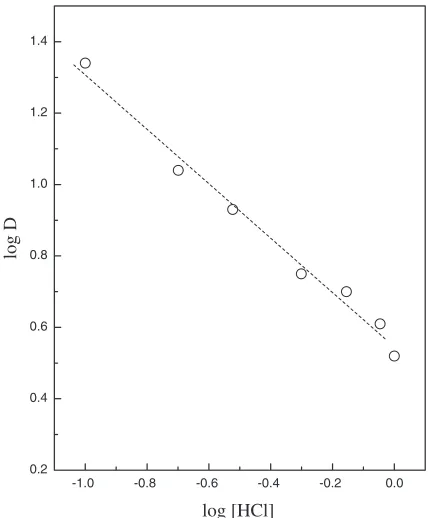
Figure 3 shows the effect of HCl concentration on the distribution coefficients of Pt(IV) when the initial
concen-trations of Pt(IV) and Alamine336 were 4:3104 and
0.002 kmol/m3, respectively. The distribution coefficients of
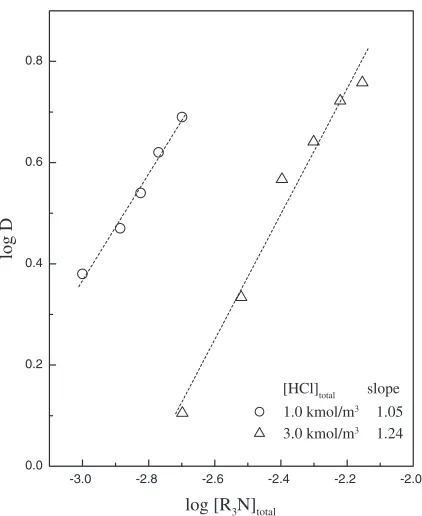
Pt(IV) decreased with the increase of HCl concentration. Figures 4 and 5 show the effect of Alamine336 concen-tration on the distribution coefficients of Pt(IV) from HCl
solution of 1.0 and 3.0 kmol/m3, respectively. In Fig. 4, the
initial concentration of Pt(IV) was 4:3104kmol/m3,
while the initial concentration of Pt(IV) in Fig. 5 was
9:1104kmol/m3. In both figures, the concentration range
of Alamine336 was from 0.002 to 0.007 kmol/m3. Figures 4
and 5 show that log D increases linearly with the increase
of log [R3N] in the experimental range and the slope is close to unity.
Figure 6 shows the effect of Pt(IV) concentration when Alamine336 and HCl concentrations were fixed at 0.002 and
1.0 kmol/m3, respectively. The logarithm of Pt(IV)
concen-tration in organic phase is proportional to that of Pt(IV) in the aqueous phase and the slope of this plot is unity, indicating
0 -0.2 -0.1 0.0 0.1 0.2 0.3 0.4 0.5
log D
Mixing time (min)
[R3N]total (kmol/m 3)
0.002 0.005
60 50 40 30 20 10
[image:2.595.318.535.71.335.2]Fig. 1 Effect of shaking time on the distribution coefficients of Pt(IV) at the initial extraction condition of5104kmol/m3Pt(IV) and 1 kmol/ m3HCl.
Table 1 Stepwise stability constant for the formation of Pt(IV)-chloro complexes at 25C.
Reaction logKI
PtCl4þCl¼PtCl5 2.016
PtCl5þCl¼PtCl62 2.010
0 -6 -5 -4 -3 -2 -1 0
PtCl6
2-PtCl 5
-PtCl4o
log (mole fraction)
HCl concentration (kmol/m3)
5 4
3 2
1
Fig. 2 Distribution of Pt(IV) containing species with HCl concentration at the initial Pt concentration of1:0103kmol/m3.
-1.0 0.2 0.4 0.6 0.8 1.0 1.2 1.4
log D
log [HCl]
0.0 -0.2 -0.4 -0.6 -0.8
[image:2.595.320.536.385.644.2] [image:2.595.45.291.414.456.2]that the extracted Pt(IV) species exists as a monomer in the organic phase.
Equation (2) suggests that the slope of the straight line in a plot of log D against log [R3N] should be about two. However, the slope of the straight lines in Fig. 4 was close to unity, indicating that one mole of Alamine336 reacts with
one mole of PtCl26in our experimental range. Some studies
have reported that amine extractant can form double salt
when the amount of acid is in excess to amine.14,15)
Therefore, Alamine336 can form double salt with excess HCl, which is represented by
R3NHClorgþHCl¼R3NH2Cl2,org ð3Þ
The dependence of log D on log [R3N] in Figs. 4 and 5
suggests the following reaction to occur in our experimental ranges rather than eq. (2).
PtCl2
6 þR3NH2Cl2,org¼PtCl6R3NH2,orgþ2Cl ð4Þ
3.2 Evaluation of the interaction parameter between Hþ
and PtCl62
We used Bromley equation to calculate the activity coefficients of chemical species present in the aqueous phase. The following equation represents Bromley equation
for cation M at 25C.16)
logM¼
0:5108ðzMÞ2I0:5
1þI0:5 þFM¼ AðzMÞ
2
þFM ð5Þ
FM¼
X
X
ð0:06þ0:6BMXÞ jzMzXj
1þ 1:5
jzMzX
jI
2 þBMX
2 6 4
3 7 5
ðjzMj þ jzXjÞ 2
4 ½X ð6Þ
In the above equations, z is the ionic charge and I ionic
strength of a solution and BMX the interaction parameter
between cation M and anion X.
In calculating the activity coefficients of solutes present in our system by Bromley equation, the activity coefficients of
chloride ion and PtCl26 depend on the concentration of Hþ
and the interaction parameter between these two ions and
hydrogen ion. The value of BHClwas obtained from the data
reported by Bromley,16) while there is no Bromley
interac--3.0 0.0 0.2 0.4 0.6 0.8
log D
log [R3N]total
[HCl]total slope
1.0 kmol/m3 1.05
3.0 kmol/m3 1.24
-2.0 -2.2 -2.4 -2.6 -2.8
Fig. 4 Effect of Alamine336 concentration on the extraction of Pt(IV) at the HCl concentration of 1.0 and 3.0 kmol/m3. ([PtCl
4]total¼4:3104 kmol/m3)
-2.7 0.0 0.2 0.4 0.6 0.8 1.0
log D
log [R3N]total
[HCl]total slope
1.0 kmol/m3
1.35 3.0 kmol/m3 1.35
-2.0 -2.1 -2.2 -2.3 -2.4 -2.5 -2.6
Fig. 5 Effect of Alamine336 concentration on the extraction of Pt(IV) at the HCl concentration of 1.0 and 3.0 kmol/m3. ([PtCl4]total¼9:1104 kmol/m3)
-4.20 -3.60 -3.55 -3.50 -3.45 -3.40 -3.35
log [Pt]
org
log [Pt(IV)]aq
-3.95 -4.00
-4.05 -4.10
-4.15
[image:3.595.64.275.69.327.2] [image:3.595.317.531.70.320.2] [image:3.595.63.276.379.637.2]tion parameter between PtCl26 and Hþ. Lokhande et al. reported the data on the solvent extraction of Pt(IV) from
HCl solution by N-n-octylaniline (RR0NH, R¼C
6H5, R0¼
CH2(CH2)6CH3).2) We evaluated Bromley interaction
pa-rameter between PtCl2
6 and Hþ from these data. They
supposed the following reaction to represent the solvent extraction of Pt(IV) from HCl solution by N-n-octylaniline.
RR0NH
orgþHCl¼RR0NH2Clorg ð7Þ
PtCl2
6 þ2RR0NH2Clorg¼PtCl6(RR0NH2)2,orgþ2Cl ð8Þ
The equilibrium constant of the above equation can be
represented as follows14)
Kexo ¼[PtCl6(RR
0NH2)2][Cl]2
[PtCl2
6 ][RR 0NH
2Cl]
2
ðClÞ2
PtCl2
6
PtCl6(RR0NH2)2 ðRR0NH
2ClÞ 2
¼KexI ðCl Þ2
PtCl2
6
PtCl6(RR0NH2)2 ðRR0NH
2ClÞ
2 ð9Þ
In the above equation, Kexo and KexI represent the
equi-librium constant of the solvent extraction reaction at ionic strength of zero and I, respectively.
Taking logarithms on both sides of the above equation leads to
logKex0 ¼logKexI þ2 logCl
logPtCl2 6 þlog
PtCl6(RR0NH2)2
ðRR0NH 2ClÞ
2 ð10Þ
Expression for the activity coefficient of PtCl2
6 by
Bromley equation becomes
logPtCl2
6 ¼ 4Aþ
2ð0:06þ0:6BHþ,PtCl2 6 Þ
1þ1:5
2 I
2 þBHþ,PtCl2
6 2 6 6 4 3 7 7 5 3 2 4 [H
þ] ð11Þ
Substitution of the above equation into eq. (10) results in
logKexI þ2 logClþ4A
¼logKex0 þ 2ð0:06þ0:6BH þ,PtCl2
6 Þ
1þ1:5
2 I
2 þBHþ,PtCl2
6 2 6 6 4 3 7 7 5 9 4[H
þ]logPtCl6(RR0NH2)2 ðRR0NH
2ClÞ
2 ð12Þ
The value of KI
ex was obtained from the experimental
results reported by Lokhande2)and the activity coefficient of
chloride ion was calculated by Bromley equation. In Lokhandes’s experimental condition, the volume ratio of aqueous to organic phase was kept at 2.5. Therefore, the following mass balance equations were used in calculating KI
exfrom their experimental results.
[PtCl6 (RR0NH2)2]
org¼ Vaq
Vorg
ð[Pt]total[Pt]aqÞ ð13Þ
[RR0NH
2Cl]¼[RR0NH2Cl]total2[PtCl6(RR0NH2)2] ð14Þ
[Cl]¼[HCl]
totalþ4[PtCl4]total6[PtCl26]
Vorg
Vaq
ð6[PtCl6(RR0NH2)2]þ[RR0NH2Cl]Þ ð15Þ
[Hþ]¼[HCl]
total Vorg
Vaq
[RR0NH]
total ð16Þ
[image:4.595.315.535.69.340.2]In the above equation, subscript total represents the initial total concentration.
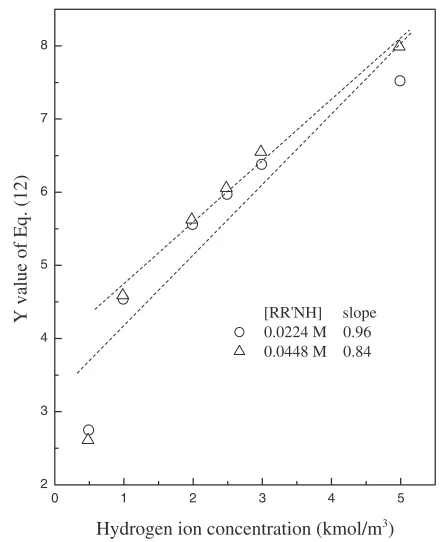
Figure 7 shows the plot of the value of the left-hand side of eq. (12) against the concentration of hydrogen ion. The slope of the straight line in this figure is related to the interaction
parameter between Hþ and PtCl2
6 . The value of Bromley
interaction parameter between Hþand PtCl2
6 was evaluated
from the slope as follows
BHþ,PtCl2
6 ¼0:28 ð17Þ
3.3 Prediction of Pt(IV) distribution coefficients from
initial extraction conditions
In order to estimate the equilibrium constant of solvent extraction reaction, eq. (4), the equilibrium concentrations and activity coefficients of chemical species present in both phases are required. In calculating the equilibrium concen-trations of chemical species present in the aqueous phase of our system, it was assumed that all of the Pt(IV) in the
aqueous phase exists as PtCl2
6 . The concentration of HCl
employed in this study was from 0.1 to 3.0 kmol/m3. The
concentration of hydroxide ion can be ignored at this HCl concentration range. On this assumption, the following mass and charge balance equations were obtained when the volume ratio of aqueous to organic was unity.
[PtCl4]total¼[PtCl26]þ[PtCl6R3NH2] ð18Þ
[R3N]total¼[R3NH2Cl2]þ[PtCl6R3NH2] ð19Þ
[Cl]total¼4[PtCl4]totalþ[HCl]total
¼[Cl]þ6[PtCl2
6 ]þ2[R3NH2Cl2]
þ6[PtCl6R3NH2] ð20Þ
0 2 3 4 5 6 7 8
Y value of Eq. (12)
Hydrogen ion concentration (kmol/m3)
[RR'NH] slope 0.0224 M 0.96 0.0448 M 0.84
5 4
3 2
1
Fig. 7 Evaluation of the interaction parameter between PtCl62and Hþ
[image:4.595.52.289.423.607.2][Hþ]¼[HCl]
total2[R3N]total ð21Þ
The number of chemical species present in both phases
after extraction is 7 (Cl, Hþ, PtCl
62, R3NH2Cl2,
PtCl6R3NH2, H2O, toluene). In order to calculate the
concentrations of these 5 species excluding H2O and toluene,
5 independent equations are required. These 5 equations were obtained from solvent extraction reaction, three mass balance equations, and charge balance. The solution of these 5 nonlinear equations was obtained by using Newton-Raphson method. Since few equations are available to calculate the activity coefficients of chemical species present in the organic phase, the activity coefficients of Alamine336 double salt and the extracted species were assumed to be unity.
In order to estimate the above equilibrium constant from the extraction data, an evaluation function was defined as follows:
Err¼ 1
N X
ðDcalcDmeasÞ2 ð22Þ
where N denotes the number of experimental data and Dcalc
and Dmeas represent the distribution coefficient of Pt(IV)
calculated in this study and measured, respectively. The following equilibrium constant was obtained by minimizing the Err function.
Kex¼
[PtCl6R3NH2][Cl]2ðClÞ2
[PtCl2
6 ][R3NH2Cl2]PtCl2
6
¼1:9103 ð23Þ
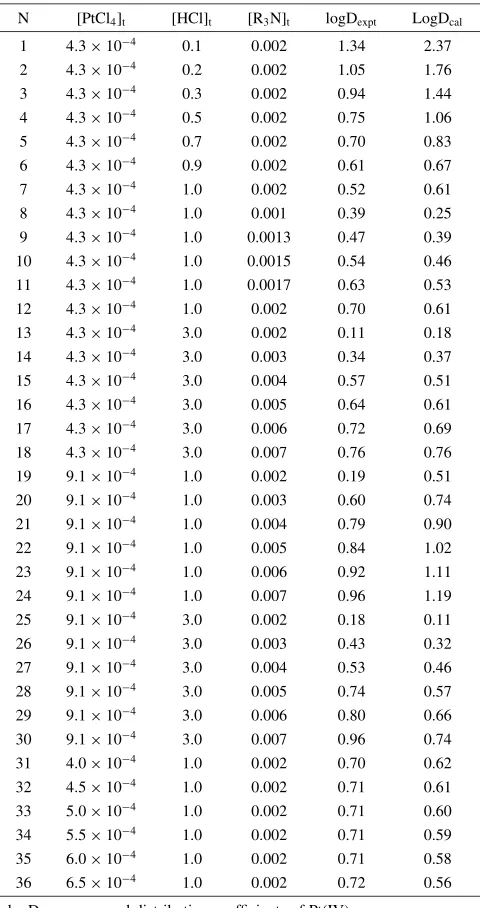
[image:5.595.312.540.73.297.2]Table 2 gives the experimental conditions along with the results of extraction experiment. Figure 8 shows the meas-ured distribution coefficients of Pt(IV) and the calculated values. The distribution coefficients of Pt(IV) calculated from the initial extraction conditions by using the above equilibrium constant are also shown in Table 2. It is seen in Table 2 and Fig. 8 that the difference between measured and calculated distribution coefficients of Pt(IV) is wide
when HCl concentration is lower than 0.5 kmol/m3. When
HCl concentration is low, Alamine336 may exist as an Alamine336 salt (R3NHCl) instead of a double salt (R3NH2Cl2). This difference in the form of Alamine336 salt at low and high HCl concentration may be the reason of the wide difference between the measured and calculated distribution coefficients of Pt(IV). Standard deviation be-tween the measured and calculated distribution coefficients of Pt(IV) was 0.06. Therefore, it can be safely said that the proposed solvent extraction reaction and equilibrium con-stant estimated in this study might well represent the reaction occurring in the experimental ranges where HCl
concen-tration is larger than 0.5 kmol/m3.
4. Conclusions
Chemical speciation of PtCl4-HCl-H2O system indicates
that most of the Pt(IV) in the solution exists as PtCl26in our
[image:5.595.49.289.93.547.2]experimental range. Applying slope analysis method to the Table 2 Initial and equilibrium conditions together with calculated results.
(Unit: kmol/m3)
N [PtCl4]t [HCl]t [R3N]t logDexpt LogDcal
1 4:3104 0.1 0.002 1.34 2.37
2 4:3104 0.2 0.002 1.05 1.76
3 4:3104 0.3 0.002 0.94 1.44
4 4:3104 0.5 0.002 0.75 1.06
5 4:3104 0.7 0.002 0.70 0.83
6 4:3104 0.9 0.002 0.61 0.67
7 4:3104 1.0 0.002 0.52 0.61
8 4:3104 1.0 0.001 0.39 0.25
9 4:3104 1.0 0.0013 0.47 0.39
10 4:3104 1.0 0.0015 0.54 0.46
11 4:3104 1.0 0.0017 0.63 0.53
12 4:3104 1.0 0.002 0.70 0.61
13 4:3104 3.0 0.002 0.11 0.18
14 4:3104 3.0 0.003 0.34 0.37
15 4:3104 3.0 0.004 0.57 0.51
16 4:3104 3.0 0.005 0.64 0.61
17 4:3104 3.0 0.006 0.72 0.69
18 4:3104 3.0 0.007 0.76 0.76
19 9:1104 1.0 0.002 0.19 0.51
20 9:1104 1.0 0.003 0.60 0.74
21 9:1104 1.0 0.004 0.79 0.90
22 9:1104 1.0 0.005 0.84 1.02
23 9:1104 1.0 0.006 0.92 1.11
24 9:1104 1.0 0.007 0.96 1.19
25 9:1104 3.0 0.002 0.18 0.11
26 9:1104 3.0 0.003 0.43 0.32
27 9:1104 3.0 0.004 0.53 0.46
28 9:1104 3.0 0.005 0.74 0.57
29 9:1104 3.0 0.006 0.80 0.66
30 9:1104 3.0 0.007 0.96 0.74
31 4:0104 1.0 0.002 0.70 0.62
32 4:5104 1.0 0.002 0.71 0.61
33 5:0104 1.0 0.002 0.71 0.60
34 5:5104 1.0 0.002 0.71 0.59
35 6:0104 1.0 0.002 0.71 0.58
36 6:5104 1.0 0.002 0.72 0.56
logDexpt: measured distribution coefficients of Pt(IV) LogDcal: calculated distribution coefficients of Pt(IV)
-0.4 -0.4
0.0 0.4 0.8 1.2 1.6 2.0 2.4 2.8
standard deviation = 0.06
log D
calc
log Dexpt
2.8 2.4 2.0 1.6 1.2 0.8 0.4 0.0
experimental results revealed that one mole of Alamine336
reacts with one mole of PtCl2
6 . Solvent extraction reaction
was supposed to explain this dependence of Pt(IV) extraction on Alamine336 concentration. The equilibrium constant for this reaction was estimated from the experimental results by considering the activity coefficients of chemical species present in the aqueous phase with Bromley equation. The
interaction parameter between Hþand PtCl2
6 was evaluated
from the data reported in the literature by using Bromley equation. The followings represent solvent extraction reac-tion supposed by us and the corresponding equilibrium constant estimated in this study.
PtCl2
6 þR3NH2Cl2,org¼PtCl6R3NH2,orgþ2Cl;
Kex¼1:9103
The measured distribution coefficients of Pt(IV) agreed well with those predicted by using the above equilibrium constant from the initial extraction conditions.
Acknowledgments
This research was supported by Basic Research Project of the Korea Institute of Geoscience and Mineral Resources (KIGAM) funded by the Ministry of Knowledge and Economy of Korea (MKE).
REFERENCES
1) C. R. M. Rao and G. S. Reddi: Trends in Analytical Chemistry19 (2000) 565–586.
2) T. N. Lokhande, M. A. Anuse and M. B. Chavan: Talanta47(1998) 823–832.
3) M. V. Rane and V. Venugopal: Hydrometallurgy84(2006) 54–59. 4) A. A. Mhaske and P. M. Dhadke: Hydrometallurgy61(2001) 143–150. 5) S. V. Bandekar and P. M. Dhadke: Separation and Purification
Technology13(1998) 129–135.
6) T. Kakoi, M. Goto and F. Nakashio: J. Membrane Science120(1996) 77–88.
7) J. H. Kim and W. H. Lee: J. Korean Inst. Met. Mater.33(1995) 1382– 1386.
8) M. Filiz: Hydrometallurgy87(2007) 58–62.
9) N. A. Sayar, M. Filiz and A. A. Sayar: Hydrometallurgy86(2007) 27–36.
10) M. S. Lee, K. J. Lee and Y. J. Oh: Mater. Trans.45(2004) 2364–2368. 11) H. F. Gai, J. L. Shen and M. A. Hughes: Hydrometallurgy25(1990)
293–304.
12) H. Yoshizawa, K. Shiomori, S. Yamada, Y. Baba, Y. Kawano, K. Kondo, K. Ijichi and Y. Hatate: Solvent Extraction Research and Development4(1997) 157–166.
13) J. Rydberg, M. Cox, C. Musikas and G. R. Choppin:Solvent extraction
principles and practice, (Marcel Dekker, Inc. 2004), p. 491.
14) F. J. Alguacil, A. Cobo, A. G. Coedo, M. T. Dorado and A. Sastre: Hydrometallurgy44(1997) 203–212.
15) N. A. Yakubu and A. W. Dudeney: Hydrometallurgy 18 (1987) 93–104.