Japanese Dependency Parsing Using Co-occurrence Information and a
Combination of Case Elements
Takeshi Abekawa Graduate School of Education
University of Tokyo
Manabu Okumura
Precision and Intelligence Laboratory Tokyo Institute of Technology
Abstract
In this paper, we present a method that improves Japanese dependency parsing by using large-scale statistical information. It takes into account two kinds of informa-tion not considered in previous statistical (machine learning based) parsing meth-ods: information about dependency rela-tions among the case elements of a verb, and information about co-occurrence re-lations between a verb and its case ele-ment. This information can be collected from the results of automatic dependency parsing of large-scale corpora. The results of an experiment in which our method was used to rerank the results obtained using an existing machine learning based parsing method showed that our method can im-prove the accuracy of the results obtained using the existing method.
1 Introduction
Dependency parsing is a basic technology for pro-cessing Japanese and has been the subject of much research. The Japanese dependency structure is usually represented by the relationship between phrasal units calledbunsetsu, each of which con-sists of one or more content words that may be followed by any number of function words. The dependency between twobunsetsus is direct from a dependent to its head.
Manually written rules have usually been used to determine which bunsetsu another bunsetsu tends to modify, but this method poses problems in terms of the coverage and consistency of the rules. The recent availability of larger-scale corpora an-notated with dependency information has thus re-sulted in more work on statistical dependency analysis technologies that use machine learning al-gorithms (Kudo and Matsumoto, 2002; Sassano,
2004; Uchimoto et al., 1999; Uchimoto et al., 2000).
Work on statistical Japanese dependency analy-sis has usually assumed that all the dependency re-lations in a sentence are independent of each other, and has considered thebunsetsus in a sentence in-dependently when judging whether or not a pair ofbunsetsus is in a dependency relation. In judg-ing whichbunsetsuabunsetsumodifies, this type of work has used as features the information of twobunsetsus, such as the head words of the two bunsetsus, and the morphemes at the ends of the bunsetsus (Uchimoto et al., 1999). It is necessary, however, to also consider features for the contex-tual information of the two bunsetsus. One such feature is the constraint that two case elements with the same case do not modify a verb.
Statistical Japanese dependency analysis takes into account syntactic information but tends not to take into account lexical information, such as co-occurrence between a case element and a verb.
The recent availability of more corpora has en-abled much information about dependency rela-tions to be obtained by using a Japanese depen-dency analyzer such as KNP (Kurohashi and Na-gao, 1994) or CaboCha (Kudo and Matsumoto, 2002). Although this information is less accu-rate than manually annotated information, these automatic analyzers provide a large amount of co-occurrence information as well as information about combinations of multiple cases that tend to modify a verb.
In this paper, we present a method for improv-ing the accuracy of Japanese dependency analy-sis by representing the lexical information of co-occurrence and dependency relations of multiple cases as statistical models. We also show the re-sults of experiments demonstrating the effective-ness of our method.
Keisatsu-de hitori-de umibe-de arui-teiru syonen-wo hogo-shita
(The police/subj) (alone) (on the beach) (was walking) (boy/obj) (had custody)
[image:2.595.102.497.94.155.2](The police had custody of the boy who was walking alone on the beach.)
Figure 1: Example of a Japanese sentence,bunsetsuand dependencies
2 Parsing Japanese
The Japanese language is basically an SOV lan-guage, but word order is relatively free. In English the syntactic function of each word is represented by word order, while in Japanese it is represented by postpositions. For example, one or more post-positions following a noun play a role similar to the declension of nouns in German, which indi-cates grammatical case.
The syntax of a Japanese sentence is analyzed by using segments, called bunsetsu, that usually contain one or more content words like a noun, verb, or adjective, and zero or more function words like a particle (case marker) or verb/noun suffix. By defining abunsetsuin this manner, we can analyze a sentence in a way similar to that used when analyzing the grammatical roles of words in inflected languages like German.
Japanese dependencies have the following char-acteristics:
• Eachbunsetsu except the rightmost one has only one head.
• Each head bunsetsu is always placed to the right of (i.e.after) its modifier.
• Dependencies do not cross one another.
Statistical Japanese dependency analyzers (Kudo and Matsumoto, 2005; Kudo and Mat-sumoto, 2002; Sassano, 2004; Uchimoto et al., 1999; Uchimoto et al., 2000) automatically learn the likelihood of dependencies from a tagged corpus and calculate the best dependencies for an input sentence. These likelihoods are learned by considering the features ofbunsetsus such as their character strings, parts of speech, and inflection types, as well as information between bunsetsus such as punctuation and the distance between bunsetsus. The weight of given features is learned
from a training corpus by calculating the weights from the frequencies of the features in the training data.
3 Japanese dependency analysis taking account of co-occurrence information and a combination of multiple cases
One constraint in Japanese is that multiple nouns of the same case do not modify a verb. Previ-ous work on Japanese dependency analysis has as-sumed that all the dependency relations are inde-pendent of one another. It is therefore necessary to also consider such a constraint as a feature for contextual information. Uchimoto et al., for ex-ample, used as such a feature whether a particu-lar type ofbunsetsuis between twobunsetsus in a dependency relation (Uchimoto et al., 1999), and Sassano used information about what is just be-fore and after the modifyingbunsetsu and modi-fyeebunsetsu(Sassano, 2004).
In the artificial example shown in Figure 1, it is natural to consider that “keisatsu-de” will mod-ify “hogo-shita”. Statistical Japanese dependency analyzers (Uchimoto et al., 2000; Kudo and Mat-sumoto, 2002), however, will output the result where “keisatsu-de” modifies “arui-teiru”. This is because in sentences without internal punctuation a noun tends to modify the nearest verb, and these analyzers do not take into account a combination of multiple cases.
In summary, we think that statistical Japanese dependency analysis needs to take into account at least two more kinds of information: the de-pendency relation between multiple cases where multiple nouns of the same case do not modify a verb, and the co-occurrence of nouns and verbs. One way to use such information in statistical de-pendency analysis is to directly use it as features. However, Kehler et al. pointed out that this does not make the analysis more accurate (Kehler et al., 2004). This paper therefore presents a model that uses the co-occurrence information separately and reranks the analysis candidates generated by the existing machine learning model.
4 Our proposed model
We first introduce the notation for the explanation of the dependency structureT:
m(T) : the number of verbs inT vi(T) : thei-th verb inT
ci(T) : the number of case elements that
mod-ify thei-th verb inT
esi(T) : the set of case elements that modify the
i-th verb inT
rsi(T) : the set of particles in the set of case
el-ements that modify thei-th verb inT nsi(T) : the set of nouns in the set of case
ele-ments that modify thei-th verb inT ri,j(T) : the j-th particle that modifies thei-th
verb inT
ni,j(T): thej-th noun that modifies thei-th verb
inT
We defined case element as a pair of a noun and following particles. For the dependency structure we assume the conditional probability P(esi(T)|vi(T)) that the set of case elements
esi(T)depends on thevi(T), and assume the set
of case elementsesi(T)is composed of the set of
nounnsi(T)and particlesrsi(T).
P(esi(T)|vi(T)) def
= P(rsi(T), nsi(T)|vi(T)) (1)
=P(rsi(T)|vi(T)) ×
P(nsi(T)|rsi(T), vi(T)) (2)
'P(rsi(T)|vi(T)) × c∏i(T)
j=1
P(ni,j(T)|rsi(T),vi(T)) (3)
'P(rsi(T)|vi(T)) × c∏i(T)
j=1
P(ni,j(T)|ri,j(T),vi(T)) (4)
In the transformation from Equation (2) to Equa-tion (3), we assume that the set of nounnsi(T)is
independent of the verbvi(T). And in the
trans-formation from Equation (3) to Equation (4), we assume that the nounni,j(T)is dependent on only
its following particleri,j(T).
Now we assume the dependency structureT of the whole sentence is composed of only the depen-dency relation between case elements and verbs, and propose the sentence probability defined by Equation (5).
P(T) =
m∏(T)
i=1
P(rsi(T)|vi(T)) ×
ci∏(T)
j=1
P(ni,j(T)|ri,j(T), vi(T))(5)
We callP(rsi(T)|vi(T))the co-occurrence
prob-ability of the particle set and the verb, and we call P(ni,j(T)|ri,j(T), vi(T)) the co-occurrence
probability of the case element set and the verb. In the actual dependency analysis, we try to se-lect the dependency structure Tˆ that maximizes the Equation (5) from the possible parsesT for the inputted sentence:
ˆ
T = argmax
T
m∏(T)
i=1
P(rsi(T)|vi(T)) ×
ci∏(T)
j=1
P(ni,j(T)|ri,j(T), vi(T)). (6)
The proposed model is inspired by the semantic role labeling method (Gildea and Jurafsky, 2002), which uses the frame element group in place of the particle set.
It differs from the previous parsing models in that we take into account the dependency relations among particles in the set of case elements that modify a verb. This information can constrain the combination of particles (cases) amongbunsetsus that modify a verb. Assuming the independence among particles, we can rewrite Equation (5) as
P(T) =
m∏(T)
i=1
ci∏(T)
j=1
P(ni,j(T), ri,j(T)|vi(T)). (7)
4.1 Syntactic property of a verb
verb:‘aru-ku’ verb: ‘hogo-suru’
case elements particle set case elements particle set
akeisatsu-de umibe-de hitori-de{de,de,de} syonen-wo {wo}
b umibe-de hitori-de {de,de} keisatsu-de syonen-wo {de,wo}
c hitori-de {de} keisatsu-de umibe-de syonen-wo {de,de,wo}
[image:4.595.74.528.64.146.2]d {none} keisatsu-de umibe-de hitori-de syonen-wo{de,de,de,wo}
Table 1: Analytical process of the example sentence
co-occurrence probability of the particle set there-fore tends to be different for verbs with different syntactic properties.
Like (Shirai, 1998), to take into account the re-liance of the co-occurrence probability of the par-ticle set on the syntactic property of a verb, instead of usingP(rsi(T)|vi(T))in Equation (5), we use
P(rsi(T)|syni(T), vi(T)), wheresyni(T)is the
syntactic property of thei-th verb inT and takes one of the following three values:
‘verb’ whenvmodifies another verb
‘noun’ whenvmodifies a noun
‘main’ whenvmodifies nothing (when it is at the end of the sentence, and is the main verb)
4.2 Illustration of model application
Here, we illustrate the process of applying our pro-posed model to the example sentence in Figure 1, for which there are four possible combinations of dependency relations. Thebunsetsucombinations and corresponding sets of particles are listed in Ta-ble 1. In the analytical process, we calculate for all the combinations the co-occurrence probability of the case element set (bunsetsuset) and the co-occurrence probability of the particle set, and we select theTˆthat maximizes the probability.
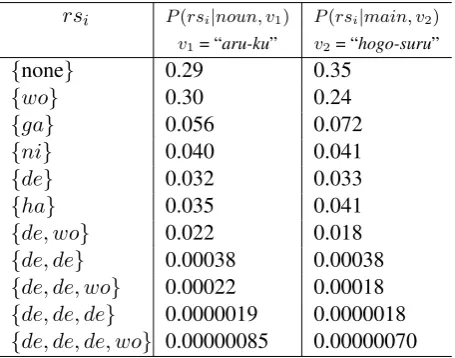
Some of the co-occurrence probabilities of the particle sets for the verbs “aru-ku” and “ hogo-suru” in the sentence are listed in Table 2. How to estimate these probabilities is described in section 5.3. Basically, the larger the number of particles, the lower the probability is. As you can see in the comparison between {de, wo} and {de, de}, the probability becomes lower when multiple same cases are included. Therefore, the probability can reflect the constraint that multiple case elements of the same particle tend not to modify a verb.
5 Experiments
We evaluated the effectiveness of our model ex-perimentally. Since our model treats only the
de-rsi P(rsi|noun, v1) P(rsi|main, v2)
v1= “aru-ku” v2= “hogo-suru”
{none} 0.29 0.35
{wo} 0.30 0.24
{ga} 0.056 0.072
{ni} 0.040 0.041
{de} 0.032 0.033
{ha} 0.035 0.041
{de, wo} 0.022 0.018
{de, de} 0.00038 0.00038
{de, de, wo} 0.00022 0.00018
{de, de, de} 0.0000019 0.0000018
{de, de, de, wo} 0.00000085 0.00000070
Table 2: Example of the co-occurrence probabili-ties of particle sets
pendency relations between a noun and a verb, we cannot determine all the dependency relations in a sentence. We therefore use one of the currently available dependency analyzers to generate an or-dered list ofn-best possible parses for the sentence and then use our proposed model to rerank them and select the best parse.
5.1 Dependency analyzer for outputting
n-best parses
We generated then-best parses by using the “pos-terior context model” (Uchimoto et al., 2000). The features we used were those in (Uchimoto et al., 1999) and their combinations. We also added our original features and their combinations, with ref-erence to (Sassano, 2004; Kudo and Matsumoto, 2002), but we removed the features that had a fre-quency of less than 30 in our training data. The total number of features is thus 105,608.
5.2 Reranking method
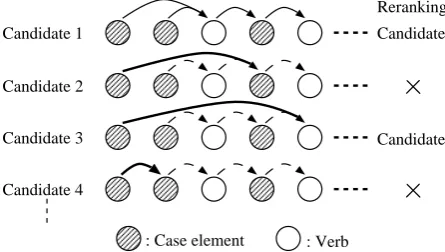
[image:4.595.308.536.191.370.2]reranking as illustrated in Figure 2. The possi-ble parses for reranking were the first-ranked parse and those of the next-best parses in which the verb to modify was different from that in the first-ranked one. For example, parses 1 and 3 in Figure 2 are the only candidates for reranking. In our ex-periments,nis set to 50.
The score we used for reranking the parses was the product of the probability of the posterior con-text model and the probability of our proposed model:
score=Pcontext(T)α×P(T), (8)
wherePcontext(T)is the probability of the
poste-rior context model. Theαhere is a parameter with which we can adjust the balance of the two proba-bilities, and is fixed to the best value by consider-ing development data (different from the trainconsider-ing data)1.
Reranking
Candidate 1
Candidate 2
Candidate 3
Candidate 4
: Case element : Verb
Candidate
[image:5.595.73.296.343.469.2]Candidate
Figure 2: Selection of possible parsesforreranking
Many methods for reranking the parsing of En-glish sentences have been proposed (Charniak and Johnson, 2005; Collins and Koo, 2005; Hender-son and Titov, 2005), all of which are discrimina-tive methods which learn the difference between the best parse and next-best parses. While our reranking model using generation probability is quite simple, we can easily verify our hypothesis that the two proposed probabilities have an effect on improving the parsing accuracy. We can also verify that the parsing accuracy improves by using imprecise information obtained from an automati-cally parsed corpus.
Klein and Manning proposed a generative model in which syntactic (PCFG) and semantic (lexical dependency) structures are scored with separate models (Klein and Manning, 2002), but
1In our experiments, αis set to 2.0 using development
data.
they do not take into account the combination of dependencies. Shirai et al. also proposed a statis-tical model of Japanese language which integrates lexical association statistics with syntactic prefer-ence (Shirai et al., 1998). Our proposed model dif-fers from their method in that it explicitly uses the combination of multiple cases.
5.3 Estimation of co-occurrence probability
We estimated the co-occurrence probability of the particle set and the co-occurrence probability of the case element set used in our model by analyz-ing a large-scale corpus. We collected a 30-year newspaper corpus2, applied the morphological an-alyzer JUMAN (Kurohashi and Nagao, 1998b), and then applied the dependency analyzer with a posterior context model3. To ensure that we collected reliable co-occurrence information, we removed the information for the bunsetsus with punctuation4.
Like (Torisawa, 2001), we estimated the co-occurrence probability P(hn, r, vi) of the case element set (noun n, particle r, and verb v) by using probabilistic latent semantic indexing (PLSI) (Hofmann, 1999)5. If hn, r, vi is the co-occurrence of n and hr, vi, we can calculate P(hn, r, vi)by using the following equation:
P(hn, r, vi) = ∑
z∈Z
P(n|z)P(hr, vi|z)P(z), (9)
where z indicates a latent semantic class of co-occurrence (hidden class). Probabilistic parame-tersP(n|z),P(hr, vi|z), andP(z)in Equation (9) can be estimated by using the EM algorithm. In our experiments, the dimension of the hidden class zwas set to 300. As a result, the collectedhn, r, vi total 102,581,924 pairs. The number ofnandvis 57,315 and 15,098, respectively.
The particles for which the co-occurrence prob-ability was estimated were the set of case particles, the “ha” case particle, and a class of “fukujoshi”
2
13 years’ worth of articles from the Mainichi Shimbun, 14 years’ worth from the Yomiuri Shimbun, and 3 years’ worth from the Asahi Shimbun.
3
We used the following package for calculation of Maximum Entropy:
http://homepages.inf.ed.ac.uk/s0450736/maxent toolkit.html.
4
The result of dependency analysis with a posterior con-text model for the Kyodai Corpus showed that the accuracy for thebunsetsuwithout punctuation is 90.6%, while the ac-curacy is only 76.4% for those with punctuation.
5We used the following package for calculation of PLSI:
Bunsetsuaccuracy Sentence accuracy Whole data Context model 90.95%(73,390/80,695) 54.40%(5,052/9,287)
Our model 91.21%(73,603/80,695) 55.17%(5,124/9,287)
Only for reranked sentences Context model 90.72%(68,971/76,026) 48,33%(3,813/7,889)
Our model 91.00%(69,184/76,026) 49.25%(3,885/7,889)
Only for case elements Context model 91.80%(28,849/31,427) – Our model 92.47%(29,062/31,427) –
Table 3: Accuracy before/after reranking
particles. Therefore, the total number of particles was 10.
We also estimated the co-occurrence probability of the particle setP(rs|syn, v)by using PLSI. We regarded the triplehrs, syn, vi(the co-occurrence of particle set rs, verbv, and the syntactic prop-ertysyn) as the co-occurrence ofrsandhsyn, vi. The dimension of the hidden class was 100. The total number ofhrs, syn, vi pairs was 1,016,508, vwas 18,423, andrs was 1,490. The particle set should be treated not as a non-ordered set but as an occurrence ordered set. However, we think crect probability estimation using an occurrence or-dered set is difficult, because it gives rise to an ex-plosion in the number of combination,
5.4 Experimental environment
The evaluation data we used was Kyodai Cor-pus 3.0, a corCor-pus manually annotated with depen-dency relations (Kurohashi and Nagao, 1998a). The statistics of the data are as follows:
• Training data: 24,263 sentences, 234,474 bunsetsus
• Development data: 4,833 sentences, 47,580 bunsetsus
• Test data: 9,287 sentences, 89,982bunsetsus
The test data contained 31,427 case elements, and 28,801 verbs.
The evaluation measures we used werebunsetsu accuracy (the percentage ofbunsetsufor which the correct modifyee was identified) and sentence ac-curacy (the percentage of sentences for which the correct dependency structure was identified).
5.5 Experimental results
5.5.1 Evaluation of our model
Our first experiment evaluated the effectiveness of reranking with our proposed model. Bunsetsu
Our reranking model correct incorrect Context model correct 73,119 271
incorrect 484 6,821
Table 4:2×2contingency table of the number of correct bunsetsu (posterior context model × our model)
and sentence accuracies before and after rerank-ing, for the entire set of test data as well as for only those sentences whose parse was actually reranked, are listed in Table 3.
The results showed that the accuracy could be improved by using our proposed model to rerank the results obtained with the posterior context model. McNemar testing showed that the null hy-pothesis that there is no difference between the ac-curacy of the results obtained with the posterior context model and those obtained with our model could be rejected with a p value < 0.01. The difference in accuracy is therefore significant.
5.5.2 Comparing variant models
We next experimentally compare the following variations of the proposed model:
(a) one in which the case element set is assumed to be independent [Equation (7)]
(b) one using the co-occurrence probability of the particle set,P(rs|syn, v), in our model
(c) one using only the co-occurrence probability of the case element,P(n|r, v), in our model
(d) one not taking into account the syntactic property of a verb (i,e. a model in which the co-occurrence probability is defined as P(r|v), without the syntactic propertysyn)
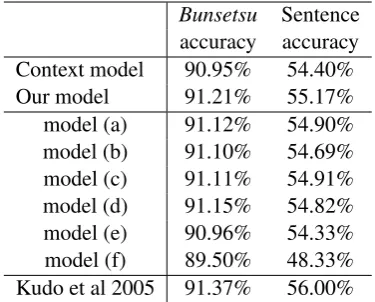
Bunsetsu Sentence accuracy accuracy Context model 90.95% 54.40% Our model 91.21% 55.17% model (a) 91.12% 54.90% model (b) 91.10% 54.69% model (c) 91.11% 54.91% model (d) 91.15% 54.82% model (e) 90.96% 54.33% model (f) 89.50% 48.33% Kudo et al 2005 91.37% 56.00%
Table 5: Comparison of various models
to a feature set used in the posterior context model
(f) one using only our proposed probabilities without the probability of the posterior con-text model
The accuracies obtained with each of these models are listed in Table 5, from which we can conclude that it is effective to take into account the dependency between case elements because model (a) is less accurate than our model.
Since the accuracy of model (d) is comparable to that of our model, we can conclude that the con-sideration of the syntactic property of a verb does not necessarily improve dependency analysis.
The accuracy of model (e), which uses the co-occurrence probability of the case element set as features in the posterior context model, is compa-rable to that of the posterior context model. This result is similar to the one obtained by (Kehler et al., 2004), where the task was anaphora resolution. Although we think the co-occurrence probability is useful information for dependency analysis, this result shows that simply adding it as a feature does not improve the accuracy.
5.5.3 Changing the amount of training data
Changing the size of the training data set, we investigated whether the degree of accuracy im-provement due to reranking depends on the accu-racy of the existing dependency analyzer.
Figure 3 shows that the accuracy improvement is constant even if the accuracy of the dependency analyzer is varied.
5.6 Discussion
The score used in reranking is the product of the probability of the posterior context model and the
0.894 0.896 0.898 0.9 0.902 0.904 0.906 0.908 0.91 0.912 0.914
4000 6000 8000 10000 12000 14000 16000 18000 20000 22000 24000 26000
No. of training sentences
Bunsetsu
accuracy
posterior context model proposed model
Figure 3: Bunsetsuaccuracy when the size of the training data is changed
probability of our proposed model. The results in Table 5 show that the parsing accuracy of model (f), which uses only the probabilities obtained with our proposed model, is quite low. We think the reason for this is that our two co-occurrence prob-abilities cannot take account of syntactic proper-ties, such as punctuation and the distance between twobunsetsus, which improve dependency analy-sis.
Furthermore, when the sentence has multiple verbs and case elements, the constraint of our pro-posed model tends to distribute case elements to each verb equally. To investigate such bias, we calculated the variance of the number of case ele-ments per verb.
Table 6 shows that the variance for our proposed model (Equation [5]) is the lowest, and this model distributes case elements to each verb equally. The variance of the posterior context model is higher than that of the test data, probably because the syntactic constraint in this model affects parsing too much. Therefore the variance of the reranking model (Equation [8]), which is the combination of our proposed model and the posterior context model, is close to that of the test data.
The best parse which uses this data set is (Kudo and Matsumoto, 2005), and their parsing accuracy is 91.37%. The features and the parsing method used by their model are almost equal to the poste-rior context model, but they use a different method of probability estimation. If their model could generate n-best parsing and attach some kind of score to each parse tree, we would combine their model in place of the posterior context model.
[image:7.595.310.523.62.211.2]pos-context model test data Equation [8] Equation [5] variance (σ2) 0.724 0.702 0.696 0.666
[image:8.595.136.458.62.102.2]*The average number of elements per verb is 1.078.
Table 6: The variance of the number of elements per verb
sible methods that deal with other relations should be taken into account. This will be one of our fu-ture tasks.
6 Conclusion
We presented a method of improving Japanese de-pendency parsing by using large-scale statistical information. Our method takes into account two types of information, not considered in previous statistical (machine learning based) parsing meth-ods. One is information about the dependency re-lations among the case elements of a verb, and the other is information about co-occurrence relations between a verb and its case element. Experimen-tal results showed that our method can improve the accuracy of the existing method.
References
Eugene Charniak and Mark Johnson. 2005.
Coarse-to-fine n-best parsing and maxent discriminative
reranking. InProceedings of the 43rd Annual
Meet-ing of the ACL, pages 173–180.
Michael Collins and Terry Koo. 2005. Discriminative
reranking for natural language parsing.
Computa-tional Linguistics, 31(1):25–69.
Daniel Gildea and Daniel Jurafsky. 2002. Automatic
labeling of semantic roles. Computational
Linguis-tics, 28(3):245–288.
James Henderson and Ivan Titov. 2005. Data-defined kernels for parse reranking derived from
probabilis-tic models. InProceedings of the 43rd Annual
Meet-ing of the ACL, pages 181–188.
Thomas Hofmann. 1999. Probabilistic latent semantic
indexing. InProceedings of the 22nd Annual
Inter-national SIGIR Conference on Research and Devel-opment in Information Retrieval, pages 50–57.
Andrew Kehler, Douglas Appelt, Lara Taylor, and
Aleksandr Simma. 2004. The (non)utility of
predicate-argument frequencies for pronoun
inter-pretation. InProceedings of the HLT/NAACL 2004,
pages 289–296.
Dan Klein and Christopher D. Manning. 2002. Fast exact inference with a factored model for natural
language parsing. InAdvances in Neural
Informa-tion Processing Systems 15 (NIPS 2002), pages 3– 10.
Taku Kudo and Yuji Matsumoto. 2002. Japanese
dependency analysis using cascaded chunking. In CoNLL 2002: Proceedings of the 6th Conference on Natural Language Learning 2002 (COLING 2002 Post-Conference Workshops), pages 63–69.
Taku Kudo and Yuji Matsumoto. 2005. Japanese de-pendency parsing using relative preference of
depen-dency. Transactions of Information Processing
So-ciety of Japan, 46(4):1082–1092. (in Japanese).
Sadao Kurohashi and Makoto Nagao. 1994. Kn parser:
Japanese dependency/case structure analyzer. In
Proceedings of the Workshop on Sharable Natural Language Resources, pages 48–55.
Sadao Kurohashi and Makoto Nagao. 1998a. Building a Japanese parsed corpus while improving the
pars-ing system. InProceedings of the 1st International
Conference on Language Resources and Evaluation, pages 719–724.
Sadao Kurohashi and Makoto Nagao. 1998b.Japanese
Morphological Analysis System JUMAN version
3.5. Department of Informatics, Kyoto University.
(in Japanese).
Manabu Sassano. 2004. Linear-time dependency
anal-ysis for Japanese. In Proceedings of the COLING
2004, pages 8–14.
Kiyoaki Shirai, Kentaro Inui, Takenobu Tokunaga, and Hozumi Tanaka. 1998. An empirical evaluation on statistical parsing of Japanese sentences using
lexi-cal association statistics. InProceedings of the 3rd
Conference on EMNLP, pages 80–87.
Kiyoaki Shirai. 1998. The integrated natural language processing using statistical information. Technical Report TR98–0004, Department of Computer Sci-ence, Tokyo Institute of Technology. (in Japanese).
Kentaro Torisawa. 2001. An unsupervised method for
canonicalization of Japanese postpositions. In
Pro-ceedings of the 6th Natural Language Processing Pacific Rim Symposium (NLPRS), pages 211–218.
Kiyotaka Uchimoto, Satoshi Sekine, and Hitoshi Isa-hara. 1999. Japanese dependency structure
analy-sis based on maximum entropy models.
Transac-tions of Information Processing Society of Japan, 40(9):3397–3407. (in Japanese).
Kiyotaka Uchimoto, Masaki Murata, Satoshi Sekine,
and Hitoshi Isahara. 2000. Dependency model
using posterior context. In Proceedings of the